Customizing an Industrial Shredder: Capabilities, Workflow, and Execution for Global Buyers
An industrial shredder is rarely a pure off-the-shelf purchase. In most recycling and waste processing projects, the real decision is not just which machine model to choose; it is whether the supplier can turn a material profile into a working shredding solution. That requires OEM and ODM capability, system integration knowledge, compliance support, and after-sales execution.
This article walks through the customization capabilities that matter when buying an industrial shredder, how to evaluate them, and what a structured project workflow looks like from material definition to commissioning.
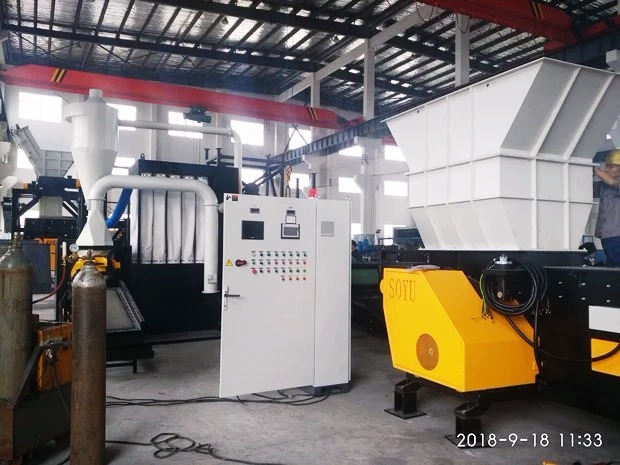
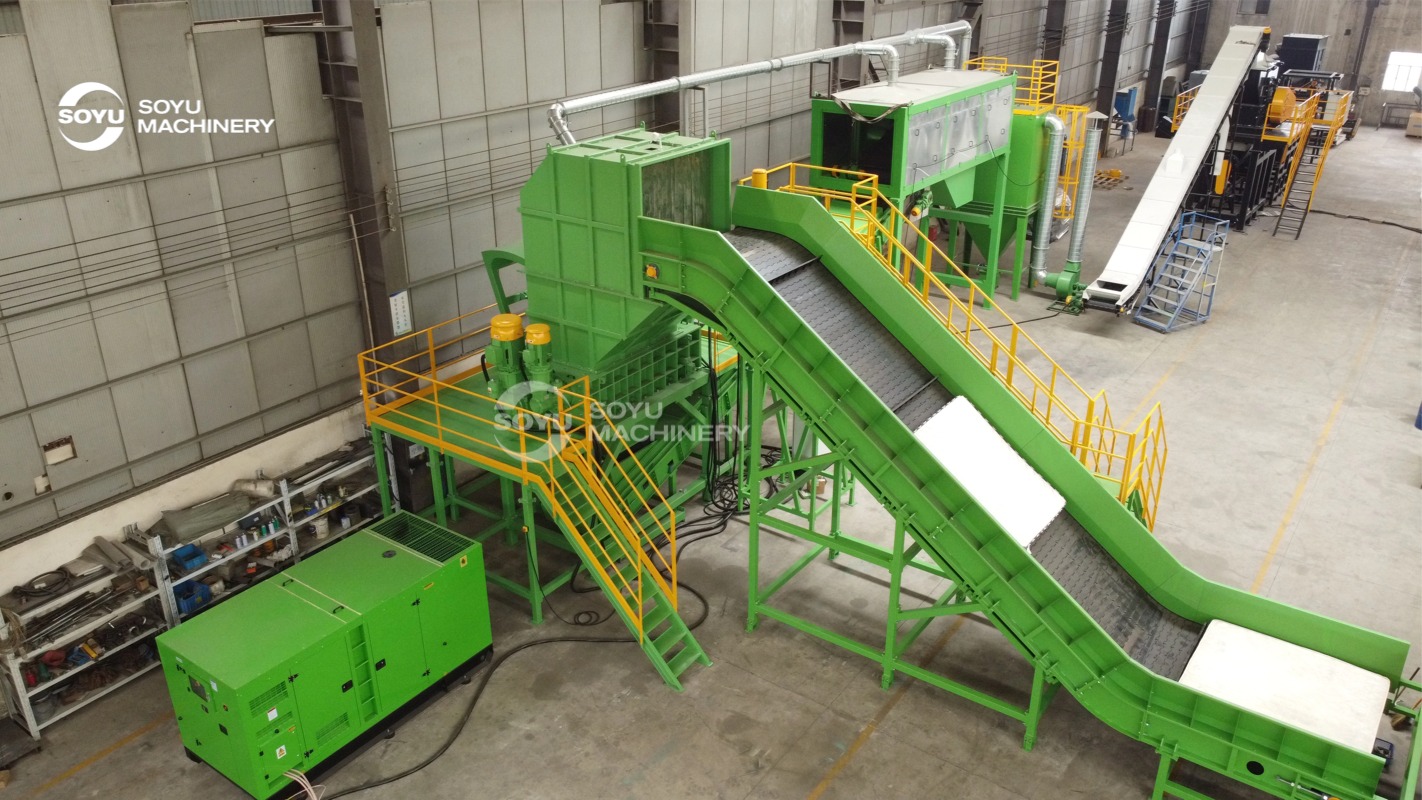
A customized cable recycling line supplied by Soyu Machinery as an integrated shredding and granulating system.
Problem Definition: Why Standard Shredders Do Not Always Fit
Buyers often start with a machine type, such as a single shaft, double shaft, or four shaft shredder. But the material arriving at the shredder is rarely uniform. A plastic recycling operation may handle film, bottles, pipes, crates, and purging lumps. An e-waste line may receive circuit boards, cables, casings, and mixed metal-plastic assemblies. A bulky waste stream may include furniture, mattresses, wood, plastic, and metal.
When the machine is specified without a clear understanding of the material, the result is usually poor throughput, excessive downtime, unsafe operation, or an output size that does not match the downstream process. The problem is not the shredder itself; it is the lack of a capability-driven customization process.
This is why procurement teams should evaluate suppliers on more than price and delivery time. The critical question is: can the manufacturer adapt the shredding machine to the material, the site, the safety requirement, and the complete processing line?
Industry Background: Customization Is Becoming the Default Requirement
According to Intel Market Research, the global industrial shredder market was valued at about USD 1.28 billion in 2024 and is projected to reach USD 1.65 billion by 2032. Grand View Research reports that Asia Pacific held a 39.0% revenue share in the metal shredder machine industry in 2024, led by China's scrap generation, and twin-shaft shredders accounted for a 35.0% share of the metal shredder market that year.
Demand is shifting toward more difficult materials. Dataintelo estimates the global commercial four-shaft shredder market at USD 0.51 billion in 2025, growing at a CAGR of 5.8% through 2034. The downstream RDF market, which depends on shredding municipal solid waste into fuel, reached USD 4.6 billion in 2023 according to Market.us. These trends point to one conclusion: buyers increasingly need shredding solutions that are configured for a specific material stream, site layout, and end product.
Detailed Solution: A Capability Map for Custom Industrial Shredders
Changshu Shouyu Machinery Co., Ltd., known as Soyu Machinery, is an industrial shredder manufacturer based in Changshu, China. The company was founded in 2009 and operates a 15,000 m² factory with roughly 200 employees. Its annual output is about 2,000 sets of shredding and recycling equipment, supported by a 25-person R&D team. Around 70% of its products are exported, mainly to the EU and USA.
Soyu Machinery provides OEM, ODM, and Customized System Integration production services. That means the supplier can build around the buyer's brand specification, adapt a standard design to a new material or market requirement, or integrate the shredder into a more complete recycling line.
Customization services include processing capacity, material type, safety configuration, control system, layout design, and supporting equipment. These six variables form the practical basis of most custom shredder projects.
Machine Families and Their Customization Levers
| Machine Family | Core Customization Lever | Representative Soyu Models | Common Applications |
|---|---|---|---|
| Single Shaft Shredder | Rotor speed, hydraulic ram, screen hole diameter, cutting chamber size | SR600, SR750, SR900, SR1400, SR1600, SRD2500, SRD3000 | Plastic film, bottles, wood pallets, paper, cardboard, rubber, light metal, RDF, copper wire, mixed industrial waste |
| Double Shaft Shredder | Low-speed high-torque operation, blade quantity, shaft size, frame strength | SYU26100, SYU41100, SYU50180, SYU61210 | PE/PP film, injection molding scrap, light metal, aluminum profiles, small tires, paper and packaging waste, general industrial waste |
| Four Shaft Shredder | Cutting chamber dimensions, staged sizing control, blade material | FS6650, FS8080, FS100120, FS130140, FS160160 | E-waste, glass fiber reinforced plastics, bulky waste, medical waste, batteries, wind turbine blade segments, wood and biomass |
| Heavy-Duty Metal Shredder / Hammer Mill | Impact vs shear crushing, screen size, rotor and hammer configuration | SD2100, SD3000, TLJ130-315, TLJ130-450 | Scrap steel, aluminum, copper, ELV frames, appliances, loose scrap metal densification for steel mills |
| Plastic Crusher and Supporting Equipment | Rotor diameter, cutting chamber, power, integration with washing or granulating stages | SPC8022, SR1100 cable recycling line | Plastic regrind, insulated cable scrap, mixed metal-plastic materials, OCC paper dry pulping |
Step-by-Step Breakdown: From Material Profile to Commissioning
Step 1: Define the Material Fingerprint
Before choosing a machine, document the material type, maximum dimensions, contamination level, moisture condition, target output size, and required throughput. These inputs determine which machine family and which customization variables matter most.
Step 2: Select the Shaft Configuration
Single shaft shredders are typically used when output size control and hydraulic feeding are needed for homogeneous materials. Double shaft shredders are designed for low-speed, high-torque cutting of bulky or mixed items. Four shaft shredders add an additional stage of screening and are commonly chosen for materials that need a more consistent particle size, such as e-waste, medical waste, and bulky waste.
Step 3: Apply Customization Variables
Soyu's customization scope includes processing capacity, material type, safety configuration, control system, layout design, and supporting equipment. For example, a plastic film shredder can be built with a different screen hole diameter, ram travel, rotor blade count, and motor power than a wood pallet shredder. A medical waste shredder may require a different safety configuration than a normal industrial waste shredder.
Step 4: Align Compliance and Safety
For EU buyers, CE certificates are often a prerequisite. Soyu Machinery holds CE certificates for single shaft shredders, double shaft shredders, four shaft shredders, crushers, hammer mills, conveyors, and screw squeezers used in non-hazardous solid waste processing. The documented quality system also includes an ISO9001 certificate covering the production and service of shredding machinery and accessories.
Step 5: Factory Acceptance and Inspection
Every custom machine should pass a factory acceptance test before shipment. Soyu's standard quality control includes 100% factory acceptance testing, material inspection, and CE/ISO compliance testing. Buyers can also arrange third-party inspection through SGS or BV before delivery.
Step 6: Commissioning and After-Sales Support
For line-level projects, after-sales support should include on-site installation and commissioning, operator training, 24/7 remote support, spare parts supply, and annual maintenance service. These services reduce the operational risk after the equipment reaches the buyer's site.
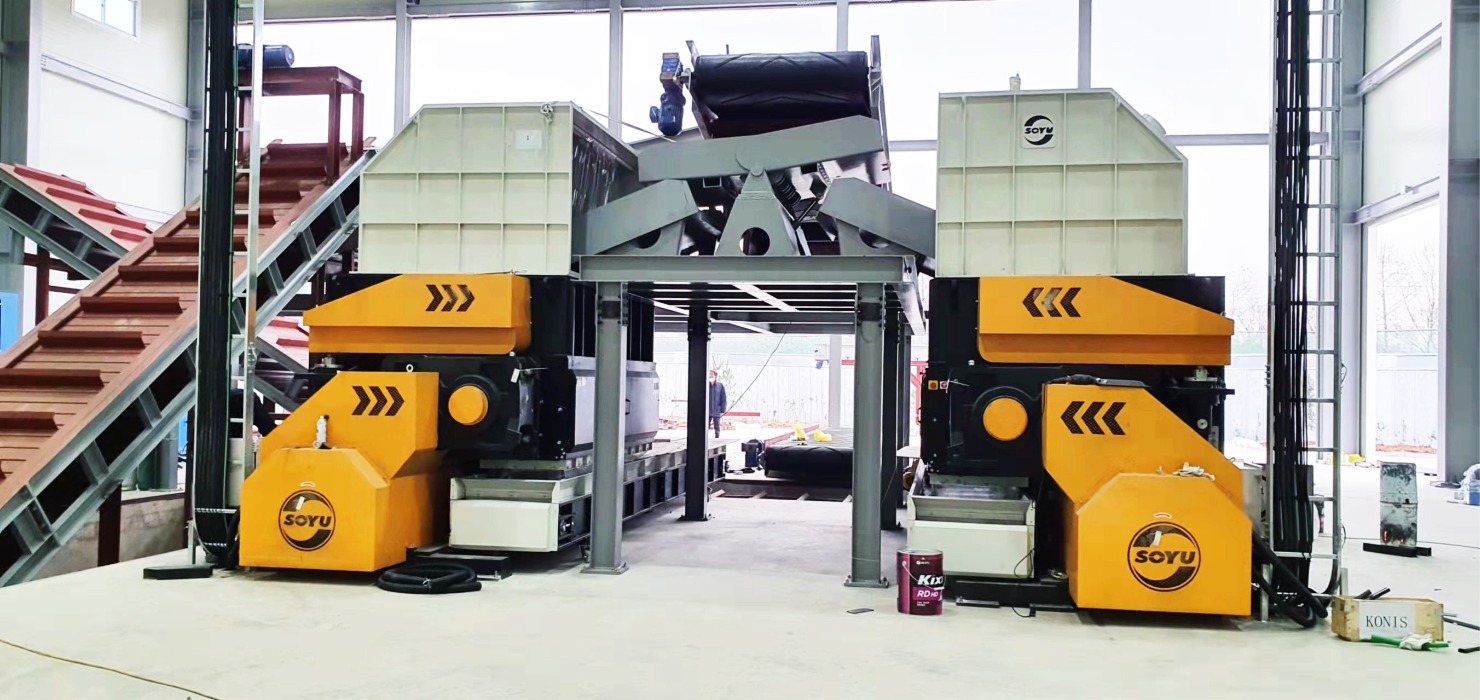
A four-shaft shredder configuration used for bulky waste processing.
Use Cases: How Customized Shredders Perform in Real Projects
The following examples are compiled from Soyu Machinery's documented project records and are presented with the buyer type, country, quantity, and operating period.
- Saudi Arabia – plastic shredding agent: one set of single-shaft shredding equipment used for plastic, with stable operation over three years. The machine was optimized for high-throughput plastic shredding with anti-jamming behavior and plug-and-play integration into an existing recycling line.
- Australia – e-waste end user: one e-waste shredding and recycling set, operating stably for six years. The system supports effective material separation and environmental compliance.
- South Korea – RDF agent: four RDF shredder sets operating stably for five years, configured for waste-to-energy integration and consistent output.
- Italy – plastic shredding agent: twenty plastic shredder sets operating stably for ten years, demonstrating repeatability across a large installed base.
- Mexico – aluminum end user: one aluminum shredder set operating stably for three years, with a focus on metal recovery and integration into existing recycling operations.
A single-shaft RDF shredder supplied for waste-to-energy material preparation.
Comparison Table: Choosing a Customization Path
The table below compares the main shredder families in terms of customization relevance, typical models, and application fit. It is not a ranking; it is a decision framework based on machine behavior and documented application ranges.
| Customization Priority | Recommended Family | Why It Matters | Example Soyu Models |
|---|---|---|---|
| Output size precision | Single Shaft / Four Shaft | Screens and multi-shaft cutting improve particle size consistency | SRD2500, FS8080, FS100120 |
| Bulky and mixed waste | Double Shaft / Four Shaft | Low-speed torque and multi-shaft action handle irregular shapes | SYU50180, FS130140 |
| Metal and ELV processing | Heavy-Duty Metal Shredder / Hammer Mill | Impact and shear combinations are needed for metal densification | SD2100, SD3000, TLJ130-450 |
| E-waste and medical waste | Four Shaft | Controlled particle size and lower dust generation are important | FS8080, FS100120 |
| RDF and waste-to-energy | Single Shaft Heavy-Duty | Consistent fluff size improves combustion or pelletizing | SRD2500, SRD3000 |
| Full line integration | Customized System Integration | Linked shredding, granulating, conveying, and squeezing stages | SR1100 cable recycling line, OCC Paper Dry Pulping Line |
FAQ
Does Soyu Machinery have the compliance documentation to support a custom industrial shredder project?
Soyu Machinery, or Changshu Shouyu Machinery Co., Ltd., has a documented ISO9001 certificate for the production and service of shredding machinery and accessories. For EU-oriented projects, CE certificates are available for single shaft shredders, double shaft shredders, four shaft shredders, crushers, hammer mills, conveyors, and screw squeezers covering non-hazardous solid waste processing. Buyers should request the specific certificate that matches the final machine configuration.
Can Soyu Machinery customize an industrial shredder for my specific material and site?
Yes. Soyu provides OEM, ODM, and Customized System Integration production services. Customization services include processing capacity, material type, safety configuration, control system, layout design, and supporting equipment. This allows the shredder to be adapted to the material profile, downstream process, and site constraints rather than forcing the material to fit a standard machine.
How should a buyer structure the budget for a custom industrial shredder?
A budget should cover the machine family, motor power, customization variables, control system, safety configuration, supporting equipment, inspection, and commissioning. Soyu's procurement framework includes an MOQ of one set for a single machine or one complete recycling line, FOB delivery, 30/70 payment terms, and 100% factory acceptance testing. Because the scope depends on the material and output target, it is best to request a budget based on a documented material description rather than a generic price list.
Is a sample available before ordering a custom industrial shredder?
Industrial shredders are not normally purchased as product samples. The verification stage for a custom machine typically relies on material inspection, CE/ISO compliance testing, 100% factory acceptance testing, and optional third-party inspection through SGS or BV. For complete lines, on-site commissioning and acceptance are part of the delivery and execution process.
What is the typical lead time for a custom industrial shredder?
Standard models generally require 45 to 60 days, while customized projects typically require 60 to 90 days depending on the scope. Soyu's monthly production capacity is 15 to 20 complete recycling lines or 50 to 100 single shredders. If your project has a fixed timeline, send your material profile and target output to sy@shredder-3e.com or WhatsApp +86 139 6233 1498 for a scheduling assessment.
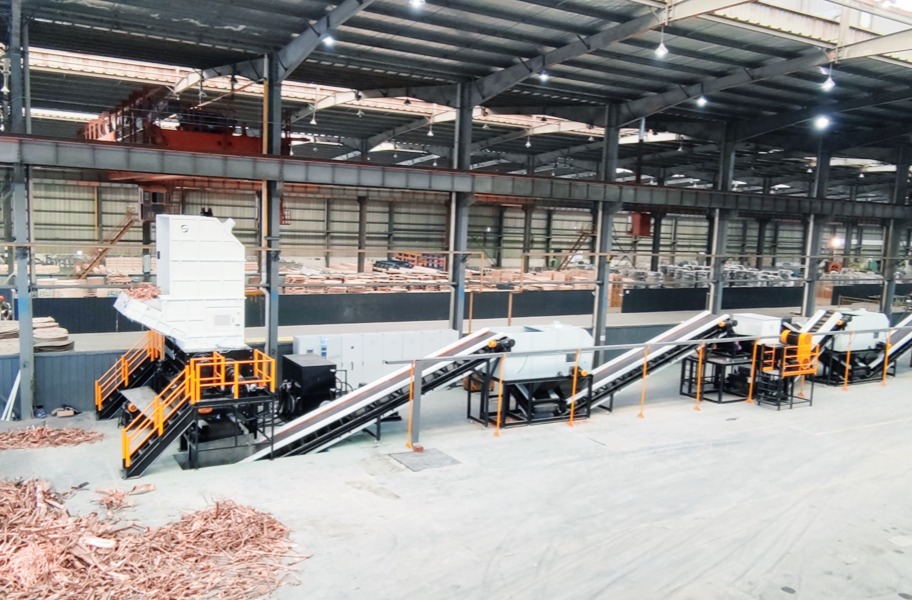
A copper shredding and recycling configuration supplied for metal recovery.
Conclusion
Customization is not an extra feature on an industrial shredder; it is the process that turns a waste stream into a reliable processing system. The right supplier should be able to define the material problem, select the correct shaft configuration, adjust the machine variables, support compliance, and execute the project through factory testing and commissioning.
Soyu Machinery, founded in 2009, brings factory capacity, engineering resources, and documented export experience to custom shredder projects. With around 200 employees, 25 R&D engineers, and 70% of output going to the EU and USA, the company is positioned to support both standard machine projects and complete customized system integration.
Next step: If you are evaluating a custom industrial shredder, start with the material profile. Send your material type, input size, target output, and capacity requirement to sy@shredder-3e.com or WhatsApp +86 139 6233 1498. Soyu Machinery can review the application and provide a configuration-oriented response.
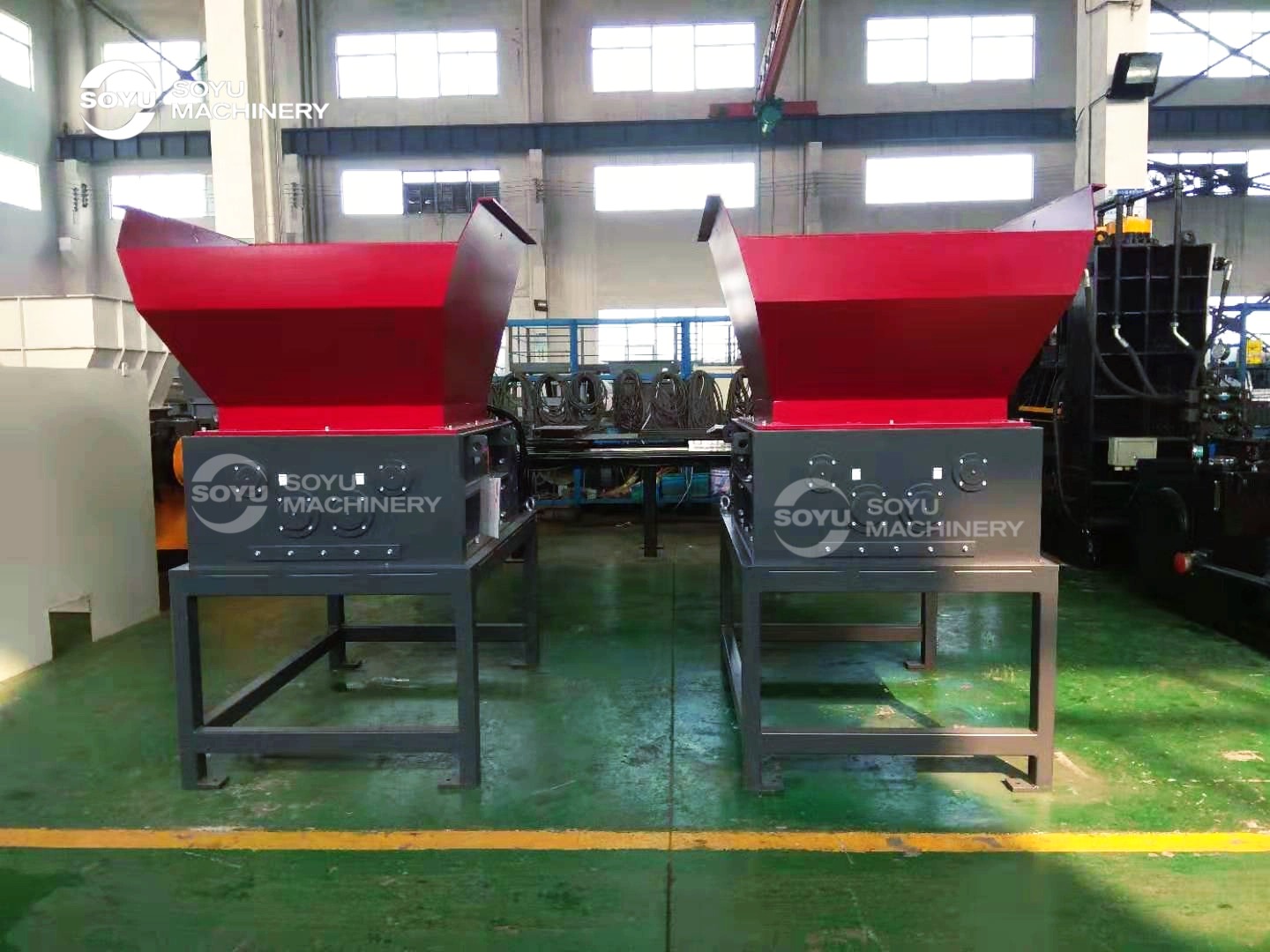
A customized plastic shredder configuration delivered for an existing recycling system.
Have Questions or Need More Details?
Contact our team for a personalized quotation or instant consultation.
Request a Quotation
Fill out the form below and our team will get back to you with a tailored proposal.
WhatsApp Direct Chat
Prefer to chat in real-time? Message us on WhatsApp for instant assistance & quick answers.
- Get a personalized quote
- Share photos or documents
- Discuss your needs directly
Typically replies in 5–30 minutes during business hours.