Double Shaft vs. Four Shaft Shredders: Which One Wins for Your Bulky Waste Operation?
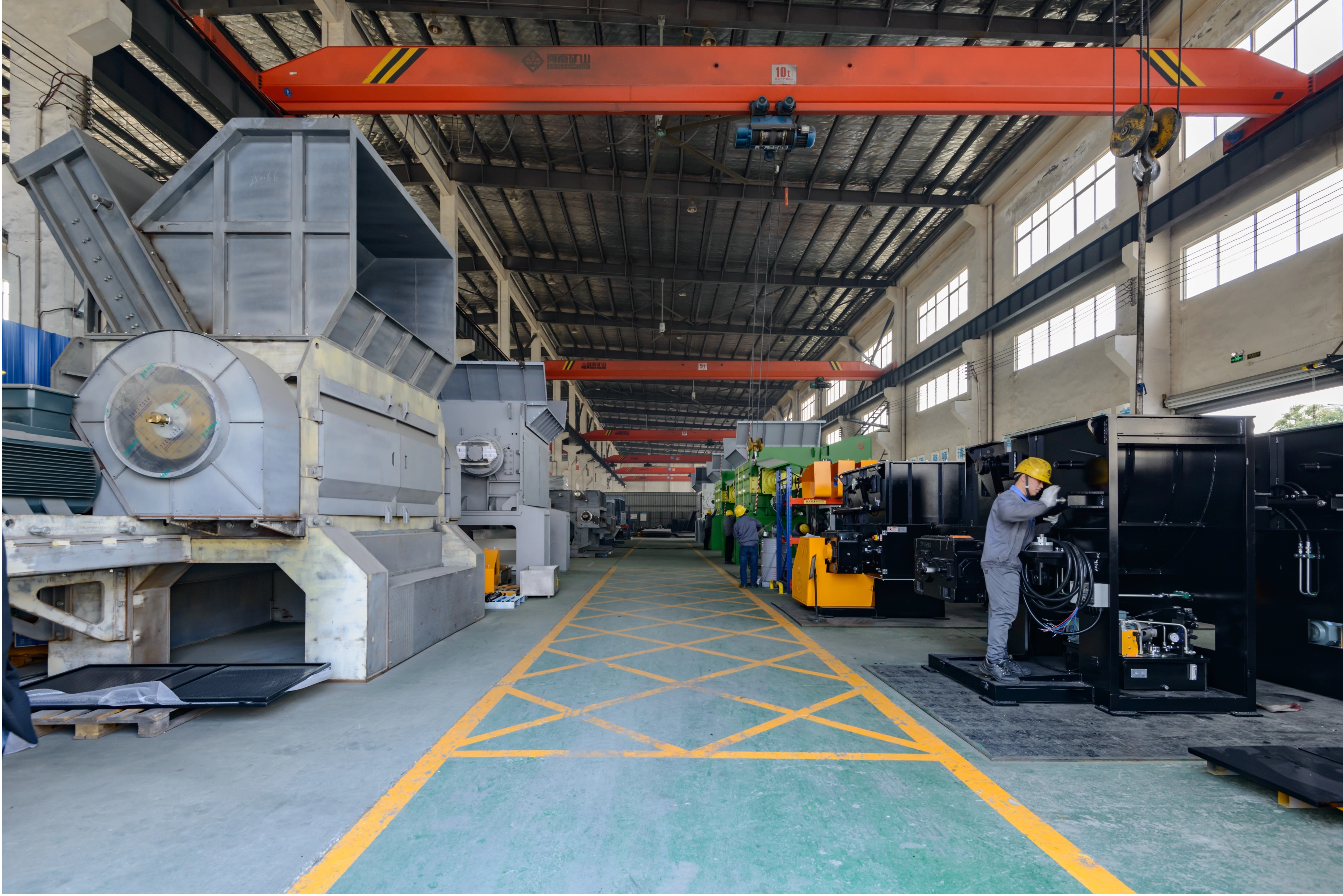 Factory workshop - SOYU Machinery (Changshu Shouyu Machinery Co., Ltd.). Caption: Factory workshop.
Bulky waste is the stream that punishes a shredder specification written for clean, single-material feed. Sofas, cabinets, mattresses, wooden formwork, plastic templates and oversized industrial scrap arrive mixed and irregular, sometimes wrapped in film, sometimes carrying metal fittings - and the shaft configuration you buy decides whether the line absorbs that variation or stops on it.
So the real question is not how many kilowatts the machine has. It is which configuration is documented for your dominant material, which one gives you mechanical control over output size, how much contamination the intake tolerates, and what the wear package costs per tonne over the life of the machine.
Quick answer. If your feed is dominated by oversized, irregular bulky items - household furniture, cabinets, construction formwork, large industrial scrap - the four-shaft FS platform is the configuration SOYU documents for bulky waste disposal and is the safer default. If your feed is broader and includes light-gauge metal, wire, cans and tires up to 1.2 m in diameter, a double-shaft SYU machine - including the low speed high torque SYU61210 build - is typically the more efficient capital choice for high-torque pre-shredding.
Why bulky waste exposes the wrong shaft configuration
SOYU defines the bulky waste stream through the material lists published for its four-shaft FS series: household bulky waste such as sofas and cabinets, construction waste such as wooden formwork and plastic templates, and industrial large-scale scrap. That is a definition built on item size and irregularity rather than on material chemistry - which is exactly why this stream is difficult to shred.
When the configuration does not match the stream, the failure appears in predictable places:
- Bridging and blocking. Oversized items sit above the cutting chamber instead of entering it, and throughput collapses to the speed of manual intervention.
- Wrapping. Film, textiles and fibre wrap around shafts and discharge points, reducing effective cutting area until the machine is stopped and cleaned.
- Unplanned downtime from contaminants. Metal fittings, dense castings or stones enter the chamber and stop the drive.
- Oversized output. The shredded product fails the downstream specification - boiler feed, RDF line or transfer-station volume target - and the whole plant pays for it.
- Accelerated blade wear. The wrong blade geometry or material on an abrasive, contaminated feed turns a planned blade rotation into an unplanned production stop.
The label problem: "double shaft", "four shaft" and "heavy duty" are not specifications
Machine labels overlap across the industry, and they overlap inside individual catalogues. In SOYU's range, the SYU61210 build appears as a double shaft shredder, as a slow speed shredder and as a low speed high torque shredder - in all three listings with the same 2 x 90 kW drive, 21 main blades and 23,000 kg equipment weight. The SRD3000 platform appears as a heavy duty shredder, a heavy duty industrial shredder and an RDF shredder, again with one shared specification: 280 kW, a 3,006 x 1,620 mm cutting chamber, a 650 mm rotor, 52 rotor blades, 25 + 2 fixed blades and approximately 25,000 kg.
The practical rule for evaluation-stage buyers is simple: compare drive configuration, chamber dimensions, blade count, blade material, operating weight and certificate scope - not the label printed on the quotation.
What the shredder and bulky waste markets look like in 2026
Third-party research shows demand expanding across both shaft families. Intel Market Research values the global industrial shredder market at approximately USD 1.28 billion in 2024, projected to reach USD 1.65 billion by 2032. Estimates vary with study scope - a Strategic Market Research study places the same category near USD 5.1 billion - so market size is best read as an order of magnitude rather than a precise number.
Within the metal shredder segment, Grand View Research reports that twin shaft shredders held a 35.0% revenue share in 2024, and that Asia Pacific accounted for 39.0% of metal shredder machine revenue that year, led by China's scrap generation. The four-shaft segment is smaller but expanding: Dataintelo estimates the global commercial four shaft shredder market at USD 0.51 billion in 2025, growing at a 5.8% CAGR through 2034.
Supplier concentration is moderate. Intel Market Research lists Doppstadt, Vecoplan, Untha, Lindner Recyclingtech and Komptech as the leading global players, together holding roughly 38% of the market - which leaves a long tail of regional and specialized manufacturers. Downstream demand matters just as much as the machine market: Market.us valued the refuse-derived fuel market that consumes shredded municipal and commercial waste at USD 4.6 billion in 2023.
How SOYU configures double shaft and four shaft shredders
Changshu Shouyu Machinery Co., Ltd. - SOYU Machinery - has manufactured single shaft, double shaft and four shaft shredders since 2009 from a 15,000 m2 facility with around 200 employees and a 25-engineer R&D team, producing roughly 2,000 sets annually, with about 70% of output exported to EU and US markets. For a bulky waste decision, what matters is how the two shaft families are actually built.
Double shaft (SYU platform): torque across a broad material mix
The SYU platform spans four documented models: SYU26100 (22 kW, 25 main blades, 4,600 kg), SYU41100 (2 x 32 kW, 20 main blades, 9,000 kg), SYU50180 (2 x 75 kW, 24 main blades, 20,000 kg) and SYU61210 (2 x 90 kW, 21 main blades, 23,000 kg). Documented applications cover plastic recycling (PE/PP films, bottles, PVC pipes), metal scrap (light-gauge sheet, aluminium profile scraps, steel wire, cans, metal-plastic composites), wood (planks, pallets, branches, packaging), small-to-medium tire recycling (tires up to 1.2 m diameter, hoses, gaskets), paper and packaging waste (cartons, cardboard, tubes, composite packaging) and general industrial waste.
Blades are specified in DC53/D2 high-alloy wear-resistant steel at HRC 60-62 after heat treatment, in a multi-face reversible grinding design that SOYU specifies as extending blade service life by 30% compared with conventional blades. Fixed blades use chromium-molybdenum-vanadium (Cr12MoV) steel, replaceable wear plates use HARDOX, and the main frame is thickened high-strength carbon steel at 16-25 mm with welded reinforcement ribs and a corrosion-resistant coating.
Four shaft (FS platform): bulky waste intake with adjustable output control
The FS platform starts at FS6650 (7.5 kW, 660 x 500 mm chamber, 1,000 kg) and scales through FS8080 (2 x 11 kW, 800 x 800 mm, 2,000 kg), FS100120 (2 x 30 kW, 1,000 x 1,200 mm, 6,000 kg) and FS130140 (2 x 15 + 2 x 37 kW, 1,300 x 1,400 mm, 13,500 kg) to FS160160 (2 x 30 + 2 x 45 kW, 1,600 x 1,600 mm, 18,000 kg). Two details drive the bulky waste case. First, the FS series is the platform SOYU documents for bulky waste disposal - household bulky waste such as sofas and cabinets, construction waste such as wooden formwork and plastic templates, and industrial large-scale scrap - alongside e-waste, glass-fibre reinforced plastics, PE/PP pipes, tires, wood and biomass. Second, the moving-to-fixed blade gap is adjustable down to 0.5 mm, which gives operators a mechanical lever on final particle size instead of relying on drive speed alone.
The blade package is built for abrasive, contaminated feed: DC53 moving blades hardened to HRC 60-62 through vacuum deep cryogenic treatment, a modular quick-release, multi-angle reversible design that SOYU specifies as extending service life by 30% against industry averages and as enabling 1,000-1,500 tonnes of continuous shredding on PE pipe scrap, D2 fixed blades for impact resistance in multi-shaft synergistic shredding, and a Q355B main frame with 20-30 mm plate thickness and dense reinforcement ribs.
Heavy duty (SRD3000): the third option above both platforms
When bulky waste volumes justify a dedicated primary shredder, the SRD3000 heavy duty industrial shredder sits above both families: 280 kW drive, 3,006 x 1,620 mm cutting chamber, 650 mm rotor diameter, 52 rotor blades, 25 + 2 fixed blades, 80 mm screen and approximately 25,000 kg operating weight, with a main shaft speed range of 73-300 rpm. It is the same platform SOYU catalogues for heavy duty and RDF shredding duty.
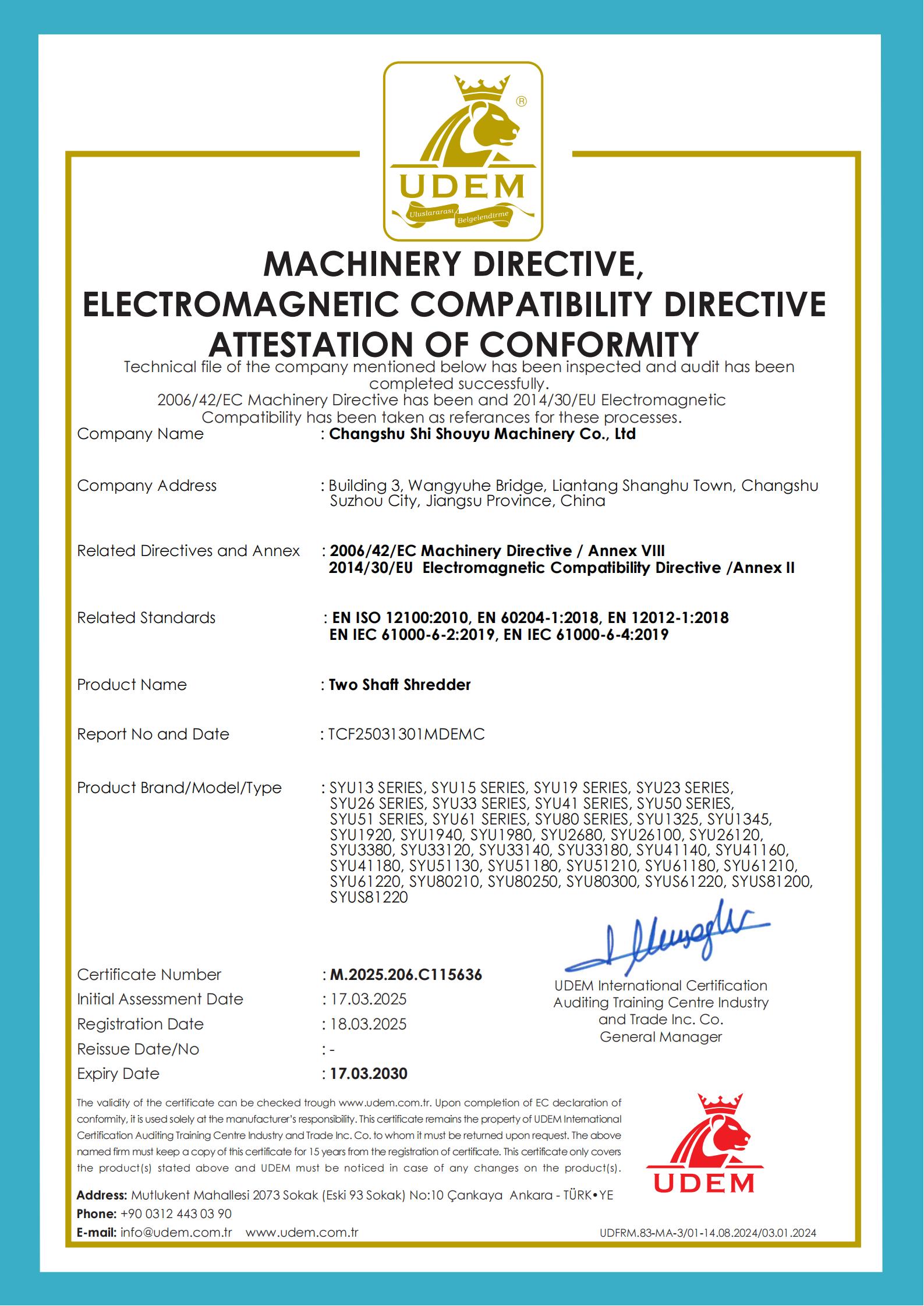 CE Certificate for Double Shaft Shredder (UDEM, M.2025.206.C115636, valid to 17 March 2030).
Certification is configuration-specific
The four-shaft shredder holds CE certificate M.2024.206.C102138, issued by UDEM for non-hazardous solid waste processing - a scope that explicitly includes furniture and mattresses - and valid until 11 June 2029. The double-shaft shredder holds a separate certificate, M.2025.206.C115636, covering two-shaft machines for the same class of material, valid until 17 March 2030. Both were assessed against EN ISO 12100:2010, EN 60204-1:2018, EN 12012-1:2018, EN IEC 61000-6-2:2019, EN IEC 61000-6-4:2019 and EN 13030:2019. Separately, EN ISO 13857:2019 governs safety distances intended to prevent hazard zones from being reached.
For procurement, the implication is direct: ask for the certificate whose scope names the shaft configuration you are buying and the material class you intend to process.
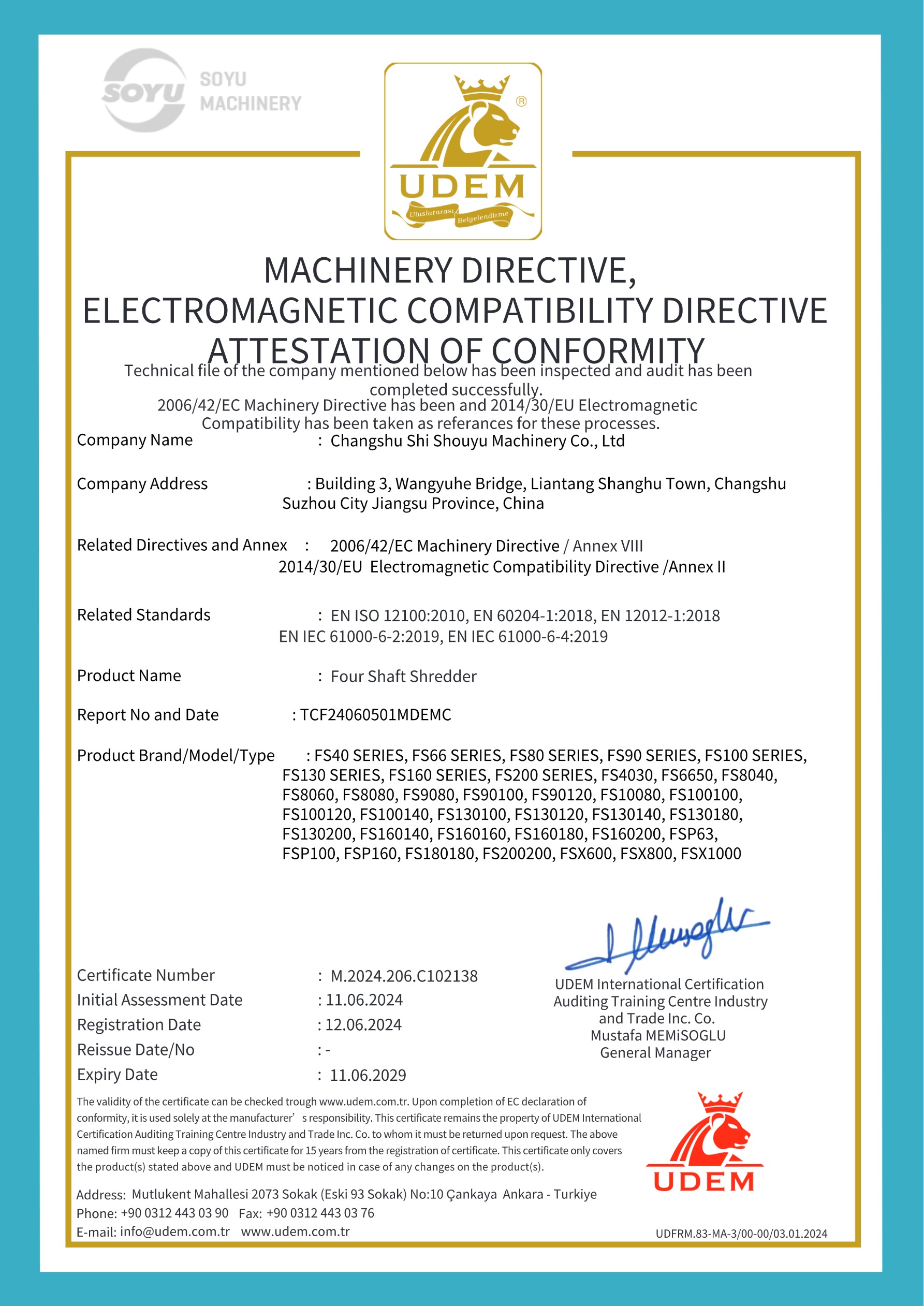 CE Certificate for Four Shaft Shredder (UDEM, M.2024.206.C102138, valid to 11 June 2029).
A six-step framework for matching shaft configuration to material mix
- Characterise the stream, not the category. Record largest item dimensions, bulk density, moisture, the share of film and textile, metal content and the presence of tires or dense castings. The FS series is documented for oversized household and construction items; the SYU series is documented for wood, film, pipe, small tires and light metal. Your item inventory decides which list you match.
- Set the output target before the machine. Define the required particle size for the downstream process. Because final size depends on blade gap, screen and feed behaviour rather than on a single nameplate figure, treat it as a specification to confirm by test, not by quotation.
- Match shaft count to the dominant failure mode. If the recurring problem is bridging or oversized intake, a four-shaft configuration addresses intake and size control. If the recurring problem is a broad mix including light metal and tires at higher tonnage, a double-shaft or low speed high torque configuration is the more direct fit.
- Validate the wear package. Confirm blade material, hardness and, importantly, whether blades are reversible. Both SYU and FS blades use DC53/D2 at HRC 60-62 with multi-face or multi-angle reversible designs, and the FS series adds a 0.5 mm adjustable blade gap.
- Confirm compliance and safety documentation. Check that the CE certificate scope matches the shaft configuration and the material class, and confirm machine guarding against recognised safety-distance requirements.
- Lock the service model. SOYU's support scope covers 100% factory acceptance testing (FAT), material inspection, CE/ISO compliance testing, on-site installation and commissioning, operator training, 24/7 remote support, spare parts supply and annual maintenance. On an abrasive bulky waste line, spares and service terms usually matter more to lifetime cost than the purchase-price gap between two configurations.
Double shaft vs four shaft: side-by-side comparison
| Decision dimension | Double shaft (SYU platform) | Four shaft (FS platform) |
|---|---|---|
| Documented models | SYU26100, SYU41100, SYU50180, SYU61210 | FS6650, FS8080, FS100120, FS130140, FS160160 |
| Drive range | 22 kW to 2 x 90 kW | 7.5 kW to 2 x 30 + 2 x 45 kW |
| Equipment weight range | 4,600 - 23,000 kg | 1,000 - 18,000 kg |
| Blade material and hardness | DC53/D2, HRC 60-62 after heat treatment | DC53, HRC 60-62 after vacuum deep cryogenic treatment |
| Fixed blade material | Cr12MoV chromium-molybdenum-vanadium steel | D2 high-carbon high-chromium steel |
| Blade design | Multi-face reversible grinding | Modular quick-release, multi-angle reversible |
| Output control feature | Replaceable HARDOX wear plates | Moving-to-fixed blade gap adjustable down to 0.5 mm |
| Documented material fit | Wood and pallets, light-gauge metal, steel wire, cans, small tires up to 1.2 m, cartons and cardboard, plastic pallets, general industrial waste | Household bulky waste (sofas, cabinets), construction waste (wooden formwork, plastic templates), industrial large-scale scrap, e-waste, GFRP, pipes, tires, wood and biomass |
| CE certification (UDEM) | M.2025.206.C115636, valid to 17 March 2030 | M.2024.206.C102138, valid to 11 June 2029 |
| Structural frame | Thickened carbon steel, 16-25 mm, welded reinforcement ribs | Q355B, 20-30 mm, dense reinforcement ribs |
Where these configurations are already running
Documented installations help separate a brochure specification from a working machine.
- Four shaft in e-waste. End users and agents in Australia, the United States, Japan and the United Kingdom run four-shaft units (FS8080 and FS100120) on e-waste shredding and recycling, with reported stable operation over 6 years, 4 years, 6 years and 5 years respectively.
- Four shaft in battery processing. A battery crushing system project in China using an FS100120 four shaft shredder has operated stably for 4 years.
- Double shaft on paper mill waste. A Malaysian end user operates two SYU41100 double shaft shredders on paper mill waste, reported as stable over 3 years.
- Heavy duty SRD3000 in RDF. RDF shredding installations using the SRD3000 heavy duty platform include an agent in Korea with 4 sets (5 years), an agent in Japan with 6 sets (4 years) and an end user in Russia (5 years).
Note what these references do not claim. None of them substitutes for testing your own bulky waste: their value is that they show these configurations running in long-duration industrial duty, not that they predict behaviour on your feed.
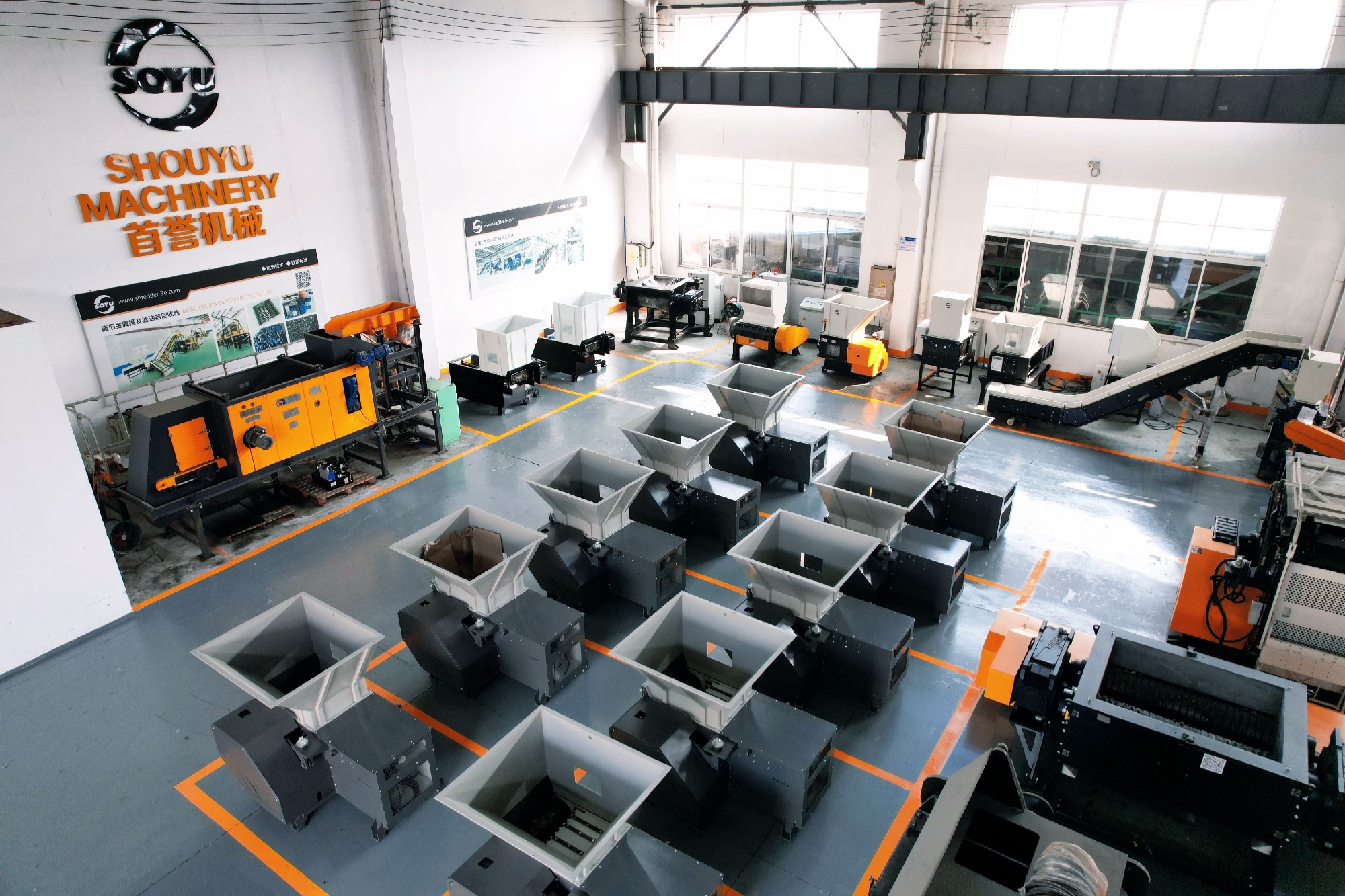 Factory showroom - machine review and acceptance discussions before shipment.
FAQ: choosing between double shaft and four shaft shredders
Are both double shaft and four shaft shredders CE certified for bulky waste?
They are certified separately. SOYU's four-shaft shredder holds UDEM CE certificate M.2024.206.C102138 for non-hazardous solid waste processing - a scope that explicitly includes furniture and mattresses - valid until 11 June 2029. The double-shaft shredder holds certificate M.2025.206.C115636 for two-shaft machines in the same material class, valid until 17 March 2030. Both were assessed against EN ISO 12100:2010, EN 60204-1:2018, EN 12012-1:2018, EN IEC 61000-6-2:2019, EN IEC 61000-6-4:2019 and EN 13030:2019, and safety distances against reachable hazard zones are addressed under EN ISO 13857:2019. Always confirm that the certificate scope names the shaft configuration and material class on your purchase order.
Which configuration suits contaminated, mixed bulky waste better?
It depends on which part of the mix dominates. The FS four-shaft series is the platform documented for bulky waste disposal - household bulky waste such as sofas and cabinets, construction waste such as wooden formwork and plastic templates, and industrial large-scale scrap - and it offers a moving-to-fixed blade gap adjustable down to 0.5 mm for output control. The SYU double-shaft series is documented for waste wood, pallets, light-gauge metal, steel wire, cans, tires up to 1.2 m in diameter, paper, cardboard, plastic pallets and general industrial waste. If oversized irregular items define your stream, start with the four-shaft list; if a broad mix with metal content defines it, start with the double-shaft list.
What drives the cost difference between the two configurations?
SOYU does not publish prices, but the documented variables that drive capital and operating cost are visible. Drive power ranges from 22 kW to 2 x 90 kW on the SYU platform and from 7.5 kW to 2 x 30 + 2 x 45 kW on the FS platform. Equipment weight ranges from 4,600 kg to 23,000 kg and from 1,000 kg to 18,000 kg respectively, which affects foundation, transport and rigging. Blade material, hardness and reversibility determine wear cost per tonne - both families use HRC 60-62 DC53/D2 blades with reversible designs. Lead time and customisation scope also affect project cost: 45-60 days for standard models and 60-90 days for customized projects, against a monthly capacity of 15-20 complete recycling lines or 50-100 single shredders.
Can we test our own bulky waste before ordering?
Yes - validation is a defined part of the process. Minimum order quantity is one set, whether a single machine or a complete line, and every unit goes through a 100% factory acceptance test (FAT) together with material inspection and CE/ISO compliance testing before shipment. For a mixed bulky waste stream, the practical approach is to define acceptance criteria - output size, throughput and contamination tolerance - with the engineering team and confirm them against FAT results, with blade gap and screen configuration recorded as part of the machine documentation.
What is the lead time, and how do we start?
Standard models ship in 45-60 days; customized projects, including bespoke layouts and material-specific configurations, take 60-90 days. SOYU exports to the EU, North America, the Middle East, Southeast Asia, Australia and Latin America, and supports installations with on-site commissioning, operator training, 24/7 remote support, spare parts supply and annual maintenance. To move from evaluation to a configured proposal, send your material mix, largest item dimensions, target throughput and required output size to sy@shredder-3e.com or WhatsApp +86-13962331498 - the reply should map your stream to a specific SYU or FS model rather than to a generic machine class.
Conclusion: match the shaft count to the material mix, not to the biggest machine
For bulky waste operations, the four-shaft FS platform is the safer default when oversized household, construction and industrial items dominate the feed, because that is the configuration SOYU documents for bulky waste disposal and because the 0.5 mm adjustable blade gap gives operators direct control over output size. The double-shaft SYU platform - including the low speed high torque SYU61210 build - is the more efficient choice when the feed is broader and includes light-gauge metal, wire and small tires, at drive levels from 22 kW to 2 x 90 kW. Where volumes justify a dedicated primary shredder, the 280 kW SRD3000 heavy duty platform extends the same logic to the largest streams.
The capital justification follows from that match, not from machine size. Confirm the configuration against your item inventory, verify the CE certificate scope for that configuration, validate output and throughput through factory acceptance testing, and price the wear package over the machine's working life. That sequence answers this article's title question for your operation rather than for the industry in general.
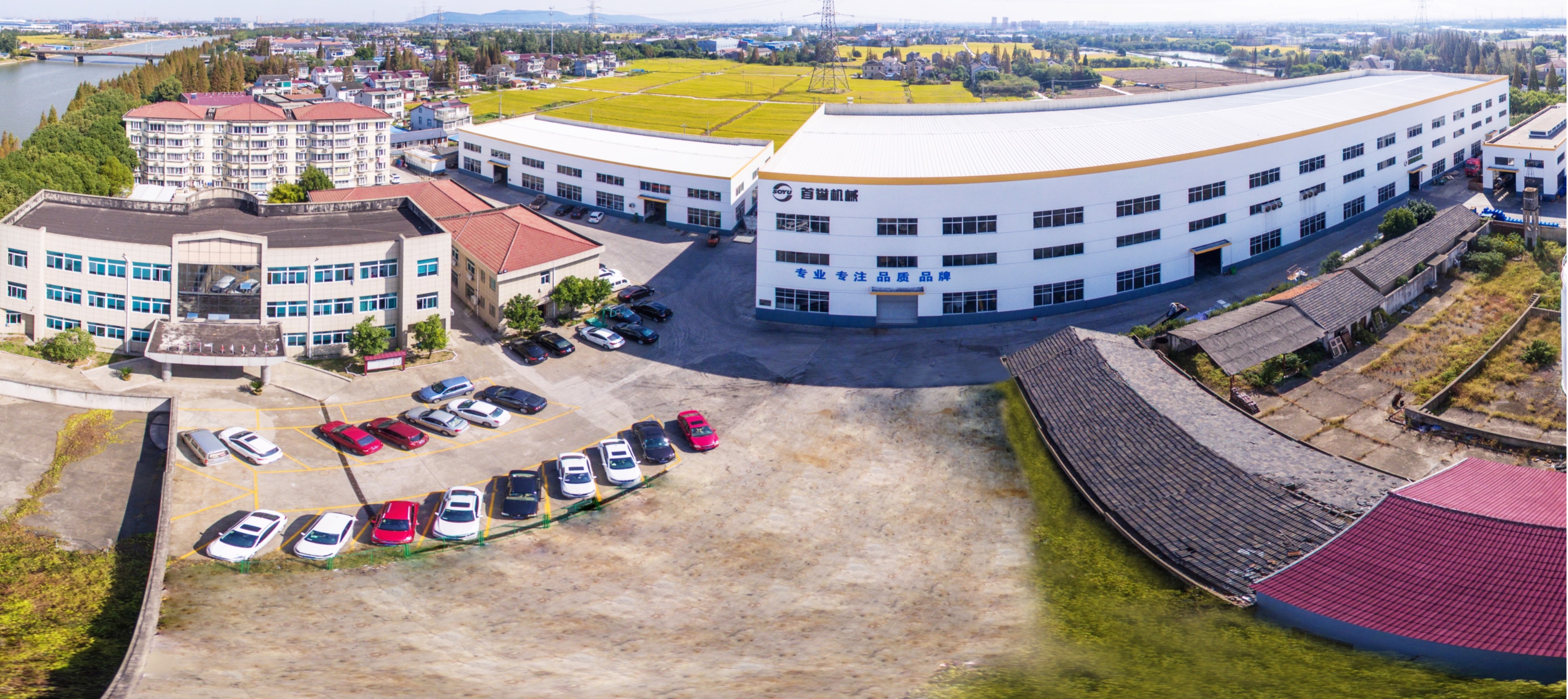 SOYU Machinery manufacturing base, Changshu, China. Caption: Factory exterior view.
Next step: map your bulky waste stream to a shaft configuration
SOYU Machinery (Changshu Shouyu Machinery Co., Ltd.) builds single shaft, double shaft and four shaft shredders for bulky waste, e-waste, metal, plastic, wood and RDF applications. Share your material mix, largest item dimensions, throughput target and required output size to receive a model-level configuration and quotation.
Email: sy@shredder-3e.com | WhatsApp: +86-13962331498 | Website: www.shredder3e.com
Have Questions or Need More Details?
Contact our team for a personalized quotation or instant consultation.
Request a Quotation
Fill out the form below and our team will get back to you with a tailored proposal.
WhatsApp Direct Chat
Prefer to chat in real-time? Message us on WhatsApp for instant assistance & quick answers.
- Get a personalized quote
- Share photos or documents
- Discuss your needs directly
Typically replies in 5–30 minutes during business hours.