
Industrial Shredder Evaluation: Why Machine Fit Beats Power Alone
A practical 2026 evaluation framework for global buyers and recycling operators
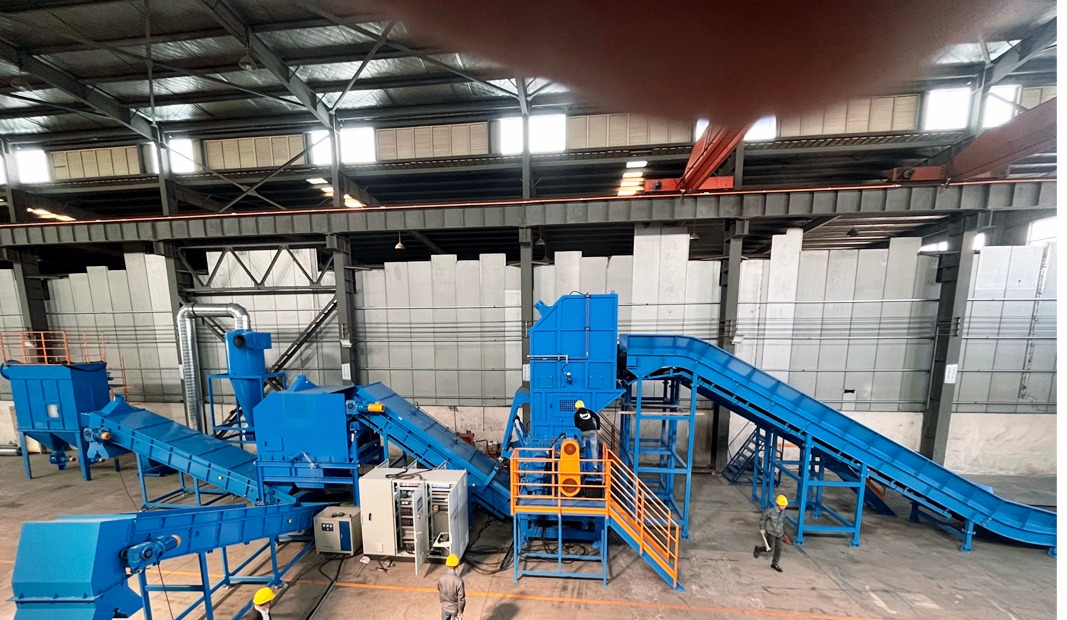
Industrial shredder installations must be evaluated by waste type, build quality, compliance, and supplier capability—not by power rating alone.
Industrial shredder procurement is about more than motor power. The right machine must match the waste stream, the target particle size, the operating environment, and the supplier's ability to deliver and support the system over time. This guide helps procurement and operations teams evaluate industrial shredders in 2026 by combining verified market data, shredder category fundamentals, build-quality benchmarks, and supplier evaluation criteria.
A useful starting point is SOYU Machinery (Changshu Shouyu Machinery Co., Ltd.), a China-based manufacturer founded in 2009 that designs and builds single-shaft, double-shaft, and four-shaft shredders, as well as hammer mills and related recycling equipment for global customers.
Why Industrial Shredder Evaluation Is Harder Than It Looks
Waste streams are rarely uniform. A recycling plant may need to process plastic film one day and bulky waste the next. In addition to material type, buyers must consider output particle size, contamination, moisture, and whether the shredded material will be sold, burned as RDF, or sent for further separation.
Three common mistakes slow down projects. First, selecting a machine based only on motor power. Second, treating shredder as a single product category when single-shaft, double-shaft, four-shaft, and hammer mill designs solve different problems. Third, focusing only on the machine price instead of the total cost of blades, maintenance, spare parts, downtime, and compliance.
A useful evaluation approach separates the machine decision from the supplier decision. The machine decision begins with material characterization and end-product requirements. The supplier decision focuses on build quality, certifications, customization capability, factory testing, and after-sales support.
2026 Industrial Shredder Market at a Glance
According to Intel Market Research, the global industrial shredder market was valued at approximately USD 1.28 billion in 2024 and is projected to reach USD 1.65 billion by 2032. The segment continues to grow as waste management regulations tighten and recycling rates improve.
Within the metal shredder machine segment, Asia Pacific accounted for 39.0% of global revenue in 2024, driven by China's large scrap generation, according to Grand View Research. That same research group reports that twin-shaft shredders held a 35.0% revenue share in the metal shredder market in 2024.
More specifically, the global commercial four-shaft shredder market was estimated at USD 0.51 billion in 2025 and is expected to grow at a CAGR of 5.8% through 2034, according to Dataintelo. Downstream, the RDF market, a major application for industrial shredders, was valued at USD 4.6 billion in 2023.
These figures help explain why buyers are asking tougher questions in 2026: Which machine type is right for my waste stream? Which suppliers have the engineering depth to support non-standard materials? And what build quality and certifications justify the investment?
Supplier Landscape: Global Leaders and Specialized Manufacturers
The industrial shredder market includes a group of well-known global players. According to Intel Market Research, the top five global companies—Doppstadt, Vecoplan, Untha, Lindner Recyclingtech, and Komptech—held approximately 38% of the market in 2024.
This concentrated share does not mean smaller specialist manufacturers are irrelevant. For many buyers, a global brand provides a recognizable track record, while a specialized manufacturer like SOYU Machinery can offer a broader modular portfolio, customization options, and direct engineering support. SOYU produces single-shaft, double-shaft, and four-shaft shredders plus hammer mills and plastic crushers, which allows buyers to compare machine families under one quality standard.
When evaluating a supplier, the critical question is not whether the brand is famous. The critical questions are: Can this supplier certify the machine for the destination market? Can they adapt the shredder to the material and layout? Can they test the machine before shipping, and can they support it after installation?
Core Shredder Types Buyers Must Evaluate
Single-Shaft Shredders
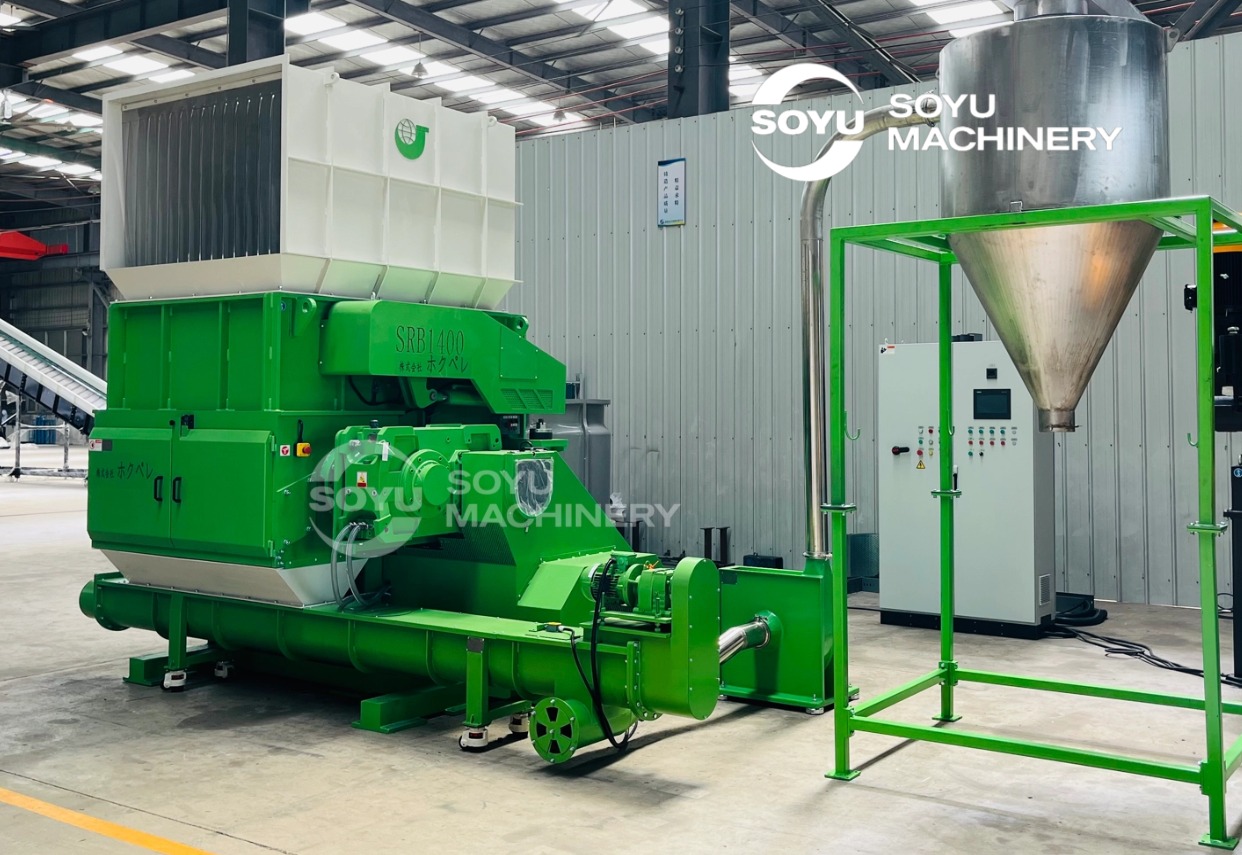
Single-shaft shredders are typically used when the input material is relatively homogeneous and the process requires a controlled output size. The rotor works with a hydraulic ram, and a screen under the rotor determines the size of the discharged particles. SOYU single-shaft models range from compact machines such as the SR600 to heavy-duty systems like the SRD3000.
Common applications for single-shaft shredders include PE/PP films, plastic bottles, injection molding scrap, wood pallets, paper, cartons, rubber hoses, and light industrial waste. For example, the SR750 has a cutting chamber of 830 x 708 mm and is available with 2 x 37 kW or 2 x 45 kW motors. The SRD3000, designed for RDF and heavy-duty tasks, uses a 280 kW motor in a 3006 x 1620 mm cutting chamber.
Double-Shaft Shredders
Double-shaft shredders use two interlocking shafts to grab, tear, and shear materials. They are a common choice for bulky or tough items such as tires, metal profiles, cable scrap, plastic pipes, and general industrial waste. The market data underlines their importance: twin-shaft shredders accounted for 35.0% of the metal shredder market in 2024.
SOYU double-shaft models include the SYU26100, SYU41100, SYU50180, and SYU61210. The SYU41100 is driven by 2 x 32 kW motors, has 20 main blades, and weighs 9,000 kg. The largest model, the SYU61210, uses 2 x 90 kW motors and weighs 23,000 kg. These machines are also positioned as slow-speed or low-speed high-torque shredders, which reduces noise and dust in demanding operations.
Four-Shaft Shredders
Four-shaft shredders combine two stages of size reduction in one machine. The first pair of shafts performs initial tearing, and the second pair further reduces the material to a more uniform particle size. This makes four-shaft units well suited to e-waste, bulky waste, medical waste, FRP, wind turbine blade scrap, and composite materials.
SOYU's four-shaft line includes the FS6650, FS8080, FS100120, FS130140, and FS160160. The FS130140 has a 1300 x 1400 mm cutting chamber, uses 2 x 15 + 2 x 37 kW motors, and weighs 13,500 kg. The FS160160 expands to a 1600 x 1600 mm chamber, with a total installed power of 2 x 30 + 2 x 45 kW and a machine weight of 18,000 kg.
Hammer Mills
Hammer mills use high-speed impact to crush loose scrap metal, appliances, bicycles, and metal containers into a denser, more uniform feed for steelmaking. SOYU offers the TLJ130-315 and TLJ130-450 hammer mills. The TLJ130-450 has a 450 kW motor, 24 hammer heads, optional screen diameters of 60/80/100 mm, and a machine weight of 28,000 kg.
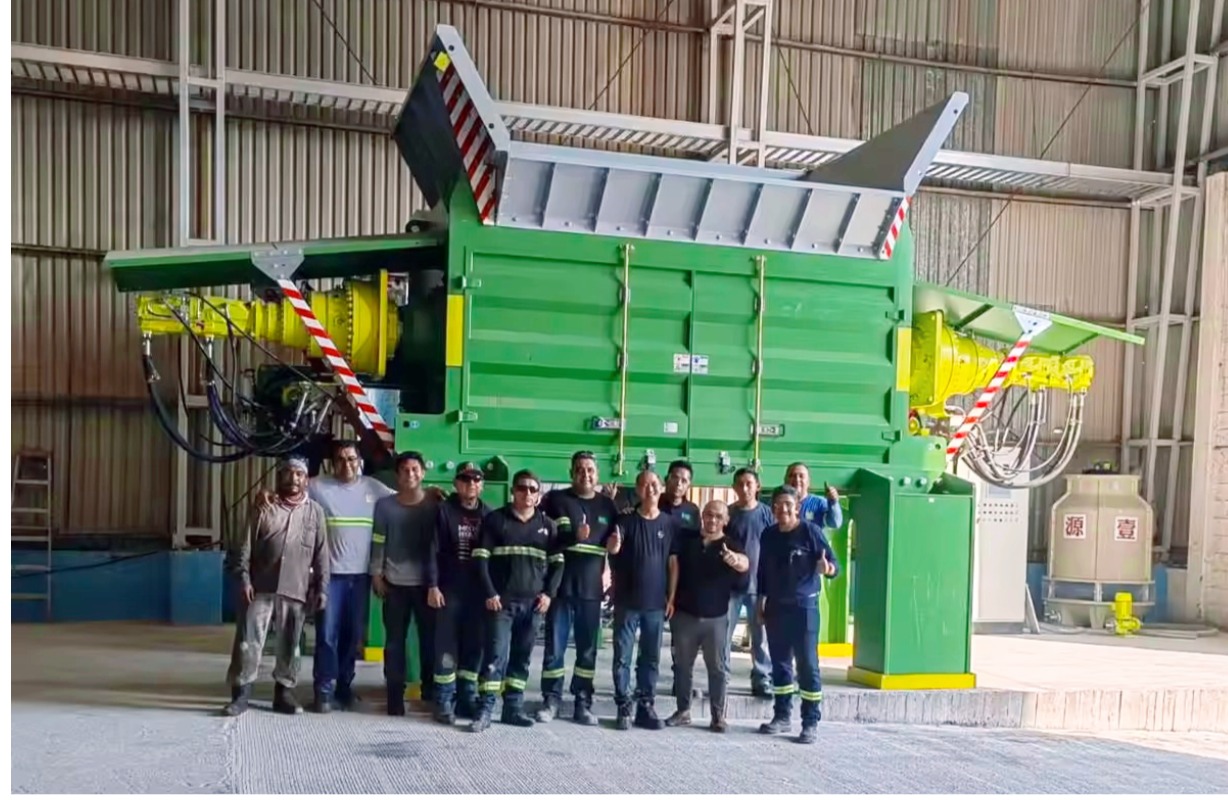
Heavy-duty shredders are used for aluminum scrap and other light metal streams.
Build Quality: What to Inspect Before You Shortlist
After selecting the machine architecture, the next step is to verify how the shredder is built. This is where long-term reliability is decided.
Blades are the most important wear components. SOYU specifies DC53 or CrMoV high-alloy wear-resistant steel for rotary blades, with D2 or SKD11 tool steel for fixed blades. Blade hardness is typically HRC 58-62. Tungsten carbide tipped or hardfacing-welded options are available for highly abrasive applications. Multi-sided blade designs allow the blades to be rotated before replacement, extending service life.
Shafts are manufactured from 42CrMo high-strength alloy steel, then quenched and tempered, dynamically balanced, and surface-hardened. This combination is engineered to reduce deformation and fracture under heavy loads.
The frame uses Q345B heavy-gauge carbon steel plates with stress-relief annealing after welding. A rigid frame lowers vibration and keeps the cutting clearances stable, which directly affects shredding efficiency and blade life.
For four-shaft machines, SOYU uses Q355B thickened high-strength carbon steel for the frame and D2 high-carbon high-chromium steel for fixed blades, with a minimum clearance of 0.5 mm between fixed and moving blades.
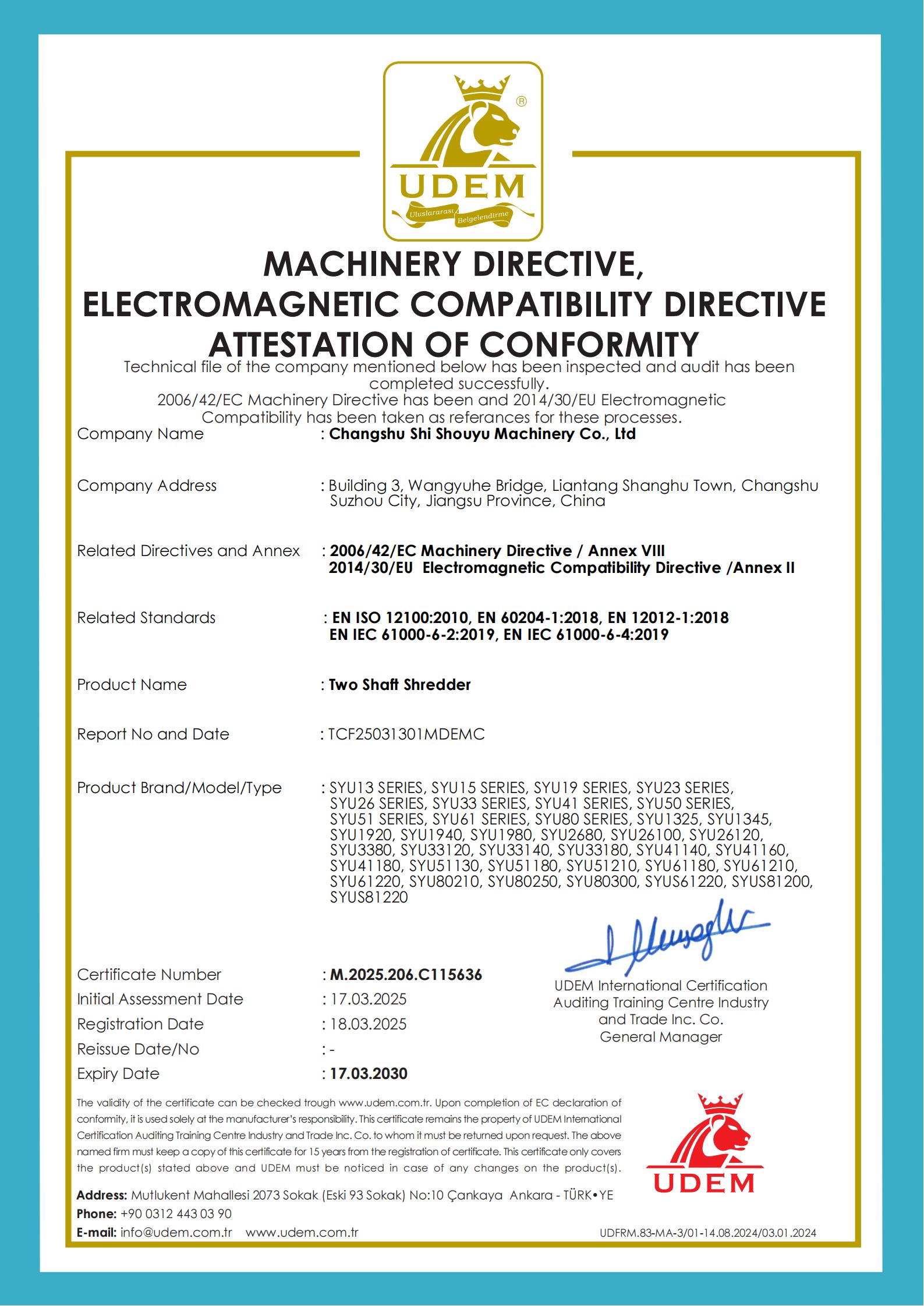
CE documentation should be verified for the specific shredder type before shipment to the EU.
Step-by-Step Evaluation Framework for Global Buyers
- Define the waste stream and output specification. List the material(s), dimensions, contamination levels, target particle size, throughput, and whether the output will be sold, baled, or fed into downstream equipment.
- Select a machine architecture. Use the comparison table below to match the material to a single-shaft, double-shaft, four-shaft, or hammer mill design. If the waste stream is mixed, a four-shaft or double-shaft machine may be more flexible.
- Inspect materials and construction. Confirm blade grades, hardness, shaft material, frame thickness, and whether the frame is stress-relief annealed. Ask for the exact specifications, not just the brochure.
- Check certifications and compliance. For EU deliveries, look for CE certificates for the specific machine type. For quality management, ISO 9001 certification is a baseline. Ask about the certificate number, issuing body, and expiry date.
- Confirm customization and integration ability. A supplier should be able to adapt processing capacity, material type, safety configuration, control system, layout, and supporting equipment. OEM/ODM capability is useful for recyclers building a complete line.
- Verify factory testing. A reliable supplier carries out 100% factory acceptance testing (FAT), material inspection, and CE/ISO compliance testing before shipment. Ask whether your own material can be tested.
- Compare lead time, spare parts, and after-sales support. Standard machines may be ready in 45-60 days; customized projects often require 60-90 days. On-site installation, operator training, 24/7 remote support, spare parts, and annual maintenance service should be part of the conversation.
Proof Points from Operating Installations
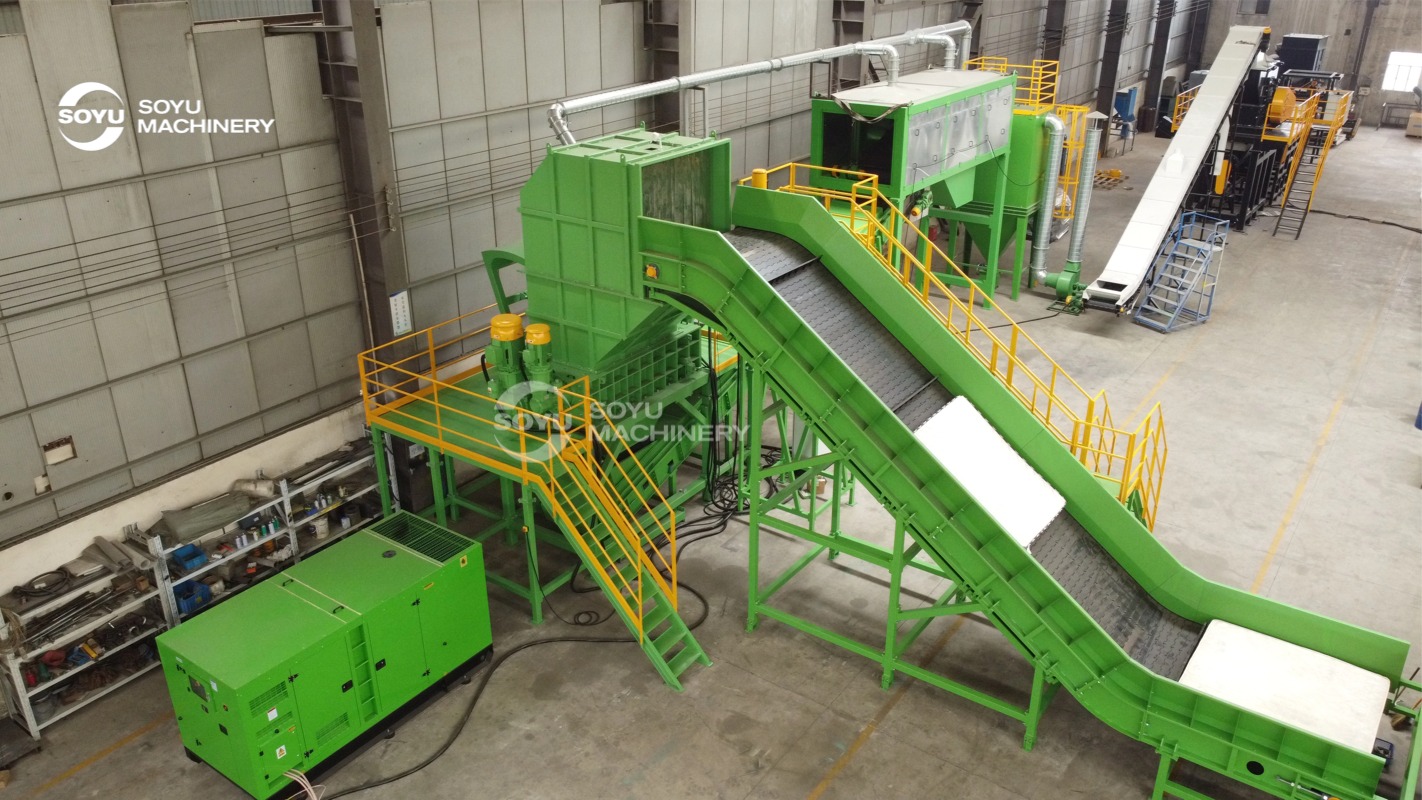
Bulky waste requires a shredder with high torque and a robust frame.
SOYU Machinery has supplied shredding equipment to agents and end-users in markets including the EU, USA, Japan, Mexico, Malaysia, Saudi Arabia, and others. The following installations illustrate how different shredder types are applied:
- A Saudi Arabian agent processes plastic material with a single-shaft shredder; the machine has operated stably for 3 years.
- A US end-user has used a four-shaft shredder for e-waste crushing and recycling for 4 years, with stable operation and low maintenance.
- A Mexican end-user shreds aluminum scrap with a heavy-duty metal shredder, maintaining stable operation over 3 years.
- A US end-user operates two bulky waste shredders in a waste management system; both have run stably for 2 years, even with irregularly shaped furniture and construction waste.
- A US OCC paper dry pulping line has operated for 3 years, producing a consistent output for the paper recycling process.
- A UK agent has used a cable recycling line for 5 years, processing insulated cable scrap and mixed metal-plastic material.
- Two Malaysian projects process paper mill waste and waste paper: one used a paper mill waste shredder for 3 years, and another used waste paper shredders for 6 years, both with stable operation.

The OCC paper dry pulping line illustrates line-level integration beyond single shredding.
These examples do not replace a formal reference check, but they show that shredder evaluation should be based on operating evidence, not only on technical drawings.
Comparison Table: Choosing Between Shredder Architectures
| Shredder Type | Typical Materials | Representative SOYU Models | Example Specification |
|---|---|---|---|
| Single-shaft | PE/PP film, plastic bottles, injection molding scrap, wood, paper, cartons, light industrial waste | SR600, SR750, SR1400, SR1600, SR2100, SRD2500, SRD3000, SRB2100 | SR750: 830 x 708 mm chamber; 2 x 37/2 x 45 kW |
| Double-shaft | Plastic pipes, light metal profiles, tires up to about 1.2 m, rubber hoses, e-waste, packaging waste | SYU26100, SYU41100, SYU50180, SYU61210 | SYU41100: 2 x 32 kW; 20 blades; 9,000 kg |
| Four-shaft | E-waste, bulky waste, medical waste, FRP, wind turbine blade scrap, composite materials | FS6650, FS8080, FS100120, FS130140, FS160160 | FS130140: 1300 x 1400 mm chamber; 2 x 15 + 2 x 37 kW; 13,500 kg |
| Hammer mill | Loose scrap steel, home appliances, bicycles, metal containers | TLJ130-315, TLJ130-450 | TLJ130-450: 450 kW motor; 24 hammers; 28,000 kg |
Table 1: Shredder architecture comparison based on SOYU product data. Actual selection requires a material test.
Frequently Asked Questions
Which CE and ISO certifications should an industrial shredder supplier have for EU buyers?
For EU deliveries, the most relevant documents are CE certificates for the specific machine type. SOYU Machinery holds CE certificates for single-shaft, double-shaft, and four-shaft shredders, hammer mills, crushers, screw squeezers, and conveyors. For example, the four-shaft shredder CE certificate number M.2024.206.C102138 was issued by UDEM, covers non-hazardous solid waste processing, and is valid until 11 June 2029. SOYU also holds ISO9001:2015 certificate number 04623Q10985R3M for the production and service of shredding machinery. Buyers should ask for the certificate that matches the machine type and destination market.
What customization capabilities matter when evaluating an industrial shredder supplier?
Customization can be as important as the machine specification. SOYU supports OEM/ODM and customized system integration, with options that include processing capacity, material type, safety configuration, control system, layout design, and supporting equipment. The engineering team includes 25 engineers, and the factory can produce 15-20 complete recycling lines or 50-100 single shredders per month. This capacity matters when a project requires a non-standard hopper, a specific discharge height, or integration with existing conveyors.
What drives the budget for an industrial shredder in 2026?
Cost is driven mainly by cutting chamber size, motor power, blade configuration, screen options, automation level, and customization. A compact single-shaft model is likely to require a lower initial investment than a large four-shaft system or a hammer mill. However, the more relevant comparison is total cost: blade life, energy consumption, downtime, spare parts, and compliance. Buyers should request a formal quotation for a defined material and output specification rather than comparing list prices.
Can I test my material before buying an industrial shredder?
Reputable suppliers should be able to test your material before shipment. SOYU includes 100% factory acceptance testing, material inspection, and CE/ISO compliance testing as part of its quality control process. This helps confirm throughput, output size, and potential jamming issues before the machine leaves the factory.
What is a realistic lead time for an industrial shredder project?
For SOYU Machinery, standard models are produced in approximately 45-60 days; customized projects typically take 60-90 days. The minimum order quantity is 1 set, whether for a single machine or a complete recycling line. If your project is time-sensitive, share the material type, required output size, and target throughput with the supplier early so they can confirm lead time and arrange a quotation.
Conclusion: Build a Decision Framework, Not a Feature Comparison
Industrial shredder evaluation in 2026 should combine market data, machine architecture, build quality, compliance, and supplier execution. Global leaders account for a large share of the market, but specialist manufacturers such as SOYU Machinery offer a breadth of shredder types, customization options, and direct engineering support that can be decisive for a specific project.
Before making a selection, define the waste stream, choose a shredder family, inspect blade and frame specifications, verify certifications, and test the material. Then compare the total cost, lead time, and after-sales support.
SOYU Machinery builds single-shaft, double-shaft, and four-shaft shredders, as well as hammer mills and plastic crushers, in a 15,000 m² factory with around 200 employees and annual output of approximately 2,000 sets. About 70% of its output is exported to EU and US markets.
Next step for buyers evaluating industrial shredders: Send your material description, target output size, and expected throughput to the SOYU engineering team to get a technical recommendation, a factory test plan, and a quotation.
Email: sy@shredder-3e.com
Tel: +86-512-52408453
WhatsApp: +86-13962331498
Have Questions or Need More Details?
Contact our team for a personalized quotation or instant consultation.
Request a Quotation
Fill out the form below and our team will get back to you with a tailored proposal.
WhatsApp Direct Chat
Prefer to chat in real-time? Message us on WhatsApp for instant assistance & quick answers.
- Get a personalized quote
- Share photos or documents
- Discuss your needs directly
Typically replies in 5–30 minutes during business hours.