
Industrial Shredder Technology Explained: Types, Applications and a Framework for Choosing Right
Industrial shredders are high-capacity size-reduction machines used across recycling, solid-waste treatment and manufacturing to transform waste into controlled, transportable, recoverable fractions. They are not office paper shredders: a real industrial shredder is engineered to continuously process pallets, cables, tires, appliances, electronic scrap, baled plastics, packaging and other bulky or abrasive streams.
Because waste streams differ so widely in composition, shape and required post-processing state, no single machine configuration can be called universally best. The practical choice usually sits between single-shaft, double-shaft, four-shaft and hammer-mill designs. For a buyer at the early research stage, the essential task is to understand how each technology family creates a specific output profile and when that profile matches an operating goal.
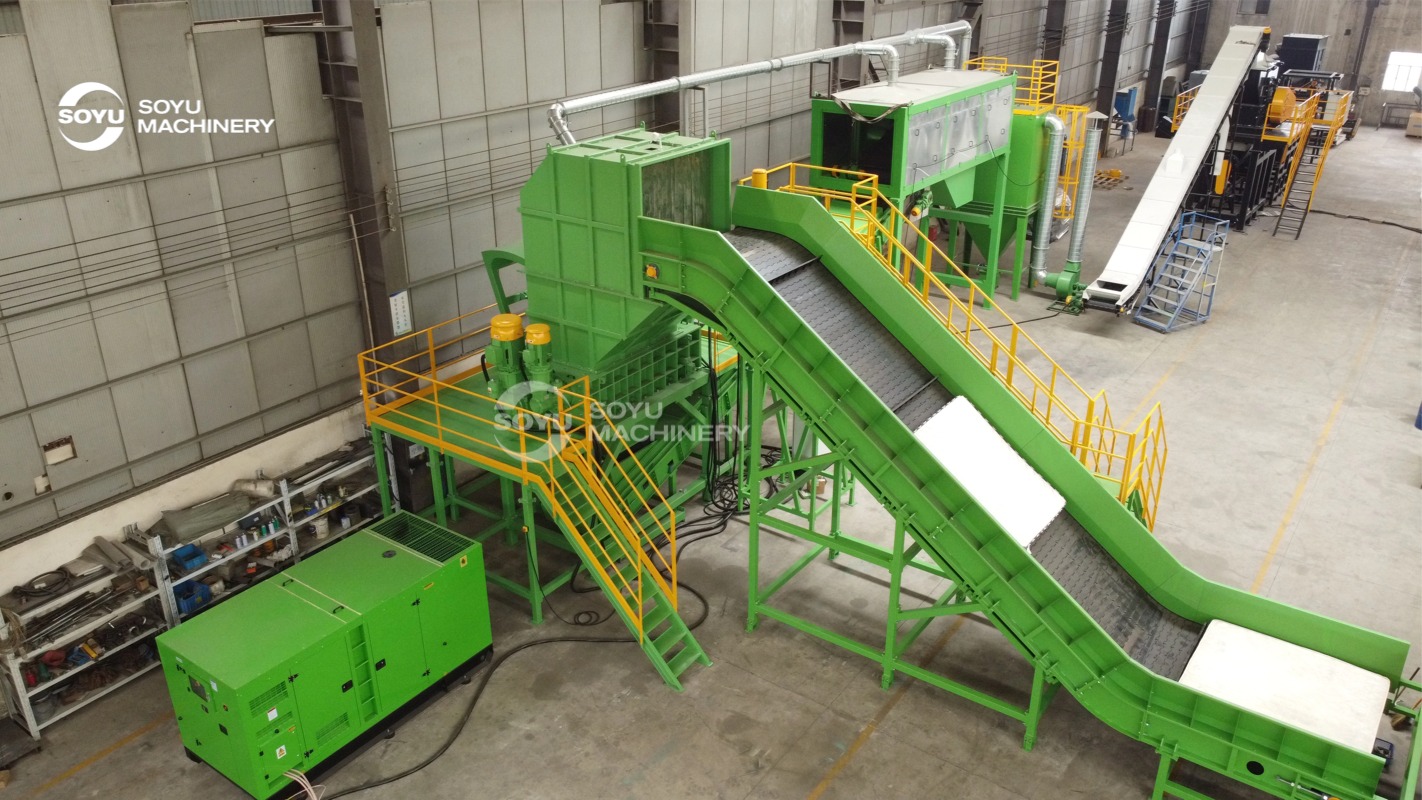
Why the Wrong Shredder Selection Can Be Expensive
The biggest mistake made during shredder procurement is treating it as a simple 'horsepower contest.' Shredding outcome depends on blade geometry, rotor speed, cutting gap, screening, hydraulic control, frame rigidity and the physical feed method. A high-power machine connected to the wrong cutting tool or rotor speed can still generate too many oversized pieces, excessive dust, high energy cost or unnecessary wear.
Processing challenges also take physical forms. Industrial feed includes dense, nailable, elastic and friable objects. A machine that performs well on cardboard may not be adequate for post-consumer plastic film or municipal bulky waste; a machine built for electronic scrap may not be the right first stage for pure metal stampings. Buyers who start from waste analysis and target particle size reduce the risk of commissioning inefficiency and avoid expensive modifications later.
Market Context for Industrial Shredding Equipment
The global industrial shredder market, estimated at around USD 1.28 billion in 2024 and projected to reach USD 1.65 billion by 2032 according to Intel Market Research, reflects wider pressure to divert waste from landfill and raise material recovery. In the same landscape, a group of established equipment suppliers including Doppstadt, Vecoplan, Untha, Lindner Recyclingtech and Komptech accounts for approximately 38% of global market share.
This mix of global original-equipment manufacturers and specialist regional builders gives buyers more configuration options than in many other industrial-equipment categories. For example, China-based Changshu Shouyu Machinery Co., Ltd. (SOYU Machinery) builds a full range of single-shaft, double-shaft and four-shaft shredders, exports about 70% of its output and serves a customer base concentrated in the EU and USA.
Main Industrial Shredder Technologies
Four mechanical families dominate industrial applications. Each offers a different balance between throughput, particle-size control, contamination tolerance and power demand.
Single-Shaft Shredders
A single-shaft shredder uses one rotor equipped with cutter blades working against a fixed bed of counter-knives. Material is pressed towards the rotor by a hydraulically driven ram, and the discharge size is defined by a screen or grid under the rotor. This design creates a comparatively consistent product size and suits operations that need dense, uniform feed.
SOYU offers such single-shaft models as the SR1600 Wood Shredder/Single Shaft Shredder, which uses two motors in a 2×55–2×75 kW range, carries 94 rotor blades and uses an approximately 40 mm screen hole diameter in its standard configuration. The single shaft family works for plastics, wood pallets, paper, cardboard, light rubber and homogeneous production waste.
Double-Shaft Shredders
Double-shaft shredders use two intermeshing rotor assemblies that rotate at low speed with high torque. The hooks, claws and cutters grab the material and tear it under massive force. This configuration tolerates bulky, irregular and occasionally dirty feed, making it a frequent first stage for bulky waste, tires, large items and mixed industrial material.
SOYU's double-shaft range includes the SYU61210 Double Shaft Shredder / Low Speed High Torque Shredder with 2×90 kW motor power, 21 main blades and a machine weight of about 23,000 kg. Its reinforced frame is designed for load-bearing applications where extremes of torque occur during normal operation.
Four-Shaft Shredders
Four-shaft shredders improve on the double-shaft principle by adding two screening shafts below the main cutting shafts. Material is first torn and sheared between the upper shafts, then is continuously worked by the lower shafts until pieces can fall through a grill built into the machine. This produces a more defined output size than a typical double-shaft unit while retaining enough force for heterogeneous and bulky feeds.
The SOYU FS130140 Four Shaft Shredder, for instance, combines 2×15 kW and 2×37 kW motors, has a 1300×1400 mm cutting chamber and weighs around 13,500 kg. Four-shaft machines are particularly common in e-waste, bulky waste, glass-reinforced plastic, large plastic objects and composite material recycling.
Hammer Mills
Hammer mills use rapidly rotating hammers to fracture and impact material rather than shear it. They are often used after a shredder to create a final, denser product or to process brittle fractions such as scrap steel, appliances and certain mixed metal feeds.
SOYU's hammer mill family includes the TLJ130-450 Heavy Duty Hammer Mill with a 450 kW motor, 24 hammer heads and a 60/80/100 mm optional screen system. In scrap metal preparation, its role is to densify loose metal and destructure appliances so the resulting fraction can be sold as furnace feedstock.
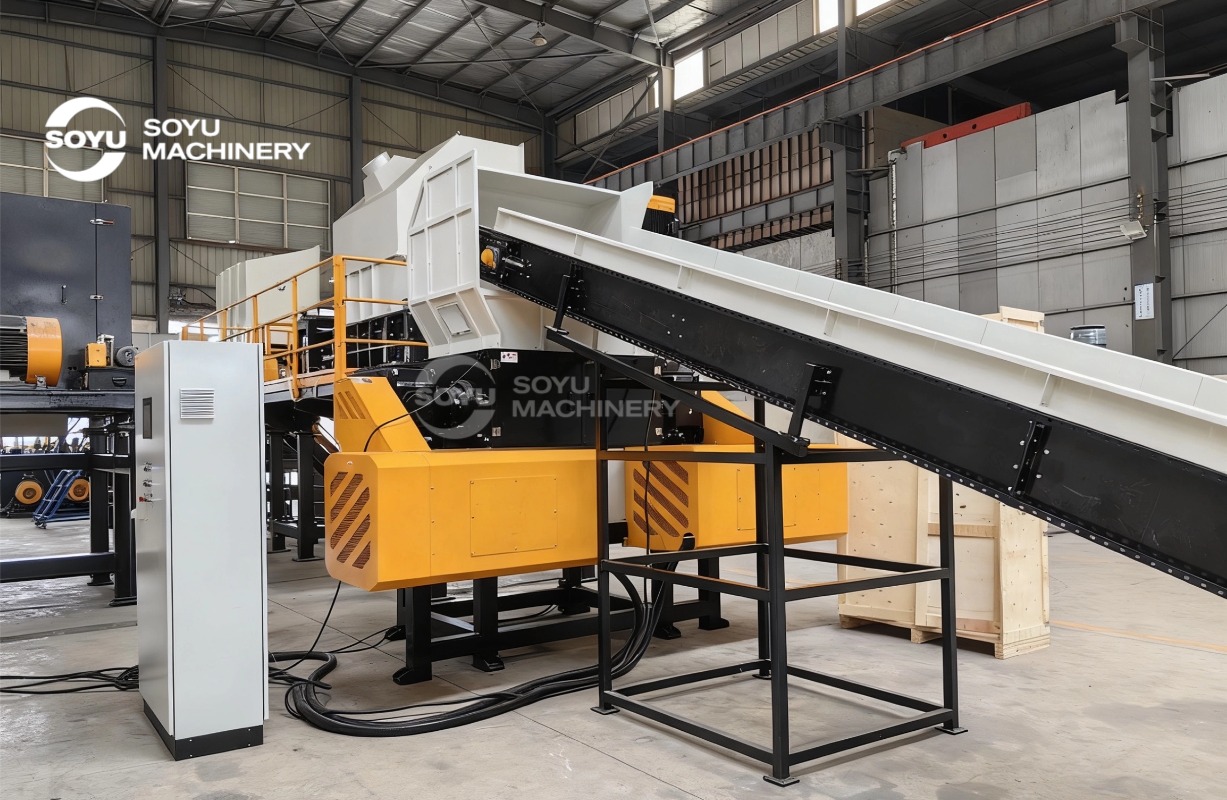
Comparison: Single Shaft vs Double Shaft vs Four Shaft vs Hammer Mill
| Dimension | Single-shaft | Double-shaft | Four-shaft | Hammer mill |
|---|---|---|---|---|
| Representative Soyu model | SR1600 | SYU61210 | FS130140 | TLJ130-450 |
| Rotor configuration | 1 rotor + hydraulic ram + fixed knives | 2 intermeshing low-speed rotors | 2 main rotors + 2 lower sizing rotors | High-speed swinging hammer assembly |
| Typical motor power | 2×55–2×75 kW | 2×90 kW | 2×15 + 2×37 kW | 450 kW |
| Approx. machine weight | 10,800 kg | 23,000 kg | 13,500 kg | 28,000 kg |
| Output-size control | Screen under rotor, commonly Φ40 mm | Coarse-to-medium; must rely on internal spacing and downstream separation | Lower shafts force material through sizing grates | Interchangeable screens 60/80/100 mm |
| Best-suited feed | Wood, pallets, film, bottles, cushioned homogeneous production scrap | Bulky and dirt-tolerant feeds: tires, large municipal items, cable, heavy plastics | E-waste, mixed bulky materials, reinforced plastic, cables, household bulky waste | Scrap steel, appliances, bicycles, containers and metal-densification duties |
Data for representative models listed above comes from standard Soyu Machinery specification sheets. The table is intended for technology sorting, not as a ranking of machine value: an operator who processes only wood pallets does not necessarily need a four-shaft machine, while a municipal site feeding whole sofas and mattresses often benefits from the second sizing stage of a four-shaft unit.
How to Select an Industrial Shredder: A Step-by-Step Working Framework
Step 1. Describe the input material and its true contamination level
Define size, shape, moisture, temperature, density, metal content and contaminants. For example, an e-waste stream containing metal frames, glass and capacitors demands tougher containment than clean plastic film. A paper mill waste application in a humid tropical climate demands corrosion-resistant blade materials and dust-tight design.
Step 2. Fix the required output particle size
Output specification usually comes from an existing process: granulator feed, RDF preparation, magnetic separation, pulping or baler gate. Soyu's RDF shredder models such as the SRD2500 offer a 40 mm screen hole diameter; heavy-duty single-shaft machines like the SRD3000 can use an 80 mm screen. The required average size and permissible size deviation help select rotor speed, screen aperture and shaft count.
Step 3. Define duty cycle and operating schedule
A facility running 24/7 with minimal maintenance time must over-specify bearings, shafts, cooling and wear protection compared to a small line operating 10 hours a day. Several documented recycling plants run machines continuously for 16 to 24 hours per day. This fact should be stated clearly in the request-for-quotation.
Step 4. Evaluate auxiliary components and safety environment
Shredding is almost always part of a larger process. Downstream magnetic separators, eddy-current separators, dust extraction, air classifiers, conveyors and balers all affect the machine choice and connection. Enclosed, explosion-proof or low-noise facilities may impose additional motor, sealing or frame requirements.
Step 5. Request specifications and test evidence, not a generic quote
A serious supplier should provide a clear machine specification, throughput assumptions, knife material, shaft material, frame thickness and support for intended duty. Process simulation with representative client material, when available, is especially valuable because the cutting result is best predicted from the actual waste, not from a catalogue.
Typical Application Cases and What They Demonstrate
Bulky municipal waste in the USA
In North America, bulky household waste processing often combines a four-shaft shredder with conveyors, magnetic separator, air classifier and a dust-extraction system. The role is to reduce sofas, cabinets and construction discards so the material can be forwarded to energy recovery or landfill optimization. The heavy four-shaft FS130140 design, with its high-strength Q355B carbon steel frame and reinforced knife system, is a common starting point.
Plastic film recycling in Poland
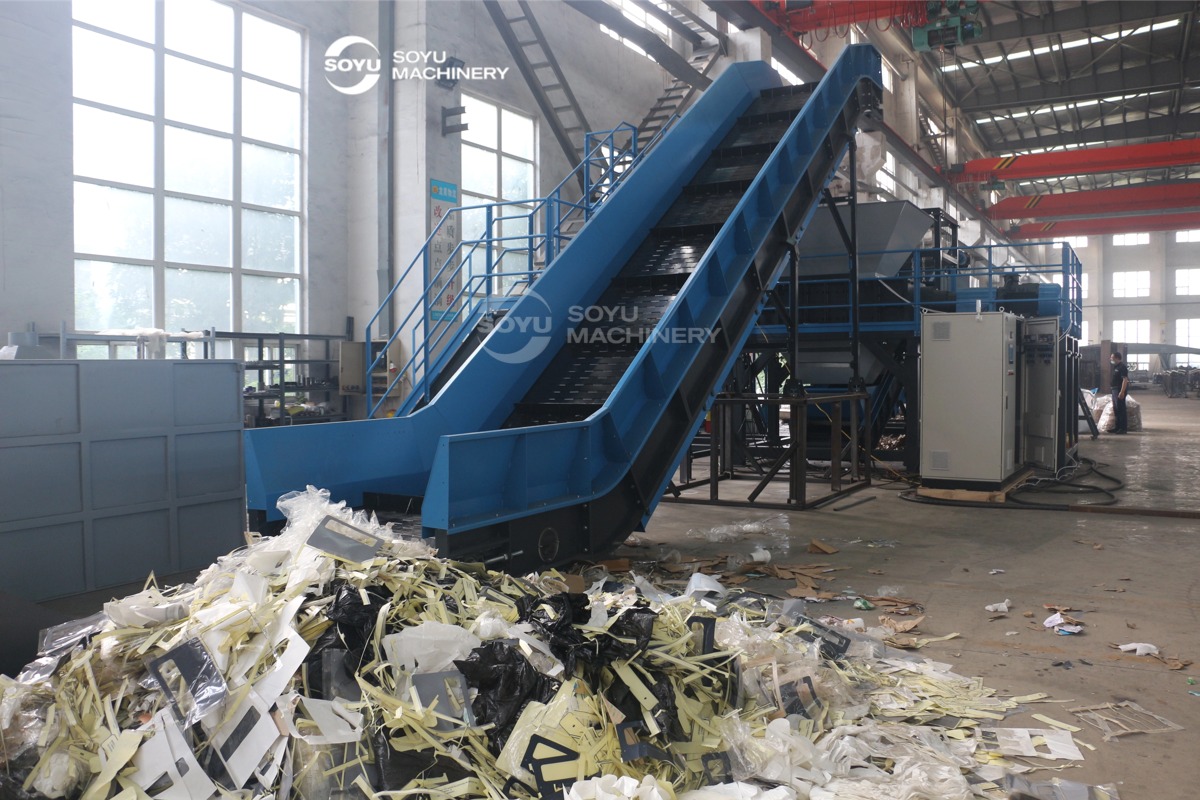
Plastic-film recyclers frequently operate near 24/7 because film is low-density and high-volume. A plant may use a plastic film shredder or double-shaft shredder followed by granulation. Soyu offers dedicated Plastic Film Shredder configuration based on the SR1400 single-shaft machine with 75–90 kW, hydraulic ram and 40 mm standard screen to break loose film and bales into a consistent fraction for washing and pelletizing.
E-waste processing in the United Kingdom
The UK WEEE stream includes computers, phones, drives and power supply units. Recyclers increasingly use enclosed, explosion-conscious facilities, magnetic separators and eddy-current separation to recover non-ferrous metal. A four-shaft shredder or e-waste shredder such as the FS8080/FS100120 series is used to liberate metal from plastic and to contain hazardous components before sorting.
Wood pallet shredding in Spain
A wood recycler handling continuous streams of pallets and packaging benefits from a single-shaft wood shredder with hydraulic ram. The machine feeds wood at a selected rate, cuts it against fixed blades, and discharges chips below the rotor. For this duty, Soyu matches models like SR1600 Wood Shredder, using 2×55–2×75 kW and a rotor carrying 94 blades.
RDF preparation in South Korea and Russia
In RDF plants, shredders must homogenize municipal or industrial solid waste before it enters densification or co-processing. Soyu is involved in such lines with machines from SRD2500 to SRD3000, which combine high rotor performance and screens to deliver a consistent fuel-like material. Downstream conveyors, ferrous removal and dust control protect combustion equipment and improve fuel quality.
Frequently Asked Questions
1. What is an industrial shredder and why is it different from a granulator or crusher?
An industrial shredder is a heavy-duty size-reduction machine that cuts or tears solid waste into fragments large enough for sorting, conveying, baling, densifying or further processing. It differs from a granulator by accepting larger, dirtier feeds; it differs from a crusher because it mainly uses shear and tear forces rather than compression. Industrial shredders are used for municipal solid waste, plastics, metal, e-waste, cardboard, tires, wood and production scrap.
2. Single-shaft or double-shaft: which is better for a first industrial shredder?
There is no universal first machine. Single-shaft units are generally better when the feed stream is relatively homogeneous and a more consistent output size is needed; double-shaft machines are more tolerant of bulky, irregular and bale-type feed. If the operation handles full pallets, white goods or municipal waste, a double-shaft machine may be safer. If the operation processes production scrap from one source, such as plastic purgings or wood offcuts, a single-shaft machine with a hydraulic ram and screen is often more stable and easier to control.
3. How important is blade material in a heavy duty industrial shredder?
Blade material is among the most important life-cycle variables in shredder procurement. Soyu's standard manufacturing practice uses DC53 or D2 high-alloy steel for many four-shaft and double-shaft blades, often with HRC 60–62 hardness after heat treatment. Fixed blades may use D2 high-carbon high-chromium steel or Cr12MoV alloy steel for impact resistance. Shafts are often manufactured from 42CrMo high-strength alloy steel with heat treatment and dynamic balancing. Buyers should compare not only initial blade price but also sharpening intervals, edge life and replaceability.
4. Can I shred material to a specific particle size with a single machine?
Many industrial shredder configurations include screens that constrain discharge to a nominal size, such as 40 mm or 80 mm. Pressing the material against the rotor and holding particles in the cutting chamber until they pass through the screen is how single-shaft models achieve better control. Four-shaft machines use lower sizing shafts for similar effect. For more demanding sizes, operators combine a shredder with a downstream granulator, hammer mill or classifier.
5. What should a buyer measure before comparing shredder suppliers?
A responsible comparison starts with material identity, max feed dimension, throughput in tons/hour, target output dimension and daily operating hours. Buyers should also compare cutting-chamber size, rotor configuration, motor power, machine weight, steel grade, blade material, screen size, hydraulic systems and spare-part access. Equipment weight is often a useful proxy for frame robustness, but it should never replace an actual process conversation with the manufacturer.
Next Step: Turn the Selection Framework into a Specification
Industrial shredder selection is not an exercise in finding the most famous brand; it is about aligning machine geometry, control and strength with the physical behavior of a waste stream. SOYU Machinery, established in 2009, manufactures single-shaft, double-shaft and four-shaft shredders, employs about 200 staff and runs an R&D team of 25 engineers. Its factory covers 15,000 m² and its annual production capacity reaches around 2,000 sets. Roughly 70% of its output is exported to markets including the EU and USA.
Products range from double-shaft low-speed high-torque units to heavy four-shaft shredders, RDF single-shaft units, wood shredders, e-waste shredders, plastic shredders and complete OCC paper dry pulping lines. Because many waste streams are local and specific, the company supports machine specification through contact with engineering and sales staff rather than relying on catalogue cross-reference alone.
Preparing a new recycling line or replacing an underperforming shredder?
Contact SOYU Machinery to discuss your material, target fraction and operating schedule.
Email: sy@shredder-3e.com
Tel/WhatsApp: +86-13962331498
Tel: +86-512-52408453
Have Questions or Need More Details?
Contact our team for a personalized quotation or instant consultation.
Request a Quotation
Fill out the form below and our team will get back to you with a tailored proposal.
WhatsApp Direct Chat
Prefer to chat in real-time? Message us on WhatsApp for instant assistance & quick answers.
- Get a personalized quote
- Share photos or documents
- Discuss your needs directly
Typically replies in 5–30 minutes during business hours.