
Industrial Shredder vs. Hammer Mill: Choosing the Right Equipment for Scrap Metal Recycling
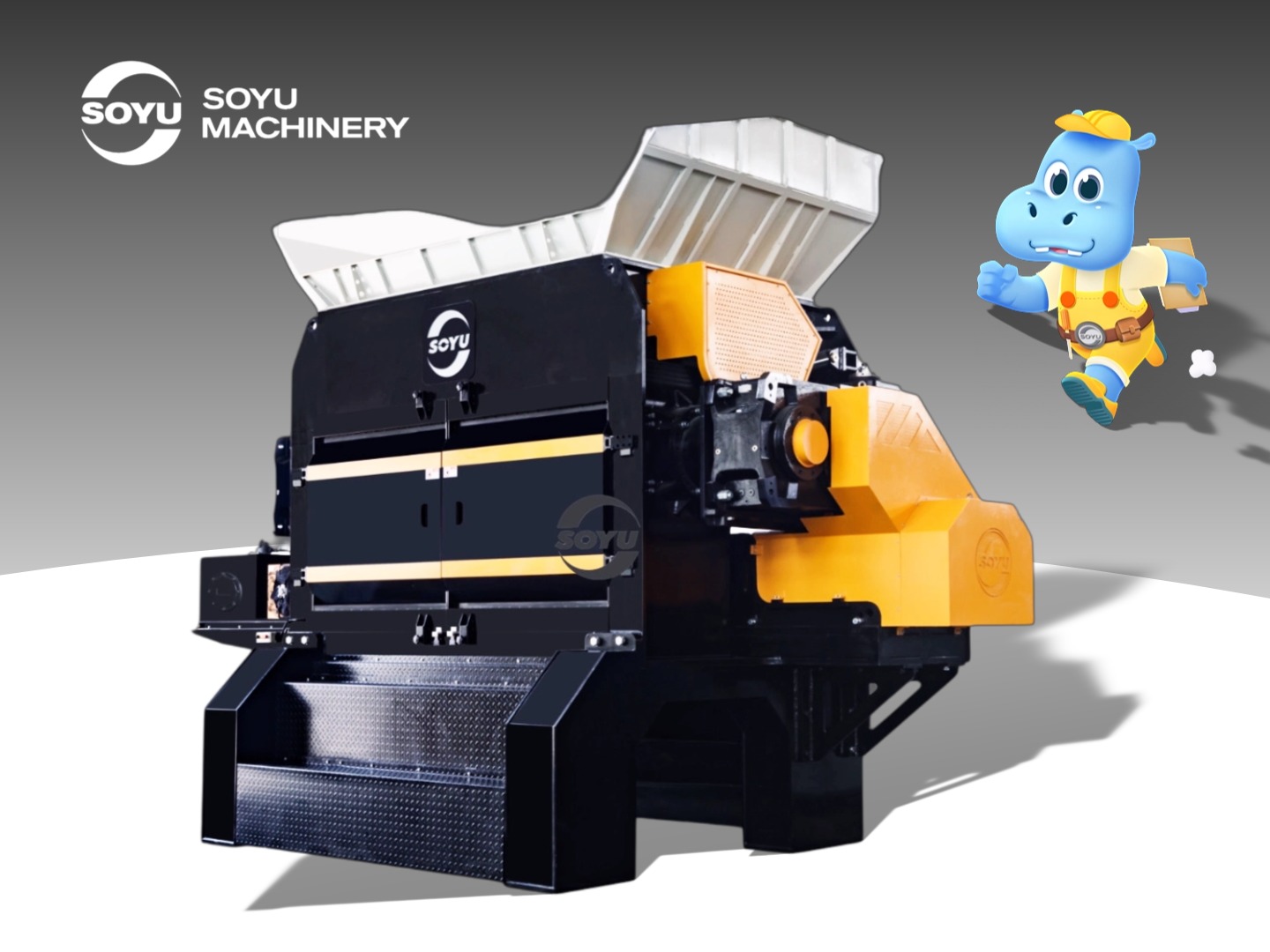
An industrial shredder and a hammer mill do different jobs in a scrap metal line, and the right choice depends on four variables: what you are feeding in, what size you need out, how many tonnes per hour must pass through, and what equipment sits downstream. In most scrap metal recycling operations the industrial shredder is the primary size-reduction stage — it shears bulky, mixed or lightly contaminated scrap into a handleable fraction. The hammer mill is an impact-based secondary mill that takes pre-sized, relatively clean scrap down to a finer and more uniform particle size. Treating one as a substitute for the other is where most of the expensive mistakes begin.
Why the Shredder-versus-Hammer-Mill Question Goes Wrong
The comparison is usually framed as a straight equipment choice, but the decision that actually matters is a stage decision. Most procurement problems trace back to four recurring omissions.
- The feed material is never characterised. Buyers describe their scrap as "mixed metal" or "aluminium". Suppliers then quote a machine sized for an assumption rather than a specification. Bulk density, piece size, coating and contamination level all change the answer.
- The output requirement is described loosely. "Small pieces" is not a specification. Downstream magnetic separation, density separation, cable recycling lines and briquetting equipment each demand a defined input dimension and shape.
- The two machines are quoted by different suppliers. One quotation covers a shredder, another covers a mill, and nobody converts either into cost per processed tonne, uptime or downstream yield — the only figures that allow a fair comparison.
- Higher speed is mistaken for higher capacity. A hammer mill running at high rotor speed is not automatically more productive than a low-speed, high-torque shredder working on the same material. Throughput depends on the material, the discharge opening and the torque available at the rotor.
The practical consequence: a buyer installs a hammer mill where a shredder was needed, then discovers the mill cannot accept bulky scrap, ingests tramp metal and consumes hammers faster than the business case allowed for. The reverse error — a coarse shredder where a fine fraction was required — produces material that downstream separation equipment cannot handle efficiently.
Industry Background: A Market Built Around Many Machine Types
The equipment landscape is fragmented because no single machine handles every scrap stream. Intel Market Research valued the global industrial shredder market at approximately USD 1.28 billion in 2024 and projects USD 1.65 billion by 2032. Asia Pacific accounted for a 39.0% revenue share of the metal shredder machine industry in 2024, according to Grand View Research, largely on the strength of regional scrap generation.
Within that market, shaft configuration matters commercially. Grand View Research records twin shaft shredders holding a 35.0% revenue share of the metal shredder market in 2024 — consistent with the fact that double shaft machines are the workhorse of primary scrap reduction, where contamination tolerance matters more than fine output control. Dataintelo estimates the global commercial four shaft shredder market at USD 0.51 billion in 2025, growing at a CAGR of 5.8% through 2034, reflecting demand for tighter output size control where downstream sorting and recovery rates are the priority.
Supplier concentration is moderate rather than dominant: Intel Market Research places Doppstadt, Vecoplan, Untha, Lindner Recyclingtech and Komptech together at roughly 38% of the market, which leaves a large share to regional manufacturers and to customised configurations. Downstream demand also pulls shredder specifications. Market.us valued the refuse derived fuel (RDF) market — a segment that relies on industrial shredders to process municipal solid waste — at USD 4.6 billion in 2023.
Market figures should be read as directional. Published estimates diverge by scope: Intel Market Research reports USD 1.28 billion for 2024, while Strategic Market Research reports USD 5.1 billion, largely because of differences in what is counted as an industrial shredder. Use these numbers to understand market direction, not to benchmark a specific machine price.
How Each Machine Reduces Scrap Metal
Industrial shredder: shear, tear and torque
An industrial shredder reduces material by shear and tearing. Rotating shafts fitted with cutters, hooks or discs grip the material and pull it against a counter-blade or screen, so the reduction happens progressively rather than in a single impact. This is why shredders are described as low speed high torque machines: the objective is force applied to a large, irregular piece, not a high-velocity strike.
- Single shaft shredder. A single rotor working against a fixed counter-blade, usually fed by a hydraulic ram that pushes material into the rotor. Suited to relatively homogeneous streams where a defined output size is required. The Soyu SR1400 single shaft shredder is documented with a rotor speed of 73 rpm and a hydraulic ram feed.
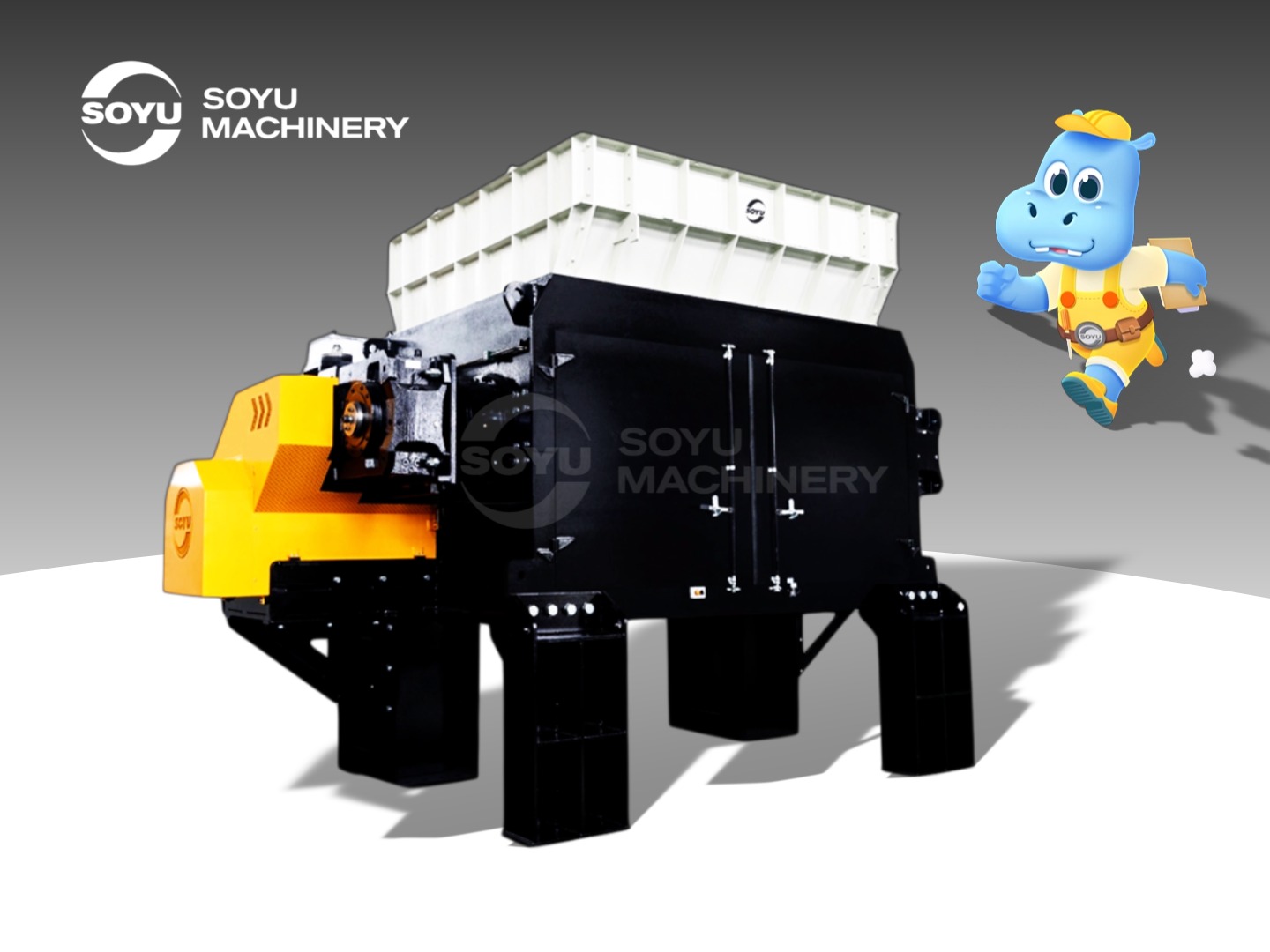
- Double shaft shredder. Two counter-rotating shafts with hooks or discs, high tolerance for bulky and lightly contaminated material, and the standard choice for primary reduction of mixed scrap metal.
- Four shaft shredder. Two-stage reduction within one machine, with a screen controlling discharge size. Preferred where the output must meet a defined dimension before downstream separation.
- Heavy duty industrial shredder. Built for abrasive, dense or tough scrap with reinforced cutting geometry and higher torque reserves — the specification to consider for mixed light iron, coated material and high-duty cycles.
Within the shredder family, application names follow the material: metal shredder, aluminum shredder, copper wire shredder, metal chips shredder, e-waste shredder, plastic shredder, wood shredder and RDF shredder. These are configurations of the same size-reduction principle, sized for the feed rather than fundamentally different technologies.
Hammer mill: impact and attrition
A hammer mill reduces material by impact. A high-speed rotor carries swinging hammers that strike the feed and drive it against a breaker plate or grate; material stays in the chamber until it is small enough to pass the openings. The result is a finer, more uniform fraction, achieved with a simpler and generally lower-cost machine.
The trade-off is feed tolerance. Hammer mills perform best on pre-sized, relatively clean material. Bulky pieces reduce throughput, tramp metal and hard contaminants damage hammers and screens, and ductile metals can deform rather than fracture under impact. That is why a hammer mill is normally the second stage in a scrap metal line, not the first — and why the specification question is rarely "shredder or hammer mill" but "how much reduction should happen before the mill".
How the two stages fit a scrap metal line
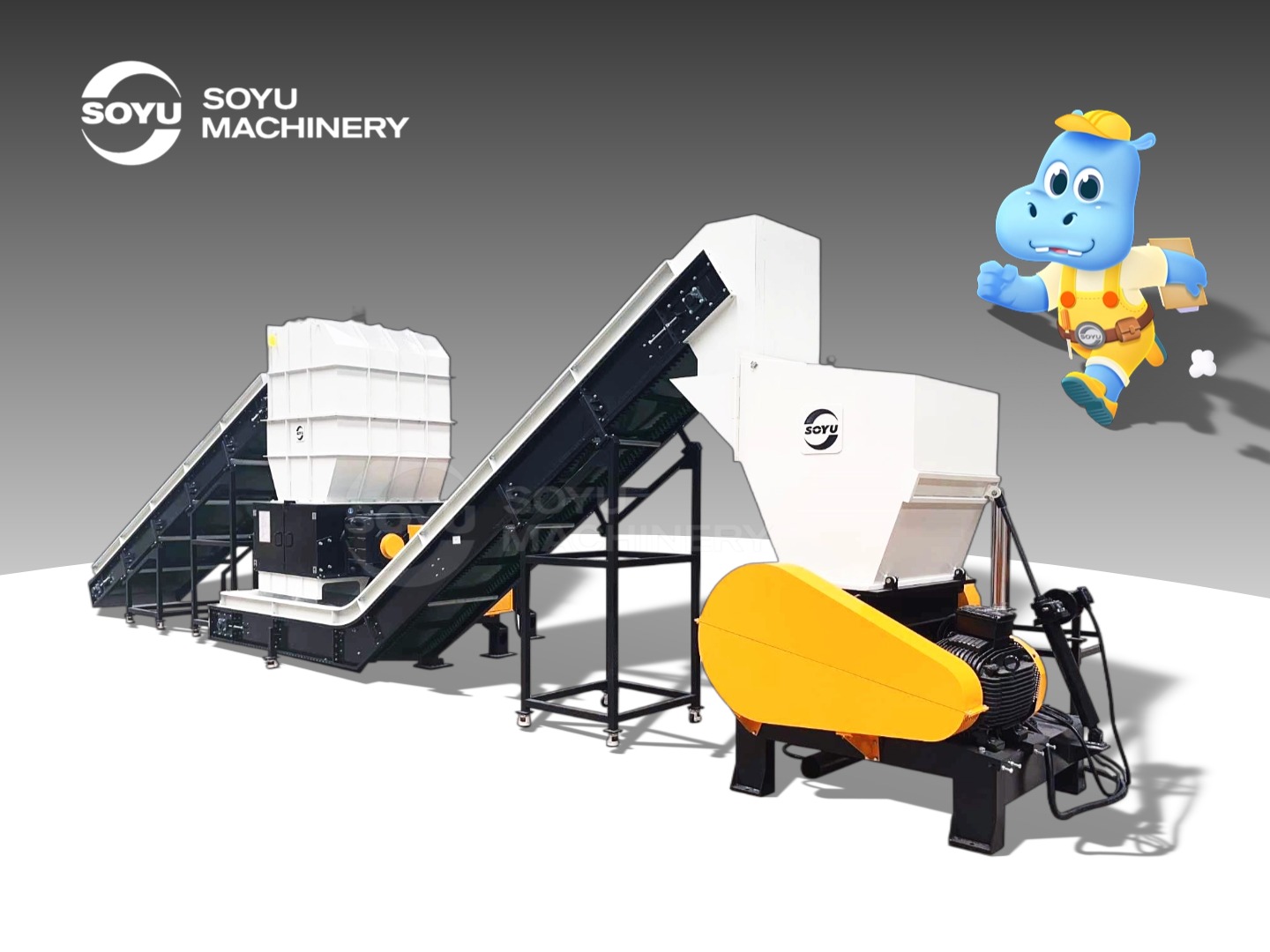
A typical sequence runs: receiving and pre-sorting, primary shredding, magnetic separation, secondary milling or granulation, density separation, then product-specific recovery. In non-ferrous operations the shredder stage commonly feeds a cable recycling line, where a copper wire shredder liberates conductor from insulation before separation. In e-waste processing, an e-waste shredder reduces assemblies ahead of component separation, with dust extraction and explosion-proof provisions specified where batteries are present.
Two integration points decide whether the line works: the shredder discharge must match what the next machine can accept, and the transfer equipment between stages must be sized for the actual bulk density of the shredded material rather than the density of the incoming scrap.
Industrial Shredder vs. Hammer Mill: Side-by-Side Comparison
| Decision factor | Industrial shredder (shear-based) | Hammer mill (impact-based) | What it means for your line |
|---|---|---|---|
| Reduction mechanism | Shear and tearing at low speed and high torque | Impact from rotating hammers against a breaker plate or grate | Determines feed tolerance more than any other factor |
| Feed tolerance | Accepts bulky, mixed and lightly contaminated scrap | Requires pre-sized, relatively clean feed | The mill is normally installed downstream of a shredder |
| Output control | Screen or comb changes set nominal size; output stays coarse to medium | Finer and more uniform fraction, set by grate openings and rotor speed | Match output to the next separation or recovery step, not to preference |
| Effect on ductile metals | Lower rotor speed, less deformation of aluminium and copper | Repeated impact can flatten or smear ductile metal | Affects downstream sorting and the value of the recovered fraction |
| Wear parts | Cutters, discs and counter-blades, serviceable in place | Hammers and screens, consumed faster on abrasive scrap | A direct total-cost-of-ownership driver |
| Contaminant risk | Overload protection and torque reversal allow recovery from unshreddables | Tramp metal and hard items damage hammers and screens | Screening upstream protects the mill and reduces downtime |
| Dust and noise | Lower speed; dust extraction can be integrated | Higher impact energy typically raises noise and dust generation | Permitting, workplace safety and operator acceptance |
| Typical line position | Primary or pre-shredding stage | Secondary or fine milling stage | The order is fixed; only the sizing is negotiable |
| Capacity scaling | Scales with shaft geometry, torque and chamber volume | Scales with mill size, screen area and feed consistency | Size on the real material, not on a nominal tonnage figure |
Step-by-Step: Specifying the Right Stage for Your Line
- Characterise the feed. Record material mix, maximum piece size, bulk density, coating and contamination, and moisture. Aluminium profile, copper wire, metal chips and swarf, e-waste assemblies and mixed light iron behave differently in the same machine.
- Define the output specification. State the required discharge dimension, the acceptable shape, and the bulk density the next stage can handle. If a cable recycling line follows, the specification should describe what the copper wire shredder stage must deliver.
- Fix throughput and duty cycle. Distinguish average throughput from peak throughput, and state how many hours per day the machine will run. A machine sized for average load will create a bottleneck during peak intake.
- Map the integration. Confirm infeed method — conveyor, grab feed or ram feed — discharge handling, magnetic separation, dust extraction and control interfaces. Decide now where a second stage will be added later, so the first stage is sized to allow it.
- Lock safety and compliance. For EU installation, EN ISO 13857:2019 defines the safety distances that prevent hazard zones from being reached by limbs, and it drives guard design at feed openings and discharge points. Safety guards, safety interlocks, emergency stops, overload protection and dust extraction belong in the specification; explosion-proof motors and leakage detection are specified where battery or e-waste streams are handled.
- Compare total cost of ownership. Include wear-part consumption, expected downtime, spare-parts availability, remote troubleshooting and energy per processed tonne. Unit price alone cannot separate a shredder from a mill, because they occupy different stages.
Choosing within the shredder family
Once a shredder stage is confirmed, the shaft configuration follows the feed. A double shaft shredder is the default for primary reduction of mixed, bulky scrap. A four shaft shredder is preferred where discharge size must be controlled for downstream separation. A single shaft shredder with hydraulic ram feed suits relatively homogeneous streams and defined output sizes. A heavy duty industrial shredder specification is appropriate where scrap is abrasive, dense or processed in long duty cycles.
Use Cases: Where Each Configuration Fits
- Mixed scrap metal and light iron. Primary reduction with a double shaft or heavy duty industrial shredder, followed by magnetic separation; a hammer mill is added only if a finer fraction is required for downstream processing.
- Aluminium. An aluminum shredder reduces profiles, sheet and cans to a defined size for briquetting or remelt preparation; output control matters more than raw reduction ratio, which is where four shaft configurations with screens are specified.
- Copper wire and cable. A copper wire shredder opens the cable structure so conductor and insulation can be separated in a cable recycling line. A hammer mill in this position only makes sense after liberation, not before.
- Metal chips and swarf. A metal chips shredder reduces turnings and swarf for volume control ahead of centrifuging or briquetting, where consistent chip size stabilises the downstream process.
- E-waste. An e-waste shredder reduces assemblies ahead of component separation, with dust extraction, explosion-proof provisions and leakage detection specified where batteries are present.
- Adjacent streams. The same stage logic applies to plastic shredder, wood shredder, cardboard and paper mill waste shredder, RDF shredder and medical waste shredder applications: primary shear reduction first, fine milling second, if a fine fraction is needed at all.
Cost and Performance: Integrated Shredder Stage vs. Conventional Configuration
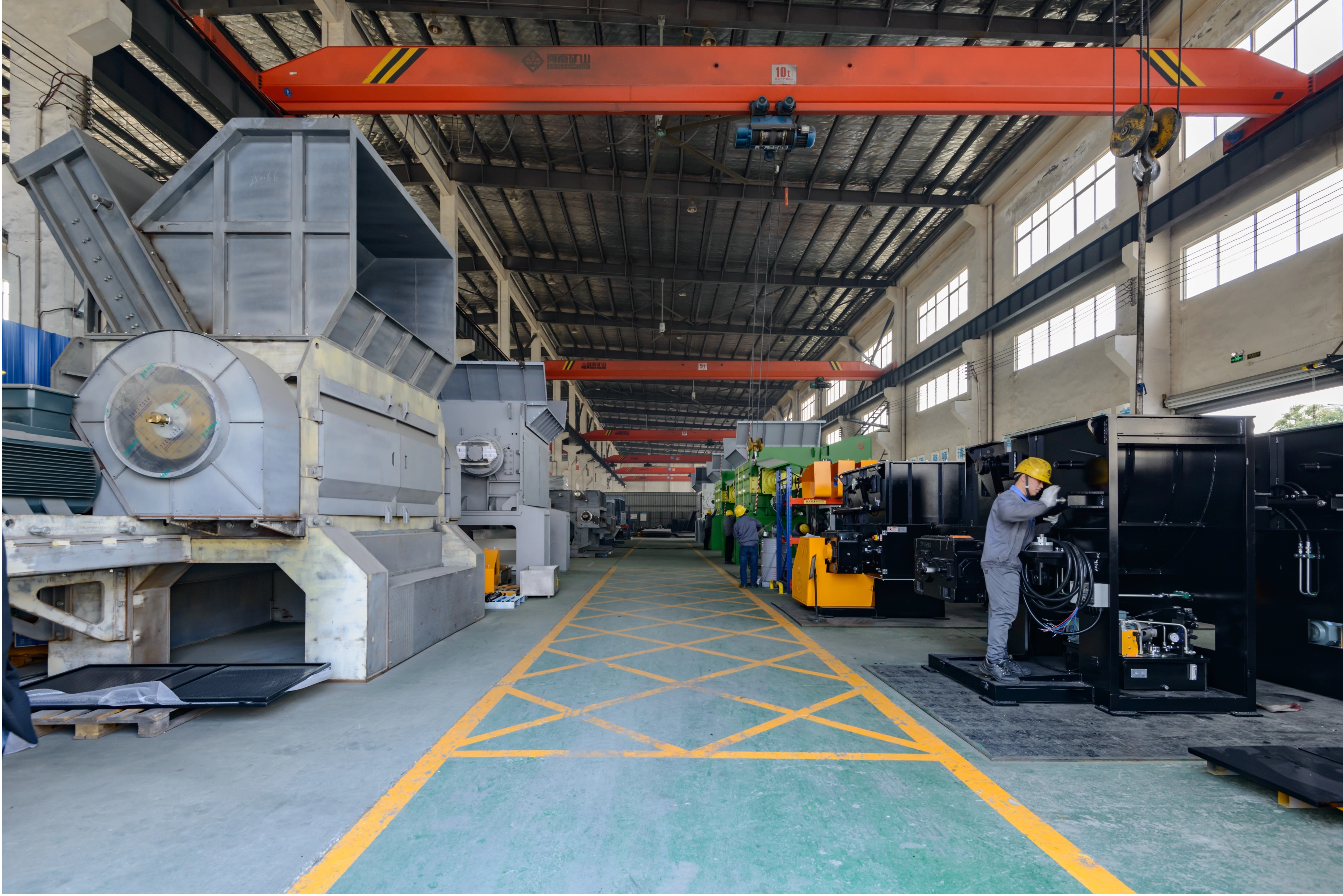
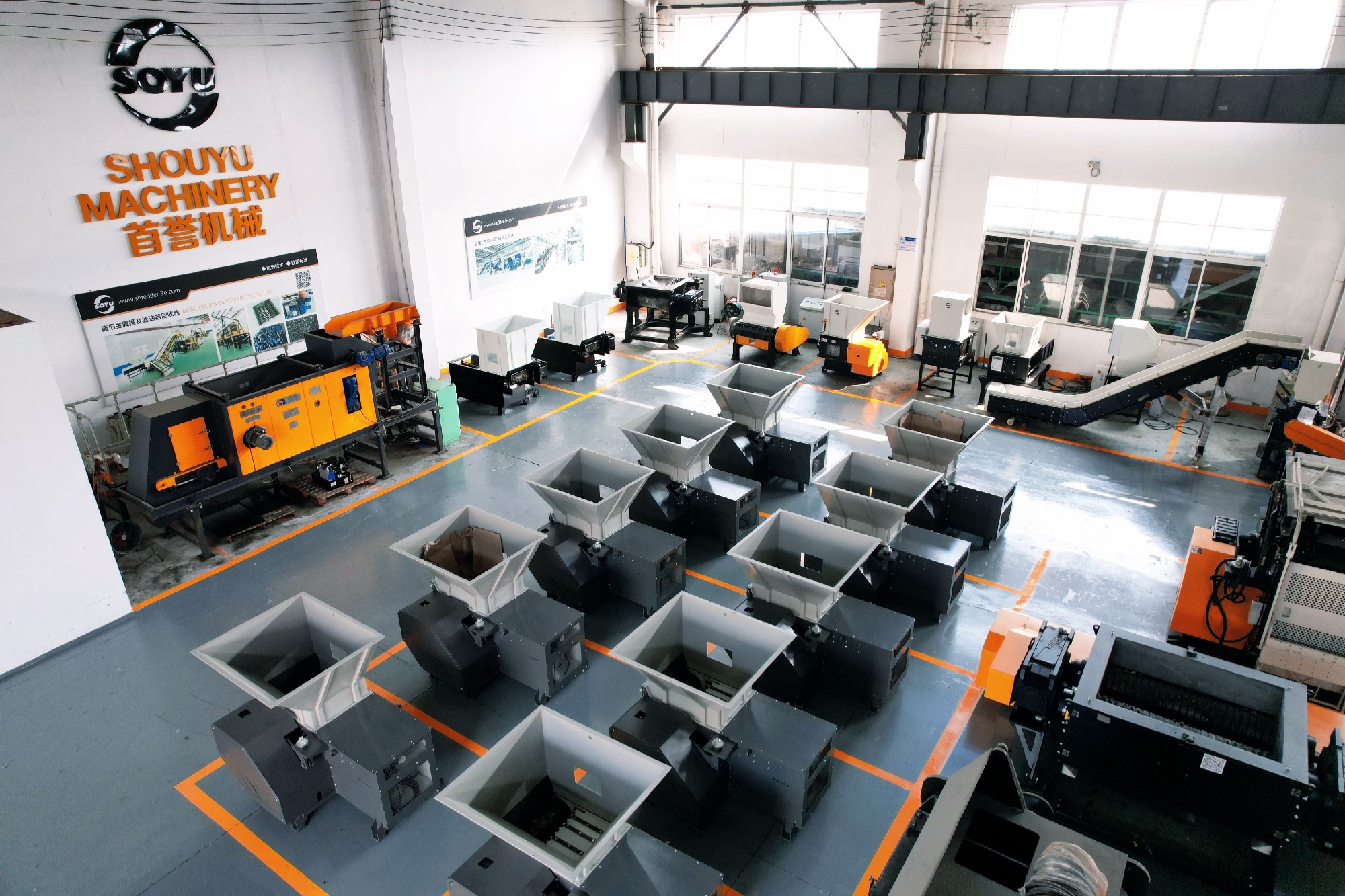
Soyu Machinery (Changshu Shouyu Machinery Co., Ltd.) is a Chinese shredder manufacturer founded in 2009, operating a 15,000 m² facility with 200 employees, 25 R&D engineers and an annual output of 2,000 sets. Around 70% of production is exported, with the EU and USA as main markets, and the product range covers four shaft, single shaft and double shaft shredders together with metal shredder, plastic shredder, RDF shredder, aluminum shredder, fiberglass shredder, solid waste shredder, e-waste shredder, wood shredder and waste paper shredder configurations.
Because a shredder decision is a stage decision, the commercial comparison that matters is against the two configurations buyers most often consider instead: foreign-brand equipment, or manual dismantling combined with a general crusher. Soyu's comparative project data for integrated shredder configurations is summarised below.
| Comparison metric | Soyu integrated shredder configuration | Foreign-brand equipment or manual dismantling + general crusher |
|---|---|---|
| Processing capacity | +20% | Baseline |
| Initial investment | 15–20% lower | Baseline |
| Downtime | -30% | Baseline |
| Energy consumption per tonne | -10% | Baseline |
| Long-term operating cost | 25% lower | Baseline |
| Maintenance cost | 30% lower, with faster spare-parts supply and 24/7 remote troubleshooting | Baseline |
Figures are Soyu's own comparative project data for integrated shredder configurations and are presented for evaluation purposes; buyers should validate them against their own material, duty cycle and local energy costs.
FAQ: Industrial Shredder vs. Hammer Mill Decisions
Do industrial shredders and hammer mills both need guarding to EN ISO 13857:2019 for EU installation?
Yes. Both machine types are supplied as machinery for EU installations and are assessed against applicable machinery safety requirements. EN ISO 13857:2019 defines the safety distances that prevent hazard zones from being reached by limbs, and it directly governs guard design at feed openings and discharge points. Soyu builds shredders with safety guards, safety interlocks, emergency stops, overload protection and dust extraction, and works to CE and ISO requirements; explosion-proof motors and leakage detection are specified where battery or e-waste streams are processed.
Can a single scrap metal line use both an industrial shredder and a hammer mill?
Yes, and this is the standard arrangement. The shredder performs primary size reduction on bulky, mixed or lightly contaminated scrap; the hammer mill then reduces that pre-sized material to a finer, more uniform fraction. In non-ferrous operations the shredder stage typically feeds a cable recycling line, where a copper wire shredder liberates conductor from insulation before separation. The limit is feed tolerance: a hammer mill should only receive material that has already passed a shredder and had tramp metal removed.
Which option has the lower total cost of ownership — a shredder or a hammer mill?
Unit price is not a reliable guide because the two machines occupy different stages. Hammer mills generally carry lower entry cost, but hammers and screens are wear parts consumed faster on abrasive or contaminated scrap. Shredders carry higher capital cost but tolerate contamination and protect downstream equipment from unshreddables. On integrated Soyu configurations, comparative project data shows 15–20% lower initial investment, 25% lower long-term operating cost and 30% lower maintenance cost than foreign-brand equipment or manual dismantling combined with a general crusher.
Can I validate a configuration with my own scrap before placing an order?
Feed material and throughput should be confirmed before a configuration is fixed, because piece size, contamination and bulk density change the machine sizing. Buyers can send material samples together with the target output dimension and hourly throughput to Soyu Machinery for a configuration review, so the shredder stage, screen selection and any downstream hammer mill or cable recycling stage are specified against real material rather than an assumption.
How long does delivery take for a shredder or hammer mill stage?
Delivery time depends on machine type, the degree of customisation and whether the order covers a single unit or a complete line including separation and downstream equipment. Soyu manufactures to order with an in-house R&D team of 25 engineers and an annual output of 2,000 sets, so the production schedule should be requested in writing at quotation stage together with the spare-parts list and commissioning plan. Requesting a written schedule and spare-parts commitment alongside the quotation is the practical way to compare lead time between suppliers.
Conclusion: Decide the Stage Before You Decide the Machine
The shredder-versus-hammer-mill question resolves once the line is described properly. If the material arriving on site is bulky, mixed or contaminated, the required investment is a shredder stage — a double shaft or heavy duty industrial shredder for primary reduction, a four shaft shredder where discharge size must be controlled, or a single shaft shredder with ram feed for homogeneous streams. A hammer mill belongs downstream, where pre-sized and cleaned material needs a finer, more uniform fraction, and where its lower entry cost is not offset by accelerated wear from unsuitable feed.
Decide in this order: feed characteristics, output specification, throughput and duty cycle, integration with existing recycling equipment, safety and compliance, then total cost of ownership. Buyers who sequence the decision this way stop comparing two quotations for two different jobs and start comparing configurations against one line design.
Send Your Material, Get a Stage Recommendation
Share your scrap type, maximum piece size, target output dimension and hourly throughput with Soyu Machinery. The team will confirm whether your process needs a primary shredder, a downstream hammer mill, or both — and specify the shaft configuration and screen accordingly.
Email: sy@shredder-3e.com | Tel: +86-512-52408453 | WhatsApp: +86-13962331498
Technical resources and configuration notes: Soyu Machinery shredder blog.
Have Questions or Need More Details?
Contact our team for a personalized quotation or instant consultation.
Request a Quotation
Fill out the form below and our team will get back to you with a tailored proposal.
WhatsApp Direct Chat
Prefer to chat in real-time? Message us on WhatsApp for instant assistance & quick answers.
- Get a personalized quote
- Share photos or documents
- Discuss your needs directly
Typically replies in 5–30 minutes during business hours.