
Industrial Shredders 101: Core Concepts, Machine Types, and Real-World Applications
An industrial shredder is a size-reduction machine that converts bulky, mixed or contaminated waste into a controlled particle size through shear, tearing and compression. The category is far wider than the name suggests. Under the same label you will find a four-shaft machine built around a 660 x 500 mm cutting chamber and a 1,000 kg frame, and a heavy-duty single-shaft machine with a 3,006 x 1,620 mm cutting chamber and a frame weight of approximately 25,000 kg. What separates them is rarely price. It is the material each machine will be asked to process every working day.
This explainer is written for new buyers, plant operators and project engineers who need the fundamentals before they compare quotations. It covers what size reduction actually does, why a low speed high torque shredder behaves differently from a standard high-speed model, how single, double and four shaft configurations relate to real waste streams, and where each machine type is typically installed. It closes with a seven-step selection method, two comparison tables and the compliance, capability, cost, validation and lead-time questions buyers raise most often.
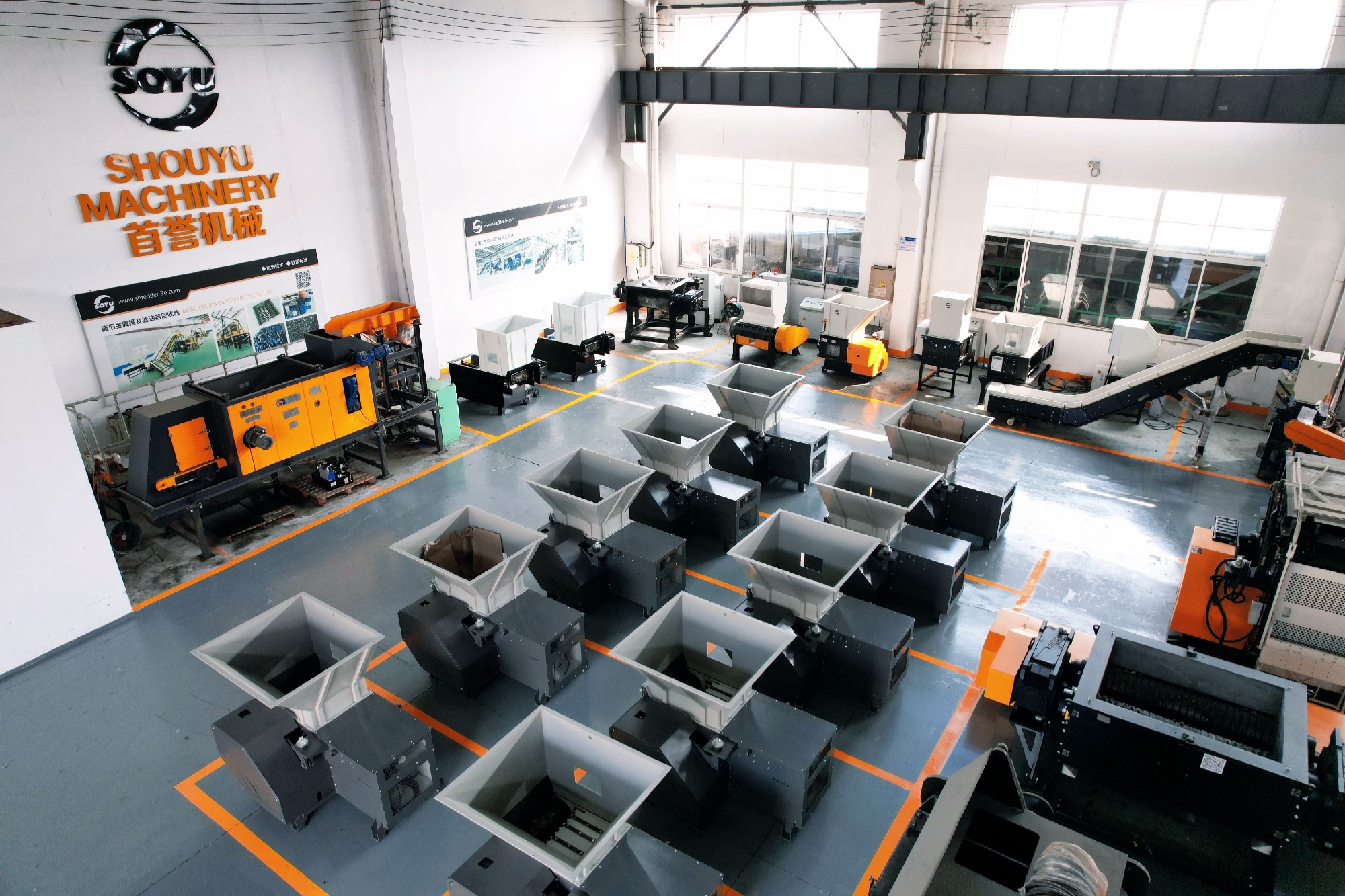
Machine examples throughout are drawn from the range of SOYU Machinery (Changshu Shouyu Machinery Co., Ltd.), a shredder manufacturer founded in 2009 in Changshu, China, operating a 15,000 m2 production facility with approximately 200 employees, an R&D team of 25 engineers and an annual output of around 2,000 machines. Roughly 70% of production is exported, mainly to the EU and the USA. The full range of single shaft, double shaft and four shaft shredders and complete recycling lines is published at www.shredder3e.com.
Why Industrial Shredder Projects Fail Before the Machine Arrives
Most underperforming shredder installations are not badly built. They are specified against the wrong problem, and the error usually happens months before the machine is ordered. Four patterns repeat across new projects.
Sizing by motor power instead of configuration
A 22 kW double shaft shredder and a 280 kW heavy-duty single shaft shredder are both marketed as industrial shredders, yet they solve different problems. The 22 kW SYU26100 double shaft unit, with a 25-blade rotor and a 2,810 x 1,100 x 2,050 mm footprint, is sized for mixed light industrial and commercial waste. The 280 kW SRD3000 single shaft unit, with a 3,006 x 1,620 mm cutting chamber and 52 rotor blades, is built for continuous, high-volume duties such as refuse-derived fuel feedstock preparation. Buying the smaller machine for the heavier duty does not result in a slow line - it results in a stalled line.
Ignoring how the material behaves at the feed opening
Waste does not fail machines evenly. Flexible polyethylene and polypropylene film wraps around shafts and bridges at the feed throat. Thick-walled drums and pipes refuse to be gripped unless the rotor geometry bites. Contaminated scrap brings tramp metal into the chamber. This is why manufacturers build dedicated configurations rather than one universal machine - for example, a plastic film shredder such as the SR1400, which runs a main shaft speed of 73 rpm and discharges through a 40 mm screen, is configured specifically for film, bottles, scrap injection mouldings and light industrial plastic waste.
Never defining the required output
The single most common omission in a shredder specification is the required output size. A shredder does not produce a fixed product; it produces whatever passes the screen installed behind the rotor. On a metal shredder such as the SD2100, the same machine can be delivered with 70 mm, 100 mm or 120 mm screen apertures, which changes the downstream baling, separation and smelting behaviour of the output. On a heavy-duty hammer mill in the same range, screens are supplied in 60 mm, 80 mm or 100 mm options. If the output is not defined, the machine cannot be matched to it.
Treating the shredder as a standalone box
In real installations, the shredder is one stage of a line. Field configurations across recycling projects routinely combine a shredder with an infeed conveyor, a magnetic separator, an eddy current separator, an air classifier, a dust extraction system, a baler and a storage silo or pulp tank. A shredder chosen without reference to the stages before and after it will bottleneck the line even when the machine itself performs exactly as specified.
Industry Background: Where the Industrial Shredder Market Stands
Industrial shredders are a mid-sized equipment category tied directly to recycling volumes, waste regulation and the economics of material recovery. Published market research places the global industrial shredder market at approximately USD 1.28 billion in 2024, projected to reach USD 1.65 billion by 2032 (Intel Market Research). It is worth noting that estimates diverge by study scope: another source, Strategic Market Research, values the same category at around USD 5.1 billion, largely because of differences in whether light office equipment or heavy industrial machinery is included. Buyers should treat single headline figures as directional rather than precise.
Regional and product-level data are more consistent and more useful for specification decisions:
- Asia Pacific accounted for a 39.0% revenue share of the global metal shredder machine industry in 2024, driven largely by scrap generation in China (Grand View Research).
- Twin shaft shredders held a 35.0% revenue share of the metal shredder market in 2024, making the two-shaft configuration the single most common architecture in that segment (Grand View Research).
- The commercial four shaft shredder subsegment was estimated at USD 0.51 billion in 2025, with a compound annual growth rate of 5.8% through 2034 (Dataintelo).
- The downstream refuse-derived fuel market, which depends on industrial shredders to prepare municipal solid waste, reached USD 4.6 billion in 2023 (Market.us).
- Five global players - Doppstadt, Vecoplan, Untha, Lindner Recyclingtech and Komptech - hold roughly 38% of the industrial shredder market combined (Intel Market Research).
Three practical conclusions follow. First, the market is not primarily an equipment-replacement market: it grows with recovery and compliance obligations, which is why downstream segments such as RDF matter so much to shredder demand. Second, the configuration mix is genuinely diverse - no single machine architecture dominates, which is why configuration fit matters more than brand preference at the research stage. Third, with the top five suppliers holding only around 38% of the market, a large share of supply comes from regional and specialist manufacturers, so the evaluation criteria described later in this guide apply well beyond the best-known names.
Core Concepts: What Actually Determines Shredder Performance
1. Size reduction uses four mechanisms, and they are not interchangeable
Rotary shaft shredders rely mainly on shear: material is trapped between rotating blades and fixed counter-blades and is cut rather than crushed. Tearing and compression occur where the material is drawn into the rotor. Impact dominates in a different machine family - the hammer mill. A heavy-duty hammer mill such as the TLJ130-450, which runs a 450 kW motor with 24 hammer heads and discharge screens of 60 mm, 80 mm or 100 mm, breaks loose scrap steel, home appliances, bicycles and metal containers by repeated impact, stripping surface coatings and raising scrap density so that the material meets steel mill charge standards. The mechanism determines the output: shear produces more uniform, blade-cut particles, while impact produces denser, more deformed scrap. Choosing the wrong mechanism cannot be corrected by adding power.
2. Low speed high torque versus standard models
Rotor speed is the second fundamental variable. In a low speed high torque shredder, the rotor turns slowly and the drive is engineered for torque rather than speed. The plastic film shredder SR1400 runs a main shaft speed of 73 rpm; the heavy-duty single shaft SRD3000 is listed with a main shaft speed range of 73 to 300 rpm; and the low speed high torque shredder SYU61210 uses a 2 x 90 kW drive with 21 main blades on a 5,400 x 2,400 x 3,700 mm chassis weighing 23,000 kg.
Slow rotation buys three things in practice. Torque at the rotor edge determines whether a dense or irregular item is gripped or simply pushed around. Lower peripheral speed reduces the tendency to generate dust and heat inside the cutting chamber, which matters for plastic films, paper and other materials sensitive to melting or smearing. And the mechanism tolerates contamination better, because a slow rotor can shear through a mixed load rather than stalling on the first obstruction. The trade-off is that low speed designs prioritise bite, durability and material tolerance over particle uniformity in light, homogeneous streams - which is exactly where a standard higher-speed configuration remains the more economical answer.
3. Single, double and four shaft: the configuration decides the application
This is the concept that most often decides whether a project succeeds, and it is best understood as a question of grip.
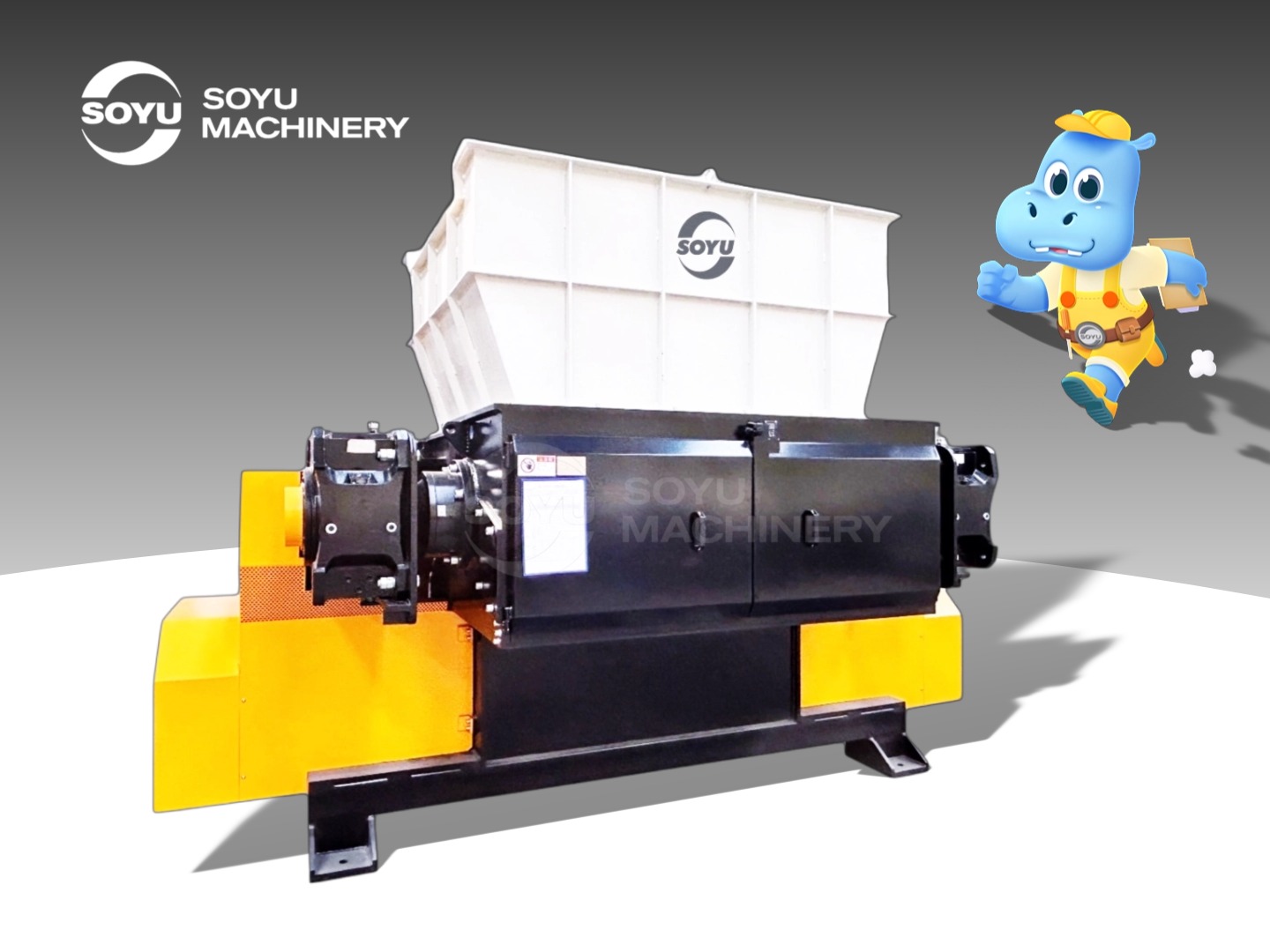
Single shaft with a hydraulic ram. One rotor carries the moving blades, working against fixed counter-blades, while a hydraulic ram pushes material into the rotor. The wood shredder SR1600 illustrates the architecture: ram travel of 1,000 mm, a 480 mm rotor diameter, 94 rotor blades, 12 fixed blades and a 40 mm discharge screen, driven by two motors rated between 55 kW and 75 kW each. This configuration suits films, bottles, pallets, branches, waste paper, cartons, paper tubes and smaller tyres, where the ram can present material to the rotor in a controlled way.
Double (twin) shaft. Two counter-rotating shafts grip material from both sides, which is why twin shaft designs hold the largest revenue share in the metal shredder segment. The double shaft family in this range runs from the 22 kW SYU26100 with 25 main blades and a 4,600 kg frame, through the 2 x 32 kW SYU41100 with 20 blades and a 9,000 kg frame, to the 2 x 75 kW SYU50180 with 24 blades at 20,000 kg and the 2 x 90 kW SYU61210 with 21 blades at 23,000 kg. Typical duties are general industrial waste, plastics, wood, light-gauge metal, packaging waste and small-to-medium tyres.
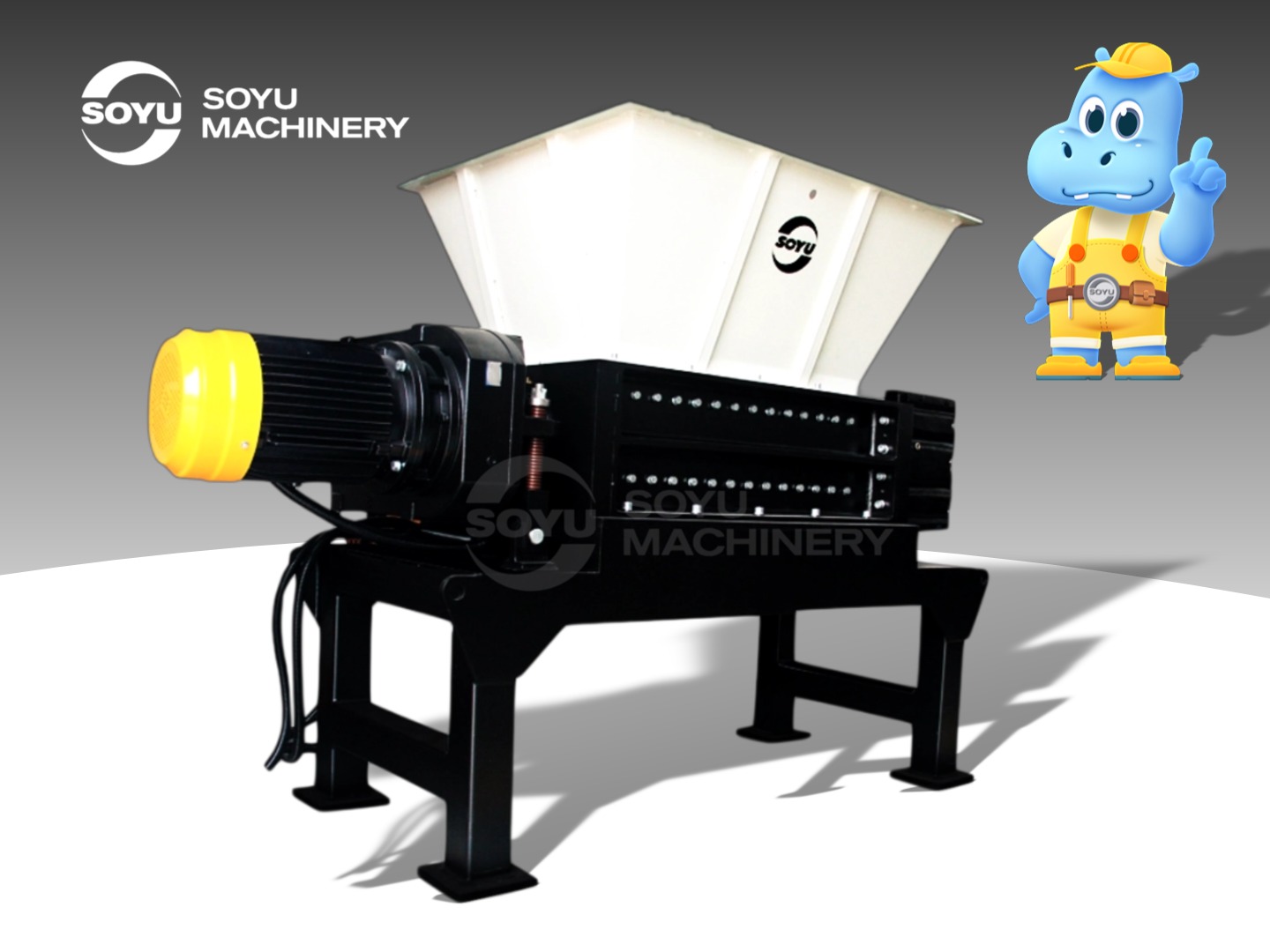
Four shaft. Four shafts create a closed cutting chamber that grabs bulky and awkward items instead of relying on gravity and a ram. The range spans the compact FS6650 (7.5 kW, 660 x 500 mm chamber, 1,000 kg) and FS8080 (2 x 11 kW, 800 x 800 mm chamber, 2,000 kg) up to the FS160160 (2 x 30 kW plus 2 x 45 kW, 1,600 x 1,600 mm chamber, 18,000 kg). Four shaft machines are applied to household and industrial bulky waste, plastic barrels, chemical drums and IBC containers, waste electrical and electronic equipment including circuit boards and power supply units, glass fibre reinforced plastics and composite material, tyres, non-hazardous medical waste, and wood or biomass feedstock.
The rule of thumb is simple: the harder an item is to grip, the more shafts the cutting chamber needs. Films and papers are gripped easily by a single ram-fed rotor. Sealed drums, cubic containers, sofas and mixed bulky loads generally require the closed geometry of a four shaft chamber.
4. The screen - not the motor - sets the output size
Output size is controlled by the screen or mesh installed beneath or around the rotor. The same machine family is routinely supplied with different apertures: 40 mm screen holes on the SR1400 plastic film shredder and on the wood shredder SR1600, 80 mm on the heavy-duty SRD3000, and 70 mm, 100 mm or 120 mm options on the SD2100 metal shredder. This single component is what allows one shredder platform to serve several downstream specifications, from a coarse pre-shred for baling to a finer fraction for separation or fuel blending.
5. Blade material and frame construction determine life-cycle cost
Two shredders with identical power ratings can differ substantially in what they cost to own. Across the general range described here, rotary blades are made from DC53 or CrMoV high-alloy wear-resistant steel and fixed blades from D2 or SKD11 tool steel, with hardness typically quoted in the HRC 58-62 band and optional upgrades to tungsten carbide tips or hardfacing welding. In the four shaft family, moving blades are specified as DC53 wear-resistant steel achieving HRC 60-62 after vacuum deep cryogenic treatment, with a modular quick-release, multi-angle reversible design and a minimum adjustable gap of 0.5 mm against the fixed blades. The multi-angle reversible geometry is what allows blades to be re-sharpened and rotated rather than replaced.
Shafts are made from 42CrMo high-strength alloy steel, quenched and tempered, dynamically balanced and surface hardened so they resist deformation under sustained heavy load. Frames use heavy-gauge carbon steel with reinforced welding, overall stress-relief annealing and rib reinforcement; the four shaft family specifies Q355B grade plates of 20 to 30 mm depending on model, while double shaft and general industrial models use Q345B grade plate with replaceable HARDOX wear plates. In a machine that may run for six years or more in continuous service, these are the components that decide total cost of ownership.
Step-by-Step: Matching a Machine to a Project
The following sequence mirrors the technical review a shredder supplier performs before quoting. Working through it before contacting suppliers shortens the evaluation cycle considerably.
- Characterise the waste stream. Record material type, maximum item size, bulk density, moisture, contamination level and whether the material is hazardous or non-hazardous. Film, rigid mouldings, sealed containers and mixed bulky waste behave completely differently at the feed throat.
- Define the required output. Specify the target particle size and the downstream process. Screen apertures such as 40 mm, 70 mm, 100 mm or 120 mm correspond to very different downstream equipment and handling costs.
- Select the configuration. Single shaft with a ram for films, paper, pallets and flexible material; twin shaft for mixed industrial and commercial waste, plastics and light metal; four shaft for bulky, sealed or awkward items. Use the grip test: if the item cannot be held by two counter-rotating shafts, it likely cannot be held by one.
- Choose the torque and speed profile. Low speed high torque designs suit dense, contaminated or heat-sensitive streams and continuous duty; standard configurations suit lighter, more homogeneous material where output uniformity matters more than bite.
- Size the drive and cutting chamber. Compare chamber dimensions and motor power across models before choosing. A 830 x 1,302 mm chamber with a 75-90 kW drive (SR1400) and a 1,368 x 1,533 mm chamber with a 2 x 55 to 2 x 75 kW drive (SR1600) serve very different throughput requirements, even though both are single shaft machines.
- Verify safety, compliance and site constraints. In the EU, shredder installations are expected to respect the safety-distance requirements defined by EN ISO 13857:2019, which specifies distances that prevent hazard zones from being reached by limbs. Confirm the available power supply, required dust extraction, noise limits and the physical footprint before finalising the layout.
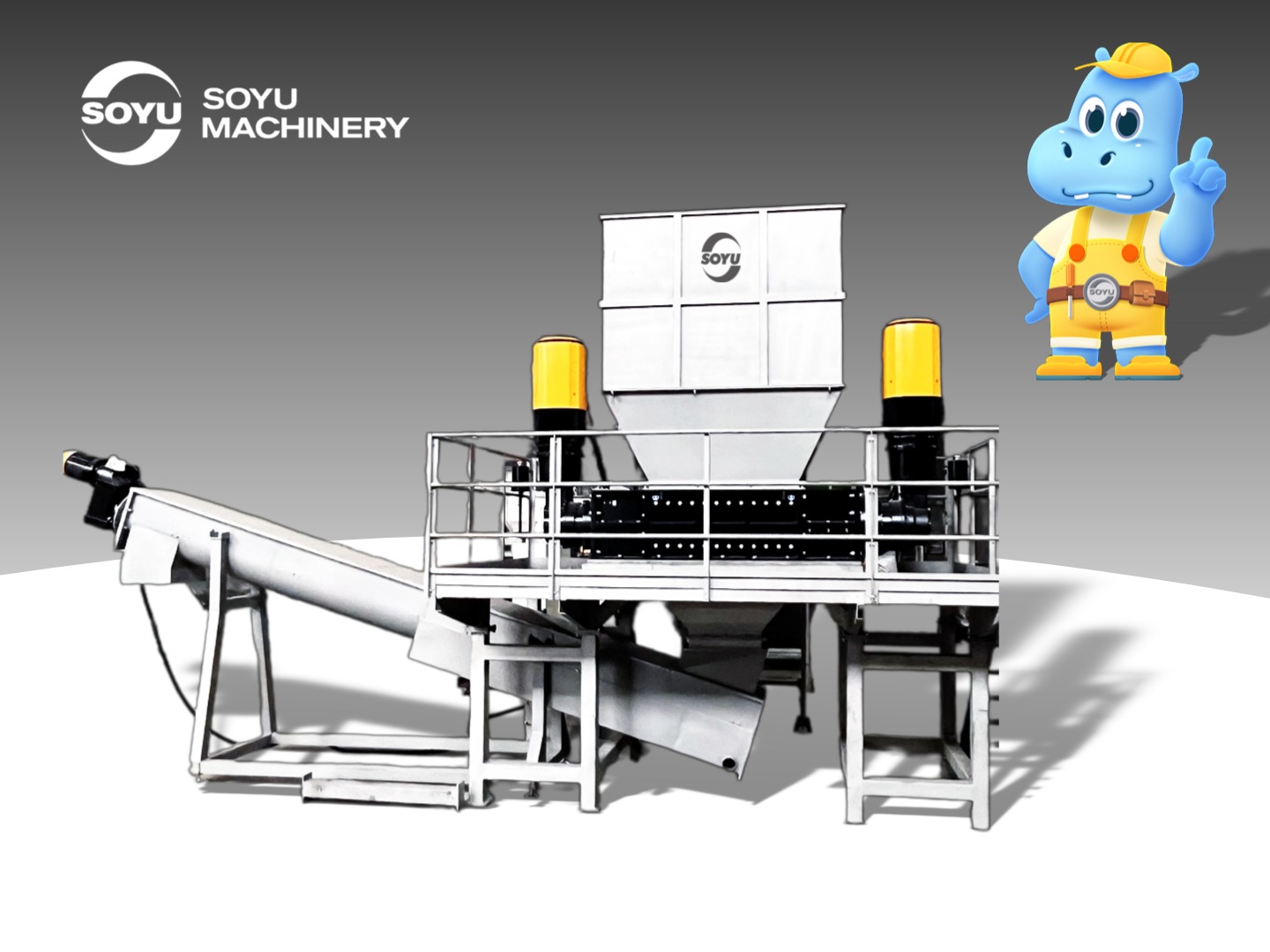
- Plan the line and validate the machine. Map the surrounding stages - infeed conveyor, magnetic separator, eddy current separator, air classifier, dust extraction, baler, storage. Then confirm the acceptance procedure: 100% factory acceptance testing (FAT), material inspection and CE/ISO compliance testing before shipment.
Use Cases: Where Each Shredder Type Is Typically Used
Wood and pallet shredding
Wood waste is one of the most common entry points into shredding because the material is voluminous and transport costs dominate. Single shaft wood shredders such as the SR750 (830 x 708 mm chamber, 2 x 37 kW or 2 x 45 kW drive) and the SR1600 (94 rotor blades, 1,000 x 1,533 mm chamber) process waste pallets, branches, wooden packaging, crates and sawdust aggregates into biomass fuel feedstock. A Spanish installation runs a wood shredding and crushing system combining a conveyor with a single shaft shredder, and an end user in Australia has operated a wood shredder for two years with stable performance on dense wood material.
Plastic and film shredding
Plastic streams split into two very different problems. Film, bags and flexible packaging require a ram-fed single shaft machine with a slow rotor to avoid wrapping: the plastic film shredder SR1400 runs at 73 rpm with a 40 mm screen. Rigid plastics, barrels, drums and containers are better handled by a four shaft chamber or a large single shaft unit such as the SR2100 with a 1,000 x 1,995 mm chamber. Field records include a Norwegian operator running three machines for plastic barrel shredding with six years of stable operation, and a Polish recycler running a plastic film shredder for five years.
Metal and cable processing
Metal scrap covers scrap steel, aluminium profiles, copper scrap, cans, steel wire, end-of-life vehicle frames and construction metal. Heavy single shaft metal shredders such as the SD2100 (400 kW, 2,055 x 1,626 mm chamber, approximately 28,600 kg) and the larger SD3000-400 (2,550 x 1,626 mm chamber, approximately 41,000 kg) serve this duty with 70 mm, 100 mm or 120 mm screens. Insulated cable is handled differently, through a two-stage line: the SR1100 cable recycling line pairs a 17.2 kW shredder stage with 24 rotor blades and a 40 mm mesh with a 45 kW granulator running a 12 mm mesh at 526 rpm. An aluminium shredder installation in Mexico has operated for three years, and a cable recycling line in the United Kingdom for five years.
E-waste and WEEE processing
Electronic waste requires a chamber that can accept whole units without pre-cutting. Four shaft e-waste shredders such as the FS8080 (2 x 11 kW, 800 x 800 mm chamber, 2,000 kg) and the FS100120 (2 x 30 kW, 1,000 x 1,200 mm chamber, 6,000 kg) process computers, mobile phones, circuit boards, power supply units and electronic components, and are typically integrated with a magnetic separator, eddy current separator, air classifier and dust extraction system to recover metals and contain hazardous fractions. Documented installations include end users in Australia and the United States running e-waste shredders for six years and four years respectively, and a Japanese agent installation in service for six years.
Heavy-duty industrial waste and RDF preparation
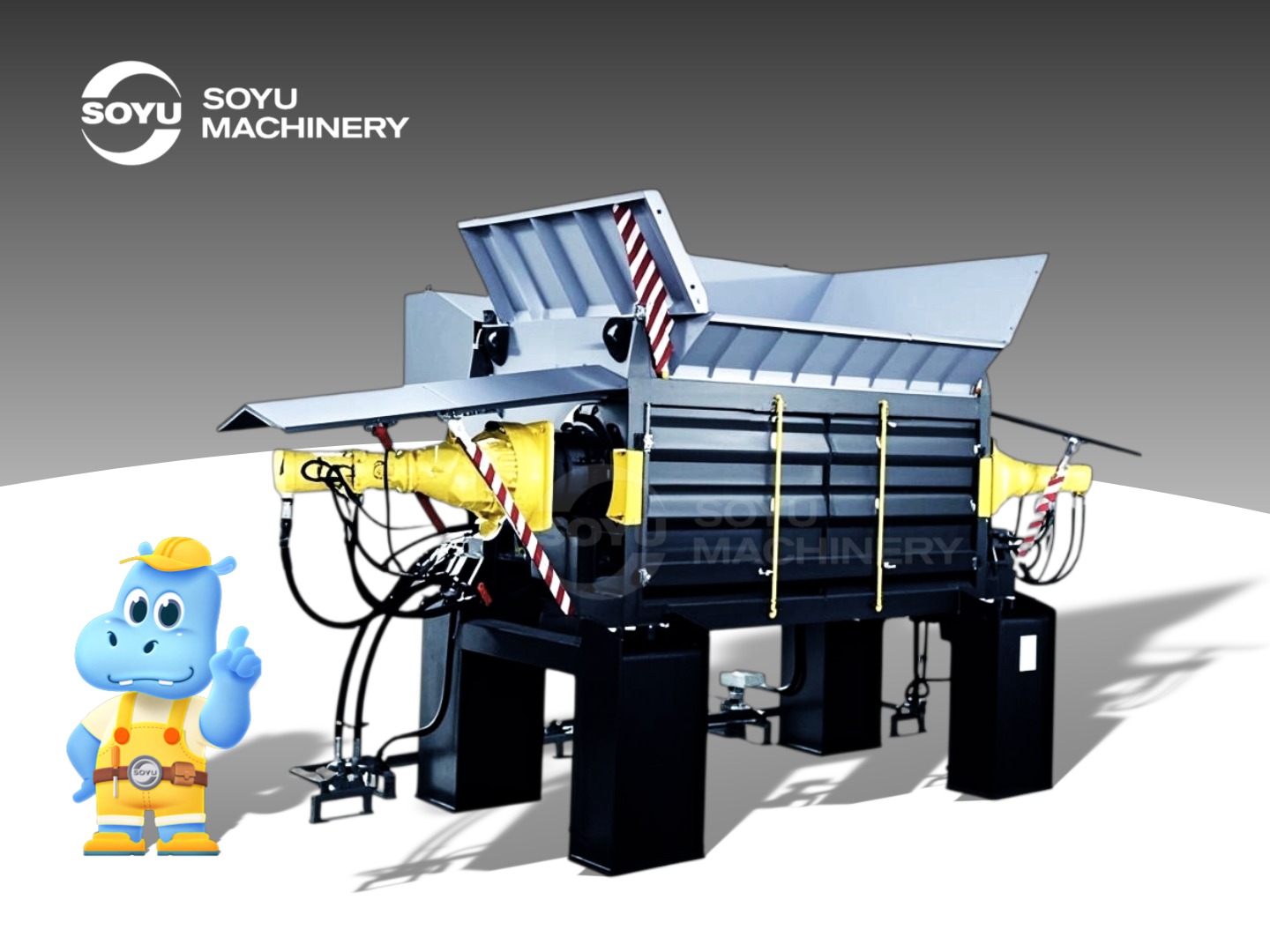
Where the stream is municipal-solid-waste derived, mixed industrial scrap or bulky non-hazardous material, the low speed high torque single shaft platform is the usual choice. The heavy-duty industrial shredder SRD3000 combines a 280 kW motor, an 11 kW hydraulic unit, a 650 mm rotor, 52 rotor blades and 25 plus 2 fixed blades in a 3,006 x 1,620 mm chamber, discharging through an 80 mm screen. RDF shredders in the same family are used to homogenise feedstock for energy recovery - a market context worth noting, since the refuse-derived fuel sector reached USD 4.6 billion in 2023 (Market.us). Field records include a Korean agent operating four RDF shredders for five years, a Taiwanese end user with five units in service for five years, and a Russian installation running for five years.
Paper, cardboard and OCC
Waste paper is processed either as a size-reduction duty or as part of a fibre recovery line. A heavy-duty cardboard shredder such as the FS130140 (2 x 15 plus 2 x 37 kW, 1,300 x 1,400 mm chamber, 13,500 kg) and a paper shredder such as the SR750 handle cartons, waste paper, paper tubes and composite packaging; where fibre is being recovered rather than volume-reduced, an integrated OCC paper dry pulping line such as the FS200200 (1,000 kW, 2,000 x 2,000 mm chamber, approximately 80,000 kg) performs fibre separation, impurity removal and pulp preparation. A Malaysian paper recycling operation has run ten machines for six years, and a Chilean end user has run a paper shredder for three years.

Comparison Table: Configuration Selection at a Glance
The table below compares the four main configurations on the criteria that matter during evaluation. All specifications are drawn from the machine range described above.
| Configuration | How it grips material | Typical waste streams | Output control | Example models |
|---|---|---|---|---|
| Single shaft with hydraulic ram | Hydraulic ram pushes material into a single rotor working against fixed counter-blades | Films, bottles, pallets, branches, waste paper, cartons, paper tubes, small tyres up to 800 mm | Interchangeable screen (commonly 40 mm) | SR600, SR750, SR1400, SR1600 |
| Double (twin) shaft | Two counter-rotating shafts grip from both sides | Mixed industrial and commercial waste, plastics, wood, light-gauge metal, packaging, small-to-medium tyres | Screen aperture combined with shaft speed and blade geometry | SYU26100, SYU41100, SYU50180, SYU61210 |
| Four shaft | Closed four-shaft cutting chamber grabs bulky and awkward items without a ram | Bulky waste, plastic barrels and chemical drums, IBC containers, WEEE and circuit boards, GFRP and composites, tyres, non-hazardous medical waste, biomass | Screen aperture plus chamber geometry | FS6650, FS8080, FS100120, FS130140, FS160160 |
| Low speed high torque single shaft | High torque delivered at low rotor speed with hydraulic ram feed | Dense and contaminated streams, light industrial waste, RDF feedstock, municipal solid waste derivatives | Screen aperture (commonly 80 mm) plus ram travel | SRD2500, SRD3000, SYU61210 |
A second table maps common applications to a starting configuration and a reference specification. It is a starting point, not a substitute for a technical review.
| Application | Starting configuration | Example model | Key specification |
|---|---|---|---|
| Wood, pallets, biomass | Single shaft with ram | Wood shredder SR1600 | 2 x 55 to 2 x 75 kW; 1,000 x 1,533 mm chamber; 94 rotor blades; 40 mm screen |
| Plastic film and flexible packaging | Single shaft with ram | Plastic film shredder SR1400 | 73 rpm main shaft; 830 x 1,302 mm chamber; 75-90 kW; 40 mm screen |
| Rigid plastic, barrels and drums | Four shaft | Four shaft shredder FS130140 | 2 x 15 plus 2 x 37 kW; 1,300 x 1,400 mm chamber; 13,500 kg |
| Mixed metal scrap | Heavy single shaft | Metal shredder SD2100 | 400 kW; 2,055 x 1,626 mm chamber; 70/100/120 mm screens |
| E-waste and WEEE | Four shaft | E-waste shredder FS8080 | 2 x 11 kW; 800 x 800 mm chamber; 2,000 kg |
| RDF and MSW derivatives | Low speed high torque single shaft | Heavy duty industrial shredder SRD3000 | 280 kW; 3,006 x 1,620 mm chamber; 52 rotor blades; 80 mm screen |
| Paper, cardboard and OCC | Heavy duty shredder or integrated line | Cardboard shredder FS130140; OCC paper dry pulping line FS200200 | FS130140: 2 x 15 plus 2 x 37 kW, 1,300 x 1,400 mm. FS200200: 1,000 kW, 2,000 x 2,000 mm chamber, approximately 80,000 kg |
FAQ: What Buyers Ask Before Specifying an Industrial Shredder
1. What safety and compliance standards should an industrial shredder meet for EU or US projects?
Industrial shredders installed in the EU are expected to respect the safety-distance requirements defined by EN ISO 13857:2019, which specifies distances that prevent hazard zones from being reached by limbs. On the manufacturing side, quality control for the machines described here includes 100% factory acceptance testing (FAT), material inspection and CE/ISO compliance testing before shipment, and the equipment is regularly exported to the EU, North America, the Middle East, Southeast Asia, Australia and Latin America. Buyers should also confirm site-specific requirements such as electrical supply, dust extraction and noise limits during the layout stage, because compliance is a property of the installation, not only of the machine.
2. Can one industrial shredder handle more than one waste stream?
Within limits, yes - and the mechanism is usually the screen rather than the machine itself. Changing the discharge screen aperture, for example from 40 mm to 80 mm on the same platform, changes the output particle size and therefore the downstream process the material can feed. Configuration, not just the screen, also matters: a ram-fed single shaft machine handles film and paper well, while sealed drums, cubic containers and mixed bulky loads generally require a four shaft cutting chamber. Where a project genuinely spans several streams, the practical route is customisation rather than compromise - processing capacity, material type, safety configuration, control system, layout design and supporting equipment can all be specified, which is the basis of the OEM, ODM and customised system integration work behind these machines.
3. What drives the cost of an industrial shredder?
Cost is driven by configuration and duty, not by a single headline figure. The main variables are the number of shafts and the cutting chamber dimensions; the drive power and hydraulic package; the blade material and wear options such as tungsten carbide tips or hardfacing; the control system; and the surrounding line equipment, including conveyors, separators, dust extraction and storage. A compact four shaft unit such as the FS6650 (7.5 kW, 660 x 500 mm chamber) and a heavy-duty single shaft unit such as the SRD3000 (280 kW, 3,006 x 1,620 mm chamber, approximately 25,000 kg) sit at very different points on that scale. Minimum order quantity is one set for either a single machine or a complete line, so smaller projects are not excluded by volume thresholds. No equipment prices are published in this guide; commercial terms are quoted against a defined configuration.
4. How is machine performance validated before shipment?
The standard quality gate before shipment is a 100% factory acceptance test, supported by material inspection and CE/ISO compliance testing. Because the cutting chamber, rotor, screen and hydraulic package are configured for a specific waste stream, the factory acceptance test is the point at which the configured machine is verified as built. Buyers who need to validate a particular material behaviour - for example, bridging risk with a specific film grade, or grip on an unusually shaped container - should raise that requirement during technical review so it can be addressed in the configuration rather than after commissioning.
5. What is the typical lead time, and how should a project start?
Lead time is 45 to 60 days for standard models and 60 to 90 days for customised projects, with a minimum order quantity of one set. Monthly production capacity is 15 to 20 complete recycling lines or 50 to 100 single shredders, and after-sales support covers on-site installation and commissioning, operator training, 24/7 remote support, spare parts supply and annual maintenance service. The most efficient way to start is with a configuration review: share the waste stream, the maximum item size, the required output particle size and the surrounding line equipment, and the matching configuration can be proposed directly. Technical enquiries can be sent to sy@shredder-3e.com or raised by phone on +86-512-52408453.
Conclusion
Industrial shredders are not a single product with different power ratings. They are a family of size-reduction machines in which the configuration - single shaft with a ram, twin shaft, four shaft, or low speed high torque - determines what the machine can grip, and the screen determines what it produces. Power matters, but it matters after those two decisions are made, not before.
For a project engineer or first-time buyer, the practical sequence is short and repeatable: characterise the stream, define the output size, choose the configuration by grip rather than by habit, then size the drive, verify compliance against standards such as EN ISO 13857:2019, and plan the line around the shredder rather than the other way round. Buyers who follow that order tend to end up with a machine that still runs six years later; buyers who start from a power figure tend to end up modifying the line around it.
The broader market supports that discipline. With twin shaft machines holding a 35.0% revenue share of the metal shredder segment and four shaft designs growing at a 5.8% compound annual rate through 2034, the configuration chosen today is likely to remain the mainstream architecture of the waste stream it serves. Matching it correctly the first time is the cheapest engineering decision in the project. More detail on the full range is available on the SOYU Machinery blog and at www.shredder3e.com.
Next Step: Match a Configuration to Your Waste Stream
Send your material type, maximum item size, required output particle size and surrounding line equipment, and the matching shredder configuration can be proposed directly.
Email: sy@shredder-3e.com | Tel: +86-512-52408453 | WhatsApp: +86-13962331498
Website: www.shredder3e.com
Have Questions or Need More Details?
Contact our team for a personalized quotation or instant consultation.
Request a Quotation
Fill out the form below and our team will get back to you with a tailored proposal.
WhatsApp Direct Chat
Prefer to chat in real-time? Message us on WhatsApp for instant assistance & quick answers.
- Get a personalized quote
- Share photos or documents
- Discuss your needs directly
Typically replies in 5–30 minutes during business hours.