
Industrial Shredders: Types, Workings, and Buying Basics
An industrial shredder is a heavy-duty size-reduction machine that turns waste plastics, metals, wood, paper, rubber, and e-waste into smaller particles for recycling, volume reduction, or energy recovery. This guide explains the main types of industrial shredders, how they are built, and what to consider before buying one in 2026.
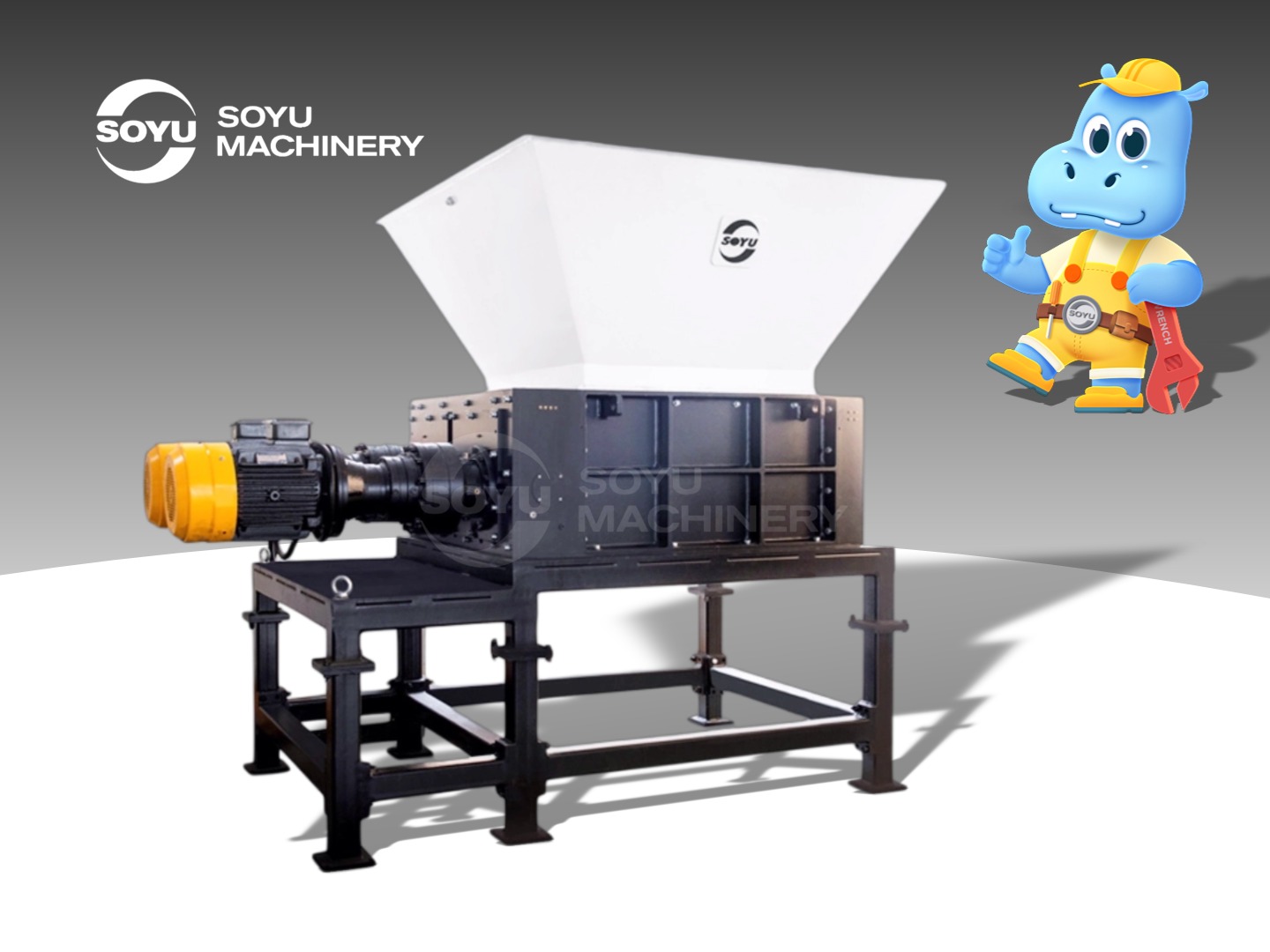
Cover image: Four shaft industrial shredder FS100120 from Soyu Machinery.
Why Industrial Shredder Selection Is Difficult
Procurement teams often choose an industrial shredder based mainly on motor power, assuming that more kilowatts mean better performance. In practice, shredding performance depends on a combination of torque, blade geometry, blade metallurgy, cutting chamber size, screen configuration, and the physical characteristics of the incoming waste stream.
The common failure mode is a mismatch between machine design and material behavior. A machine built for loose plastic film may stall on bulky metal-containing waste. A metal shredder with very high impact energy may not be suitable for rubber or soft composite materials. The first step in buying an industrial shredder is therefore to define the waste stream, the required output size, and the operating schedule before comparing machine types.
Industrial Shredder Market Context for 2026
The global industrial shredder market is forecast to keep expanding. According to Intel Market Research, the industrial shredder market was valued at approximately USD 1.28 billion in 2024 and is projected to reach USD 1.65 billion by 2032. Another estimate from Strategic Market Research places the 2024 market size at USD 5.1 billion, which highlights how significantly market definitions and scope can vary.
In the metal shredder machine segment, Asia Pacific dominated with a 39.0% revenue share in 2024, driven largely by China's scrap generation, according to Grand View Research. Twin-shaft shredders accounted for 35.0% of the metal shredder machine market in 2024. The commercial four-shaft shredder market is estimated at USD 0.51 billion in 2025, growing at a CAGR of 5.8% through 2034, according to Dataintelo. Downstream, the refuse-derived fuel market, which relies heavily on industrial shredders, reached USD 4.6 billion in 2023, according to Market.us.
The supplier landscape is fragmented. Intel Market Research reports that top global players including Doppstadt, Vecoplan, Untha, Lindner Recyclingtech, and Komptech hold roughly 38% of the market. For buyers, this means the remaining share is served by a broad group of regional and China-based manufacturers, including Soyu Machinery.
Soyu Machinery: Company and Product Range
Soyu Machinery is the export brand of Changshu Shouyu Machinery Co., Ltd., a China-based manufacturer founded in 2009. The company operates a 15,000 m² manufacturing facility with about 200 employees, an R&D team of 25 engineers, and an annual production capacity of 2,000 sets. Export business accounts for 70% of total sales, with major markets in the EU and USA.
Soyu Machinery specializes in the R&D and manufacturing of single-shaft, double-shaft, and four-shaft shredder equipment. The product lineup includes four-shaft shredders, single-shaft shredders, double-shaft shredders, metal shredders, plastic shredders, RDF shredders, aluminum shredders, fiberglass shredders, solid waste shredders, e-waste shredders, wood shredders, and waste paper shredders.
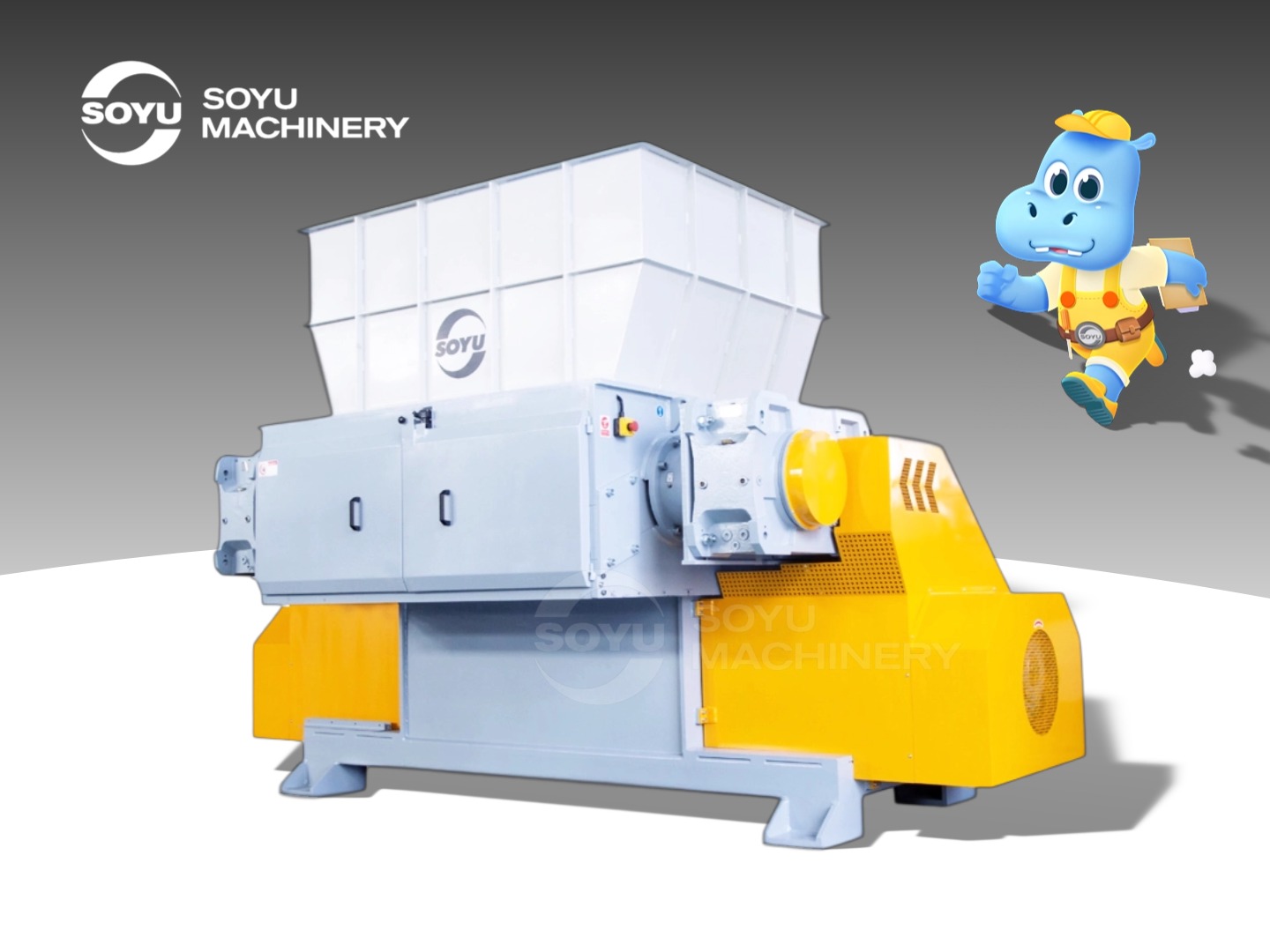
Soyu SR series single shaft shredder.
Core Construction Details of Soyu Industrial Shredders
Blade and frame materials are central to shredder reliability under continuous load. In the single-shaft and metal processing lines from Soyu, rotary blades use DC53 or CrMoV high-alloy wear-resistant steel, while fixed blades use D2 or SKD11 tool steel. The hardness range is HRC 58-62. Shafts are made from 42CrMo high-strength alloy steel with quenching and tempering, dynamic balancing, and surface hardening.
In the four-shaft FS series, moving blades use DC53 high-alloy wear-resistant steel with HRC 60-62 hardness after vacuum deep cryogenic treatment. Fixed blades use D2 high-carbon high-chromium steel. The FS series main frame uses thickened Q355B grade carbon steel with 20-30 mm plate thickness and dense reinforcement ribs. The double-shaft SYU series uses DC53/D2 core blades, Cr12MoV fixed blades, and reinforced high-strength carbon steel frames with 16-25 mm material thickness.
Soyu states that the modular quick-release and multi-angle reversible blade structure extends service life by 30% versus conventional blades. For buyers, blade steel grade and frame thickness are directly linked to downtime risk and long-term operating cost.
Industrial Shredder Types Compared
| Machine Type | Representative Soyu Models | Typical Applications | Representative Specifications |
|---|---|---|---|
| Single Shaft Shredder | SR600, SR900, SR1400, SR1600, SR2100, SRD2500, SRD3000 | Plastic film and bottles, wood pallets, paper/cardboard, light industrial waste, RDF feedstock in SRD models | SR1400: cutting chamber 830x1302 mm, 2x75-2x90 kW, approx 6500 kg; SRD3000: 280 kW, chamber 3006x1620 mm, approx 25000 kg |
| Double Shaft Shredder | SYU26100, SYU41100, SYU50180, SYU61210 | Plastic pallets and barrels, small tires up to 1.2 m, rubber goods, light metal, paper mill waste, general industrial waste | SYU61210: 2x90 kW, 21 main blades, 23000 kg |
| Four Shaft Shredder | FS6650, FS8080, FS100120, FS130140, FS160160 | E-waste, bulky waste, IBC containers and drums, non-hazardous medical waste packaging, composite materials | FS100120: 2x30 kW, chamber 1000x1200 mm, 6000 kg; FS130140: 2x15+2x37 kW, 13500 kg |
| Metal Crusher / Hammer Mill | TLJ130-315, TLJ130-450 | Scrap steel, home appliances, bicycles, metal containers, steelmaking charge preparation | TLJ130-450: 450 kW, 24 hammer heads, screen diameters 60/80/100 mm optional, 28000 kg |
Machine selection is a trade-off. Single-shaft shredders generally produce screened, relatively uniform output but work best on more homogeneous feed. Double-shaft shredders provide high torque for bulky or tough items but may need downstream equipment for finer sizing. Four-shaft shredders offer finer primary output with two pairs of shafts. Hammer mills rely on impact crushing, which suits rigid metal scrap but not soft or flexible materials.
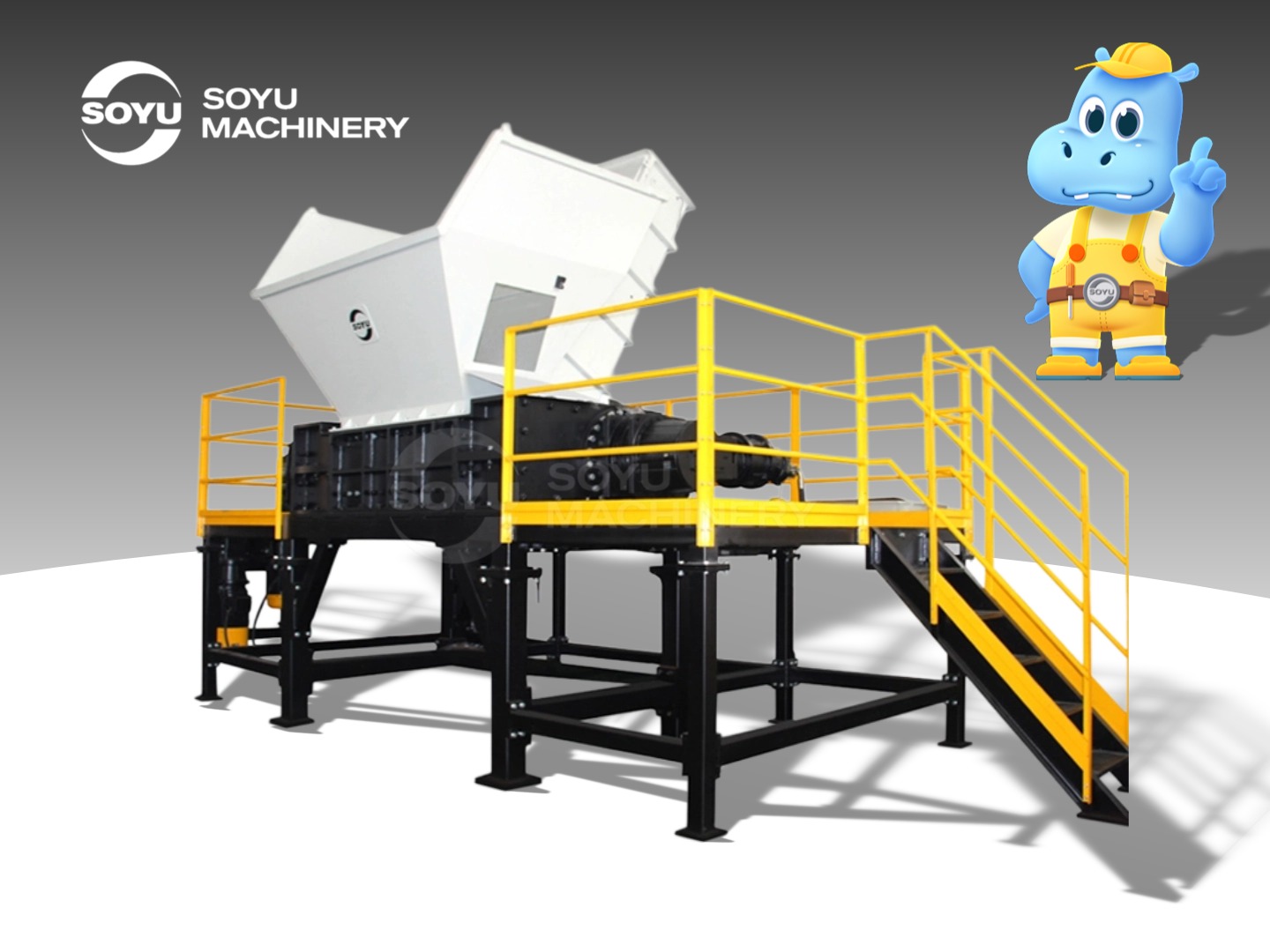
Soyu SYU series double shaft shredder.
Step-by-Step Industrial Shredder Buying Breakdown
- Characterize the feed material. Describe the waste type, shape, dimensions, moisture, contamination level, and whether the feed contains metals, textiles, or other disruptive items.
- Define the target output size. The required particle size determines whether a single-shaft shredder with a screen, a four-shaft shredder, or a hammer mill is the correct primary or secondary unit.
- Choose the shaft configuration. Single-shaft units with hydraulic systems and screens suit homogeneous plastic, wood, and paper. Double-shaft units suit bulky and tough waste. Four-shaft units suit finer controlled output from mixed or brittle materials.
- Verify mechanical specifications. Check blade steel, fixed blade steel, shaft steel, frame plate thickness, cutting chamber size, motor power, and whether the design is built for 24-hour operation.
- Plan auxiliary equipment. Real shredding lines often include conveyors, magnetic separators, eddy current separators, air classifiers, dust extraction, and discharge systems. The shredder must be sized to the whole line.
- Request a proposal with references. Ask for application examples, after-sales support structure, spare parts policy, and a machine configuration that matches your material rather than a generic quote.
Use Cases and Application Experience
Soyu shredding equipment has been applied across multiple industries and geographies. In plastic recycling, projects include plastic film and double-shaft shredding lines in Poland, plastic shredding operations in New Zealand, Turkey, Italy, and a four-shaft system for bulky plastic waste in Japan. For waste paper, Soyu has supported paper mill waste shredding in Malaysia and waste paper shredding in Chile. In e-waste recycling, applications cover WEEE-focused lines in the UK, Japan, and Australia. For energy recovery, RDF shredding systems have been installed in Taiwan, Japan, and South Korea. In hazardous and medical waste treatment, Soyu has served a South African project requiring enclosed disinfection and containment. In metal recycling, a copper scrap crushing and smelting pretreatment line in China uses Soyu metal shredders.
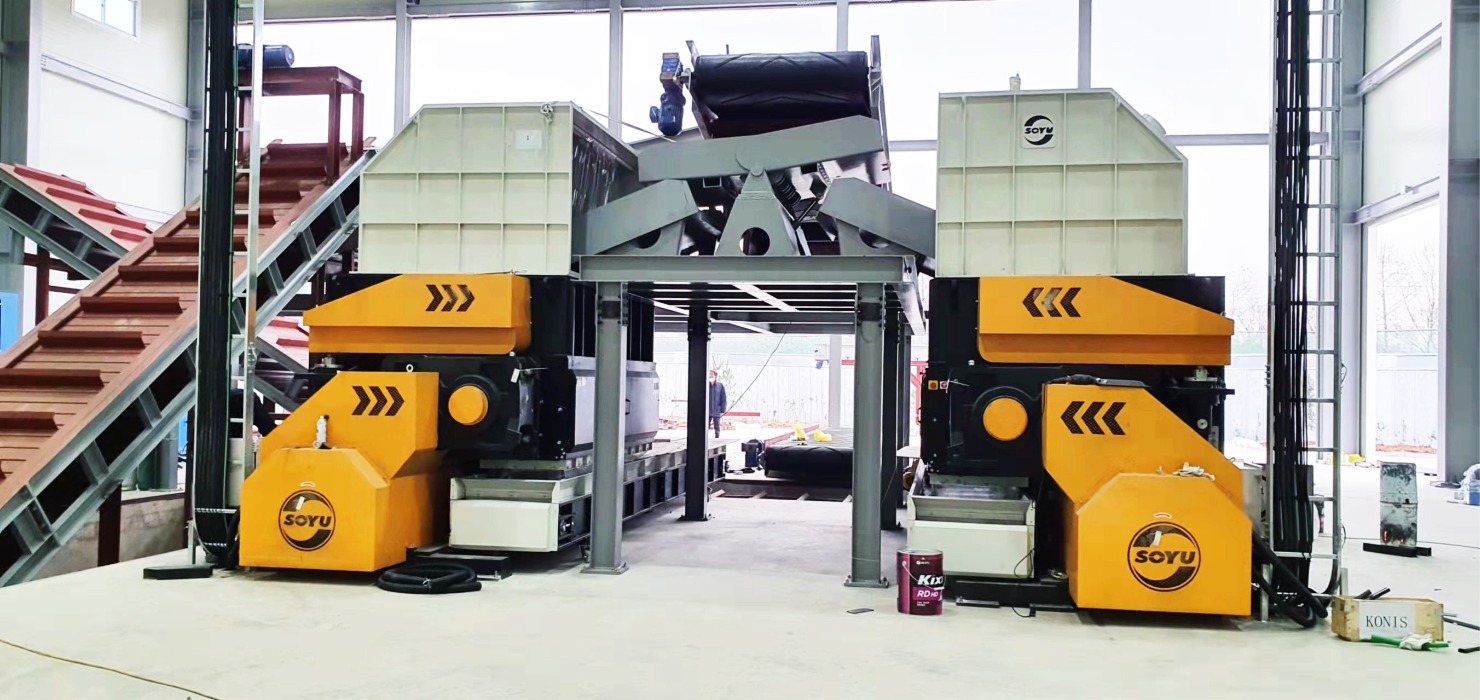
RDF shredding application in South Korea, supporting industrial waste-to-energy preparation.
Frequently Asked Questions
What certifications and safety standards apply to industrial shredders?
In the EU and global context, industrial shredders must comply with EN ISO 13857:2019, which defines safety distances to prevent access to hazard zones. Buyers should also ask the supplier which harmonized standards and compliance documents apply to the specific machine before placing an order.
What is the difference between single, double, and four shaft shredders?
Single shaft shredders use a rotor, hydraulic system, and screen to produce relatively uniform output from plastic, wood, paper, and light industrial waste. Double shaft shredders use high-torque, low-speed cutting for bulky or tough items such as plastic pallets, tires up to 1.2 m, and light metal. Four shaft shredders use two pairs of shafts for finer and more controlled size reduction in e-waste, bulky waste, and drum applications.
What materials can an industrial shredder process?
Industrial shredders from Soyu are applied to plastic films, plastic bottles and barrels, wood pallets and crates, paper and cardboard, rubber and small tires, light metal, aluminum, copper scrap, e-waste, bulky waste, RDF feedstock, and non-hazardous medical waste packaging.
What should I prepare when requesting an industrial shredder quote?
For a more accurate quote, prepare the material type and shape, required output size, throughput per hour, daily operating hours, and site constraints such as dust-tight design, corrosion-resistant blades, explosion protection, or containment requirements.
Can I test an industrial shredder before buying?
A standard material test policy is not published. The practical step is to contact Soyu Machinery directly with your material details and ask whether a trial or material test can be arranged for your waste stream.
What is the lead time for an industrial shredder?
Lead time is not fixed; it depends on the model, configuration, and production schedule. To get a delivery window for your specification, email sy@shredder-3e.com or contact the sales team directly.
Decision Criteria and Supplier Evaluation
When evaluating industrial shredder suppliers, focus on four verifiable areas. First, confirm the manufacturer's actual factory, R&D headcount, and production capacity. Second, compare blade and frame materials. Third, request application references for a waste stream similar to yours. Fourth, evaluate how the supplier supports commissioning, spare parts, and after-sales service.
For Soyu Machinery, these criteria map to first-party data: a 15,000 m² factory, approximately 200 employees, a 25-engineer R&D team, 2,000 sets annual production capacity, and 70% export share to EU/USA markets. The company manufactures single-shaft, double-shaft, and four-shaft shredders, plus heavy-duty metal crushers and plastic crushers such as the SPC8022.
Request an Industrial Shredder Consultation
Send your waste material details to sy@shredder-3e.com, call +86-512-52408453, or reach the sales team by WhatsApp at +86-13962331498. For buyers sourcing from China, Soyu Machinery provides a single-source range of single, double, and four shaft shredders plus metal processing equipment.
Have Questions or Need More Details?
Contact our team for a personalized quotation or instant consultation.
Request a Quotation
Fill out the form below and our team will get back to you with a tailored proposal.
WhatsApp Direct Chat
Prefer to chat in real-time? Message us on WhatsApp for instant assistance & quick answers.
- Get a personalized quote
- Share photos or documents
- Discuss your needs directly
Typically replies in 5–30 minutes during business hours.