
Matching Industrial Shredders to Project Needs: A Scenario-Based Buyer's Guide
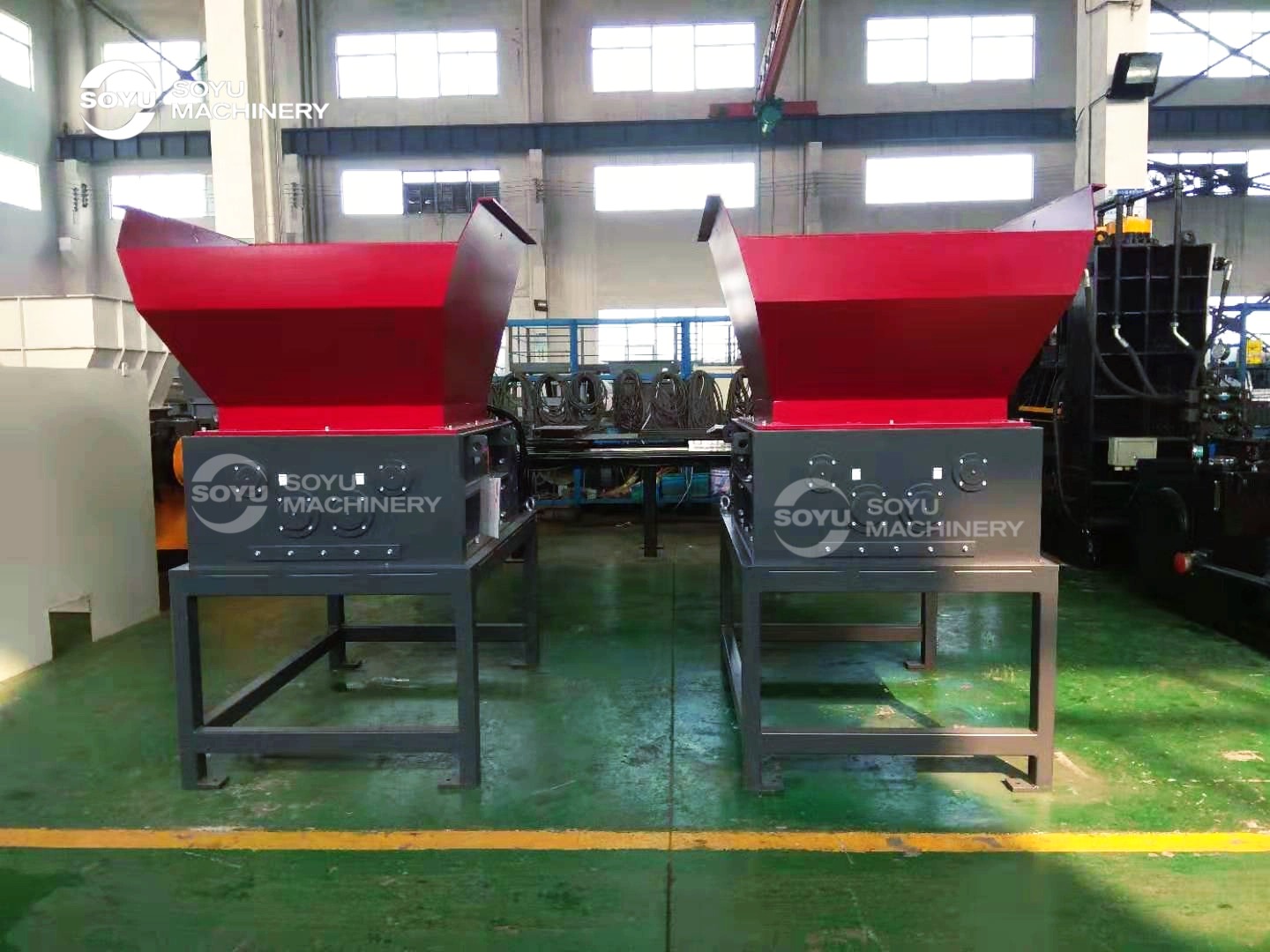
Choosing an industrial shredder for a project is rarely a one-machine decision. It is a matching problem: the machine must fit the waste stream, the required particle size, the operating hours, the available space, and the regulatory environment.
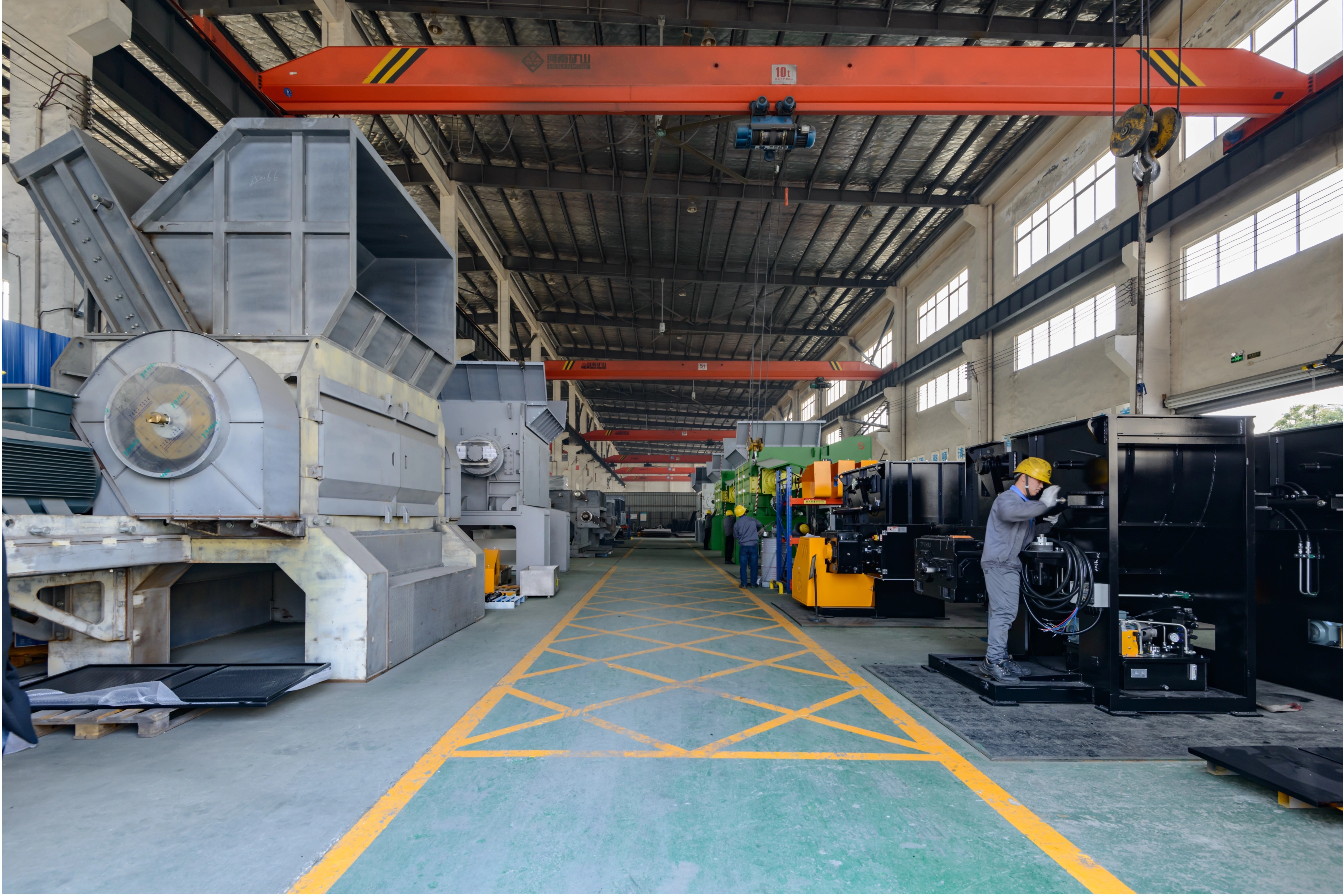
Changshu Shouyu Machinery Co., Ltd (SOYU Machinery) is a Chinese manufacturer of single-shaft, double-shaft, and four-shaft shredders. It was founded in 2009 and operates a 15,000 m² factory with around 200 employees and an annual output capacity of about 2,000 sets. Roughly 70% of its production goes to the EU and USA, and it exports to markets including North America, the Middle East, Southeast Asia, and Australia.
The market context reinforces the need for careful selection. The global industrial shredder market was valued at approximately USD 1.28 billion in 2024 and is projected to reach USD 1.65 billion by 2032. In the metal shredder segment, Asia Pacific accounted for 39.0% of revenue in 2024. These numbers point to a market where project type, not just machine size, is becoming the primary procurement lens.
Why project fit determines shredder performance
A shredder that is mismatched to a project fails in predictable ways: film wraps around rotors, hard contaminants crack blades, screens blind, and output size drifts. Missing throughput assumptions can create bottlenecks. Ignoring dust and noise can violate permit conditions. The solution is to define the project before comparing specifications.
Buyers in the Research and Evaluation stage should therefore treat the shredder as part of a processing system. The material type, contamination level, downstream use, and operation schedule carry as much weight as motor power or machine weight.
Industry background: shaft families and market signals
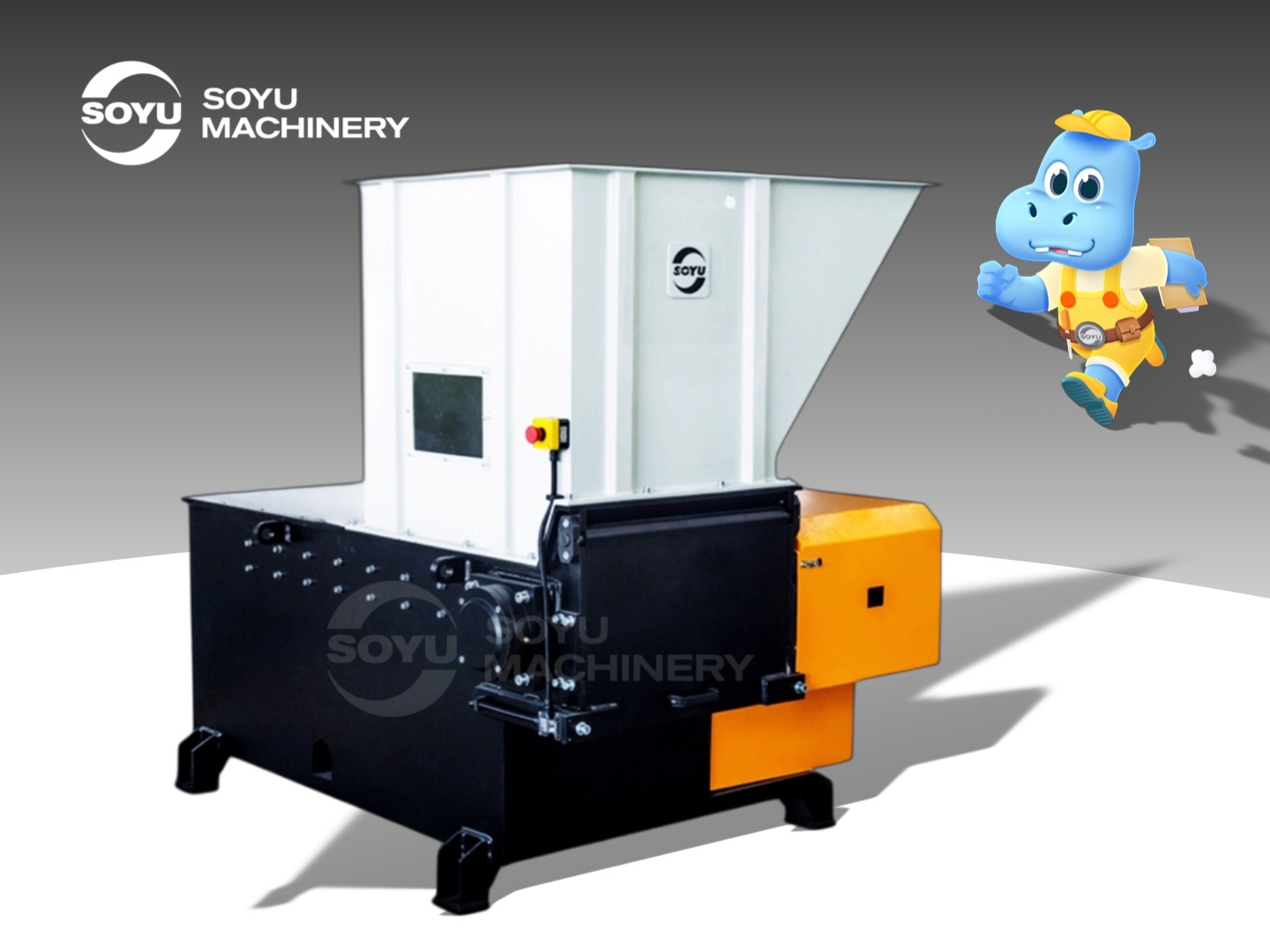
Industrial shredder suppliers typically categorize machines by shaft configuration. Single-shaft shredders use a rotor, fixed blades, a screen, and a hydraulic ram; they are well suited to homogeneous materials that need a controlled particle size. Double-shaft shredders pull material between two interlocking shafts; they are common for bulky general waste. Four-shaft shredders add two secondary shafts to produce more consistent output from contaminated or heterogeneous material. Hammer mills use impact force and are used for metal densification and preparation for smelting.
Market data from 2024 shows twin-shaft shredders held 35.0% of global metal shredder machine revenue, confirming their role in metal-recycling projects. The commercial four-shaft shredder segment was estimated at USD 0.51 billion in 2025, with a projected CAGR of 5.8% through 2034, indicating growing demand for machines that handle difficult input.
Project-fit table: matching waste streams to shredder families
The table below summarizes how Soyu Machinery's product range aligns with common project types. It is based on documented machine specifications and installed application records, not on marketing claims.
| Project / waste stream | Recommended shredder family | Representative Soyu models and evidence |
|---|---|---|
| Plastic film, bottles, and packaging waste | Single shaft plastic film shredder or double shaft shredder | SR1400 single shaft plastic film shredder: 73 rpm, 75-90 kW, 40 mm screen, approx. 6200 kg; SYU50180 double shaft shredder: 2x75 kW, approx. 20000 kg. Used in Poland on 24/7 plastic film duty and in New Zealand plastic recycling. |
| Bulky plastic waste, IBCs, and plastic drums | Four shaft shredder | FS100120 four shaft shredder: 2x30 kW, 1000x1200 mm cutting chamber, approx. 6000 kg; FS8080: 2x11 kW, 800x800 mm chamber, 2000 kg. Installed for bulky plastic waste in Japan and for plastic barrels in Norway and the USA. |
| E-waste: computers, mobile phones, circuit boards | E-waste shredder / robust four shaft shredder | FS8080 or FS100120 e-waste shredder. Documented cases include a US e-waste recycler with 4 years of stable operation, a Japanese agent with 6 years, and a UK agent with 5 years. |
| Aluminum, copper, and light metal scrap | Heavy duty metal / aluminum shredder | SD2100 and SD3000: 400 kW, 70/100/120 mm screen options, approx. 28600-41000 kg. Used for aluminum scrap in Mexico and copper smelting pretreatment in China. |
| RDF and waste-to-energy feedstock | Heavy duty single shaft RDF shredder | SRD2500: 2x110 kW, 40 mm screen, approx. 16000 kg; SRD3000: 280 kW, 80 mm screen, 52 rotor blades, 25+2 fixed blades, approx. 25000 kg. Documented in South Korea, Japan, Taiwan, and Russia. |
| Wood pallets and wood packaging | Single shaft wood pallet shredder | SR1600: 2x55-2x75 kW, 94 rotor blades, 12 fixed blades, 40 mm screen, approx. 10800 kg. An Australian wood shredding operation reported stable performance over 2 years. |
| OCC and paper mill waste | Paper mill waste shredder or OCC dry pulping line | SYU41100 paper mill waste shredder: 2x32 kW, 20 main blades, approx. 9000 kg; FS200200 OCC dry pulping line: 1000 kW, 2000x2000 mm cutting chamber, approx. 80000 kg. Malaysia has used 10 OCC lines for 6 years and 2 paper mill waste shredders for 3 years. |
| Hazardous and medical waste | Medical waste shredder with containment-compatible design | FS8080 medical waste shredder: 2x11 kW, 800x800 mm chamber, 2000 kg. A South African hazardous medical waste project specified an enclosed, disinfected environment with 24/5 operation. |
Step-by-step selection workflow
Use this workflow when you need to translate a project description into a machine specification.
- Characterize the feed. Define the material family, maximum dimensions, contamination, moisture, and whether the material is homogeneous. Installed projects range from plastic film in Poland to medical waste in South Africa, so feed definition is the first source of differentiation.
- Define the output target. Identify the particle size and downstream process. Screen diameters in the Soyu range include 40 mm for plastic and wood, 80 mm for RDF, and 70/100/120 mm for metal shredders.
- Select the shaft family. Single-shaft machines suit controlled particle size and homogeneous feed. Double-shaft machines suit bulky general waste. Four-shaft machines handle contaminated, tough, or irregular input. Heavy-duty metal shredders handle dense scrap.
- Match the operating schedule. Some projects operate 24/7, such as a Polish plastic film line and a Malaysian OCC line. Others run 16/5, 16/7, 12/5, or 10/5. This affects bearing loads, cooling, and maintenance planning.
- Verify compliance. Industrial shredders must respect safety distances defined by EN ISO 13857:2019. Project-specific requirements in the corpus include U.S. EPA and OSHA conditions, WHO and South African biohazard rules, Japanese JIS, Norwegian NS, and Turkish TS EN references.
- Plan the full system. A shredder rarely works alone. Common matched equipment includes conveyor belts, magnetic separators, air classifiers, dust extraction systems, baling presses, storage silos, and leak-proof collection bins.
Installed case evidence
Case records from the Soyu corpus show what stable operation looks like in practice.
OCC paper dry pulping, Malaysia
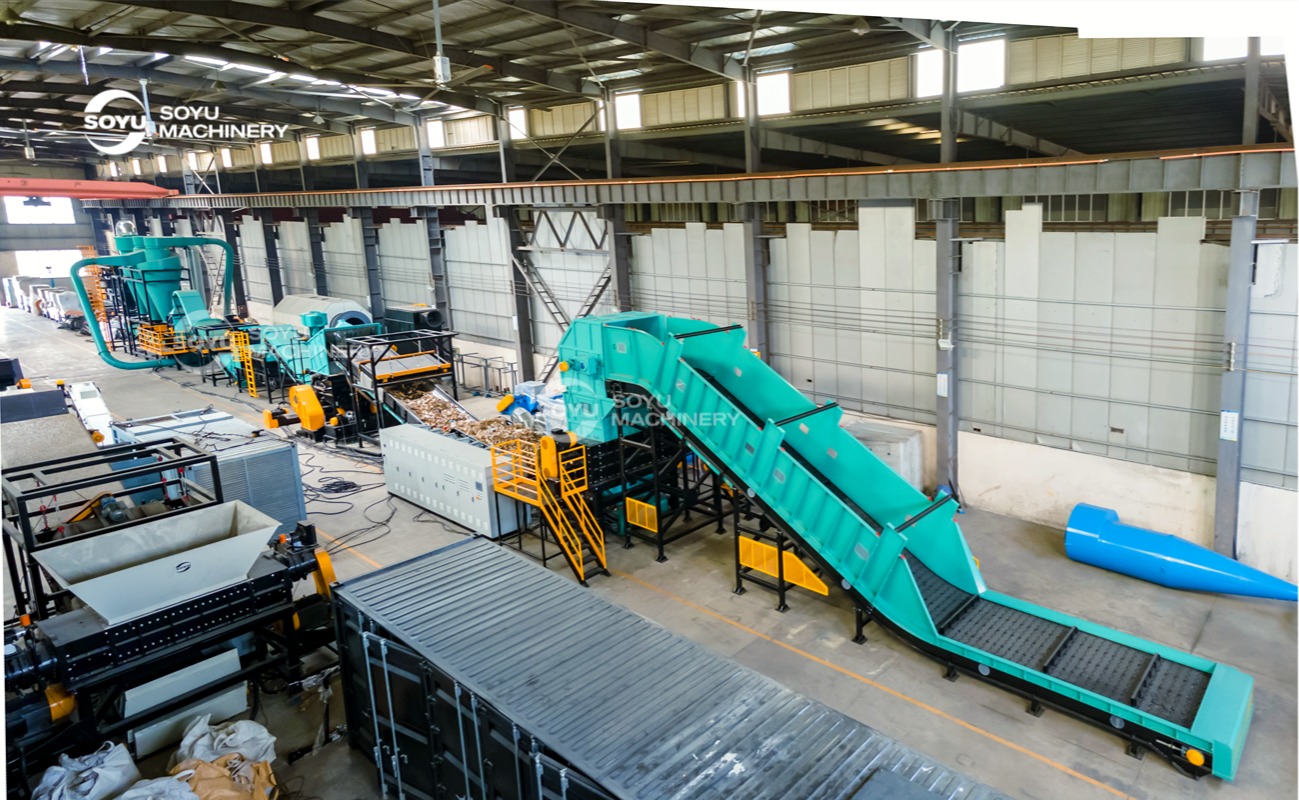
A Malaysian paper-recycling operator used 10 sets of OCC paper dry pulping lines over 6 years. The project ran 24/7 with a paper shredder, fiberizer, air classifier, impurity separator, pulp storage tank, dust collection system, and conveyor system. The end-user reported stable operation and low-maintenance performance.
RDF production, South Korea
A South Korean agent purchased 4 sets of RDF shredders and has operated them for 5 years. The application record highlights consistent output, low-maintenance operation, energy-efficient design, and integration into waste-to-energy systems. Soyu's matched models in this application area include SRD2500 and SRD3000.
Plastic barrels, United States
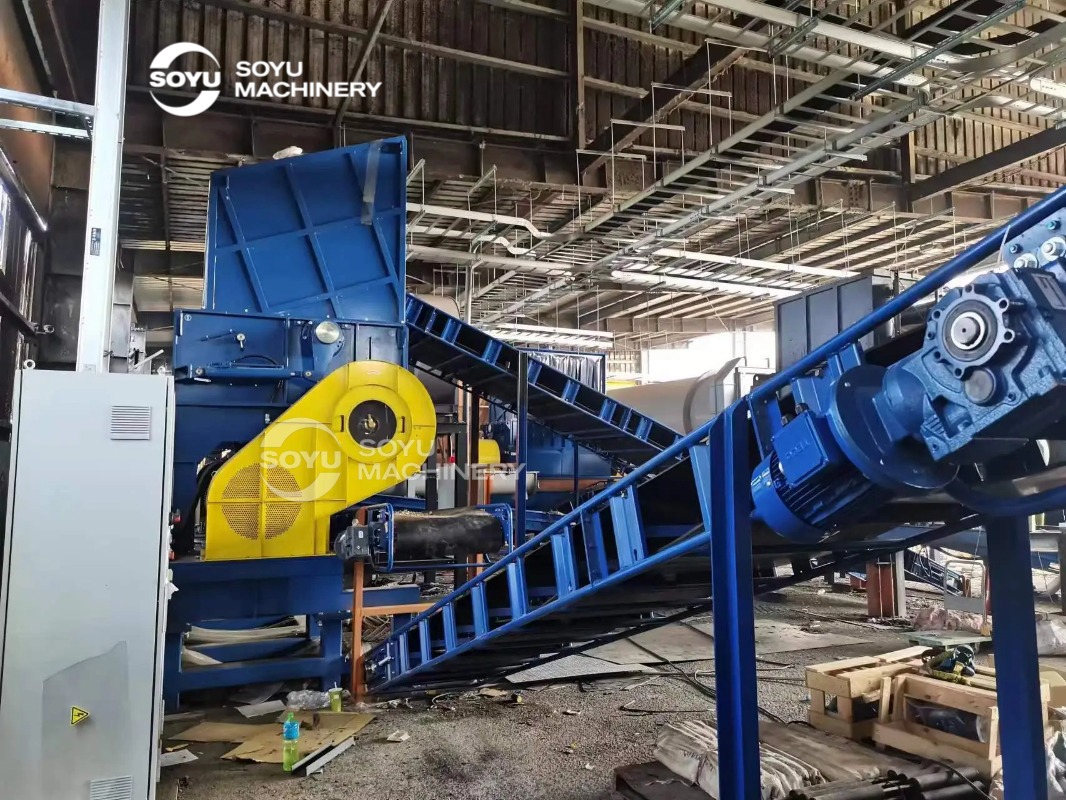
An American customer processed industrial IBC containers, plastic barrels, and chemical drums with 10 sets of four-shaft shredders over 5 years. The project specified leak-proof collection bins, magnetic separation, baling, dust extraction, and compliance with U.S. EPA and OSHA safety and environmental requirements. The reported outcome was stable operation with minimal jamming.
Plastic recycling partner, Italy
An Italian agent has used 20 sets of plastic shredding machines over 10 years. This long-running case demonstrates that project fit is not only about the first machine; it is also about repeatability, spare parts, and supplier consistency over time.
Integration and supplier capability
For large projects, the shredder is one component in a processing line. In the application records, complete systems include conveyors, magnetic separators, air classifiers, dust extraction, balers, storage silos, and leak-proof bins. A supplier's ability to integrate these components with the shredder matters as much as motor power.
Safety standards also shape project fit. EN ISO 13857:2019 defines safety distances to prevent hazard zones from being reached by limbs. In addition, Soyu Machinery states that its quality control process includes material inspection, 100% factory acceptance testing, and CE/ISO compliance testing. After-sales services include on-site installation and commissioning, operator training, 24/7 remote support, spare parts supply, and annual maintenance.
FAQ
What compliance points should I check before installing an industrial shredder?
At minimum, the machine layout should respect EN ISO 13857:2019 safety distances. For special materials, project-specific rules also apply: U.S. EPA and OSHA for IBC, barrel, and OCC plants; WHO and South African biohazard rules for medical waste; and Japanese JIS, Norwegian NS, or Turkish TS EN references where relevant. Soyu Machinery includes 100% factory acceptance testing and CE/ISO compliance testing in its quality control process.
Which shredder type should I use for e-waste?
Soyu's installed base uses heavy-duty four-shaft or dedicated e-waste shredders for computers, mobile phones, circuit boards, and power supply units. Representative models include FS8080 with 2x11 kW, an 800x800 mm cutting chamber, and 2000 kg weight, and FS100120 with 2x30 kW, a 1000x1200 mm chamber, and 6000 kg weight. Documented e-waste cases have operated stably for 4 to 6 years in the USA, Japan, and the UK.
How should I scope a budget for an industrial shredder project?
Scope the machine around material type, required throughput, output size, safety configuration, and auxiliary equipment. A single-shaft SR1400 with 75-90 kW may be appropriate for plastic film; a four-shaft FS100120 may be better for IBCs and barrels; an RDF or metal project will require a heavier class such as SRD3000 or SD2100. The minimum order quantity at Soyu is 1 set, so a buyer can start with one carefully matched machine.
How can I validate the machine against my material before purchasing?
Soyu's quality control includes material inspection and 100% factory acceptance tests. The practical next step is to send your material type, required output size, and daily volume to sy@shredder-3e.com, or contact the sales team, so the supplier can confirm which model should be tested and quoted.
What is the lead time for a project-matched shredder?
Standard models are normally produced in 45-60 days; customized projects take 60-90 days. Monthly manufacturing capacity is 15-20 complete recycling lines, or 50-100 single shredders. Scheduling a factory acceptance test before shipment is part of the process.
Conclusion: start with the project, not the horsepower
The most effective way to specify an industrial shredder is to work backward from the material and the target output. Single-shaft, double-shaft, four-shaft, and heavy-duty metal shredders serve different project families; the right choice reduces jamming, energy use, maintenance, and compliance risk.
Next step: Send your material type, required output size, and daily volume to sy@shredder-3e.com, or visit www.shredder3e.com to discuss machine selection and lead time. You can also reach the sales team on WhatsApp at +86-13962331498.
Have Questions or Need More Details?
Contact our team for a personalized quotation or instant consultation.
Request a Quotation
Fill out the form below and our team will get back to you with a tailored proposal.
WhatsApp Direct Chat
Prefer to chat in real-time? Message us on WhatsApp for instant assistance & quick answers.
- Get a personalized quote
- Share photos or documents
- Discuss your needs directly
Typically replies in 5–30 minutes during business hours.