
TPU vs PVC vs Polyester for Custom Outdoor Shelters & Inflatables
TPU vs PVC vs Polyester for Custom Outdoor Shelters & Inflatables
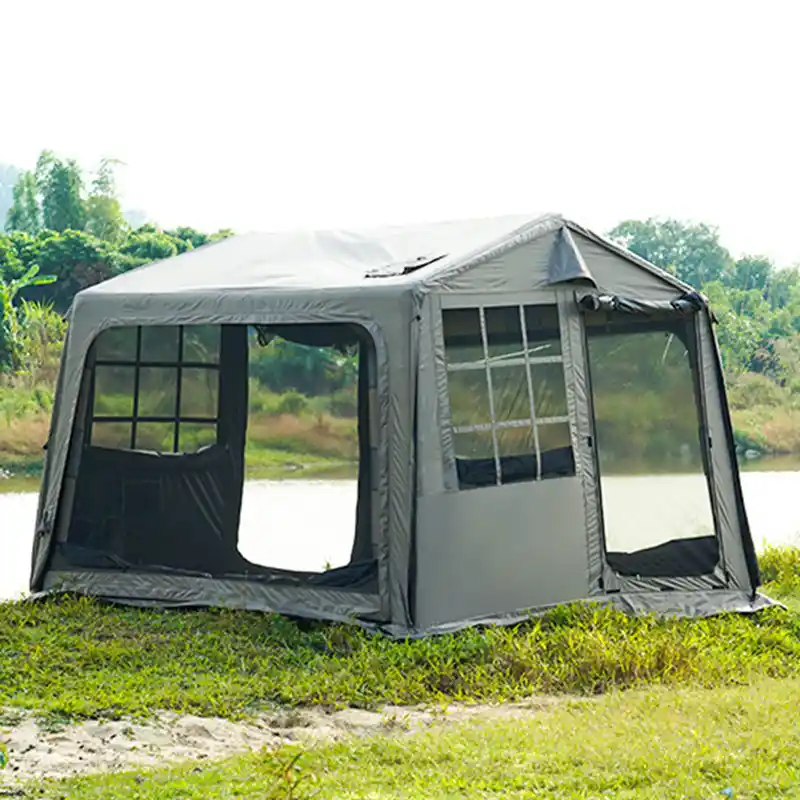
Cover: a custom outdoor shelter structure. Its waterproofing, UV resistance, weight and durability are decided by the material family chosen before pattern making starts.
Short answer: the choice between TPU, PVC and polyester is governed by four parameters - waterproofing, UV resistance, weight and durability - and by one structural question: is the product a welded, air-retaining inflatable, or a sewn textile cover? TPU and PVC are welded-film materials used for inflatables such as the I-FB inflatable football goal and the CS-01 inflatable container shelter. Polyester with a PU coating is a sewn textile used for covers and shelters such as ST-01 and the BS-01 boat shelter.
This technical guide compares the three material families parameter by parameter, then converts those parameters into a selection framework for four application areas: sports, events, transportation and camping. The reference points come from documented specifications and delivered projects of Star Canopy (Zhuhai Star Canopy Co., Ltd.), a multi-material manufacturer founded in 2005 in Zhuhai, China, that produces hardware, sewn technical textiles and inflatables under one roof and exports 100% of its output to the EU, USA, Canada, Japan, Australia and New Zealand.
Why material choice is the least reversible decision in the project
Material selection sits at the front of a custom outdoor product project, but its consequences arrive at the end. Once the material family is fixed, it determines the joining process (welding for TPU and PVC film, sewing for polyester), the pattern engineering and seam layout, the packed weight and volume, the repair method available to the end user, which exposure conditions the product can be specified against, and which quality tests are meaningful at final inspection.
That is why switching material family after pattern making and prototyping does not modify a design - it restarts it. For buyers working from Evaluation into Execution, the practical consequence is simple: lock the material family before a prototype is built, and use the prototype to confirm the decision rather than to make it.
Industry background: where waterproofing, UV and weight are being tested
Outdoor fabric demand is broad and still expanding, which is why specification quality has become a competitive variable rather than a formality. Dataintelo values the global outdoor patio umbrella market at USD 1.82 billion in 2025, projected to reach USD 3.14 billion by 2034. Business Research Insights estimates the global custom inflatables market at USD 170.5 billion in 2026, reaching USD 239.42 billion by 2035 at a 3.8% CAGR. Intel Market Research puts the custom boat covers market, including luxury yacht covers, at USD 118 million in 2024, growing to USD 155 million by 2032. Growth Market Reports places inflatable yard decorations - including custom arches and pillars - at USD 2.12 billion in 2025.
Where that demand concentrates matters for material planning. Grand View Research recorded patio furniture, including custom covers and chairs, as the largest outdoor fabric application segment with a 42.7% revenue share in 2024. In the USA, the voluntary standard ASTM F3681-24/25 requires beach umbrellas to resist 75 lbs of upward force or remain secure in 30 mph winds, a benchmark that pushes material and anchoring decisions earlier into the design process.
One caution on the numbers: market size estimates diverge because some reports count industrial and military inflatables alongside promotional products, while others cover recreational items only. The figures above should be read as scope-dependent estimates. The implication is nonetheless consistent - as volume grows across shelters, covers and inflatables, buyers compete on specification, and specification starts with material.
How TPU, PVC and polyester behave in practice
TPU film: air-retaining structures where air tightness is the acceptance criterion
TPU (thermoplastic polyurethane) is used in welded, air-retaining inflatables. In Star Canopy's documented product range it appears combined with PVC: the I-FB inflatable football goal is specified with TPU+PVC fabric, and the CS-01 inflatable container shelter is specified with TPU+PVC material, anti-UV, removable and inflatable, designed to be installed in the gap between two shipping containers.
Delivered evidence is specific. In the I-FB project, one unit was supplied to a France-based sports goods retailer and sports event OEM brand for playing football games; the client reported full satisfaction with air tightness and durability, and no air leakage during long-term outdoor training. In the CS-01 project, two units were installed in France for logistics staff rest, goods sorting and outdoor commercial events, and the installation operated stably over a one-year period.
Where it fits: sports equipment, event structures, temporary work shelter and any inflatable that must hold air rather than merely shed water. On the specification side, the useful approach is to state the performance requirement - air retention, anti-UV exposure, packable size, service environment - rather than a film trade name, because the welding parameters and the inspection criteria follow the requirement.
PVC: welded film for larger coverage and mixed-material builds
PVC appears in Star Canopy documentation in two ways. First, as a welded film used together with TPU in inflatable structures (I-FB and CS-01). Second, as one of two material options on a single product: the BS-01 boat shelter is listed with material 'polyester or PVC fabric' and a fully customized size.
That second point is the most useful illustration of the parameter logic. The shelter geometry stays the same, but the material decision changes the joining process - welding versus sewing - and therefore changes the weight, the repair method and the surface finish the buyer receives. PVC is the family considered when a welded structure needs broader coverage or a mixed build, and it shares the same QC logic as TPU builds: air tightness and material tensile testing at final inspection.
Polyester with PU coating: sewn covers, shelters and umbrellas
Polyester with a PU coating is a sewn technical textile. Documented specification uses across the range include the UM-01 outdoor umbrella (aluminium frame, polyester fabric, waterproof, fully customized size), the C01 folding outdoor chair (aluminium frame with anti-UV PU fabric), ST-01 (polyester with PU coating) and the BS-01 boat shelter (polyester or PVC fabric, fully customized size).
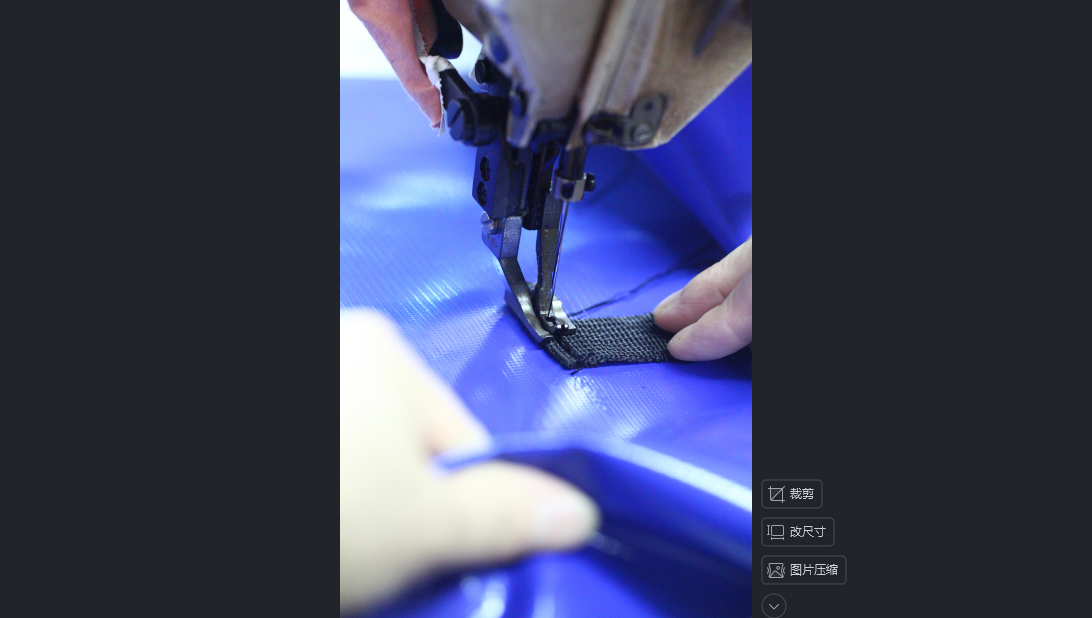
Sewn technical textile production: the joining process that defines polyester-based covers, shelters and umbrellas.
Delivered evidence is equally specific. The BS-01 project covered ten fully customized roof covers produced for a China-based boat shelter cover OEM client; the covers showed good waterproof and anti-aging performance under humid waterfront conditions, with no tearing or water seepage within the service cycle, supported by anti-UV, anti-mold, waterproof and tear-resistant material properties. The C01 programme delivered 1,000 units for a France-based outdoor chair OEM client over a two-year project, with zero mass quality complaints across two years of all-season outdoor use and portability, light weight and durability cited as product highlights. The UM-01 programme delivered 500 units in France, reported as easy to set up, working well under all-season outdoor use, with zero mass quality complaints within two years.
The four selection parameters, translated into questions
- Waterproofing. Does the product need to shed water (cover, umbrella, shelter roof) or hold air (inflatable)? Shedding water is a coating and film property, documented on the waterproof polyester fabric of UM-01 and on the BS-01 covers in service. Holding air is a seam-integrity property, validated through air tightness inspection, as in the I-FB project.
- UV resistance. How long is the exposure cycle? Documented anti-UV specifications appear on the C01 chair fabric (anti-UV PU fabric), on the CS-01 shelter (anti-UV) and on the BS-01 shelter cover (anti-UV option).
- Weight and handling. Is the structure installed once, or moved by staff between events? The I-FB goal is documented as inflatable and easy to transport, set up and pack; the CS-01 shelter is documented as removable and inflatable; the C01 chair is documented as portable and light.
- Durability. What is the failure mode that actually matters - tearing, seepage, mould, or loss of air? BS-01 was specified tear-resistant and anti-mold for humid waterfront conditions; I-FB was validated on air retention during long-term outdoor training.
Material comparison table
| Selection parameter | Polyester + PU coating | PVC | TPU |
|---|---|---|---|
| Joining process | Sewn technical textile (cut and sew) | Welded film / coated fabric | Welded film |
| Documented waterproofing | Waterproof polyester fabric (UM-01); waterproof performance in service under humid waterfront conditions (BS-01) | Waterproof and tear-resistant option documented on BS-01 | Air-retention validated through air tightness inspection (I-FB) |
| Documented UV performance | Anti-UV PU fabric (C01); anti-UV option on BS-01 | Anti-UV specified on the CS-01 build (TPU+PVC) | Anti-UV specified on the CS-01 build (TPU+PVC) |
| Documented anti-mold | Anti-mold property documented on BS-01 (polyester or PVC option) | Anti-mold property documented on BS-01 (polyester or PVC option) | Not documented on the referenced models |
| Weight and handling in delivered projects | Portable and light (C01, 1,000 units); easy setup (UM-01, 500 units) | Removable and inflatable (CS-01, 2 units) | Inflatable, easy to transport, set up and pack (I-FB, 1 unit) |
| Documented durability evidence | Zero mass quality complaints over 2 years of all-season use (C01 and UM-01) | Stable operation over a 1-year period (CS-01) | No air leakage during long-term outdoor training (I-FB) |
| Documented applications | Outdoor umbrellas, outdoor furniture, boat shelter covers, sewn shelters | Boat shelter covers, container shelters, inflatable structures | Inflatable sports and event products, container shelters |
| Referenced models | UM-01, C01, ST-01, BS-01 | BS-01, CS-01, I-FB | I-FB, CS-01 |
Step-by-step: matching material properties to application requirements
- Classify the structure. Decide whether the product is an air-retaining inflatable or a sewn cover or shelter. This single question eliminates one of the two joining processes.
- List the exposure conditions. All-season outdoor use, humid waterfront conditions, UV exposure hours, transport frequency and wind loading each point toward different material behaviour.
- Write the four parameters as pass/fail requirements. Waterproofing, UV resistance, weight or packed volume, and the durability failure mode to be avoided.
- Choose the material family. Polyester with PU coating for sewn covers, umbrellas and shelters (ST-01, BS-01); PVC for welded builds including larger covers (BS-01, CS-01); TPU-containing film builds where air retention is the acceptance criterion (I-FB, CS-01).
- Confirm the joining process and its inspection method. Welding for film-based structures, with air tightness testing; sewing for textiles, with seam quality and size verification.
- Validate through prototype and lab testing. Star Canopy's documented ODM sequence runs engineering design, material development, pattern making, lab testing, prototyping and then mass production delivery.
- Lock the acceptance criteria before production. The documented acceptance criterion is a pre-shipment test, and every shipment is 100% inspected before dispatch, covering air tightness, material tensile test, size verification and appearance check.
- Confirm the commercial terms. Documented OEM terms include a minimum order quantity from 1 unit for customization projects, a lead time of 1-2 weeks for small quantities, a monthly capacity of 1000 units, delivery terms of FOB/EXW or FOB/CIF, and payment terms of 50% deposit with 50% balance before shipment.
Use cases: documented material-to-application matches
| Model | Product | Material | Market and scale | Documented outcome |
|---|---|---|---|---|
| I-FB | Inflatable football goal | TPU + PVC fabric | France, 1 unit | Air tightness and durability confirmed by client; no air leakage during long-term outdoor training |
| CS-01 | Inflatable container shelter | TPU + PVC, anti-UV | France, 2 units | Stable operation over a 1-year period; removable and inflatable between two containers |
| BS-01 | Boat shelter cover | Polyester or PVC fabric | China, 10 units | Good waterproof and anti-aging performance in humid waterfront conditions; no tearing or water seepage |
| C01 | Folding outdoor chair | Aluminium + anti-UV PU fabric | France, 1,000 units | Zero mass quality complaints over 2 years of all-season outdoor use |
| UM-01 | Outdoor umbrella | Aluminium + waterproof polyester fabric | France, 500 units | All-season performance, easy setup, zero mass quality complaints within 2 years |
Sports: inflatable structures that must hold air
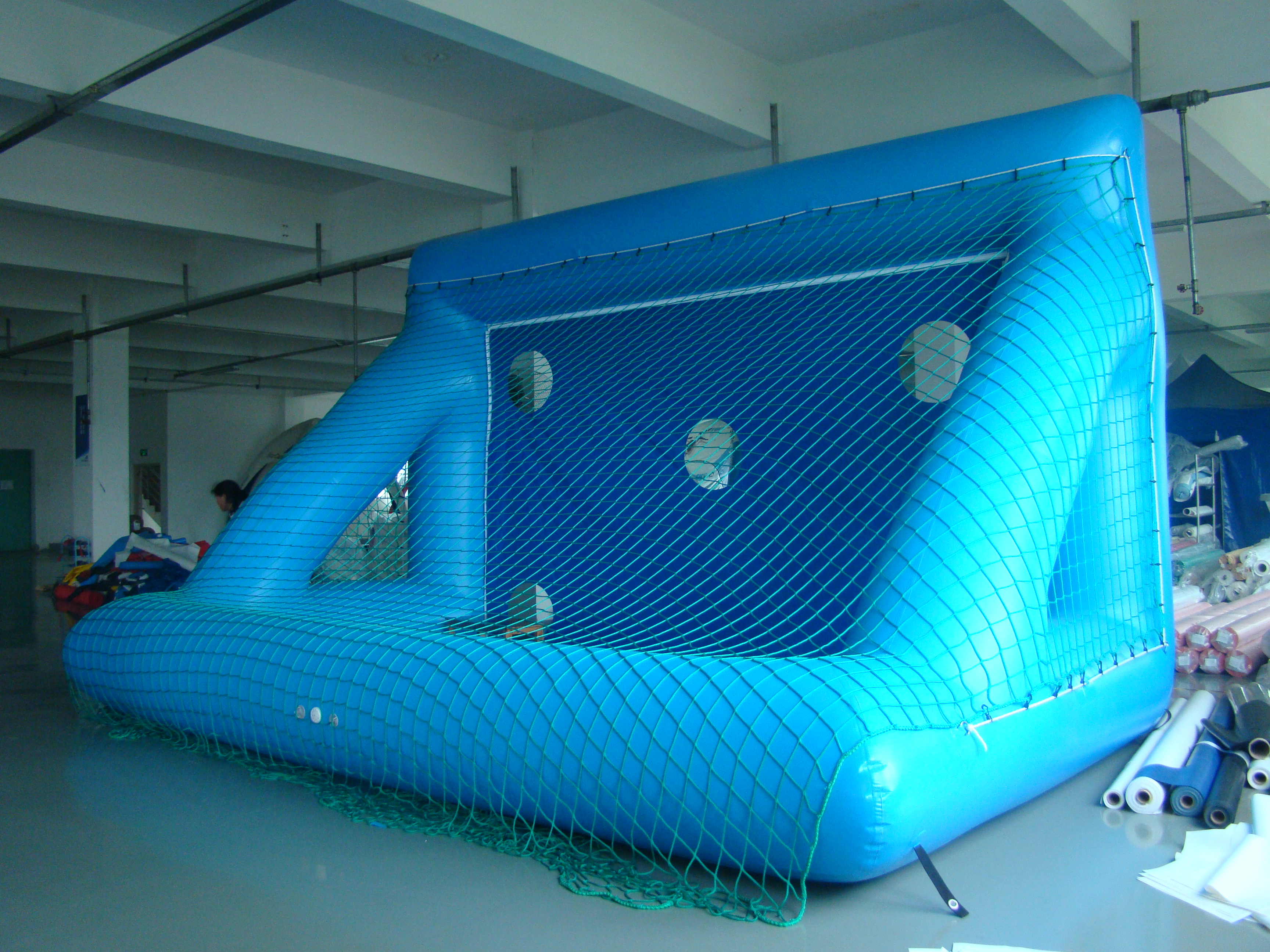
Case reference: the I-FB inflatable football goal, specified with TPU+PVC fabric and delivered to a sports goods retailer and sports event OEM brand in France.
For sports applications the dominant parameter is air retention, not water shedding. The I-FB specification therefore centres on the TPU+PVC film build and on air tightness inspection, and the reported outcome is measured in the same terms: no leakage across long-term outdoor training, plus easy transport, setup and packing between sessions.
Events and shelter: removable structures between fixed assets
The CS-01 inflatable container shelter shows how a material decision follows a site constraint. The structure is built in the gap between two shipping containers and used for logistics staff rest, goods sorting and outdoor commercial events, so it must be removable and inflatable, and UV exposure must be specified into the material - which is why the material record reads TPU+PVC with anti-UV.
Transportation: sewn covers where tearing and seepage are the failure modes
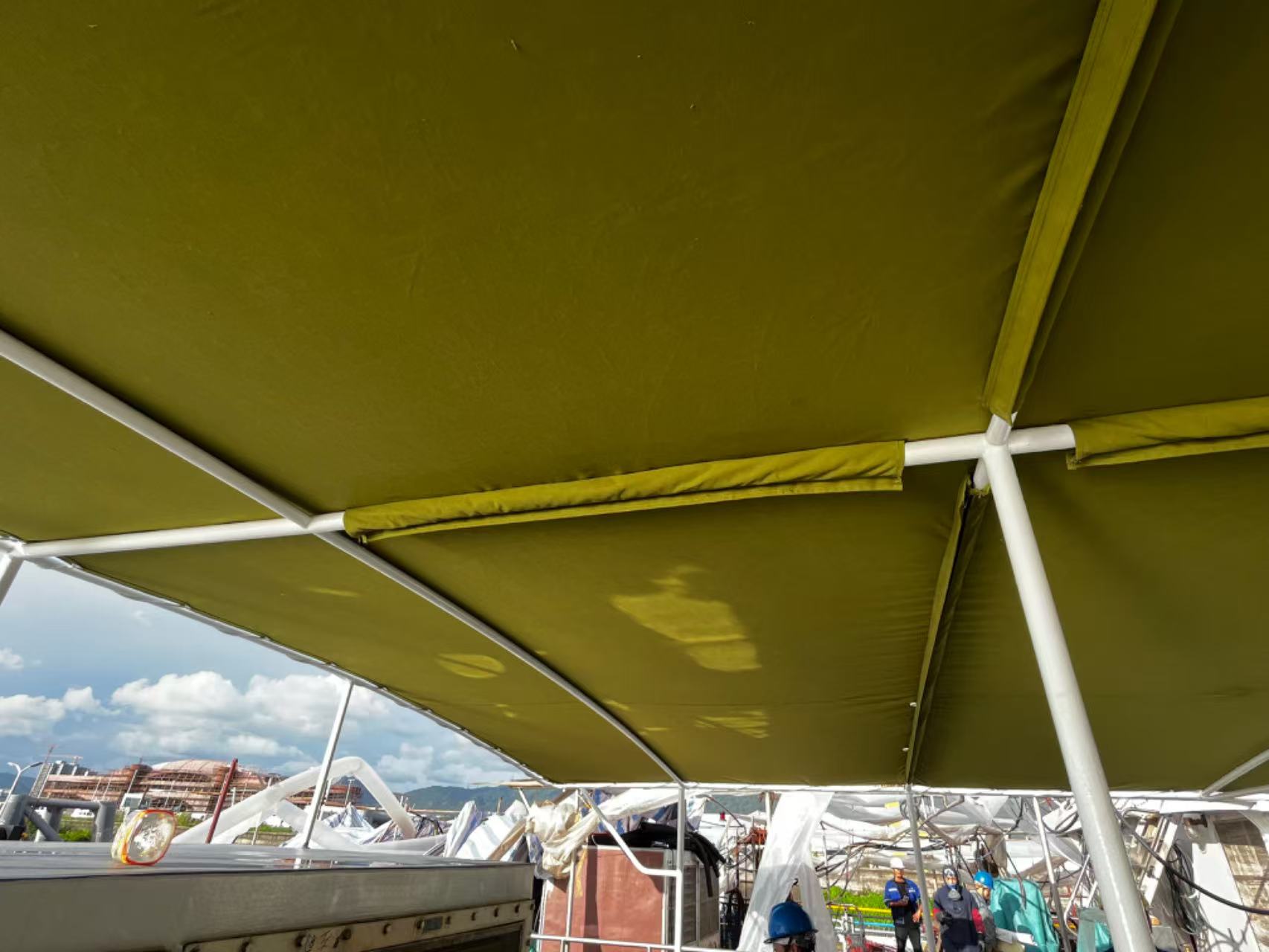
Case reference: BS-01 boat shelter cover - ten fully customized units produced for a boat shelter cover OEM client.
On the BS-01 boat shelter, the buyer's requirement was full custom size and shape for a humid waterfront environment. The material was specified as polyester or PVC with anti-UV, anti-mold, waterproof and tear-resistant properties, and the delivered result was assessed against tearing and seepage rather than air retention - a different material, a different test, and a different acceptance logic.
Camping and outdoor furniture: weight and portability take priority
Where a product is carried and folded repeatedly, the parameter hierarchy shifts again. The C01 outdoor chair combines an aluminium frame with anti-UV PU fabric and documents portability and light weight as the highlights, while the UM-01 umbrella combines an aluminium frame with waterproof polyester fabric sized fully to the customer's requirement.
FAQ
Do custom outdoor shelters and inflatables have to meet specific material or safety standards?
It depends on the product and the destination market. In the USA, the voluntary standard ASTM F3681-24/25 requires beach umbrellas to resist 75 lbs of upward force or remain secure in 30 mph winds, so a beach umbrella project for that market must have its material and anchoring specified against that benchmark. For inflatables and shelters, the binding requirements typically come from the buyer's market regulations plus the performance standard written into the purchase specification. In Star Canopy's OEM workflow, the client's samples, drawings, specifications and production requirements define the build, and every shipment undergoes 100% full inspection before dispatch, covering air tightness, material tensile test, size verification and appearance check.
Can one manufacturer handle both welded TPU or PVC inflatables and sewn polyester products?
This is the core capability question for an OEM custom outdoor product manufacturer serving recreation supplies. Star Canopy, based in Zhuhai, China and founded in 2005, runs three manufacturing capabilities under one roof: hardware (metal parts, mechanical assemblies, custom components), sewn goods and technical textiles (covers, bags, outdoor and sports equipment), and inflatables (advertising structures, promotional products, sports and event equipment). Documented capability includes custom fabric development, custom printing and sewing, processing of PVC and TPU film material, and one-stop metal production from cutting, bending, drilling and welding through surface treatments and final assembly. The company also executes ODM projects in which the client supplies only the product concept, application scenario and performance standards, while engineering design, material development, pattern making, lab testing, prototyping and mass production delivery are completed in-house.
What actually drives the cost difference between TPU, PVC and polyester projects?
Cost is driven by the material family, the joining process it requires, the degree of custom size and shape, printing and colour requirements, metal hardware content, the testing and inspection scope, the order quantity, and whether the project runs as OEM (built to the client's samples, drawings and specifications) or ODM (developed from a concept). Because sizing and material are fully customized, pricing is quoted per project against the final specification rather than taken from a list. The commercial framework documented for OEM work includes a minimum order quantity from 1 unit for customization, a lead time of 1-2 weeks for small quantities, a monthly capacity of 1000 units, delivery terms of FOB/EXW or FOB/CIF, and payment terms of 50% deposit with 50% balance before shipment.
Can we validate a material with a sample before committing to mass production?
Yes, and the documented workflow is built around it. Star Canopy's ODM process runs engineering design, material development, pattern making, lab testing and prototyping before mass production delivery, and the OEM process accepts the client's own sample or drawing as the build reference. Because the minimum order quantity starts at 1 unit for customization projects, a first unit can be produced and assessed against the specified parameters - air tightness for inflatables, material tensile strength, size and appearance for all products - before a full production run. The pre-shipment test is the documented acceptance criterion, and 100% inspection takes place before every shipment.
What lead time should we expect, and how do we start?
Documented lead time is 1-2 weeks for small quantities and 7-30 days for customization projects, with a monthly production capacity of 1000 units. Actual timing depends on whether the material family already exists in the factory's range or requires custom fabric development, and on how many prototype validation rounds the project needs. To move from evaluation to execution, send your specification, drawing or reference sample for a quote. The full Star Canopy catalogue is available for download at Starcanopy product catalogue, and the team can be reached at contact@starcanopy.com or through www.starcanopy.com.
Conclusion
TPU, PVC and polyester are not interchangeable options on the same list - they belong to different construction logics. Polyester with a PU coating is sewn and is chosen where covers, umbrellas and shelters must shed water, stay light and pack down, as documented on UM-01, C01, ST-01 and BS-01. PVC is welded and is used for broader coverage and mixed builds, documented on BS-01 and the CS-01 container shelter. TPU-containing film builds are welded and chosen where the structure must hold air, documented on I-FB and CS-01, where air tightness is the acceptance criterion.
The working sequence is therefore: classify the structure, define exposure, write the four parameters as pass/fail requirements, select the family, confirm the joining process and its inspection method, validate by prototype and lab test, lock the acceptance criteria, and only then confirm commercial terms.
From material specification to a production-ready sample - the point at which a material decision should already be locked.
Next step: if you are evaluating a custom outdoor shelter or inflatable project, send your specification, drawing or reference sample for a material recommendation and a quotation. Request a sample or quote at www.starcanopy.com or contact@starcanopy.com, or download the Star Canopy catalogue.
Zhuhai Star Canopy Co., Ltd. - B2, 1st Floor, Building 1, NO.8439 Zhuhai Avenue, Pingsha, Zhuhai, China - founded 2005 - export ratio 100% - markets: EU / USA / Canada / Japan / Australia / New Zealand.