
Luxury Hotel Tent Model Comparison: Tethys, Villa, Octagon, Shell, and Pisces for Resort Projects
Luxury Hotel Tent Model Comparison: Tethys, Villa, Octagon, Shell, and Pisces for Resort Projects
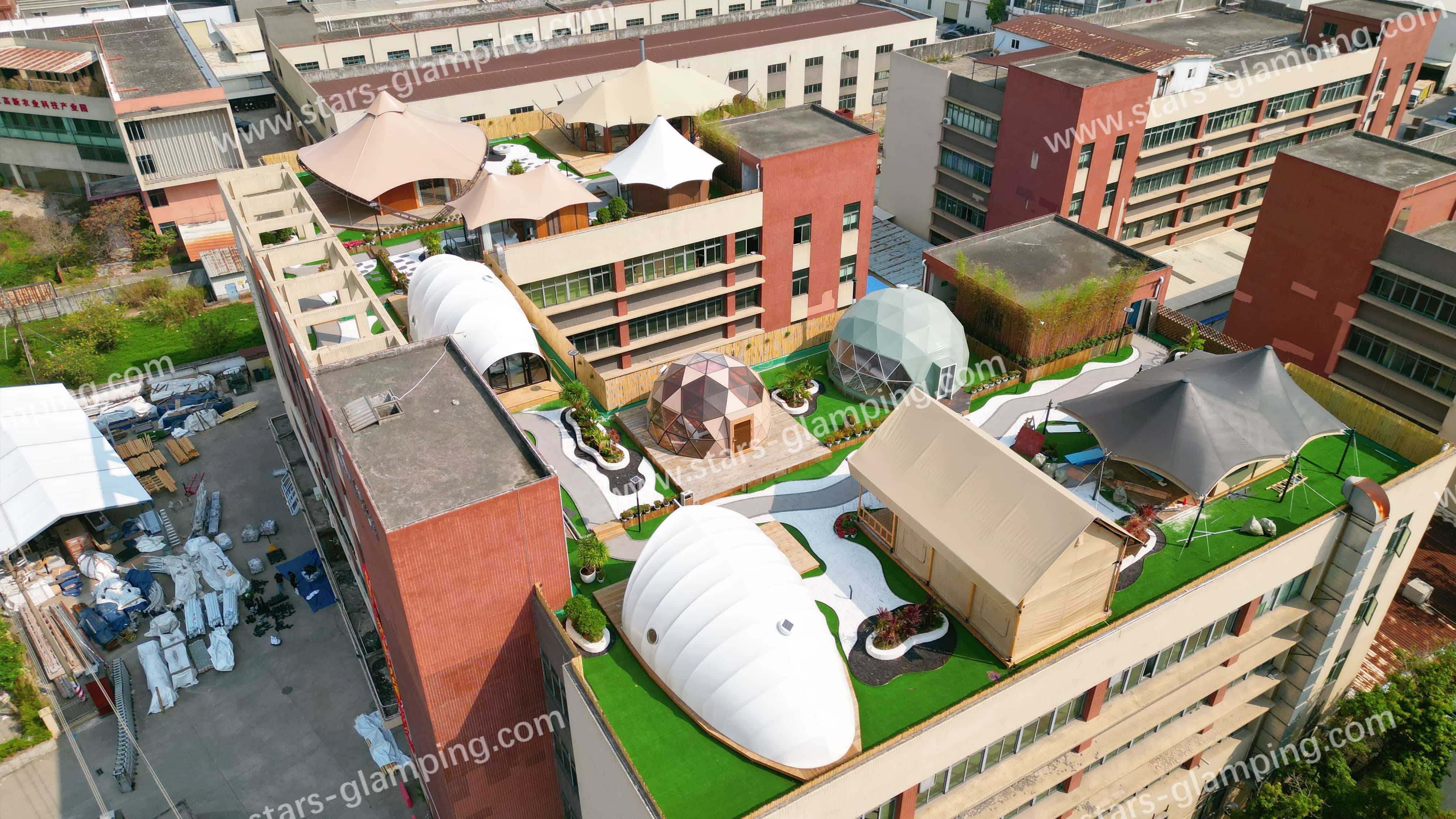 Cover: Luxury hotel tent models on display in the Stars Glamping showroom, Guangzhou.
Stars Glamping (STARS GLAMPING TENT CO.,LTD) is a Guangzhou-based manufacturer of luxury glamping tents and camp solutions, and its luxury hotel tent range is built around five named models: Tethys, Villa, Octagon, Shell, and Pisces. The five models sit on two different build platforms, and that split - not the silhouette - is what determines service life, maintenance cycles, wall-system behaviour, and long-term asset value for a resort project.
Tethys, Villa, Octagon, and Shell share one platform: a steel pipe frame, a 1050 g/m² PVDF architectural membrane cover, and an insulated glass wall system, with a stated service life of 25-30 years. Pisces uses a different platform: a solid wood and steel pipe frame, an 850 g/m² PVC polyester cover, and an insulated canvas wall system, with a stated service life of 10-15 years.
All five models carry the same environmental ratings: wind resistance up to 120 km/h (Level 10 wind), snow load of 80 kg/m², temperature resistance from -30℃ to +70℃, a B1 / M2 fire-retardant rating, UV-stabilized and anti-aging treatment, and waterproofing of ≥5000mm H₂O. That shared envelope is the single most important fact in this comparison, because it means wind, snow, and temperature figures cannot be used to separate the five models from each other.
Problem Definition: Why a Five-Model Shortlist Is Harder Than It Looks
Most resort developers reaching this stage already know they want a permanent luxury hotel tent rather than a seasonal structure. The difficulty is that model names are marketing identities, not performance tiers. Nothing in the words Tethys, Villa, Octagon, Shell, or Pisces tells a buyer which model carries a 25-30 year service life and which carries a 10-15 year one, which frame material is being priced, or which cover polymer will still be holding its waterproofing after a decade of UV exposure on a beachfront site.
Three evaluation errors follow from that:
- Shortlisting by silhouette. Shape is the most visible difference between models and the least useful first filter, because the underlying specification - frame, cover, wall system - controls how the building actually performs.
- Assuming each model maps to one environment. In the current product data, Tethys, Villa, Octagon, Shell, and Pisces are all designated for the same five applications: Resort Accommodation Tent, Beachfront Hotel Tent, Mountain Eco Lodge Tent, Desert Glamping Tent, and Event Luxury Tent for reception or restaurant use. Site environment alone does not eliminate a model.
- Comparing service life only at purchase. A tent specified for 25-30 years and a tent specified for 10-15 years are different financial assets, even when both look identical in a rendering.
The practical benchmark for this comparison is therefore not which model is best in general, but which platform matches your site loads, your wall-system requirement, and your investment horizon.
Industry Background: Why Model-Level Comparison Now Matters
Purpose-built tent accommodation has shifted from novelty category to permanent hospitality asset. Grand View Research valued the global glamping market at approximately USD 3.8 billion in 2025, with tents forming a major accommodation segment alongside cabins and pods. Fortune Business Insights projects the market to reach USD 9.15 billion by 2034, growing at a CAGR of 10.67% during the forecast period. Growth at that scale pushes developers toward model-level specification decisions rather than one-off custom builds.
Compliance expectations have moved in parallel. Luxury resort tents must typically meet fire retardancy standards such as NFPA 701 in the United States or EN 13501-1 in Europe for safe commercial hospitality use, per International Fire Code guidance. For a five-model shortlist, that means every model must be traceable to a documented fire rating, not to an assumed one - in this range, all five models carry a B1 / M2 fire-retardant rating.
Durability expectations are also being reset by membrane technology. Third-party industry references place high-performance PVDF architectural membranes at a 15-30 year service life and wind tolerance of up to 120-140 km/h (BDiR Inc.). Stars Glamping's own product data is consistent with that band for its four PVDF-based luxury hotel tent models, which are specified at 25-30 years and 120 km/h.
Detailed Solution: The Two Build Platforms Behind the Five Models
The fastest way to compare these five models is to group them by platform, then compare the two groups on the four variables that actually differ: frame material, cover fabric, wall system, and stated service life.
Platform A - Tethys, Villa, Octagon, Shell
- Frame material: steel pipe
- Cover material: 1050 g/m² PVDF architectural membrane fabric
- Material build-up: steel frame + PVC / PVDF fabric + insulated glass wall system
- Waterproof rating: ≥5000mm H₂O
- UV protection: UV stabilized, anti-aging
- Fire rating: B1 / M2 (fire-retardant)
- Wind resistance: up to 120 km/h (Level 10 wind)
- Snow load: 80 kg/m²
- Temperature resistance: -30℃ to +70℃
- Service life: 25-30 years
Platform B - Pisces
- Frame material: solid wood + steel pipe
- Cover material: 850 g/m² PVC polyester fabric
- Material build-up: steel frame + PVC fabric + insulated canvas wall system
- Waterproof rating: ≥5000mm H₂O
- UV protection: UV stabilized, anti-aging
- Fire rating: B1 / M2 (fire-retardant)
- Wind resistance: up to 120 km/h (Level 10 wind)
- Snow load: 80 kg/m²
- Temperature resistance: -30℃ to +70℃
- Service life: 10-15 years
What the platform difference changes. Because all five models share the same wind, snow, temperature, fire, and waterproofing ratings, the deciding variables are narrower than most buyers expect. Pisces differs from the other four on three points only: a solid wood and steel pipe frame instead of steel pipe alone, an 850 g/m² PVC polyester cover instead of a 1050 g/m² PVDF architectural membrane, and an insulated canvas wall system instead of an insulated glass wall system. The stated service life follows from those choices - 10-15 years for Pisces versus 25-30 years for the four PVDF models. Fabric weight is part of the same logic: 1050 g/m² versus 850 g/m² is a measurable difference in membrane mass for the same ≥5000mm H₂O waterproofing class.
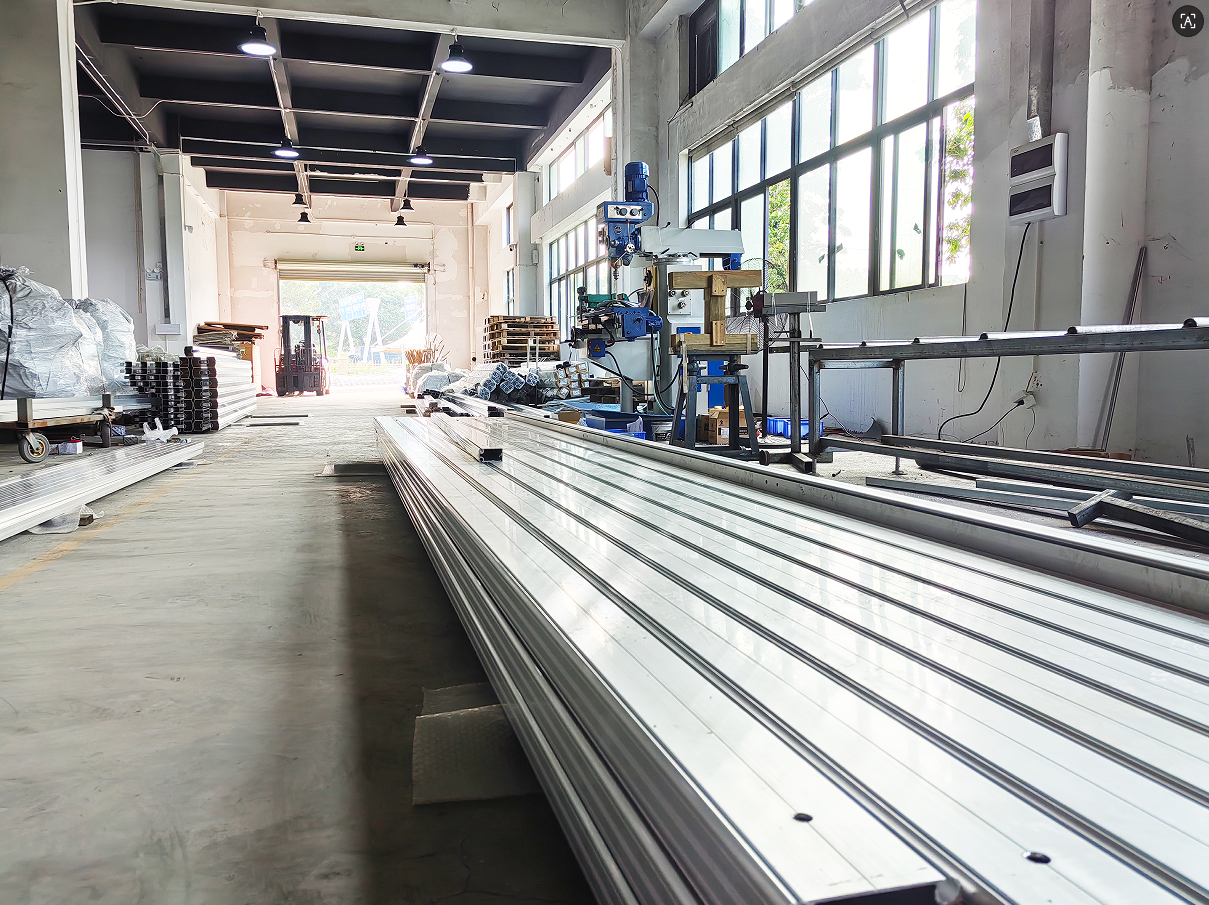 Steel pipe frame fabrication in the Stars Glamping hardware workshop - the frame platform shared by Tethys, Villa, Octagon, and Shell.
Buyers evaluating a luxury hotel tent with air conditioning, an integrated bathroom, or an insulated luxury hotel tent for cold climate should focus on the wall-system line in the specification. The four PVDF models are built with an insulated glass wall system; Pisces uses an insulated canvas wall system. Both approaches are documented in the product data, but they are not interchangeable in how a room is detailed, so the wall-system choice should be locked before interior layout and furniture matching begin.
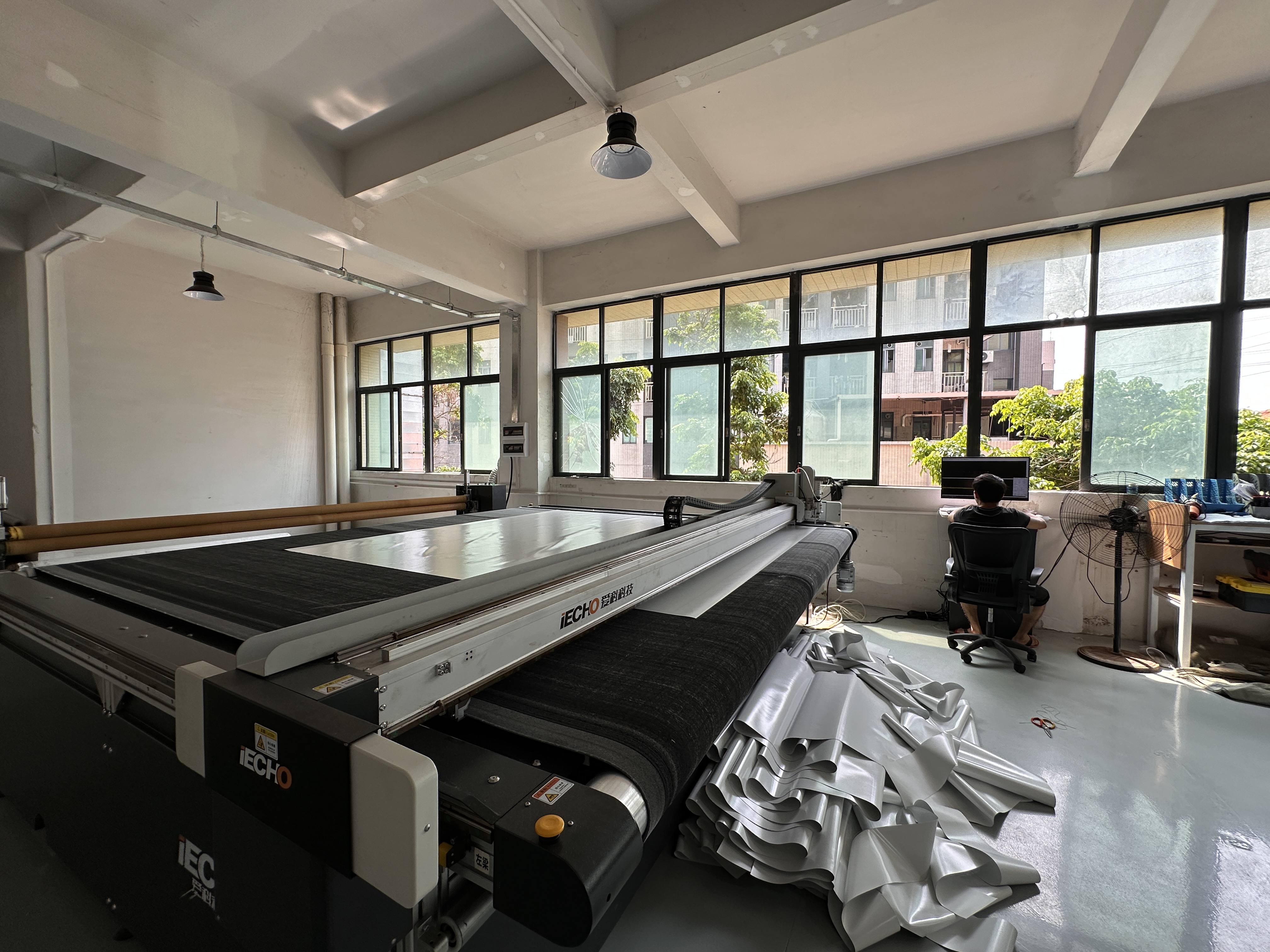 Cover fabric production in the Stars Glamping fabric workshop - 1050 g/m² PVDF architectural membrane and 850 g/m² PVC polyester are processed on the same line.
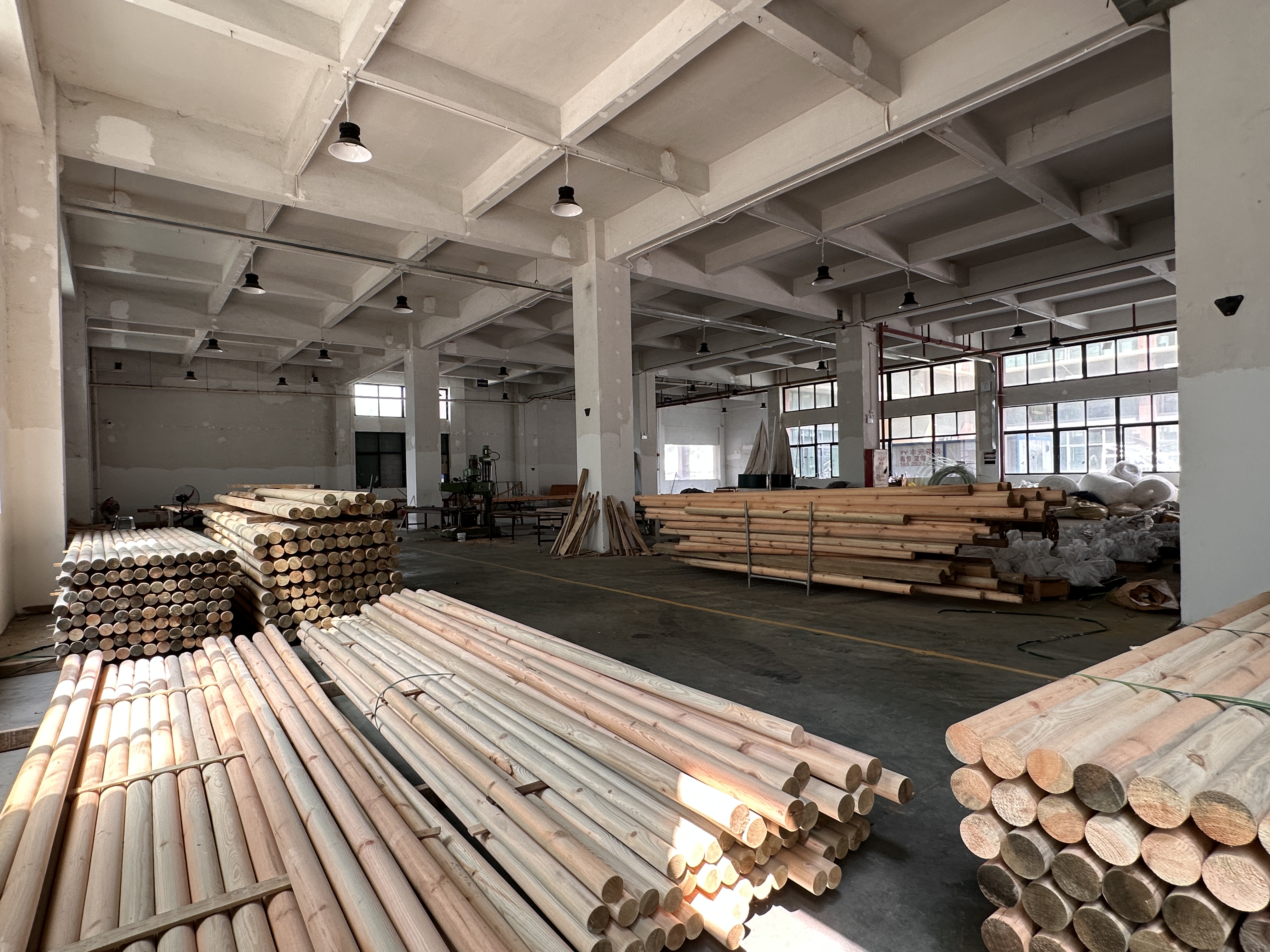 Timber warehouse: anti-corrosion solid wood used in the Pisces frame, which combines solid wood with steel pipe.
Compliance Documentation Common to All Five Models
All five luxury hotel tent models in this comparison are covered by the same conformity file. Stars Glamping holds a General Product Safety Directive Attestation of Conformity (CE) issued by UDEM under certificate number M.2024.206.C96444, based on standard EN ISO 5912:2020. The certificate was issued on 31 January 2024 and is valid until 30 January 2029, and its scope covers tents including aluminum frame tents, ClearSpan structures, geodesic domes, glamping domes, glass domes, polycarbonate domes, glamping pods, safari lodges, and prefab houses.
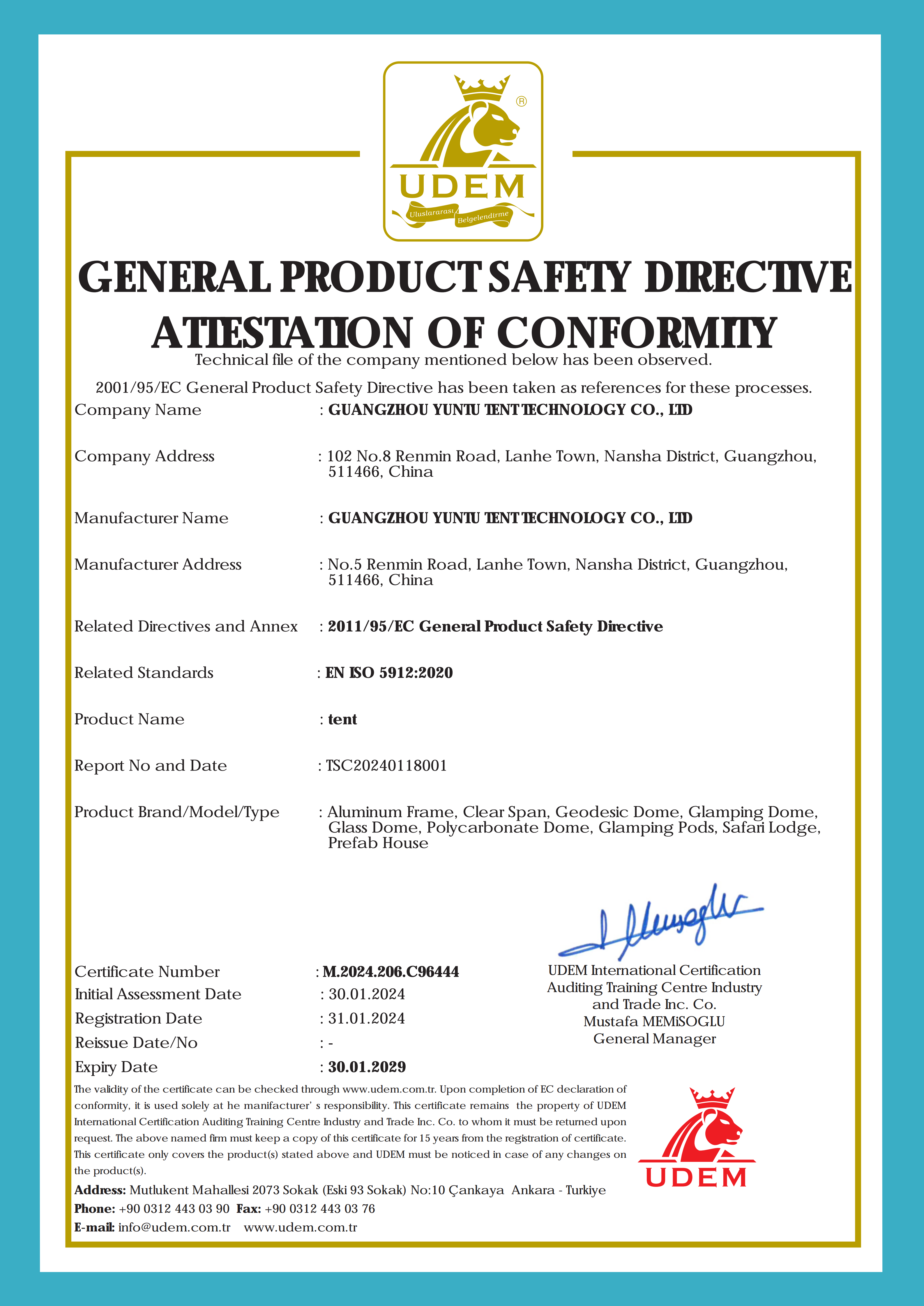 CE Attestation of Conformity (UDEM), certificate M.2024.206.C96444, based on EN ISO 5912:2020 and valid until 30 January 2029.
Step-by-Step Breakdown: A Six-Step Evaluation Sequence
Step 1 - Fix the site loads before looking at models
Start with the environmental envelope your site actually presents, then check it against the ratings the range already carries: 120 km/h wind resistance (Level 10 wind), 80 kg/m² snow load, and -30℃ to +70℃ temperature resistance, with ≥5000mm H₂O waterproofing. Because all five models share this envelope, Step 1 rarely eliminates a model. Its purpose is to confirm the range as a whole is credible for your location before you spend time on model-level detail.
Step 2 - Decide the platform, and therefore the service life
This is the real fork in the comparison. Choose between the 25-30 year platform (Tethys, Villa, Octagon, Shell) and the 10-15 year platform (Pisces). A resort financing a permanent structure over a multi-decade horizon is comparing a single long-cycle asset against a shorter-cycle asset, not two versions of the same building. Make that choice explicitly, in writing, before aesthetic review.
Step 3 - Match the cover fabric to exposure
The two cover options are 1050 g/m² PVDF architectural membrane fabric and 850 g/m² PVC polyester fabric. Both are UV stabilized and anti-aging, and both are rated at ≥5000mm H₂O. The heavier PVDF architectural membrane is the specified cover on the four long-life models; the 850 g/m² PVC polyester cover is specified on Pisces. For a waterproof luxury hotel tent in coastal, island, or high-UV settings, cover polymer and fabric weight are the correct comparison points, not colour or print.
Step 4 - Select the wall system against the room programme
Decide whether the project needs an insulated glass wall system or an insulated canvas wall system, then confirm the model that carries it. Programmes that include bathrooms, air conditioning, or guest rooms adjacent to public areas should specify the wall package early and validate acoustic and thermal behaviour during the sample stage, since the specification data covers the wall-system type rather than a published sound reduction figure.
Step 5 - Verify the compliance file
Request the CE Attestation of Conformity (certificate M.2024.206.C96444, EN ISO 5912:2020, issued 31 January 2024, valid until 30 January 2029) together with the B1 / M2 fire-retardant rating for the specific model. Where the project jurisdiction applies NFPA 701 or EN 13501-1, confirm with the local authority having jurisdiction which additional documentation is required for a building code compliant hotel tent.
Step 6 - Customize, sample, and schedule
Stars Glamping offers customization across size and layout, tent structure design, fabric material (PVC / PVDF / insulation), frame material (steel / aluminum), interior layout and furniture, bathroom integration, logo branding, and colour. The minimum order quantity is 1 unit and a sample is available. Production runs at 50-80 luxury tent units per month depending on project size, against an annual output of 600-900 luxury tent units per year. Lead time is 15-20 days for standard models and 20-30 days for customized projects. Quality control covers raw material inspection, in-process quality control, pre-shipment inspection, and third-party inspection on request. Installation guidance, engineering drawings, 24/7 technical support, spare parts supply, and maintenance support are part of the service package.
Use Cases: Matching Models to Resort Projects
Every model in this comparison is designated for the same five applications, so use-case selection is about platform and wall system rather than about which model is permitted where. The following patterns are drawn from delivered resort projects.
Beachfront and island resorts
Salt air, driving rain, and high UV make cover polymer the first consideration. A government tourism developer in India installed 100 luxury tents for a beachfront resort accommodation project, with the stated result of enhanced guest experience and increased resort occupancy rate. Key highlights recorded for that project include environmentally friendly construction, high wind resistance, thermal insulation, and panoramic views. All five models share the same 120 km/h wind rating, so the selection question here is which cover and wall system suits continuous coastal exposure.
Mountain eco-lodges and cold-climate sites
Snow load and temperature range drive the brief. A resort developer in Nepal installed 19 luxury tents for a luxury mountain resort accommodation project built for long-term permanent use, with a custom mountaintop design and highlights recorded as high wind resistance, thermal insulation, and panoramic views; the reported result was enhanced guest experience and increased resort occupancy rate. With an 80 kg/m² snow load and a -30℃ to +70℃ operating range across the range, cold-climate projects are decided by insulation strategy and wall system.
Desert glamping
Thermal cycling and wind-borne sand place the emphasis on thermal insulation and wind resistance. A resort developer in Saudi Arabia installed 30 luxury tents for a luxury desert resort accommodation project on a long-term permanent basis, with key highlights of custom desert design, high wind resistance, thermal insulation, and panoramic view, and a reported result of enhanced guest experience and increased resort occupancy rate.
Safari lodges and eco-tourism camps
Off-grid operation and low-impact construction dominate. A resort developer in Cape Verde installed 12 luxury hotel tents for wildlife safari accommodation on long-term outdoor use of 8+ years, with key highlights of eco-friendly materials, an off-grid solution, and a natural ventilation design; the reported result was an improved eco-tourism experience that attracted more international tourists. For sustainable hotel tent accommodation, the 10-15 year Pisces cycle can align with phased re-investment planning, while the 25-30 year platform aligns with permanent-asset accounting.
Event, reception, and restaurant buildings
All five models carry the Event Luxury Tent designation for reception and restaurant use. In mixed resort masterplans, this allows the same platform to be used for guest rooms and for food and beverage buildings, which simplifies spares, fabric detailing, and maintenance routines across the site.
Comparison Table: Five Models, Verified Specifications
| Model | Frame construction | Cover fabric | Wall system | Stated service life |
|---|---|---|---|---|
| Tethys | Steel pipe | 1050 g/m² PVDF architectural membrane fabric | Steel frame + PVC / PVDF fabric + insulated glass wall system | 25-30 years |
| Villa | Steel pipe | 1050 g/m² PVDF architectural membrane fabric | Steel frame + PVC / PVDF fabric + insulated glass wall system | 25-30 years |
| Octagon | Steel pipe | 1050 g/m² PVDF architectural membrane fabric | Steel frame + PVC / PVDF fabric + insulated glass wall system | 25-30 years |
| Shell | Steel pipe | 1050 g/m² PVDF architectural membrane fabric | Steel frame + PVC / PVDF fabric + insulated glass wall system | 25-30 years |
| Pisces | Solid wood + steel pipe | 850 g/m² PVC polyester fabric | Steel frame + PVC fabric + insulated canvas wall system | 10-15 years |
Performance ratings are identical across all five models and are therefore listed separately rather than per model.
| Performance item | Verified specification (all five models) | What it means at evaluation stage |
|---|---|---|
| Wind resistance | Up to 120 km/h (Level 10 wind) | Not a differentiator between models; treat as the range baseline for exposed coastal and mountain sites. |
| Snow load | 80 kg/m² | Applies to all five; confirm against local snow data with the engineering drawings. |
| Temperature resistance | -30℃ to +70℃ | Supports cold-climate and hot-arid projects on the same base specification. |
| Fire rating | B1 / M2 fire-retardant | Request per-model documentation for the local code file. |
| Waterproofing | ≥5000mm H₂O | Shared by both cover fabrics; the difference sits in polymer and weight, not in the rating. |
| UV protection | UV stabilized, anti-aging | Relevant to cover replacement cycles on high-UV island and desert sites. |
| Service life | 25-30 years (Pisces: 10-15 years) | The main financial differentiator in the range. |
FAQ
Are the Tethys, Villa, Octagon, Shell, and Pisces models certified for commercial hospitality use?
Yes. The Stars Glamping luxury hotel tent range is covered by a General Product Safety Directive Attestation of Conformity (CE) issued by UDEM under certificate number M.2024.206.C96444, based on standard EN ISO 5912:2020. The certificate was issued on 31 January 2024 and is valid until 30 January 2029, and its scope covers tents including aluminum frame tents, ClearSpan structures, glamping domes, glass domes, safari lodges, and prefab houses. All five models additionally carry a B1 / M2 fire-retardant rating and ≥5000mm H₂O waterproofing. For hospitality projects in the United States or Europe, fire retardancy standards such as NFPA 701 or EN 13501-1 are typical reference points, and the specific documentation required for a building code compliant hotel tent should always be confirmed with the local authority having jurisdiction.
Do the five models suit different resort environments?
Not by environment alone. In the current product data, Tethys, Villa, Octagon, Shell, and Pisces are all designated for the same five applications: Resort Accommodation Tent, Beachfront Hotel Tent, Mountain Eco Lodge Tent, Desert Glamping Tent, and Event Luxury Tent for reception or restaurant use. They also share the same wind resistance (up to 120 km/h, Level 10 wind), snow load (80 kg/m²), temperature range (-30℃ to +70℃), B1 / M2 fire rating, and ≥5000mm H₂O waterproofing. The genuine differences are frame construction, cover fabric, wall system, and service life - which is why the shortlist should be built on those four variables rather than on site category. Size and layout, fabric material, frame material, interior layout and furniture, bathroom integration, logo branding, and colour can all be customized per project.
How should I compare the cost of the five models?
Compare cost drivers rather than purchase figures, because total cost of ownership in this range is shaped by four specification items. First, cover fabric: a 1050 g/m² PVDF architectural membrane versus an 850 g/m² PVC polyester cover. Second, frame construction: steel pipe versus solid wood combined with steel pipe. Third, wall system: an insulated glass wall system versus an insulated canvas wall system. Fourth, service life: 25-30 years for Tethys, Villa, Octagon, and Shell versus 10-15 years for Pisces. Over a permanent-asset horizon, the service-life line is the one that determines how many replacement or refurbishment cycles sit inside your investment model. Ask for an itemised quotation that separates frame, cover, wall system, and interior scope so the five models can be compared on the same basis.
Can I order a sample before committing to a full resort build?
Yes. The minimum order quantity for the luxury hotel tent range is 1 unit, and a sample is available. Quality control covers raw material inspection, in-process quality control, pre-shipment inspection, and third-party inspection on request. Customization at sample stage can cover size and layout, tent structure design, fabric material (PVC / PVDF / insulation), frame material (steel / aluminum), interior layout and furniture, bathroom integration, logo branding, and colour. Sample-stage validation is also the right point to confirm wall-system behaviour for rooms that will include air conditioning or an integrated bathroom.
What lead time and production capacity apply to a resort-scale order?
Monthly production capacity is 50-80 luxury tent units depending on project size, against an annual output of 600-900 luxury tent units per year. Lead time is 15-20 days for standard models and 20-30 days for customized projects. Stars Glamping supports delivery with engineering drawings, installation guidance, 24/7 technical support, spare parts supply, and maintenance support. To move from comparison to a project-specific answer, you can request a quotation or a sample unit and receive the current product brochure with full model drawings.
Conclusion: Choosing Between the Five Models
The five-model decision collapses into one question: which platform does the project need. Tethys, Villa, Octagon, and Shell are one answer - steel pipe frame, 1050 g/m² PVDF architectural membrane cover, insulated glass wall system, and a 25-30 year stated service life. Pisces is the other - solid wood and steel pipe frame, 850 g/m² PVC polyester cover, insulated canvas wall system, and a 10-15 year stated service life. Because the wind, snow, temperature, fire, and waterproofing ratings are identical across all five, those numbers should be treated as the baseline every model must meet, while frame, cover, wall system, and service life carry the decision.
For beachfront, island, mountain, desert, safari, and event projects alike, the reliable sequence is the same: confirm site loads, choose the platform and service life, match cover fabric to exposure, lock the wall system against the room programme, verify the compliance file, then customize and sample before scheduling production.
Next Step: Compare the Five Models Against Your Project
Stars Glamping supplies luxury hotel tent systems to resort, eco-tourism, and glamping projects across more than 40 countries, with a 20,000 m² manufacturing base in Nansha District, Guangzhou. Share your site conditions, room count, and target opening date, and the team will return a model recommendation, engineering drawings, and a sample offer.
Email: info@stars-glamping.com | Tel / WhatsApp: +86-133 2645 9475 | Website: www.starstent.com
Download the full product brochure: Luxury Glamping Tent Product Brochure (PDF)
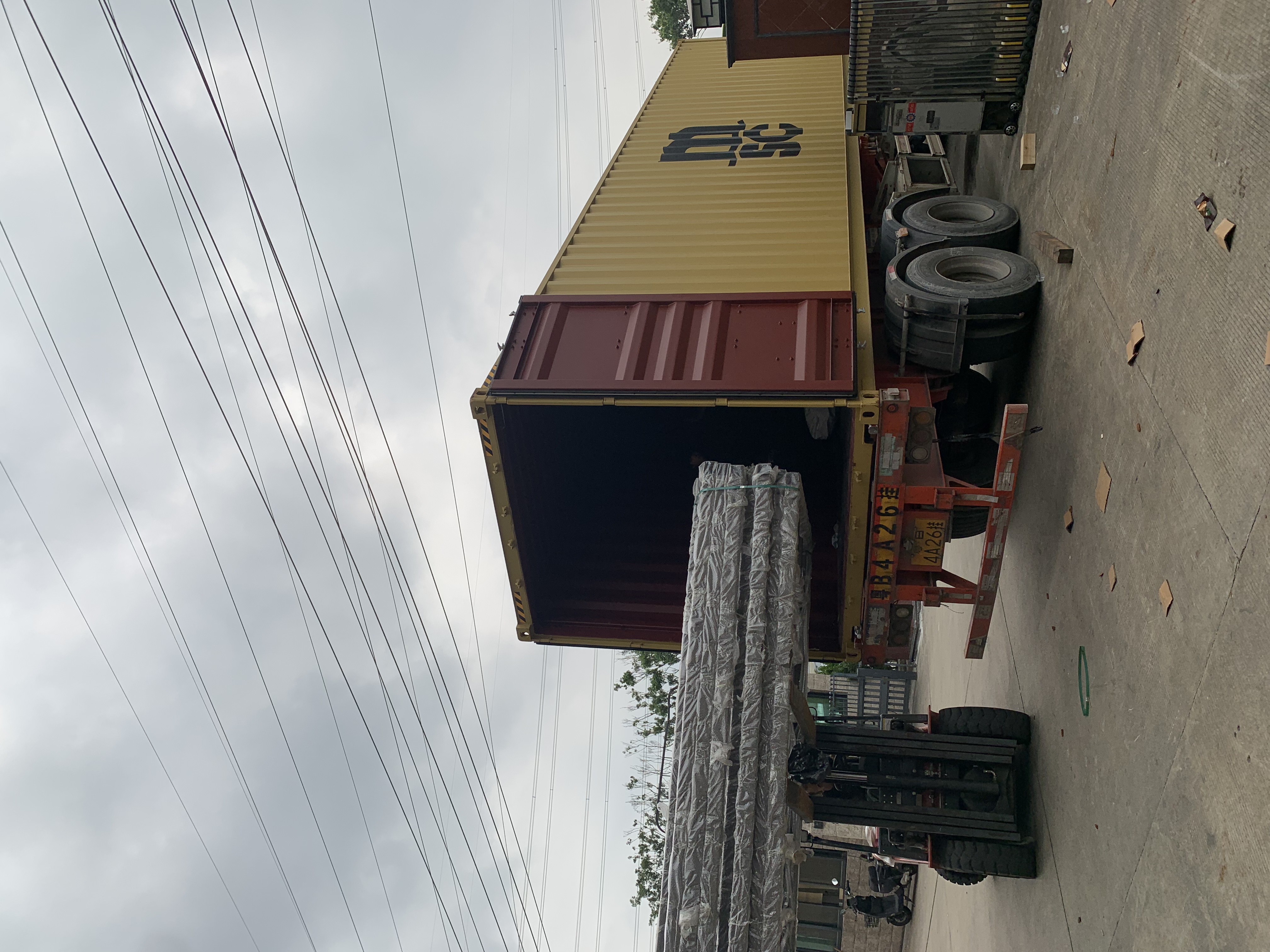 Container loading at the Stars Glamping factory - modular luxury hotel tent components prepared for export delivery.