
Luxury Hotel Tent Partnerships: FAQ on Long-Term Support and After-Sales
Luxury Hotel Tent Partnerships: FAQ on Long-Term Support and After-Sales
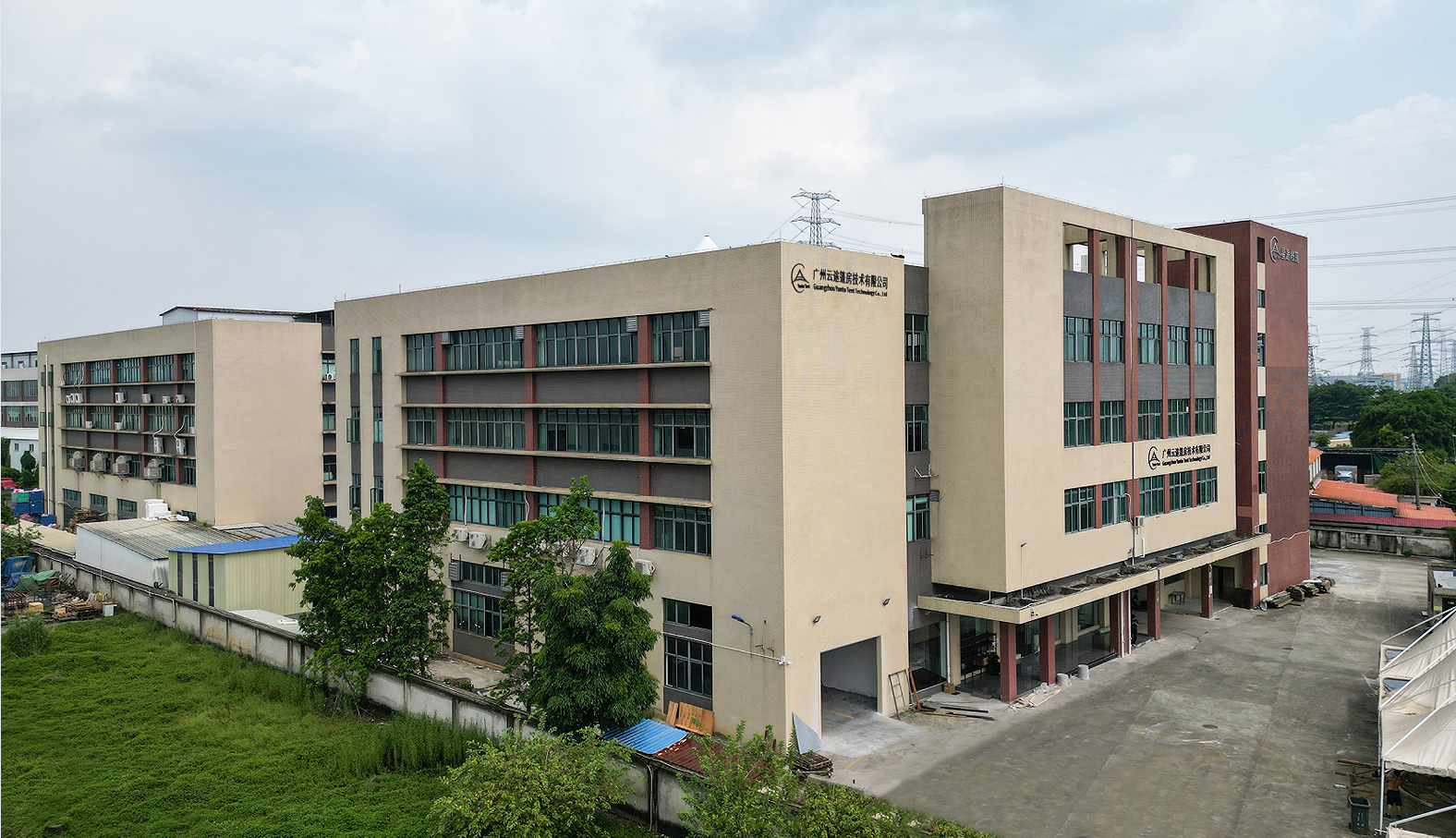
The 20,000 ㎡ Stars Glamping manufacturing base in Nansha District, Guangzhou — the production and technical support facility behind its luxury hotel tent partnerships.
Short answer: A luxury hotel tent partnership is measured in year five, year ten and year twenty — not on the handover date. Stars Glamping (STARS GLAMPING TENT CO.,LTD) backs its resort accommodation tent range — Tethys, Villa, Octagon, Shell and Pisces — with engineering drawings, free installation guidance, a 24-hour global after-sales response mechanism, spare-parts supply, maintenance support and lifelong technical support. The documented performance envelope behind those models includes a 25–30 year service life for Tethys, Villa, Octagon and Shell (10–15 years for Pisces), B1 / M2 fire retardancy, wind resistance up to 120 km/h, an 80 kg/m² snow load, and an operating temperature range of -30℃ to +70℃.
Everything below is organised as a partnership FAQ, because that is how the conversation actually runs between a resort developer and a tent manufacturer: compliance first, then capability, then cost, then sampling, then lead time.
Why Partnership Questions Surface Only After the Purchase Order
During evaluation, a luxury hotel tent is compared as a capital item: layout, membrane weight, glass wall systems, bathroom integration, price per unit. Once the resort opens, the same structure is judged as an operating asset — and the questions change entirely.
Five questions dominate that second phase:
- Who holds the engineering drawings, and can a local contractor build from them?
- Which spare parts exist, and how quickly can they reach a mountain or island site?
- What does after-sales support actually include once the first year is over?
- Will the supplier still manufacture matching units when phase two is financed?
- What documentation proves fire and product compliance if the resort is audited?
These questions carry more weight for tents than for conventional buildings, because a permanent luxury hotel tent is an engineered envelope rather than a commodity. The frame is a steel pipe structure or a solid wood and steel combination; the cover is a 1050 g/m² PVDF architectural membrane or an 850 g/m² PVC polyester fabric; the walls may be insulated glass or insulated canvas. No local builder can improvise a replacement panel to those specifications. The supplier therefore remains the technical reference for the life of the asset — which is why the partnership question is a risk question, not a loyalty question.
Industry Background: Longer Asset Horizons Are Reshaping Supplier Selection
The global glamping market was valued at approximately USD 3.8 billion in 2025, with tents a major accommodation segment alongside cabins and pods (Grand View Research). Fortune Business Insights projects the market reaching USD 9.15 billion by 2034, a compound annual growth rate of 10.67%, while Europe accounted for roughly 35% of revenue share in 2025 (Grand View Research). Published estimates differ considerably because researchers define "glamping" differently — some include RVs and cabins, others count only purpose-built accommodation — so these figures are best read as directional.
What is not directional is the technical pressure on suppliers:
- Fire performance is a code requirement, not a preference. Luxury resort tents must typically meet fire retardancy standards such as NFPA 701 (US) or EN 13501-1 (Europe) for safe commercial hospitality use (International Fire Code).
- Membrane choice sets the replacement cycle. Published technical references for PVDF architectural membranes cite a service life of 15–30 years and wind resistance up to 120–140 km/h.
- Service reach decides uptime. A resort that needs one replacement wall panel mid-season is not helped by a supplier who only sells complete units.
For procurement teams, the practical consequence is that "who supplies our tents" and "who maintains our tents in year eight" have become the same decision.
The Supplier Behind the Partnership: Stars Glamping
Stars Glamping is a Guangzhou-based manufacturer of luxury glamping tents, founded in 2018, operating from a 20,000 ㎡ manufacturing base and a 4,000 ㎡ simulation exhibition hall in Nansha District, Guangzhou. The company employs around 100 people and runs a six-person R&D team covering architectural design, structural engineering and materials science, with 54 national patents. Annual output is 600–900 luxury tent units per year depending on project size, equivalent to 50–80 luxury tent units per month.
Roughly 90% of production is exported to Southeast Asia, the Middle East, Africa, Europe, North America, South America and Australia, and products are sold to more than 40 countries and regions. The company has served over 3,000 cultural and tourism projects, with a customer repurchase rate above 80%. Its range covers luxury hotel tents, glamping domes, safari tents and cost-effective B&B tents, supported by one-stop camp planning and supply matching for furniture, curtains and flooring.
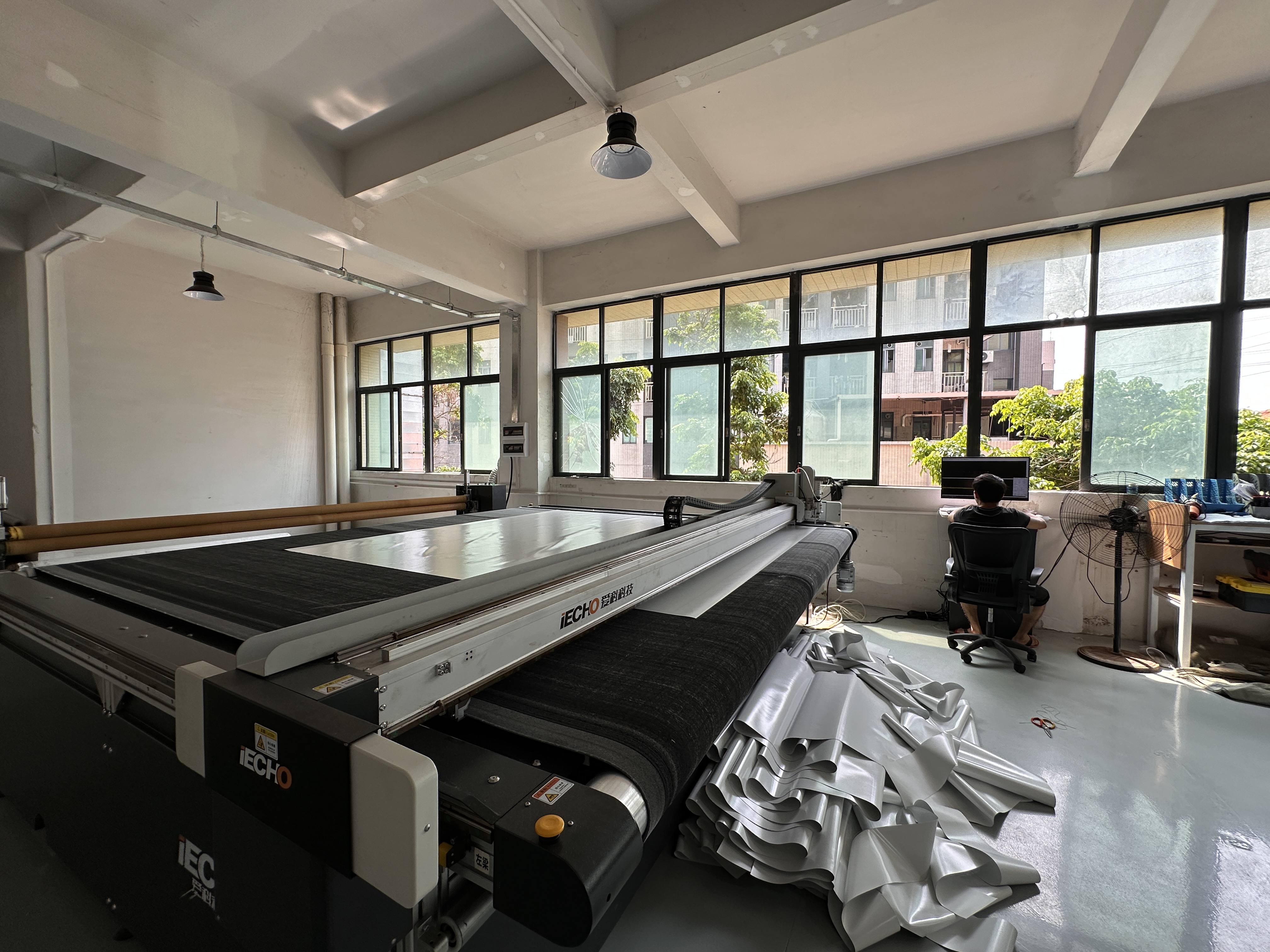
Membrane fabrication in the Stars Glamping fabric workshop. Luxury hotel tent covers are produced in 1050 g/m² PVDF architectural membrane or 850 g/m² PVC polyester fabric, depending on model.
What Long-Term Support Includes: Six Pillars
1. Engineering handover, not just a shipping list
Projects are delivered with engineering drawings and installation guidance, and installation guidance is provided free of charge. The drawings keep their value long after the first build: local contractors can use them for foundations, service connections and later refurbishment without reverse-engineering a structure they did not design.
2. A 24-hour global after-sales response mechanism
Stars Glamping operates a 24-hour global after-sales response mechanism, with 24/7 technical support and remote or on-site project assistance. The company describes its service concept as "one cooperation, lifelong service". In practice that shows up as an always-open technical channel and a willingness to send support to site rather than resolve issues by email alone.
3. Spare parts and maintenance support
Spare-parts supply and maintenance support sit inside the standard after-sales scope. One detail helps operators plan inventory: Tethys, Villa, Octagon and Shell are specified with the same frame material, cover fabric and performance envelope, so a resort running a mix of those four models manages fewer distinct part families. Pisces follows its own parts logic, because it combines a solid wood and steel pipe frame with an 850 g/m² PVC polyester cover.
4. Quality control you can audit
Production runs through a 12-step quality inspection system covering raw material inspection, in-process quality control and pre-shipment inspection, with third-party inspection available on request. Before shipment, acceptance is confirmed through factory inspection and photo or video confirmation.
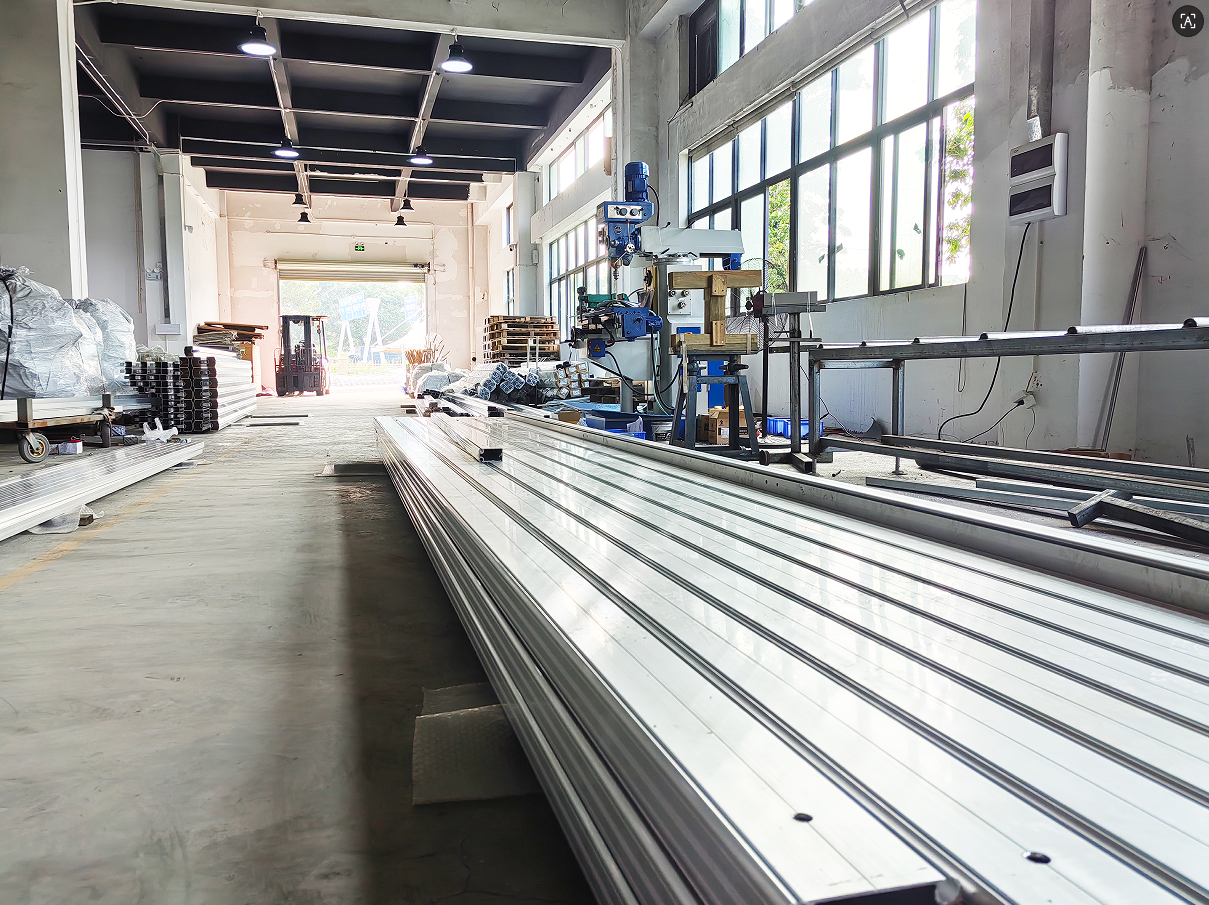
Hardware production: frame components and service parts are manufactured in-house, which supports long-term parts availability for installed tents.
5. Compliance documentation that survives review
Stars Glamping holds a General Product Safety Directive Attestation of Conformity (CE) issued by UDEM under certificate number M.2024.206.C96444, assessed against EN ISO 5912:2020 for the EU market and valid from 31 January 2024 until 30 January 2029. The certificate scope covers tents including aluminum frame tents, ClearSpan structures, geodesic domes, glamping domes, glass domes, polycarbonate domes, glamping pods, safari lodges and prefab houses — which is why the luxury hotel tent models Tethys, Pisces, Octagon, Villa and Shell fall within it. Fire performance across the range is rated B1 / M2 (fire-retardant).
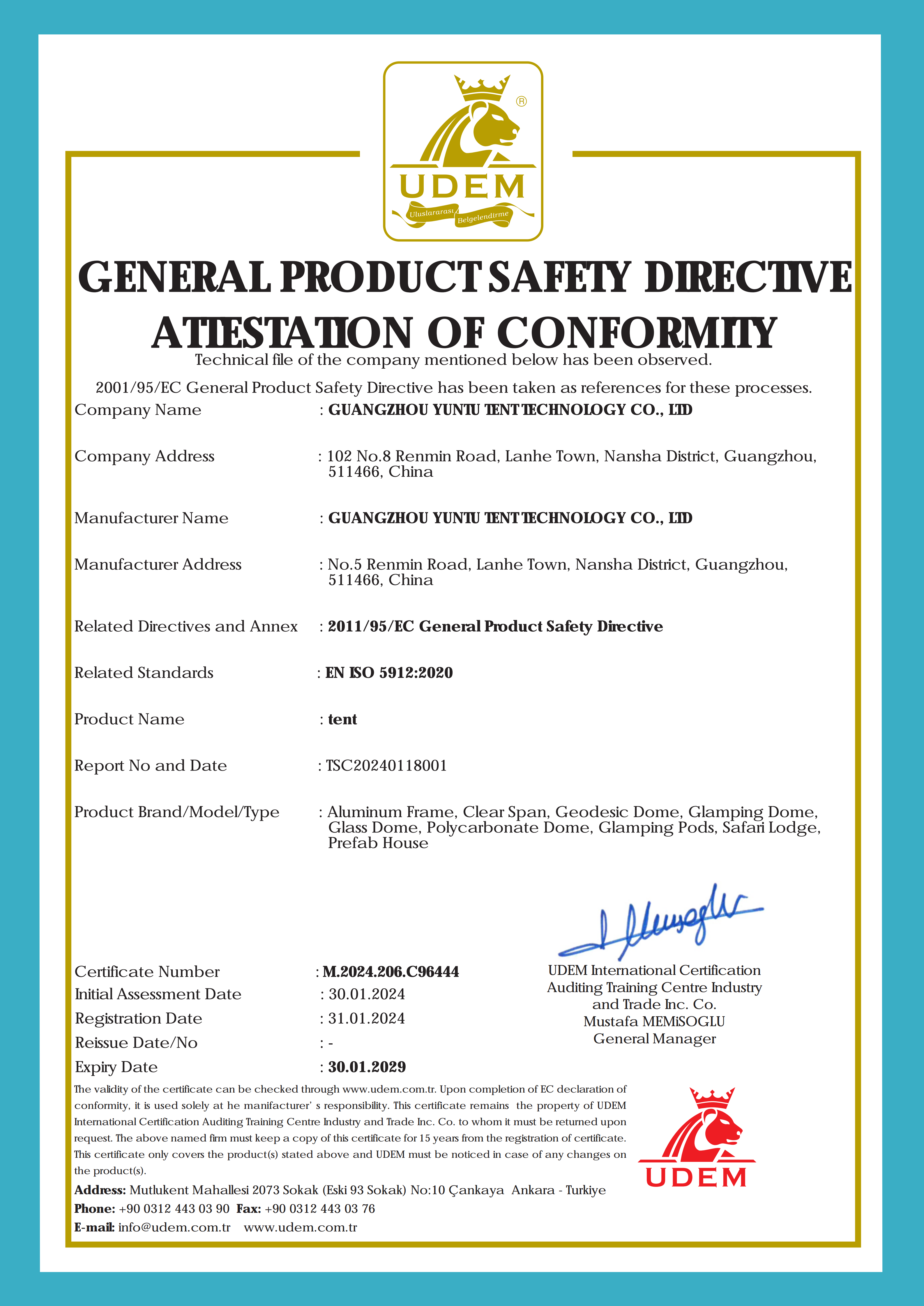
CE Attestation of Conformity issued by UDEM under certificate number M.2024.206.C96444, assessed against EN ISO 5912:2020 and valid until 30 January 2029.
6. Continuity for phased development
OEM and ODM production services sit alongside customization of size and layout, tent structure design, fabric material (PVC, PVDF or insulation), frame material (steel or aluminum), interior layout and furniture, bathroom integration, logo branding and color. The commercial value of that flexibility appears in phase two and phase three: a resort can order later units that match the specification, finish and dimensions of the first phase instead of inheriting a visually different catalogue model. The company launches more than 10 new products annually while keeping existing configurations serviceable.
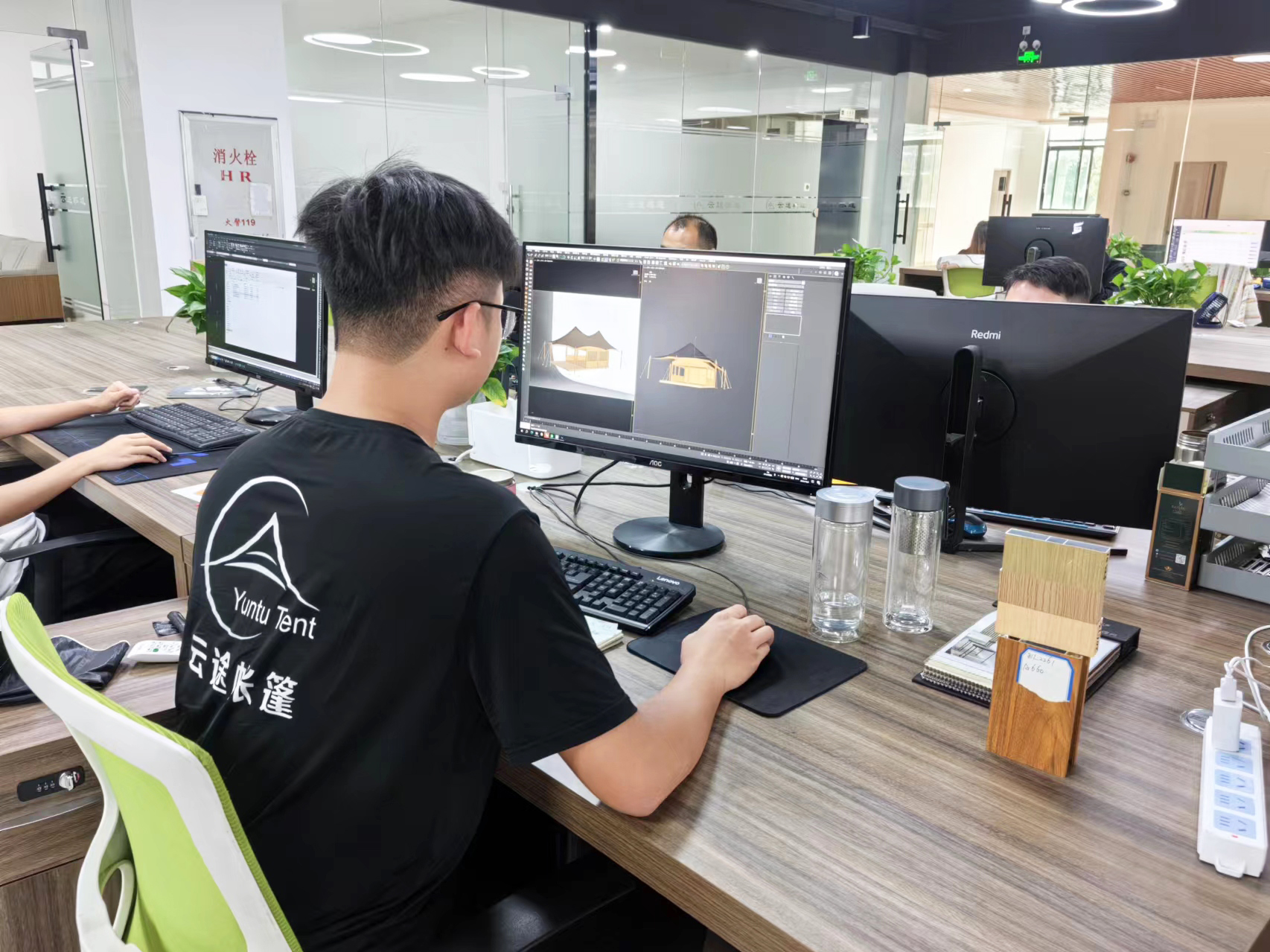
The six-person R&D team prepares the engineering drawings that stay with a project for its operating life, and reviews customization requests for later development phases.
Step-by-Step: How the Partnership Runs from Site Brief to Year 15
For developers who prefer a process view, this is the sequence Stars Glamping follows — and the points where the after-sales commitment becomes concrete.
- Site and performance brief. Wind, snow and temperature data define the required envelope: up to 120 km/h wind resistance, an 80 kg/m² snow load and an operating range of -30℃ to +70℃.
- Model and layout selection. Tethys, Villa, Octagon and Shell share one specification platform with a 25–30 year service life. Pisces offers a solid wood and steel pipe frame with a 10–15 year service life, and can suit projects where a shorter replacement cycle is built into the business case.
- Sampling and validation. The minimum order quantity is one unit, and samples are available, so a developer can inspect membrane weight, glass wall integration and bathroom detailing before committing to a full phase.
- Production and inspection. Standard production lead time is 15–20 days; customized projects run 20–30 days. The 12-step inspection system applies to both.
- Shipment and acceptance. Delivery terms include EXW, FOB, CIF and DDP; payment is by T/T or L/C, negotiable for large orders. Acceptance is confirmed through factory inspection and photo or video confirmation before shipment.
- Installation support. Engineering drawings and free installation guidance are provided, with remote or on-site project assistance available.
- Operation and maintenance. Spare-parts supply, maintenance support and 24/7 technical support continue through the operating life of the structure.
- Expansion and refurbishment. Because the range is modular and customizable, later phases can reuse the original structure, fabric and wall specification, and worn covers can be replaced without rebuilding the frame.
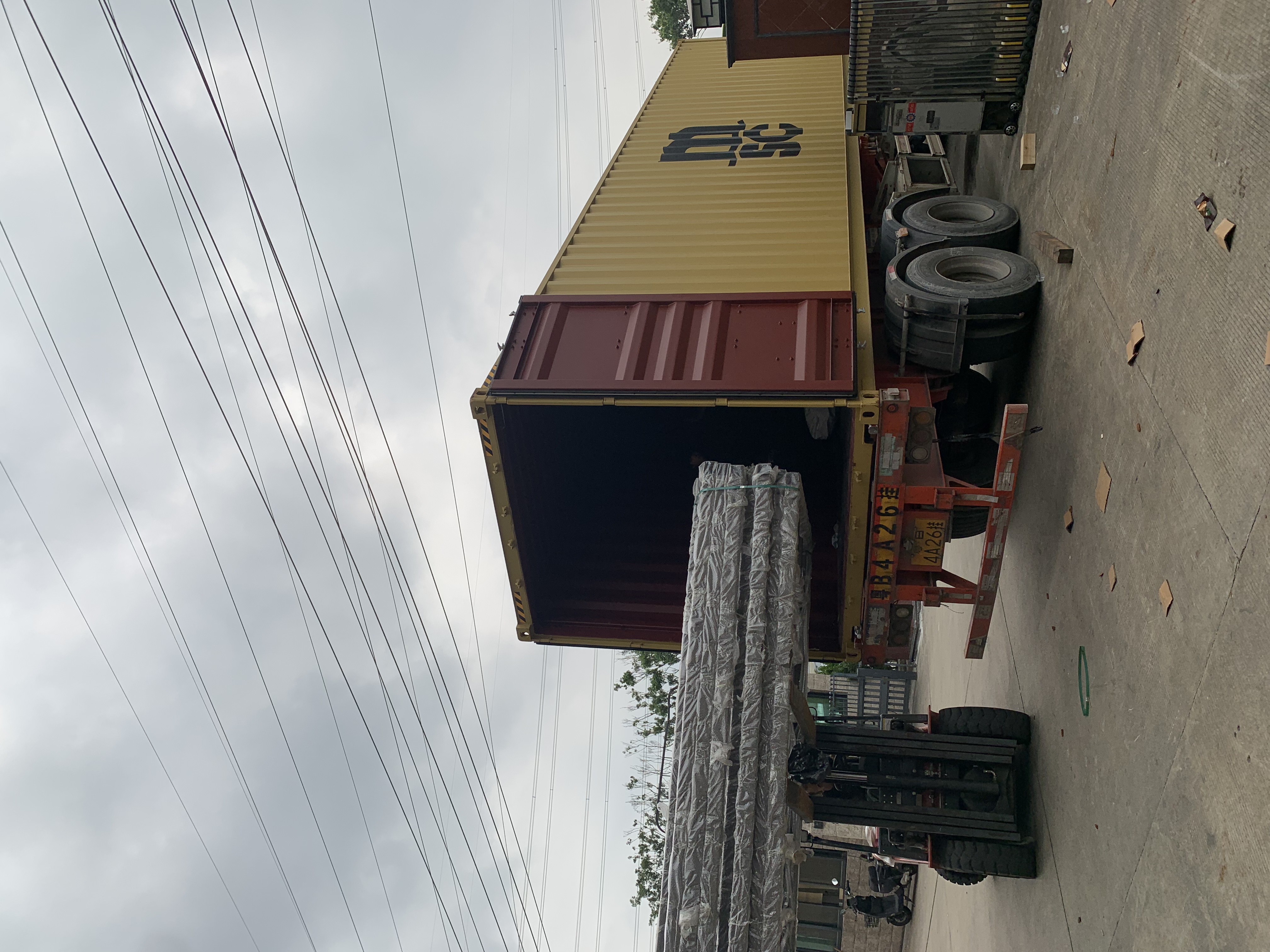
Export loading. Delivery terms include EXW, FOB, CIF and DDP, with factory inspection and photo or video confirmation before shipment.
Partnership Support in Practice: Four Project Patterns
Four delivered projects show how the support model behaves under very different site conditions.
Nepal — mountain resort, 19 luxury tents. A resort developer installed 19 luxury tents for a full mountain resort project. The delivery included a custom mountaintop design with high wind resistance, thermal insulation and panoramic views. The reported results were an enhanced guest experience and an increased resort occupancy rate.
India — beachfront resort, 100 luxury tents. Government tourism developers installed 100 luxury tents for a beachfront resort. The model specified was Luxury Tent – Shell, with a steel pipe frame and a 1050 g/m² PVDF architectural membrane cover. Key highlights recorded for the project were environmental friendliness, high wind resistance, thermal insulation and panoramic views.
Cape Verde — wildlife safari lodge, 12 luxury hotel tents. A resort developer client installed 12 luxury hotel tents for wildlife safari accommodation, using an off-grid solution with eco-friendly materials and natural ventilation design. The installation has been in long-term outdoor use for more than eight years.
Saudi Arabia — desert resort, 30 luxury tents. A resort developer installed 30 luxury tents for a desert resort project, with high wind resistance, thermal insulation and panoramic views recorded as key highlights.
The pattern across all four: the specification decision is made once, but the support relationship continues through occupancy growth, seasonal wear and later development phases.
Model Comparison: Performance Envelope and Service Life
The table below reflects the published specification of the five luxury hotel tent models discussed in this FAQ. It is the fastest way to check which model matches a site condition and a target replacement cycle.
| Model | Frame material | Cover material | Fire rating | Wind / snow / temperature | Service life |
|---|---|---|---|---|---|
| Luxury Tent – Tethys | Steel pipe | 1050 g/m² PVDF architectural membrane fabric | B1 / M2 (fire-retardant) | Up to 120 km/h · 80 kg/m² · -30℃ to +70℃ | 25–30 years |
| Luxury Tent – Villa | Steel pipe | 1050 g/m² PVDF architectural membrane fabric | B1 / M2 (fire-retardant) | Up to 120 km/h · 80 kg/m² · -30℃ to +70℃ | 25–30 years |
| Luxury Tent – Octagon | Steel pipe | 1050 g/m² PVDF architectural membrane fabric | B1 / M2 (fire-retardant) | Up to 120 km/h · 80 kg/m² · -30℃ to +70℃ | 25–30 years |
| Luxury Tent – Shell | Steel pipe | 1050 g/m² PVDF architectural membrane fabric | B1 / M2 (fire-retardant) | Up to 120 km/h · 80 kg/m² · -30℃ to +70℃ | 25–30 years |
| Luxury Tent – Pisces | Solid wood + steel pipe | 850 g/m² PVC polyester fabric | B1 / M2 (fire-retardant) | Up to 120 km/h · 80 kg/m² · -30℃ to +70℃ | 10–15 years |
All five models are UV stabilized and anti-aging, with a waterproof rating of ≥ 5000 mm H₂O. Tethys, Villa, Octagon and Shell are available with an insulated glass wall system; Pisces uses an insulated canvas wall system. The models serve Resort Accommodation Tent, Beachfront Hotel Tent, Mountain Eco Lodge Tent, Desert Glamping Tent and Event Luxury Tent (Reception / Restaurant) applications.
One clarification worth raising during evaluation: product data sheets for this range state a waterproof rating of ≥ 5000 mm H₂O, while third-party technical references for heavy-duty PVC/PVDF membranes used in luxury tents describe hydrostatic head ratings above 10,000 mm. The two figures measure different things — a finished structure specification versus a material capability — so ask the supplier to confirm in writing which figure applies to the exact fabric batch specified for your project.
FAQ: Partnership Questions Resort Developers Ask Most
1. Which certifications and compliance documents come with a Stars Glamping tent partnership?
Stars Glamping holds a CE General Product Safety Directive Attestation of Conformity issued by UDEM, certificate number M.2024.206.C96444, assessed against EN ISO 5912:2020 for the EU market and valid from 31 January 2024 to 30 January 2029. The certificate scope covers tents including glamping domes, glass domes, safari lodges and prefab houses alongside the luxury hotel tent models Tethys, Pisces, Octagon, Villa and Shell. Fire performance across the range is rated B1 / M2 (fire-retardant), and third-party inspection can be arranged before shipment. Because fire retardancy requirements such as NFPA 701 (US) or EN 13501-1 (Europe) are frequently applied to commercial hospitality tents, buyers should confirm the specific standard their local authority requires and match it against the project documentation.
2. What manufacturing and customization capability stands behind a multi-year supply relationship?
Stars Glamping operates a 20,000 ㎡ manufacturing base in Nansha District, Guangzhou, with a six-person R&D team, 54 national patents and an output of 600–900 luxury tent units per year, or 50–80 units per month depending on project size. Customization covers size and layout, tent structure design, fabric material (PVC, PVDF or insulation), frame material (steel or aluminum), interior layout and furniture, bathroom integration, logo branding and color. In practical terms, a developer can scale a resort from a pilot cluster to a full property while keeping the same structural language, dimensions and finish.
3. How should a resort plan the cost of support after installation?
Support is structured inside the cooperation model rather than sold as a separate product: free installation guidance, 24/7 technical support, spare-parts supply and maintenance support are all part of the after-sales scope, under the principle of "one cooperation, lifelong service". The real cost variables over a ten-year horizon are the type and quantity of spare parts required, site accessibility, and whether service is delivered remotely or on site — which is why support is quoted as part of a project-specific commercial proposal rather than as a list price. Commercial terms include EXW, FOB, CIF and DDP delivery, with payment by T/T or L/C, negotiable for large orders.
4. Can we validate a tent before committing to a phased resort build?
Yes. The minimum order quantity is one unit, and samples are available. A sample allows the buying team to check membrane weight and finish (1050 g/m² PVDF architectural membrane or 850 g/m² PVC polyester fabric), glass wall integration, bathroom fit-out and brand customization before a full phase is ordered. Acceptance can be reinforced with factory inspection and photo or video confirmation before shipment, and third-party inspection is available on request.
5. What are the lead times, and how quickly does support respond after handover?
Standard models are produced in 15–20 days, while customized projects take 20–30 days. After handover, Stars Glamping maintains a 24-hour global after-sales response mechanism, supported by a global logistics and distribution system for spare parts, with remote or on-site project assistance when a site issue requires it. Developers evaluating a long-term partner can test these commitments directly by requesting a sample, a project quote, or both.
Conclusion: Choose the Partnership Before the Model
The model determines how a luxury hotel tent performs; the supplier determines whether it keeps performing. Tethys, Villa, Octagon and Shell cover most resort requirements with a 25–30 year service life, B1 / M2 fire retardancy, 120 km/h wind resistance and an 80 kg/m² snow load across a -30℃ to +70℃ operating range. Pisces covers projects that plan around a 10–15 year cycle with a solid wood and steel structure. What sits underneath all five is the part that is hardest to compare on a quotation sheet: engineering drawings, a 24-hour response mechanism, spare parts, maintenance support and the ability to repeat a specification in a later phase.
For procurement and hospitality decision-makers, the efficient way to evaluate that is to ask the support questions first, and the price question second. If the answers hold up, the model choice becomes straightforward.
Next step
If you are comparing luxury hotel tent suppliers for a resort development, the fastest way to test the partnership claim is to test the process: request a sample or a project-specific quote, ask for the engineering drawing set and the compliance documentation that applies to your market, and review the full luxury hotel tent range in the company brochure.
Download the Stars Glamping brochure (PDF): https://cdn.socialarks.com/sbsp/24776/0/2026/0417/69e1f2fd1dd44.pdf
Email: info@stars-glamping.com · Tel / WhatsApp: +86-133 2645 9475 · Website: www.starstent.com
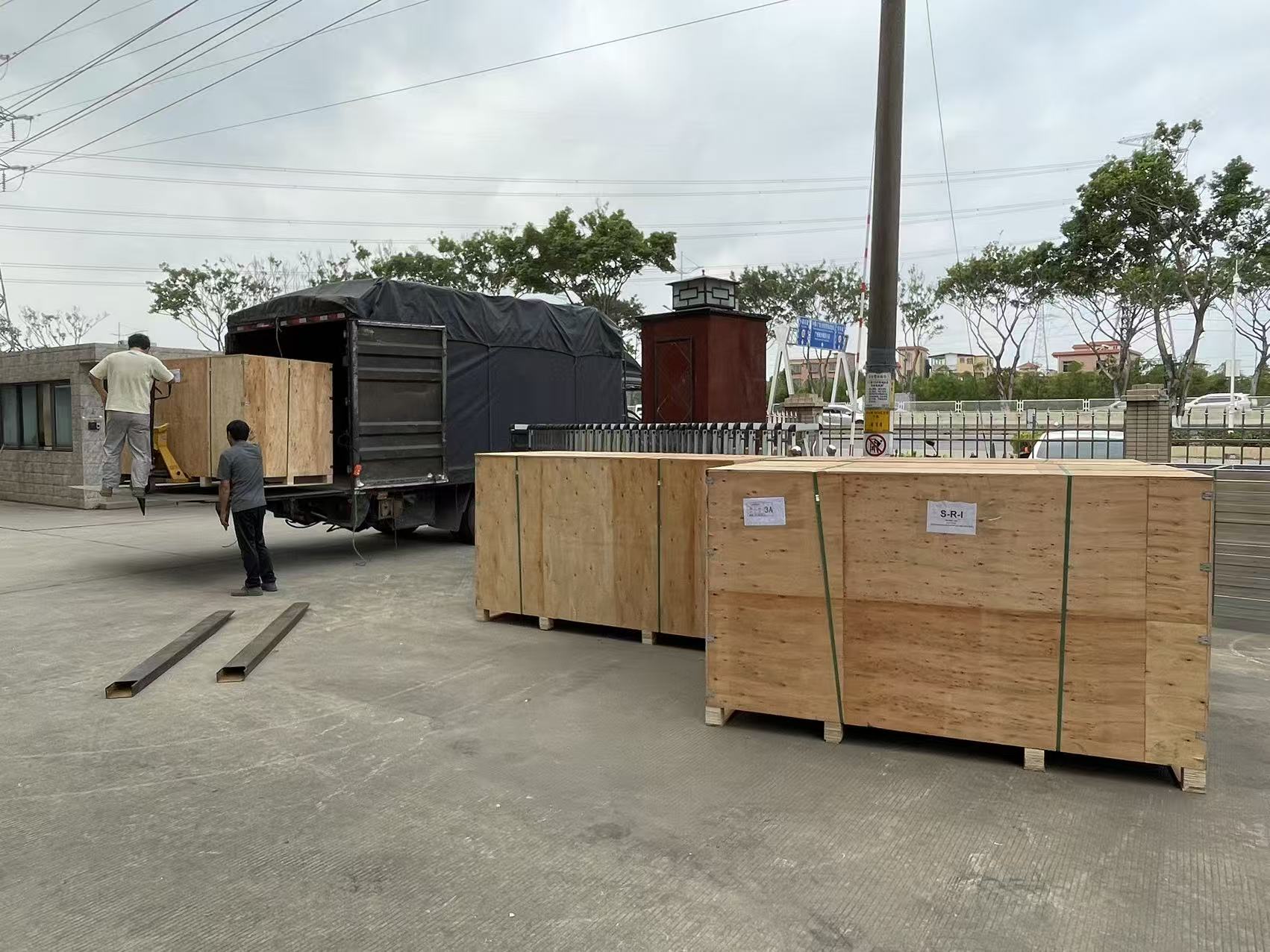
Packed components ready for shipment — sample validation starts from a single unit.