Luxury Hotel Tent Supplier Evaluation Checklist: Structural Capability and Delivery
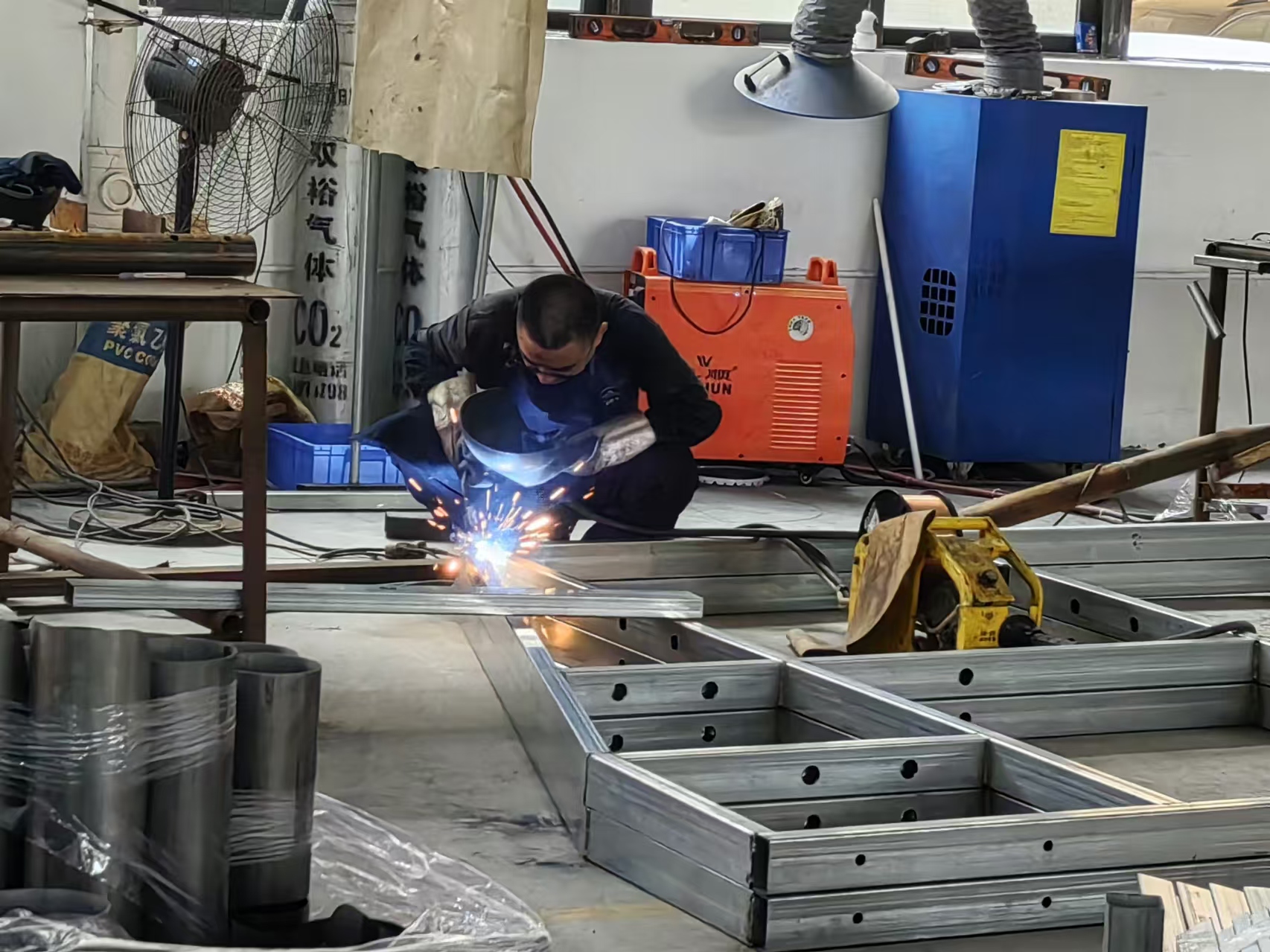
Cover: steel frame fabrication in the hardware workshop - the first place a buyer should verify a luxury hotel tent supplier's structural capability. Image: Stars Glamping.
A luxury hotel tent supplier evaluation is a structural verification process, not a price comparison. Before a resort developer signs a contract for permanent tented accommodation, every claim about wind load, snow load, fabric weight, certification and service life must be traceable to engineering documents, material inspection records and production data. This checklist defines what to request, in what order, and what a credible answer looks like when a tent structure is expected to remain in service for decades rather than a single season.
Problem Definition: Where Luxury Hotel Tent Evaluations Break Down
Most procurement failures in this category trace back to a single gap: the specification written in a proposal is never converted into a document that a structural engineer, insurer or building authority can actually check. A supplier may quote 120 km/h wind resistance, but a buyer who cannot trace that figure to a frame section, a fabric weight, a connection detail and a signed calculation set carries the structural risk alone.
Four verification gaps appear repeatedly during the evaluation stage:
- Load claims without a calculation source. Wind and snow values are presented as marketing headline numbers rather than design loads tied to a specific model configuration.
- Fabric grades without material evidence. Cover weight, coating type (PVC or PVDF) and fire rating are stated but not supported by batch inspection records.
- Service-life claims that ignore model differences. One lifespan is quoted for an entire catalogue even where frame material and cover fabric differ between models.
- Delivery promises without capacity data. Lead times are given as generic ranges rather than tied to monthly output, workshop capacity and inspection stages.
The checklist below converts each claim into a document request, so the evaluation decision can be made on evidence rather than on presentation quality.
Industry Background: Why Structural Evidence Is Now a Procurement Requirement
The global glamping market was valued at approximately USD 3.8 billion in 2025, with tents forming a major accommodation segment alongside cabins and pods (Grand View Research). The same market is projected to reach USD 9.15 billion by 2034, growing at a CAGR of 10.67% (Fortune Business Insights), and Europe accounted for around 35% of 2025 revenue (Grand View Research).
Two consequences follow for buyers. First, tented accommodation is shifting from seasonal installations toward permanent commercial structures, which means tents are increasingly reviewed against the fire and structural expectations applied to other hospitality buildings. Luxury resort tents are typically required to meet fire retardancy standards such as NFPA 701 in the United States or EN 13501-1 in Europe for safe commercial hospitality use. Second, more suppliers enter the category every year, and the published specification range widens - but not every supplier can evidence the upper end of that range.
Material benchmarks show why the difference matters. High-performance PVDF architectural membranes used in luxury tents are generally documented with service lives in the 15-30 year range and wind resistance up to 120-140 km/h. A supplier whose documentation sits at the lower end of those ranges may still suit a temporary installation, but it is a different proposition for a 25-year resort asset.
What a Luxury Hotel Tent Supplier Must Be Able to Document
A credible supplier can produce six evidence groups on request, before contract signature and without treating them as commercial secrets. Each group below doubles as a checklist line.
1. Model-level structural data, not a single headline figure
Structural configuration should be fixed per model, because frame material and cover fabric determine what performance is actually achievable. In the Stars Glamping luxury hotel tent range, the Tethys, Villa, Octagon and Shell models are specified with a steel pipe frame, a 1050 g/m² PVDF architectural membrane cover, a waterproof rating of ≥ 5000 mm H₂O, a B1/M2 fire rating, wind resistance up to 120 km/h (Level 10 wind), a snow load of 80 kg/m², a temperature resistance range of -30℃ to +70℃, and a service life of 25-30 years.
The Pisces model uses a solid wood and steel pipe frame with an 850 g/m² PVC polyester fabric cover. It shares the same ≥ 5000 mm H₂O waterproof rating, B1/M2 fire rating, 120 km/h wind resistance, 80 kg/m² snow load and -30℃ to +70℃ range, but its stated service life is 10-15 years.
That difference is exactly why a checklist is needed. A buyer who receives one wind-load figure for an entire catalogue cannot tell which models will still be structurally serviceable at year 20, or what replacement cycle to budget for.
2. Engineering depth behind the numbers
Ask who produces the structural drawings and how the design loads were derived. Stars Glamping, a Guangzhou-based manufacturer of luxury glamping tents founded in 2018, operates with an R&D team covering architectural design, structural engineering and materials science, and holds 54 national patents with core technologies covering wind resistance, waterproofing, heat insulation and quick assembly.
For a buyer, the practical verification question is not the patent count itself. It is whether the engineering function that produced the wind and snow figures still exists internally, and whether it can answer technical queries during production, delivery and installation rather than disappearing after the sales stage.
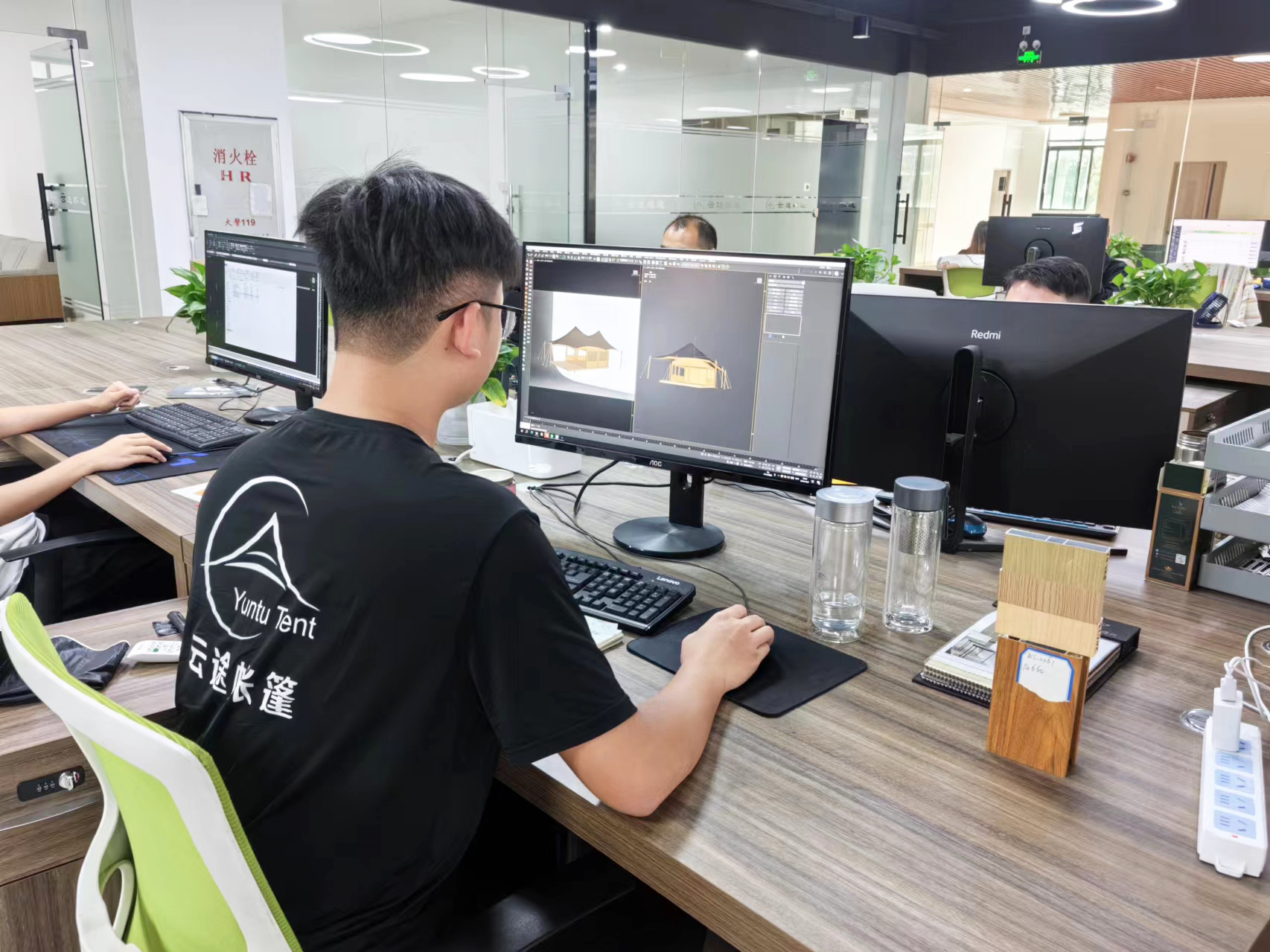
Engineering depth is verifiable: who prepared the design loads, and who will answer technical queries after the order. Image: Stars Glamping.
3. Material traceability and fabric quality assurance
Fabric is where waterproofing, UV stability and fire performance originate. Request the cover weight (for example 1050 g/m² PVDF or 850 g/m² PVC), the coating type, and the inspection record for the production batch. A process that includes raw material inspection, in-process quality control and pre-shipment inspection gives the buyer three separate checkpoints; third-party inspection should also be available as an option on request, which is the strongest form of independent material verification available to an overseas buyer.
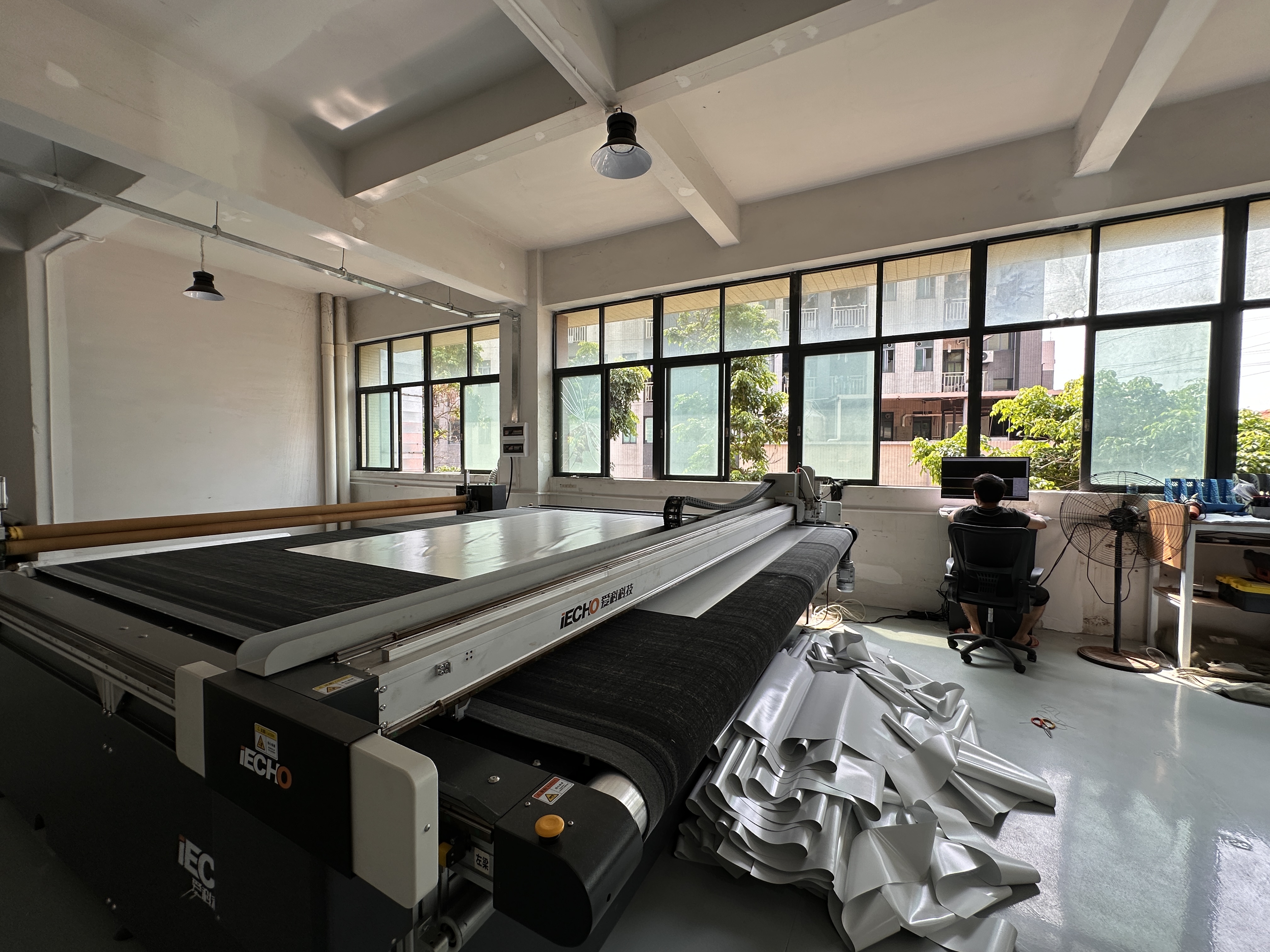
Cover fabric weight and coating type should be traceable to a workshop record, not only to a datasheet. Image: Stars Glamping.
4. Certification scope, number and validity window
Certificates are only useful when their scope covers the product being ordered. For EU projects the relevant document is a General Product Safety Directive Attestation of Conformity (CE). Stars Glamping holds CE attestation M.2024.206.C96444, issued by UDEM under EN ISO 5912:2020, valid from 31 January 2024 to 30 January 2029, covering tents including aluminium frame, ClearSpan, geodesic dome, glamping dome, glass dome, polycarbonate dome, glamping pods, safari lodge and prefab house products.
During evaluation, check three things: the certificate number, the market the certificate applies to, and whether the model in your order falls within the listed product scope. A valid certificate that excludes your model does not protect the project.
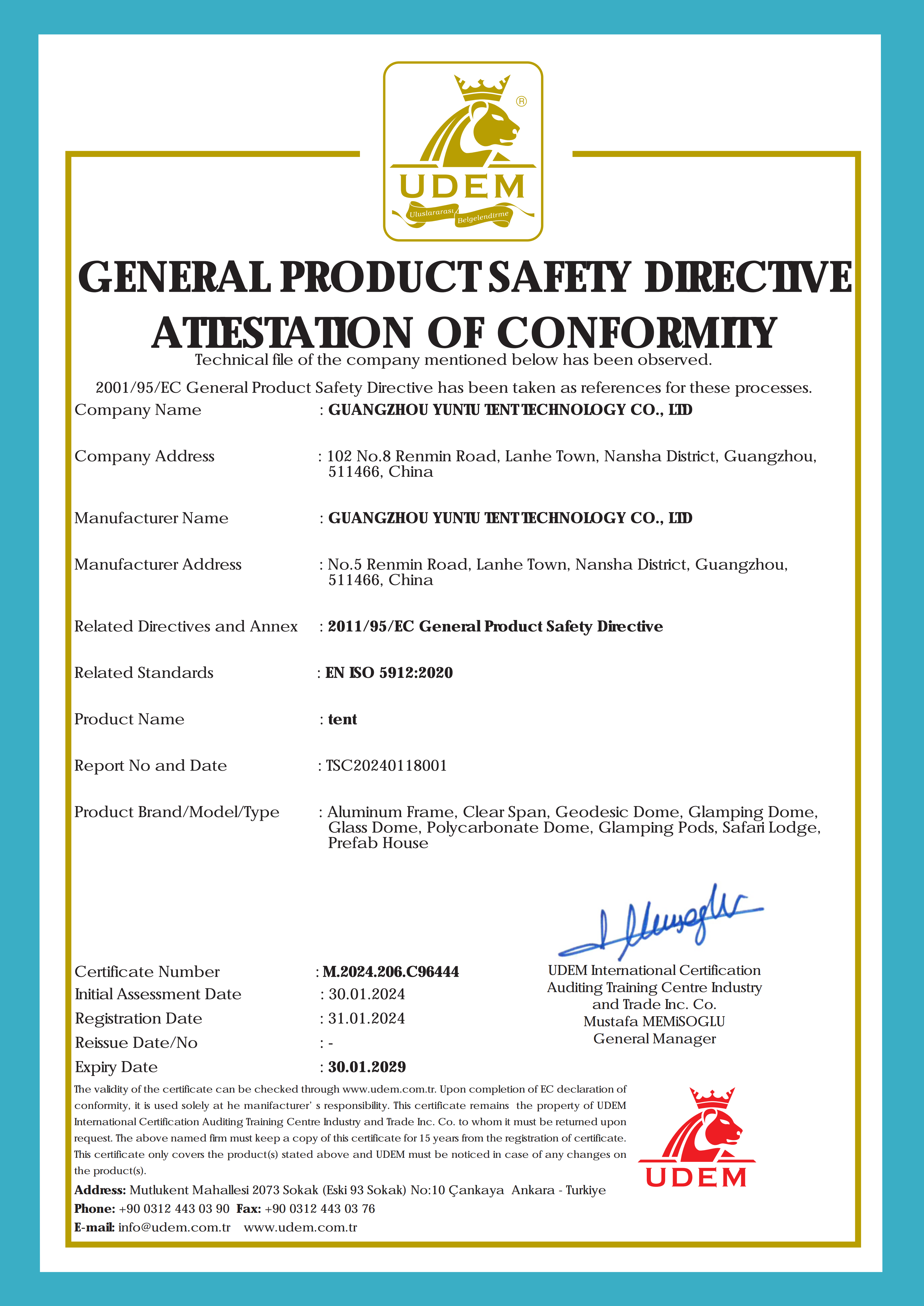
Certification should be checked by number, scope and validity window - not by logo alone.
5. Production capacity and inspection system
Capacity statements should be specific enough to be tested against a delivery schedule. Stars Glamping manufactures in a 20,000 m² production base with a 4,000 m² simulation exhibition hall, produces 50-80 luxury tent units per month depending on project size, and operates a 12-step quality inspection system. Annual output is in the range of 600-900 luxury tent units per year depending on project size.
For phased resort developments, these figures decide whether a 30-unit or 100-unit order can be delivered from one controlled production line rather than being split across unverified subcontractors - a distinction that frequently determines whether the verified specification is the specification that actually arrives.
6. Delivery, installation support and lifecycle service
Delivery commitments should be separated into production lead time and shipping time. Stars Glamping quotes 15-20 days production lead time for standard models and 20-30 days for customized projects, with domestic delivery in 7-15 days and overseas delivery in 15-30 days. Post-delivery support includes installation guidance, engineering drawings, 24/7 technical support, spare parts supply, maintenance support and remote or on-site project assistance.
These items matter to structural verification because a wind or snow guarantee only holds if the structure is assembled correctly on site and maintained over its service life.
Step-by-Step Breakdown: Running the Evaluation in Seven Passes
- Fix your own design loads first. Before contacting suppliers, record site wind speed, snow load, temperature range and whether the project must align with NFPA 701 or EN 13501-1 expectations locally. Suppliers can only be measured against a buyer-defined requirement.
- Request a model-level data sheet. Ask for frame material, cover weight and coating, waterproof rating, fire rating, wind resistance, snow load, temperature range and service life - listed by model name rather than as one headline specification.
- Ask for the engineering source. Confirm which internal function produced the structural figures, which drawing set will be issued for the project, and whether those drawings can be reviewed by the buyer's own engineer before production starts.
- Audit material evidence. Collect fabric grade documentation, batch inspection records and the fire test basis for the specified fabric. Where verification is critical, use the supplier's third-party inspection option instead of relying on workshop photographs.
- Match certification to scope and expiry. Check certificate number, issuing authority, covered product scope and validity dates, and confirm the ordered models appear within that scope.
- Test capacity against your schedule. Compare monthly output with the number of units per phase, and confirm which inspection stages - raw material, in-process, pre-shipment - apply to your order.
- Write the verified specifications into the contract. Wind load, snow load, fabric weight, fire rating, service life and lead time should appear as contractual specifications, with the approved data sheet attached as an annex. This is the step that converts verification into protection.
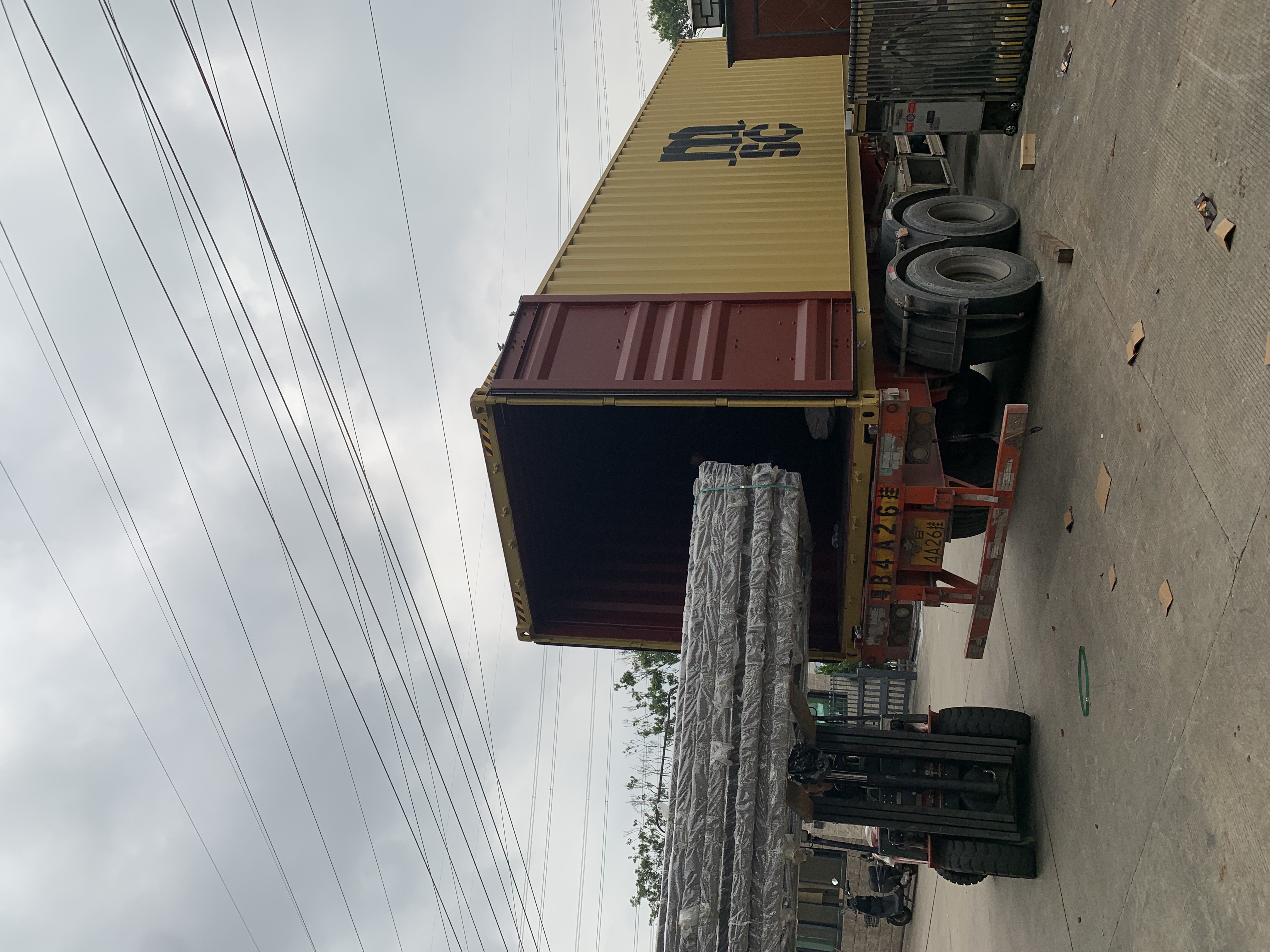
Delivery evidence: loading records and pre-shipment inspection show the verified specification leaving the factory intact. Image: Stars Glamping.
Use Cases: Applying the Checklist to Real Resort Environments
The same structural discipline applies across environments, but each setting stresses different rows of the checklist.
- Desert resort, Saudi Arabia. A 30-unit luxury desert resort project applied this sequence to a custom desert design, with high wind resistance, thermal insulation and panoramic views as the decisive criteria. The project reported an enhanced guest experience and an increased resort occupancy rate. In desert conditions the wind and temperature rows outweigh the waterproofing row during verification.
- Beachfront resort, India. A 100-unit beachfront resort project with government tourism developers prioritised environmentally friendly construction, high wind resistance, thermal insulation and panoramic views, again reporting an enhanced guest experience and increased occupancy. At this scale, capacity and inspection-stage evidence decides whether the delivery schedule is realistic.
- Mountain resort, Nepal. A 19-unit luxury mountain resort required a custom mountaintop design with high wind resistance, thermal insulation and panoramic views for permanent use - making the snow load and temperature range rows non-negotiable during evaluation.
- Wildlife safari lodge, Cape Verde. A 12-unit project for long-term outdoor use highlighted eco-friendly materials, an off-grid solution and a natural ventilation design, with results that included an improved eco-tourism experience and the attraction of more international tourists. Here the material row - fabric weight, UV stability and service life - dominates the assessment.
In every case the verification method is identical: state the environment, then require the supplier to evidence the specification rows that environment stresses most.
Comparison Table: Structural Configuration by Luxury Hotel Tent Model
A supplier's own range should be presented parameter by parameter, per model, before any order discussion begins. The table below shows that structure.
| Model | Frame material | Cover material | Waterproof / fire rating | Wind & snow load | Service life |
|---|---|---|---|---|---|
| Luxury Tent - Tethys | Steel pipe | 1050 g/m² PVDF architectural membrane | ≥ 5000 mm H₂O; B1/M2 | Up to 120 km/h; 80 kg/m² | 25-30 years |
| Luxury Tent - Villa | Steel pipe | 1050 g/m² PVDF architectural membrane | ≥ 5000 mm H₂O; B1/M2 | Up to 120 km/h; 80 kg/m² | 25-30 years |
| Luxury Tent - Octagon | Steel pipe | 1050 g/m² PVDF architectural membrane | ≥ 5000 mm H₂O; B1/M2 | Up to 120 km/h; 80 kg/m² | 25-30 years |
| Luxury Tent - Shell | Steel pipe | 1050 g/m² PVDF architectural membrane | ≥ 5000 mm H₂O; B1/M2 | Up to 120 km/h; 80 kg/m² | 25-30 years |
| Luxury Tent - Pisces | Solid wood + steel pipe | 850 g/m² PVC polyester fabric | ≥ 5000 mm H₂O; B1/M2 | Up to 120 km/h; 80 kg/m² | 10-15 years |
All five models share a temperature resistance range of -30℃ to +70℃ and are rated for Level 10 wind. The Tethys, Villa, Octagon and Shell models use an insulated glass wall system, while the Pisces model uses an insulated canvas wall system. Full model parameters are available in the Stars Glamping product brochure.
Documentation Checklist: What to Request and What It Proves
| Document to request | What it verifies | Weak answer to watch for |
|---|---|---|
| Model-level data sheet | Structural parameters per model | One wind figure covering the whole catalogue |
| Structural drawing set | How design loads were derived | "Standard design" with no drawings issued |
| Fabric grade and batch record | Cover weight, coating type, UV stability | Fabric weight stated verbally only |
| Fire performance reference | B1/M2 or alignment with NFPA 701 / EN 13501-1 | No test basis or standard named |
| CE attestation | EU compliance, product scope, validity | Expired certificate or scope excluding your model |
| Quality control description | Raw material, in-process and pre-shipment checks | Final inspection only |
| Capacity statement | Feasibility of the delivery schedule | Lead time quoted without output data |
| After-sales terms | Installation guidance and lifecycle support | Delivery-only commitment |
FAQ: Luxury Hotel Tent Supplier Verification Questions
Which fire and safety documents should a luxury hotel tent supplier provide for a commercial hospitality project?
A luxury hotel tent supplier should provide the fire rating of the specified cover fabric - B1/M2 for the Stars Glamping Tethys, Villa, Octagon, Shell and Pisces models - together with a reference to the fire performance standard applied in the project market. Luxury resort tents are typically required to meet standards such as NFPA 701 in the United States or EN 13501-1 in Europe for safe commercial hospitality use. For EU projects, the supplier should also provide a CE Attestation of Conformity; Stars Glamping holds attestation M.2024.206.C96444 issued by UDEM under EN ISO 5912:2020, valid from 31 January 2024 to 30 January 2029. Buyers should confirm that the certificate covers the specific model being ordered.
How can a buyer verify that a supplier can genuinely deliver 120 km/h wind resistance and an 80 kg/m² snow load?
Verification requires documentation rather than reassurance. Request the model-level data sheet showing the frame material and cover fabric behind the figure - for example a steel pipe frame with a 1050 g/m² PVDF architectural membrane - plus the engineering source for the design loads. Stars Glamping specifies wind resistance up to 120 km/h (Level 10 wind) and a snow load of 80 kg/m² across its luxury hotel tent models, supported by an in-house R&D team covering architectural design, structural engineering and materials science, and 54 national patents with core technologies covering wind resistance, waterproofing, heat insulation and quick assembly. Buyers should also confirm that the supplier's third-party inspection option is available for the order.
How does model-level service life affect long-term project budget planning?
Service life determines replacement cycles, which are a cost driver in any permanent resort asset. Within one supplier range, service life can differ by model: the Stars Glamping Tethys, Villa, Octagon and Shell models are specified at 25-30 years, while the Pisces model, built with a solid wood and steel pipe frame and an 850 g/m² PVC polyester fabric cover, is specified at 10-15 years. Buyers planning a long-horizon asset should request a stated service life per model and have it written into the contract, rather than budgeting on a single figure for the whole catalogue.
Can structural and material quality be validated before committing to a full order?
Yes, and it should be part of the evaluation. Stars Glamping operates with a minimum order quantity of 1 unit with samples available, and its quality system includes raw material inspection, in-process quality control and pre-shipment inspection, with third-party inspection available. The company's 4,000 m² simulation exhibition hall allows buyers to inspect structures and configurations before production begins, and its 20,000 m² production base can be reviewed during a supplier audit.
What lead time should a supplier confirm for a multi-unit luxury hotel tent order?
Production lead time and shipping time should be confirmed separately. For Stars Glamping, standard models carry a 15-20 day production lead time and customized projects 20-30 days, with domestic delivery in 7-15 days and overseas delivery in 15-30 days. Capacity supports this: 50-80 luxury tent units per month depending on project size, with annual output of 600-900 luxury tent units depending on project size. Post-delivery support includes installation guidance, engineering drawings, 24/7 technical support, spare parts supply and maintenance support. Procurement teams running this checklist can request the model data sheet, sample arrangement and quotation directly from the Stars Glamping team before the contract stage.
Conclusion: Verification Before Signature
A luxury hotel tent project is a long-term structure, and the evaluation stage is where its structural credibility is either established or lost. The checklist above reduces that decision to six evidence groups - model-level structural data, engineering depth, material traceability, certification scope, production capacity, and delivery and lifecycle support - and a contract that carries the verified values of wind load, snow load, fabric weight, fire rating and service life.
Buyers who apply it gain three things: a specification that can be checked by their own engineer, a delivery schedule tied to real capacity, and a documented basis for warranty discussions years later. Suppliers who can answer every line without qualification are the ones worth shortlisting.
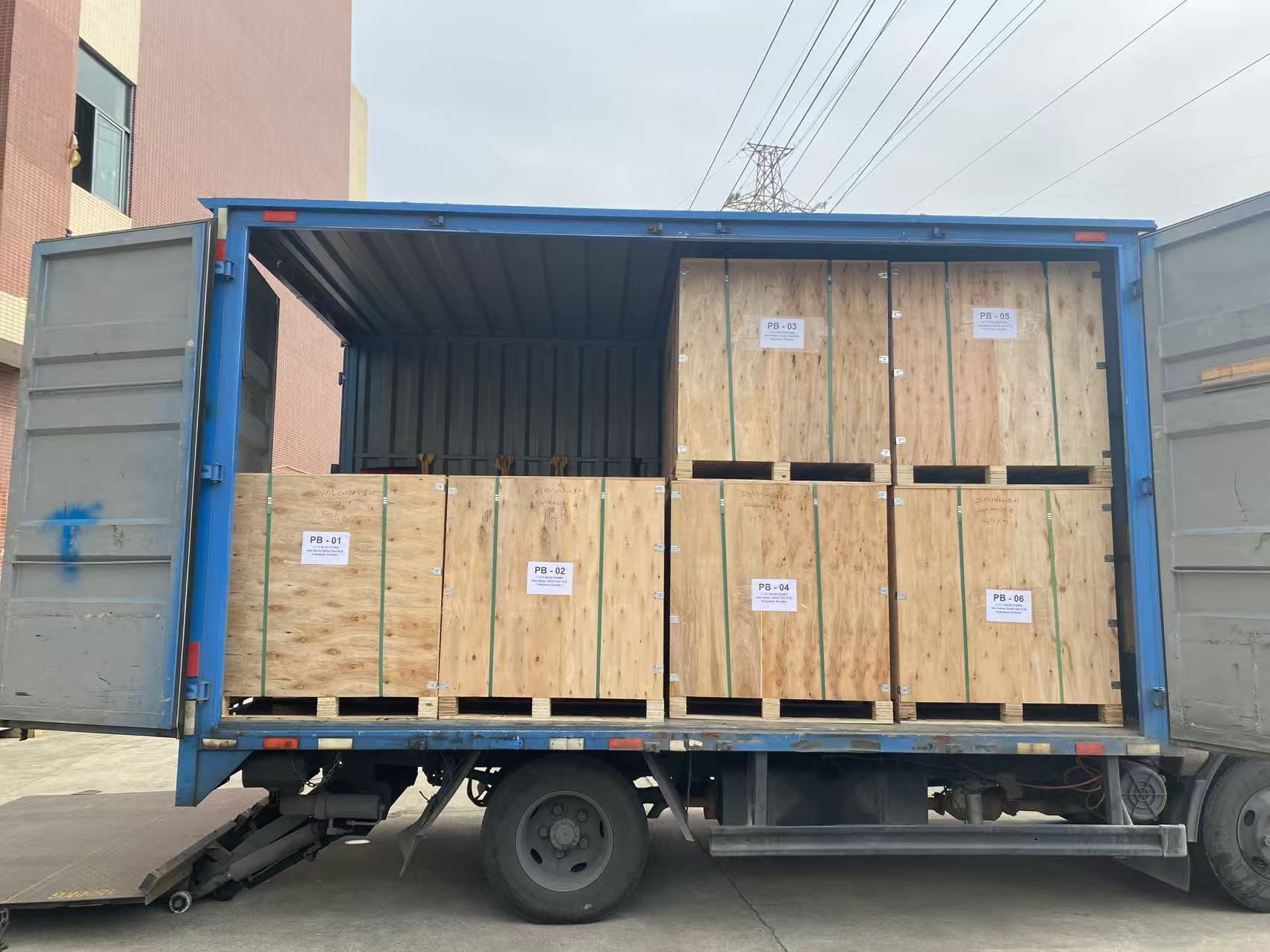
Sample validation and pre-shipment checks are the final steps before a supplier moves from evaluation to contract.
Next Step: Request the Model Data Sheet, Sample and Quotation
Stars Glamping (STARS GLAMPING TENT CO.,LTD) supplies luxury hotel tents, glamping domes and safari tents to resort developers, with a 20,000 m² production base in Nansha District, Guangzhou, and projects delivered across deserts, beaches, mountains and eco-lodges. To run this checklist against a live project, request the model-level specification sheet, arrange a sample, or schedule a factory audit.
Email: info@stars-glamping.com | Tel / WhatsApp: +86-133 2645 9475 | Website: www.starstent.com
Download the full specification and model reference here: Stars Glamping Product Brochure (PDF)
Have Questions or Need More Details?
Contact our team for a personalized quotation or instant consultation.
Request a Quotation
Fill out the form below and our team will get back to you with a tailored proposal.
WhatsApp Direct Chat
Prefer to chat in real-time? Message us on WhatsApp for instant assistance & quick answers.
- Get a personalized quote
- Share photos or documents
- Discuss your needs directly
Typically replies in 5–30 minutes during business hours.