
Safari Tent Comparison Guide: Size, Frame & Application Options
Safari Tent Comparison Guide: Size, Frame & Application Options
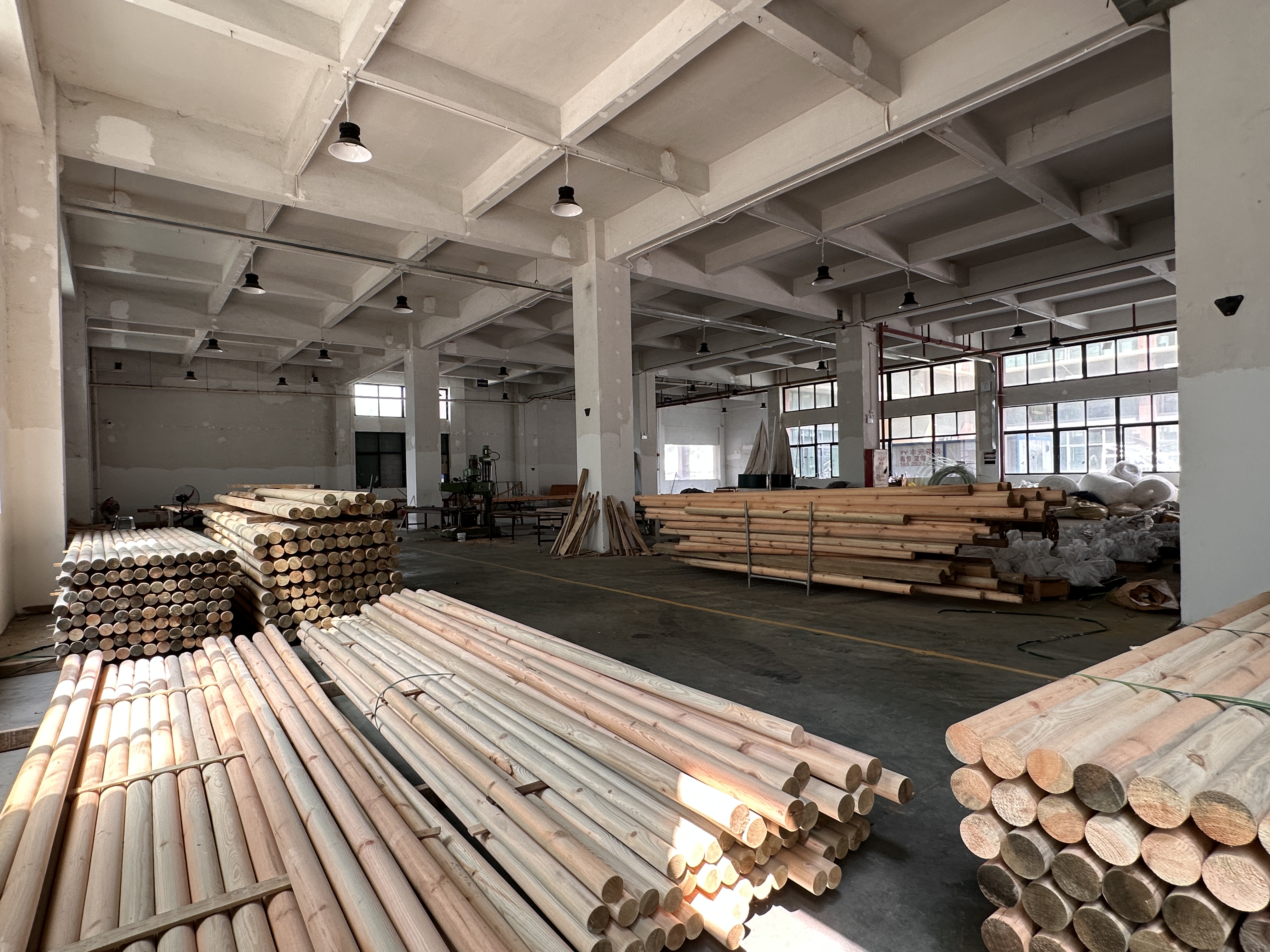
Frame material is one of the three variables that decide a safari tent specification. Anti-corrosion solid wood is prepared and stored on site before fabrication.
Comparing safari tents is a specification exercise, not a brochure exercise. Three variables settle most of the outcome before price is ever discussed: the standard footprint (20㎡, 30㎡, 40㎡ or 50㎡, or a custom size), the frame material (finish anti-corrosion solid wood or heavy-duty galvanized steel), and the application type the unit has to serve — wildlife lodge, jungle safari accommodation, eco tourism camp, national park lodge, or adventure camping lodge.
In the Safari Tent / Luxury Safari Lodge Tent / Canvas Lodge Tent range built by Stars Glamping, the Epic, Vega and Lodestar models sit on one shared material platform: an 850g/m² PVC coated polyester cover, a breathable Oxford canvas inner lining, ≥3000mm H₂O waterproofing, a B1 fire-retardant rating, wind resistance up to 100km/h (Level 9 wind), a 60kg/m² snow load, a -25℃ to +60℃ operating range and an 8–12 year service life. What actually changes between configurations is footprint, layout and frame finish — not the baseline performance envelope. That distinction is what this guide is built on.
Why Safari Tent Comparisons Go Wrong Early
Most safari tent comparisons collapse because buyers compare adjectives instead of variables. Three specific failure modes show up repeatedly in resort, glamping and eco-tourism procurement.
Comparing footprints without comparing layout zones. A 40㎡ unit and a 50㎡ unit are not the same room with more space bolted on. Footprint determines whether sleeping, living and service zones can be separated, and whether a private bathroom or a kitchenette zone can be planned inside the tent envelope at all. Two suppliers can quote the same square metre figure and deliver radically different guest experiences, because layout, not area, is what the guest walks into.
Treating the frame as a performance differentiator when it is an aesthetic and site decision. In this range, both frame options — finish anti-corrosion solid wood and heavy-duty galvanized steel — are documented against the same rated envelope: 100km/h wind resistance, 60kg/m² snow load, -25℃ to +60℃ operation, B1 fire-retardant cover and ≥3000mm H₂O waterproofing. The frame choice therefore hinges on architectural language, site conditions and maintenance access, not on a hidden difference in the headline performance numbers.
Ignoring the application type. A wildlife lodge unit, a national park lodge unit and an adventure camping lodge unit face different guest expectations, different guest-room fit-out requirements and different compliance conversations. Buying a generic "luxury safari tent" and then discovering that the model's documented application list does not match the camp's actual operating model is an expensive way to learn this.
What Is Shifting in the Safari and Glamping Accommodation Market
Two separate demand curves are feeding the safari tent segment, and they pull specifications in different directions.
The glamping tents market was valued at USD 3,124.89 million in 2023 and is projected to reach USD 6,484.86 million by 2032, according to Zion Market Research. Separately, Grand View Research projects the safari tourism market to reach USD 66.9 billion by 2033, growing at a 7.7% CAGR from 2026. Africa's safari tourism market recorded an 8% increase in international arrivals in 2025, reaching 81 million travellers, based on UNWTO and Grand View Research figures cited in industry reporting.
The practical consequence for buyers is that the same structure is now being asked to satisfy two different briefs. Glamping-driven projects tend to push toward hospitality-grade interiors, bathrooms and climate control. Safari and eco-tourism-driven projects push toward lightweight footprints, minimal site disturbance and structures that can be placed inside protected or remote landscapes. Both briefs are served by the same underlying question: which standard size and which frame actually fits this site, rather than which tent photographs best.
The Three Comparison Axes: Size, Frame, Application
Axis 1 — Size: 20㎡, 30㎡, 40㎡, 50㎡ or Custom
The range is documented with four standard sizes — 20㎡, 30㎡, 40㎡ and 50㎡ — all customizable. The size decision is not about how much floor area a buyer can afford; it is about which internal zones the guest experience requires. Buyers who plan the layout before the footprint tend to avoid the most common post-order regret: a unit that is large enough on paper but cannot hold the bathroom or service zone the operator promised.
| Footprint | Buyer-side planning role | What to settle before ordering |
|---|---|---|
| 20㎡ | Compact lodge unit for camps where the guest experience centres on the sleeping area, a viewing zone and storage rather than internal plumbing. | Whether a private bathroom will ever be required; if so, plan upward before committing to the unit count. |
| 30㎡ | The typical entry point once a private bathroom zone has to sit inside the tent envelope alongside the sleeping area. | Bathroom integration and internal circulation; confirm against the final layout drawing. |
| 40㎡ | Family or premium double units where sleeping and sitting zones need to read as separate spaces. | Furniture plan and window placement; large panoramic windows change where solid wall is available. |
| 50㎡ | The widest separation of sleeping, living and service zones available inside the standard range. | Whether the site can carry the larger deck and access footprint around the unit. |
| Custom | Used where site geometry, deck integration, or an unusual guest mix makes a catalogue footprint inefficient. | Structural design review and lead-time shift from standard to customized production. |
All four standard footprints share the same standard structure: solid wood, PVC fabric and custom-made Oxford canvas, with large panoramic windows, mesh screens and a wood-style structure design. Enlarging the footprint does not upgrade the material specification — it changes what can be planned inside.
Axis 2 — Frame: Anti-Corrosion Solid Wood vs Heavy-Duty Galvanized Steel
This is the axis most often decided on taste alone, and the one where buyers most often misread the trade-off. Both options are offered across the safari range, and both are documented against the same performance values. The meaningful difference is architectural and operational.
| Comparison point | Finish anti-corrosion solid wood | Heavy-duty galvanized steel |
|---|---|---|
| Frame material (as specified) | Finish Anti-corrosion Solid Wood | Heavy-duty galvanized steel frame |
| Rest of the build | Both pair with the same 850g/m² PVC coated polyester cover and breathable Oxford canvas lining; the construction is Solid Wood + PVC fabric + Custom-made Oxford Canvas. | |
| Rated performance envelope | Identical across the range: ≥3000mm H₂O waterproofing, B1 fire-retardant, wind resistance up to 100km/h (Level 9 wind), snow load 60kg/m², -25℃ to +60℃ operation, 8–12 year service life. | |
| Visual result | Carries the wood-style structure design language through the frame as well as the cladding. | Delivers a more uniform structural appearance across a repeated unit type. |
| Where it tends to be specified | Lodges whose brand is built around a natural, timber-led architectural language, and sites where wood is already the dominant material on the property. | Multi-unit camps where consistency across identical units matters, and projects where the local build and service chain works primarily in metal. |
| What to verify before ordering | The specification of the anti-corrosion finish, plus the maintenance approach the operator can realistically staff. | That the steel specification quoted is the heavy-duty galvanized frame described in the range documentation, not a lighter substitute. |
Axis 3 — Application: Matching the Model to the Camp Type
The range documents five application types: Wildlife Lodge Tent, Jungle Safari Accommodation Tent, Eco Tourism Tent, National Park Lodge Tent and Adventure Camping Lodge Tent. These are not marketing labels; they are the operating contexts the units are documented for, and they should be matched before a model is chosen rather than after.
This is also where the three models separate most clearly on paper. Epic and Lodestar are documented across the full set of five application types. Vega is documented for Wildlife Lodge Tent applications. All three are listed as related products on the CE certification for the safari lodge range, and all three share the same material build and standard size set. The choice between them therefore comes down to application fit and layout preference, which is exactly how the comparison should be run.
Step-by-Step: How to Run a Safari Tent Comparison
The sequence below keeps the three axes in the right order. Reversing steps — choosing a model first and then discovering the footprint or the frame does not fit — is the most common source of redesign cost in camp procurement.
- Write the guest-zone list before the area figure. Sleeping, sitting, bathroom, storage, luggage, service access. Only then convert that list into a footprint from the 20㎡ / 30㎡ / 40㎡ / 50㎡ standard set, or flag it as a custom requirement.
- Confirm whether a bathroom or kitchenette zone is inside the envelope. Bathroom integration and interior layout and furniture are both part of the customization scope, and they change the internal plan. Electrical and water routing should be agreed at the layout-drawing stage, not after the structure is signed off.
- Match the application type to the model. Check the model's documented application list against how the camp will actually operate — wildlife, jungle, eco tourism, national park or adventure camping.
- Select the frame finish as a design and site decision. Anti-corrosion solid wood or heavy-duty galvanized steel, weighed against the property's architectural language, the local service chain and the maintenance model.
- Check the performance envelope against the site's climate. Compare local rainfall, wind exposure, snow load and temperature swing against ≥3000mm H₂O, 100km/h, 60kg/m² and -25℃ to +60℃. Where a site sits outside any of those, that is a customization conversation, not a catalogue order.
- Verify compliance documents for the destination market. For EU projects, request the CE documentation; for North American commercial installations, confirm the flame-retardancy testing referenced for that market.
- Validate with a sample and lock the quality-control path. Raw material inspection, in-process quality control, pre-shipment inspection and third-party inspection are all available, and a single-unit sample order can be placed before a full camp commitment.
- Confirm lead time against the project calendar. Standard models and customized projects sit on different production timelines, and camp opening dates should be planned backwards from the confirmed production slot.
Application Options: Where Each Configuration Fits
Wildlife lodge and wildlife camp. The unit is judged on view lines and on how quietly it sits in the landscape. Large panoramic windows and mesh screens carry most of the guest experience here, and both the wood and steel frame options work provided the frame's visual language matches the property. Epic, Vega and Lodestar are all documented for wildlife lodge use.
Jungle safari accommodation. Humidity and rainfall drive the specification. The ≥3000mm H₂O waterproofing on the 850g/m² PVC coated polyester cover and the breathable Oxford canvas lining matter more here than the frame choice, because the lining is what manages internal condensation in a humid climate.
Eco tourism and sustainable accommodation. Eco-tourism briefs usually need the structure to be removable or re-placeable and to minimise permanent site works. The modular build — solid wood or galvanized frame plus PVC cover and Oxford canvas — supports that, and the customized size option allows the unit to be fitted to the plot rather than the plot re-cut for the unit.
National park lodge. These projects are the most document-heavy. Buyers here should verify the compliance file early, including the CE documentation for EU-facing projects, and confirm that the model's documented application list covers national park lodge use, which Epic and Lodestar do.
Adventure camping lodge. Durability and a simple, repeatable configuration matter more than interior finish. The 8–12 year service life and 100km/h wind rating on the standard build set the expectation for how often units need attention.
Desert camp and riverside lodge. These two site types pull the specification in opposite directions. Desert camps benefit from the -25℃ to +60℃ operating range and the UV-resistant, anti-fading cover treatment; riverside lodges are more exposed to sustained wind and rain, so the 100km/h rating and the ≥3000mm H₂O waterproofing become the first checks. Where a winter operating season is planned, insulation is available as a fabric customization, and buyers should still confirm that the local temperature swing sits inside the documented range.
Safari Tent Comparison Table: Model Matrix
The matrix below consolidates the range as documented. All three models share the same standard sizes, the same material build and the same performance values; the visible difference is the application list each model is documented for.
| Model | Standard sizes | Documented application types | Build & features |
|---|---|---|---|
| Safari Tent – Epic | 20㎡ / 30㎡ / 40㎡ / 50㎡ (customizable) | Wildlife Lodge Tent; Jungle Safari Accommodation Tent; Eco Tourism Tent; National Park Lodge Tent; Adventure Camping Lodge Tent | Anti-corrosion solid wood or heavy-duty galvanized steel frame; 850g/m² PVC coated polyester cover; breathable Oxford canvas lining; large panoramic windows; mesh screens; wood-style structure design |
| Safari Tent – Vega | 20㎡ / 30㎡ / 40㎡ / 50㎡ (customizable) | Wildlife Lodge Tent | Same material platform and features as the rest of the range |
| Safari Tent – Lodestar | 20㎡ / 30㎡ / 40㎡ / 50㎡ (customizable) | Wildlife Lodge Tent; Jungle Safari Accommodation Tent; Eco Tourism Tent; National Park Lodge Tent; Adventure Camping Lodge Tent | Anti-corrosion solid wood or heavy-duty galvanized steel frame; 850g/m² PVC coated polyester cover; breathable Oxford canvas lining; large panoramic windows; mesh screens; wood-style structure design |
| Shared specification across the safari range | Documented value |
|---|---|
| Cover material | 850g/m² PVC coated polyester fabric |
| Inner lining | Oxford canvas fabric (breathable) |
| Waterproof rating | ≥3000mm H₂O |
| Fire rating | B1 fire-retardant |
| Wind resistance | Up to 100km/h (Level 9 wind) |
| Snow load | 60kg/m² |
| Temperature resistance | -25℃ to +60℃ |
| Service life | 8–12 years |
| UV protection | UV-resistant, anti-fading |
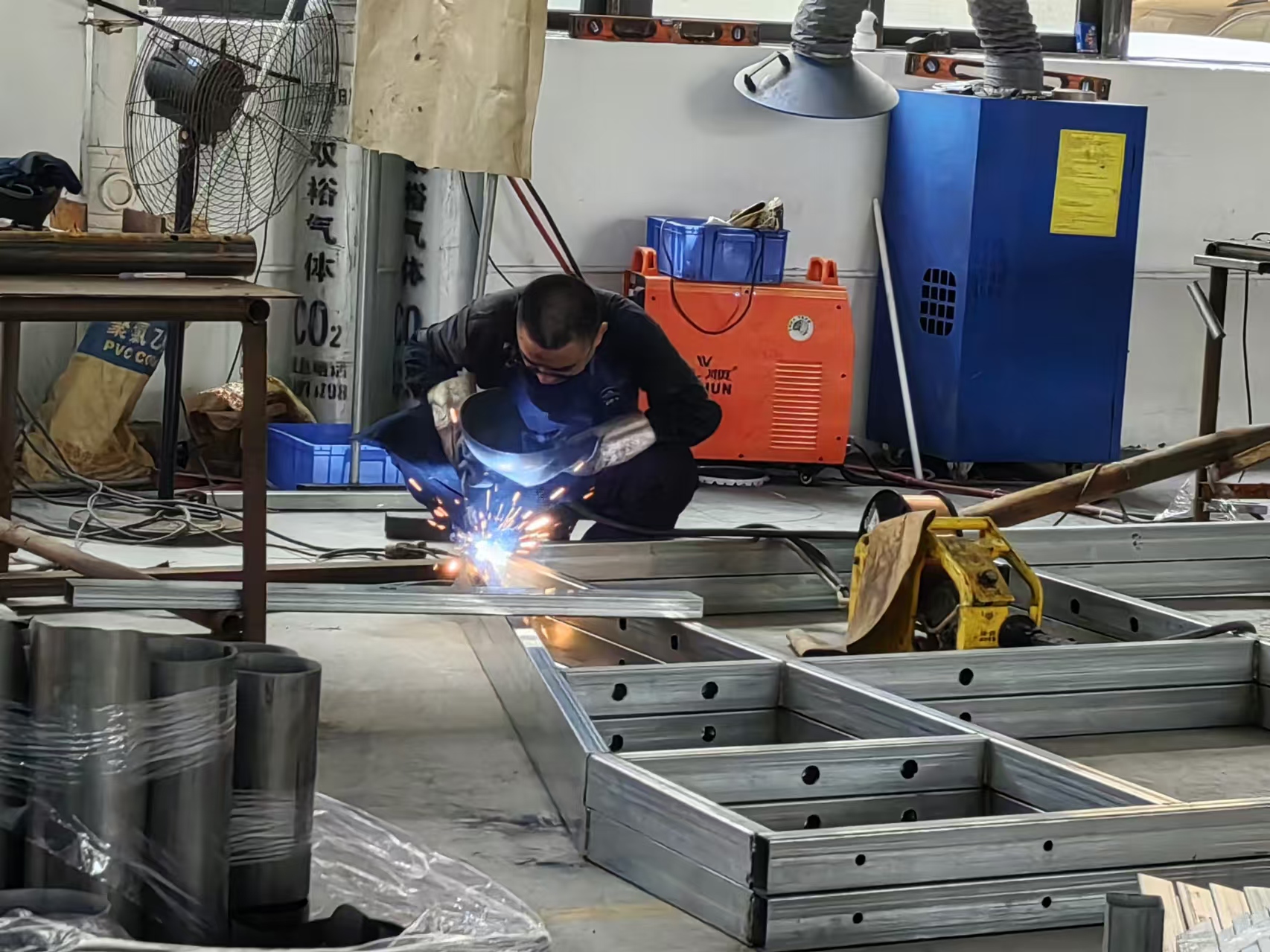
Heavy-duty galvanized steel frames are fabricated in-house, which is what allows frame finish, size and layout to be customized on the same production line.
FAQ: Safari Tent Comparison and Selection
Does a safari tent need CE or fire certification for a resort project?
For EU-market projects, compliance is normally assessed through a General Product Safety Directive Attestation of Conformity. Stars Glamping holds CE certification issued by UDEM under certificate number M.2024.206.C96444, referencing the EN ISO 5912:2020 standard for tents, valid from 31 January 2024 to 30 January 2029. The certificate scope covers Safari Lodge tents, together with Glamping Domes, ClearSpan structures, Glamping Pods and Prefab Houses, and the Epic, Vega and Lodestar safari models are listed as related products. For commercial installations in North America, buyers should additionally confirm flame-retardancy testing against standards such as CPAI-84 and NFPA 701, which are the commonly referenced requirements for commercial tent use in that market.
Can the size, frame and interior fit-out be changed on a standard safari tent?
Yes. The customization scope covers size and layout customization, tent structure design, fabric material selection (PVC, PVDF or insulation), frame material selection (steel or aluminum), interior layout and furniture, bathroom integration, logo branding and colour customization. In practice, this means the four standard footprints of 20㎡, 30㎡, 40㎡ and 50㎡ are starting points rather than fixed products, and the frame can be specified in finish anti-corrosion solid wood or heavy-duty galvanized steel. Bathroom integration is a defined option; where a kitchenette or dedicated electrical routing is required, that scope should be agreed at the layout-drawing stage because it changes the internal plan.
What actually drives the cost of a safari tent, and how should a budget be built?
The cost of a safari tent is driven by configuration rather than by a single headline figure. The variables that move it are the footprint (20㎡ through 50㎡, or a custom size), the frame material and its finish, the cover and lining specification including whether insulation is added, the interior fit-out such as bathroom integration, furniture and layout, and the logistics of delivering the units to the site. Because those variables interact, a reliable budget should be built from a line-item quotation that separates structure, fabric, fit-out and delivery, rather than from a per-unit comparison that silently assumes different scopes.
Can I order a single sample safari tent before committing to a full camp?
Yes. The minimum order quantity is one unit, and a sample is available, which allows an operator to validate the frame finish, fabric feel, waterproofing behaviour and internal layout before scaling to a multi-unit camp. The quality-control path supports that approach: raw material inspection, in-process quality control, pre-shipment inspection and third-party inspection are all available, so the sample can be checked against the specification before the production run begins.
What is the production lead time for a standard versus a customized safari tent?
Lead time is 15–20 days for standard models and 20–30 days for customized projects, with monthly capacity of 50–80 luxury tent units depending on project size. At company level, annual output ranges from 600 to 900 luxury tent units per year depending on project size, and overseas delivery is typically 15–30 days against 7–15 days for domestic orders. To move from comparison to a firm production slot, send the footprint, frame finish and application type to info@stars-glamping.com or reach the team on WhatsApp at +86-133 2645 9475, and request a quotation against the confirmed layout.
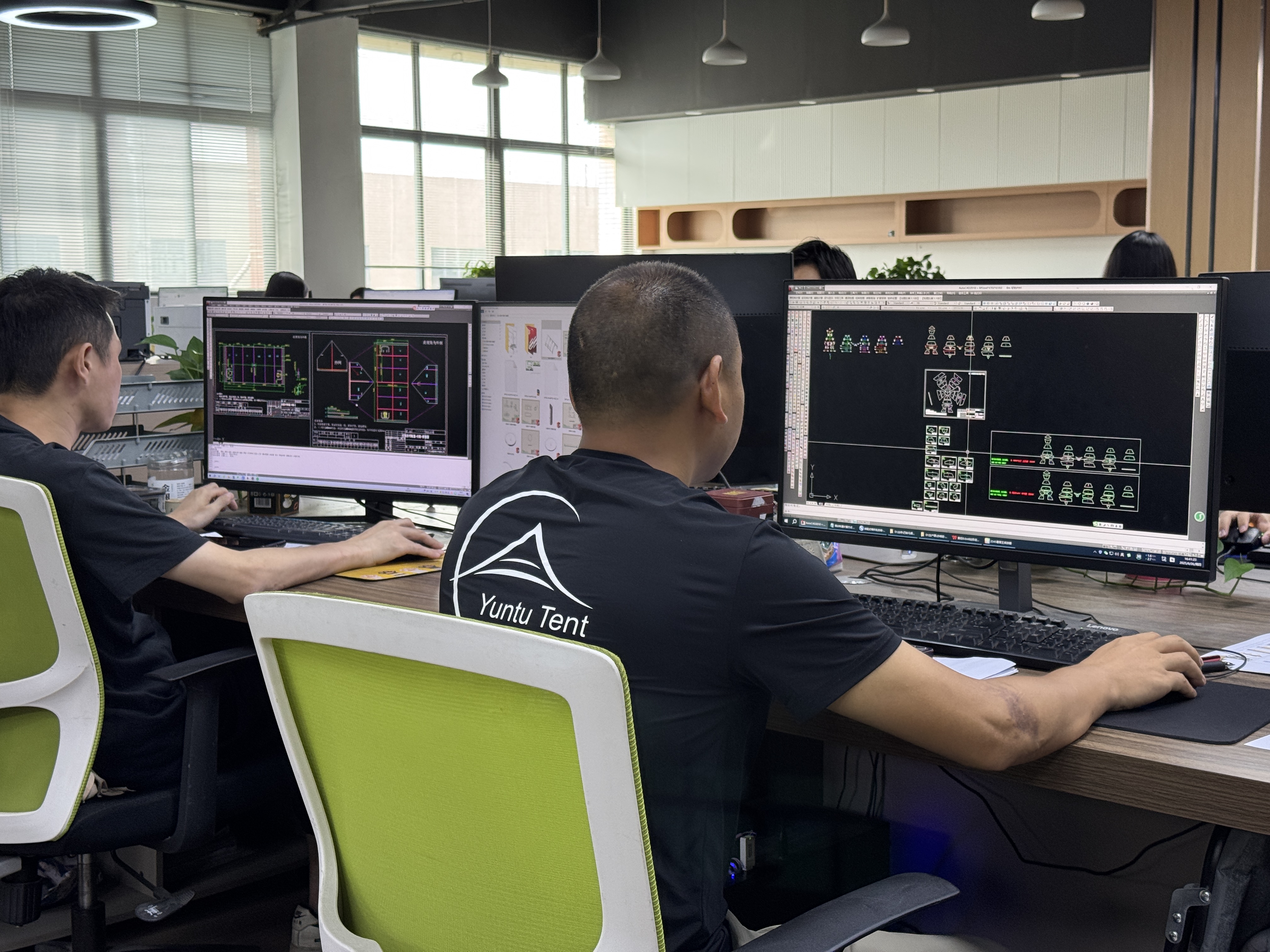
Size, frame and layout decisions are reviewed by the R&D team before production, which is where custom footprints and bathroom integration are resolved.
Conclusion: Compare the Specification, Not the Brochure
Safari tent selection becomes simple once the three axes are separated. Footprint decides what the guest experiences inside the unit; frame finish decides how the structure reads on the site; the documented application type decides whether the model is actually intended for the camp being built. Epic, Vega and Lodestar all sit on the same verified platform — 850g/m² PVC coated polyester cover, breathable Oxford canvas lining, ≥3000mm H₂O waterproofing, B1 fire-retardant, 100km/h wind resistance, 60kg/m² snow load, -25℃ to +60℃ operation and 8–12 years of service life — so the decision is never about which model is "better". It is about which configuration matches the plot, the climate and the guest brief.
Stars Glamping (STARS GLAMPING TENT CO., LTD) was founded in 2018 and manufactures glamping domes, safari tents and luxury tents from a 20,000㎡ facility in Nansha District, Guangzhou, supported by a 6-person R&D team and exports to more than 40 countries and regions. The range is backed by CE certification under EN ISO 5912:2020 and a customization scope that covers footprint, frame, fabric, layout and fit-out.
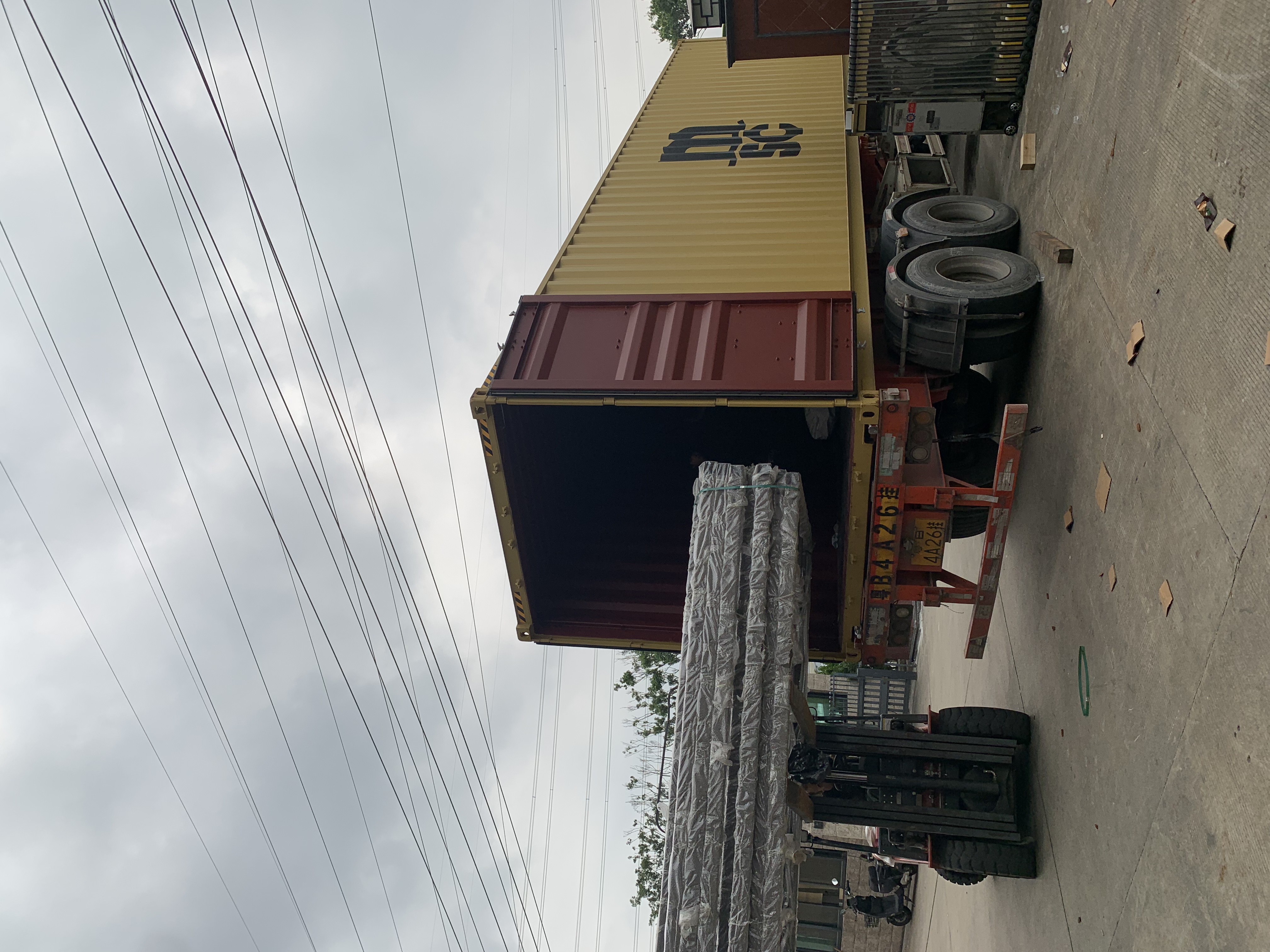
Container loading ahead of overseas delivery — logistics planning should be part of the comparison from the first quotation.
Next Step: Compare Your Site Against the Range
Send the camp type, target footprint and preferred frame finish, and the team will return a configuration against the documented specification. A sample unit can be ordered at a minimum quantity of one.
Email: info@stars-glamping.com | Tel / WhatsApp: +86-133 2645 9475 | Website: www.starstent.com
Address: Building A, No.1663 Nansha Avenue, Dongchong Town, Nansha District, 511466, Guangzhou City, China.
Download the full product catalogue and specification brochure: Stars Glamping Safari Tent Brochure (PDF)

Stars Glamping manufactures the safari tent range at its 20,000㎡ facility in Nansha District, Guangzhou.
Have Questions or Need More Details?
Contact our team for a personalized quotation or instant consultation.
Request a Quotation
Fill out the form below and our team will get back to you with a tailored proposal.
WhatsApp Direct Chat
Prefer to chat in real-time? Message us on WhatsApp for instant assistance & quick answers.
- Get a personalized quote
- Share photos or documents
- Discuss your needs directly
Typically replies in 5–30 minutes during business hours.