Safari Tent Envelope and Frame Selection: Technical Parameters for Lodge Developers
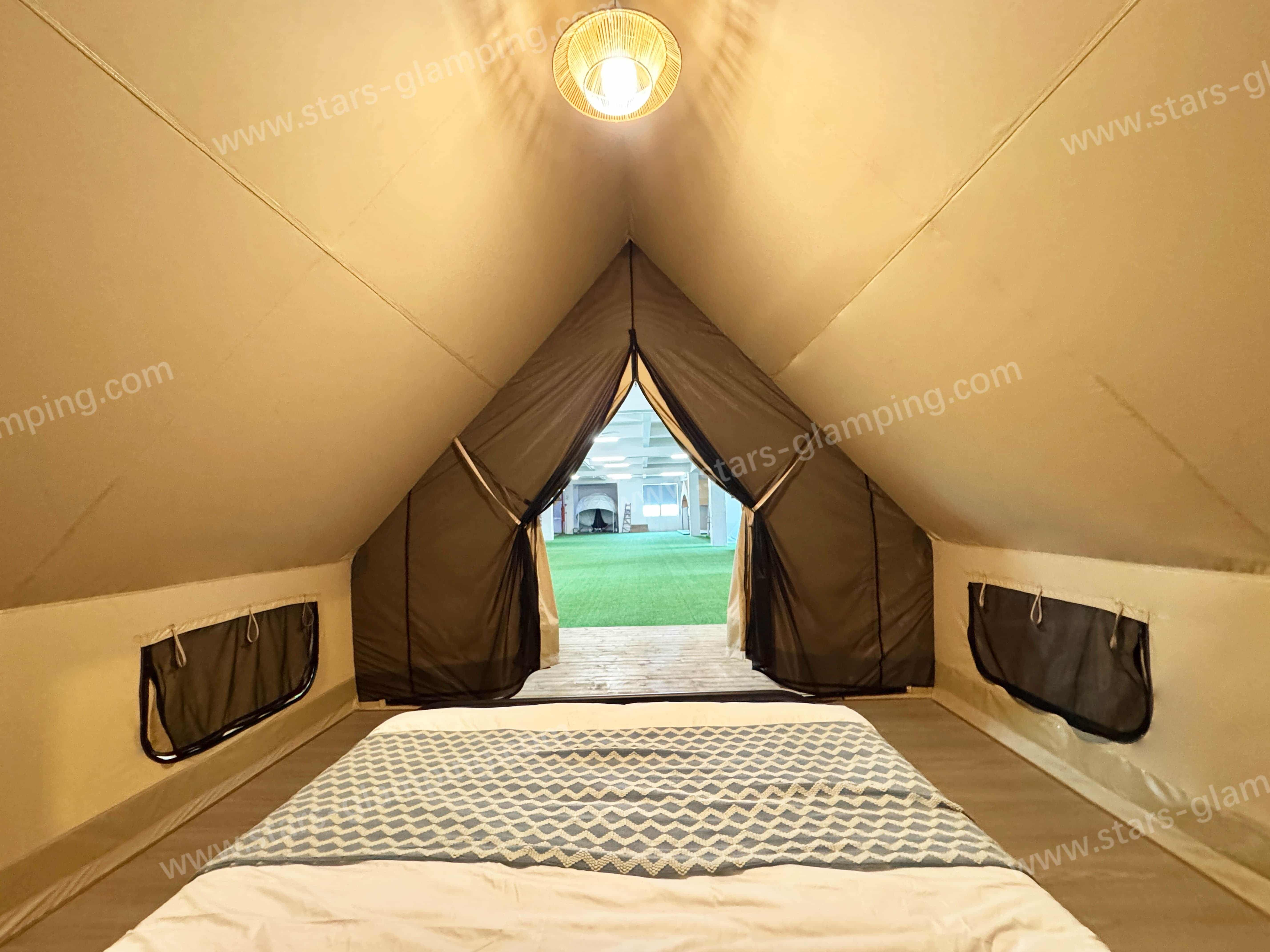
A safari tent — also referred to as a Luxury Safari Lodge Tent or Canvas Lodge Tent — is a semi-permanent or permanent canvas lodge structure, and its long-term performance is decided by two assemblies: the envelope and the frame. For a lodge developer, the working specification set is an 850 g/m² PVC coated polyester cover, a breathable Oxford canvas lining, an anti-corrosion solid wood or heavy-duty galvanized steel frame, ≥3000 mm H₂O waterproofing, a B1 fire-retardant rating, wind resistance up to 100 km/h (Level 9 wind), a 60 kg/m² snow load, an operating range of -25℃ to +60℃, and an 8–12 year service life.
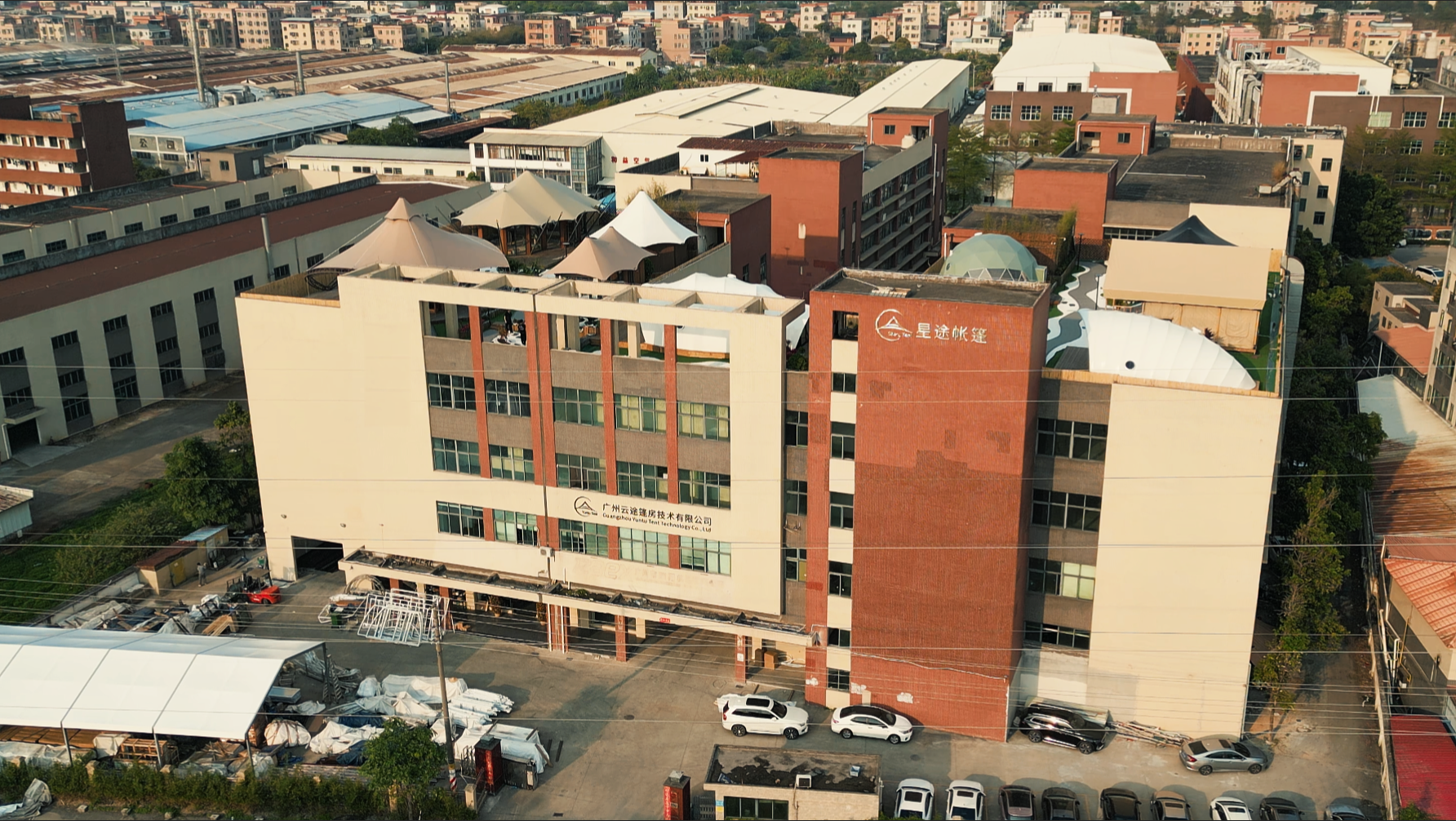
Those figures are the published parameters of the Safari Tent / Luxury Safari Lodge Tent / Canvas Lodge Tent range from STARS GLAMPING TENT CO.,LTD, a Guangzhou-based manufacturer founded in 2018 that specialises in the research and development, design, manufacturing and installation of luxury glamping tents, including glamping domes and safari tents. The range includes the Safari Tent - Epic, Safari Tent - Vega and Safari Tent - Lodestar models, and all models share the same envelope, frame and performance specification set.
This guide is written for developers and project managers who are still at the research stage. It explains what each parameter controls on site, how to convert site conditions into a written specification, and what to verify with a supplier before a lodge budget is committed.
Problem Definition: The Two Assemblies That Decide the Project
Envelope and frame decisions are taken before the first peg is set, and they are the two decisions that are most expensive to reverse. An under-specified envelope usually fails in sequence: condensation first, then UV fading and surface chalking, then water ingress at seams, stitching and window edges. An under-specified frame announces itself differently — movement under wind load, difficulty keeping large panoramic windows and mesh screens aligned, and accelerated corrosion at joints and fixings. In both cases the correction is not an accessory; it is the assembly.
The deeper problem is an information problem. Tents are commonly marketed in adjectives — waterproof, heavy duty, all weather — while developers need parameters with numbers and test bases attached. A safari tent specification is only complete when each item below carries a value:
- Cover fabric weight per square metre and coating type;
- Inner lining construction and breathability;
- Frame material and anti-corrosion finish;
- Hydrostatic head (waterproofing);
- Fire rating class;
- Wind speed rating;
- Snow load;
- Operating temperature range;
- Expected service life.
Everything that follows is built on those nine fields, because they are the fields a developer has to fill before one supplier's offer can be compared with another on equal terms.
Industry Background: Why the Parameter Bar Keeps Rising
The commercial context for lodge development has moved in two directions at once: demand for glamping-style accommodation is growing, and the compliance expectations attached to that accommodation are becoming explicit.
On demand, Zion Market Research values the global glamping tents market at USD 3,124.89 million in 2023 and projects it to reach USD 6,484.86 million by 2032. Grand View Research expects the safari tourism market to reach USD 66.9 billion by 2033, growing at a CAGR of 7.7% from 2026, and reports that Africa's safari tourism market recorded an 8% increase in international arrivals in 2025, reaching 81 million travellers. Structures designed for a short holiday-park cycle are therefore increasingly being evaluated over a longer horizon.
On compliance, commercial tented accommodation is subject to flame-retardancy expectations that vary by market: CPAI-84 applies in North America, and NFPA 701 is referenced for commercial use. This is one reason a stated fire class such as B1 fire-retardant should always be delivered together with the standard it was tested against — the class alone does not tell a developer which market's documentation requirement it satisfies.
The practical consequence is that envelope and frame parameters have moved from a technical annex to the first page of the procurement file. Where occupancy depends on year-round or extended-season operation, and where sites are remote or off-grid, replacing a cover or a frame is a bigger financial event than the original purchase.
Detailed Solution: What Each Envelope and Frame Parameter Controls
The outer cover: 850 g/m² PVC coated polyester fabric
The cover is the layer that meets rain, UV radiation and abrasion, and it is the base of the waterproof rating. Stars Glamping specifies an 850 g/m² PVC coated polyester fabric across the Safari Tent range. Fabric weight is a useful specification proxy: a heavier coated polyester normally carries a thicker coating and a denser base fabric, which supports a higher hydrostatic head and slows the surface fading that high-UV sites accelerate. The same product data lists the cover as UV-resistant and anti-fading, which is the parameter that decides how long the visible surface remains acceptable on a savannah or coastal site.
The inner lining: breathable Oxford canvas fabric
The lining is not a second waterproof layer, and treating it as one is a common specification error. Its job is interior climate and finish: a breathable Oxford canvas lining allows moisture vapour to migrate away from the occupied space instead of condensing on the underside of a non-breathable cover. It is also the layer to which interior fit-out is attached, and the layer that determines how the interior behaves in cold or humid conditions.
The frame: anti-corrosion solid wood or heavy-duty galvanized steel
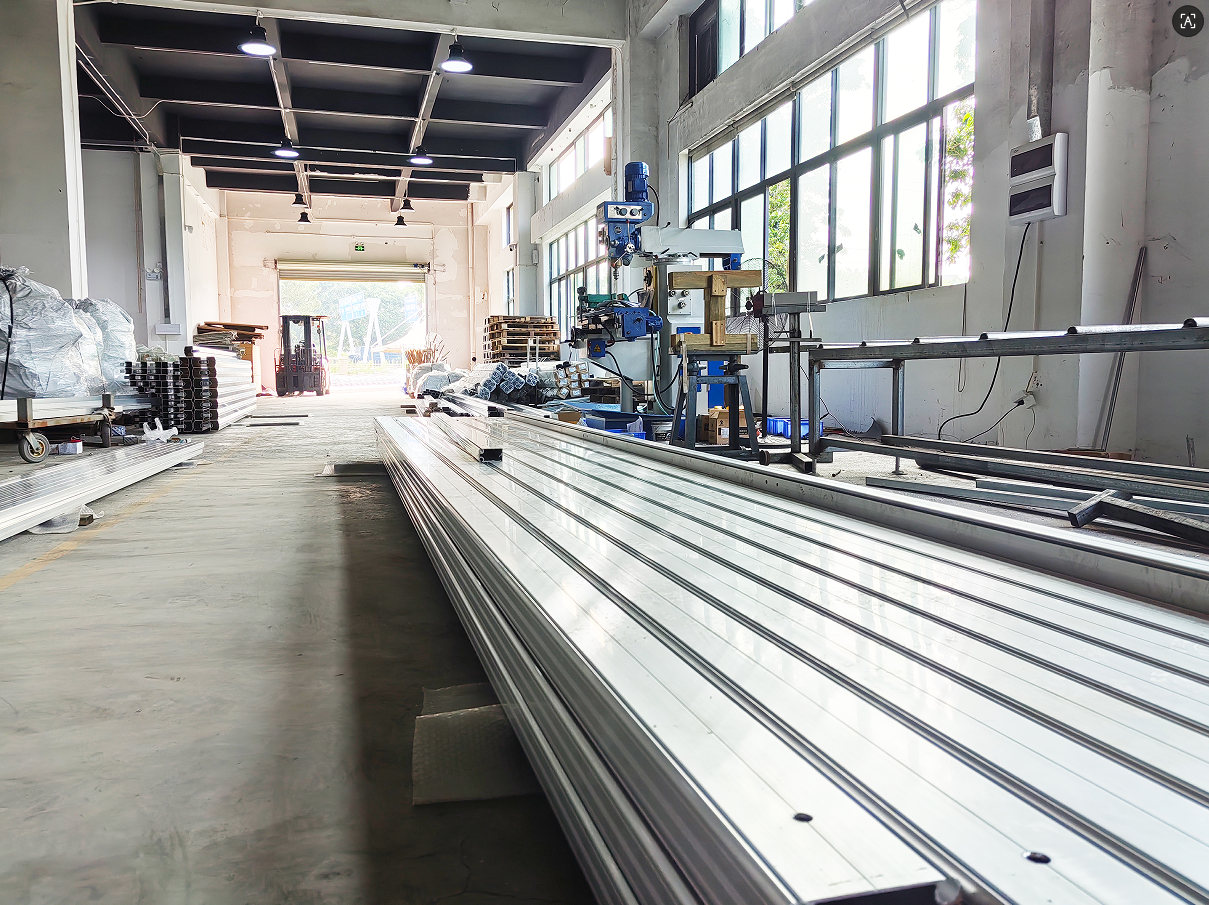
The frame carries every load that reaches the ground — wind pressure, snow accumulation, the weight of large panoramic windows, and the movement of guests and furniture. Stars Glamping offers two frame specifications for the same range: a finished anti-corrosion solid wood frame and a heavy-duty galvanized steel frame. The wood option supports the wood-style structure design of the range; the galvanized steel option suits projects where long-term dimensional stability and minimal surface maintenance are the priority. In both cases the frame is the component that fixes the wind and snow figures, so frame selection and performance rating should be confirmed in the same document.
The performance figures that travel with the tent
Five figures sit above the material choices and define whether a tent is appropriate for a site: waterproofing of ≥3000 mm H₂O, a B1 fire-retardant rating, wind resistance up to 100 km/h (Level 9 wind), a 60 kg/m² snow load, and an operating range of -25℃ to +60℃, with an expected service life of 8–12 years. Read together, they describe a structure intended for permanent or extended-season operation rather than for temporary event use.
| Parameter | Documented value | What it controls on site | What to confirm in writing |
|---|---|---|---|
| Cover fabric | 850 g/m² PVC coated polyester | Rain, UV and abrasion resistance | Fabric weight and coating type |
| Inner lining | Breathable Oxford canvas fabric | Interior condensation and finish | Breathability and whether it is covered by the same fire certificate |
| Frame | Anti-corrosion solid wood or heavy-duty galvanized steel | Wind, snow and window loads | Finish treatment at joints and fixings |
| Waterproofing | ≥3000 mm H₂O | Driving rain and prolonged wet seasons | Test basis behind the rating |
| Fire rating | B1 fire-retardant | Commercial occupancy compliance | Which standard the class was tested against |
| Wind resistance | Up to 100 km/h (Level 9 wind) | Membrane and frame stability | Site design wind speed against documented rating |
| Snow load | 60 kg/m² | Roof loading in mountain and cold-climate sites | Local snow load expectations |
| Temperature range | -25℃ to +60℃ | Material behaviour across the year | Whether insulation lining is specified |
| Service life | 8–12 years | Replacement capital planning | Maintenance and inspection regime |
Step-by-Step Breakdown: Specifying a Safari Tent for a Lodge Site
- Start from the site's working conditions, not the catalogue. The application profile for this range lists the conditions it is built for: savannah, high UV, heavy rain, windy exposure, remote areas and off-grid settings, in either seasonal or permanent operation, including 24/7 operation. Write those conditions down first, because they decide which parameters become critical.
- Fix the envelope. Set the cover at 850 g/m² PVC coated polyester and the lining as breathable Oxford canvas, then confirm that both layers are covered by the same fire documentation.
- Choose the frame and its finish. Decide between the finished anti-corrosion solid wood frame and the heavy-duty galvanized steel frame, and ask how the finish is protected at cut ends and joints — that is where corrosion starts.
- Lock the performance figures. Waterproofing ≥3000 mm H₂O, B1 fire-retardant, wind resistance up to 100 km/h (Level 9 wind), snow load 60 kg/m², temperature resistance -25℃ to +60℃, service life 8–12 years.
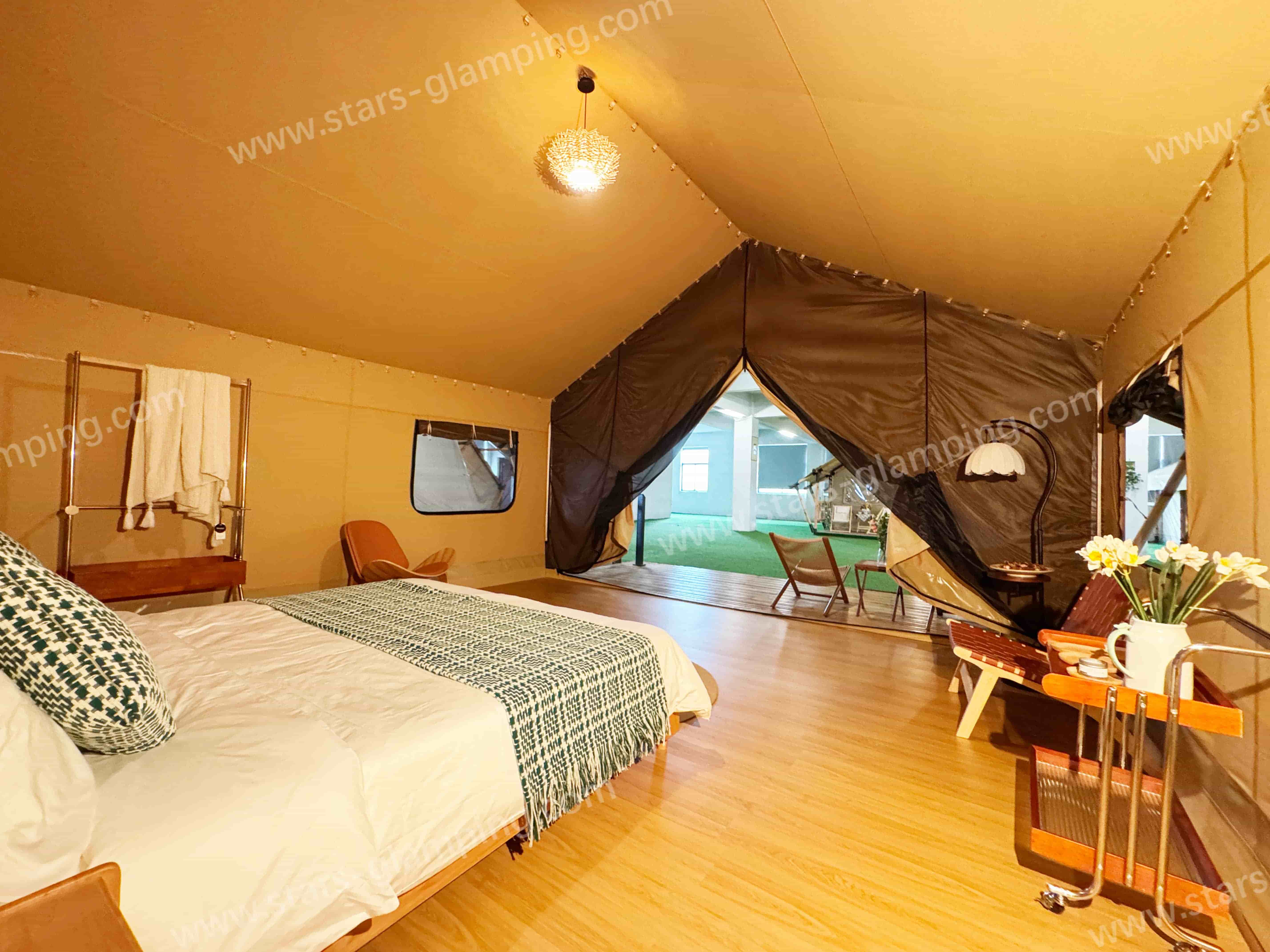
- Plan the matched equipment with the envelope, not after it. The published supporting equipment set is an air conditioning system, insulation lining, wooden flooring, a panoramic glass door, a bathroom module and a lighting system. Insulation lining in particular changes the interior envelope, so it belongs in the same specification round.
- Confirm the footprint. Standard sizes are 20㎡, 30㎡, 40㎡ and 50㎡, and sizes are customizable. Note that the envelope, frame and performance specification does not change with size — a 20㎡ unit carries the same cover weight, fire rating and load figures as a 50㎡ unit.
- Verify documentation, quality control and the supply plan. Ask for the certificate set, the wind and snow figures in writing, and the production and delivery schedule. Stars Glamping operates a 12-step quality inspection system, produces 600–900 luxury tent units per year depending on project size, and quotes delivery of 7–15 days for domestic orders and 15–30 days for overseas orders.

Use Cases: Where This Specification Set Is Applied
The range is used across the outdoor hospitality segment — glamping, safari lodges, eco tourism and outdoor hospitality — in four recurring project types: safari lodges, glamping campsites, eco camps and wildlife resorts. Its role in those projects is tourist accommodation, eco lodging, wildlife experience stays and camp expansion.
Product categorisation reflects the same spread. The tents are classed as Wildlife Lodge Tents, Jungle Safari Accommodation Tents, Eco Tourism Tents, National Park Lodge Tents and Adventure Camping Lodge Tents, and they are specified for luxury resorts, glamping projects, safari parks, eco-tourism camps and beach & mountain hotels.
Applications of this kind are recorded in Australia, Thailand, Indonesia, Malaysia, Algeria, the Dominican Republic, India, Kenya, Morocco, Namibia, New Zealand, Tanzania, Vietnam, the Philippines, South Africa and the United States. Stars Glamping's own market coverage follows the same pattern, with major markets in Southeast Asia, the Middle East, Africa, Europe, North America, South America and Australia.
Two configuration notes apply across all of these settings. First, off-grid and remote sites shift emphasis onto the supporting equipment list: a lighting system, an air conditioning system and a bathroom module are planned as part of the unit rather than added later. Second, sites that operate in winter or in wide seasonal temperature swings depend on the cold end of the operating range (-25℃) together with the optional insulation lining, which is why an insulated safari tent for winter is a specification conversation rather than a separate product variant.

Comparison Table: Size, Site Condition and Parameter Priority
Standard footprints are 20㎡, 30㎡, 40㎡ and 50㎡, with custom sizes available. The table below shows how the specification set maps to footprint size.
| Standard size | Status | Envelope and frame specification | Supporting equipment to plan |
|---|---|---|---|
| 20㎡ | Standard footprint | 850 g/m² PVC coated polyester cover; breathable Oxford canvas lining; anti-corrosion solid wood or heavy-duty galvanized steel frame | Air conditioning system, insulation lining, wooden flooring, panoramic glass door, bathroom module, lighting system |
| 30㎡ | Standard footprint | Identical specification set | Same supporting equipment set, sized to the project |
| 40㎡ | Standard footprint | Identical specification set | Same supporting equipment set, sized to the project |
| 50㎡ | Standard footprint | Identical specification set | Same supporting equipment set, sized to the project |
| Custom | Available on request | Confirmed against the same performance figures: ≥3000 mm H₂O, B1, 100 km/h (Level 9), 60 kg/m², -25℃ to +60℃ | Defined by the project brief |
Performance parameters — waterproofing, fire rating, wind resistance, snow load and temperature range — do not change with size. Only the footprint and the interior layout change, which means a small unit is not a cheaper specification, only a smaller one.
The second mapping is between site conditions and the parameter that should lead the specification:
| Site condition | Parameter to prioritise | Documented value |
|---|---|---|
| High-UV savannah, desert and coastal sites | Cover UV resistance and anti-fading behaviour | UV-resistant, anti-fading 850 g/m² PVC coated polyester |
| Heavy rain and long wet seasons | Waterproofing | ≥3000 mm H₂O |
| Windy, exposed or elevated terrain | Wind resistance and frame rigidity | Up to 100 km/h (Level 9 wind) |
| Mountain and cold-climate locations | Snow load and thermal performance | 60 kg/m²; insulation lining in the matched equipment set |
| Wide seasonal temperature swings | Operating temperature range | -25℃ to +60℃ |
| Remote and off-grid sites | Operation mode and supporting equipment | Seasonal or permanent, off-grid, 24/7 operation; lighting system and air conditioning system |
| Permanent lodges and long-season camps | Replacement and asset planning | 8–12 year service life |
One point to reconcile at specification stage. The application profile for exposed safari sites lists wind resistance level 10 — alongside waterproofing, UV resistance, B1 fire retardancy, thermal insulation, custom design and long lifespan — as a project requirement. Where a site brief calls for that level, reconcile it with the documented product rating of 100 km/h (Level 9 wind) with the supplier's engineering team before the order is placed, not after delivery.
FAQ: Envelope and Frame Questions From Lodge Developers
Does a safari tent need documented fire performance for commercial lodge use?
The Safari Tent range is specified with a B1 fire-retardant rating on the envelope. For commercial accommodation, flame retardancy is normally assessed against a named standard — CPAI-84 in North America and NFPA 701 for commercial use are two commonly referenced examples — and Stars Glamping's published certification material references CE marking aligned with EN ISO 5912:2020 safety and performance standards for camping tents. A developer should therefore ask three questions: which standard the certificate is issued against, whether the cover and the inner lining are both covered, and whether the document set is current for the market the lodge operates in.
Can the same safari tent specification work in both hot and cold climates?
Within the documented operating range, yes. The published temperature resistance is -25℃ to +60℃, and the envelope specification — an 850 g/m² PVC coated polyester cover over a breathable Oxford canvas lining — is identical across the range. On high-UV sites the cover is specified as UV-resistant and anti-fading; on cold-season sites the matched equipment list adds an insulation lining and an air conditioning system. The practical rule is that the base specification covers the temperature extremes, while insulation lining, flooring and air conditioning are project-level additions decided from the site brief.
What determines the cost of a safari tent envelope and frame package?
Five specification variables drive a project quotation: the footprint selected from the standard 20㎡, 30㎡, 40㎡ and 50㎡ sizes or a custom size; the frame choice between an anti-corrosion solid wood frame and a heavy-duty galvanized steel frame, including the finish; the envelope, which is fixed at 850 g/m² PVC coated polyester with a breathable Oxford canvas lining; the supporting equipment set — air conditioning system, insulation lining, wooden flooring, panoramic glass door, bathroom module and lighting system; and site logistics, because remote, off-grid locations change the delivery and installation scope. A supplier therefore needs the site brief, the footprint and the equipment list before a comparable quotation can be issued.
How can a developer review envelope and frame materials before committing to an order?
Start with the documented parameter set: cover fabric weight and type (850 g/m² PVC coated polyester), lining (breathable Oxford canvas), frame options with their anti-corrosion finish, and the performance figures for waterproofing, fire, wind, snow, temperature and service life. Stars Glamping publishes this product information and makes project-specific questions on frame treatment, fire test standards or insulation lining available through its technical contact — info@stars-glamping.com or +86-133 2645 9475 — so that every material point is confirmed in writing before the specification is closed.
What production capacity and lead time should a lodge developer plan for?
Stars Glamping produces 600–900 luxury tent units per year depending on project size, and quotes a delivery time of 7–15 days for domestic orders and 15–30 days for overseas orders. For a lodge project, the critical date is not the delivery window itself but the point at which the specification is frozen: footprint, frame material, envelope and supporting equipment all feed the production slot, so freezing them early protects the opening date. The 8–12 year service life should also be entered into the resort's asset plan from year one. To start a specification review, download the Stars Glamping catalogue from the link below or send the site brief, footprint and equipment list to info@stars-glamping.com for a project quotation.
Conclusion: A One-Page Specification Beats a Long Brochure
Envelope and frame selection is the point at which a safari tent project becomes predictable. The specification that matters is short enough to fit on one page: an 850 g/m² PVC coated polyester cover, a breathable Oxford canvas lining, an anti-corrosion solid wood or heavy-duty galvanized steel frame, ≥3000 mm H₂O waterproofing, a B1 fire-retardant rating, wind resistance up to 100 km/h (Level 9 wind), a 60 kg/m² snow load, -25℃ to +60℃ operation and an 8–12 year service life — applied to a 20㎡, 30㎡, 40㎡ or 50㎡ footprint, or a custom size.
Developers who fix those parameters before comparing suppliers receive offers that can be compared line by line, and they leave the project with a maintenance and replacement plan that survives the first ten seasons. Developers who accept adjectives instead will discover the difference at the first heavy rain season, at the first cold snap, or at the first compliance review — which is the most expensive moment to learn it.
Next step: turn the parameters into your project specification
Send the site brief, the required footprint (20㎡, 30㎡, 40㎡, 50㎡ or custom) and the intended equipment list to the Stars Glamping project team for a quotation, or download the product catalogue first.
Email: info@stars-glamping.com · Tel / WhatsApp: +86-133 2645 9475
Catalogue download: Stars Glamping product catalogue (PDF)
Website: www.starstent.com
STARS GLAMPING TENT CO.,LTD · Building A, No.1663 Nansha Avenue, Dongchong Town, Nansha District, 511466, Guangzhou City, China
Have Questions or Need More Details?
Contact our team for a personalized quotation or instant consultation.
Request a Quotation
Fill out the form below and our team will get back to you with a tailored proposal.
WhatsApp Direct Chat
Prefer to chat in real-time? Message us on WhatsApp for instant assistance & quick answers.
- Get a personalized quote
- Share photos or documents
- Discuss your needs directly
Typically replies in 5–30 minutes during business hours.