
Safari Tent Models Ranked: Epic, Vega, and Lodestar for Luxury Glamping Projects
For most luxury glamping, safari lodge and eco-resort briefs, the realistic shortlist comes down to three Stars Glamping safari tent models: Safari Tent - Epic, Safari Tent - Vega and Safari Tent - Lodestar. This ranking places Lodestar first for flagship wildlife lodge, national park and eco-tourism projects, Epic second as the repeatable multi-terrain unit for camps deploying many identical structures, and Vega third as the focused wildlife lodge model for operators who prefer a single, narrow application over the widest one.
The three models are built on the same verified engineering envelope, so this is not a ranking of structural strength. It is a ranking of project fit, and the deciding factors are application coverage, footprint range, climate envelope and the customization support behind each model.
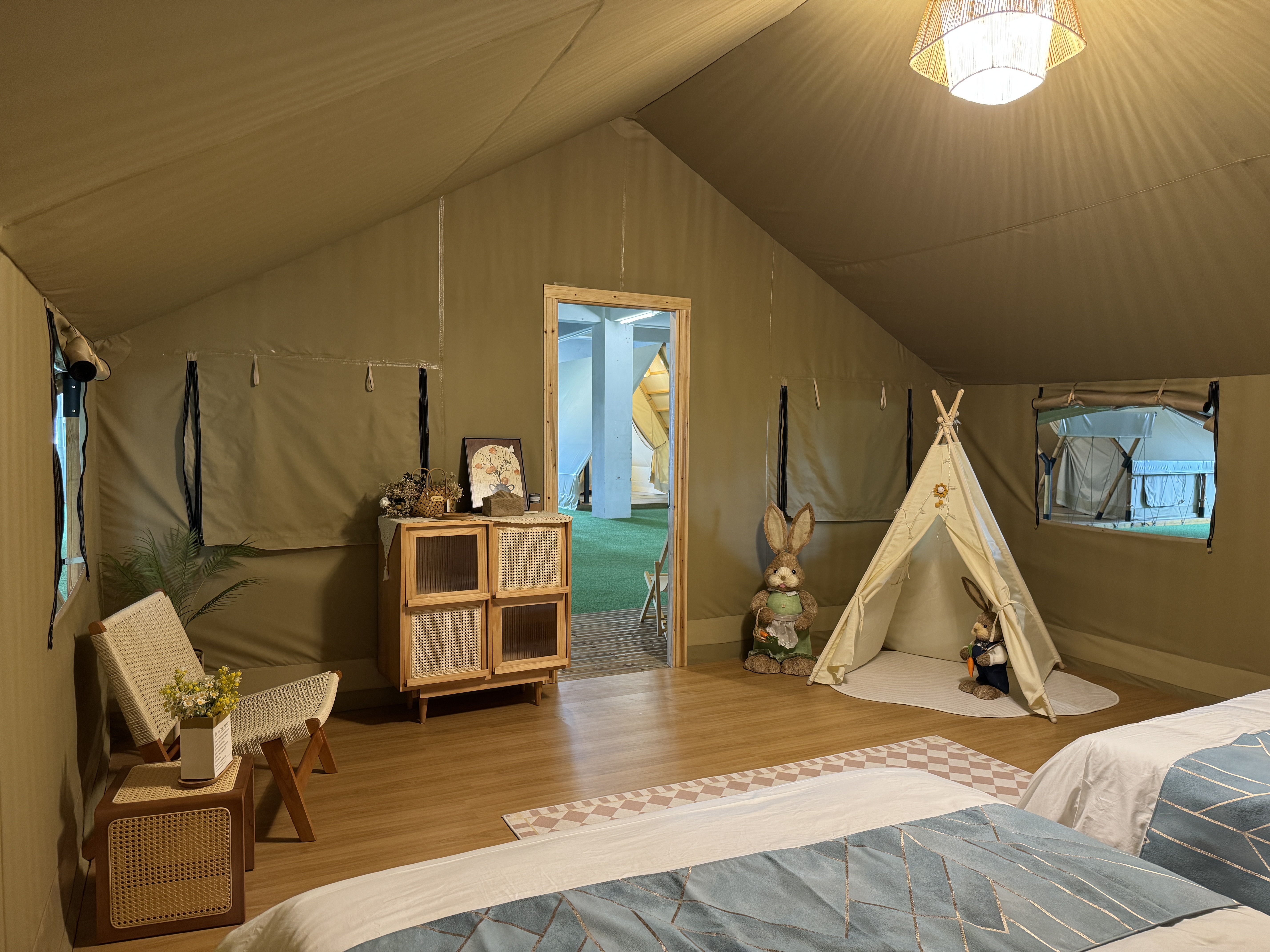
Safari Tent - Epic — one of three ranked safari tent models for luxury glamping, safari lodge and eco-tourism projects.
Why Safari Tent Model Selection Goes Wrong on Luxury Projects
Most safari tent procurement errors are not fabric errors. They happen earlier, when a project team compares models on a category page instead of against a specific site. A 20㎡ unit that performs perfectly on a shaded riverside plot can be the wrong choice for an exposed desert camp — not because the cover is weak, but because guest dwell time, heat load and privacy strategy change the layout requirement.
Three failure patterns repeat across luxury glamping developments:
- Specification drift. The tender says waterproof and fire retardant, but never defines the numeric envelope — water column, wind speed, snow load, operating temperature. Without numbers, two suppliers can both be technically compliant and still deliver different products.
- Application mismatch. A model designed as a wildlife lodge unit is deployed as a family eco-resort suite without the interior fit-out the guest profile expects, which shows up later in review scores rather than in inspection reports.
- Phase mismatch. A flagship model with the widest application coverage is ordered for a two-unit pilot that only needed a smaller, simpler configuration.
Ranking the models against project scenarios — rather than against each other in the abstract — is the fastest way to avoid all three.
Industry Background: What Rising Safari and Glamping Demand Changes for Buyers
Demand context matters because it sets the guest expectations a safari tent has to meet. The global glamping tents market was valued at USD 3,124.89 million in 2023 and is projected to reach USD 6,484.86 million by 2032, according to Zion Market Research. Grand View Research projects the safari tourism market to reach USD 66.9 billion by 2033, growing at a CAGR of 7.7% from 2026. Data from UNWTO and Grand View Research indicates Africa's safari tourism market recorded an 8% increase in international arrivals in 2025, reaching 81 million travellers.
Those two growth figures measure different things — safari tourism versus glamping tents — so they should not be treated as interchangeable, and market estimates for tent-related segments vary by scope.
Regulatory expectations are tightening in parallel. Safari tents intended for commercial use are commonly required to meet flame retardancy standards such as CPAI-84 in North America and NFPA 701, while European projects increasingly request CE-related product safety documentation. One industry report suggests that eco-resort accommodation such as certified safari tents can achieve up to 25% higher occupancy than non-certified or traditional low-end structures; that figure is best read as a directional commercial signal rather than a guaranteed outcome.
The practical consequence for a buyer in the research and evaluation stage is that a safari tent is no longer judged only on appearance. It is judged on whether its documented numbers survive a site audit, a fire inspection and five seasons of guest reviews.
How This Ranking Was Built
Five criteria were applied, in this order:
- Application coverage — how many of the target project types (safari park, national park lodge, eco-tourism camp, jungle safari accommodation, adventure camp) a model is formally designed for.
- Footprint range — whether the model supports 20㎡ through 50㎡ so one camp can mix intimate units and family suites on a single platform.
- Climate envelope — waterproofing, fire rating, wind resistance, snow load, operating temperature and UV behaviour.
- Guest-experience features — large panoramic windows, mesh screens and wood-style structure design, which influence both photography value and review scores.
- Manufacturing and customization support — whether the factory behind the model can deliver the layout, insulation and bathroom integration the project actually needs.
Criteria 3 and 4 are identical across the three models, which is why the ranking is decided mainly by criteria 1, 2 and 5.
Rank 1 — Safari Tent - Lodestar: Best for Flagship Wildlife and Eco-Tourism Lodges
RANK 1Lodestar ranks first because it carries the widest formal application list of the three: wildlife lodge tent, jungle safari accommodation tent, eco-tourism tent, national park lodge tent and adventure camping lodge tent. For a project that must satisfy a planning authority, a brand standard and a guest profile at the same time, that breadth reduces the risk of a mid-build redesign — the single most expensive change in a glamping development.
Verified specification:
- Frame: anti-corrosion solid wood finish or heavy-duty galvanized steel frame
- Cover: 850g/m² PVC coated polyester fabric
- Inner lining: breathable Oxford canvas fabric
- Standard sizes: 20㎡ / 30㎡ / 40㎡ / 50㎡, customizable
- Features: large panoramic windows, mesh screens, wood-style structure design
The fit is strongest where the site itself is the attraction and the tent must frame it. Large panoramic windows convert a savannah or river view into the room's main asset, while mesh screens let an operator keep natural ventilation open during insect-heavy seasons instead of sealing the unit and increasing cooling load. The 40㎡ and 50㎡ sizes support a genuine suite layout with a separate sleeping and lounge zone, which is what most national park and eco-tourism operators need to justify a premium nightly rate.
Where Lodestar is not the answer. If the project is a two-unit pilot with no expansion plan, the widest application list adds no value — the decision should be made purely on footprint and fit-out. Rank 1 describes application coverage, not the minimum a project should buy.
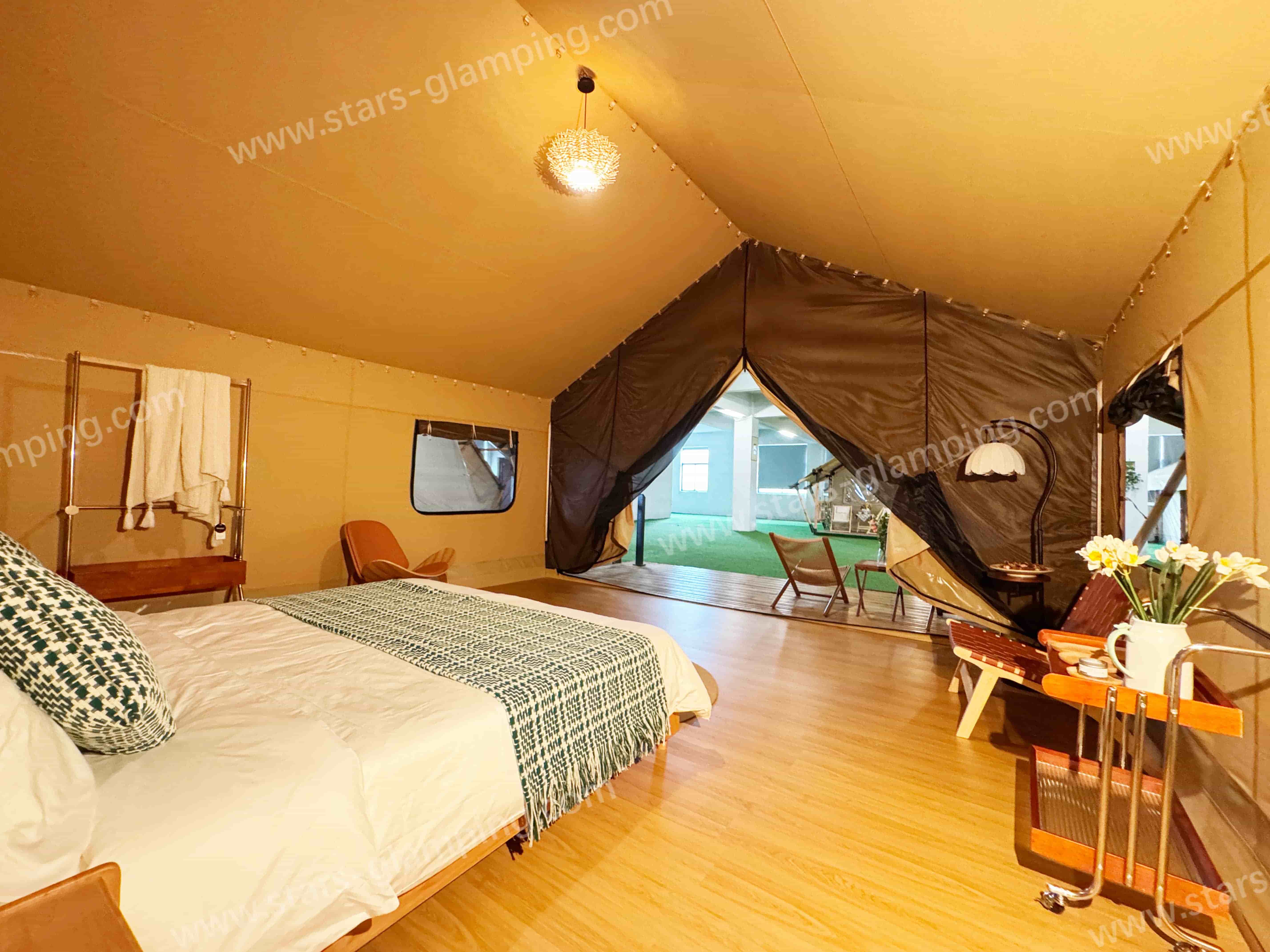
Safari Tent - Lodestar, ranked first for flagship wildlife lodge, national park and eco-tourism applications.
Rank 2 — Safari Tent - Epic: Best for Multi-Terrain Adventure and Eco Camps
RANK 2Epic is documented for the same five applications as Lodestar — wildlife lodge, jungle safari accommodation, eco-tourism, national park lodge and adventure camping — and shares the identical engineering envelope. Because criteria 3 and 4 are tied, the order between rank 1 and rank 2 reflects a positional tie-break rather than a performance gap: Lodestar is the configuration most often specified as the anchor or flagship unit of a luxury property, while Epic is the configuration that suits camps deploying a series of similar units across mixed terrain.
Verified specification (identical to Lodestar):
- Frame: anti-corrosion solid wood finish or heavy-duty galvanized steel frame
- Cover: 850g/m² PVC coated polyester fabric
- Inner lining: breathable Oxford canvas fabric
- Standard sizes: 20㎡ / 30㎡ / 40㎡ / 50㎡, customizable
- Features: large panoramic windows, mesh screens, wood-style structure design
Epic earns rank 2 rather than rank 3 because of its application breadth, and it earns rank 2 rather than rank 1 because a single flagship lodge layout, not a repeated camp grid, is the more common anchor for a luxury development. Buyers comparing a 20–40 unit multi-terrain camp against a single flagship property should treat ranks 1 and 2 as interchangeable and decide on layout instead.
Where Epic is not the answer. Where a project has one narrow use case — a pure wildlife lodge circuit, for example — the extra application coverage is unused capacity, and a narrower model may be easier to standardise across a phased build.
Rank 3 — Safari Tent - Vega: Best for Focused Wildlife Lodge Units
RANK 3Vega is documented as a wildlife lodge tent, and it carries the same verified engineering envelope and the same standard size range as the other two models. It ranks third for one reason only: its application list is narrower. For an operator building a defined wildlife lodge product with repeatable units, that narrowness is a feature, not a limitation — a tighter specification is easier to standardise, easier to train staff around and easier to replicate across phases.
Verified specification:
- Frame: anti-corrosion solid wood finish or heavy-duty galvanized steel frame
- Cover: 850g/m² PVC coated polyester fabric
- Inner lining: breathable Oxford canvas fabric
- Standard sizes: 20㎡ / 30㎡ / 40㎡ / 50㎡, customizable
- Features: large panoramic windows, mesh screens, wood-style structure design
The 20㎡ and 30㎡ footprints are the practical entry point for staged development: an operator can open with a small number of wildlife lodge units, validate occupancy and nightly rate, then extend the same model into 40㎡ or 50㎡ configurations without changing supplier, structure type or installation method.
All three models share the following verified performance data, which is the core of the climate envelope discussed throughout this ranking.
Comparison Table: Epic vs Vega vs Lodestar
| Model | Rank & best-fit project | Documented applications | Standard sizes | Structure | Signature features |
|---|---|---|---|---|---|
| Safari Tent - Lodestar | Rank 1 — flagship wildlife lodge, national park lodge, eco-tourism resort | Wildlife lodge tent; jungle safari accommodation tent; eco-tourism tent; national park lodge tent; adventure camping lodge tent | 20㎡ / 30㎡ / 40㎡ / 50㎡ (customizable) | Anti-corrosion solid wood finish or heavy-duty galvanized steel frame; 850g/m² PVC coated polyester cover; breathable Oxford canvas lining | Large panoramic windows; mesh screens; wood-style structure design |
| Safari Tent - Epic | Rank 2 — multi-terrain camps deploying repeated units | Wildlife lodge tent; jungle safari accommodation tent; eco-tourism tent; national park lodge tent; adventure camping lodge tent | 20㎡ / 30㎡ / 40㎡ / 50㎡ (customizable) | Anti-corrosion solid wood finish or heavy-duty galvanized steel frame; 850g/m² PVC coated polyester cover; breathable Oxford canvas lining | Large panoramic windows; mesh screens; wood-style structure design |
| Safari Tent - Vega | Rank 3 — focused, standardised wildlife lodge builds | Wildlife lodge tent | 20㎡ / 30㎡ / 40㎡ / 50㎡ (customizable) | Anti-corrosion solid wood finish or heavy-duty galvanized steel frame; 850g/m² PVC coated polyester cover; breathable Oxford canvas lining | Large panoramic windows; mesh screens; wood-style structure design |
Because the performance envelope is shared, the table above should be read as a fit table, not a quality table. The next table shows the shared technical values that apply to all three models.
| Specification | Verified value (all three models) | What it means for a project |
|---|---|---|
| Waterproof rating | ≥ 3000mm H₂O | Supports monsoon and heavy-rain sites without relying on seasonal re-coating |
| Fire rating | B1 fire-retardant | A verifiable starting point for commercial fire review |
| Wind resistance | Up to 100km/h (Level 9 wind) | Relevant for exposed savannah, coastal and mountain plateaus |
| Snow load | 60kg/m² | Allows mountain and high-altitude deployment |
| Operating temperature | -25℃ to +60℃ | Covers both desert heat and winter alpine use |
| Service life | 8–12 years | The basis for any 8-year-plus operating cost calculation |
| UV performance | UV-resistant, anti-fading | Protects appearance on high-UV sites where fabric fading is the main visual risk |
Step-by-Step: Matching One of the Three Models to Your Project
Use the following sequence in the research and evaluation stage. It is deliberately ordered so that each step eliminates options before the next one adds cost.
- Define the unit mix and footprint. Decide how many 20㎡, 30㎡, 40㎡ and 50㎡ units the site can support. If the answer includes more than one size, all three models remain valid; if it is a single size, Vega may be the most efficient choice.
- Audit the site against the climate envelope. Match local rainfall against ≥ 3000mm H₂O, peak gust exposure against up to 100km/h (Level 9 wind), winter accumulation against 60kg/m² snow load, and annual temperature swing against -25℃ to +60℃.
- Confirm the fire and safety requirements for the jurisdiction. B1 fire-retardant is the stated product rating; commercial projects may also be assessed against regional standards such as CPAI-84 or NFPA 701 in North America.
- Plan the interior fit-out before you order. Bathroom module, kitchen zone, electricity and lighting runs, insulation lining, wooden flooring, panoramic glass door and air conditioning all affect size selection. A 20㎡ unit with a full bathroom module is a different product from a 20㎡ sleeping unit.
- Choose frame and finish. Anti-corrosion solid wood finish suits operators chasing a wood-style, nature-integrated look; heavy-duty galvanized steel is the usual choice for remote or high-humidity sites where maintenance access is limited.
- Verify delivery, installation and after-sales support. Confirm customization scope, minimum order, production lead time and technical support before finalizing the shortlist.
Use Cases: Which Model Fits Which Project Type
- Safari park and national park lodge: Lodestar. The national park lodge application and 40–50㎡ sizes support premium suite layouts with controlled sight lines.
- Eco-tourism camp: Lodestar or Epic. Both carry the eco-tourism and adventure camping applications; choose Lodestar for a flagship anchor unit and Epic for a repeated camp grid.
- Jungle resort and wildlife camp: Epic for multi-unit deployment, Vega for a standardised single unit type. Mesh screens are the deciding feature in both cases.
- Desert camp: any of the three, provided the high-UV and +60℃ upper limit are respected and insulation lining is specified. The UV-resistant, anti-fading fabric matters more here than in shaded sites.
- Riverside lodge: Vega or Epic, with mesh screens and elevated flooring used to manage humidity and insect pressure.
- Beach and mountain hotels: Lodestar. Coastal exposure is covered by the wind and UV values, while mountain deployment requires the 60kg/m² snow load.
All three models are suitable for environments described as savannah, high UV, heavy rain, windy, remote area and off-grid conditions.
Manufacturing and Customization Behind the Ranking
Stars Glamping — formally STARS GLAMPING TENT CO.,LTD — is a Guangzhou-based manufacturer of glamping domes, safari tents and luxury tents, founded in 2018 and operating a 20,000㎡ manufacturing base with around 100 employees and a six-person R&D team. The company produces 600–900 luxury tent units per year depending on project size, exports roughly 90% of output to markets including Southeast Asia, the Middle East, Africa, Europe, North America, South America and Australia, and supports OEM and ODM programs as well as custom luxury tent manufacturing and engineering support.
Customization available across the safari tent range covers size and layout, tent structure design, fabric material (PVC, PVDF or insulation), frame material (steel or aluminum), interior layout and furniture, bathroom integration, logo branding and colour. This is what turns a model ranking into a project decision: the three ranked models share a platform, but the fit-out specification is where a wildlife lodge differs from a beach hotel unit.
Quality control follows raw material inspection, in-process quality control and pre-shipment inspection, with third-party inspection available on request.
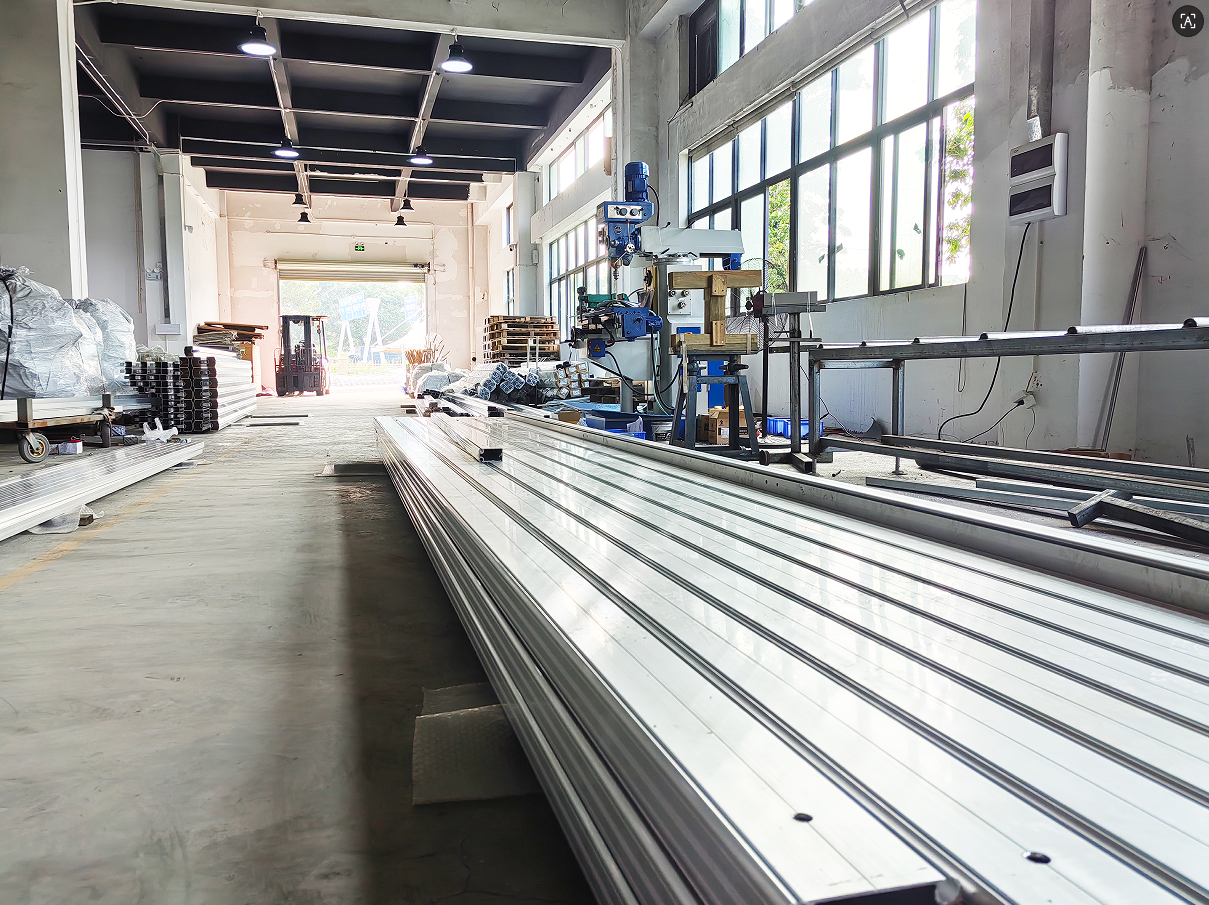
Frame and hardware production for the safari tent range at the Stars Glamping manufacturing base in Nansha District, Guangzhou.
FAQ: Safari Tent Model Selection
1. What fire, waterproof and safety standards do the Epic, Vega and Lodestar models meet?
All three models carry a waterproof rating of ≥ 3000mm H₂O and a B1 fire-retardant fire rating as documented product specifications. Stars Glamping holds CE certification (General Product Safety) for its safari tents, meeting EN ISO 5912:2020 safety and performance standards. For commercial projects, regional requirements may also apply — safari tents in North America are commonly assessed against flame retardancy standards such as CPAI-84 and NFPA 701. Because jurisdiction requirements differ, buyers should confirm the applicable standard for their specific site and use case rather than assuming a single rating covers every market.
2. Can one model be customized for a desert camp, jungle resort or riverside lodge?
Yes. Available customization covers size and layout, tent structure design, fabric material (PVC, PVDF or insulation), frame material (steel or aluminum), interior layout and furniture, bathroom integration, logo branding and colour. In practice, a desert camp project typically prioritizes insulation lining and the UV-resistant, anti-fading fabric specification, a jungle or riverside project prioritizes mesh screens and elevated flooring for humidity control, and a mountain project prioritizes the 60kg/m² snow load and wind resistance up to 100km/h (Level 9 wind). All three models are designed for savannah, high UV, heavy rain, windy, remote area and off-grid conditions, so the customization decision is usually about fit-out and layout rather than about changing the base structure.
3. What drives the cost of these safari tent models?
Cost is driven by four variables rather than by the model name alone: footprint (20㎡ through 50㎡), frame selection (anti-corrosion solid wood finish versus heavy-duty galvanized steel), cover and lining specification (850g/m² PVC coated polyester with breathable Oxford canvas lining, plus optional insulation), and interior fit-out scope such as bathroom modules, kitchen zones, electricity and lighting, flooring and panoramic glass doors. Service life of 8–12 years is the figure to use when converting purchase cost into annual operating cost, and it is the reason a slightly higher specification can be cheaper over the life of the camp. Published pricing is not part of this ranking — buyers should request a project-specific quotation based on unit mix and fit-out.
4. Can we order a sample unit before committing to a full camp build?
Yes. The minimum order quantity for the safari tent range is one unit, and a sample is available. A single sample is usually the cheapest way to validate the fabric feel, the panoramic window framing and the mesh screen performance against real site conditions before committing to a multi-unit order — particularly for operators who have never built with PVC-coated polyester before.
5. How long does production and delivery take, and what support follows?
Lead time is 15–20 days for standard models and 20–30 days for customized projects. After-sales support includes installation guidance, engineering drawings, 24/7 technical support, spare parts supply, maintenance support and remote or on-site project assistance. The fastest next step for most projects is to download the product brochure and request a quotation against your unit mix, site climate and interior specification. Download the Stars Glamping product brochure or send your project brief to info@stars-glamping.com to start the evaluation.
Conclusion
Ranking the three Stars Glamping safari tent models is less about picking a winner and more about matching coverage to intent. Safari Tent - Lodestar takes first place because its five documented applications — wildlife lodge, jungle safari accommodation, eco-tourism, national park lodge and adventure camping — make it the safest anchor for a flagship luxury property. Safari Tent - Epic follows closely and should be treated as equal in specification for camps that deploy repeated units across mixed terrain. Safari Tent - Vega takes third place by design: a narrower wildlife lodge application list that is easier to standardise across phased development.
What all three share is the part that decides long-term performance: anti-corrosion solid wood or heavy-duty galvanized steel frames, 850g/m² PVC coated polyester covers, breathable Oxford canvas lining, ≥ 3000mm H₂O waterproofing, B1 fire-retardant rating, wind resistance up to 100km/h (Level 9 wind), 60kg/m² snow load, -25℃ to +60℃ operation and an 8–12 year service life, with large panoramic windows, mesh screens and wood-style structure design across the range.
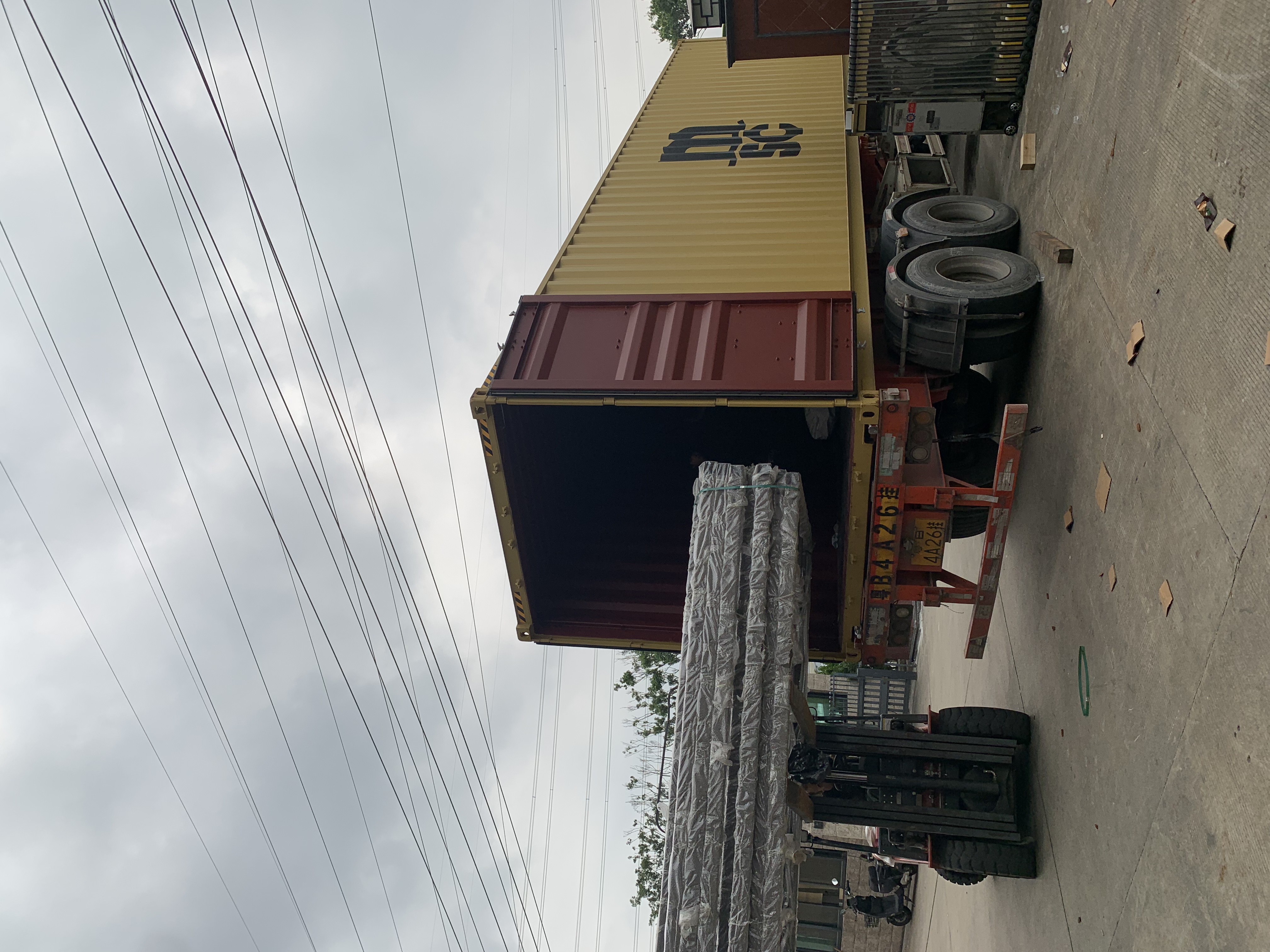
Safari tent units prepared for export — Stars Glamping ships to more than 40 countries and regions worldwide.
Stars Glamping supports luxury resorts, glamping projects, safari parks, eco-tourism camps and beach & mountain hotels with OEM and ODM safari tent manufacturing, one-unit sample orders and project-specific quotation.
Download the brochure: Stars Glamping Product Brochure (PDF)
Website: www.starstent.com | Email: info@stars-glamping.com | WhatsApp: +86-133 2645 9475
Have Questions or Need More Details?
Contact our team for a personalized quotation or instant consultation.
Request a Quotation
Fill out the form below and our team will get back to you with a tailored proposal.
WhatsApp Direct Chat
Prefer to chat in real-time? Message us on WhatsApp for instant assistance & quick answers.
- Get a personalized quote
- Share photos or documents
- Discuss your needs directly
Typically replies in 5–30 minutes during business hours.