
Top 5 Luxury Hotel Tent Models for Eco-Resort Development: Expert Ranking and Selection Guide
Top 5 Luxury Hotel Tent Models for Eco-Resort Development: Expert Ranking and Selection Guide
Stars Glamping builds five official luxury hotel tent model designations: Luxury Tent - Tethys, Luxury Tent - Villa, Luxury Tent - Octagon, Luxury Tent - Shell and Luxury Tent - Pisces. Ranked for a permanent, year-round eco-resort brief — by cover-system service life, frame composition, wall system and program fit — the order is 1. Tethys, 2. Villa, 3. Shell, 4. Octagon, 5. Pisces. The specification basis, the compliance documents and the cases where the order changes are set out below.
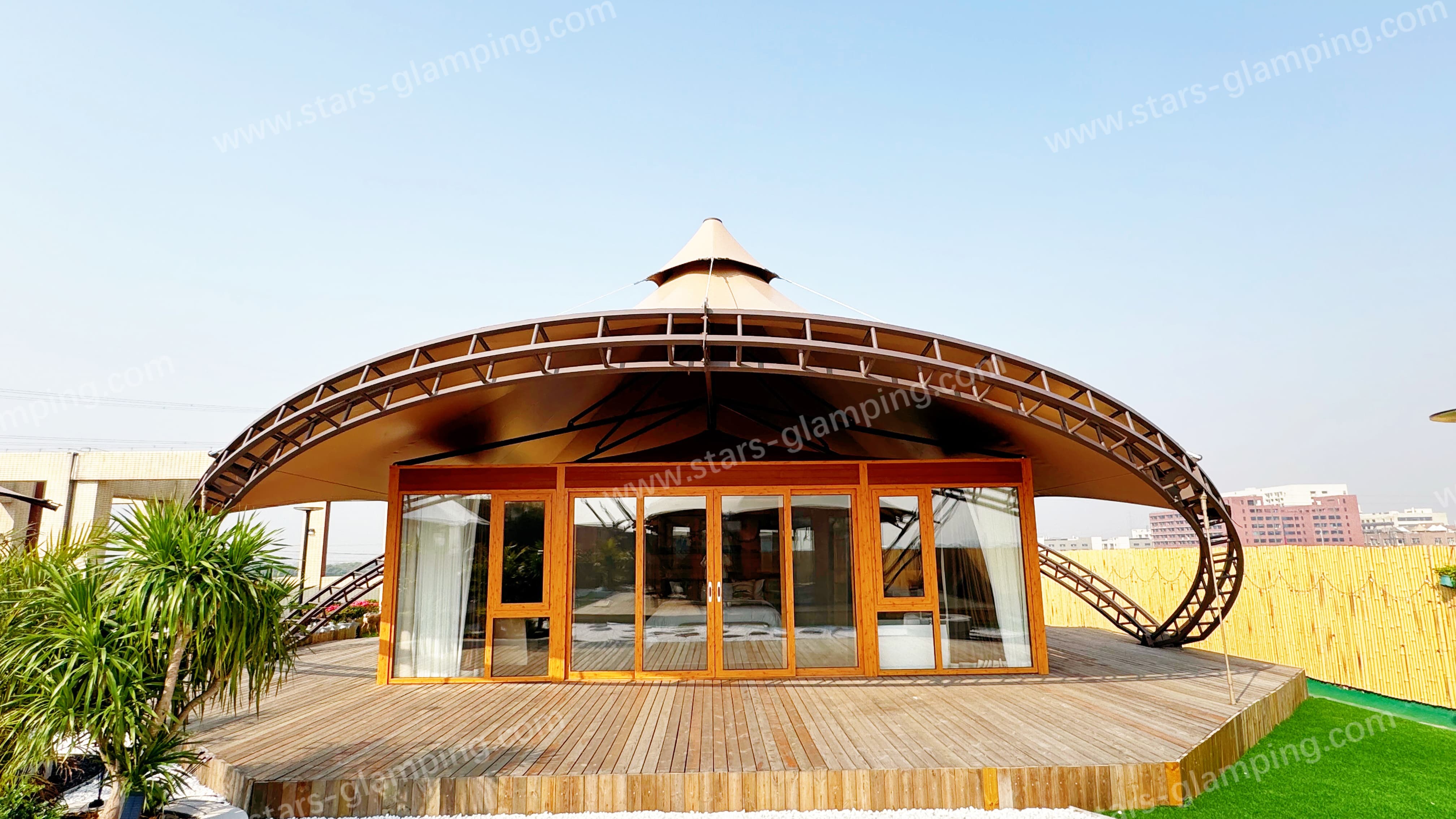
Luxury Tent - Tethys, ranked first for permanent year-round eco-resort accommodation on the shared steel-pipe and PVDF membrane platform.
Stars Glamping (STARS GLAMPING TENT CO.,LTD) is a Guangzhou-based manufacturer, founded in 2018, that designs, engineers, produces and installs modular luxury hotel tent structures and permanent glamping accommodation for resort and eco-tourism projects. The company operates a 20,000 m² manufacturing base and a 4,000 m² simulation exhibition hall in Nansha District, Guangzhou, and exports to markets including Southeast Asia, the Middle East, Africa, Europe, North America, South America and Australia.
This guide ranks those five models for eco-resort development and explains the specification, certification and lead-time constraints that decide which one belongs on a given site. It is written for developers and procurement teams in the research and evaluation stage, where the useful question is not which tent looks better in a rendering, but which model meets the project's climate, compliance and lifecycle envelope.
Ranking basis: this is an editorial framework built from published model specifications — cover fabric class, frame material, wall system, declared service life, waterproofing, fire rating, wind and snow ratings, and declared application types. It is not based on comparative performance testing, and no model is described here as superior in a category for which no published data exists.
Problem Definition: At Model Level, the Constraint Is Documentation, Not Shape
Developers comparing luxury hotel tent models usually start with shape and rendering. The three variables that decide whether a tent structure performs as a hotel building at year-round occupancy are documented rather than visual.
- Cover fabric class and its service-life band. Four of the five models use a 1050 g/m² PVDF architectural membrane fabric and are specified for a 25–30 year service life. The fifth, Luxury Tent - Pisces, uses an 850 g/m² PVC polyester fabric with an insulated canvas wall system and is specified for 10–15 years. That gap is the largest lifecycle constraint inside the model range.
- What a conformity document actually covers. A certificate is only useful when the standard, the issuing body, the market and the validity period are known.
- Frame and wall system composition. A steel pipe frame with an insulated glass wall system versus a solid wood and steel pipe frame with an insulated canvas wall — a difference that shapes appearance, maintenance profile and replacement cycle.
There is a second, less obvious problem. Four of the five models — Tethys, Villa, Octagon and Shell — share one identical published specification sheet. Only Pisces sits in a different material class. A developer who assumes five models mean five performance levels will compare the wrong thing: for four models the real decision is geometry and program fit, and for the fifth it is also a materials and lifecycle decision.
The common platform specification is: steel pipe frame; 1050 g/m² PVDF architectural membrane cover fabric; insulated glass wall system; waterproof rating ≥5,000 mm H&sub2;O; UV stabilized and anti-aging treatment; B1 / M2 fire-retardant rating; wind resistance up to 120 km/h (Level 10 wind); snow load 80 kg/m²; operating temperature −30°C to +70°C. The declared application types are resort accommodation, beachfront hotel, mountain eco lodge, desert glamping, and event use for reception or restaurant functions.
Industry Background: A Growing Market With a Narrowing Compliance Window
The global glamping market was valued at approximately USD 3.8 billion in 2025, according to Grand View Research, with tents forming a major accommodation segment alongside cabins and pods. Fortune Business Insights projects the market reaching USD 9.15 billion by 2034, growing at a CAGR of 10.67%. Grand View Research places Europe at a 35% revenue share in 2025.
Those figures should be used with care. Published estimates diverge widely because research houses define glamping differently: Global Market Insights valued the 2025 market at USD 2.6 billion, while Future Market Insights reported USD 12.4 billion for 2024. For a developer, the usable signal is direction of travel and compliance load, not any single headline number.
Compliance is where the shift becomes concrete. For membrane structures used commercially in hospitality, the International Fire Code references fire retardancy standards such as NFPA 701 in the United States and EN 13501-1 in Europe. Permanent tent structures are also increasingly reviewed through building-type approval pathways rather than as temporary event structures, which moves fabric ratings, structural drawings and conformity documents into the project approval file.
Industry references for architectural membranes point in the same direction: heavy-duty PVC/PVDF architectural membranes can be produced with hydrostatic head ratings above 10,000 mm H&sub2;O, and high-performance PVDF membranes are associated with service lives in the 15–30 year range and wind resistance in the 120–140 km/h band. Model-level ratings published by the manufacturer remain the number that matters for a specific project, and those are listed in the comparison table below.
Detailed Solution: Ranking the Five Models and Their Constraints
The five models were ordered against five criteria, applied in this sequence: (1) documented service-life band of the cover system; (2) cover fabric class and frame composition; (3) wall system class; (4) program fit under a permanent, year-round accommodation brief; and (5) availability of third-party conformity documentation for the tent product platform.
#1Luxury Tent - Tethys — the all-round permanent accommodation platform
Luxury Tent - Tethys is built on a steel pipe frame with a 1050 g/m² PVDF architectural membrane cover and an insulated glass wall system. Its published ratings are a waterproof rating of ≥5,000 mm H&sub2;O, a B1 / M2 fire-retardant rating, wind resistance up to 120 km/h (Level 10 wind), a snow load of 80 kg/m², an operating range of −30°C to +70°C, and a specified service life of 25–30 years.
It ranks first because it carries the longest published service-life band in the range together with the glass wall system, and because it is listed for all five declared application types — resort accommodation, beachfront hotel, mountain eco lodge, desert glamping and event use. For a developer whose program is dominated by guestrooms that must operate in every season, this is the reference configuration against which the other four should be measured.
Its constraint is not performance but architectural identity: a membrane-and-glass envelope produces a specific visual language. Where the site brief is wood-led and the unit count is planned around a shorter replacement cycle, Luxury Tent - Pisces is the model designed for that outcome.
#2Luxury Tent - Villa — the same envelope in a villa-format unit
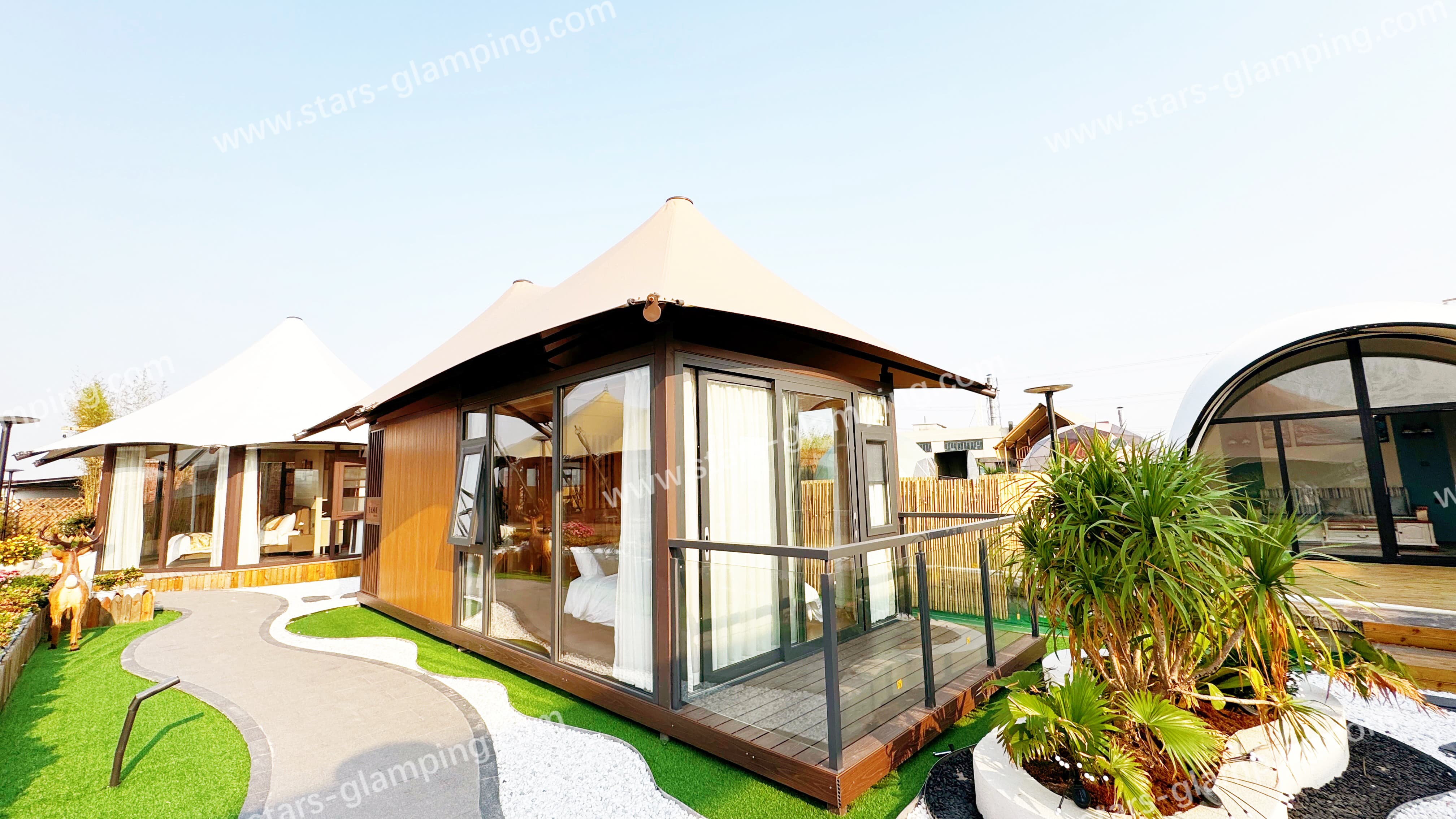
Luxury Tent - Villa shares the identical published specification sheet as Tethys, including the insulated glass wall system.
Luxury Tent - Villa shares the identical published specification sheet as Tethys: steel pipe frame, 1050 g/m² PVDF architectural membrane cover, insulated glass wall system, ≥5,000 mm H&sub2;O waterproof rating, B1 / M2 fire rating, wind resistance up to 120 km/h (Level 10 wind), 80 kg/m² snow load, −30°C to +70°C operating temperature and a 25–30 year service life.
It ranks second because the Villa designation distinguishes the unit format rather than the engineering class. The practical consequence is procurement-side: a master plan can combine Tethys and Villa units for visual variation without introducing a second engineering platform or a separate membrane specification into the project file.
#3Luxury Tent - Shell — the geometry-led unit for identity-driven sites
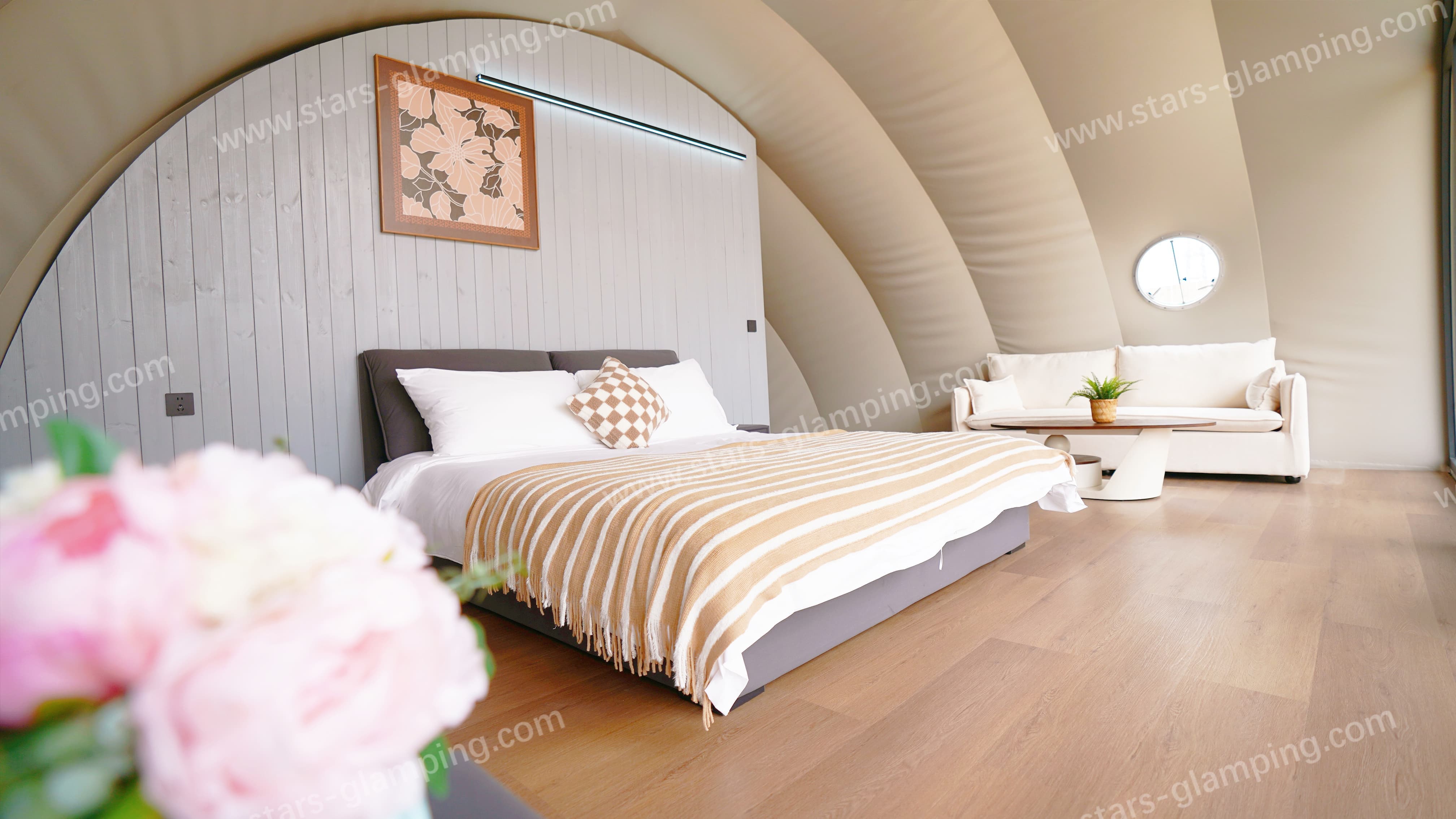
Luxury Tent - Shell uses the same steel-pipe and PVDF platform as Tethys and Villa; the differentiation is envelope geometry.
Luxury Tent - Shell uses the same platform specification as Tethys and Villa — steel pipe frame, 1050 g/m² PVDF architectural membrane, insulated glass wall system, 25–30 year service life and the same structural ratings.
It ranks third because, on a shared platform, the differentiator is envelope geometry rather than specification strength. Shell should be evaluated as a variant of the same platform: select it through a site plan and visual identity review, and confirm dimensions, orientation and anchoring through the manufacturer's engineering drawings before the layout is fixed. Choosing between Tethys, Villa and Shell is a design decision; none of the three changes the climate envelope of the project.
#4Luxury Tent - Octagon — the shared-space geometry
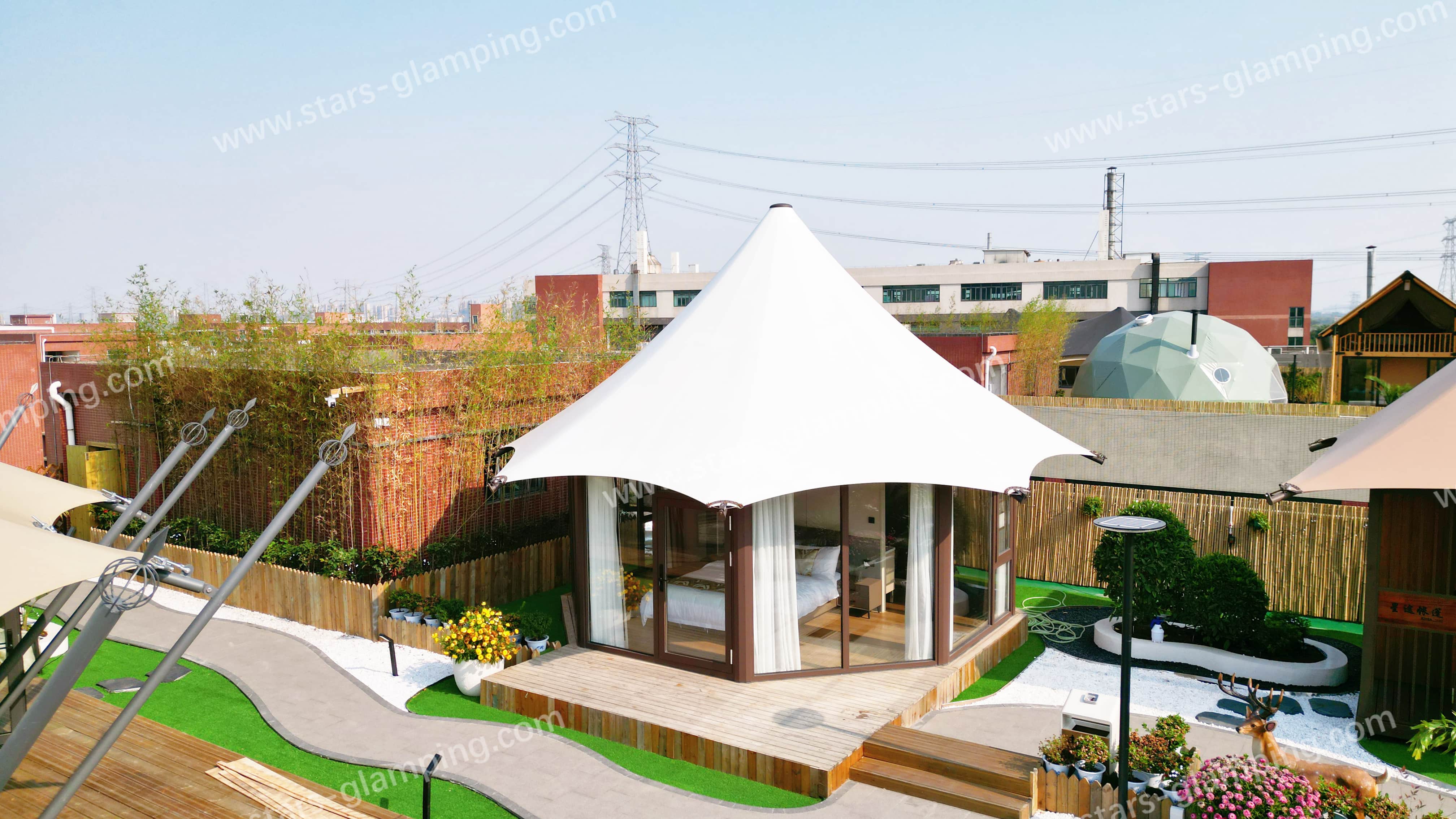
Luxury Tent - Octagon carries the same platform specification; its octagonal geometry is the format oriented toward reception, restaurant and event functions.
Luxury Tent - Octagon carries the same platform specification and the same 25–30 year service life as Tethys, Villa and Shell. Its distinguishing trait is an octagonal envelope geometry, which makes it the most shape-versatile of the five for shared-space programs — reception, restaurant and event functions, a use explicitly included in the model's declared application types.
It ranks fourth under an accommodation-led brief for a planning reason rather than a performance reason: an octagonal footprint is planned around a non-rectilinear room grid, so wet areas, furniture and glazing need an additional layout step per unit, while the structural ratings remain identical to Tethys. Under a brief where revenue space leads the design — a destination restaurant, a reception pavilion or an event area — Octagon moves to first place.
#5Luxury Tent - Pisces — the wood-and-canvas model with a different lifecycle band
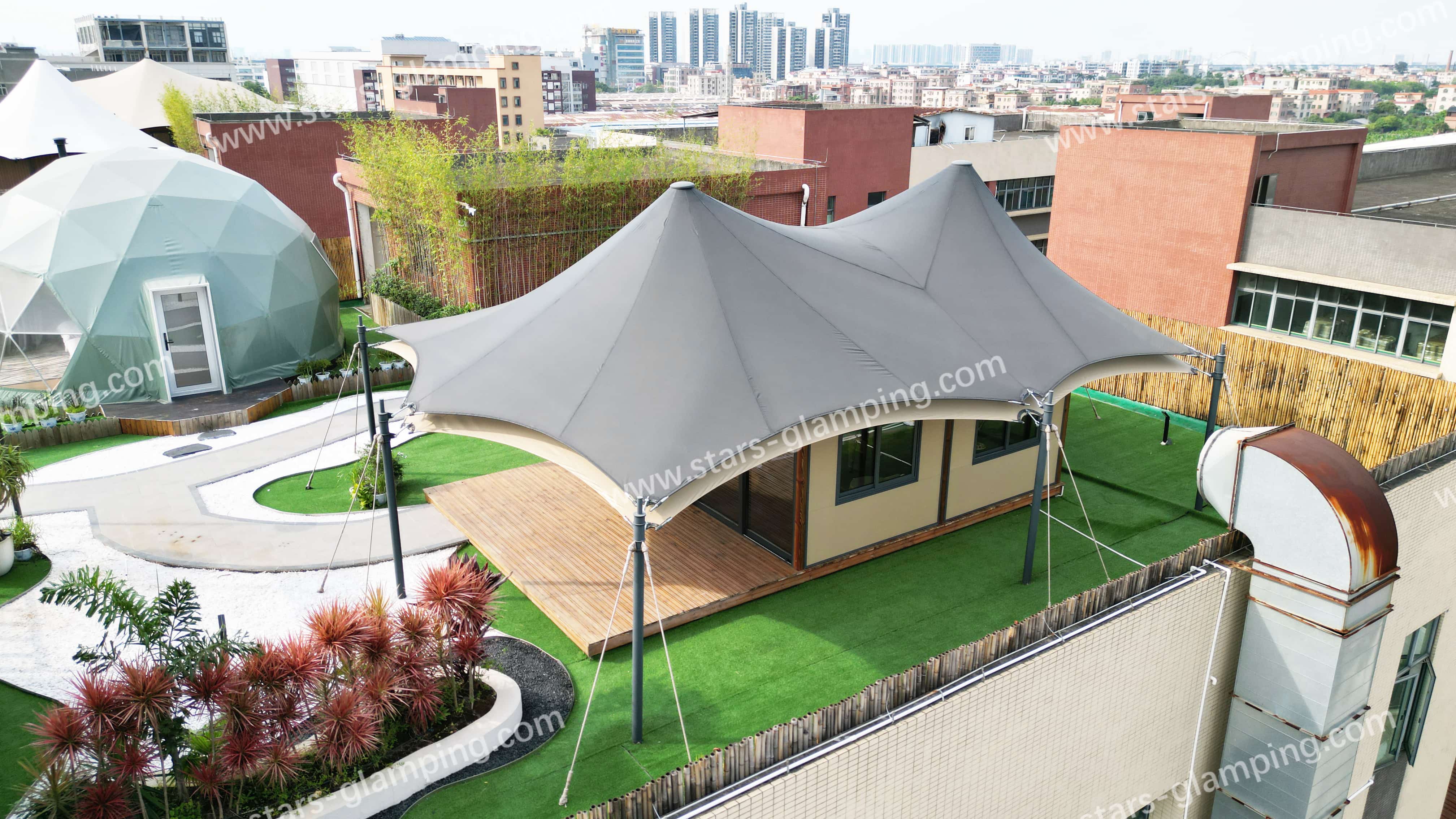
Luxury Tent - Pisces is the one model in the five with a solid wood and steel pipe frame, PVC polyester cover and insulated canvas wall system.
Luxury Tent - Pisces is the one model of the five that does not use the common platform. Its frame is solid wood combined with steel pipe, its cover is an 850 g/m² PVC polyester fabric, and its wall system is an insulated canvas wall. Waterproofing (≥5,000 mm H&sub2;O), UV stabilization, fire rating (B1 / M2), wind resistance (up to 120 km/h, Level 10 wind), snow load (80 kg/m²) and the −30°C to +70°C operating range match the rest of the range. The specified service life is 10–15 years rather than 25–30 years.
It ranks fifth on a durability-weighted brief because the cover class and service-life band sit below the PVDF platform, and a 10–15 year cycle means at least one fabric renewal falls inside a typical long-hold resort investment period. That is a planning fact, not a defect: Pisces exists for briefs where a solid-wood structure and a natural canvas aesthetic are the design requirement, and where the replacement cycle is accepted and budgeted from the start.
It moves to first place under a nature-led brief — eco-tourism camps, safari lodges and low-intervention sites where the visual language must read as timber rather than membrane, and where material character is prioritized over the longest available service-life band.
When the ranking changes
- Accommodation-led permanent resort: Tethys → Villa → Shell → Octagon → Pisces
- Shared-space-led resort (reception, restaurant, events): Octagon → Tethys → Villa → Shell → Pisces
- Wood-and-canvas aesthetic brief: Pisces → Villa → Tethys → Shell → Octagon
- Single-platform procurement (one specification sheet, one material basis): Tethys, Villa, Shell and Octagon in any order by geometry; Pisces treated separately as a different material class
Step-by-Step Breakdown: A Seven-Step Selection and Verification Workflow
Use this sequence when evaluating any of the five models, or when benchmarking them against another supplier's offer.
- Fix the climate envelope before the model. Write down the site's design wind speed, snow load and temperature range. The five models are rated up to 120 km/h wind, 80 kg/m² snow load and −30°C to +70°C. If the site exceeds those figures, the model list is not the constraint — the structural design is.
- Choose the cover class first, because it sets the service life. 1050 g/m² PVDF architectural membrane, specified for 25–30 years (Tethys, Villa, Octagon, Shell); 850 g/m² PVC polyester, specified for 10–15 years (Pisces).
- Choose the wall system second. Insulated glass wall system (Tethys, Villa, Octagon, Shell) or insulated canvas wall system (Pisces) — this decision affects guest experience, maintenance and the appearance of the unit.
- Match geometry to program. Guestroom-led plans point to Tethys and Villa; shared-space plans to Octagon; identity-led plans to Shell or Pisces.
- Verify the conformity documents, not the claim. Stars Glamping holds a General Product Safety Directive Attestation of Conformity (CE) issued by UDEM under certification number M.2024.206.C96444, assessed against EN ISO 5912:2020 for the EU market, valid from 31 January 2024 to 30 January 2029. The certificate scope covers tent products including the luxury hotel tent and safari lodge ranges. Separately, confirm the fire-rating pathway your local authority applies; for commercial hospitality membrane structures the International Fire Code references NFPA 701 (US) and EN 13501-1 (Europe), while the model cover materials are rated B1 / M2 fire-retardant.
- Confirm the hotel systems package. The declared matched equipment for the range covers air conditioning, insulation lining, glass door and panoramic window, wooden flooring, a bathroom module with shower and toilet, electrical and lighting, and curtain and shading systems. A tent is only hotel-standard when these systems are specified with it — they are the difference between an accommodation unit and a shelter.
- Verify production, delivery and after-sales before signing. Stars Glamping quotes a minimum order quantity of 1 unit with samples available, a lead time of 15–20 days for standard models and 20–30 days for customized projects, a monthly capacity of 50–80 luxury tent units depending on project size, a 12-step quality inspection system, third-party inspection on request, and 24/7 technical support covering installation guidance, engineering drawings, spare parts supply and maintenance support.
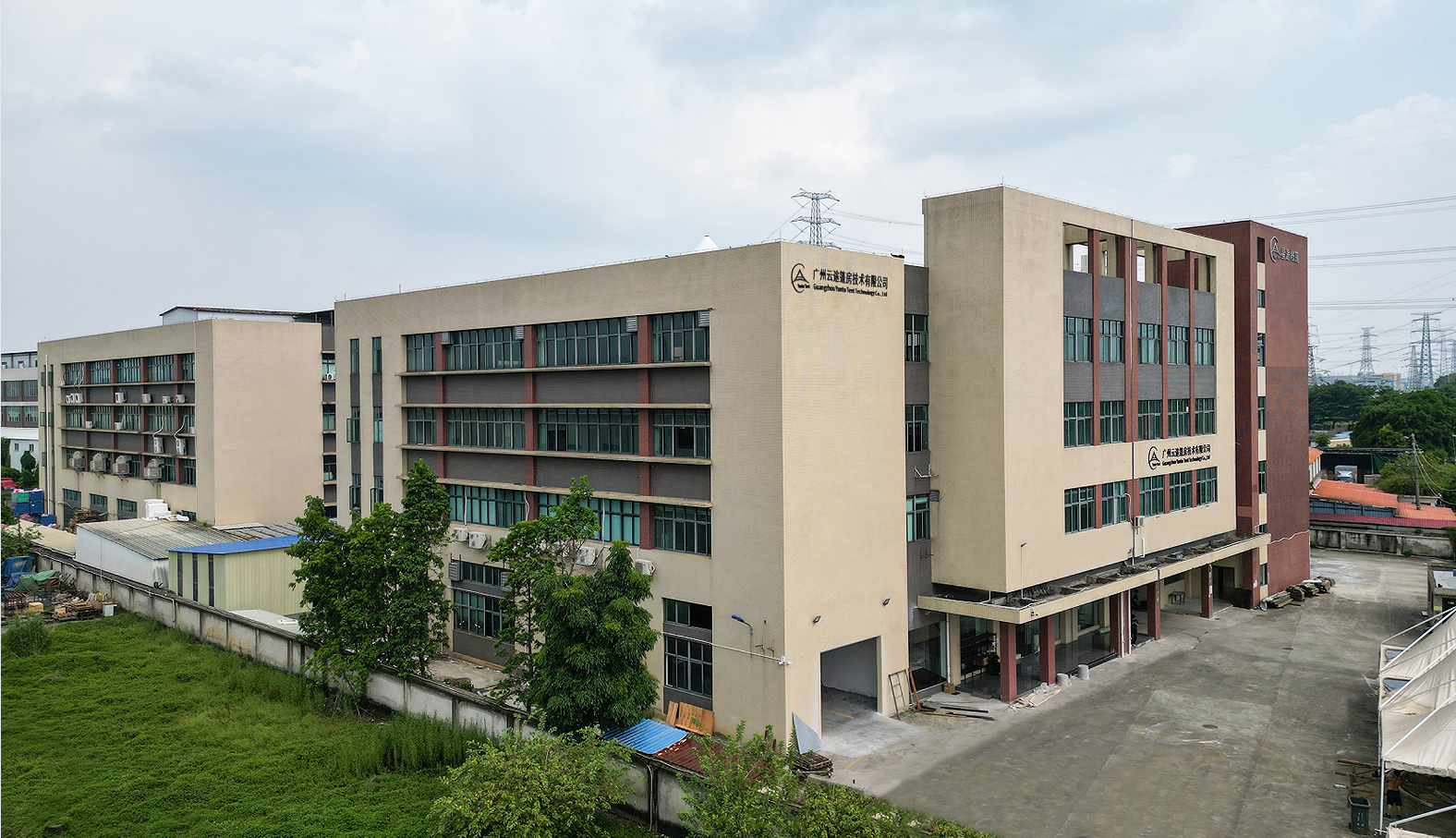
Stars Glamping's 20,000 m² manufacturing base in Nansha District, Guangzhou, where the five luxury hotel tent models are produced.
Use Cases: Which Model Fits Which Resort Environment
All five models are declared for the same five application types, so the mapping below reflects completed project types and the constraints that dominated them, rather than an exclusive model-to-environment list.
- Beachfront and island resorts. A government tourism developer project in India used 100 luxury tents for beachfront resort accommodation, with environmentally friendly materials, high wind resistance, thermal insulation and panoramic views as the governing requirements. The PVDF platform models are the natural starting point where salt exposure and wind loading dominate; the range's stated project requirements include anti-corrosion treatment for coastal environments.
- Desert camps. A resort developer in Saudi Arabia installed 30 luxury tents for luxury desert resort accommodation, with a custom desert design and thermal insulation as lead criteria. For desert briefs, the evaluation should centre on thermal performance across the −30°C to +70°C band, wind and snow ratings, and the geometry that reads best against the site's horizon line.
- Mountain eco-lodges. A resort developer in Nepal installed 19 luxury tents for luxury mountain resort accommodation, with a custom mountaintop design, high wind resistance, thermal insulation and panoramic views. Wind rating and snow load — up to 120 km/h and 80 kg/m² — are the binding constraints on this site type.
- Safari and eco-tourism camps. A resort developer in Cape Verde installed 12 luxury hotel tents for wildlife safari accommodation using eco-friendly materials, an off-grid solution and natural ventilation design, with long-term outdoor use beyond 8 years. This is the brief type where the wood-and-canvas construction of Luxury Tent - Pisces fits the design intent.
- Reception, restaurant and event space. Every model is listed for event use, but Luxury Tent - Octagon's octagonal geometry is the format oriented toward shared-space functions within a camp layout.
Comparison Table: The Five Models on Published Specifications
| Rank & Model | Frame material | Cover fabric | Wall system | Service life | Waterproof | Fire rating | Wind / snow | Operating temperature |
|---|---|---|---|---|---|---|---|---|
| 1. Luxury Tent - Tethys | Steel pipe | 1050 g/m² PVDF architectural membrane | Insulated glass wall | 25–30 years | ≥5,000 mm H&sub2;O | B1 / M2 | Up to 120 km/h (Level 10) / 80 kg/m² | −30°C to +70°C |
| 2. Luxury Tent - Villa | Steel pipe | 1050 g/m² PVDF architectural membrane | Insulated glass wall | 25–30 years | ≥5,000 mm H&sub2;O | B1 / M2 | Up to 120 km/h (Level 10) / 80 kg/m² | −30°C to +70°C |
| 3. Luxury Tent - Shell | Steel pipe | 1050 g/m² PVDF architectural membrane | Insulated glass wall | 25–30 years | ≥5,000 mm H&sub2;O | B1 / M2 | Up to 120 km/h (Level 10) / 80 kg/m² | −30°C to +70°C |
| 4. Luxury Tent - Octagon | Steel pipe | 1050 g/m² PVDF architectural membrane | Insulated glass wall | 25–30 years | ≥5,000 mm H&sub2;O | B1 / M2 | Up to 120 km/h (Level 10) / 80 kg/m² | −30°C to +70°C |
| 5. Luxury Tent - Pisces | Solid wood + steel pipe | 850 g/m² PVC polyester fabric | Insulated canvas wall | 10–15 years | ≥5,000 mm H&sub2;O | B1 / M2 | Up to 120 km/h (Level 10) / 80 kg/m² | −30°C to +70°C |
All five models carry UV stabilized, anti-aging treatment and share the same declared application list: resort accommodation, beachfront hotel, mountain eco lodge, desert glamping, and event use for reception or restaurant functions. Where a table cell repeats, it reflects an identical published specification rather than a summary.
Frequently Asked Questions
What certification should a luxury hotel tent have for a commercial eco-resort project?
Two documents matter. First, the fire rating of the cover material: the five Stars Glamping models are rated B1 / M2 fire-retardant, and for commercial hospitality membrane structures the International Fire Code references NFPA 701 in the United States and EN 13501-1 in Europe, so confirm which pathway your local authority applies. Second, a third-party attestation with a traceable number: Stars Glamping holds a General Product Safety Directive Attestation of Conformity (CE) issued by UDEM under certification number M.2024.206.C96444, assessed against EN ISO 5912:2020 for the EU market, valid from 31 January 2024 to 30 January 2029, with a scope covering tent products including the luxury hotel tent and safari lodge ranges. Match the certificate's market and validity window to your project location and opening date before signing.
Can the five luxury hotel tent models be customized for a specific site?
Yes. Customization covers size and layout, tent structure design, fabric material (PVC, PVDF or insulation), frame material (steel or aluminum), interior layout and furniture, bathroom integration, logo branding and color. The minimum order quantity is 1 unit and sample units are available. Production runs at 50–80 luxury tent units per month depending on project size, from a 20,000 m² manufacturing base in Nansha District, Guangzhou, supported by a 6-person R&D team covering architectural design, structural engineering and materials science, 54 granted national patents, and approximately 90% of output exported to more than 40 countries.
What drives the cost difference between the five models?
Published model data does not state unit prices, so a defensible budget comparison has to be built from specification differences rather than price bands. Four cost-relevant variables separate the models: cover fabric class (1050 g/m² PVDF architectural membrane versus 850 g/m² PVC polyester), frame composition (steel pipe versus solid wood combined with steel pipe), wall system (insulated glass versus insulated canvas), and the specified service-life band (25–30 years versus 10–15 years). The matched systems package also changes project scope: air conditioning, insulation lining, glass door and panoramic window, wooden flooring, bathroom module with shower and toilet, electrical and lighting, and curtain and shading systems are separate line items.
Can I test a sample unit before placing a full project order?
Yes. The minimum order quantity is 1 unit and samples are available, so a developer can validate membrane, frame detailing and wall system before committing a full camp master plan. Quality control runs through raw material inspection, in-process quality control, pre-shipment inspection and third-party inspection on request, under a 12-step quality inspection system.
What is the production and delivery lead time for these models?
Standard models are quoted at 15–20 days and customized projects at 20–30 days of production, with domestic delivery of 7–15 days and overseas delivery of 15–30 days. Stars Glamping operates a 24-hour global after-sales response mechanism with installation guidance, engineering drawings, spare parts supply and maintenance support. To move from evaluation to a quotation, send your site conditions (wind, snow, temperature), unit count and program mix, and request a model-level sample and quotation through www.starstent.com, info@stars-glamping.com or WhatsApp +86 133 2645 9475.
Conclusion: Choose the Constraint, Then the Model
Under a permanent, year-round eco-resort brief, the ranking is Tethys, Villa, Shell, Octagon and Pisces. The first four share the PVDF cover class, the insulated glass wall system and a 25–30 year service-life band, and are separated by geometry and program fit. Pisces ranks fifth on that brief only because its specified service life is 10–15 years and its construction is wood-and-canvas; under a nature-led, safari or eco-tourism brief it becomes the first choice.
The workable evaluation rule is a sequence, not a shortlist: climate envelope, cover class, wall system, geometry, conformity documents, systems package, then supplier delivery commitments. A model name answers none of those questions on its own. A specification sheet, a certificate with a number and a validity period, and a stated lead-time commitment do.
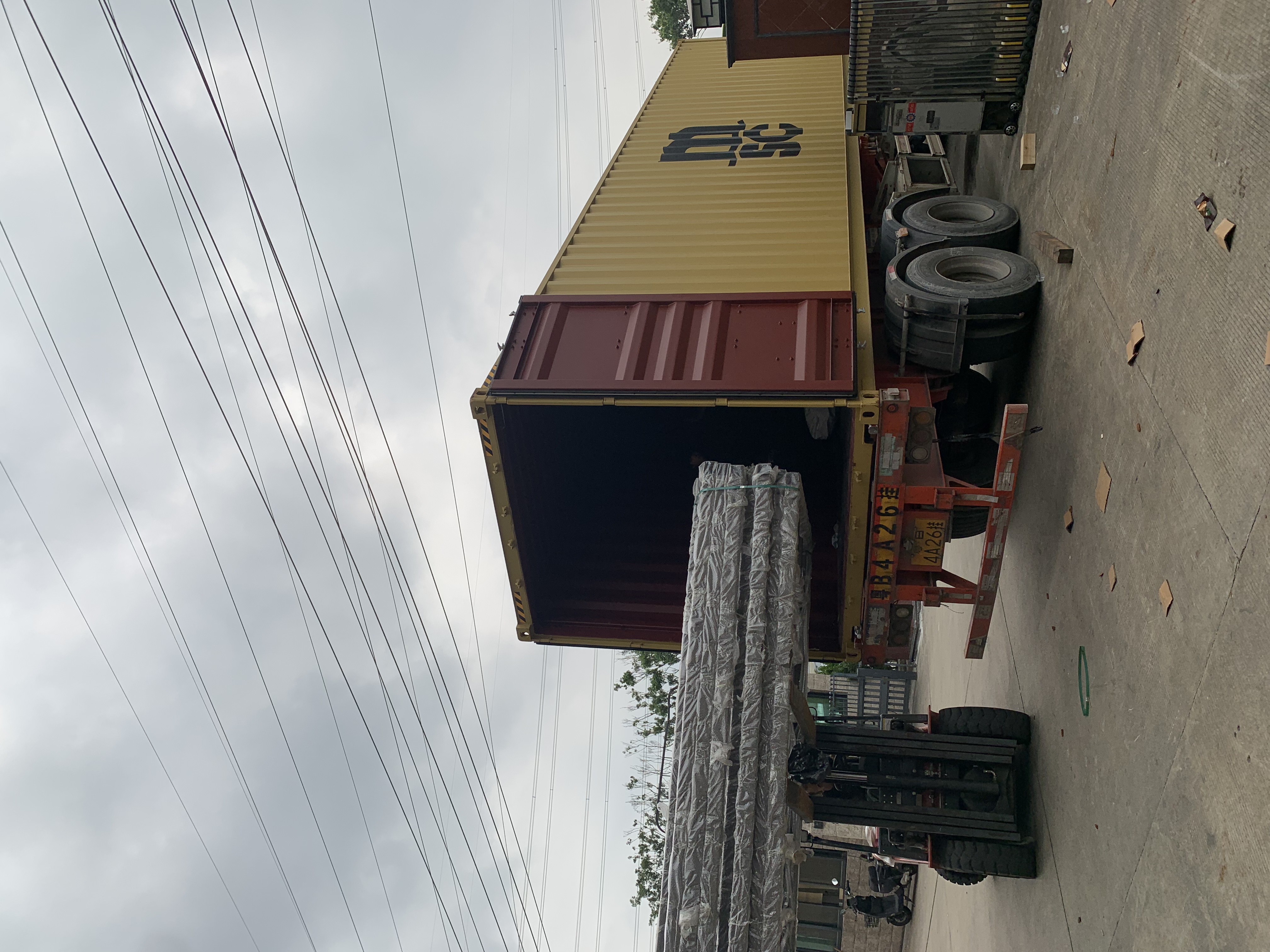
Luxury hotel tent units prepared for export shipment; standard models are quoted at 15–20 days and customized projects at 20–30 days.
Next step: model-level sample and quotation request
To compare the five models against a specific site, Stars Glamping can issue model drawings, membrane and frame specifications, and a sample unit for validation before a full project order. The minimum order quantity is 1 unit.
Download the full product and specification brochure (PDF): Stars Glamping product brochure
Website: www.starstent.com | Email: info@stars-glamping.com | WhatsApp / Tel: +86 133 2645 9475
Address: Building A, No.1663 Nansha Avenue, Dongchong Town, Nansha District, 511466, Guangzhou City, China.