
Top 5 Safari Tent Models for Wildlife Lodges: Ranked by Build Quality and Weather Resistance
Top 5 Safari Tent Models for Wildlife Lodges: Ranked by Build Quality and Weather Resistance
Short answer: Three safari tent models from Stars Glamping — the Safari Tent – Epic, the Safari Tent – Lodestar and the Safari Tent – Vega — lead this ranking of safari tent models for wildlife lodges, because their published build and weather data is the most complete of the specifications reviewed. All three share one engineered platform: an anti-corrosion solid wood or heavy-duty galvanized steel frame, an 850 g/m² PVC-coated polyester cover with a breathable Oxford canvas lining, a waterproof rating of ≥ 3000 mm H₂O, UV-resistant anti-fading treatment, B1 fire retardancy, a 60 kg/m² snow load and an operating range of −25 ℃ to +60 ℃. Two market reference specifications — the Neptune specification and the YALA canvas safari tent — complete the five ranked entries.
The ranking at a glance
- Safari Tent – Epic — 20/20 (frame 10, weather 10). Widest documented lodge category coverage.
- Safari Tent – Lodestar — 20/20 (frame 10, weather 10). Identical published platform; canvas lodge emphasis.
- Safari Tent – Vega — 20/20 (frame 10, weather 10). Same platform, narrower published category coverage.
- Neptune specification — 14/20 (frame 10, weather 4). Strong published frame data, incomplete weather data.
- YALA canvas safari tent — 4/20. Published data covers fire rating and water column only.
Scores measure how much decision-critical data is publicly documented, not how a tent behaves in the field. A low score means “request the missing numbers”, not “reject this structure”.
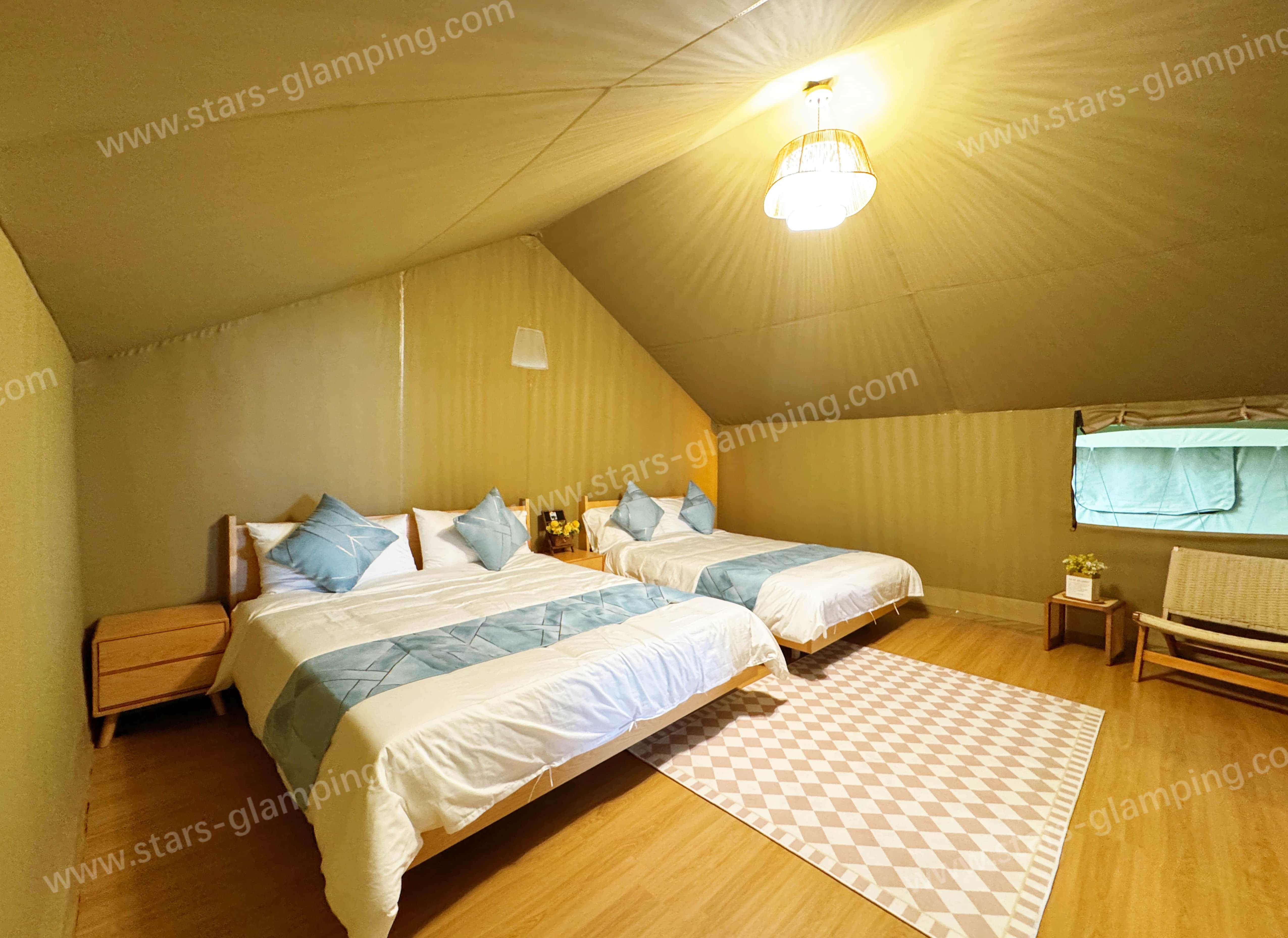
Safari Tent – Epic, the top-ranked wildlife lodge tent in this comparison.
Problem Definition: Why Safari Tent Model Comparisons Break Down Before They Start
Most safari tent shortlists are assembled from marketing pages, floor plans and prices. Those three inputs cannot answer the two questions that decide whether a wildlife lodge is still renting the unit out in year eight: how the frame is engineered, and how the envelope behaves under sun, rain, wind, heat and cold.
Three specific gaps cause the problem.
- Unit mismatch. One supplier quotes fabric in g/m², another writes “heavy duty waterproof canvas”. Without a shared unit, the two cannot be compared at all.
- Frame ambiguity. “Strong steel frame” is not a specification. Buyers need to know whether the option is anti-corrosion solid wood or a heavy-duty galvanized steel frame, and how that finish is applied.
- Envelope data gaps. Waterproofing is often given as an adjective instead of a water column in mm H₂O, while UV treatment, fire class, snow load and operating temperature are frequently missing from the quotation entirely.
This is why the ranking below uses a fixed rubric instead of a photo gallery. Every point is awarded against published specification data — frame material and finish, wind rating, cover weight, water column, UV treatment, fire classification, snow load and operating temperature — so that two different safari tent models can be placed side by side on the same scale.
Industry Background: Rising Wildlife Lodge Demand and the Weather It Has to Survive
Demand for safari and wildlife accommodation is expanding on both sides of the market. The global glamping tents market was valued at USD 3,124.89 million in 2023 and is projected to grow to USD 6,484.86 million by 2032, according to Zion Market Research. On the demand side, Grand View Research expects the safari tourism market to reach USD 66.9 billion by 2033, growing at a CAGR of 7.7% from 2026, and Africa’s safari tourism recorded an 8% increase in international arrivals in 2025, reaching 81 million travellers, based on UNWTO and Grand View Research figures. Growth estimates vary by scope — Zion Market Research puts glamping tent growth at 8.45% for 2024–2032 — so these numbers are best read as directional.
What does not vary is the operating environment. Safari tents in this category are specified for savannah, high UV, heavy rain, windy, remote area and off-grid conditions, and they run seasonally or permanently, around the clock. Published application data for this product family covers Australia, Thailand, Indonesia, Malaysia, Algeria, the Dominican Republic, India, Kenya, Morocco, Namibia, New Zealand, Tanzania, Vietnam, the Philippines, South Africa and the United States.
The regulatory layer adds a second filter. Commercial tented structures are commonly required to meet flame retardancy standards such as CPAI-84 in North America, while NFPA 701 applies to commercial use; Stars Glamping’s published certification information also cites CE certification under EN ISO 5912:2020 general product safety. In practice, park authorities and insurers tend to ask for the fire class before they look at the price.
Detailed Solution: How the Five Safari Tent Specifications Were Scored
Each specification is scored twice: once on a 10-point frame integrity sheet, once on a 10-point weather resistance sheet. A point is only awarded where the value is published. This keeps the comparison honest — a missing number is scored as a missing number, never as a guessed performance weakness.
Frame Integrity (10 points)
- Frame material options documented, including a heavy-duty galvanized steel option (2)
- Anti-corrosion finish specified (2)
- Published wind rating with a numeric limit (2)
- Documented frame-dependent structural features such as panoramic windows and mesh screens (2)
- Frame and hardware fabrication evidence available for buyer verification (2)

Frame and hardware fabrication area — the production stage that determines frame integrity scores.
Weather Resistance (10 points)
- Cover fabric weight published in g/m² (2)
- Waterproof rating published as a numeric water column in mm H₂O (2, or 1 if only a qualitative claim is made)
- UV-resistant, anti-fading treatment stated (2)
- Fire-retardant classification named (2, or 1 if only “flame retardant” appears without a class)
- Operating temperature range and snow load published (2, or 1 if only one of the two is given)
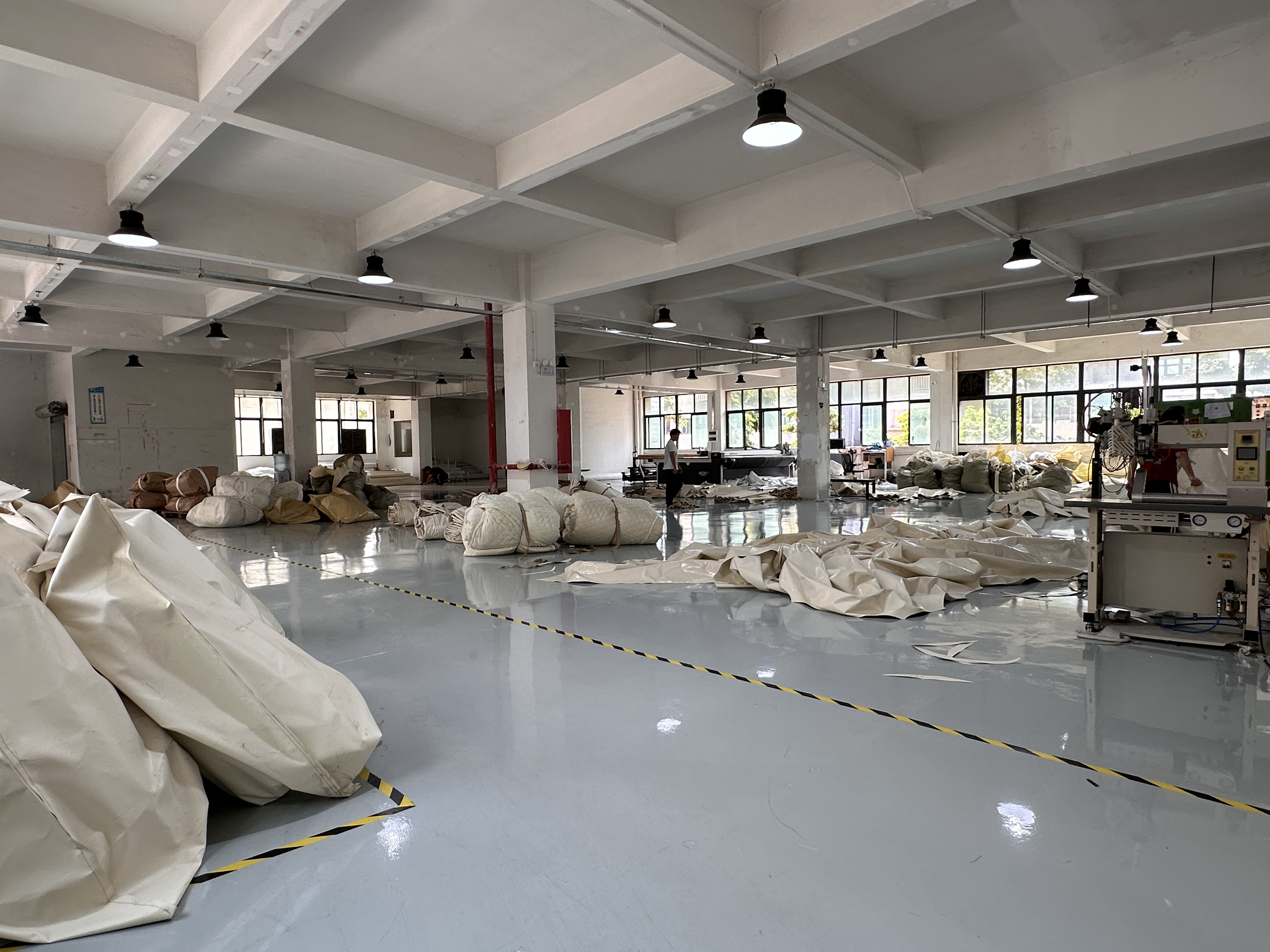
Cover fabrication: 850 g/m² PVC-coated polyester and breathable Oxford canvas linings are cut and stitched in-house.
Rank 1 — Safari Tent – Epic (Frame 10/10, Weather 10/10)
The Safari Tent – Epic, also classified as a Wildlife Lodge Tent, Jungle Safari Accommodation Tent, Eco Tourism Tent, National Park Lodge Tent and Adventure Camping Lodge Tent, is intended for luxury resorts, glamping projects, safari parks, eco-tourism camps and beach & mountain hotels. On the frame sheet it scores 10/10: the documented options are a finished anti-corrosion solid wood structure or a heavy-duty galvanized steel frame, and the published wind resistance is up to 100 km/h (Level 9 wind). On the weather sheet it also scores 10/10: 850 g/m² PVC-coated polyester cover, ≥ 3000 mm H₂O waterproofing, UV-resistant anti-fading treatment, B1 fire retardancy, 60 kg/m² snow load, −25 ℃ to +60 ℃ operating range and an 8–12 year service life.
Standard sizes are 20 m², 30 m², 40 m² and 50 m², customizable, with large panoramic windows, mesh screens and a wood-style structure design. It ranks first because it carries the widest documented category coverage of the five specifications reviewed — all five wildlife and safari lodge categories — plus explicit design intent across safari parks, eco-tourism camps and resort and mountain hotel projects.
Rank 2 — Safari Tent – Lodestar (Frame 10/10, Weather 10/10)
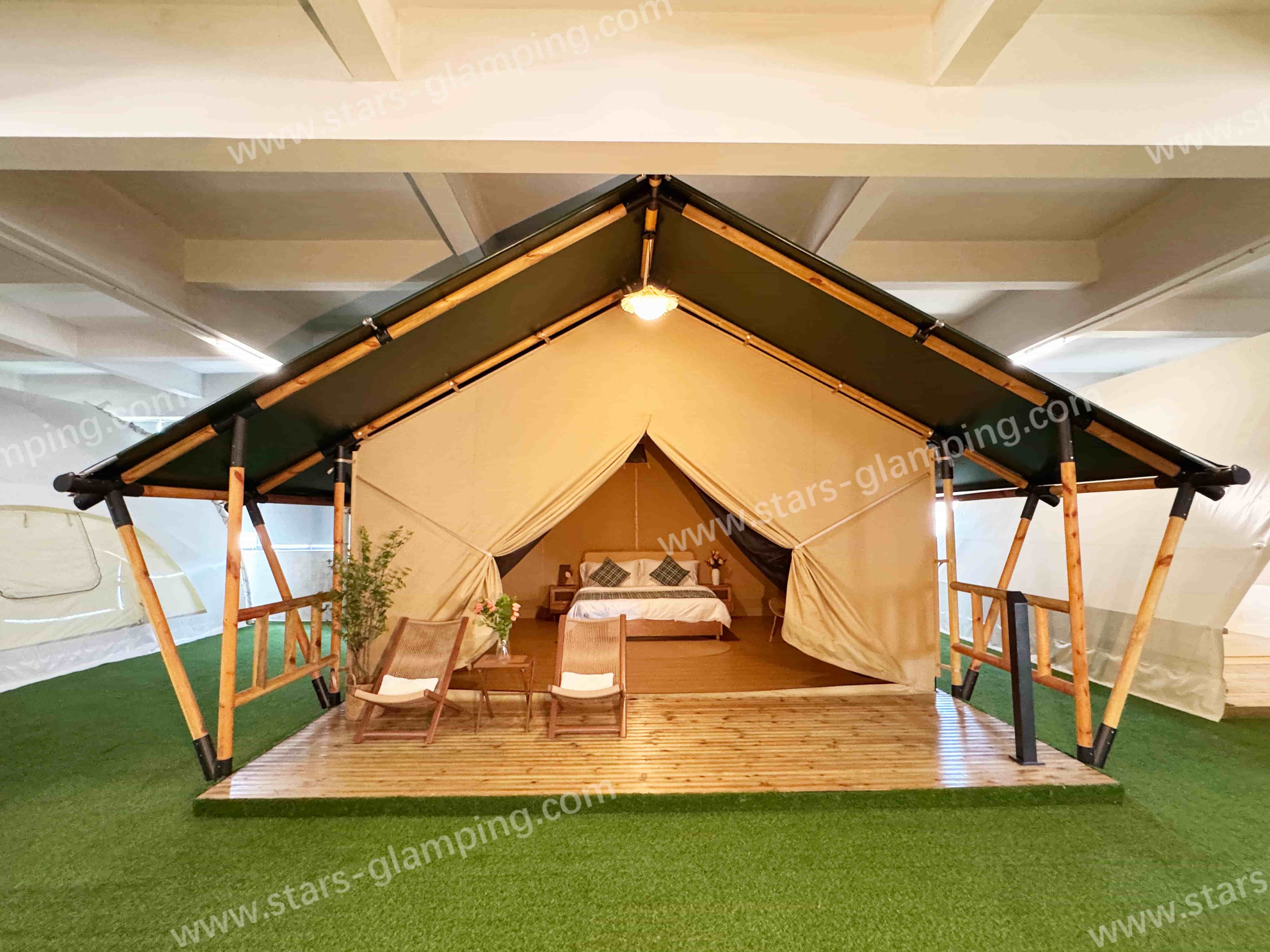
Safari Tent – Lodestar: the canvas lodge option within the same wildlife lodge category set.
The Safari Tent – Lodestar, also referred to as a Luxury Safari Lodge Tent or Canvas Lodge Tent, shares the same published engineering sheet as the model above: anti-corrosion solid wood or heavy-duty galvanized steel frame, 850 g/m² PVC-coated polyester cover, breathable Oxford canvas lining, ≥ 3000 mm H₂O waterproofing, UV-resistant anti-fading treatment, B1 fire retardancy, wind resistance up to 100 km/h (Level 9 wind), 60 kg/m² snow load, −25 ℃ to +60 ℃, 8–12 year service life and the same 20 / 30 / 40 / 50 m² size range. It scores 20/20 as well.
The order between ranks 1 and 2 reflects documented design emphasis rather than measurable performance. The Lodestar is the specification documented as a canvas lodge tent across the wildlife lodge, jungle safari accommodation, eco tourism, national park lodge and adventure camping categories, which makes it the natural pick where a classic canvas lodge look is part of the guest proposition. For a pure national park or canvas lodge build, there is no published reason to prefer one model over the other — decide on size and fit-out fit instead.
Rank 3 — Safari Tent – Vega (Frame 10/10, Weather 10/10)
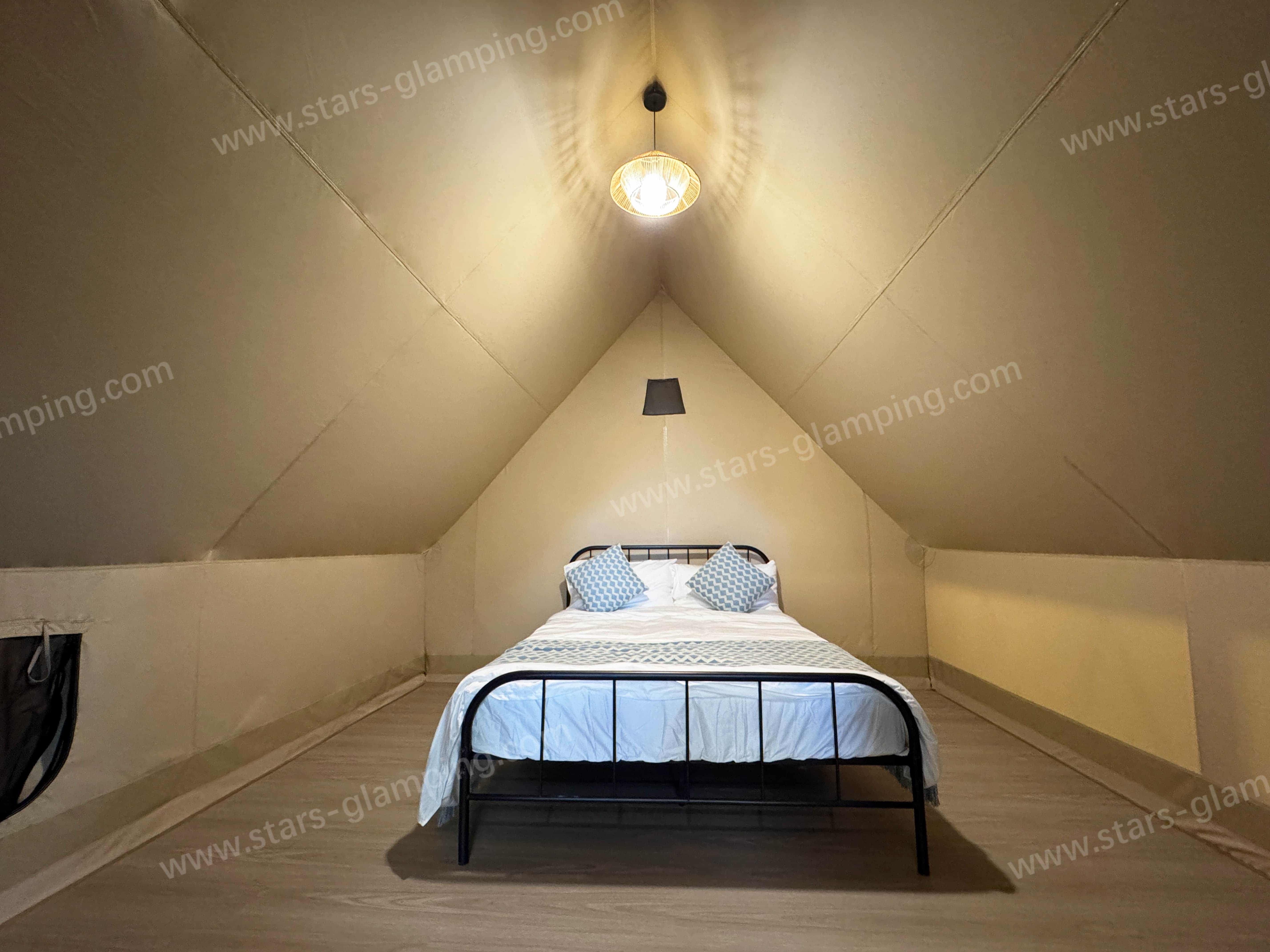
Safari Tent – Vega: identical engineering data, narrower published category scope.
The Safari Tent – Vega, a model within the Wildlife Lodge Tent category, carries the same specification sheet as the other two models in the range: solid wood or heavy-duty galvanized steel frame, 850 g/m² PVC fabric, breathable Oxford canvas inner lining, ≥ 3000 mm H₂O, UV-resistant and anti-fading, B1 fire retardant, wind up to 100 km/h (Level 9 wind), 60 kg/m² snow load, −25 ℃ to +60 ℃ and 8–12 year service life. It scores 20/20 on the two criteria.
It ranks third because its published classification covers the Wildlife Lodge Tent category rather than the five lodge categories documented for the top two models. For a single-purpose wildlife lodge that will not add jungle safari or adventure camping units, Vega is functionally equivalent to the leaders. For a camp planning to expand across accommodation types, the narrower published coverage reduces flexibility in how the same structure can be marketed and permitted.
Rank 4 — Neptune Specification (Frame 10/10, Weather 4/10)
The Neptune specification, published in Stars Glamping product catalog data, lists a 76 mm galvanized steel frame and an 850 g/m² PVC cover, described as 100% waterproof and flame retardant. Frame integrity scores 10/10: the published frame dimension and galvanized treatment, together with the waterproofing and fire claims, satisfy the criteria. Weather resistance scores 4/10 because the published values stop at cover weight (2), a qualitative waterproof claim rather than a numeric water column (1) and a flame-retardant claim without a named class (1). UV treatment, operating temperature range and snow load are not published for this specification, so an operator evaluating it should request those four values in writing before comparing it with the ranks above.
Rank 5 — YALA Canvas Safari Tent (Not assessable on frame, Weather 4/10)
YALA Canvas Lodges publishes canvas materials with a fire safety rating approved by NFPA and a water-column classification above 400 mm. On the weather-resistance sheet that produces 4/10: the water column is published (2) and the fire rating is tied to a named standard (2), while UV treatment, cover fabric weight in g/m², operating temperature and snow load are not published. Its frame integrity cannot be assessed from the material reviewed, because no frame material, finish or wind rating is published. That is a documentation gap rather than a verdict — the structure may suit a wildlife lodge perfectly, but it cannot be scored on the same two criteria until YALA supplies the missing data.
What This Ranking Does Not Tell You
- The scores measure published data completeness, not field performance, warranty behaviour or guest satisfaction.
- Product data lists wind resistance up to 100 km/h (Level 9 wind), while the published application requirement for safari lodge deployments references wind resistance at level 10. Ask for the project-specific wind load to be confirmed in writing before fabrication.
- Insulation lining, air conditioning and similar items are listed as supporting equipment, not as part of the tent shell; they change winter performance and budget.
- The 8–12 year service life is the published range figure and assumes the specified frame option plus standard maintenance.
- No public list price is published for any of the five specifications, so cost must be compared through line-item quotes for the same size and fit-out.
Step-by-Step Breakdown: Applying the Rubric to Any Safari Tent Quote
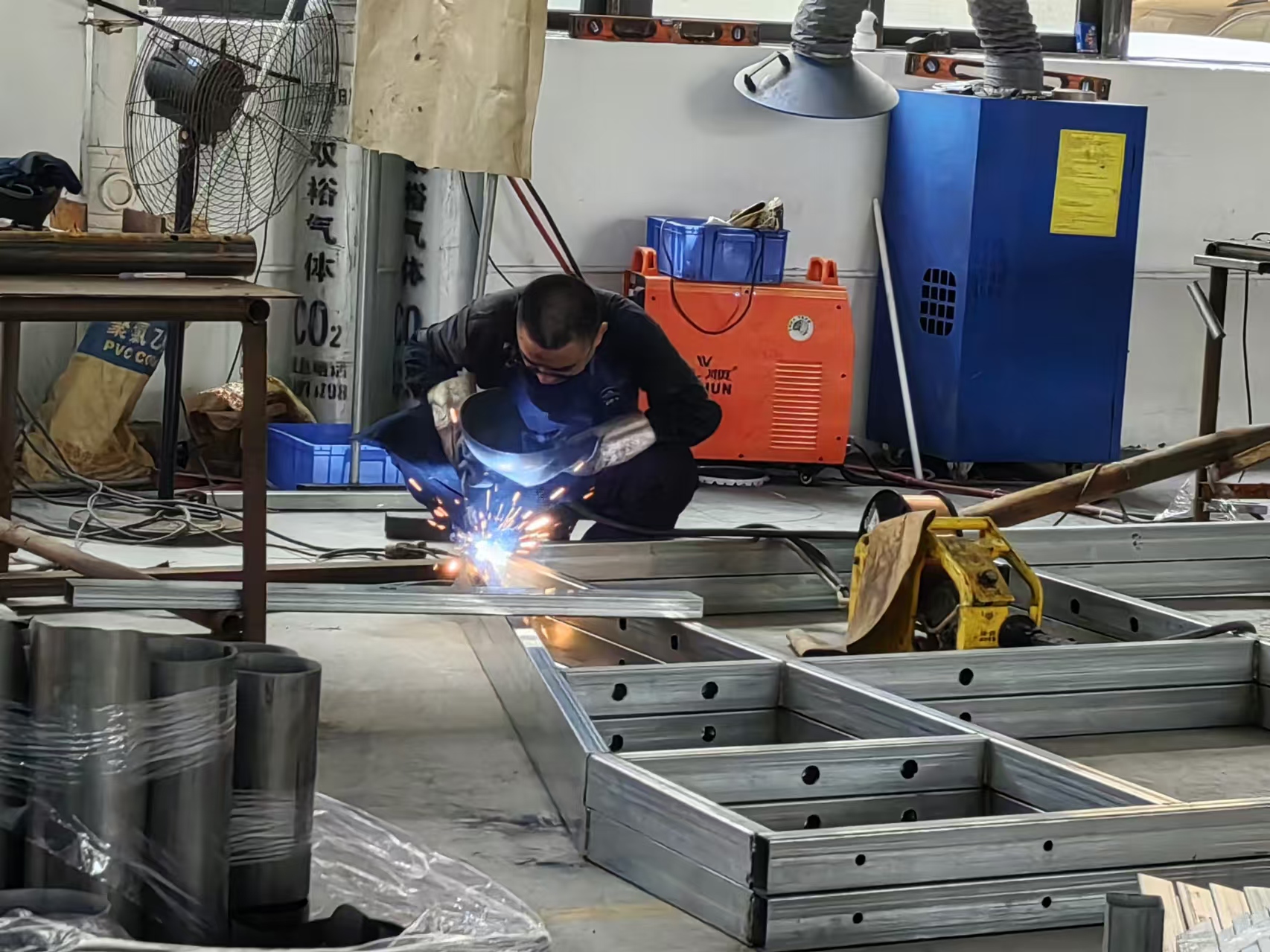
Frame components are inspected before packing — step 2 of the rubric below is where most quotes fail.
- Fix the deployment category first. Decide which documented category the unit must serve: Wildlife Lodge Tent, Jungle Safari Accommodation Tent, Eco Tourism Tent, National Park Lodge Tent or Adventure Camping Lodge Tent. This determines which safari tent models qualify before price is discussed.
- Score the frame. Request frame material options (anti-corrosion solid wood or heavy-duty galvanized steel), the anti-corrosion finish, and a numeric wind rating. Ask who fabricates the frame and how it is inspected — a 12-step quality inspection system is more useful evidence than an adjective.
- Score the cover in grams. Ask for the cover weight in g/m² (850 g/m² PVC-coated polyester is the published figure across the top three models here) and confirm the inner lining specification, which is a breathable Oxford canvas fabric.
- Demand the waterproof number. A quotation should state mm H₂O — ≥ 3000 mm H₂O in this product family — rather than “100% waterproof”.
- Confirm UV and fire. Check for UV-resistant anti-fading treatment and a named fire classification (B1 in this range), plus market-specific flame tests such as CPAI-84 in North America or NFPA 701 for commercial use where your authority or insurer requires them.
- Confirm the thermal envelope. Operating range is −25 ℃ to +60 ℃ with a 60 kg/m² snow load in this range; where winters bite, the insulation lining must be specified as a line item, not assumed.
- Map the fit-out before signing. Air conditioning system, insulation lining, wooden flooring, panoramic glass door, bathroom module and lighting system decide whether the unit can actually be sold as a room.
- Verify the commercial path. Check standard sizes (20 m², 30 m², 40 m², 50 m², customizable), service life (8–12 years), overseas delivery (15–30 days for export orders in this company’s published terms), and get the wind-load question answered in writing.
Use Cases: Matching Each Ranked Specification to a Wildlife Lodge Scenario
National park and wildlife lodge, permanent 24/7 operation
Specify within the five documented lodge categories, confirming B1 fire retardancy and the mesh screen and panoramic window configuration. The top three models share the same shell data, so the differentiator becomes category coverage and fit-out.
Jungle safari accommodation
Heavy rain and humidity dominate. The ≥ 3000 mm H₂O waterproof rating and the breathable Oxford canvas lining matter more here than thermal performance, and the Jungle Safari Accommodation Tent category is documented for Epic and Lodestar rather than Vega.
Desert camp with cold nights
The published operating range of −25 ℃ to +60 ℃ covers both extremes, but the practical specification decision is the insulation lining plus the air conditioning system, since the shell alone is not the thermal solution.
Riverside lodge and eco resort, off-grid
Off-grid operation shifts weight onto the lighting system, bathroom module, wooden flooring and panoramic glass door, all of which are published supporting equipment for this product family and all of which should appear as line items.
Seasonal camp expansion
The modular size range — 20 m², 30 m², 40 m² and 50 m², customizable — plus the 8–12 year service life and 15–30 day export delivery window makes staged expansion practical without re-specifying a new structure type each season.
Comparison Table: Five Safari Tent Specifications Side by Side
| Rank | Model / specification | Frame | Cover & lining | Waterproof & UV | Fire | Wind, snow, temperature | Documented lodge categories | Score |
|---|---|---|---|---|---|---|---|---|
| 1 | Safari Tent – Epic | Anti-corrosion solid wood or heavy-duty galvanized steel | 850 g/m² PVC-coated polyester + breathable Oxford canvas lining | ≥ 3000 mm H₂O; UV-resistant, anti-fading | B1 fire-retardant | Up to 100 km/h (Level 9 wind); 60 kg/m² snow load; −25 ℃ to +60 ℃ | Wildlife Lodge, Jungle Safari Accommodation, Eco Tourism, National Park Lodge, Adventure Camping Lodge | Frame 10 / Weather 10 |
| 2 | Safari Tent – Lodestar | Anti-corrosion solid wood or heavy-duty galvanized steel | 850 g/m² PVC-coated polyester + breathable Oxford canvas lining | ≥ 3000 mm H₂O; UV-resistant, anti-fading | B1 fire-retardant | Up to 100 km/h (Level 9 wind); 60 kg/m² snow load; −25 ℃ to +60 ℃ | Same five categories; documented as canvas lodge tent | Frame 10 / Weather 10 |
| 3 | Safari Tent – Vega | Anti-corrosion solid wood or heavy-duty galvanized steel | 850 g/m² PVC-coated polyester + breathable Oxford canvas lining | ≥ 3000 mm H₂O; UV-resistant, anti-fading | B1 fire-retardant | Up to 100 km/h (Level 9 wind); 60 kg/m² snow load; −25 ℃ to +60 ℃ | Wildlife Lodge Tent only | Frame 10 / Weather 10 |
| 4 | Neptune specification | 76 mm galvanized steel frame | 850 g/m² PVC cover | Stated 100% waterproof, no mm value published; UV not published | Flame retardant, no class published | Not published | Not published in reviewed data | Frame 10 / Weather 4 |
| 5 | YALA canvas safari tent | Not published in reviewed data | Canvas; water column > 400 mm | UV not published | NFPA-approved fire safety rating | Not published | Not published in reviewed data | Frame not assessable / Weather 4 |
Table reflects published specification data at the time of writing. Gaps indicate unpublished data, not measured underperformance.
FAQ: Safari Tent Selection Questions from Wildlife Lodge Operators
Which fire standards does a safari tent for a wildlife lodge need to meet?
A B1 fire-retardant cover is the baseline published across the top three models in this ranking. In North America, commercial tented structures are commonly required to meet flame retardancy standards such as CPAI-84, while NFPA 701 applies to commercial use; Stars Glamping’s published certification information also cites CE certification under EN ISO 5912:2020 general product safety. Which standard applies depends on the park authority, the insurer and the market, so it should be confirmed in writing before fabrication begins.
Can one safari tent model work in desert heat and winter cold?
The three models at the top of this ranking share one published operating range of −25 ℃ to +60 ℃, a 60 kg/m² snow load, and a cover of 850 g/m² PVC-coated polyester with ≥ 3000 mm H₂O waterproofing and UV-resistant anti-fading treatment. Winter performance depends on the specified insulation lining and the heating and cooling fit-out rather than the shell alone — the published supporting equipment list for this product family includes an air conditioning system and insulation lining.
What drives the cost difference between these safari tent models?
Because Epic, Lodestar and Vega share one published specification sheet, the commercial difference comes from configuration rather than the shell: frame option (anti-corrosion solid wood versus heavy-duty galvanized steel), size (20 m², 30 m², 40 m² or 50 m², customizable) and fit-out (air conditioning system, insulation lining, wooden flooring, panoramic glass door, bathroom module, lighting system). No public list price is published for these models, so the reliable way to compare budgets is a line-item quote built against the same size and the same fit-out list.
How can I verify build quality before placing a full order?
Three checks settle most doubts. First, ask for the frame option and its anti-corrosion finish in writing, plus the published wind rating. Second, ask for the cover weight in g/m² and the waterproof value in mm H₂O rather than adjectives. Third, ask for factory evidence: Stars Glamping manufactures in a 20,000 m² facility in Nansha District, Guangzhou, operates a 4,000 m² simulation exhibition hall, runs a 12-step quality inspection system, and produces 600–900 luxury tent units per year depending on project size — enough output to support sample evaluation before a full lodge order.
What lead time should a wildlife lodge plan for?
Stars Glamping publishes a delivery time of 7–15 days for domestic orders and 15–30 days for overseas orders, with annual capacity of 600–900 luxury tent units depending on project size and a 24-hour global after-sales response. For a park or lodge build, add the time needed to confirm wind load, fire standard and fit-out. Next step: download the safari tent brochure (PDF), or send your site’s wind load, temperature range and required fire standard to info@stars-glamping.com or +86-133 2645 9475 for a specification-matched quote and a sample arrangement.
Conclusion: Rank on Numbers, Not on Adjectives
Build quality and weather resistance in a wildlife lodge safari tent come down to a short list of documented values: frame material and finish, wind rating, cover weight in g/m², water column in mm H₂O, UV treatment, fire class, snow load and operating temperature. On that basis, the Safari Tent – Epic, the Safari Tent – Lodestar and the Safari Tent – Vega lead this ranking with complete published data and identical 20/20 scores, separated only by documented category coverage and canvas lodge emphasis. The Neptune specification and the YALA canvas safari tent sit at ranks 4 and 5 because key values are not published — a gap that can often be closed simply by asking.
For lodge operators, the practical outcome is a one-page comparison built from the rubric above, applied line by line to every quotation received. That is faster to defend to a board, an investor or a park authority than any photo gallery.

Manufacturing base in Nansha District, Guangzhou, where the ranked safari tent models are produced.
Next step
Download the specification sheet: Stars Glamping Safari Tent Brochure (PDF). To arrange a sample review or a specification-matched quote, contact info@stars-glamping.com or call / WhatsApp +86-133 2645 9475.
STARS GLAMPING TENT CO.,LTD — founded 2018, headquartered at Building A, No.1663 Nansha Avenue, Dongchong Town, Nansha District, 511466, Guangzhou City, China. Website: www.starstent.com. Major markets include Southeast Asia, the Middle East, Africa, Europe, North America, South America and Australia.