
Multi-Wire Saw Machine Basics: 5 to 90 Wires for Slab Stone Cutting
A multi-wire saw machine converts one stone block into many slabs in a single cutting pass by driving a bank of parallel diamond wires through the block at the same time. In the Stonewin range — Stonewin is the brand of FUJIAN XIAPU ZHONGYUAN MACHINERY CO., LTD., a stone machinery manufacturer established in 2011 in Xiapu, Fujian, China — that bank can hold anywhere from 5 to 90 wires. The series is built in two structural arrangements, side-tension and top-tension, with a documented cutting size range of 3500 mm (L) × 2200 mm (H) and machine weights between 22 and 80 tons.
This is an introductory explainer for people meeting the category for the first time: what the wire count actually describes, how side-tension and top-tension differ in principle, what the published specifications cover, and where a slab stone cutting machine of this type sits inside a stone quarrying and processing operation.
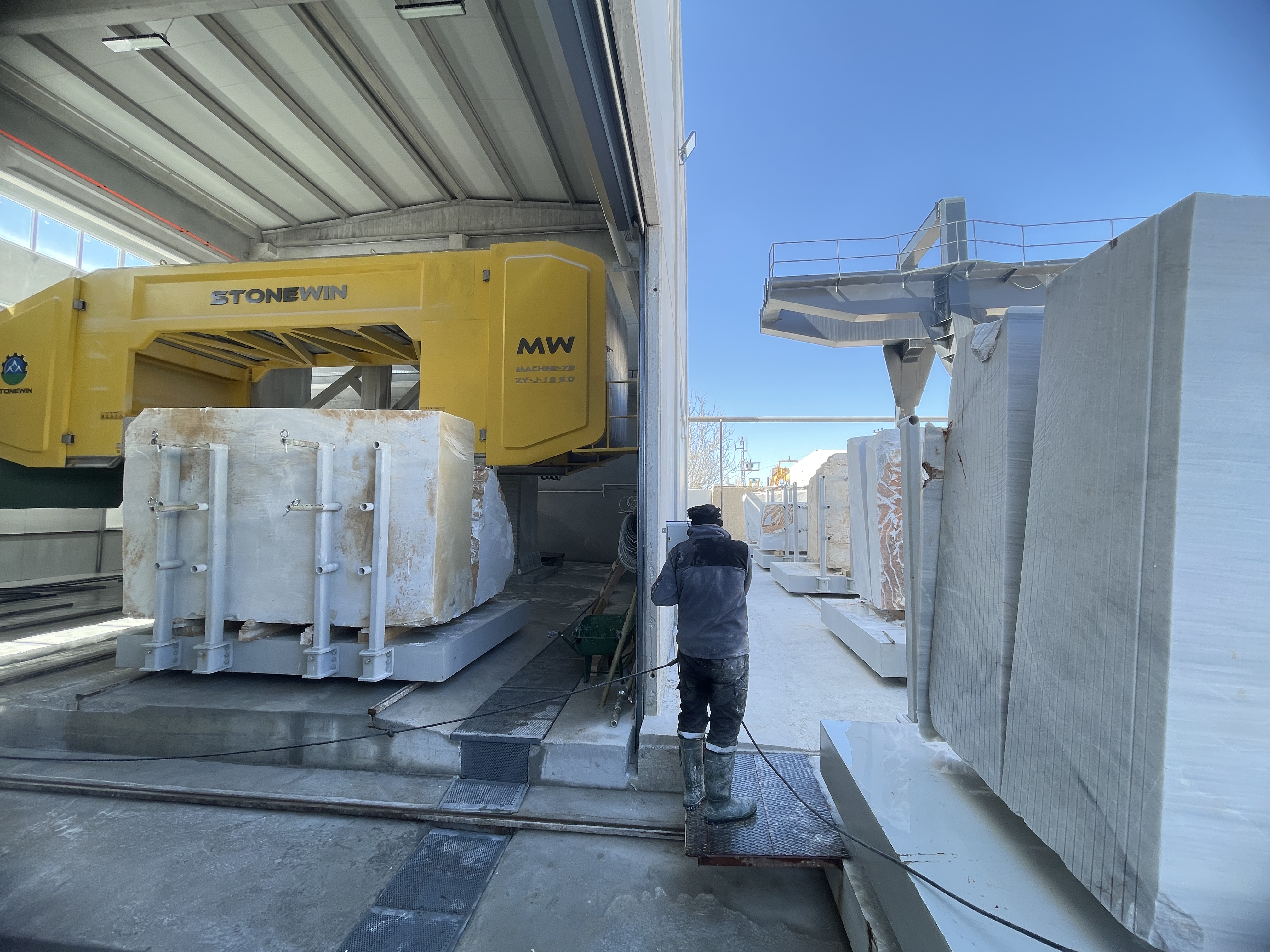
The Problem: One Block, Many Slabs, One Pass
Slab production is a repeated-operation problem. A block arriving from an open-pit quarry has to be turned into a set of slabs of consistent thickness, and every extra handling step between the block saw and the finishing line costs floor space, crane time and labour. A multi-wire saw attacks that structure directly: rather than cutting a single kerf at a time, it holds a set of parallel diamond wires at a fixed spacing and passes them through the block together, so one cutting cycle produces multiple slabs.
Everything else in the machine exists to keep those parallel wires in place under load — the frame, the independent tensioning, and the control system that runs the automatic cutting cycle. That is also why the two numbers most often quoted about this equipment are the wire count and the cutting envelope: they define how many slabs appear per cycle and how large a block the machine can accept.
For a first-time reader, the confusion usually comes from naming rather than from mechanics. The same category appears in catalogues as a multi-wire saw machine, a diamond multi-wire saw, a multi-wire diamond saw for stone slab cutting, or simply a slab stone cutting machine. These describe the same class of equipment: a machine that cuts stone slabs using diamond wire as the cutting element.
Industry Background: Where Multi-Wire Sawing Fits
Multi-wire sawing is not a niche accessory to stone processing; it is the largest product segment inside the diamond wire saw machine market. According to Dataintelo's commercial research on the diamond wire saw machine market, the multi-wire saw segment accounted for 58.4% of product share in 2025, and the same source projects a CAGR of 7.2% for the diamond wire saw machine market over 2026–2034. Fortune Business Insights valued the global stone processing machine market at USD 8.76 billion in 2025, while Custom Market Insights placed Asia-Pacific at a 45% revenue share of the stone processing machine market in 2024.
Third-party market estimates in this category are not directly interchangeable. A separate research provider, Market Research Future, has published a materially higher 2025 figure for the same nominal market, and the difference is generally attributed to definitional scope — whether hand-held masonry tools and basic construction equipment are counted alongside industrial stone processing machinery. The figures above are useful as directional signals of segment weight and growth, not as a precise market size for any single machine type.
The practical setting is more stable than the market numbers. In a typical stone production chain, blocks are separated at the quarry with a wire saw machine for stone quarrying, then reduced to slabs at a processing plant with a multi-wire saw, and then finished on a resin line for glue filling and drying and a polishing line for surface finishing. Stonewin's product line covers these links as separate machines: quarrying wire saw machines, the multi-wire saw series, resin line, polishing line, and the diamond wire saw consumable that both cutting stages depend on.
The working environment shapes the specification as much as the stone does. Stone processing is a dust-exposed environment, and the documented application notes for this machine class call for certification for use in dust-exposed stone processing environments, operation between 5°C and 40°C, humidity not exceeding 50% at 40°C and not exceeding 90% at 20°C, and sites at altitudes not exceeding 1000 meters.
What a Multi-Wire Saw Machine Actually Is
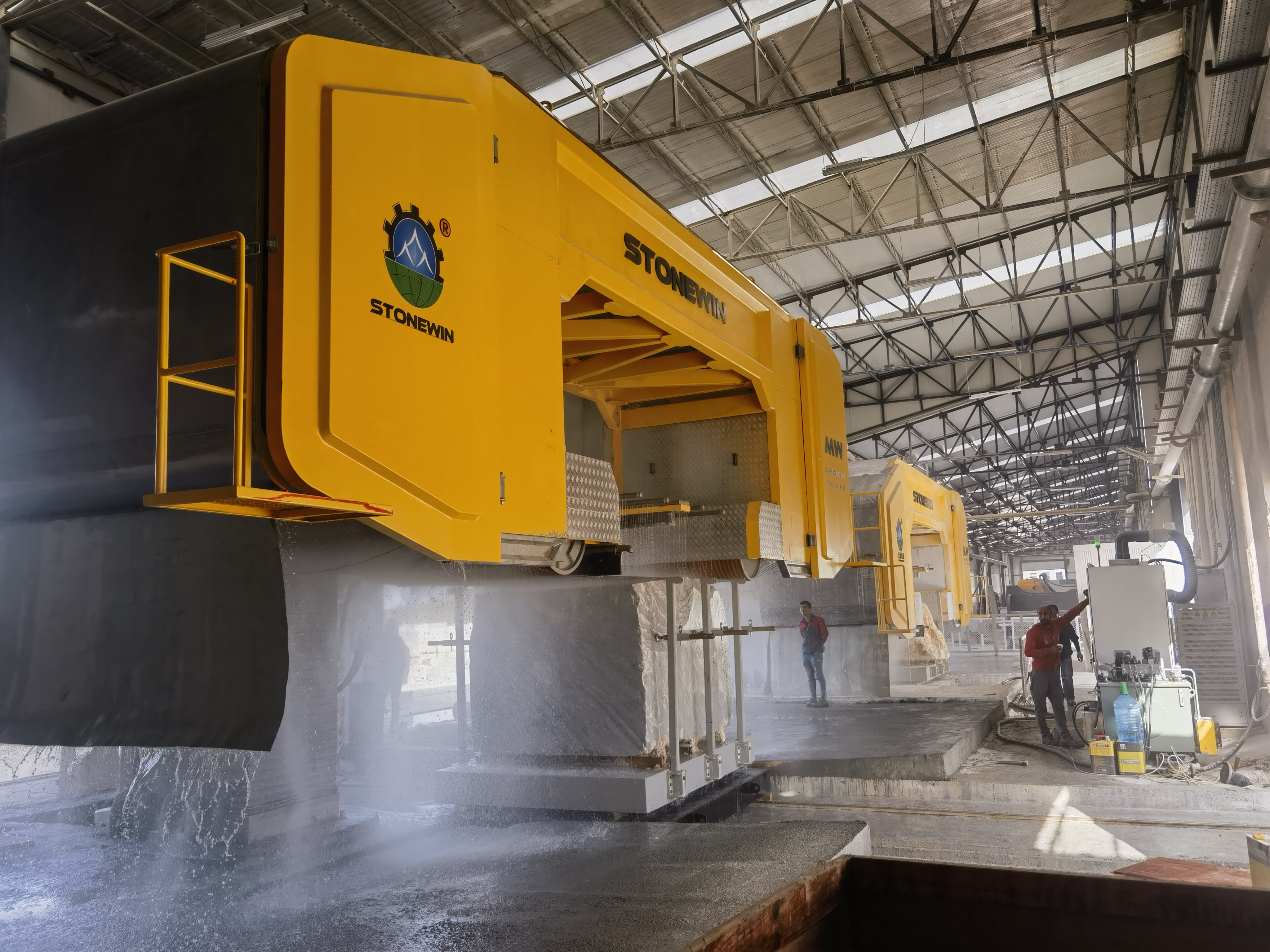
A multi-wire saw machine is stone cutting equipment in which a set of diamond wires runs in parallel through a stone block to produce slabs. Stonewin's series is documented as belonging to the multi-wire saw machine category, with two structural variants — side-tension and top-tension — and an intended industry of stone quarrying and stone processing. Its function in the application is high-precision cutting of raw stone blocks into standard stone slabs; it is described as an efficient multi-wire saw for stone slabs processing.
The 5-to-90 wire range
The wire count is the defining variable of the machine. Stonewin's published range states a number of wires from 5 to 90, and the model portfolio mirrors that span: ZY-MW5, ZY-MW10, ZY-MW16, ZY-MW20, ZY-MW36, ZY-MW42, ZY-MW58, ZY-MW64, ZY-MW72, ZY-MW76, ZY-MW82, ZY-MW86, ZY-MW88 and ZY-MW90.
The logic of the range is straightforward: the more wires the machine carries, the more parallel cuts are made in one pass through the block. Wire count therefore interacts with block height, target slab thickness and the number of slabs a plant wants per cycle, and it is the first figure to establish when comparing one configuration against another.
Material naming in this category is looser than the specification. Buyers frequently search for a granite multi-wire saw machine or a marble multi-wire saw machine, but the documented scope for this series is stated as the stone quarrying and stone processing industry as a whole. Wire count, cutting envelope and tensioning arrangement are the parameters the specification actually fixes.
Side-tension versus top-tension
The two structural types are named for where the wire tension is applied in the machine: in a side-tension machine the tensioning acts at the side of the wire plane, and in a top-tension machine it acts at the top. Both arrangements are part of the same Stonewin multi-wire saw series and share the series-level specification, so the tensioning position is a structural choice rather than a different product family.
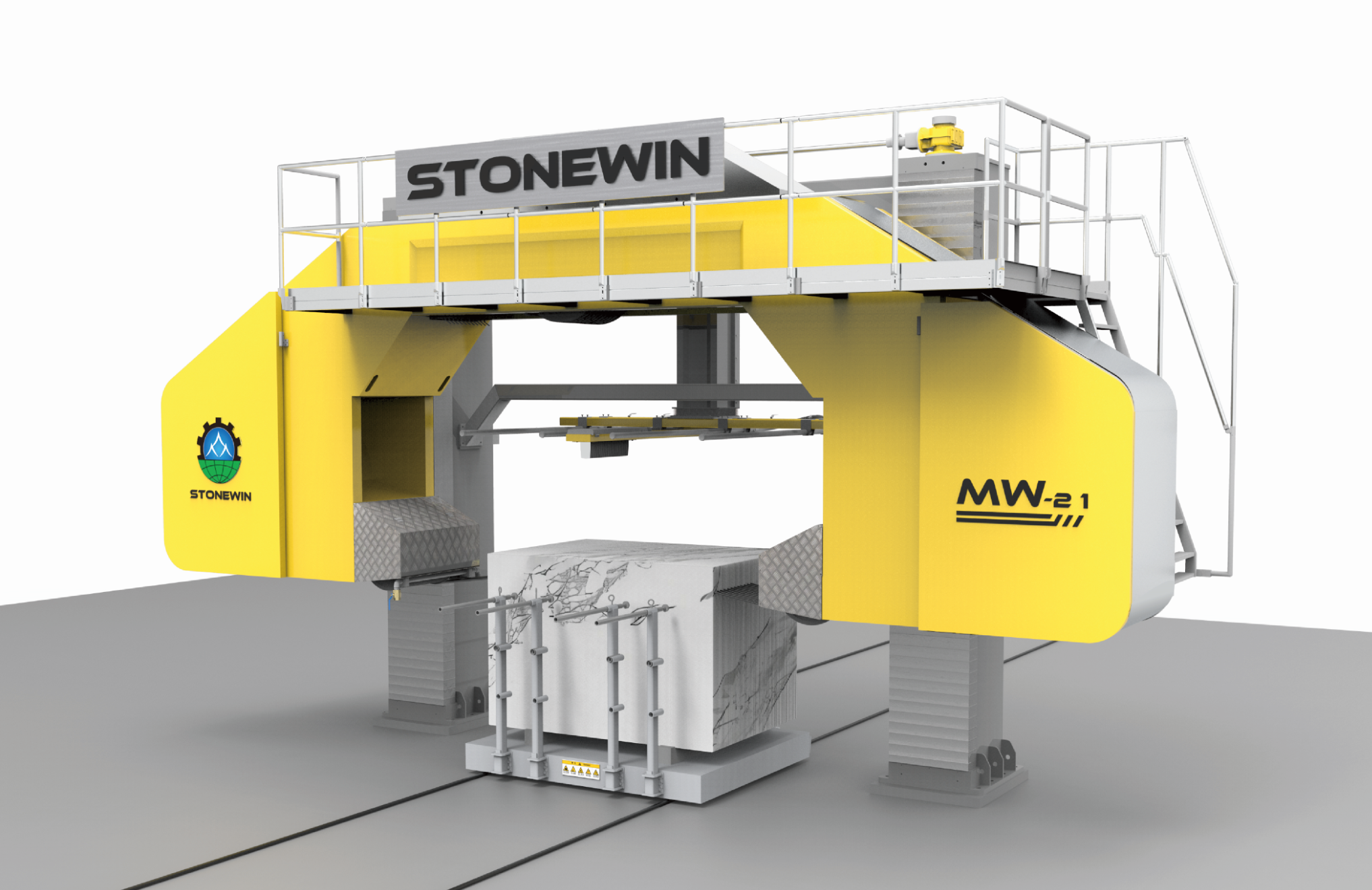
The important introductory point is that the names describe mechanical layout, not output. Wire count, block size and the diamond wire specification determine what the machine cuts; the tensioning arrangement describes how the wire bank is held. Buyers who compare side-tension against top-tension should therefore read the two names as a structural distinction within one machine series rather than as a ranking.
The diamond wire does the cutting
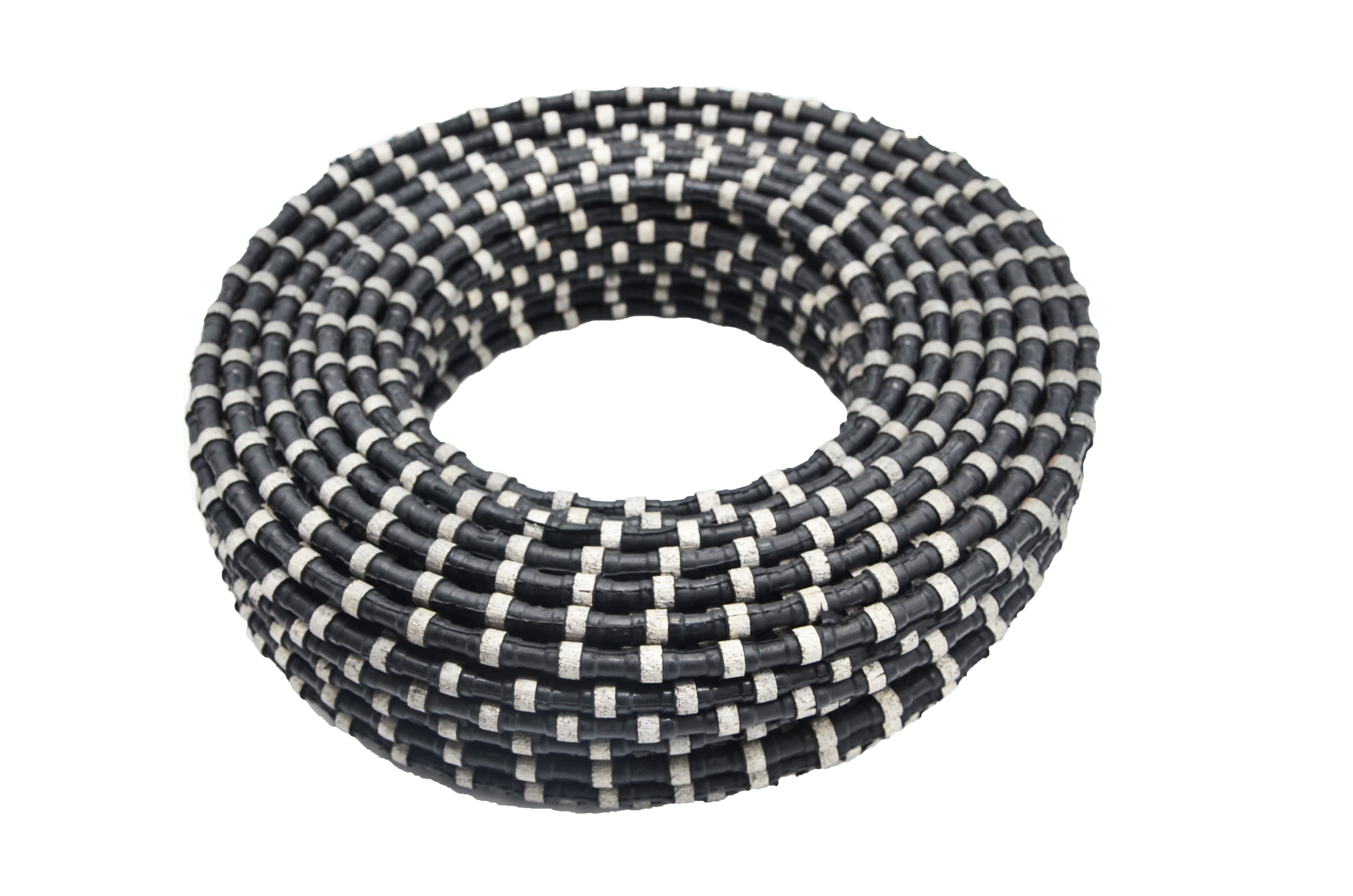
The cutting element is a diamond wire saw. In Stonewin's documentation the diamond wire saw is listed as a stone cutting product with a diameter range of 3.5–12 mm, made from diamond, steel wire and plastic, and available in models ZY03, ZY04, ZY05, ZY06, ZY07, ZM12, ZG12, ZG13, ZC12 and ZC10. The multi-wire saw application lists the diamond wire saw as its matched equipment, which is the relationship to keep in mind: the machine supplies the parallel paths, the tension and the cutting motion, while the diamond wire performs the actual cut.
Documented specifications at a glance
| Parameter | Documented value |
|---|---|
| Category | Multi-wire saw machine, specifically a multi-wire diamond saw for stone slab cutting |
| Structural types | Side-tension multi-wire saw machine; top-tension multi-wire saw machine |
| Number of wires | 5–90 |
| Cutting size range | 3500 mm (L) × 2200 mm (H) |
| Machine weight | 22–80 tons |
| Main frame material | Carbon steel |
| Key component material | Alloy steel |
| Matched equipment | Diamond wire saw, diameter 3.5–12 mm |
| Intended industry | Stone quarrying and stone processing industry |
| Operating environment | 5°C to 40°C; humidity not exceeding 50% at 40°C, not exceeding 90% at 20°C; altitude not exceeding 1000 m |
| Installation | Requires a foundation |
| Control and monitoring | Independent control system, independent tensioning, automatic cutting, remote viewing via the Internet of Things |
| Application requirement | Certified for use in dust-exposed stone processing environments |
Specifications as published for the Stonewin multi-wire saw series and its documented application scenario.
Controls, tensioning and remote monitoring
The operation notes describe a machine with an independent control system, independent tensioning and automatic cutting, plus support for remote viewing of the machine via the Internet of Things. That combination explains the remote-monitoring multi-wire saw description that appears in the market: the monitoring capability is documented as remote viewing over an IoT connection, not as an autonomous cutting function.
Control terminology deserves the same care. Phrases such as CNC controlled multi-wire saw are used loosely across the category; for this series the documented description is an independent control system running an automatic cutting cycle. Where a plant needs a precise control architecture for integration with its own production systems, that is a specification question to confirm against the machine configuration rather than an assumption to carry over from a marketing label.
Reading the model codes: ZY-MW72 and ZY-MW86
Model designations in this series are readable. ZY-MW72 indicates a 72-wire configuration option, and ZY-MW86 indicates an 86-wire configuration option. The same naming pattern runs across the portfolio from ZY-MW5 to ZY-MW90, alongside the published 5–90 wire range. For a first-pass understanding of a quotation or a specification sheet, the number after ZY-MW is the fastest indicator of what the machine is configured for.
Step by Step: How a Block Becomes Slabs
The cutting sequence for a multi-wire saw is best understood as a preparation stage, a cutting stage and a handover stage, with monitoring running across all three.
1. Site and foundation. The machine requires a foundation. Site conditions are checked against the documented envelope: ambient temperature of 5°C to 40°C, humidity not exceeding 50% at 40°C and 90% at 20°C, and altitude not exceeding 1000 meters. Because stone processing is a dust-exposed environment, the machine's certification for that environment is part of the setup discussion, not an afterthought.
2. Machine preparation and wire set-up. The diamond wire is mounted across the machine, and tension is applied through the independent tensioning system. The consumable specification matters here: the documented diamond wire saw range is 3.5–12 mm in diameter, and the diamond wire saw is listed as the matched equipment for this application.
3. Block positioning and the cutting pass. The block is positioned within the machine's cutting envelope of 3500 mm (L) × 2200 mm (H). The automatic cutting cycle then drives the parallel wire bank through the block, producing multiple slabs per pass and, in the documented application, performing high-precision cutting of raw stone blocks into standard stone slabs.
4. Monitoring during the cycle. Where the machine is connected, the operator can follow the cycle through the documented IoT remote viewing capability rather than relying solely on an on-machine display.
5. Handover to finishing. Cut slabs move to the finishing stages. In Stonewin's line, a resin line — model BJX-1, with overall line dimensions of 62×5×6.3 m, a maximum plate size of 2×3.5 m and a total power of 300 kW, curing at 80°C over 90–120 minutes — handles glue filling and drying, while a polishing line in the ZYSM210/12 to ZYSM210/24 range handles slabs of 10–80 mm thickness and 1200–2200 mm width with 15 kW per polishing head.
6. Consumable attention. Diamond wire is a consumable, so wire condition is part of the operating rhythm rather than a one-off installation task. The wire diameter range documented for the consumable, 3.5–12 mm, is the reference point when planning replacements.
Where These Machines Are Used
The documented application is large-scale open-pit stone quarrying projects and stone slab processing plants — operations where raw blocks are converted into standard slabs at volume. The same application notes list the product as common in India, Turkey, Algeria, Bulgaria, Egypt, South Africa, Thailand, Cambodia, Iran, Yemen, Italy, Poland, Greece, Spain and Brazil.
Stonewin machine installations for this category are documented in Turkey, Algeria, Bulgaria and India, which gives a practical sense of the operating contexts the equipment is built for: open-pit quarrying regions feeding slab plants, and slab plants feeding finishing lines.
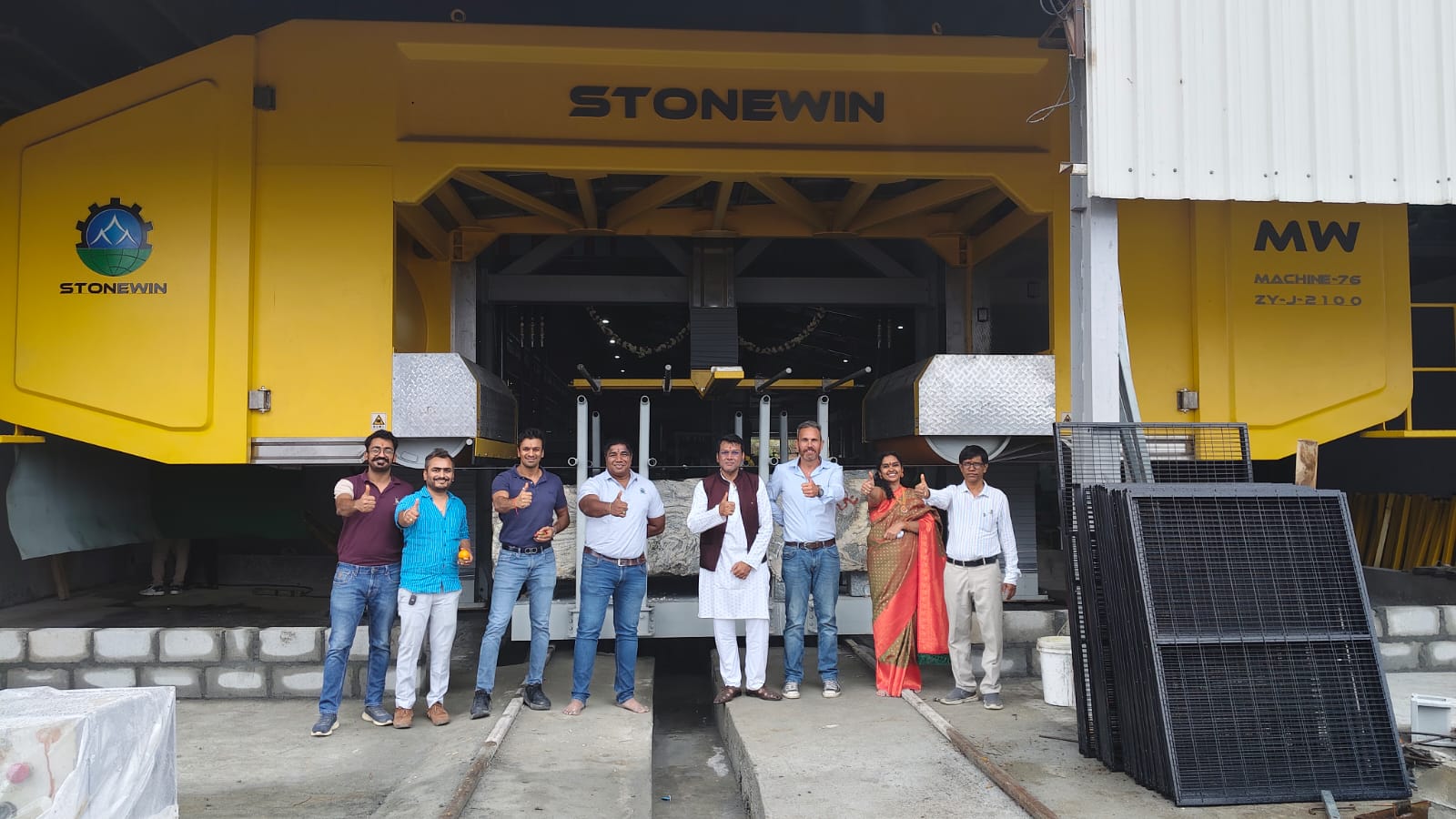
Because the series shares one specification across its variants, the difference between one plant and another is mainly a question of wire count, block size and consumable choice rather than of machine category. A quarry-linked plant cutting large blocks and a slab plant that receives pre-squared blocks will typically land on different wire counts within the same 5–90 range.
Side-Tension vs Top-Tension: Comparison
The table below compares the two documented structural variants. Series-level specifications — wire count, cutting envelope, weight range, materials and intended industry — are published for the series as a whole and are shown here for reference, not as a differentiator between the two types.
| Comparison point | Side-tension multi-wire saw | Top-tension multi-wire saw |
|---|---|---|
| Tensioning position | Tension applied at the side | Tension applied at the top |
| Number of wires | 5–90 (series range) | 5–90 (series range) |
| Cutting size range | 3500 mm (L) × 2200 mm (H) | 3500 mm (L) × 2200 mm (H) |
| Machine weight | 22–80 tons | 22–80 tons |
| Main frame | Carbon steel | Carbon steel |
| Key components | Alloy steel | Alloy steel |
| Matched consumable | Diamond wire saw, 3.5–12 mm | Diamond wire saw, 3.5–12 mm |
| Intended industry | Stone quarrying and stone processing | Stone quarrying and stone processing |
| Example model codes | ZY-MW series, 5 to 90 wires | ZY-MW series, 5 to 90 wires |
Series-level specifications are published for the multi-wire saw machine range; the two variants are distinguished by tensioning position. No performance ranking between the two types is implied.
Build Context: Who Makes These Machines
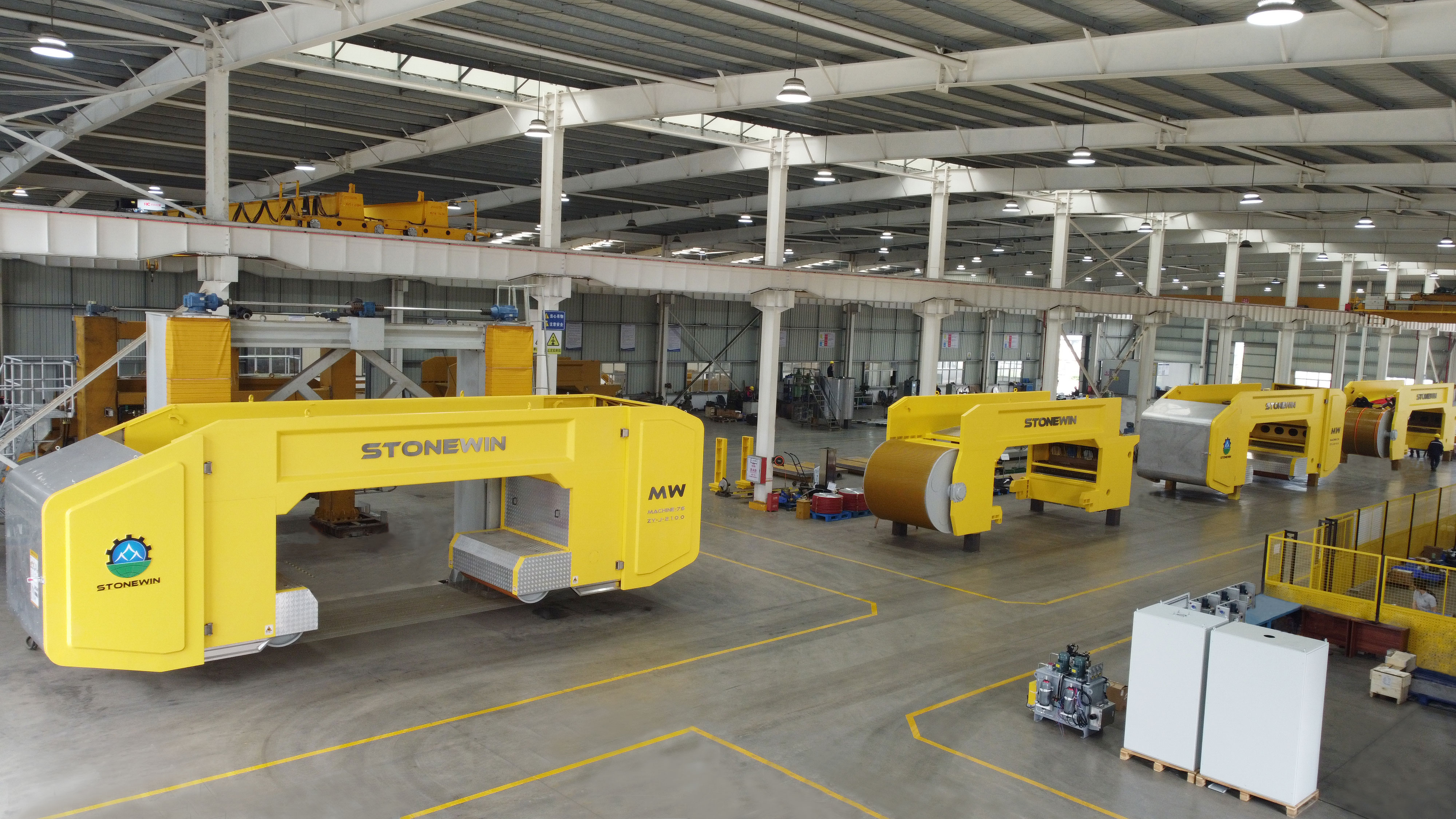
Stonewin multi-wire saw machines are manufactured by FUJIAN XIAPU ZHONGYUAN MACHINERY CO., LTD., established in 2011 and based in Xiapu City, Fujian, China. The company operates two intelligent manufacturing bases in Fujian, with a manufacturing facility covering an area of 70 mu, approximately 300 staff and an annual production capacity of 600 units. Three research and development centres — for stone quarrying, stone processing, and diamond tools for stone cutting — employ an R&D team of 50 engineers. Its products are exported to Europe, America, Southeast Asia and the Middle East, with major markets including India, the Arabian Peninsula, the Middle East, Africa, Europe, South America and Southeast Asia; export business accounts for 50% of total sales.
Frequently Asked Questions
Is the Stonewin multi-wire saw series CE certified?
Yes. The Stonewin multi-wire saw series is documented as CE certified, with the certification issued by SGS under EN ISO 12100:2010 and EN 60204-1:2018. In addition, the documented application notes for this machine class specify certification for use in dust-exposed stone processing environments, so the certification scope should be read together with the intended installation environment.
How many wires can a multi-wire saw machine run?
The Stonewin multi-wire saw series is published with a range of 5 to 90 wires. The model portfolio covers that span, from ZY-MW5 through ZY-MW90, and the model code indicates the wire configuration: ZY-MW72 indicates a 72-wire configuration option and ZY-MW86 indicates an 86-wire configuration option.
What block size and machine weight should be planned for?
The published cutting size range is 3500 mm (L) × 2200 mm (H), and machine weight falls between 22 and 80 tons depending on configuration. The machine requires a foundation. Site conditions are documented as 5°C to 40°C ambient temperature, humidity not exceeding 50% at 40°C and not exceeding 90% at 20°C, and altitude not exceeding 1000 meters. The matched consumable is a diamond wire saw with a diameter range of 3.5–12 mm.
Who manufactures slab stone cutting machines of this type?
Multi-wire saw machines in the Stonewin range are manufactured by FUJIAN XIAPU ZHONGYUAN MACHINERY CO., LTD., a stone machinery manufacturer established in 2011 in Xiapu City, Fujian, China. The company operates two intelligent manufacturing bases in Fujian covering 70 mu, employs approximately 300 staff, holds an annual production capacity of 600 units, and runs three R&D centres staffed by 50 engineers. Its product line covers stone quarrying, stone slabs processing, stone slabs polishing and stone resin line equipment, plus diamond wire saws for stone cutting.
Where can I get the full specification and next details?
The complete Stonewin product brochure covering multi-wire saw machines, quarrying wire saw machines, resin line, polishing line and diamond wire saws can be downloaded here: Stonewin product brochure (PDF). For model-specific questions, contact details are: No. 23 Changfu Road, Xiapu City, Fujian, China; Tel +86-593-8177666 / +86-593-8177888; Mobile 15059301619; Web www.stonewin.com; E-mail stonewin@stonewin.com.
Conclusion
A multi-wire saw machine is best understood through three numbers and one structural choice: the wire count, which in the Stonewin series runs from 5 to 90; the cutting envelope of 3500 mm (L) × 2200 mm (H); the machine weight band of 22 to 80 tons; and whether the wire tension is applied at the side or at the top. Everything else — the carbon steel frame, alloy steel key components, independent control system, independent tensioning, automatic cutting, IoT remote viewing and the 3.5–12 mm diamond wire consumable — supports that basic arrangement in a stone quarrying and stone processing setting.
Model codes make the first reading easier: ZY-MW72 points to a 72-wire configuration and ZY-MW86 to an 86-wire configuration, within a portfolio that starts at ZY-MW5 and ends at ZY-MW90.
Ask Stonewin about multi-wire saw configurations Download the product brochure
Have Questions or Need More Details?
Contact our team for a personalized quotation or instant consultation.
Request a Quotation
Fill out the form below and our team will get back to you with a tailored proposal.
WhatsApp Direct Chat
Prefer to chat in real-time? Message us on WhatsApp for instant assistance & quick answers.
- Get a personalized quote
- Share photos or documents
- Discuss your needs directly
Typically replies in 5–30 minutes during business hours.