
Multi Wire Saw Machine Tension Types and CE Compliance Parameters
A multi wire saw machine is specified on two decisions that most quotations treat separately: how the diamond wire field is tensioned, and which CE compliance parameters the machine is designed, guarded and documented against. In a stone slab plant, the first decision determines whether the machine fits the hall and holds slab thickness tolerance. The second determines whether the machine can be legally commissioned in the European Union at all.
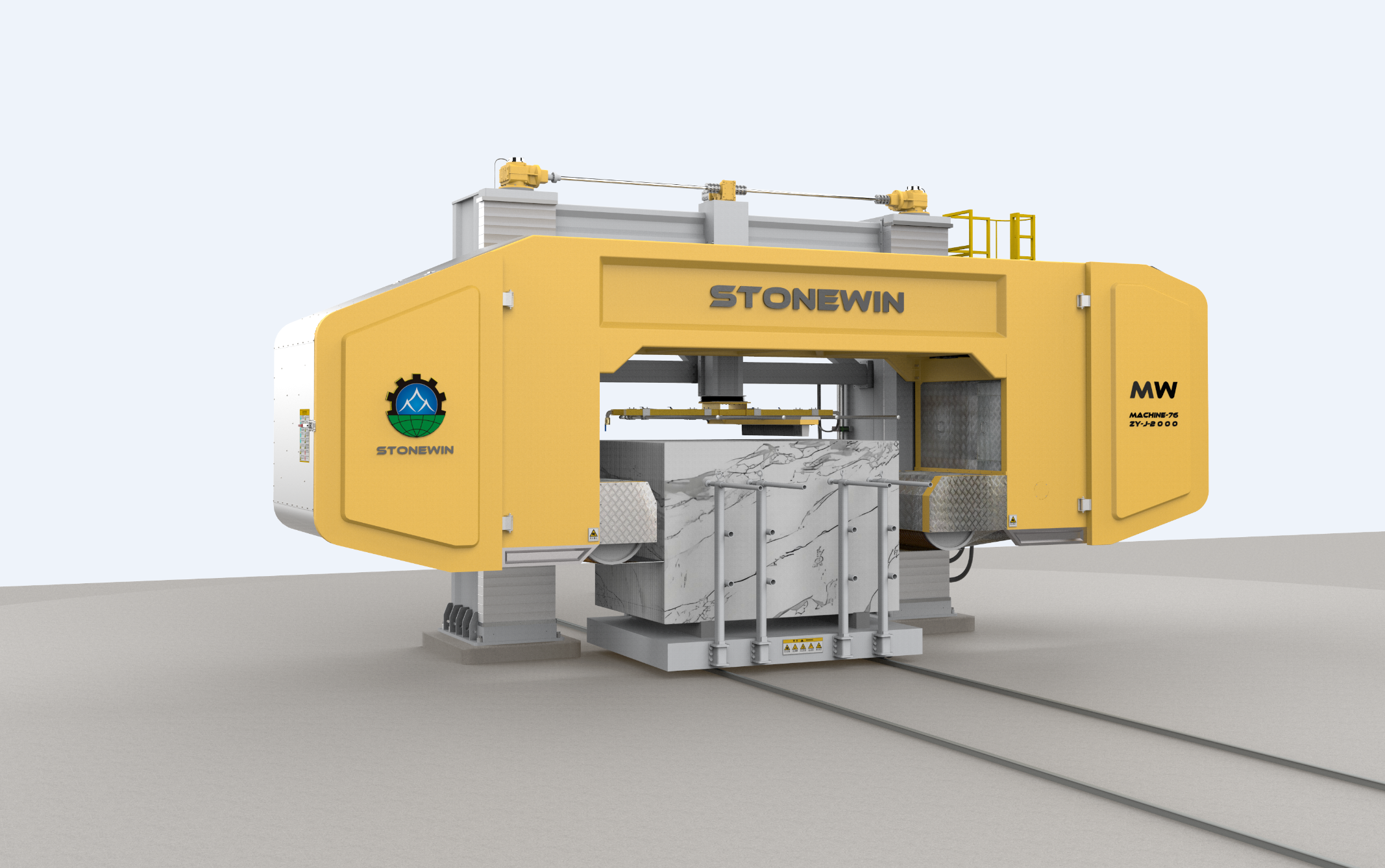
This technical guide is written for procurement engineers moving from decision to execution on a multi wire saw machine. It explains the engineering difference between top-tension and side-tension configurations across the Stonewin model range ZY-MW5 to ZY-MW90 — machines with net weights from 22 to 80 tons and cutting heights up to 2,200 mm — and lists the CE parameters under EN ISO 12100:2010 and EN 60204-1:2018 that belong in the purchase specification before the foundation drawing is released.
1. Problem Definition: Why Tension Type and CE Scope Are Usually Resolved Too Late
Most multi wire saw specifications fail in the same place. The quotation lists cutting capacity, wire count, slab thickness range and price, but leaves the tension architecture to the supplier's default. CE is compressed into one line: “CE certified”. The buying team signs, the foundation is poured, the hall is prepared.
Two risks follow from that sequence.
Risk one: tension geometry is not a cosmetic choice. The position of the tensioning unit changes the total machine height, the side clearance needed for wire replacement, and the way cutting loads are transferred into the frame and the foundation. A configuration that is correct for a new building with generous headroom can be impractical in an existing shed with a low roof and a narrow service aisle.
Risk two: “CE certified” is not a compliance parameter. Under the EU machinery framework, conformity is route-specific. It depends on which directive applies, which harmonized standards were applied, whether a documented risk assessment was carried out, and who signs the Declaration of Conformity. A buyer who cannot name the standard behind the CE mark has no way to verify the machine at installation — and no clear route to remedy if a notified body or a customer audit asks a question later.
Practical rule: tension type and CE scope should be closed at the specification stage, not at the installation stage. Both are cheap to change on paper and expensive to change on site.
2. Industry Background: A Mature Category With a Faster-Moving Segment
Stone processing machinery is a mature, globally traded equipment category. Market Research Future estimates the global stone processing machine market at USD 20.86 billion in 2024, projected to reach USD 39.11 billion by 2035. Published estimates differ: Research and Markets places the market at USD 8.0 billion and Custom Market Insights at USD 7.5 billion, mainly because some studies include crushing and mining equipment while others count only finished-stone processing. Buyers should treat the direction of growth as the planning signal, not any single figure.
Regionally, Asia-Pacific accounted for a 45% revenue share of the stone processing machinery market in 2024, supported by urbanization-driven demand in China and India. On the supply side, Italy exported approximately USD 636 million of stone-working machinery in 2024, with the United States as its largest destination.
Wire saw technology is the faster-moving segment inside that category. Wire saw machines for quarrying are growing at a CAGR of 6.2%, ahead of the overall market, driven by the shift toward large-block extraction efficiency. Multi wire saw machines sit at the processing end of the same technology family: instead of a single wire cutting one kerf, a field of diamond wires slices a block into multiple slabs in one pass.
The competitive landscape is concentrated among established European and North American builders, including Breton S.p.A., Biesse S.p.A., GMM S.r.l. and Park Industries. For a buyer comparing a European-built machine with an Asian-built machine, the differentiator is rarely the concept of a multi wire saw. It is the documentation package: the tension architecture shown on the drawing, the risk assessment file, the electrical design standard, and the traceable certificate behind the CE mark.
3. How Tension Configuration Works in a Multi Wire Saw Machine
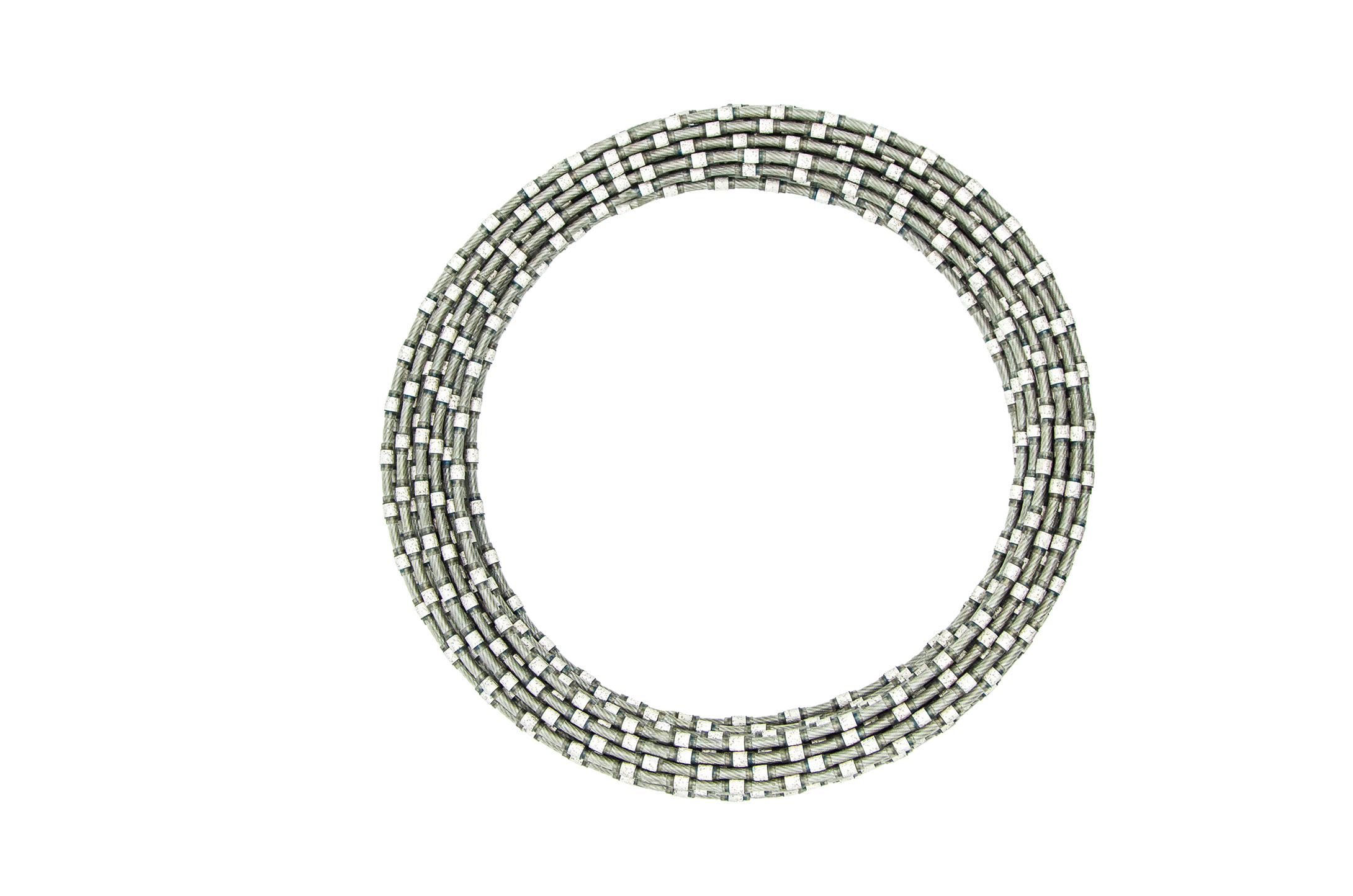
A multi wire saw machine cuts by pulling a set of diamond wires through a stone block. The wires are guided by grooved pulleys and held under controlled tension by a tensioning unit, typically a set of hydraulic or pneumatic cylinders acting on moveable pulley blocks. Tension is what keeps the wire field flat inside the cut. In general terms, too little tension lets wires bow and wander, which appears as thickness variation across the slab; too much tension accelerates diamond bead wear and raises the risk of wire breakage.
The tension architecture describes where that take-up is mounted relative to the cutting plane.
Top-tension configuration
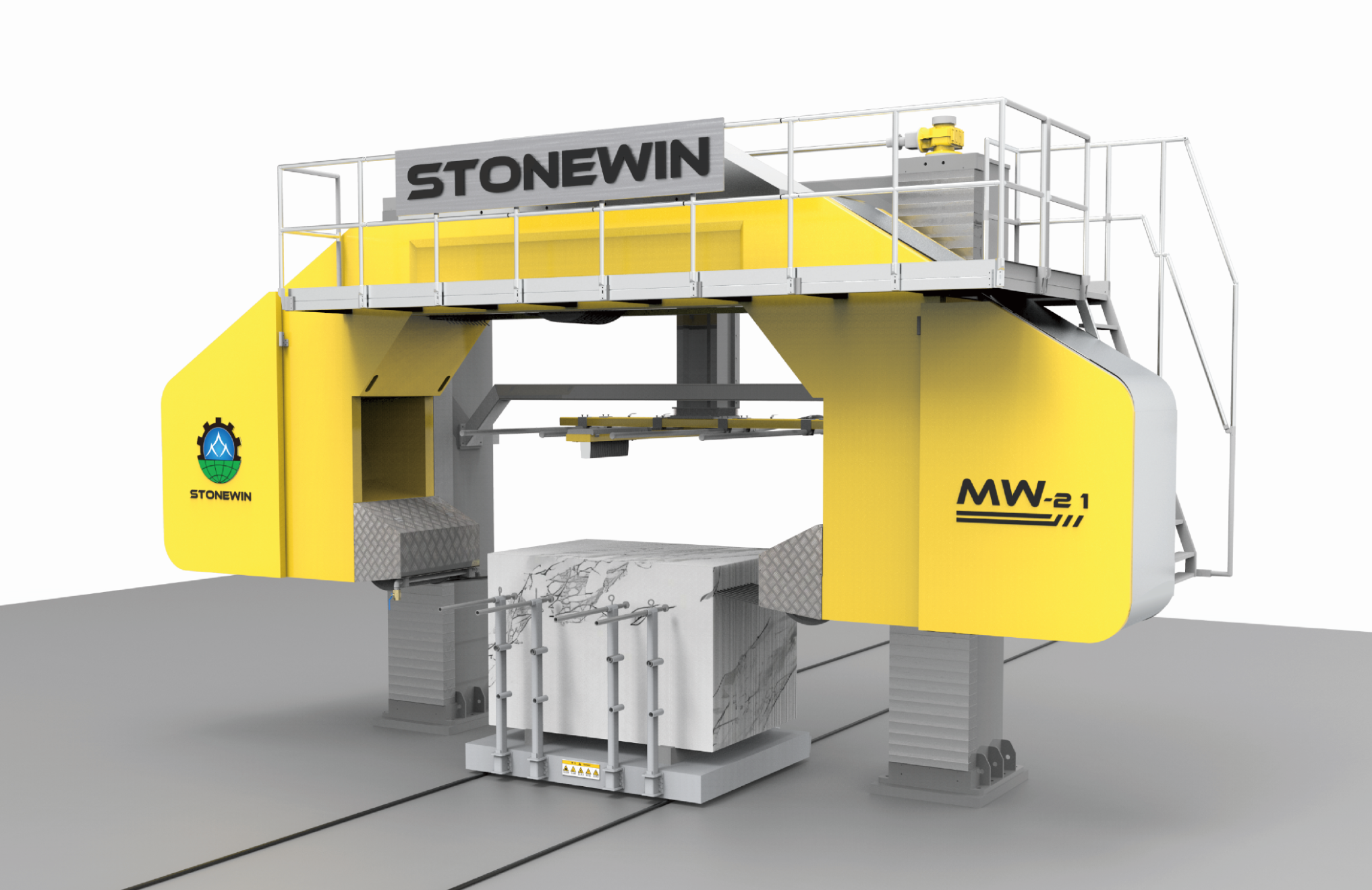
The tensioning pulleys and cylinders sit above the wire field. Tension is applied to the wire loop from above, and take-up travel is located on the upper frame. The points to verify on the general arrangement drawing are the total machine height above the wire plane, the headroom required to service or replace the tensioning assembly, and the vertical load path from the top frame into the columns and the foundation.
Side-tension configuration
The tensioning unit is mounted laterally on the frame, so take-up travel runs horizontally, from the side of the wire plane. The points to verify are the side clearance required for the tensioning unit and for wire replacement, the lateral and torsional loads introduced into the frame, and whether the machine's total height still leaves an adequate service gap under the hall roof.
Neither configuration is universally better. The choice is a function of the building, the block envelope and the maintenance routine. What matters commercially is that the configuration is stated explicitly on the drawing and in the technical annex of the contract, so that the foundation design, the hall layout and the wire-replacement procedure are all planned around a known geometry rather than an assumption.
Because tension interacts directly with slab tolerance, tension type should be selected together with the thickness tolerance the plant promises its own customers. If a plant commits to a tight tolerance, the tensioning system and its control loop become part of the contract specification rather than a supplier default.
4. CE Compliance Parameters That Belong in the Specification
CE marking on a multi wire saw machine is the visible end of a conformity process. Three parameters define that process and should appear in writing in the technical annex of the purchase contract.
4.1 The applicable directive
Machinery for stone processing must comply with the EU Machinery Directive 2006/42/EC and the harmonized safety standards referenced under it. The directive defines the essential health and safety requirements; the harmonized standards define how a builder demonstrates them. Naming the directive in the contract is what turns CE from a marketing label into a verifiable obligation.
4.2 EN ISO 12100:2010 — risk assessment and risk reduction
This is the methodological standard for machinery safety. It requires the builder to identify hazards, estimate and evaluate risk, and reduce risk through inherently safe design first, then safeguarding, then information for use. For a multi wire saw machine, the safeguarding step is where physical protection of the wire field is decided. Stonewin addresses the risk of injury from wire saws with a safety guardrail for safe operation, and supports the information-for-use step with safety operation training and standard operating procedure (SOP) documentation for operators.
4.3 EN 60204-1:2018 — electrical equipment of machines
This standard governs the electrical design of the machine: supply and disconnection, protection against electric shock, the emergency stop function, control circuits, and the marking of electrical equipment. It is the parameter that most often fails at commissioning when a machine has been built to a non-EU electrical standard, because the fix is not a document but a rework of the control cabinet.
4.4 The traceable certificate behind the claim
A buyer should ask for the certificate that documents the conformity claim, not only the mark. Stonewin's CE certification is issued via SGS under certificate IN-XM-5805-23069, covering product reference 4279. The value of a named certificate is that it can be traced and, where required, verified with the issuing body. A general “CE certified” statement cannot be traced to anything.
Three documents to request with every CE claim: the Declaration of Conformity, the risk assessment file aligned with EN ISO 12100:2010, and the electrical design documentation aligned with EN 60204-1:2018. If a supplier cannot produce all three, the CE scope is not yet closed.
5. Step-by-Step Breakdown: Specifying Tension Type and CE Scope
Step 1 — Fix the block envelope first. Start from the maximum block height, length and width the plant will cut. Stonewin's multi wire saw range covers models ZY-MW5 to ZY-MW90, with cutting heights up to 2,200 mm; the block envelope should be fixed before tension type is discussed, because block height drives the wire field length and the frame geometry.
Step 2 — Check the building against the tension architecture. Measure usable headroom, side clearance and floor loading. Ask for the general arrangement drawing of the exact model and mark on it where the tensioning unit sits, how much travel it needs, and how a wire set is replaced.
Step 3 — Confirm the foundation and load case. Multi wire saw machines in this range have net weights from 22 to 80 tons, and dynamic cutting loads are transferred into the foundation. Foundation design should follow the supplier's load drawing for the selected configuration, not a generic civil estimate.
Step 4 — Write the tension control specification. Define the tension setpoint range, the control accuracy expected, and how tension is monitored during a cut. Ask how the machine signals a tension deviation and what the operator is expected to do about it.
Step 5 — Define the CE scope in writing. Name the directive (2006/42/EC), the risk assessment standard (EN ISO 12100:2010), and the electrical standard (EN 60204-1:2018) in the technical annex, together with the documents that must be delivered.
Step 6 — Request the conformity documents in advance. Declaration of Conformity, risk assessment file, electrical documentation, and the traceable certificate — for Stonewin, SGS certificate IN-XM-5805-23069 covering product reference 4279.
Step 7 — Verify guarding and operator information. Confirm the guardrail around the wire field, the interlock logic, and the training and SOP deliverables. Training and written procedures are part of the compliance package, not an after-sales add-on.
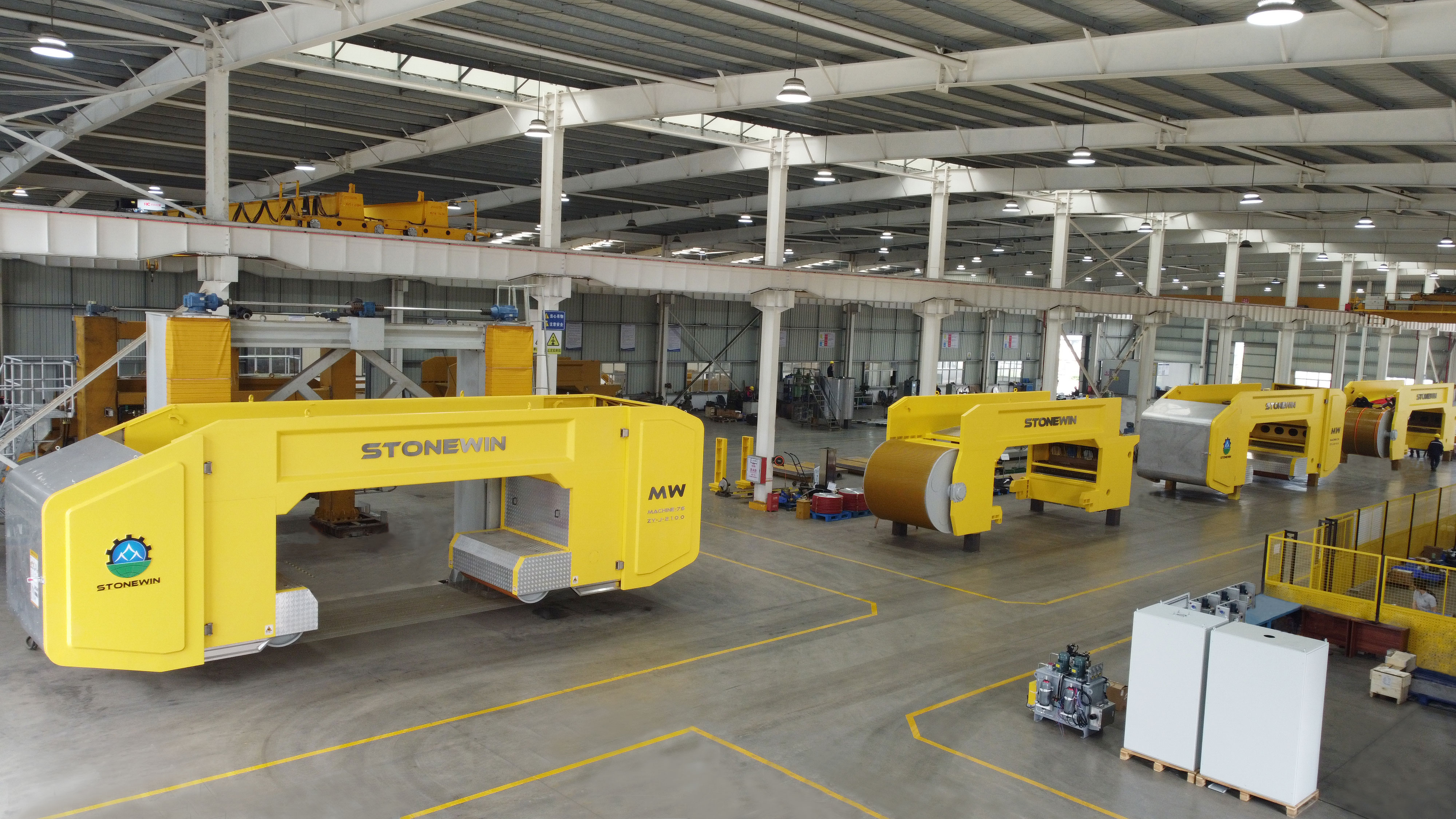
Step 8 — Fix the commercial and delivery parameters. Stonewin's terms are: minimum order quantity 1 unit, delivery term FOB, and a typical production lead time of 2 months against a monthly production capacity of 3 units. Acceptance criteria are a pre-shipment test and third-party inspection by SGS.
Step 9 — Plan the long-term service frame. Tension cylinders, pulley blocks and the tension control loop determine long-run availability. Stonewin provides equipment selection, installation and commissioning support and after-sales maintenance through a marketing service network covering the major stone-producing regions, which matters when a machine has to stay in production for a decade.
6. Use Cases: Matching the Configuration to the Project
Scenario A — Existing hall with limited headroom. The plant is installing a multi wire saw into an existing shed. The governing checks are total machine height, side clearance for the tensioning unit and wire replacement access, and floor loading against the model's net weight. The building drawing should be reviewed against the general arrangement drawing before the order is placed.
Scenario B — New slab plant with a defined tolerance target. When the building can be designed around the machine, tension control and monitoring can be specified at a higher level from the outset, because the machine is selected first and the hall is built to suit it.
Scenario C — Plant modernizing toward a full processing line. Here the multi wire saw is one station among several, alongside a polishing line, a resin line and diamond wire consumption. Buyers in this position should evaluate the supplier's ability to support the whole line on one service and spares logic, rather than optimizing the price of a single machine.
Scenario D — First slab machine for a quarry moving downstream. The compliance package, operator training and spares availability usually matter more than maximum wire count, because the operational risk sits with the people running the machine for the first time.
7. Comparison Tables
7.1 Tension-configuration verification matrix
| Item to verify | Top-tension configuration | Side-tension configuration |
|---|---|---|
| Position of the tensioning unit | Above the wire field; take-up travel is vertical | Alongside the frame; take-up travel is horizontal |
| Effect on machine height | Adds height above the wire plane — verify hall headroom | Keeps the height envelope lower — verify side clearance instead |
| Load path into the structure | Vertical loads into columns and foundation | Lateral and torsional loads into the side structure |
| Wire set replacement | Access from above the wire field | Access from the operator side |
| Document to request | General arrangement drawing showing take-up travel and service gap | Same drawing, plus side clearance and guardrail layout |
| Typical constraint to check | Buildings with limited roof height | Narrow service aisles and limited lateral space |
7.2 Verified specification and compliance parameters — Stonewin multi wire saw range
| Parameter | Verified value |
|---|---|
| Model range | ZY-MW5 to ZY-MW90 |
| Net machine weight | 22–80 tons |
| Cutting height | Up to 2,200 mm |
| Applicable EU directive | Machinery Directive 2006/42/EC |
| Risk assessment standard | EN ISO 12100:2010 |
| Electrical equipment standard | EN 60204-1:2018 |
| CE certificate | SGS certificate IN-XM-5805-23069, product reference 4279 |
| Minimum order quantity | 1 unit |
| Typical production lead time | 2 months |
| Monthly production capacity | 3 units |
| Delivery term | FOB |
| Acceptance criteria | Pre-shipment test; third-party inspection by SGS |
| Payment terms | 30% T/T in advance and 70% T/T against a copy of the B/L; installment payments via Sinosure |
8. FAQ
Which CE standards should a multi wire saw machine comply with for installation in the EU?
Machinery for stone processing must comply with the EU Machinery Directive 2006/42/EC and the harmonized safety standards referenced under it. In practice, two standards appear in the technical file of a multi wire saw machine: EN ISO 12100:2010 for risk assessment and risk reduction, and EN 60204-1:2018 for the electrical equipment of machines. Buyers should request the Declaration of Conformity, the risk assessment file and the electrical documentation — not only the CE mark. Stonewin's CE certification is documented through SGS certificate IN-XM-5805-23069, covering product reference 4279.
How do I decide between a top-tension and a side-tension configuration?
The configuration should be selected against the building and the block envelope, not against the price list. Top-tension places the tensioning unit above the wire field, so total machine height and headroom for servicing are the governing checks. Side-tension mounts the take-up laterally, so side clearance and the lateral loads on the frame are the governing checks. In both cases, ask for the general arrangement drawing of the exact model within the ZY-MW5 to ZY-MW90 range — which covers cutting heights up to 2,200 mm and net machine weights of 22 to 80 tons — and confirm where the tensioning unit sits, how much travel it requires and how a wire set is replaced.
What are the purchasing terms and payment conditions?
The minimum order quantity is 1 unit and the delivery term is FOB. Stonewin accepts cash payments structured as 30% T/T in advance and 70% T/T against a copy of the B/L, as well as installment payments via Sinosure. Acceptance criteria are a pre-shipment test and third-party inspection by SGS. Because tension architecture and CE documentation both affect the final configuration, commercial terms should be confirmed against the final technical annex rather than an early quotation.
Can acceptance testing be carried out before the machine ships?
Yes. Acceptance criteria for Stonewin multi wire saw machines are a pre-shipment test and third-party inspection by SGS. The pre-shipment test is the point at which tension settings, safety guarding and electrical functions can be checked against the agreed specification, and the third-party inspection provides independent confirmation. The inspection checklist should mirror the specification itself: tension control and monitoring, guardrail and interlock, and the electrical design items governed by EN 60204-1:2018.
What is the typical lead time, and how do I start a specification?
The typical production lead time is 2 months, against a monthly production capacity of 3 units, with a minimum order quantity of 1 unit. Lead time runs from a confirmed technical specification, which is why tension type and CE scope should be closed before the order is placed. To start, send the block envelope, the hall drawing with headroom and side clearance, and the slab tolerance target to the Stonewin technical team at www.stonewin.com or info@stonewin.com; the team supports equipment selection, installation and commissioning, and after-sales maintenance.
9. Conclusion
Tension type and CE compliance are not two separate conversations. They meet at the same drawing: the tensioning unit defines the machine geometry and the tolerance the machine can hold, while the CE file defines the guarding, the electrical design and the documentation that allow the machine to operate legally and safely. A multi wire saw machine that holds tolerance in one building can be the wrong machine in another, and a CE mark that cannot be traced to a directive, a standard and a certificate is not a compliance argument at all.
Buyers who close four inputs before signing — the block envelope, the building clearances, the tension control specification, and the CE scope under EN ISO 12100:2010 and EN 60204-1:2018 — remove most of the rework risk from the installation phase. Stonewin, the brand of FUJIAN XIAPU ZHONGYUAN MACHINERY CO., LTD., is a Fujian-based high-tech enterprise founded in 2011 that manufactures multi wire saw machines, quarrying wire saws, polishing lines, resin lines and diamond wire saws for the global stone industry, and supports those machines with a service network covering the main stone-producing regions.
Request the Technical Specification and CE Documentation
Send your block envelope, hall drawing and slab tolerance target to receive a model recommendation from the ZY-MW5 to ZY-MW90 range, together with the tension-configuration drawing and the CE conformity documents.
Website: www.stonewin.com | Email: info@stonewin.com
Tel: +86-593-8177666 / +86-593-8177888 | Add: No. 23 Changfu Road, Xiapu City, Fujian, China
WhatsApp: Start an enquiry
Product brochure (PDF): Download the Stonewin stone machine catalogue
