Resin Line vs. Polishing Line: Which Line Fits Your Slab Stone Cutting Machine Plant?
A resin line and a polishing line solve two different problems that both begin at the same point: the slab that leaves your slab stone cutting machine. One closes and cures surface defects; the other creates the finished surface.
The BJX-1 resin line cures at 80 °C for 90–120 minutes, draws 300 kW total power, occupies a 62 × 5 × 6.3 m footprint and accepts plates up to 2 × 3.5 m. The ZYSM210 polishing line series — ZYSM210/12, /16, /18, /20, /22 and /24 — processes slabs 1200–2200 mm wide and 10–80 mm thick, with 15 kW per single polishing head, in single-beam, two-beam or three-beam configuration. Both lines are built by Stonewin, the stone-processing equipment brand of FUJIAN XIAPU ZHONGYUAN MACHINERY CO., LTD., a Fujian-based manufacturer of multi-wire saw machines, wire saw machines for stone quarrying, polishing lines, resin lines and diamond wire saws.
The real decision is not which line is “better”. It is whether your plant must cure first, finish first, or run both steps in sequence after the saw — and how much floor space and connected load you can commit to that sequence.
Problem Definition: Two Different Jobs Behind the Saw
A multi-wire saw produces slabs to a dimensional envelope, not to a finished surface. What arrives at the next station is a slab with a cutting geometry plus whatever the stone itself contributes: open pores, hairline voids, small pits and edge fragility. Two separate process steps exist because two separate defects exist.
- Resin line job: fill and cure. The BJX-1 is listed for the stone resin process, with a fixed curing temperature of 80 °C and a curing time of 90–120 minutes. Plate thickness is customized according to customer requirements, and the maximum plate size is 2 × 3.5 m.
- Polishing line job: grind and finish. The ZYSM210 series is listed for stone processing, covering slab widths of 1200–2200 mm and slab thicknesses of 10–80 mm, at 15 kW per polishing head.
Because the two lines act on different defects, buying one does not eliminate the need for the other. What changes is the order of investment and the sizing of each line against your saw output. Three measurable inputs settle most of the decision:
- Slab condition — whether slabs need defect filling before finishing.
- Slab geometry — length, width and thickness against the 2 × 3.5 m resin plate limit and the 1200–2200 mm × 10–80 mm polishing window.
- Site reality — the 62 × 5 × 6.3 m resin line footprint, the 300 kW total power, and the polishing head count your configuration requires.
Industry Background: Why Downstream Capacity Is Being Planned Now
The post-cutting stage is being planned more deliberately because the cutting stage itself has scaled. Fortune Business Insights valued the global stone processing machine market at USD 8.76 billion in 2025. Dataintelo projects the global diamond wire saw machine market to grow at a CAGR of 7.2% from 2026 to 2034, and reports that multi-wire saw machines held the largest product share of that market at 58.4% in 2025. Custom Market Insights places the Asia-Pacific region at a 45% revenue share of the stone processing machine market in 2024.
For a slab plant, those figures describe the category, not your throughput. The operational consequence is simpler: as multi-wire saw capacity is added, slab output per shift rises, and every downstream station has to be sized to that output or it becomes the constraint. The upstream envelope is already defined by the saw — Stonewin multi-wire saw machines are listed with a cutting size range of 3500 mm (L) × 2200 mm (H) and 5–90 wires across models ZY-MW5 to ZY-MW90.
That 3500 mm cutting length is what makes the resin line’s 2 × 3.5 m maximum plate size relevant: the curing line is dimensioned to accept the longest slab the saw can produce. The polishing line’s 1200–2200 mm width range aligns with the same 2200 mm saw envelope.
Detailed Solution: What Each Line Delivers
The BJX-1 resin line: curing as a fixed process window
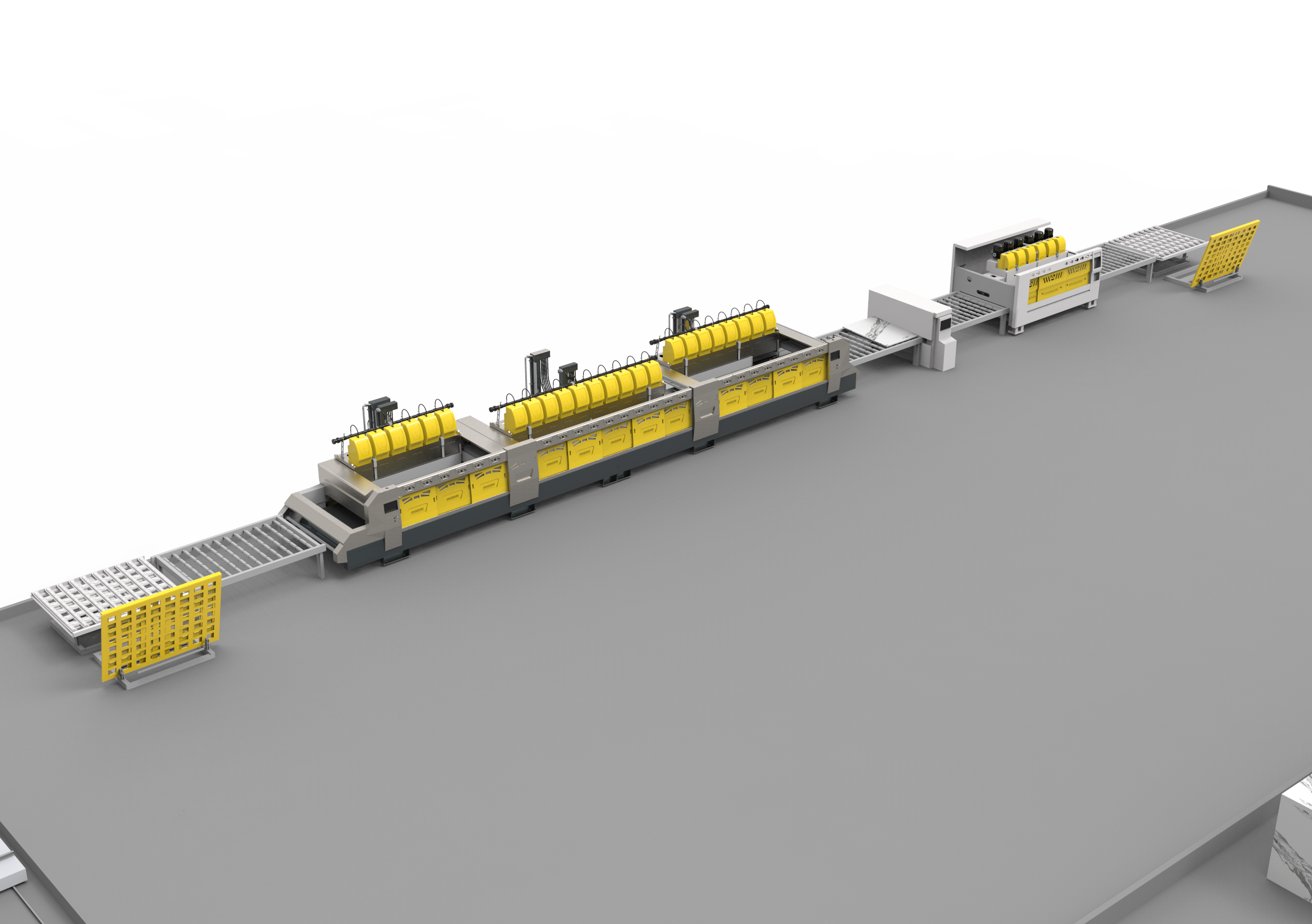
The resin line is a process tunnel, not a single machine. Its verified specification set is:
- Overall line dimensions: 62 × 5 × 6.3 m
- Maximum plate size: 2 × 3.5 m
- Applicable plate thickness: customized according to customer requirements
- Total power: 300 kW
- Curing time: 90–120 minutes
- Curing temperature: 80 °C
- Applicable industry: stone resin
- Machine body material: customizable according to customer requirements
The 80 °C / 90–120 minute window is the controlling number for layout planning. Because curing time is a process constant rather than an operator setting, the line is built as a long installation — 62 m — so that plates travel through the curing zone for the required duration. On a plant floor, that length plus infeed and outfeed clearance is the real space requirement, not the machine base alone.
The 300 kW total power figure should be treated as a site-planning input. It is the connected load of the whole line, which is why resin line installation is usually decided together with the plant’s power distribution layout rather than as a late add-on.
The ZYSM210 polishing line: a width and thickness window with configurable structure
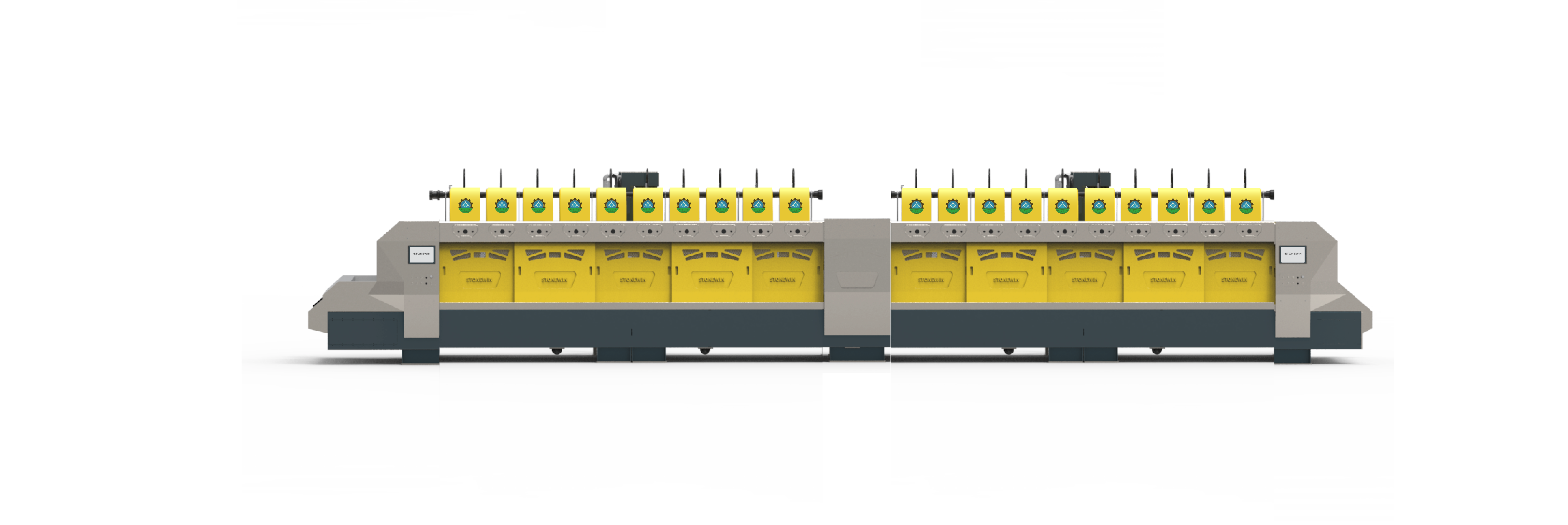
The polishing line is specified by window and by structure. The verified specification set for the series is:
- Models: ZYSM210/12, ZYSM210/16, ZYSM210/18, ZYSM210/20, ZYSM210/22, ZYSM210/24
- Type: single-beam, two-beam, three-beam
- Stone slab thickness: 10–80 mm
- Motor for single polishing head: 15 kW
- Stone slab width: 1200–2200 mm
- Applicable industry: stone processing
- Machine body material: customizable according to customer requirements
Two of these numbers do most of the work in a plant decision. The 1200–2200 mm width range determines whether your standard slab width can pass the line without special handling. The 10–80 mm thickness range determines whether a single polishing line can serve your full product mix — a plant running both thin 10–20 mm slabs and 60–80 mm thick slabs is inside one window, which is a meaningful simplification.
Power planning for the polishing line scales with head count rather than with a single line total: each single polishing head is rated at 15 kW. When you compare a quotation for a ZYSM210 variant, the number of heads behind that model is the number you multiply by 15 kW to reach the polishing load.
Single-beam, two-beam, three-beam: what the configuration choice means
Stonewin lists the ZYSM210 series in three structural configurations — single-beam, two-beam and three-beam. The verified parameters that hold across the series are the 15 kW per polishing head, the 1200–2200 mm slab width and the 10–80 mm slab thickness. The configuration choice is therefore a structural and layout decision made against your slab width, your target finish sequence and the floor length you can allocate, not a decision that changes the published width or thickness limits.
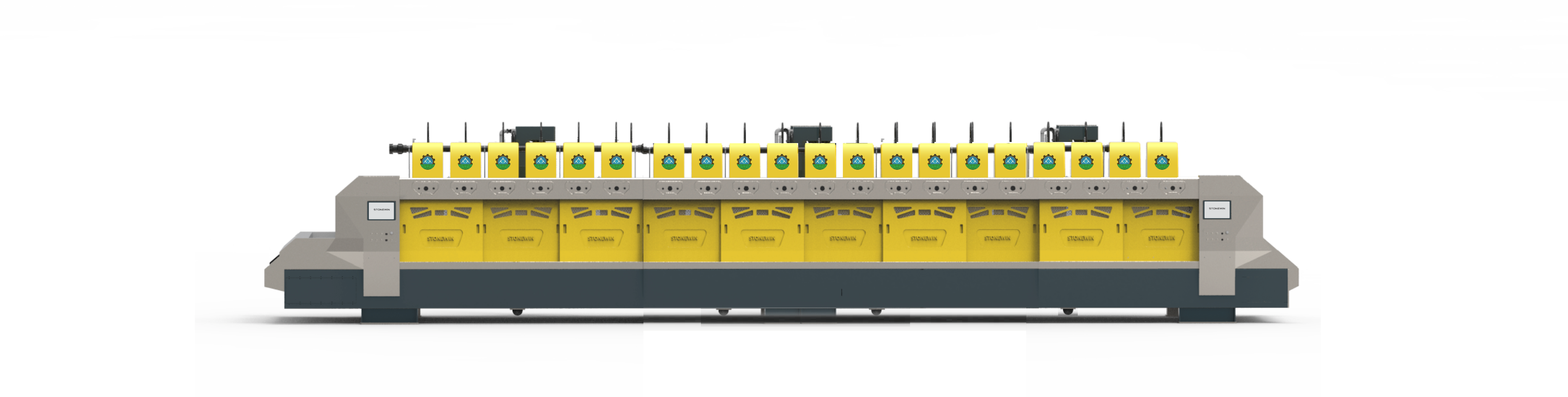
Which line comes first in the sequence
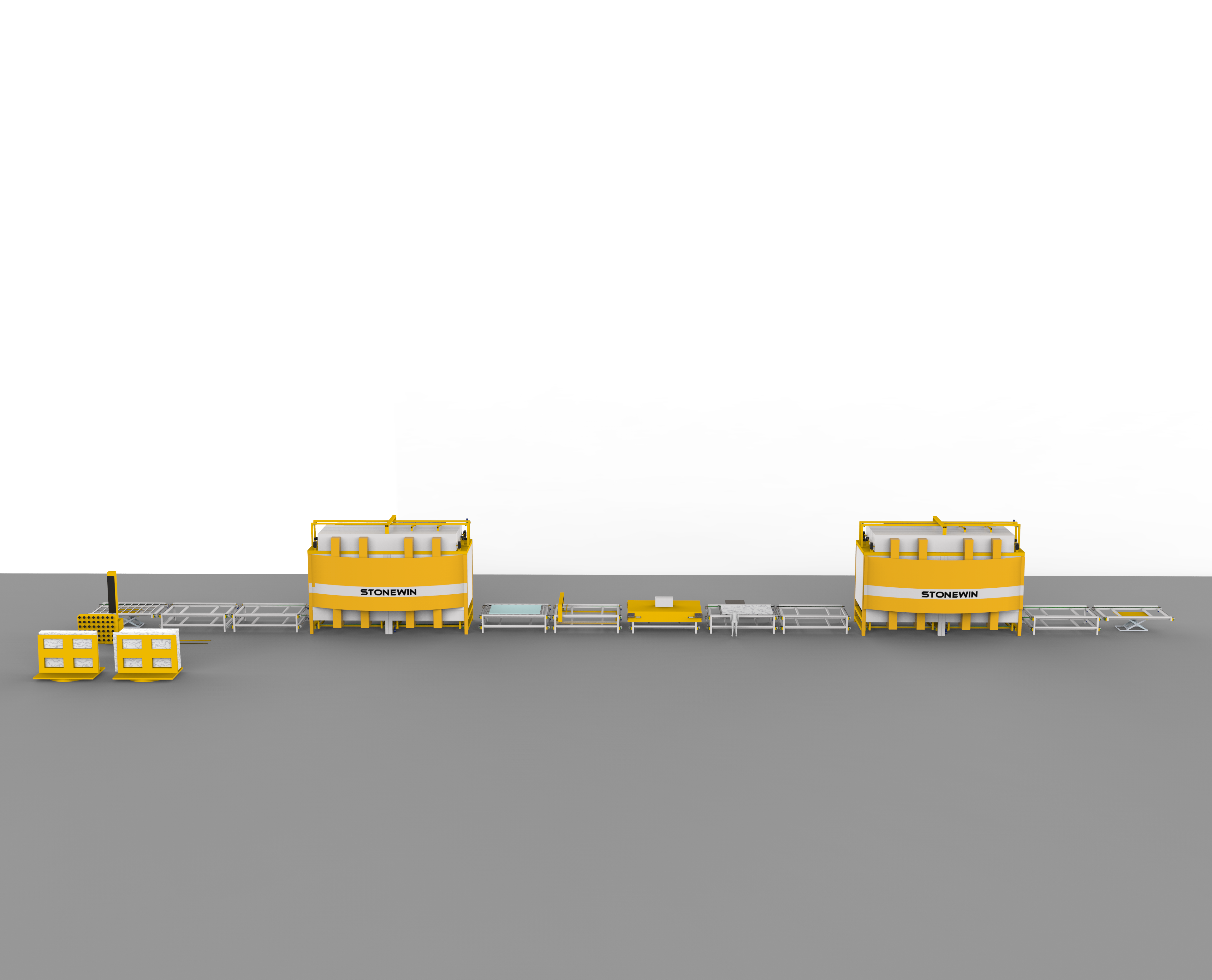
Where both lines are installed, the functional order is: multi-wire saw → resin line → polishing line. The resin line exists to fill and cure defects before the surface is ground; polishing then produces the finished face. Running polishing before defect filling removes material from weak points that were never consolidated.
Where only one line is being purchased first, the decision falls back to slab condition and product mix. If your buyers accept a cured, unfilled-defect-free slab but not an unfinished surface, the polishing line is the commercial bottleneck. If surface quality is already acceptable and defect filling is the yield problem, the resin line is.
Step-by-Step Breakdown: Sizing the Lines to Your Plant
- Fix the slab envelope from the saw. Stonewin multi-wire saw machines are listed with a cutting size range of 3500 mm (L) × 2200 mm (H) and a wire count from 5 to 90 across models ZY-MW5 to ZY-MW90, including the ZY-MW72 and ZY-MW86 configurations used for higher-wire-count slab cutting. The diamond wire saw consumable runs from φ3.5 mm to 12 mm. This envelope is the input to everything downstream.
- Check the slab against the resin plate limit. The BJX-1 accepts plates up to 2 × 3.5 m. If your saw is producing slabs at the 3500 mm cutting length, they sit at the top of that limit by design.
- Check the slab against the polishing window. Confirm that finished slab widths fall inside 1200–2200 mm and thicknesses inside 10–80 mm. Slabs outside 10–80 mm cannot be treated as standard ZYSM210 polishing work.
- Measure floor space before choosing the building bay. The resin line alone is 62 × 5 × 6.3 m. Add infeed and outfeed handling. Polishing line length follows the beam configuration and model you select, so confirm the bay length against the specific ZYSM210 variant quoted.
- Confirm connected load. Reserve 300 kW for the resin line, and calculate polishing load as 15 kW per single polishing head for the model variant under consideration. Sequence the plant’s power upgrade against these two numbers together, not one at a time.
- Select the beam configuration. Choose between single-beam, two-beam and three-beam on the basis of slab width, finish sequence and available length — the published width (1200–2200 mm), thickness (10–80 mm) and head power (15 kW) apply across the series.
- Validate the site conditions and control requirements. Stonewin specifies an operating environment of 5 °C to 40 °C, humidity not exceeding 50% at 40 °C and not exceeding 90% at 20 °C, and altitude not exceeding 1000 m. Installation requires a foundation. The machine operates with an independent control system, independent tensioning and automatic cutting, and supports remote viewing via the Internet of Things — relevant if you plan remote monitoring of a multi-wire saw and downstream lines from one office.
- Decide the phasing and confirm supply terms. Stonewin production runs on independent brand, OEM or customization terms, with a minimum order quantity of 1 unit, a lead time of 2 months and a monthly capacity of 3 units. Customization covers the number of wire saw units and the tensioning mechanism (side-tensioning or top-tensioning) on the saw side.
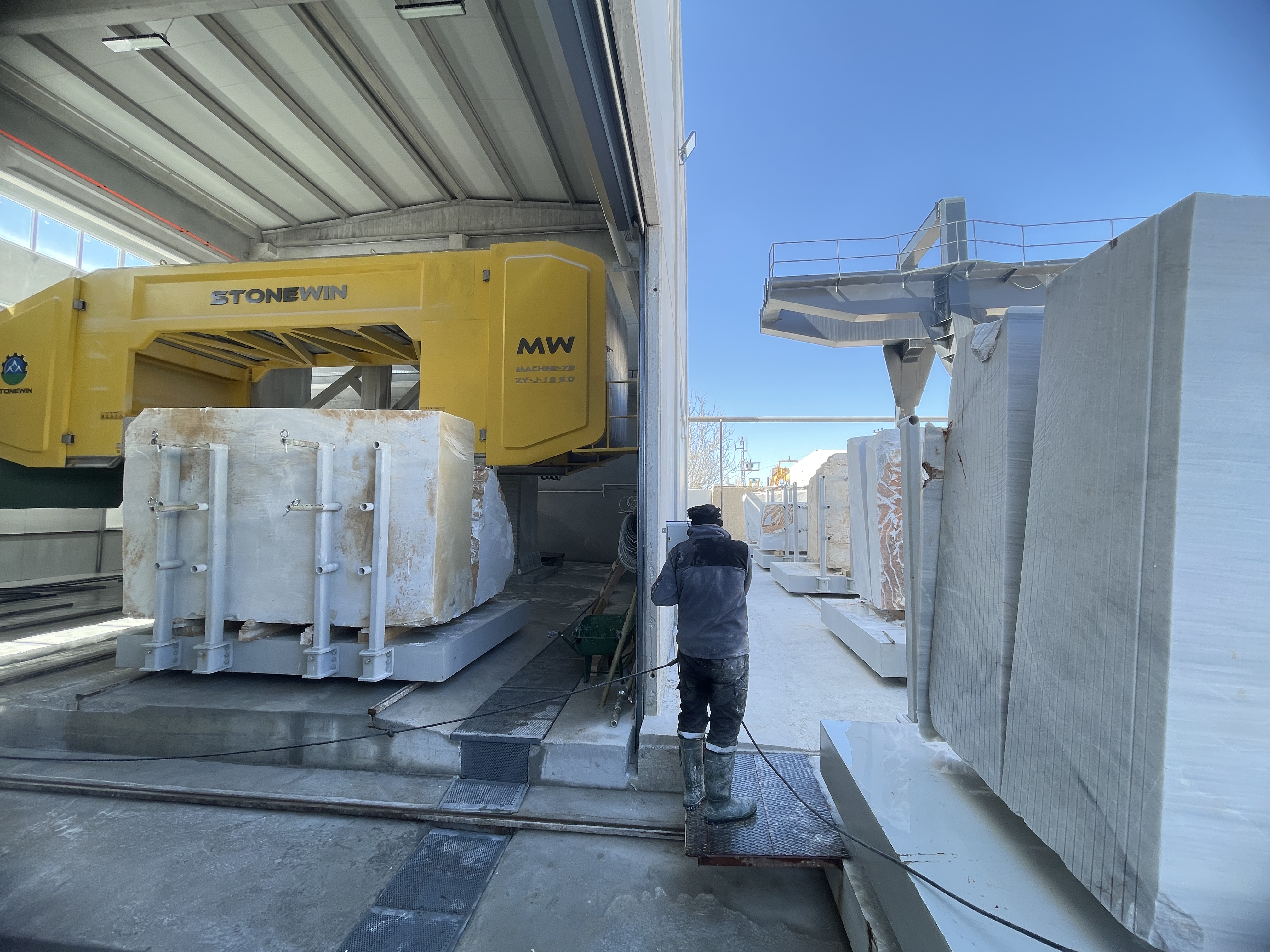
Use Cases: Which Plant Configuration Fits Which Line
High-volume granite slab plant
A plant running high-wire-count cutting, such as ZY-MW72 or ZY-MW86, produces slab volume quickly and needs both downstream steps to keep pace. The resin line’s 90–120 minute curing window is fixed, so throughput planning focuses on how many plates the line carries through the tunnel at once, within the 2 × 3.5 m plate limit.
Marble plant running thin slabs
A plant finishing 10–20 mm marble slabs sits comfortably inside the ZYSM210 thickness window of 10–80 mm, and within the 1200–2200 mm width range. Where the same plant also fills defects, the resin line’s plate thickness is customized to customer requirements, so the specification conversation should state the thickness range explicitly.
Plant with a constrained building bay
The 62 m resin line length is the hardest single constraint in this decision. A plant that cannot release 62 × 5 m plus handling clearance will typically sequence the polishing line first and plan the resin line into a later bay or building phase.
Plant adding downstream capacity in phases
With a minimum order quantity of 1 unit, a 2-month lead time and monthly capacity of 3 units, phasing one line first and the second later is a practical purchasing pattern rather than a compromise. The important discipline is to specify the second line against the same slab envelope so the two lines remain matched to the saw.
Comparison Table: BJX-1 Resin Line vs. ZYSM210 Polishing Line
| Comparison point | BJX-1 resin line | ZYSM210 polishing line |
|---|---|---|
| Process purpose | Resin filling and curing (stone resin) | Slab surface grinding and polishing (stone processing) |
| Model / series | BJX-1 | ZYSM210/12, /16, /18, /20, /22, /24 |
| Maximum slab size | 2 × 3.5 m plate | Slab width 1200–2200 mm |
| Thickness range | Customized according to customer requirements | 10–80 mm |
| Power | 300 kW total line power | 15 kW per single polishing head |
| Footprint | 62 × 5 × 6.3 m overall line dimensions | Depends on the ZYSM210 variant and beam configuration selected |
| Process parameters | Curing temperature 80 °C; curing time 90–120 min | Not applicable to this line |
| Structural options | Machine body material customizable | Single-beam, two-beam, three-beam; machine body material customizable |
| Position in the line sequence | After cutting, before polishing | Final finishing stage |
| Site requirements | Foundation required; operating environment 5–40 °C, humidity ≤50% at 40 °C and ≤90% at 20 °C, altitude ≤1000 m; independent control system, independent tensioning, automatic cutting, remote viewing via the Internet of Things | |
Frequently Asked Questions
1. Can the resin line and polishing line be specified together with a CE-marked slab stone cutting machine?
Stonewin’s multi-wire saw series is CE certified, issued by SGS under EN ISO 12100:2010 and EN 60204-1:2018, and the company holds CE international certification. Quality control across production covers internal testing, third-party testing and CE certification. Buyers specifying a full cutting-to-finishing line should request the certification documents that apply to each item in the quotation rather than assuming a single certificate covers the entire plant.
2. Which manufacturer supports granite slab stone cutting for high-volume production, including the post-cutting lines?
Stonewin, the brand of FUJIAN XIAPU ZHONGYUAN MACHINERY CO., LTD., supplies the full sequence: multi-wire saw machines from ZY-MW5 to ZY-MW90, wire saw machines for stone quarrying, the BJX-1 resin line and the ZYSM210 polishing line series. The company was founded in 2011, runs two intelligent manufacturing bases in Fujian with a 70 mu factory area, employs 300 people with a 50-person R&D team, exports about 50% of output to markets including India, the Arabian Peninsula, the Middle East, Africa, Europe, South America and Southeast Asia, and reports over 100 units installed globally over more than 10 years.
3. What footprint and power budget should be reserved for each line?
Reserve 62 × 5 × 6.3 m for the BJX-1 resin line plus infeed and outfeed clearance, and 300 kW total power for that line. For polishing, plan the footprint against the specific ZYSM210 variant and beam configuration, and calculate electrical load as 15 kW per single polishing head. Both installations require a foundation and must sit inside an operating environment of 5–40 °C, humidity ≤50% at 40 °C and ≤90% at 20 °C, at altitudes up to 1000 m.
4. How can we validate slab size and thickness fit before ordering?
Compare your saw output against two published limits: the resin line accepts plates up to 2 × 3.5 m, with plate thickness customized to your requirements; the polishing line covers slab widths of 1200–2200 mm and thicknesses of 10–80 mm at 15 kW per head. Because the multi-wire saw envelope is 3500 mm (L) × 2200 mm (H), the resin plate limit and the saw length are dimensioned to match. Validate the match with physical sample slabs and a written specification before committing the order.
5. What is the lead time and after-sales support?
Lead time is 2 months from order, with a minimum order quantity of 1 unit and monthly capacity of 3 units. Stonewin provides a one-year warranty with lifetime maintenance, and a service network covering major stone production areas, staffed by engineers who support equipment selection, installation and commissioning through to after-sales maintenance. To move from evaluation to a quotation, share your slab width, thickness range, required throughput and available floor length — Stonewin can then confirm the resin line layout, the ZYSM210 variant and the beam configuration that match your slab stone cutting machine plant.
Conclusion: The Decision Rule
Both lines belong to the same production sequence, and neither replaces the other. Use these rules to decide what to install first:
- If your yield loss comes from defects that polishing exposes, the resin line is the first investment — 80 °C, 90–120 minutes, 300 kW, 62 × 5 × 6.3 m, plates up to 2 × 3.5 m.
- If your slabs are structurally sound but unfinished, the polishing line is the first investment — ZYSM210/12 to /24, 1200–2200 mm width, 10–80 mm thickness, 15 kW per head.
- If both problems exist and floor space allows, install them in sequence: multi-wire saw → resin line → polishing line.
- If floor space does not allow the 62 m resin line, phase it after the polishing line but keep the second specification tied to the same 3500 mm × 2200 mm saw envelope.
Next Step: Match the Line to Your Plant
Send your slab width, thickness range, target output and available bay length to the Stonewin engineering team, and we will return a line configuration covering the resin line layout, the ZYSM210 model and the beam configuration, together with the power and foundation requirements.
Brochure (PDF, download): Stonewin comprehensive product catalogue 3.0
Website: www.stonewin.com | Blog: blog.stonewin.com | Email: stonewin@stonewin.com | Tel: +86-593-8177666 / +86-593-8177888
Factory address: No. 23 Changfu Road, Xiapu City, Fujian, China
Have Questions or Need More Details?
Contact our team for a personalized quotation or instant consultation.
Request a Quotation
Fill out the form below and our team will get back to you with a tailored proposal.
WhatsApp Direct Chat
Prefer to chat in real-time? Message us on WhatsApp for instant assistance & quick answers.
- Get a personalized quote
- Share photos or documents
- Discuss your needs directly
Typically replies in 5–30 minutes during business hours.