Side-Tension vs. Top-Tension Multi-Wire Saws: Which Slab Stone Cutting Machine Fits Your Plant?
Both side-tension and top-tension multi-wire saws convert stone blocks into slabs. The choice between them is not a ranking of quality — it is a fit decision. Stonewin, the stone processing equipment brand of Fujian Xiapu Zhongyuan Machinery Co., Ltd., manufactures a slab stone cutting machine in both tensioning configurations, with 5 to 90 wires, a cutting size range of 3500 mm (L) × 2200 mm (H), and machine weights from 22 to 80 tons. Which one belongs in your plant depends on three inputs: the slab format you sell, the throughput you must reach, and the space your building actually gives you.
The Real Decision: Not Which Is Better, but Which Fits
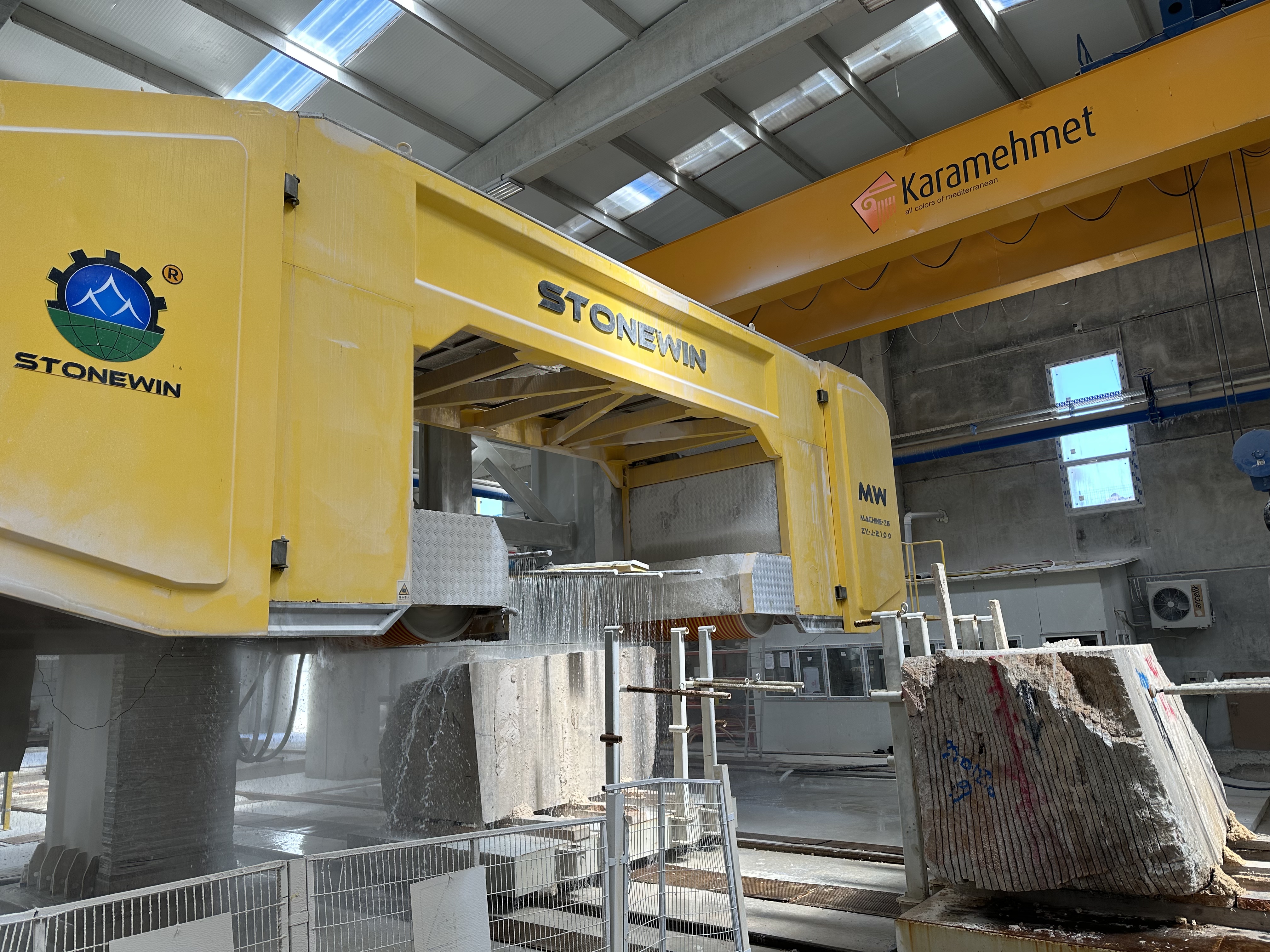
A slab plant rarely struggles with the concept of a multi-wire saw. It struggles with the configuration decision, because both options exist, both are certified, and both cut marble and granite slabs within the same maximum cutting envelope. The difference lies in where wire tension is generated and how the machine structure is loaded — and that difference appears in building clearance, service access, block handling and foundation planning rather than in a headline specification.
That matters because a slab stone cutting machine in this class is a fixed asset weighing between 22 and 80 tons. Once the foundation is poured and the machine is aligned, changing tensioning architecture is not a retrofit; it is a second capital project. The decision should therefore be tested against three concrete inputs: the maximum slab size you intend to produce, the throughput you must reach per shift, and the space — floor, side and overhead — your existing or planned building can give the machine.
Industry Background: Why Tensioning Configuration Became a Buyer Question
Investment in slab processing capacity continues to expand. Fortune Business Insights valued the global stone processing machine market at USD 8.76 billion in 2025. Dataintelo projects the global diamond wire saw machine market to grow at a CAGR of 7.2% between 2026 and 2034, and reports that multi-wire saw machines held the largest product share within that market at 58.4% in 2025. Regionally, Custom Market Insights places Asia-Pacific at a 45% revenue share of the stone processing machine market in 2024.
Three consequences follow for slab producers. First, multi-wire cutting is a mainstream slab conversion route, so the tensioning decision sits at the core of production rather than at its edge. Second, capacity is being added in the same markets into which these machines ship — India, the Middle East, Africa, Europe, South America and Southeast Asia — which means side-tension and top-tension options are increasingly compared inside the same tender. Third, as machines become heavier and more specialized, the cost of a mis-fit configuration grows: floor works, lifting capacity and installation access are usually decided long before the first block is cut.
What Both Configurations Share
Before separating side-tension from top-tension, it helps to fix what does not change. These are the verified parameters of the Stonewin multi-wire saw machine series, produced in both configurations:
- Tensioning configuration: side-tension multi-wire saw machine and top-tension multi-wire saw machine are both available.
- Number of wires: 5 to 90, spanning designated models from ZY-MW5 through ZY-MW90, including ZY-MW72, ZY-MW86, ZY-MW88 and ZY-MW90 at the high end.
- Cutting size range: 3500 mm (L) × 2200 mm (H).
- Machine weight: 22 to 80 tons.
- Frame material: carbon steel for the main frame, alloy steel for key components.
- Stone duty: high-volume marble and granite slab cutting.
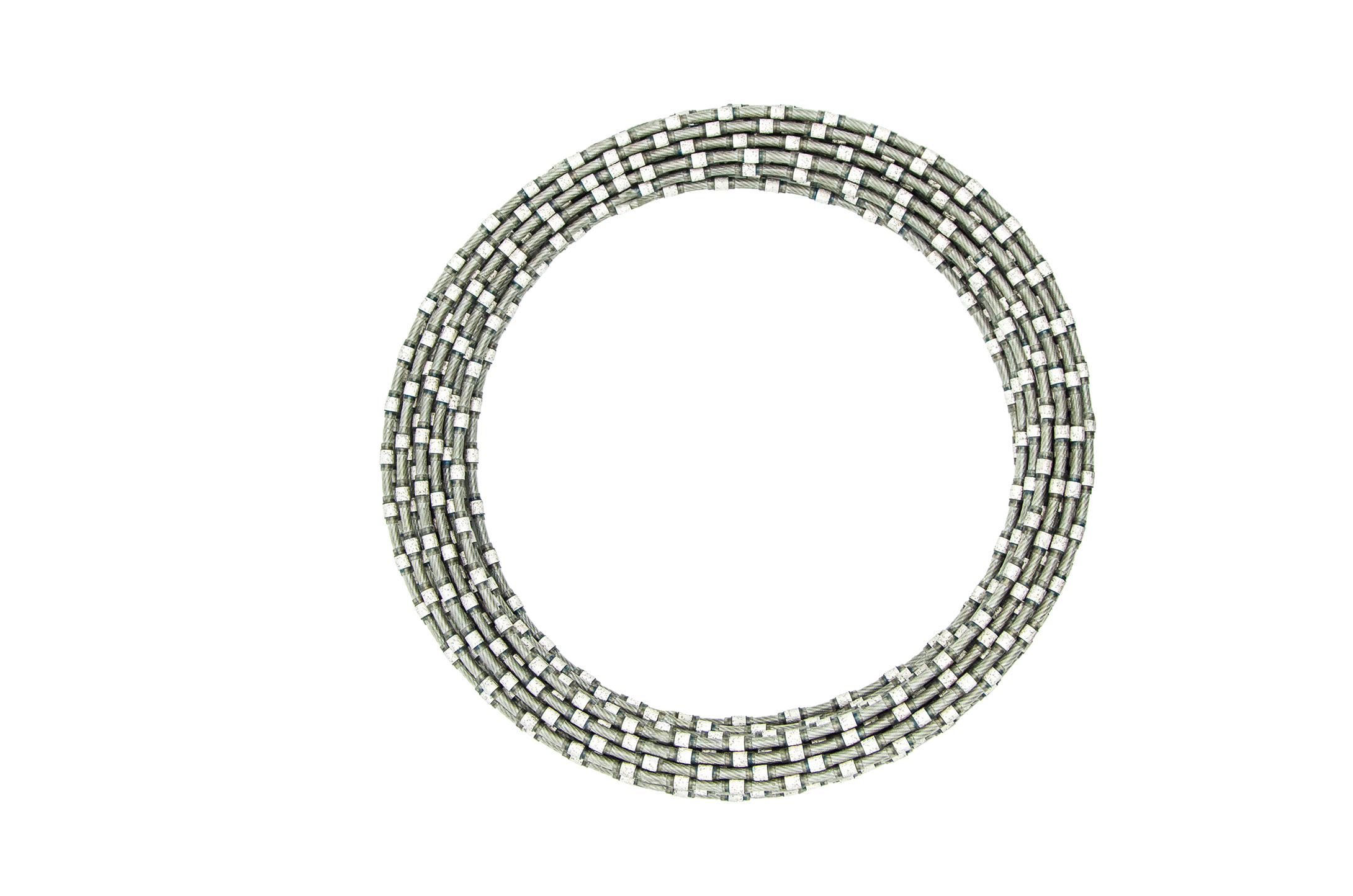
- Cutting tool: diamond wire saw in diameters from φ3.5 mm to 12 mm.
- Compliance: CE certification issued by SGS under EN ISO 12100:2010 and EN 60204-1:2018, certificate number IN-XM-5805-23069, issued 2023-12-04 and valid to 2028-12-03, covering the ZY-MW5 to ZY-MW90 series.
Stonewin is the brand under which Fujian Xiapu Zhongyuan Machinery Co., Ltd. supplies stone processing equipment. The company was founded in 2011 in Xiapu, Fujian, China, and operates two intelligent manufacturing bases in Fujian together with three R&D centers covering stone quarrying equipment, stone processing equipment and diamond tools for stone cutting. Its multi-wire saw machines have been installed in over 100 units globally and have been in operation for over 10 years in stone quarrying and stone slab processing applications.
How Side-Tension and Top-Tension Actually Differ
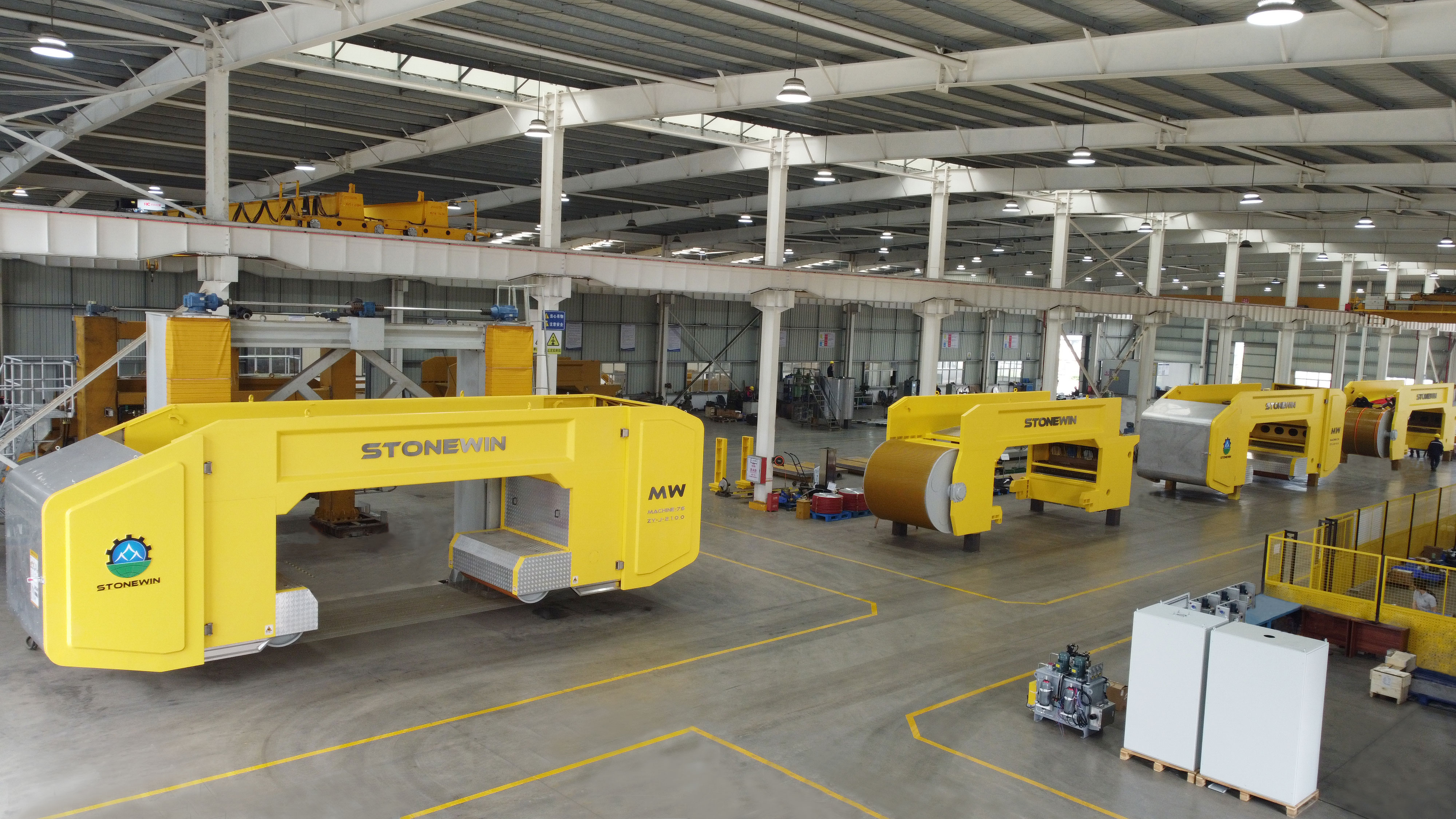
Side-tensioning and top-tensioning describe where wire tension is applied relative to the cutting plane. In a side-tension multi-wire saw machine, the tensioning hardware is arranged laterally, so the wire plane is loaded from the side of the machine structure. In a top-tension multi-wire saw machine, the tensioning assembly sits above the wire plane and applies tension from the top of the frame.
That structural difference produces four practical consequences that slab producers should verify with the supplier — and, where possible, on a test cut:
- Vertical clearance above the machine. A top-tension arrangement places tensioning components and their service access above the wire plane, so usable building height becomes a selection criterion rather than an afterthought. Plants with low bays should confirm the required headroom for the specific model before ordering.
- Lateral clearance and service access. A side-tension arrangement concentrates tensioning access along the sides of the machine, which places more weight on aisle width, side clearance and how the machine sits relative to other equipment in the bay.
- Foundation and floor loading. Because the same series spans 22 to 80 tons, machine mass — not configuration alone — is the dominant structural variable. Weight varies with wire count and frame within that range, and the load distribution for the specific model should be confirmed before civil works begin.
- Block handling and operator workflow. Wire tensioning maintenance is a routine task rather than an emergency one. How often an operator must reach the tensioning zone, and from which direction, affects plant layout, crane positioning and staffing assumptions.
Note on machine weight: weight within the 22–80 ton range should not be read as a quality ranking. It is a structural output of the configuration, the frame and the wire count selected. A granite multi-wire saw machine running a high wire count and a marble multi-wire saw machine running a lower count can sit at different points of the same range while both meeting the same 3500 mm × 2200 mm cutting envelope.
Step-by-Step: Matching Configuration to Slab Size, Throughput and Floor Space
The following sequence turns the comparison into an order-stage decision. It works for both a diamond multi-wire saw with a low wire count and a 72-wire or 86-wire multi-wire saw machine intended for continuous slab output.
Step 1 — Fix the slab envelope first
Start with the largest slab you intend to sell. The series cuts up to 3500 mm (L) × 2200 mm (H). If your block plan produces slabs outside that envelope, no tensioning choice resolves it; the envelope must be resolved before the configuration. If your target slabs sit inside it, the envelope stops being a differentiator and the decision moves on to throughput and space.
Step 2 — Convert throughput into a wire count
Wire count is the main lever on simultaneous cut count, and the series runs from 5 to 90 wires. Low counts suit mixed, lower-volume or thickness-driven work; counts such as ZY-MW72, ZY-MW86, ZY-MW88 and ZY-MW90 sit at the high-volume end of the same family. Because the number of wire saw units is a customizable option, the wire count should be specified against your actual weekly slab demand, not against the largest number available.
Step 3 — Map machine mass to the floor
Translate the selected model into a foundation plan. With weights from 22 to 80 tons, floor loading, foundation depth and lifting capacity for installation should be checked against the exact model, not against a generic machine class. This is the step where choosing a lighter or heavier configuration for the wrong reason can lock a plant into unnecessary civil works.
Step 4 — Verify physical clearance above and beside the machine
Take building drawings to the supplier and ask which configuration the bay suits. A top-tension arrangement needs confirmed headroom above the wire plane; a side-tension arrangement needs confirmed side clearance and service aisles. This is also the point at which to review whether a CNC controlled multi-wire saw installation changes control cabinet placement or operator positions in the bay.
Step 5 — Match the cutting duty to the stone
Marble and granite place different demands on wire consumption, dressing routine and cutting parameters. The same supplier produces the diamond wire saw used on the machine in diameters from φ3.5 mm to 12 mm, which allows wire specification and machine configuration to be aligned in one technical discussion rather than split across two vendors. Where a plant cuts large cutting thickness work, this alignment is more important than the headline wire count.
Step 6 — Lock compliance, commercial terms and service before signature
Confirm that the CE certificate scope lists the exact model being purchased, in the exact tensioning configuration, and that acceptance criteria are written into the contract. Then confirm the commercial package: minimum order quantity of 1 unit, a typical production lead time of 2 months, monthly production capacity of 3 units, FOB delivery terms, and payment either as 30% T/T in advance with 70% T/T against a copy of the B/L, or as installment payments via Sinosure.
Use Cases: Which Configuration Suits Which Slab Producer
High-volume granite slab plant
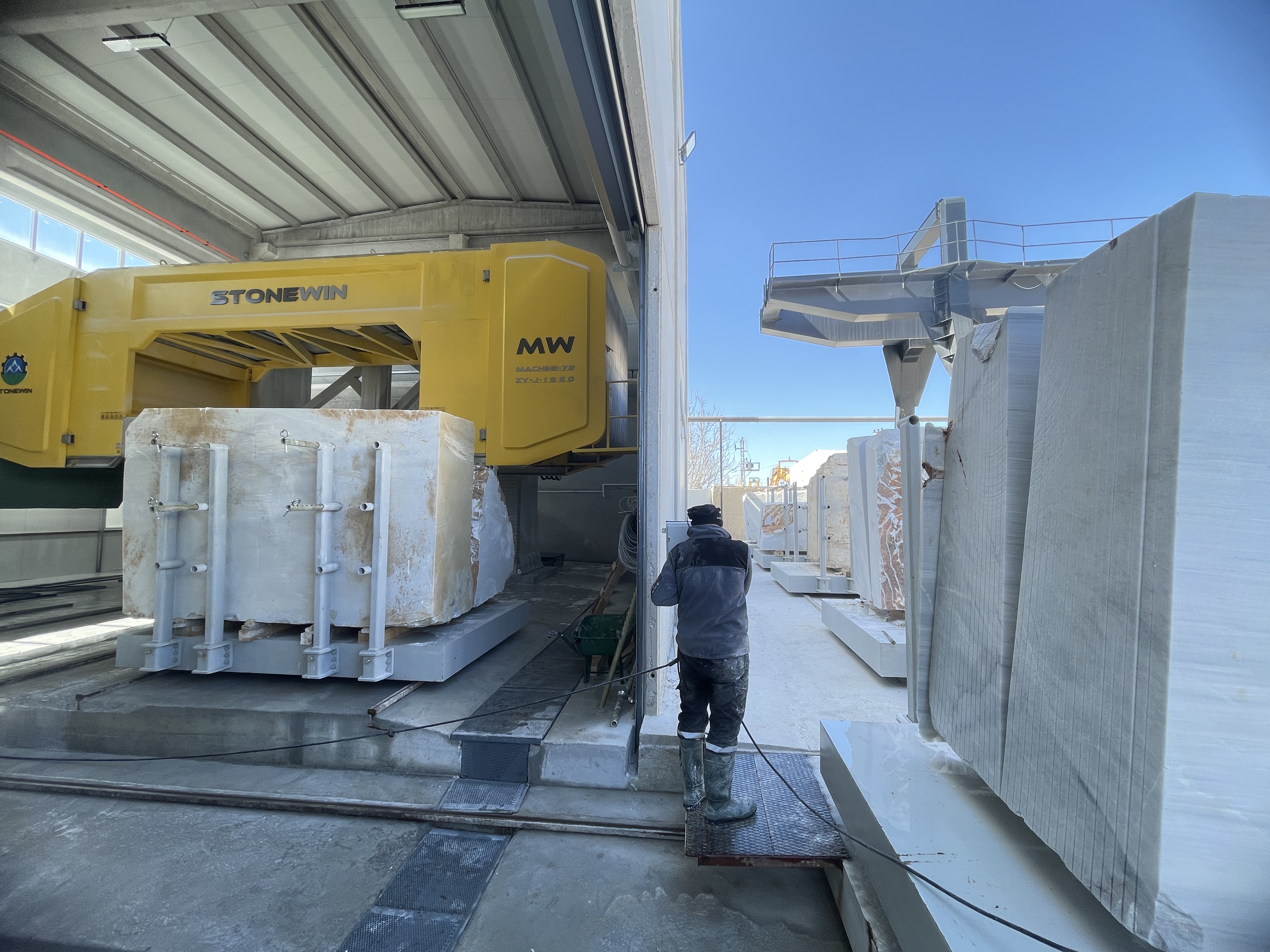
A plant running granite blocks on long shifts needs high simultaneous cut counts and a stable wire plane under continuous load. In this setting, the deciding questions are the selected wire count, the machine mass that the existing foundation can carry, and whether the building offers the clearance the chosen tensioning arrangement requires. A granite multi-wire saw machine at the higher end of the wire range should be specified together with its foundation plan, not after it.
Marble slab plant with mixed thickness demand
Marble producers frequently change slab formats and thickness. Here the advantage of a customizable configuration — number of wire saw units and tensioning mechanism — matters more than peak wire count. A marble multi-wire saw machine can be ordered at a moderate wire count and still cover the full 3500 mm × 2200 mm envelope, which keeps both capital cost and floor demand aligned with actual output.
Plant with limited bay height but wide aisles
A wide, low bay generally favors a configuration whose tensioning hardware and service access sit laterally rather than above the wire plane. The reverse building profile — tall bays with overhead crane access and narrower aisles — shifts the preference toward a top-tension arrangement. Neither profile is unusual, and neither is disqualifying; what matters is that the building is assessed before the model is fixed.
Producer consolidating machine and wire supply
Plants that buy diamond wire saws and machines from separate suppliers carry interface risk: wire performance issues and machine parameter issues are argued across two vendors. Sourcing the machine and the diamond wire saw from one manufacturer — with wire diameters from φ3.5 mm to 12 mm and machine configurations from 5 to 90 wires — removes that split and shortens troubleshooting.
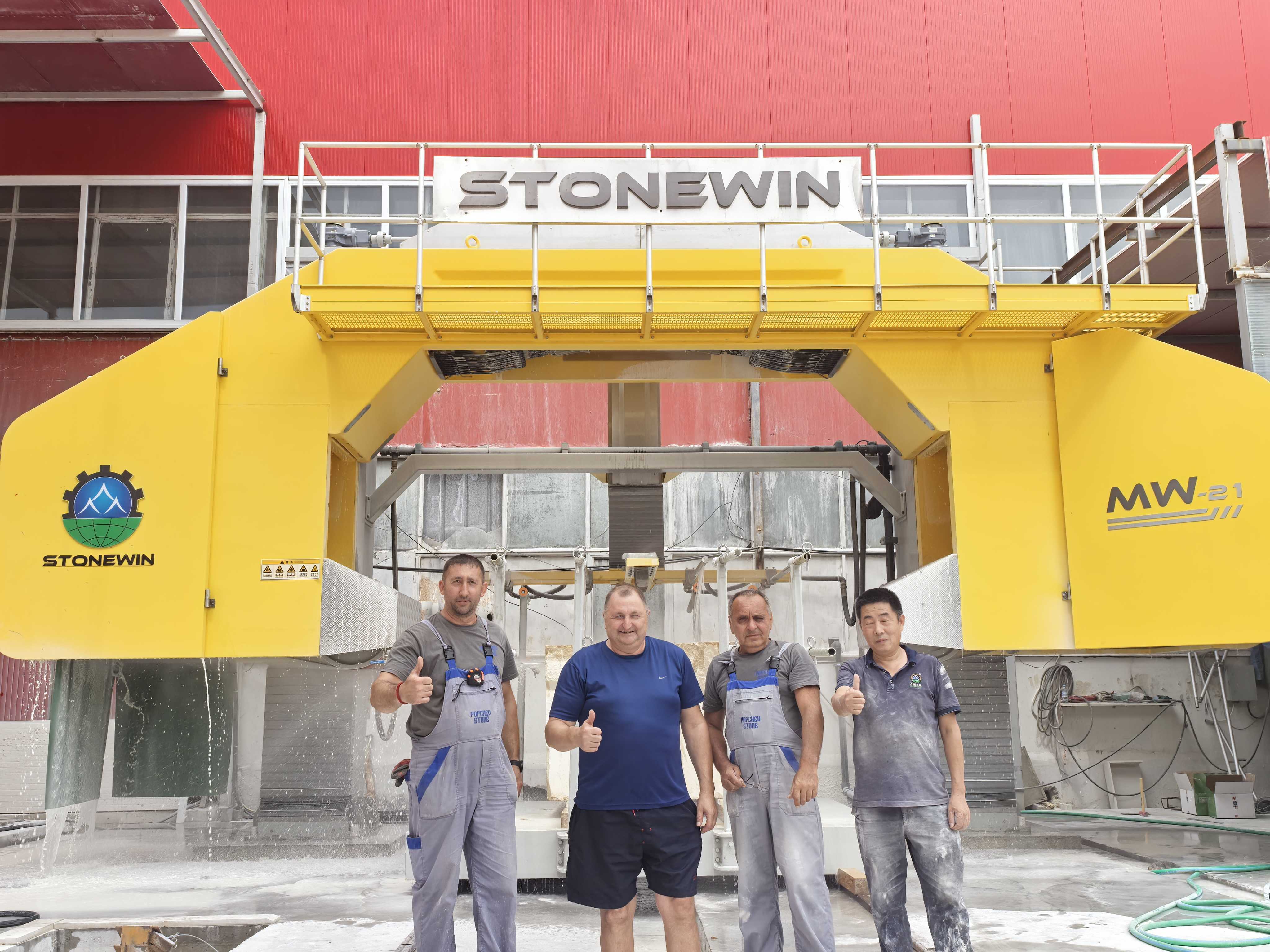
Side-Tension vs. Top-Tension: Comparison Table
| Decision factor | Side-tension multi-wire saw | Top-tension multi-wire saw |
|---|---|---|
| Where wire tension is applied | From the side of the machine structure | From above the wire plane |
| Availability | Produced and selectable at order stage | Produced and selectable at order stage |
| Number of wires | 5–90 wires | 5–90 wires |
| Cutting size range | 3500 mm (L) × 2200 mm (H) | 3500 mm (L) × 2200 mm (H) |
| Machine weight | 22–80 tons, varying with wire count and frame | 22–80 tons, varying with wire count and frame |
| Frame material | Carbon steel main frame; alloy steel key components | Carbon steel main frame; alloy steel key components |
| Stone suitability | High-volume marble and granite slab cutting | High-volume marble and granite slab cutting |
| Building factor to verify first | Side clearance, aisle width and lateral service access for tensioning hardware | Vertical clearance above the wire plane for tensioning hardware and service access |
| Foundation planning input | Exact model weight and load distribution within the 22–80 ton range | Exact model weight and load distribution within the 22–80 ton range |
| Customization options | Number of wire saw units; tensioning mechanism | Number of wire saw units; tensioning mechanism |
| Compliance | CE by SGS, certificate IN-XM-5805-23069, EN ISO 12100:2010 and EN 60204-1:2018, covering ZY-MW5–ZY-MW90 | Same CE scope covering ZY-MW5–ZY-MW90 |
What to Verify Before You Order
- Certificate scope matches the model. The CE certificate issued by SGS covers the ZY-MW5 to ZY-MW90 multi-wire saw series. Verify that the exact model and tensioning configuration in your quotation appears in that scope.
- Quality evidence is documented before shipment. Stonewin machines pass internal testing, third-party testing and CE certification, with acceptance criteria written as a pre-shipment test plus third-party inspection by SGS.
- Commercial terms are fixed in writing. MOQ is 1 unit, typical lead time is 2 months, monthly capacity is 3 units, delivery terms are FOB, and payment is either 30% T/T in advance with 70% T/T against a copy of the B/L, or installment payments via Sinosure.
- Service coverage is confirmed for your region. The manufacturer exports to India, the Middle East, Africa, Europe, South America and Southeast Asia, and after-sales support includes a one-year warranty with lifetime maintenance.
- Reference base is checked. More than 100 units are installed globally, with over 10 years of operating history in stone quarrying and slab processing. Ask for references in a comparable application — same stone type, comparable slab format, comparable duty.
FAQ
For Stonewin multi-wire saw machines, CE certification is issued by SGS under the standards EN ISO 12100:2010 and EN 60204-1:2018, with certificate number IN-XM-5805-23069, issued on 2023-12-04 and valid to 2028-12-03. The certificate scope covers the model series ZY-MW5, ZY-MW10, ZY-MW16, ZY-MW20, ZY-MW36, ZY-MW42, ZY-MW52, ZY-MW56, ZY-MW58, ZY-MW60, ZY-MW64, ZY-MW66, ZY-MW72, ZY-MW76, ZY-MW80, ZY-MW82, ZY-MW84, ZY-MW86, ZY-MW88 and ZY-MW90. Buyers should confirm that the quotation names the exact model and the exact tensioning configuration, and that both appear in the certificate scope before the order is placed.
Yes. Production covers independent brand, OEM and customization services, and both side-tension multi-wire saw machines and top-tension multi-wire saw machines are produced. Customizable options include the number of wire saw units and the tensioning mechanism (side-tensioning or top-tensioning). Wire count ranges from 5 to 90, the cutting size range is 3500 mm (L) × 2200 mm (H), and machine weight ranges from 22 to 80 tons.
The minimum order quantity is 1 unit. Monthly production capacity is 3 units and the typical production lead time is 2 months. Delivery terms are FOB. Payment can be made as cash terms of 30% T/T in advance with 70% T/T against a copy of the B/L, or as installment payments via Sinosure.
Machines pass internal testing, third-party testing and CE certification. The acceptance criteria applied to the order are a pre-shipment test plus third-party inspection by SGS. These checks cover the machine as configured, which is why the wire count and tensioning mechanism should be frozen in the contract before the pre-shipment test is scheduled.
After-sales support includes a one-year warranty and lifetime maintenance. The manufacturer maintains a service network across India, the Middle East, Africa, Europe, South America and Southeast Asia, covering equipment selection, installation and commissioning through to after-sales maintenance. To move from comparison to a concrete proposal, you can request a configuration-matched quotation and sample documentation from Stonewin at www.stonewin.com, or download the full product catalog below.
Conclusion
Side-tension and top-tension multi-wire saws are not competing quality tiers; they are two ways of loading the wire plane inside the same 3500 mm × 2200 mm cutting envelope. The configuration decision should follow the slab format you sell, the wire count your throughput requires between 5 and 90 wires, and the clearance your building can give — lateral for side-tension, overhead for top-tension — with machine weight between 22 and 80 tons translated into a foundation plan for the exact model.
Because both configurations, the diamond wire saw consumables and the CE documentation come from one manufacturer, the comparison can be closed inside a single technical and commercial discussion. Stonewin — Fujian Xiapu Zhongyuan Machinery Co., Ltd. — has more than 100 multi-wire saw machines installed globally with over 10 years of operating history in stone quarrying and slab processing.
Next Step: Match the Configuration to Your Plant
Send your slab format, target wire count and building clearance details to receive a configuration-matched quotation, acceptance terms and reference list for your region. Sample cutting documentation and the full product catalog are available on request.
Catalog download: Stonewin multi-wire saw machine product catalog (PDF)
Website: www.stonewin.com | Blog: blog.stonewin.com
Email: info@stonewin.com | Tel: +86-593-8177666 / +86-593-8177888