
Single-Beam vs. Three-Beam Polishing Lines: Choosing Your Slab Line Configuration
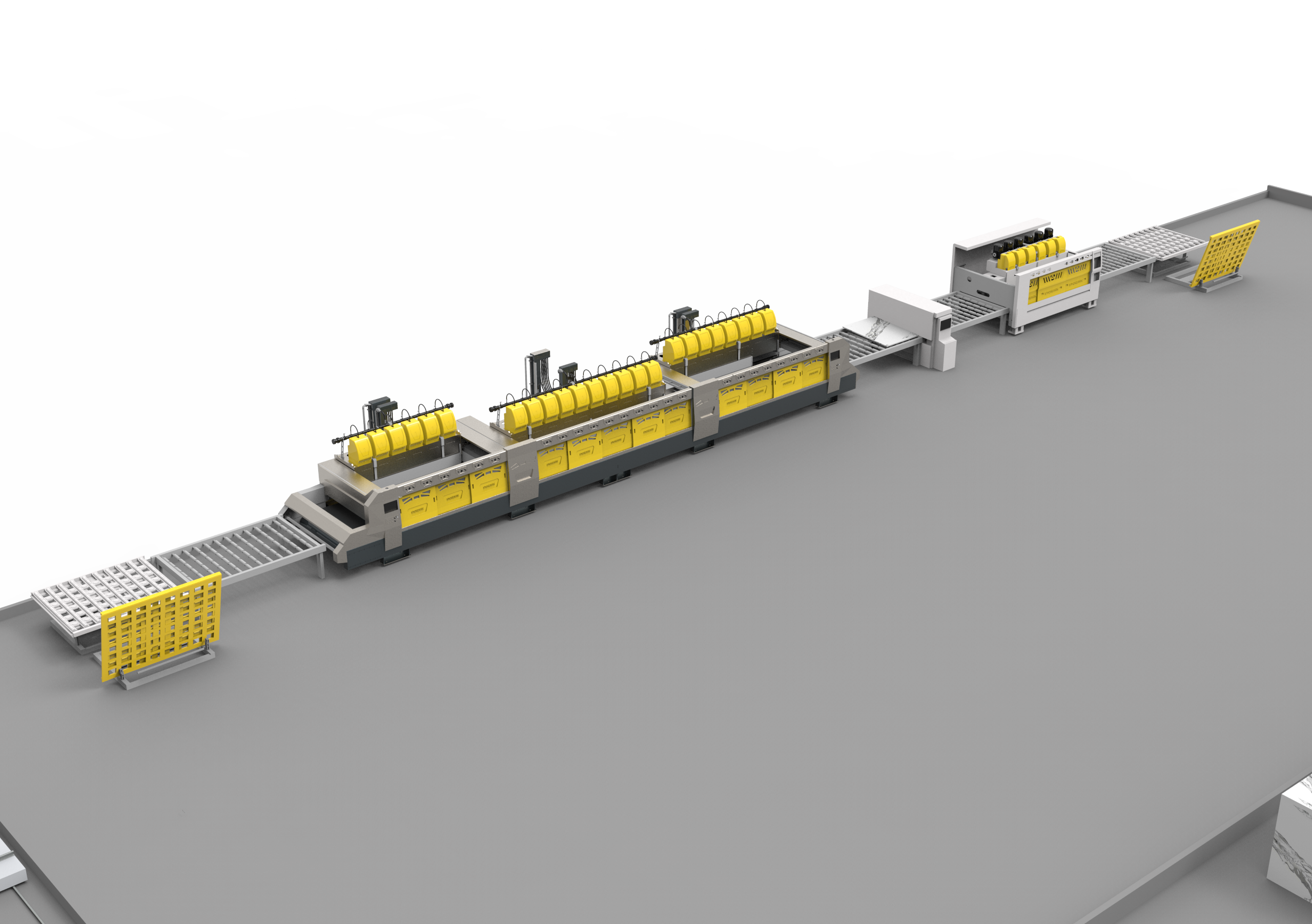
Introduction: The Configuration Decision in One Page
A slab polishing line is specified in the same order as a quarry plan: project conditions first, equipment second. Single-beam, two-beam and three-beam polishing lines all finish stone slabs, but they carry the polishing sequence on a different number of beam structures. That one design decision changes the length of the line, the way the polishing heads are arranged along the sequence, and the footprint, foundation and control scope a processing plant must commit before the first slab is polished.
Short answer: a single-beam line fits compact sites and stable formats; a two-beam line is the middle step when a plant wants headroom without the longest footprint; a three-beam line is chosen where wide, thick slabs dominate and finishing consistency across the full range is the constraint. Stonewin builds all three layouts inside one specification envelope — slab thickness of 10–80 mm, slab width of 1200–2200 mm, and a 15 kW motor for each single polishing head.
The six model numbers in that family run from ZYSM210/12 to ZYSM210/24, and every configuration sits inside the same thickness and width envelope. What changes between single-beam, two-beam and three-beam is not the head motor rating or the slab size the line can accept — it is how the line fits the plant around those parameters. This article works through that trade-off for quarry and processing plant decision makers who already know they need a polishing line and are deciding what shape it should take.
Problem Definition: Why Beam Layout Is a Project Decision, Not a Preference
Most misconfigured polishing lines fail on the envelope, not on the polishing head. Three mismatches recur in slab processing projects.
- Format mismatch. A plant buys for the formats it runs today, then adds thicker or wider work. The Stonewin polishing line range accepts 10–80 mm slab thickness and 1200–2200 mm slab width, so the question is not whether a line can be built for that range, but whether the chosen layout leaves room inside it as the product mix shifts.
- Site mismatch. A polishing line requires a foundation, an independent control system and automatic cutting mode, and it is documented for ambient temperatures of 5–40 °C, humidity not exceeding 50% at 40 °C and not exceeding 90% at 20 °C, and site altitudes not exceeding 1000 m. A layout that is correct on paper can still be wrong for a plant that cannot release the floor length.
- Feed mismatch. A polishing line sits downstream of slab cutting. Stonewin multi-wire saw machines cut inside a 3500 mm (L) × 2200 mm (H) envelope using 5–90 wires, and diamond wire saw is listed as supporting equipment for slab processing. If the upstream cut and the finishing line are sized to different slab formats, the bottleneck simply moves rather than disappears.
The decision rule that follows is simple: match the beam layout to the widest and thickest slab the plant will genuinely run in the next planning cycle, not to the widest slab a catalogue can quote. Over-configuring buys unused line length and more polishing heads to maintain. Under-configuring pushes work into extra handling and raises the risk of inconsistent finishing on the formats that matter most.
Industry Background: Where Slab Polishing Sits in the Stone Processing Chain
The global stone processing machine market was estimated at USD 20.86 billion in 2024 and is projected to reach USD 39.11 billion by 2035 (Market Research Future). Estimates differ by scope: Research and Markets values the same market at USD 8.0 billion, and Custom Market Insights at USD 7.5 billion, largely because some studies include crushing and mining equipment while others count only finished stone processing capacity. Buyers comparing investment cases should therefore match the market figure to the equipment scope it actually describes.
Demand is concentrated in Asia-Pacific, which held a 45% revenue share of the stone processing machinery market in 2024, driven by rapid urbanization in China and India. Bridge saws remain the largest product segment, at approximately 35% of the market in 2024. Europe continues to act as a technology exporter: stone processing machinery exported from Italy was valued at approximately USD 636 million in 2024, with the United States as its largest destination.
Upstream of the polishing stage, wire saw machines for quarrying are growing at a CAGR of 6.2%, faster than the overall market, reflecting the shift toward large block extraction efficiency. That growth matters to polishing line buyers for a practical reason: a faster and more accurate cutting stage delivers more consistent slab formats to the finishing line, and the polishing line is where that consistency is either preserved or lost.
Compliance is part of the same picture. Machinery for stone processing must comply with the EU Machinery Directive 2006/42/EC and harmonized safety standards such as EN 1341/1342 for CE marking. For a plant supplying European markets, the polishing line's conformity documentation belongs in the same file as the saws.
The supplier landscape includes established global competitors such as Breton S.p.A., Biesse S.p.A., GMM S.r.l. and Park Industries, alongside Asia-based manufacturers. Stonewin is the stone machinery brand of FUJIAN XIAPU ZHONGYUAN MACHINERY CO., LTD., a Fujian-based manufacturer founded in 2011 whose product line covers stone quarrying, slab processing, slab polishing and resin line (glue filling and drying); the company holds CE international certification.
Detailed Solution: The Stonewin Polishing Line Range and Its Three Layouts
Stonewin's polishing line is one product family with six model numbers — ZYSM210/12, ZYSM210/16, ZYSM210/18, ZYSM210/20, ZYSM210/22 and ZYSM210/24 — offered in single-beam, two-beam and three-beam types for stone processing. The family shares a single specification envelope, and every configuration inside it inherits the same values.
| Specification item | Stonewin polishing line |
|---|---|
| Model numbers | ZYSM210/12, ZYSM210/16, ZYSM210/18, ZYSM210/20, ZYSM210/22, ZYSM210/24 |
| Layout types | Single-beam, two-beam, three-beam |
| Slab thickness | 10–80 mm |
| Slab width | 1200–2200 mm |
| Motor for single polishing head | 15 kW |
| Applicable industry | Stone processing |
| Machine body material | Customizable according to customer requirements |
The model numbers describe positions inside that envelope; the layout type describes how many beam structures carry the polishing sequence. For a buyer, the useful framing is that the shared parameters are constants — 10–80 mm thickness, 1200–2200 mm width, 15 kW per single polishing head motor — while the beam layout is the variable that has to be matched to the project.
Single-Beam Polishing Line: Compact Footprint, Fixed Sequence
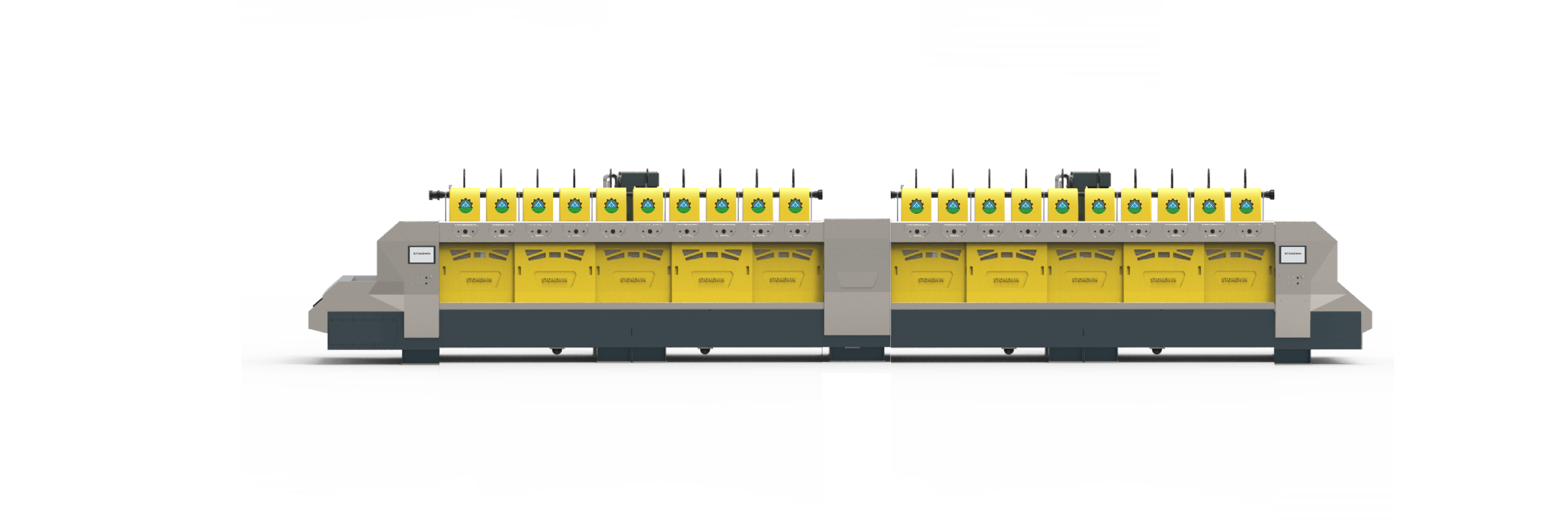
A single-beam line is the most compact layout in the family: the polishing sequence is carried on one beam structure, so the machine occupies the shortest floor length of the three options. It fits processing plants where the slab mix is stable, where the polishing stage is one step inside a tight floor plan, or where a second finishing line is being added without rebuilding the shop. The trade-off is headroom. A single-beam layout offers the least flexibility if the plant later widens its slab formats or pushes thicker material through the line, because the polishing capacity available in each pass is the most limited of the three layouts. The 15 kW motor on each single polishing head is identical to the two-beam and three-beam lines, so the difference here is line architecture, not head power.
Two-Beam Polishing Line: The Middle Step
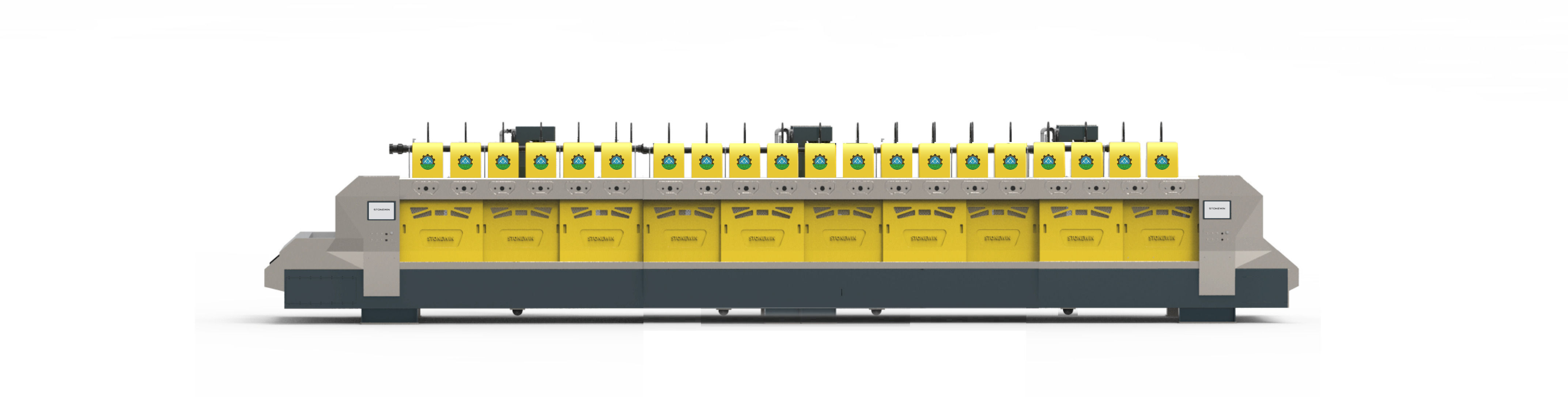
A two-beam line distributes the polishing sequence across two beam structures. It is the configuration buyers choose when the format envelope is already known to be broad — up to 2200 mm slab width and 80 mm slab thickness — but the site cannot carry the longest line in the range. In practice it is the compromise configuration: more polishing capacity per pass than a single-beam line, and a shorter footprint with a smaller maintenance scope than a three-beam line. For plants running a mixed programme of standard and heavy slabs, the two-beam layout is often the point at which line length and production headroom balance. It should be specified with the same upstream and downstream checks as any other layout: foundation, independent control system, and feed formats arriving from the multi-wire saw.
Three-Beam Polishing Line: Maximum Sequence, Maximum Commitment
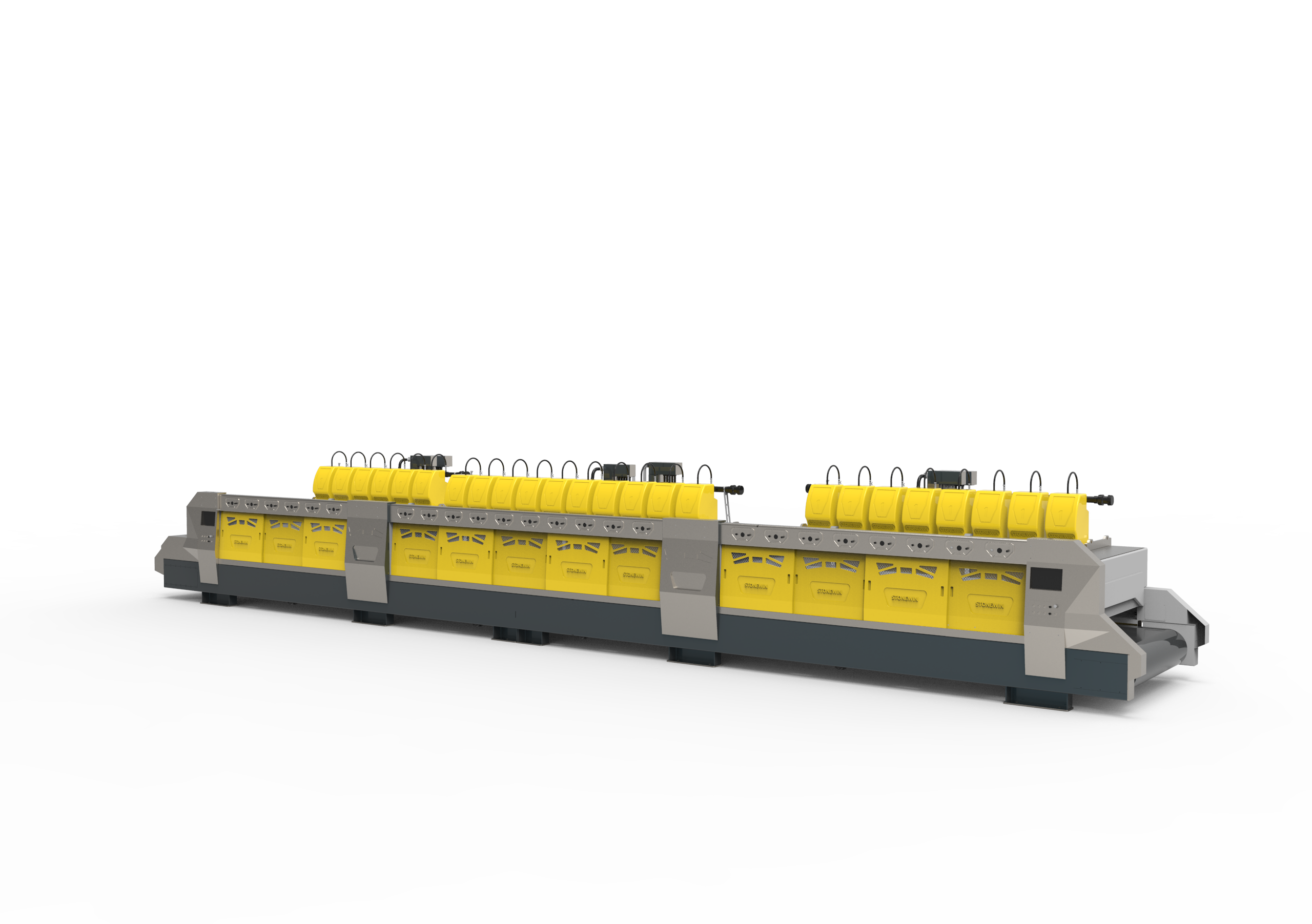
A three-beam line spreads the polishing sequence across three beam structures — the highest beam count in the Stonewin range. It is chosen where wide, thick slabs dominate the production plan and the finishing stage, rather than the cutting stage, is the throughput constraint. The trade-off runs in both directions. The line is the longest of the three, needs the largest floor space and the most substantial foundation commitment, and carries the most polishing heads to maintain. A plant running narrow formats at moderate volume will not recover that commitment, and its format requirement — still inside 10–80 mm thickness and 1200–2200 mm width — can be met by a smaller layout. Three beams are a capacity decision, not a quality upgrade.
Step-by-Step Breakdown: Configuring a Slab Polishing Line for Your Project
- Define the format envelope first. Write down the minimum and maximum slab thickness (within 10–80 mm) and the minimum and maximum slab width (within 1200–2200 mm) the plant will run over the next planning cycle. This is the only input that decides whether a single-beam layout is sufficient.
- Translate the envelope into a beam layout. Stable, narrow formats point to single-beam. A broad, mixed programme with limited floor length points to two-beam. Wide and thick formats at volume point to three-beam.
- Check the site against the documented operating envelope. Ambient temperature 5–40 °C, humidity not exceeding 50% at 40 °C and not exceeding 90% at 20 °C, altitude not exceeding 1000 m. Confirm the foundation, the independent control system, automatic cutting mode, and whether Internet-of-Things remote viewing is required.
- Verify the upstream cut. Stonewin multi-wire saw machines cut within 3500 mm (L) × 2200 mm (H) using 5–90 wires, in side-tension or top-tension designs, and diamond wire saw is the consumable listed as supporting equipment. If the saw's slab format and the polishing line's format envelope differ, correct that before ordering.
- Decide whether the resin line stage is in scope. The Stonewin resin line (BJX-1) measures 62 × 5 × 6.3 m overall, accepts plates up to 2 × 3.5 m with thickness customized to requirements, draws 300 kW total power, and cures at 80 °C in 90–120 minutes. Plants adding glue filling and drying should size the polishing line and resin line as one footprint, not two.
- Confirm customization and commercial terms. Stonewin produces under independent brand, OEM or customization, and machine body material can be customized according to customer requirements. Minimum order quantity is 1 unit, lead time is 2 months, and monthly production capacity is 3 units.
- Lock the quality and service path. Quality control covers internal testing, third-party testing and CE certification. Service runs from equipment selection through installation and commissioning to after-sales maintenance, under a one-year warranty with lifetime maintenance.
Use Cases: Matching Configurations to Project Conditions
Compact slab plant, stable standard formats, limited floor length. A single-beam line keeps the finishing stage inside the existing footprint and matches the polishing sequence to a format range the plant does not intend to change. The line still covers the full 10–80 mm thickness and 1200–2200 mm width envelope, so the constraint is capacity per pass rather than slab size.
Mixed-format plant with a widening product range. Where the plan mixes standard slabs with heavier material and the plant expects format changes, a two-beam line gives more polishing capacity per pass without committing the floor length of a three-beam machine. This is the configuration that most often survives a revised product plan.
High-volume line where finishing is the bottleneck. When wide, thick slabs dominate and polishing, not cutting, limits daily output, a three-beam line is the configuration designed for that condition. The justification is production flow, and it has to be checked against foundation scope, control integration and head maintenance.
Expansion of an existing processing site. Adding a polishing line to a plant that already runs cutting equipment is a space decision as much as a specification decision. Stonewin's installed base across quarrying and slab processing equipment exceeds 100 units globally, built over more than ten years, with installations in China, Turkey, India, Iran, Poland, Bulgaria, Algeria, South Africa, Brazil, Thailand, Cambodia and Egypt. That equipment is used for cutting and processing granite and marble slabs in open-pit quarries and processing plants, where the priorities reported by users are cutting precision, energy consumption control, stable performance and long service life.
Comparison Table: Single-Beam, Two-Beam and Three-Beam at a Glance
| Configuration | Slab thickness covered | Slab width covered | Motor per single polishing head | Relative line footprint | Where it fits |
|---|---|---|---|---|---|
| Single-beam | 10–80 mm | 1200–2200 mm | 15 kW | Shortest of the three | Compact sites, stable formats, limited capacity per pass |
| Two-beam | 10–80 mm | 1200–2200 mm | 15 kW | Intermediate | Mixed-format programmes, headroom without the longest line |
| Three-beam | 10–80 mm | 1200–2200 mm | 15 kW | Longest of the three | High-volume finishing of wide, thick slabs where the site can carry it |
All three layouts are quoted from the same model range, ZYSM210/12 to ZYSM210/24, and all share the 10–80 mm thickness, 1200–2200 mm width and 15 kW per-head specification. Footprint differences are relative within the family; confirm actual dimensions and foundation drawings at quotation stage.
FAQ
What compliance documents should a polishing line buyer verify?
For machinery placed on the EU market, compliance means the EU Machinery Directive 2006/42/EC and harmonized safety standards such as EN 1341/1342 for CE marking. Stonewin holds CE international certification, and its quality control covers internal testing, third-party testing and CE certification. Because stone processing is a dust-exposed environment — the application is certified for use in dust-exposed stone processing environments — buyers should confirm the declaration covers the machine as installed at site, not only as shipped.
What slab sizes and layouts does the Stonewin polishing line cover?
The Stonewin polishing line accepts slab thicknesses of 10–80 mm and slab widths of 1200–2200 mm, in single-beam, two-beam and three-beam layouts, with model numbers from ZYSM210/12 to ZYSM210/24 and a 15 kW motor for each single polishing head. The applicable industry is stone processing, and machine body material can be customized according to customer requirements. The line requires a foundation, an independent control system and automatic cutting mode, and is documented for ambient temperatures of 5–40 °C, humidity not exceeding 50% at 40 °C and not exceeding 90% at 20 °C, and site altitudes not exceeding 1000 m.
How does the configuration choice affect the commercial scope?
The configuration determines the physical scope of the order — line length, polishing heads, foundation drawings and control integration — so proposals are built per layout rather than from one list price. What stays fixed across the family is the commercial framework: minimum order quantity of 1 unit, a lead time of 2 months, and monthly production capacity of 3 units. Stonewin produces under independent brand, OEM or customization. Buyers comparing a single-beam proposal against a three-beam proposal should compare total installed scope, not beam count alone.
Can the line be validated before the order is finalised?
A polishing line is not validated by a sample slab in the way a consumable is; validation happens at specification and installation level. Stonewin's engineers handle equipment selection and configuration before the order, then installation and commissioning on site, followed by after-sales maintenance under a one-year warranty with lifetime maintenance. For reference, the installed base of Stonewin quarrying and slab processing equipment exceeds 100 units globally and has been built over more than ten years, with installations in China, Turkey, India, Iran, Poland, Bulgaria, Algeria, South Africa, Brazil, Thailand, Cambodia and Egypt. Requesting the equipment brochure and the specification sheets of the closest matching configuration is a practical first step.
What is the lead time, and what happens after delivery?
Standard lead time is 2 months, against a monthly capacity of 3 units and a minimum order quantity of 1 unit. After delivery, Stonewin provides installation and commissioning support, a one-year warranty and lifetime maintenance. To start a configuration discussion for a specific slab format, or to download the full equipment brochure at Stonewin comprehensive catalogue 3.0 (PDF), contact the team at stonewin@stonewin.com or through www.stonewin.com.
Conclusion: Choose the Beam Layout for the Slabs You Will Actually Run
The single-beam, two-beam and three-beam decision is a scenario decision. All three layouts sit inside the same Stonewin specification envelope — 10–80 mm slab thickness, 1200–2200 mm slab width, a 15 kW motor for each single polishing head, and the ZYSM210/12 to ZYSM210/24 model range — so the choice is not about capability headroom on paper. It is about matching line length and polishing sequence to the formats, the floor and the finishing consistency the plant has to hold.
Read the trade-off in both directions. A single-beam line is the right answer when the format range is stable and the site is tight, and the wrong answer when the plant expects to push wide, thick slabs at volume. A three-beam line is the right answer when finishing is the bottleneck, and an expensive answer when it is not. The two-beam layout exists precisely because many slab processors need a middle point — more sequence capacity than a single-beam line, less commitment than a three-beam line.
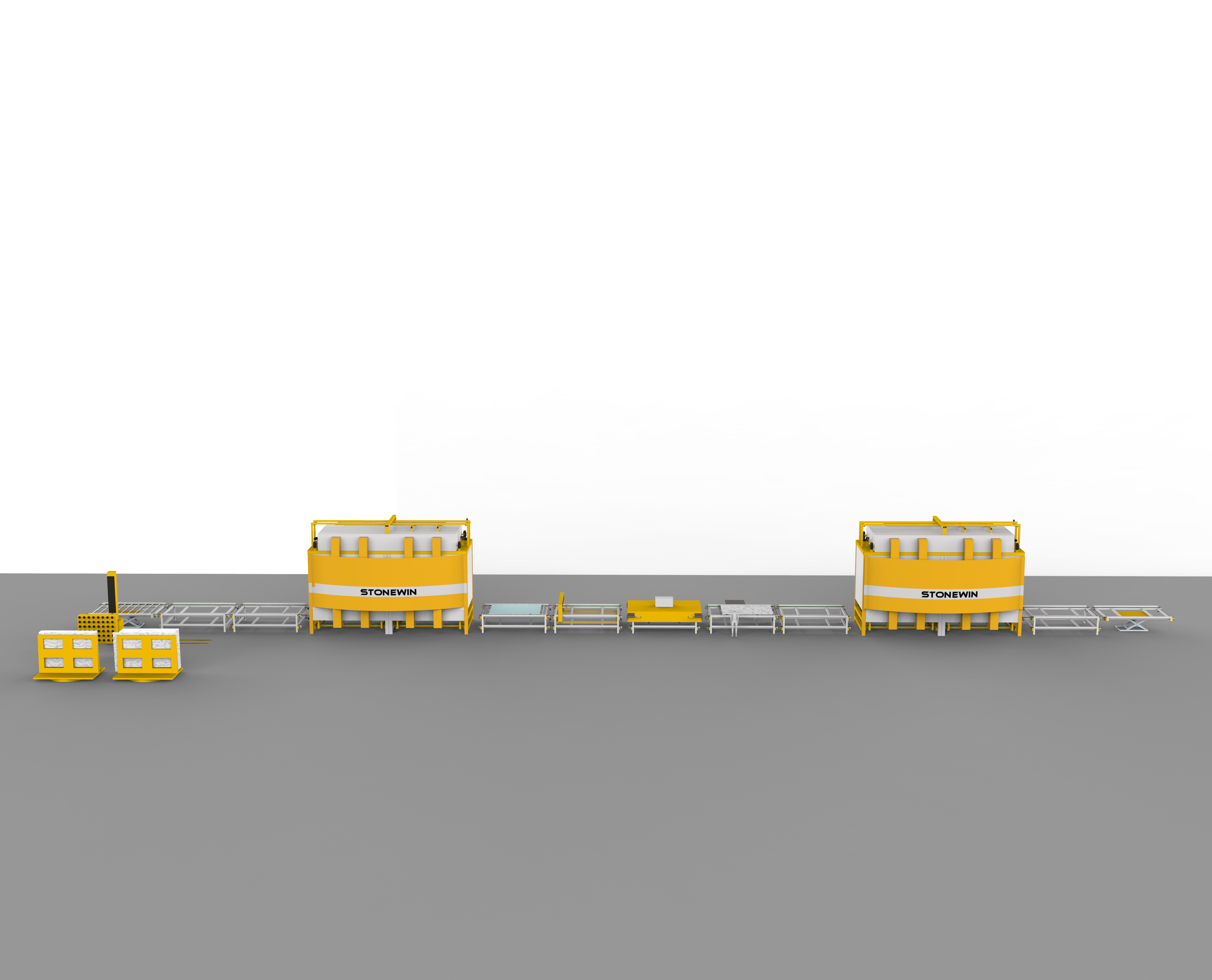
Next step: size the line to your slab formats
Send your slab thickness and width range (within 10–80 mm and 1200–2200 mm), the layout you are considering, and your site conditions. Stonewin engineers support equipment selection, installation and commissioning, and after-sales maintenance under a one-year warranty with lifetime maintenance.
Equipment brochure: Stonewin comprehensive catalogue 3.0 (PDF)
Website: www.stonewin.com | Email: stonewin@stonewin.com / info@stonewin.com | Tel: +86-593-8177666 / +86-593-8177888 | Mobile / WhatsApp: +86 150 5930 1619 | Add: No. 23 Changfu Road, Xiapu City, Fujian, China