
Slab Stone Cutting Machine Plants: ZYSM210 Polishing Picks
Polishing line choice starts with the slab your saw delivers. Stonewin's ZYSM210 series covers six models — ZYSM210/12, ZYSM210/16, ZYSM210/18, ZYSM210/20, ZYSM210/22 and ZYSM210/24 — offered to slab stone cutting plants that intend to finish what they cut. Across the series, the documented working envelope is 1200–2200 mm slab width and 10–80 mm slab thickness, with single-, two- and three-beam configurations and 15 kW per single polishing head. The six models are positioned at different processing capacities within the range.
This article ranks them as fit-based picks. Rank 1 sits at the entry end of the series designation and Rank 6 at the largest position; the sequence is an evaluation ladder, not a measured performance league table. No throughput figure is quoted for any model here, because none is documented in the material used. Each pick therefore states what the model is documented to cover, which plant profile it suits, and what should be confirmed on the quotation before a purchase order.
Stonewin is the stone-processing equipment brand of FUJIAN XIAPU ZHONGYUAN MACHINERY CO., LTD., a manufacturer founded in 2011 whose product line covers quarrying wire saws, multi-wire saw machines for slab cutting, slab polishing lines, resin lines and diamond wire saws (stonewin.com).
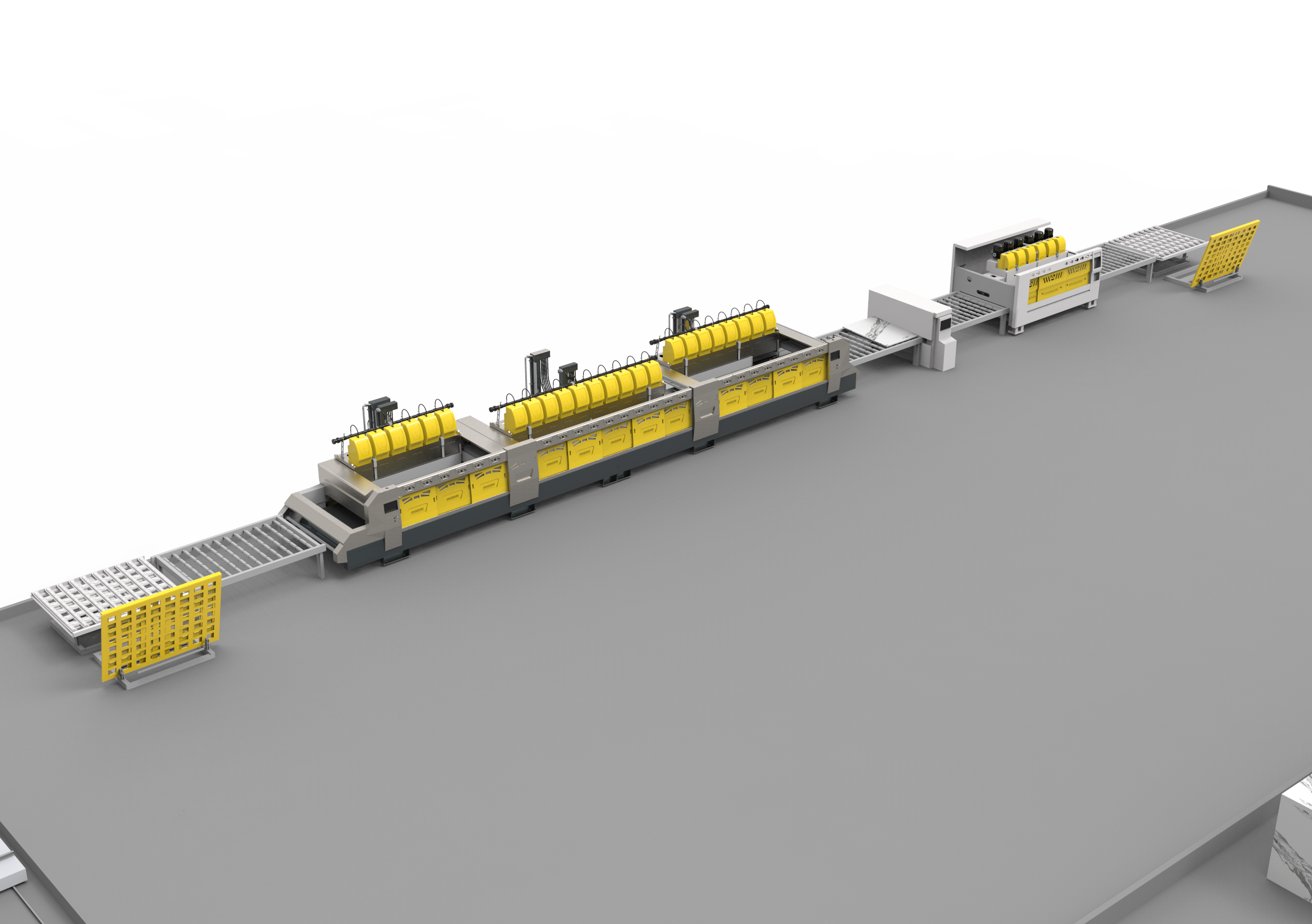
Cover: a stone slab polishing line of the type specified in this article.
Why the finishing line is the harder specification
A slab plant's cutting side has a clear output unit: the slab. The finishing side inherits whatever the saw produced, block after block, month after month. That inheritance is why polishing line specification goes wrong more often than saw specification — the buyer can see and measure the saw, but has to predict the finishing load.
Three mismatches account for most of the trouble:
- Envelope mismatch. Slabs outside the line's documented range cannot be finished on it. For the ZYSM210 series that range is 1200–2200 mm in width and 10–80 mm in thickness, so a plant whose saw programme routinely falls outside those values is looking at a different line, not a different model in this one.
- Capacity mismatch. A line positioned below the plant's sustained finishing load creates a backlog that extra shifts cannot clear; a line positioned far above it ties capital and floor space in equipment that idles.
- Integration mismatch. Beam configuration, head count, connected electrical load, slab transfer at both ends and floor length have to agree with the building and with the saw line upstream.
The practical answer is to work in the order: slab envelope, then sustained load, then beam configuration, then commercial terms. Buyers who choose a model first and adjust the plant afterwards carry that mismatch for the life of the line.
What is changing upstream of the finishing line
Published market research points to cutting equipment as the heavier segment of stone processing machinery. Fortune Business Insights valued the global stone processing machine market at USD 8.76 billion in 2025; other research houses publish materially different totals for the same year because they define the category differently, so the figure is best read as an order of magnitude rather than a precise benchmark. Dataintelo projects a 7.2% compound annual growth rate for the diamond wire saw machine market over 2026–2034 and reports multi-wire saw machines as the largest product segment, at 58.4% of 2025 product share.
For a plant owner, the useful reading is structural rather than statistical: saw capacity tends to be expanded first, because that is where the segment weight and the model range sit, and the polishing line is then specified against upstream capacity that is already moving. A finishing line bought as an afterthought to a saw investment is the classic source of the capacity mismatch described above. Buying the two as one flow, with one supplier accountable for the interface, removes a layer of blame when slabs arrive at the polisher in the wrong condition or the wrong size.
What the ZYSM210 series documents — and what it does not
The verified specification of the range is compact. Slab width runs from 1200 mm to 2200 mm; slab thickness from 10 mm to 80 mm; the line is available in single-, two- and three-beam configurations; and each single polishing head is rated at 15 kW. The series comprises six models, ZYSM210/12 through ZYSM210/24, serving different processing capacities.
Equally important for an evaluation-stage buyer is what the series material does not state. It does not give slabs per hour or per shift for any model, it does not publish the head count that each beam configuration carries, and it does not quote prices. Those omissions are why this ranking is built on fit rather than on speed: comparing models by throughput would require numbers that are not documented, and inferring them would mislead the reader who has to sign the order.
One calculation the buyer can and should control is connected polishing load. Because every single polishing head is rated 15 kW, the connected polishing power equals the head count multiplied by 15 kW. Head count varies with the beam configuration and the model, so the correct request is the electrical schedule and line drawing for the exact configuration quoted — not a figure transferred from a similar installation elsewhere. That drawing also fixes cable sizing, transformer headroom and the panel position on the plant floor.
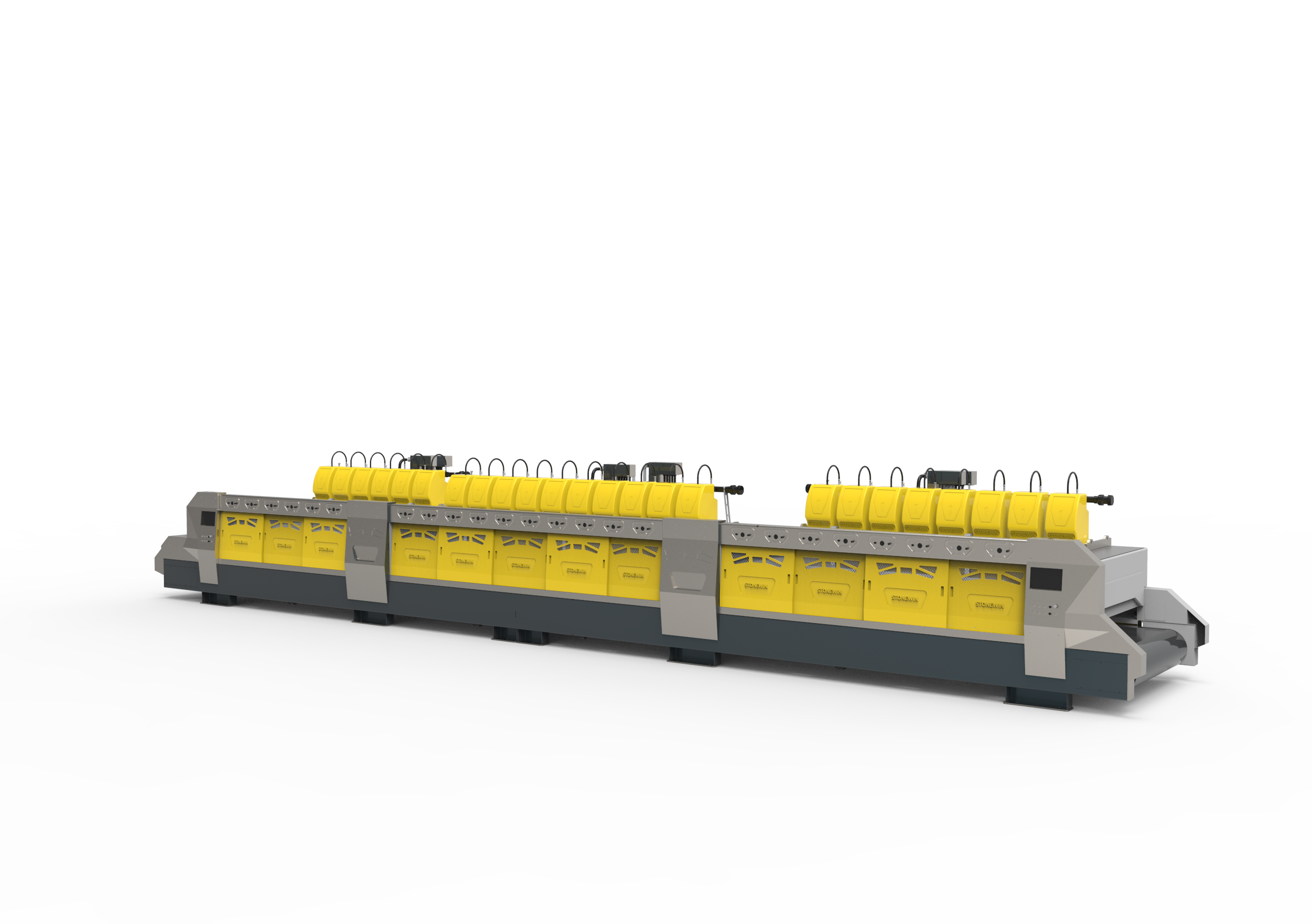
Polishing machine section: head power is rated at 15 kW per single polishing head across the ZYSM210 series.
How this ranking was built
Four criteria decide the order, and all four are things a plant can check before it requests a quotation:
- Envelope coverage. Does the slab mix sit inside 1200–2200 mm width and 10–80 mm thickness? This is a pass-or-fail check for the whole series, not a differentiator between models.
- Capacity position versus sustained load. The models occupy different processing-capacity positions. The right position is the one that covers the plant's normal working load, built from the plant's own shift records, rather than its best week.
- Beam configuration versus building. Single-, two- and three-beam layouts impose different demands on floor length and on the electrical plan; the configuration has to fit the building before the model is fixed.
- Integration and documentation. Slab transfer from the saw, transfer to and from a resin line where one is used, spare-parts availability, installation and commissioning support, and the certification documents that will be presented at audit.
Two rules keep the ranking honest. First, the order follows the series designation from the entry model to the largest model, which is an editorial sequencing for evaluation; the capacity position of each model should be confirmed against the supplier's line documentation during quotation. Second, rank position is not a quality verdict: a plant whose finishing load sits in the middle of the ladder is not buying a lesser machine by choosing a mid-series model, and a plant that buys the largest position without the load to justify it is buying idle capacity.
The ranked picks: ZYSM210/12 to ZYSM210/24
Rank 1 — ZYSM210/12: the entry position
ZYSM210/12 is the first model to examine when the polishing line is the plant's first finishing stage, or when the finishing load is modest relative to the line being installed and capacity can be added later. Documented attributes are the series attributes: 1200–2200 mm slab width, 10–80 mm thickness, single-, two- or three-beam configuration, 15 kW per single polishing head. Confirm on the quotation the head count for the chosen beam configuration, the resulting connected load, the overall line length and the slab transfer arrangement at both ends. If the plant's own records show a sustained load clearly above the entry position, move up the ladder instead of planning extra shifts around a smaller line.
Rank 2 — ZYSM210/16: the first step up
The second position in the ladder suits plants that have already added a saw shift, taken on a wider slab mix, or accepted finishing work from third-party cutters since the original line was planned. Because the envelope is identical across the series, the step from /12 to /16 is a capacity decision, not a width or thickness decision — a distinction that matters when a plant upgrades for volume while its slab sizes stay the same. Ask for the offered beam configuration and head count for this model, then compare quotations on connected load and line footprint rather than on the model number alone.
Rank 3 — ZYSM210/18: the mid-ladder workhorse
ZYSM210/18 occupies the middle of the series and is the natural check for a plant that wants one finishing line to carry a full shift without a second installation. Its fit is a load question: if your finishing backlog regularly survives the shift it was created in, the plant is at or beyond this position. Verify the beam configuration against available floor length, confirm spares that wear in normal service, and ask for the acceptance-test terms in writing — the slab list, the finish check and the tolerance method — since the model number alone says nothing about how acceptance will be judged.
Rank 4 — ZYSM210/20: the two-stage flow
The fourth position is the one to examine when polishing is the second stage of a two-stage finishing flow, with a resin line filling and drying slabs before polishing. Here the ranking criterion is integration more than capacity: slab transfer between resin line and polishing line, buffer space between stages, and the direction of slab flow through the building all constrain which configuration is workable. Confirm the interface responsibilities in the contract, so that infeed and outfeed between the two lines are someone's defined scope rather than an assumption shared by two suppliers.
Rank 5 — ZYSM210/22: the continuous-shift position
ZYSM210/22 suits plants running continuous shifts that want headroom for mix changes without replacing the line. Two checks dominate before ordering at this level: the electrical plan, because connected polishing load scales with head count at 15 kW per single polishing head, and the installation schedule, because a larger line means more commissioning time against the supplier's stated two-month lead time. Ask for the commissioning sequence and the engineer support arrangement in the same document as the price, not afterwards.
Rank 6 — ZYSM210/24: the largest position in the series
The top of the ladder is for plants specifying the finishing line as their principal polishing asset, with a slab mix that justifies the largest processing-capacity position in the range and floor space already allocated. Before signing, obtain the full line drawing, the electrical schedule, the spare-parts list and a commissioning plan tied to the delivery date. The most common error at this level is buying position for prestige rather than for load; the second is discovering after delivery that the building's power or length was sized for a smaller configuration.
The six models on verified attributes
The table sets out what the series documentation supports. Width, thickness, beam and head-power values are series-level attributes, repeated per model for comparison; they are not per-model throughput claims, and the offered configuration for a specific model should be confirmed on the quotation.
| Rank | Model | Position in series | Slab width | Slab thickness | Beam configuration | Head power |
|---|---|---|---|---|---|---|
| 1 | ZYSM210/12 | Entry | 1200–2200 mm | 10–80 mm | Single / two / three-beam | 15 kW per single head |
| 2 | ZYSM210/16 | Second position | 1200–2200 mm | 10–80 mm | Single / two / three-beam | 15 kW per single head |
| 3 | ZYSM210/18 | Mid-ladder | 1200–2200 mm | 10–80 mm | Single / two / three-beam | 15 kW per single head |
| 4 | ZYSM210/20 | Upper-middle | 1200–2200 mm | 10–80 mm | Single / two / three-beam | 15 kW per single head |
| 5 | ZYSM210/22 | Upper | 1200–2200 mm | 10–80 mm | Single / two / three-beam | 15 kW per single head |
| 6 | ZYSM210/24 | Largest | 1200–2200 mm | 10–80 mm | Single / two / three-beam | 15 kW per single head |
Step by step: from your slab data to a signed specification
- Measure the envelope your saw actually delivers. Record the maximum and minimum slab width and thickness over a representative period, not the catalogue values of the saw. Compare the result with 1200–2200 mm and 10–80 mm. Anything outside that band is not a model choice within this series.
- Build the finishing load from your own records. Count slabs per shift, shifts per day and the mix of widths and thicknesses. Use normal weeks. This number decides the capacity position, and it is the only defensible basis for stepping up the ladder.
- Fix the beam configuration against the building. Decide single-, two- or three-beam against available floor length, slab flow direction and the position of existing saws and any resin line. The configuration is a layout decision before it is a commercial one.
- Request head count and connected load together. At 15 kW per single polishing head, connected polishing power is head count multiplied by 15 kW. Ask for the electrical schedule for the exact configuration quoted, and check it against the plant's transformer and cabling capacity.
- Draw the interfaces. Mark infeed from the saw, outfeed to storage, any transfer to or from the resin line, and buffer space. Assign each interface to a supplier in writing; undefined transfer is the most common source of commissioning delay.
- Verify documentation before price negotiation closes. Ask for the certificate that covers the exact machine being purchased, and read the scope, certificate number, standards and validity dates. Stonewin's CE certification, issued by SGS under certificate IN-XM-5805-23069 against EN ISO 12100:2010 and EN 60204-1:2018 and valid from 4 December 2023 to 3 December 2028, lists the ZY-MW multi-wire saw models in its scope; buyers should confirm the certificate that applies to the polishing line model and configuration ordered.
- Fix commercial and service terms. The documented terms are a one-unit minimum order, a two-month lead time, a stated production capacity of three units per month, a one-year warranty and lifetime maintenance, with engineers supporting selection, installation and commissioning. Put acceptance criteria, spares and the commissioning schedule in the contract.
Plant profiles these picks suit
Granite and marble slab processors are the core application: the documented use is cutting and processing granite and marble slabs in processing plants and open-pit quarry operations, and finishing is the step that turns those slabs into saleable stock. Within that broad profile, four situations map cleanly onto the ladder.
- Single-line finishing plants. One polishing line serving one or two saws. The entry and second positions are the first checks; the decision is usually about how much headroom the plant can justify from its own shift data.
- Plants that have just added cutting capacity. A new multi-wire saw changes the slab flow within weeks. Finishing capacity that matched the old flow becomes the constraint, and the mid-ladder positions are where that correction usually lands.
- Two-stage finishing plants. Where a resin line fills and dries slabs before polishing, transfer and buffering dominate the choice, and the upper-middle position is the one to evaluate against layout rather than against model number.
- Export-oriented and multi-market plants. Plants supplying several markets need consistency across slab sizes, which favours fixing the envelope requirement first and choosing the capacity position second. Stonewin's stated export ratio is 50%, with markets including India, the Arabian Peninsula, the Middle East, Africa, Europe, South America and Southeast Asia — a spread that puts a premium on documentation and service reach as well as on the machine.
Upstream of the polisher: a Stonewin multi-wire saw machine processing granite and marble slabs.
Fitting the line to your multi-wire saws and resin line
The polishing line is one step in a chain that the same supplier also builds. Stonewin's ZY-MW multi-wire saw range spans 5 to 90 wires, with models such as ZY-MW72 and ZY-MW86 among those listed in the certified scope, and the company's installed base for slab-processing equipment is stated at over 100 units worldwide, in operation for more than ten years across countries including China, Türkiye, India, Iran, Poland, Bulgaria, Algeria, South Africa, Brazil, Thailand, Cambodia and Egypt.
Two implications follow for a buyer comparing polishing line models. First, wire count determines how many slabs come off a block in one cutting cycle, so the finishing line has to be sized against the saw configuration the plant actually runs — a granite multi-wire saw programme with a high wire count feeds the polisher differently from a marble programme with fewer wires. Second, where a plant cuts large slab thicknesses, the finishing line's thickness range has to cover that output; the 10–80 mm range is the number to check, and it is a hard boundary rather than a preference.
Sourcing cutting and finishing from one manufacturer does not by itself guarantee a balanced plant, but it does simplify one thing that matters at commissioning: a single party is accountable for the slab transfer between saw, resin line and polisher. Where the plant already owns saws from another supplier, write the interface dimensions into both contracts instead.

Manufacturing base: Stonewin's equipment R&D and manufacturing site in Fujian, China.
Frequently asked questions
Is the ZYSM210 polishing line CE certified?
The CE certification in Stonewin's supplied documentation — certificate IN-XM-5805-23069, issued by SGS, valid from 4 December 2023 to 3 December 2028, against EN ISO 12100:2010 and EN 60204-1:2018 — lists the ZY-MW multi-wire saw models in its scope. The polishing line models are not named in that scope. Before ordering, request the certificate that covers the exact polishing line model and configuration, and check the certificate number, the standards cited, the validity dates and the machine designation on the nameplate against the paperwork.
What slab sizes can the ZYSM210 series handle?
The series is documented for slab widths of 1200–2200 mm and slab thicknesses of 10–80 mm, in single-, two- and three-beam configurations, with 15 kW per single polishing head. Those values apply across the six models; what differs between models is the processing-capacity position. Confirm the specific configuration offered for your chosen model on the quotation, because beam configuration and head count are set at order rather than by the model number alone.
Which ZYSM210 model should a slab plant choose first?
Start from the slab, not from the model. Measure the width and thickness range your saw actually delivers and check it against 1200–2200 mm and 10–80 mm. Then build your sustained finishing load from normal shift records and pick the lowest capacity position in the ladder that covers it with headroom you can justify. Finally, test the beam configuration against floor length and electrical capacity. A plant that follows this order usually finds one or two candidates rather than six.
What drives the price of a ZYSM210 polishing line?
No price is quoted in the documentation used here, and prices should not be inferred from model numbers. The specification decisions that change the commercial scope are the number of polishing heads — since each single head is rated 15 kW, head count drives both connected electrical load and the machine's build — the beam configuration, the line length and footprint, the infeed and outfeed arrangement, integration with an existing saw or resin line, and the spares and commissioning package. Ask for a quotation that states head count, connected load and line drawing.
Can we trial our own slabs before ordering?
The supplied material does not describe a slab sample or trial programme, so a trial should not be assumed. What is documented is a one-unit minimum order, quality control through internal testing, third-party testing and CE certification, a two-month lead time, a one-year warranty and lifetime maintenance. The practical route is to write acceptance-test terms into the contract: the slab list to be run, the finish check, the tolerance method and the conditions under which the line is accepted.
What lead time and after-sales support apply?
Stonewin states a two-month lead time, a production capacity of three units per month and a one-unit minimum order. After-sales is documented as a one-year warranty with lifetime maintenance, supported by a team of engineers covering equipment selection, installation and commissioning and after-sales maintenance. For planning, tie the commissioning date to the delivery date in the contract and confirm which party supplies the engineers on site and for how long.
Which manufacturers are recommended for slab stone cutting machines?
Recommend any manufacturer against criteria you can verify rather than against a list: a certificate whose scope names the exact model, a documented installed base and operating history, stated production capacity and lead time, a named after-sales and spare-parts structure, and a customization route that matches your slab mix. Stonewin, the brand of FUJIAN XIAPU ZHONGYUAN MACHINERY CO., LTD., was founded in 2011, operates two manufacturing bases in Fujian with a 50-person R&D team and 300 employees, holds National High-tech Enterprise status and Fujian Special New SME recognition, and states over 100 slab-processing units installed worldwide over more than ten years. This article ranks that brand's polishing line models; treat any manufacturer list, including this one, as a starting point for document verification.
Conclusion: choose the position, then the model
The ZYSM210 range answers one question well: which processing-capacity position in a documented 1200–2200 mm by 10–80 mm envelope fits a given slab plant. ZYSM210/12 and ZYSM210/16 suit plants at the entry end or correcting a first line; ZYSM210/18 carries a full shift; ZYSM210/20 fits two-stage flows with a resin line; ZYSM210/22 and ZYSM210/24 serve continuous-shift and principal-asset installations. None of those picks rests on a throughput figure, because the series material does not publish one — the ranking rests on envelope, capacity position, beam configuration and verifiable documentation.
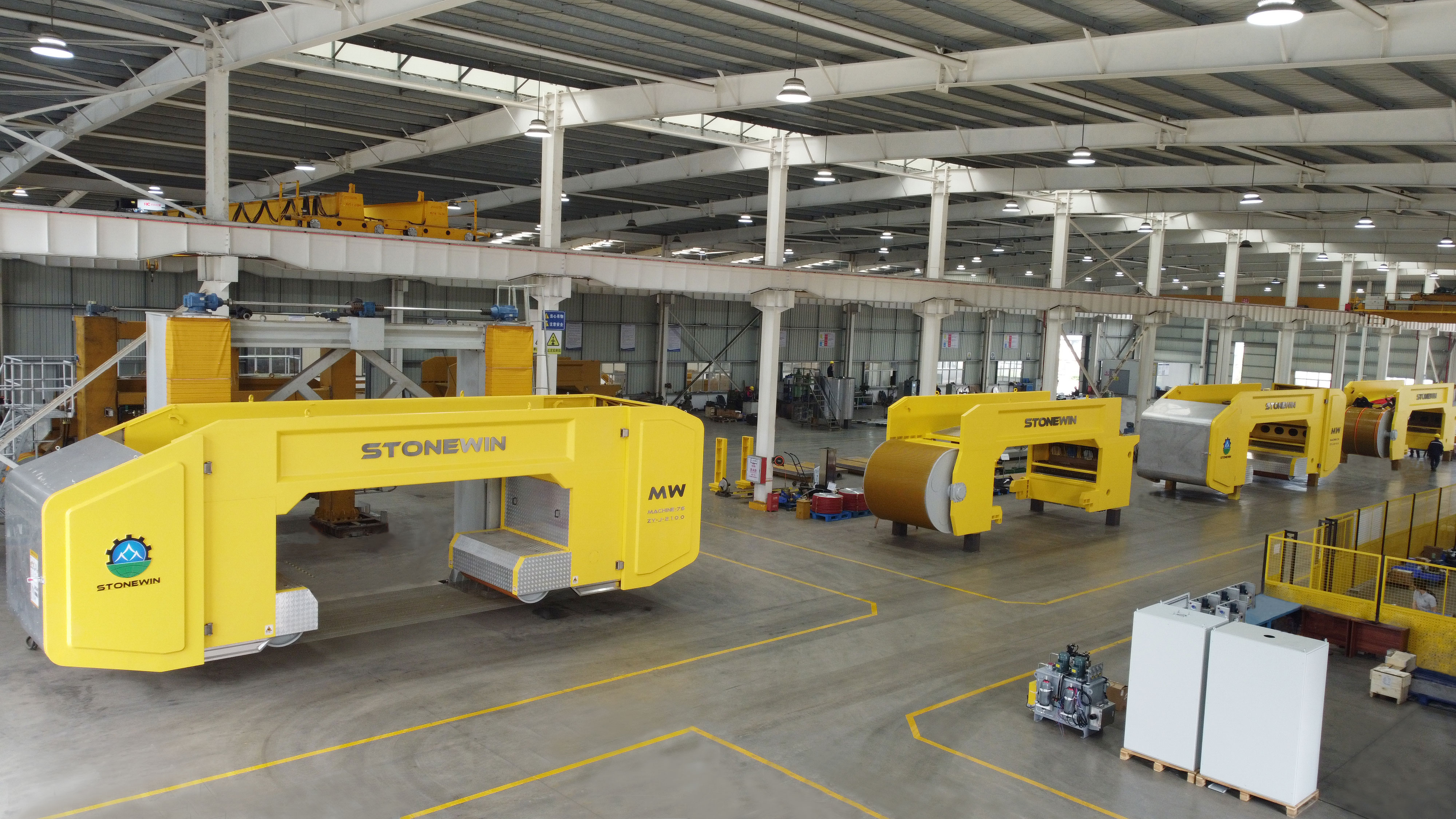
Workshop view: slab-processing equipment manufacturing at Stonewin's Fujian plant.
If you are at the quotation stage, the next practical step is to send your slab width and thickness range, your normal shift output and your building's available length and power, and ask for the line drawing, head count and connected load for the two or three positions that survive the envelope check. The full product and specification overview is available in the Stonewin catalogue (PDF), and model-specific questions can be raised through stonewin.com.
Have Questions or Need More Details?
Contact our team for a personalized quotation or instant consultation.
Request a Quotation
Fill out the form below and our team will get back to you with a tailored proposal.
WhatsApp Direct Chat
Prefer to chat in real-time? Message us on WhatsApp for instant assistance & quick answers.
- Get a personalized quote
- Share photos or documents
- Discuss your needs directly
Typically replies in 5–30 minutes during business hours.