Slab Stone Cutting Machine: Quarry to Polishing Workflow
Answer first: A slab stone cutting machine line is a sequence, not a single purchase. In a typical Stonewin quarry-to-polishing workflow, a diamond wire saw machine cuts the block at the quarry; a multi-wire saw machine converts blocks into slabs; a polishing line finishes the slab surface; and a resin line handles glue filling and drying where the product mix requires it. The equipment must be matched by slab envelope, stone type, wire count, polishing width and thickness, and plant layout.
Stonewin is the stone processing machinery brand of FUJIAN XIAPU ZHONGYUAN MACHINERY CO., LTD., a Fujian-based manufacturer founded in 2011. Its product line covers stone quarrying, slab processing, slab polishing, resin lines and diamond wire saws. This guide maps the Stonewin equipment families to each process stage and shows how buyers can check capacity matching before a line is specified.
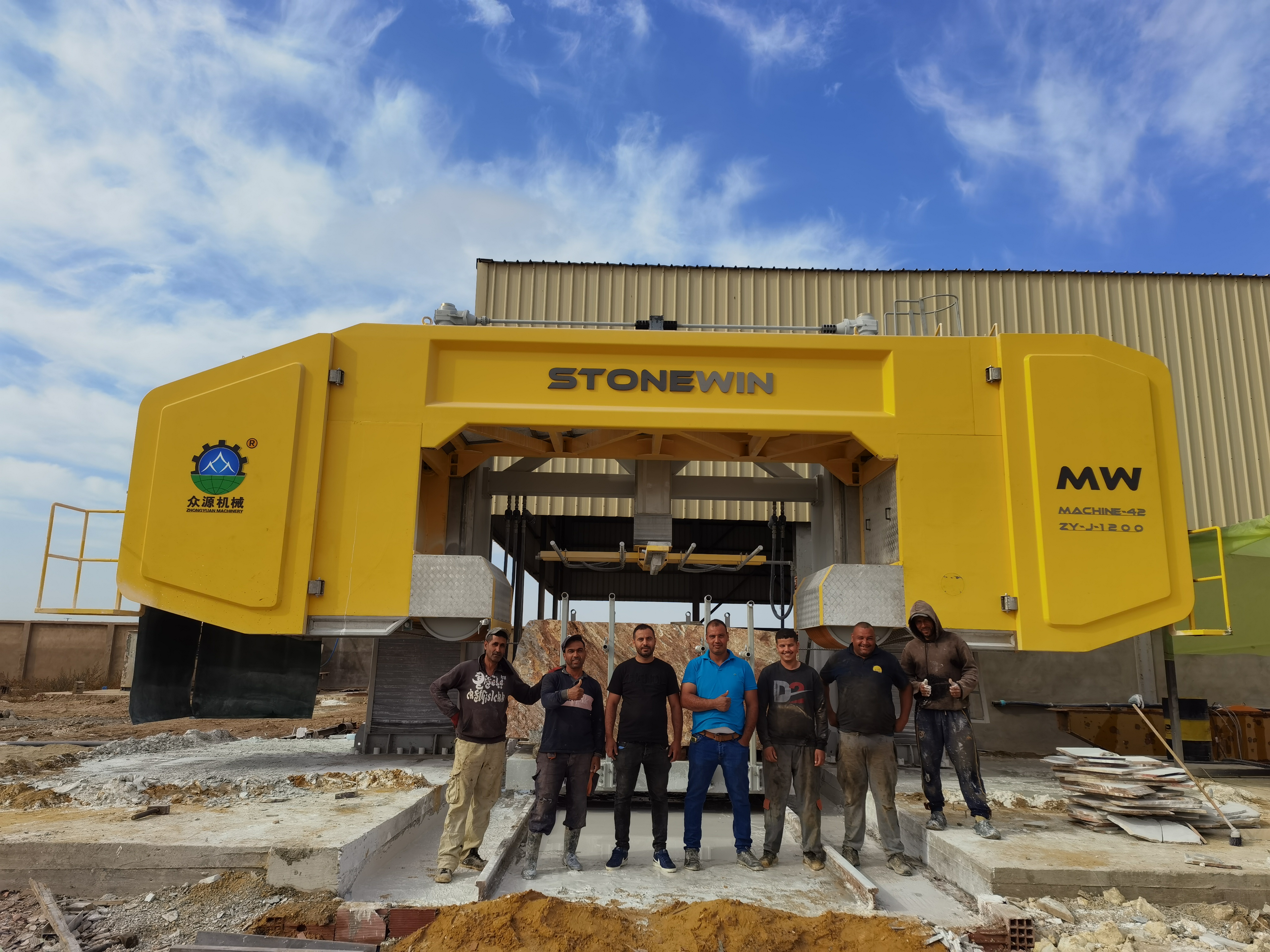
Stonewin multi-wire saw machine in Algeria — slab cutting stage.
Problem Definition: Why the Whole Line Must Be Sized Together
A common specification mistake is to size each machine on its own. A quarry may buy a wire saw for block output, a slab plant may buy a multi-wire saw for cutting speed, and a finishing department may buy a polishing line for width. When the three stages are not matched, the plant creates work-in-progress: blocks wait for the saw, slabs wait for the polishing line, or the polishing line runs below its available width because the saw cannot supply the right slab format.
The constraint is not only throughput. It includes maximum slab size, thickness range, stone hardness, wire diameter, available floor space, power supply, and compliance documentation. For a CE-market project, the equipment model must also match the certificate scope. The workflow should therefore be designed from the finished slab backward to the quarry block.
Industry Background: Slab Cutting Is a Capacity-Centre Decision
The slab cutting stage is a significant part of the stone processing equipment market. Fortune Business Insights estimated the global stone processing machine market at USD 8.76 billion in 2025. Dataintelo projects the global diamond wire saw machine market to grow at a CAGR of 7.2% from 2026 to 2034, and reports that multi-wire saw machines accounted for 58.4% of the diamond wire saw market product share in 2025. Custom Market Insights places Asia-Pacific at a 45% revenue share of the stone processing machine market in 2024.
These figures point to the same planning conclusion: the multi-wire saw is usually the capacity centre of a slab plant, but it only performs when the quarrying stage and finishing stage are specified to the same slab envelope. A high-wire-count saw cannot compensate for a polishing line that cannot accept the slab width or thickness, and a wide polishing line cannot recover capacity lost at the block-cutting stage.
Detailed Solution: Equipment Map for Each Stone Processing Stage
Stage 1: Quarrying with a Diamond Wire Saw Machine
The first stage is block production at the quarry. Stonewin's wire saw machine for stone quarrying is listed with models ZY-45G-6P, ZY-55G-6P, and ZY-75G-6P, among other configurations. The quarrying range is listed with a fly wheel diameter of zφ800 mm, a wire saw speed of 0–40 m/s, and a 360° electric rotation angle. These parameters define the machine's cutting geometry and its ability to reposition around the block.
The 800 mm fly wheel and 360-degree electric rotation are practical constraints for layout. The machine needs a foundation, an independent control system, and a cutting plan that matches the block orientation. The wire saw does not cut a slab directly; it produces the block geometry that the slab plant will later process. If the quarry stage is specified only by motor size and not by block size, the downstream multi-wire saw may receive blocks outside its 3500 mm × 2200 mm cutting range.
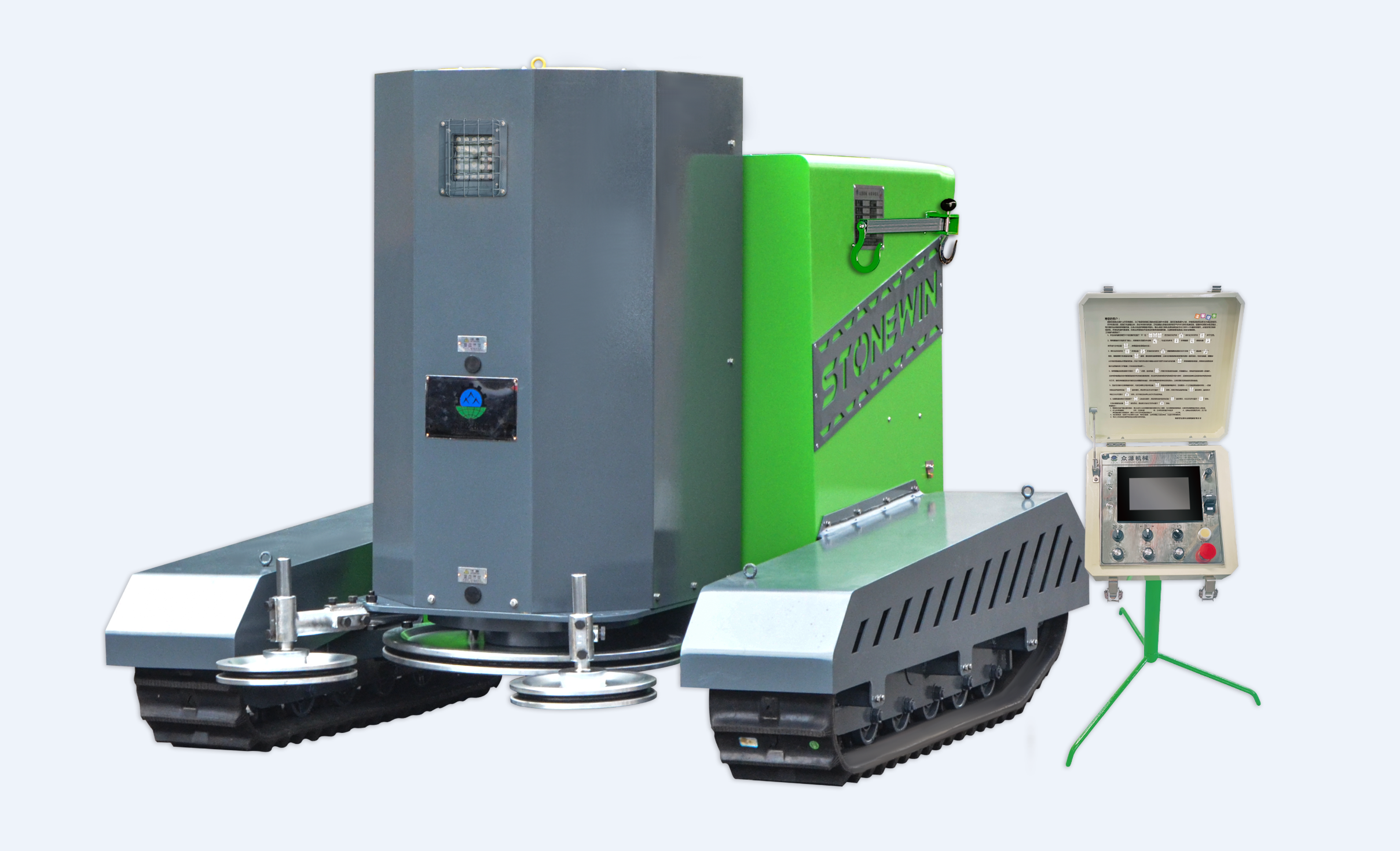
Crawler-type wire saw machine for stone quarrying.
The diamond wire itself is a consumable with its own specification. Stonewin diamond wire saw models include ZY03, ZY04, ZY05, ZY06, ZY07, ZM12, ZG12, ZG13, ZC12, and ZC10, with a diameter range of φ3.5–12 mm. The product is made of diamond, steel wire, plastic, and other materials. Diamond wire selection should be confirmed against the stone type and the wire saw machine configuration; the wire diameter is a specification input, not an afterthought.
Stage 2: Slab Cutting with a Multi-Wire Saw Machine
The multi-wire saw machine is the slab-making stage. Stonewin's multi-wire saw range runs from ZY-MW5 to ZY-MW90, with 5–90 wires. The listed cutting size range is 3500 mm (L) × 2200 mm (H), machine weight is 22–80 tons, and the main frame is carbon steel with alloy steel for key components. The range is used for granite slab cutting and marble slab cutting, and it is available in side-tension and top-tension configurations.
For high-volume marble and granite slab cutting, wire count is a central specification. A 72-wire multi-wire saw machine (ZY-MW72) and an 86-wire multi-wire saw machine (ZY-MW86) sit within the same 5–90 wire family. More wires generally mean more simultaneous cuts, but the buyer should confirm the relationship between wire count, block size, wire diameter, and the required slab thickness for the specific project. The model number alone does not define output.
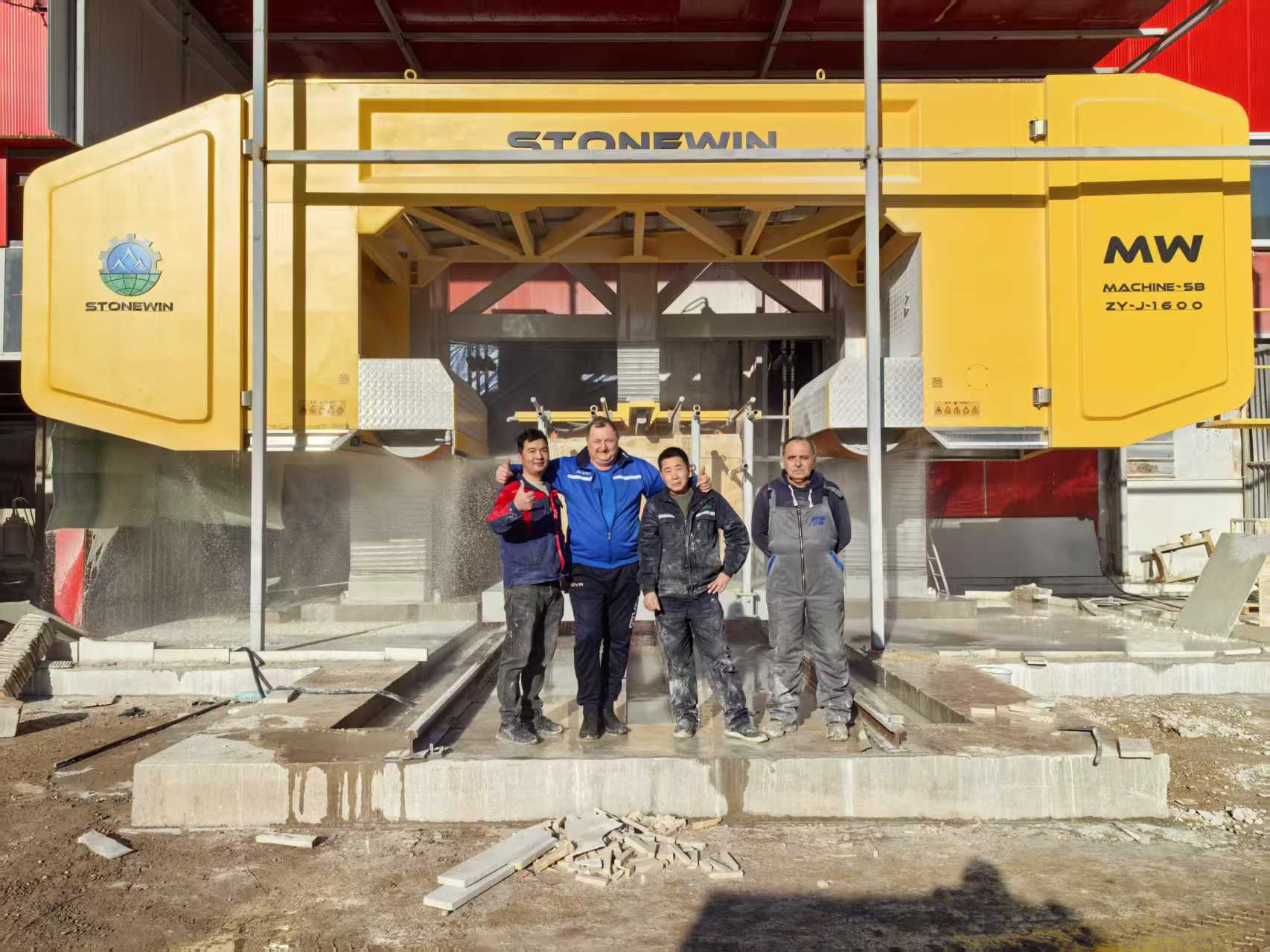
Stonewin multi-wire saw machine in Bulgaria — high-volume slab cutting.
The multi-wire saw is also where plant layout and control architecture matter. The documented Stonewin configuration includes an independent control system, independent tensioning, automatic cutting, and remote viewing via the Internet of Things. That remote-monitoring multi-wire saw capability is useful for a plant that runs multiple machines or operates in a remote quarry region. If the project specification calls for a CNC-controlled multi-wire saw machine, request the control architecture, interface list, and operator responsibilities in writing; do not assume that “CNC” is included because the machine has automatic cutting.
For large cutting thickness multi-wire saw projects, the listed 2200 mm height is the relevant ceiling. The buyer should check the block height, the slab thickness range, and the expected wire consumption together. The same platform is described for granite and marble, but the cutting plan, wire specification, and cycle time should be confirmed for the actual stone. The CE certificate scope is also model-specific; it should be checked against the ZY-MW model being ordered.
Stage 3: Polishing with the ZYSM210 Line
The polishing line converts cut slabs into finished surfaces. Stonewin's polishing line models are ZYSM210/12, ZYSM210/16, ZYSM210/18, ZYSM210/20, ZYSM210/22, and ZYSM210/24. The range covers single-beam, two-beam, and three-beam types. The listed slab thickness range is 10–80 mm, the stone slab width range is 1200–2200 mm, and the motor for a single polishing head is 15 kW.
The width and thickness ranges are the first matching check. If the multi-wire saw is set to produce slabs wider than 2200 mm, the polishing line cannot accept them without a different specification. If the product mix includes thin slabs near 10 mm or thick slabs near 80 mm, the polishing line configuration should be confirmed against that range. The ZYSM210/12 to ZYSM210/24 model span gives buyers a way to compare line configurations, but the model suffix should be read together with the beam type and the actual polishing-head arrangement.
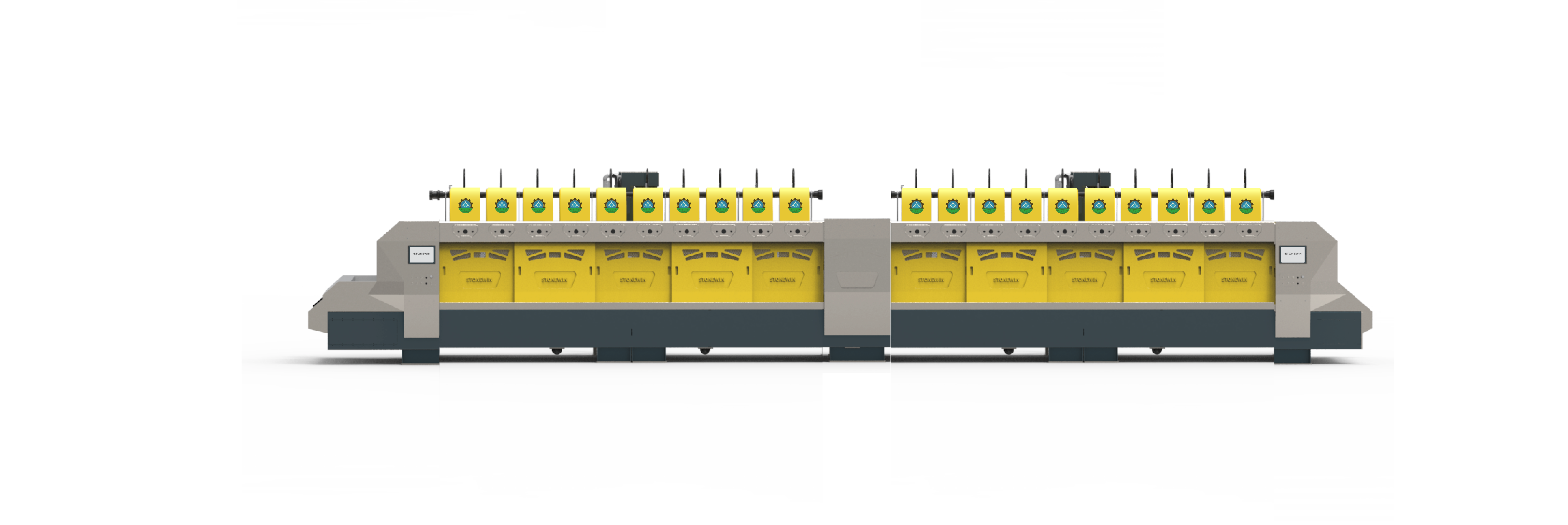
Stonewin polishing machine, two-beam type.
Polishing is often the bottleneck in an existing plant because it is a finishing stage with its own speed and consumable cost. The 15 kW per single polishing head is a power input, not a throughput guarantee. Capacity matching should compare the polishing line's accepted slab width and thickness with the upstream saw's output format, then add a buffer that reflects the plant's crane capacity and slab handling method.
Stage 4: Resin Line BJX-1 for Stone Resin Processing
Some slab products require resin treatment before or after polishing, depending on the stone and the finished product. Stonewin's resin line BJX-1 is listed with overall line dimensions of 62 × 5 × 6.3 m, a maximum plate size of 2 × 3.5 m, a total power of 300 kW, a curing time of 90–120 minutes, and a curing temperature of 80°C. The applicable plate thickness is customized according to customer requirements. The machine body material can also be customized.
The BJX-1 footprint is a fixed layout input: 62 m long, 5 m wide, and 6.3 m high. That length affects building layout, crane coverage, and the distance from the polishing line. The 300 kW total power and the 80°C curing temperature affect electrical capacity and heat management. The 90–120 minute curing time is a process window, not a line speed; it should be used to plan the number of slabs in the curing zone and the buffer before and after the resin line.
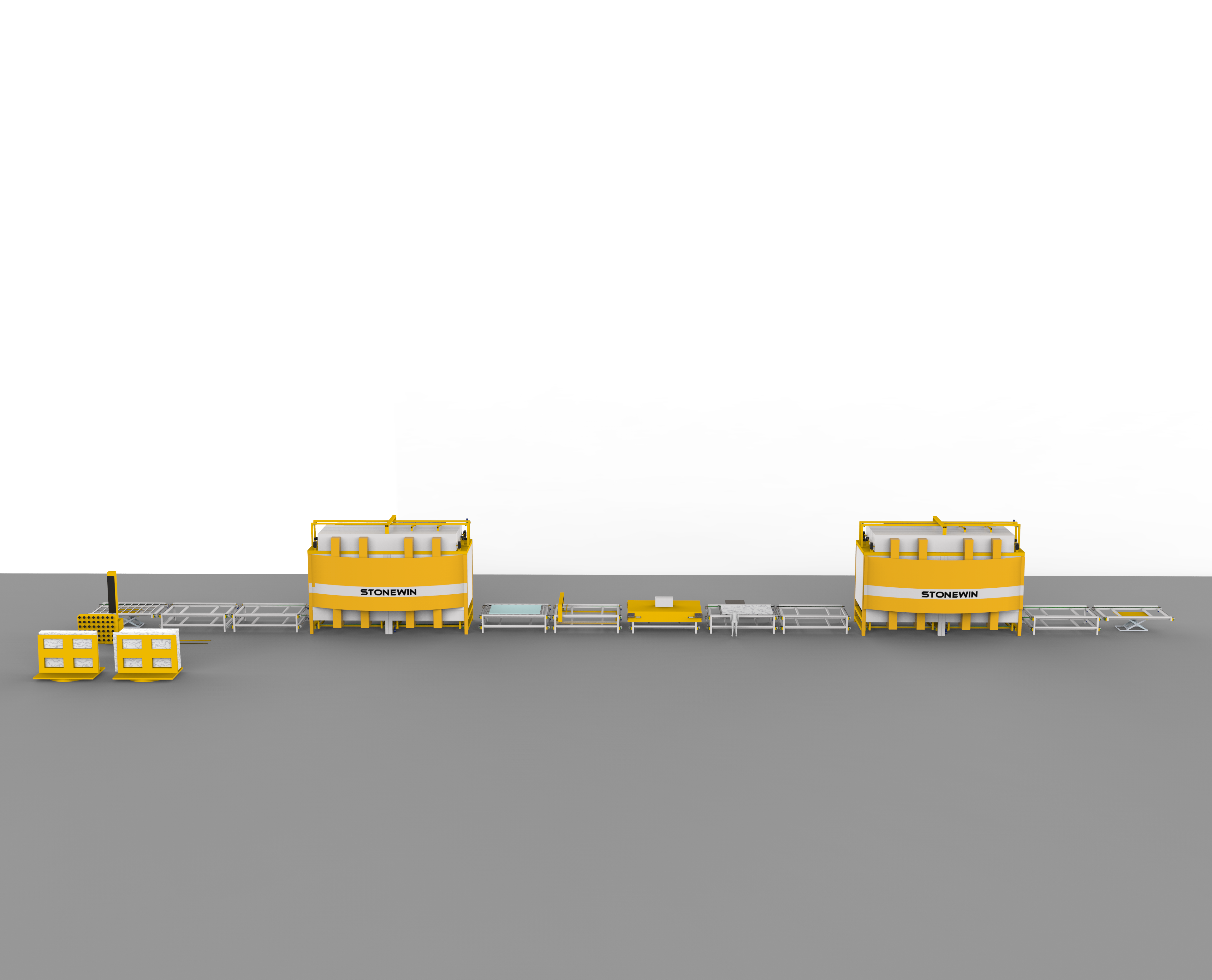
Stonewin BJX-1 resin line for glue filling and drying.
Resin line placement should be decided with the process engineer. The equipment is described for stone resin processing, including glue filling and drying, but the exact sequence depends on the slab condition and the target finish. A plant that adds a resin line after the polishing line needs a different layout from a plant that treats slabs before final polishing. The buyer should confirm the sequence, the slab transfer method, and the curing-zone length before ordering.
Step-by-Step Breakdown: Specifying a Quarry-to-Polishing Line
- Define the finished slab envelope. Start with the maximum slab width, length, and thickness you intend to sell. Compare that envelope with the polishing line range of 1200–2200 mm width and 10–80 mm thickness, and with the multi-wire saw cutting range of 3500 mm × 2200 mm.
- Fix the block size and quarrying method. Select the quarrying wire saw model from the ZY-45G-6P, ZY-55G-6P, and ZY-75G-6P range after checking the 800 mm fly wheel, 0–40 m/s wire speed, and 360° electric rotation against the quarry layout.
- Select the multi-wire saw model and wire count. Choose from ZY-MW5 to ZY-MW90 according to the slab format and volume. Confirm side-tension or top-tension, the 5–90 wire range, the 3500 mm × 2200 mm cutting size, and the 22–80 ton machine weight.
- Match the polishing line. Select the ZYSM210/12 to ZYSM210/24 model and the single-, two-, or three-beam type. Check 1200–2200 mm width, 10–80 mm thickness, and 15 kW per single polishing head.
- Decide whether the resin line is needed. If the product mix requires glue filling and drying, plan for the BJX-1 at 62 × 5 × 6.3 m, 300 kW, 90–120 minutes curing at 80°C, and a maximum plate size of 2 × 3.5 m.
- Match capacity with buffers, not nameplate numbers. Place a buffer between the saw and the polishing line, and between polishing and resin where applicable. Check crane coverage, slab transfer, power distribution, water and slurry handling, and the maintenance access around each machine.
- Verify compliance and commercial terms. Match the ordered multi-wire saw model to the CE certificate scope, then confirm MOQ, lead time, and factory capacity. Stonewin's stated MOQ is 1 unit, lead time is 2 months, and monthly capacity is 3 units.
Plant Layout and Capacity Matching
A workable layout follows the material flow: block storage → quarrying or block preparation → multi-wire saw → slab buffer → polishing → resin (if required) → finished slab storage. The layout should keep the multi-wire saw and polishing line close enough for slab handling but far enough to allow maintenance and buffer space. The BJX-1 length of 62 m makes the resin line a major layout element; it should not be treated as a small add-on.
Capacity matching should be based on the slab format and the hours available, not on the number of machines. The multi-wire saw's wire count, the polishing line's width and thickness range, and the resin line's curing window all constrain the practical flow. A plant that specifies a 86-wire multi-wire saw machine but a polishing line that cannot handle the slab width has not increased finished output. A plant that specifies a wide polishing line but a saw that cannot produce the width has the same problem in reverse.
For a new plant, ask for the machine footprints, foundation loads, power requirements, water and slurry requirements, and crane coverage for each model. For an existing plant, measure the available bay length, door height, and turning radius before selecting the BJX-1 or a long polishing line. The 6.3 m height of the BJX-1 is a building constraint, not only an equipment dimension.
Use Cases
New quarry and slab plant
A new open-pit stone quarry that also plans a slab plant should specify the quarrying wire saw and the multi-wire saw together. The quarrying range with ZY-45G-6P, ZY-55G-6P, and ZY-75G-6P produces the block; the ZY-MW multi-wire saw cuts slabs; the ZYSM210 polishing line finishes them. The block size and the 3500 mm × 2200 mm cutting range should be fixed before civil works. Stonewin reports over 100 units installed globally, with applications in countries including India, Turkey, Algeria, Bulgaria, Iran, Poland, South Africa, Brazil, Thailand, Cambodia, and Egypt.
Granite slab plant adding capacity
A granite slab plant that already has a polishing line may need more slab-cutting capacity. The granite multi-wire saw machine configuration should be selected by block height, slab thickness, and wire count. The ZY-MW72 and ZY-MW86 models are within the 5–90 wire range, but the plant should confirm the cutting plan and wire specification rather than assuming that a higher wire count fits every granite block.
Marble slab line with resin treatment
A marble slab plant may combine a multi-wire saw, a polishing line, and a resin line. The marble multi-wire saw machine cuts the slab; the BJX-1 handles stone resin processing where required; the ZYSM210 line polishes the slab. The resin line's 2 × 3.5 m maximum plate size and 62 m length should be checked against the plant layout and the slab format.
Existing plant debottlenecking
If the polishing line is the bottleneck, adding a higher-wire-count saw will not solve the problem. The buyer should first compare the polishing line's 1200–2200 mm width and 10–80 mm thickness range with the actual slab mix. If the saw is the bottleneck, the multi-wire saw model and wire count should be reviewed against the block envelope. In both cases, the CE model coverage and the machine foundation should be checked before the order.
Equipment-to-Stage Comparison
| Process stage | Stonewin equipment / model | Verified parameters | Workflow role | Buyer check |
|---|---|---|---|---|
| Quarrying | Wire saw machine for stone quarrying: ZY-45G-6P, ZY-55G-6P, ZY-75G-6P | Fly wheel zφ800 mm; wire speed 0–40 m/s; 360° electric rotation | Block cutting at the quarry | Model, foundation, power, block size, wire diameter |
| Diamond wire | Diamond wire saw: ZY03, ZY04, ZY05, ZY06, ZY07, ZM12, ZG12, ZG13, ZC12, ZC10 | Diameter φ3.5–12 mm; diamond, steel wire, plastic and other materials | Cutting tool for the wire saw | Wire specification for the stone type and machine |
| Slab cutting | Multi-wire saw machine: ZY-MW5 to ZY-MW90 | 5–90 wires; cutting size 3500 mm × 2200 mm; 22–80 tons; carbon steel frame, alloy steel key components | High-volume marble and granite slab cutting | Wire count, side/top tension, CE model coverage, foundation load |
| Polishing | Polishing line: ZYSM210/12, /16, /18, /20, /22, /24 | Slab width 1200–2200 mm; slab thickness 10–80 mm; 15 kW per single polishing head; single-, two-, three-beam | Surface finishing | Beam type, width, thickness, power, water and slurry |
| Resin treatment | Resin line: BJX-1 | 62 × 5 × 6.3 m; max plate 2 × 3.5 m; 300 kW; curing 90–120 min at 80°C; thickness customized | Stone resin processing, glue filling and drying | Footprint, height, power, curing zone, sequence before/after polishing |
The table is a specification aid, not a throughput guarantee. Each row should be confirmed with the actual stone, slab format, and plant layout.
CE Compliance for the Slab Cutting Stage
For European or CE-sensitive projects, the multi-wire saw is the stage where compliance documentation is most often requested. Stonewin's multi-wire saw machine is certified to CE standards. The certificate is issued by SGS with certification number IN-XM-5805-23069, and it is applicable to the global market. The listed standards are EN ISO 12100:2010 and EN 60204-1:2018. The issue date is 2023-12-04 and the expiry date is 2028-12-03.
The certificate scope is model-specific. It lists ZY-MW5, ZY-MW10, ZY-MW16, ZY-MW20, ZY-MW36, ZY-MW42, ZY-MW52, ZY-MW56, ZY-MW58, ZY-MW60, ZY-MW64, ZY-MW66, ZY-MW72, ZY-MW76, ZY-MW80, ZY-MW82, ZY-MW84, ZY-MW86, and ZY-MW88. A buyer should compare the ordered model and nameplate against this list, and should verify the certificate number, issuing body, standards, and validity date. CE compliance for the multi-wire saw does not automatically extend to every other machine in the line; each equipment item should be checked against its own documentation.
This is also the practical answer to the common search for CE-compliant slab stone cutting machine manufacturers: verify the certificate, not only the claim. Ask for the certificate, the model list, the standards, the issuing body, and the machine nameplate. A manufacturer that can provide these documents in a clear, consistent package is easier to audit than one that offers only a logo.
FAQ
What should buyers verify in a CE-compliant slab stone cutting machine manufacturer?
Verify the CE certificate number, issuing body, standards, model coverage, issue date, and expiry date. For the Stonewin multi-wire saw, the certificate is issued by SGS under number IN-XM-5805-23069, with standards EN ISO 12100:2010 and EN 60204-1:2018. Check that the model on the quotation and nameplate is inside the certificate scope, and confirm that the certificate is current.
Which Stonewin multi-wire saw models are covered by the CE certificate?
The certificate scope lists ZY-MW5, ZY-MW10, ZY-MW16, ZY-MW20, ZY-MW36, ZY-MW42, ZY-MW52, ZY-MW56, ZY-MW58, ZY-MW60, ZY-MW64, ZY-MW66, ZY-MW72, ZY-MW76, ZY-MW80, ZY-MW82, ZY-MW84, ZY-MW86, and ZY-MW88. The certificate is applicable to the global market. Buyers should still match the exact ordered configuration to the certificate scope.
How do I match a polishing line to my slab size?
Start with the finished slab width and thickness. The Stonewin ZYSM210 series covers slab widths of 1200–2200 mm and slab thicknesses of 10–80 mm, with 15 kW per single polishing head. The series includes ZYSM210/12, ZYSM210/16, ZYSM210/18, ZYSM210/20, ZYSM210/22, and ZYSM210/24 in single-, two-, and three-beam types. Confirm the beam type and polishing-head arrangement for your product mix.
How should a plant match multi-wire saw capacity to polishing capacity?
Match by slab format and practical flow, not by machine count. Check the multi-wire saw cutting size of 3500 mm × 2200 mm, the 5–90 wire range, and the polishing line's 1200–2200 mm width and 10–80 mm thickness range. Add a slab buffer between stages and confirm crane coverage, power, water, and slurry handling. If the plant adds a resin line, include the BJX-1 footprint of 62 × 5 × 6.3 m and its 90–120 minute curing window in the layout.
What is the lead time and MOQ for a Stonewin slab processing line?
Stonewin's stated MOQ is 1 unit, lead time is 2 months, and monthly capacity is 3 units. These figures should be confirmed against the specific model mix and project schedule. For a layout review, model confirmation, and quotation, contact Stonewin at stonewin@stonewin.com or WhatsApp +86 15059301619. The company brochure is available for download: Stonewin brochure.
Conclusion
The slab stone cutting machine workflow should be specified from the finished slab back to the quarry block. The quarrying wire saw sets the block geometry; the multi-wire saw sets slab capacity; the polishing line sets the finished width and thickness; the resin line adds a process step with a fixed footprint and curing window. Stonewin's range covers these stages with the ZY-45G-6P, ZY-55G-6P, and ZY-75G-6P quarrying models, the ZY-MW5 to ZY-MW90 multi-wire saw family, the ZYSM210/12 to ZYSM210/24 polishing line, and the BJX-1 resin line.
The next step is a layout and model review, not a generic price request. Send the block size, target slab width and thickness, stone type, expected product mix, available bay length, power supply, and CE requirement. That information is enough to check the equipment map and identify where the line needs a buffer or a different model.
Request a Workflow and Layout Review
Stonewin can review your quarry-to-polishing workflow against the equipment models and verified parameters in this guide. Contact us with your slab format and plant constraints to request a model recommendation, layout review, and quotation.
Email: stonewin@stonewin.com | WhatsApp: +86 15059301619 | Web: www.stonewin.com
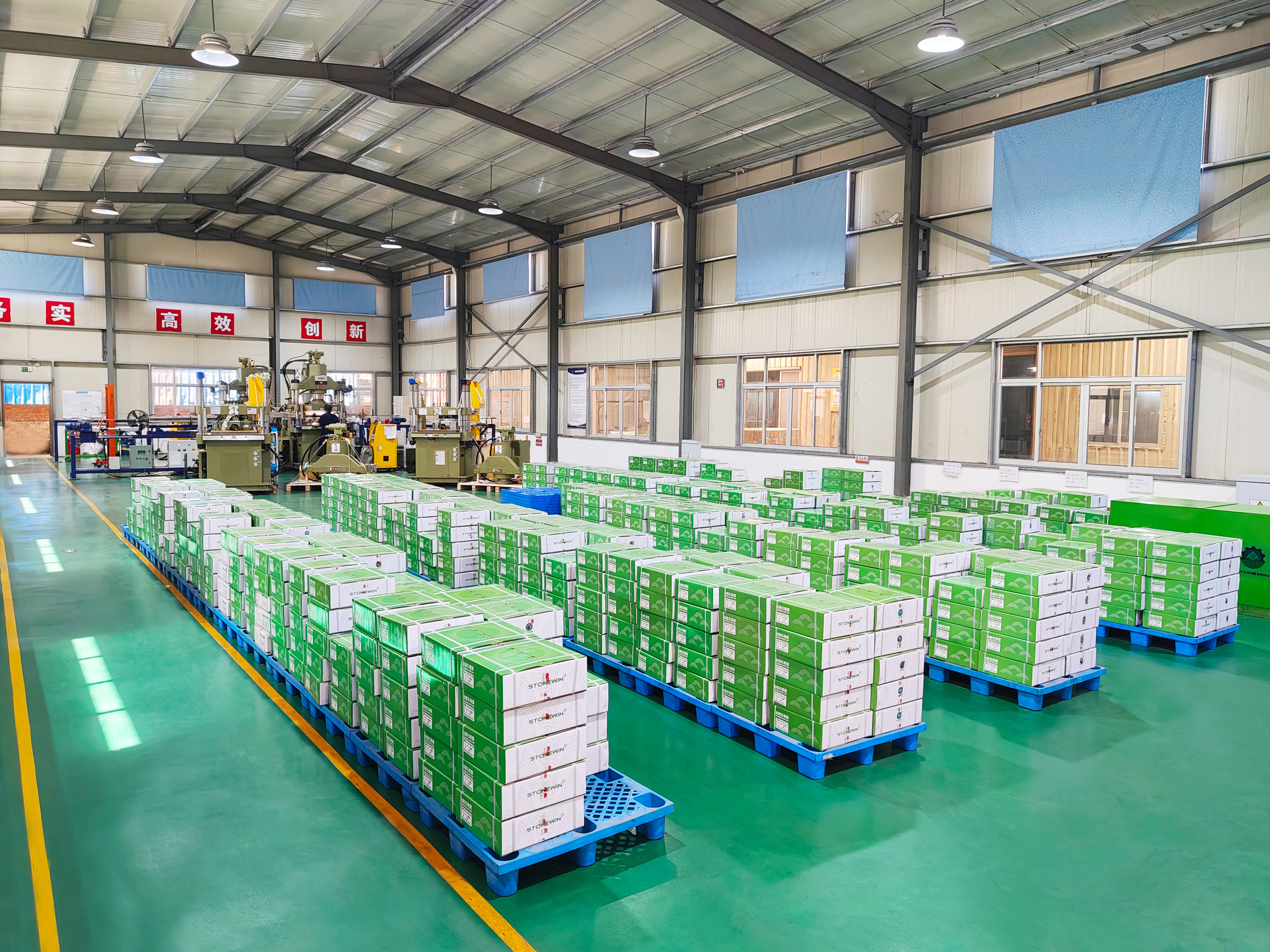
Finished product workshop for diamond bead wire saw machines — Stonewin manufacturing base, Fujian, China.
Have Questions or Need More Details?
Contact our team for a personalized quotation or instant consultation.
Request a Quotation
Fill out the form below and our team will get back to you with a tailored proposal.
WhatsApp Direct Chat
Prefer to chat in real-time? Message us on WhatsApp for instant assistance & quick answers.
- Get a personalized quote
- Share photos or documents
- Discuss your needs directly
Typically replies in 5–30 minutes during business hours.