
Top-Tension vs Side-Tension Multi-Wire Saws: Configuration Comparison for Stone Operations
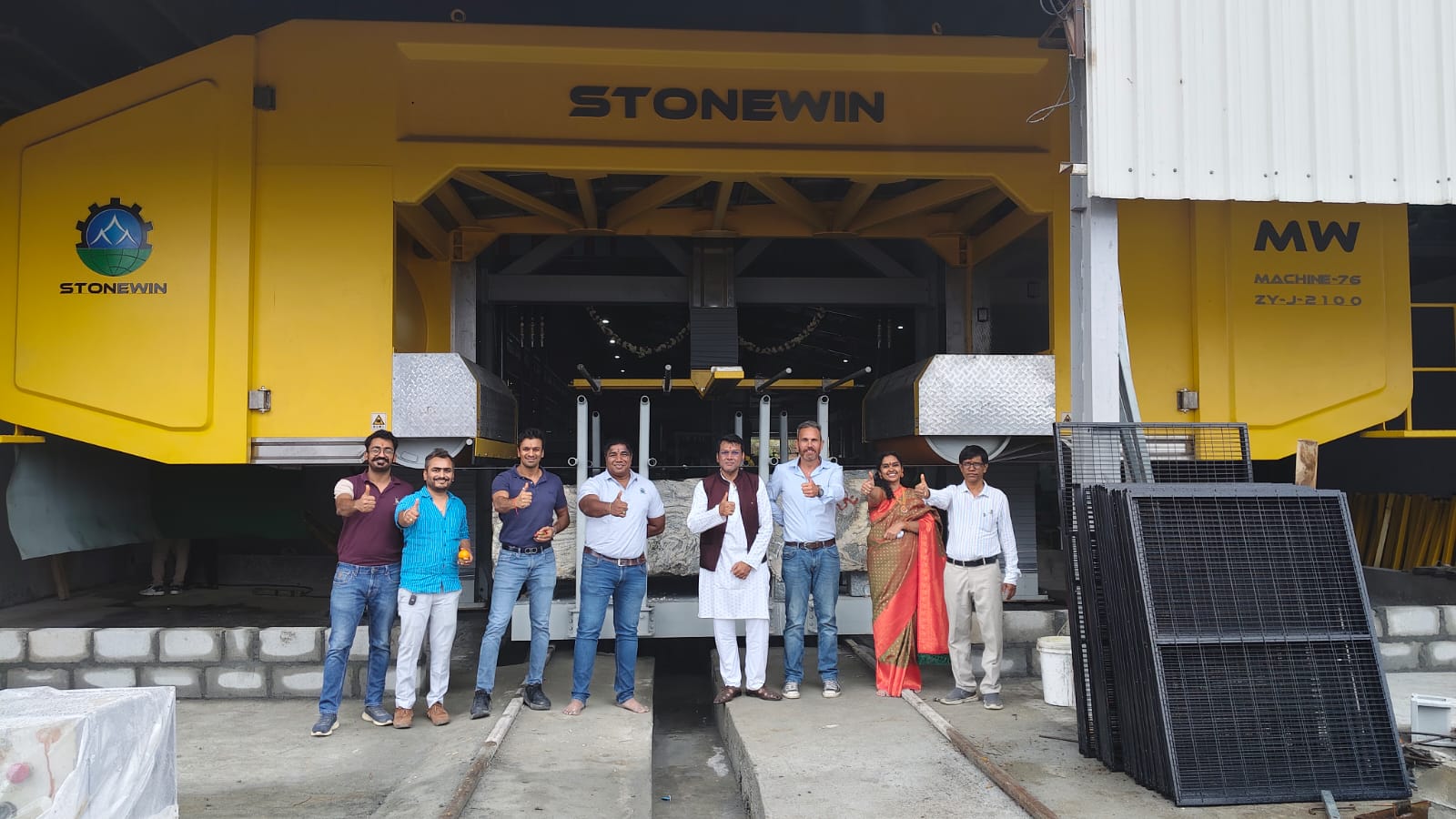
Stonewin multi-wire saw machine in operation at a stone slab processing site in India.
Top-tension and side-tension multi-wire saws do not differ in cutting capacity. They differ in which structural element reacts the wire tension and how the wire plane is presented to the block. Across the Stonewin ZY-MW5 to ZY-MW90 range, both configurations are declared with the same cutting size range of 3500 mm (L) × 2200 mm (H), the same 5–90 wire count and the same 22–80 ton machine weight band, and both sit under a single CE certification: SGS certificate IN-XM-5805-23069, assessed against EN ISO 12100:2010 and EN 60204-1:2018.
Stonewin is the stone machine brand of Fujian Xiapu Zhongyuan Machinery Co., Ltd., a manufacturer founded in 2011 and based in Xiapu, Fujian, China, producing quarry wire saw machines, multi-wire saw machines, polishing lines, resin lines and diamond wire saws for stone quarrying and stone processing. The analysis below therefore treats the two layouts as two ways of reacting the same tension load, and asks which one matches the duty a given operation places on the machine — block cutting at the quarry end of the chain, or slab cutting at the processing end.
The Configuration Question, Stated Precisely
The tensioning mechanism is an orderable option, not a fixed property of the platform. Stonewin's declared customization scope lists two adjustable items: the number of wire saw units and the tensioning mechanism, specified as side-tensioning or top-tensioning. Both variants are built on a carbon steel main frame with alloy steel key components, and both are delivered with an independent control system, independent tensioning, an automatic cutting mode and remote viewing through the Internet of Things, on a machine that requires a foundation.
Three consequences follow. First, the two configurations share their cutting envelope, weight band and automation set, so a specification sheet on its own will not separate them. Second, the choice belongs to the specification stage — the tensioning mechanism is listed as a customization item alongside the wire count, so it is decided when the unit is configured rather than afterwards. Third, because the CE file covers the platform, compliance cannot be used as a tie-breaker between the two.
Why the Tension Axis Is a Production-Chain Decision
The multi-wire saw occupies one specific junction in a chain that runs from quarry face to polished slab. Upstream, blocks are separated and trimmed by a wire saw machine for stone quarrying; the Stonewin range of that machine is declared with a φ800 mm fly wheel, a wire saw speed of 0–40 m/s and 360° electric rotation, across models from ZY-76LD-12P to ZY-22G-4P. Downstream, slab surfaces are finished on a polishing line declared for 10–80 mm slab thickness and 1200–2200 mm slab width, and surface defects are filled on a resin line declared with a maximum plate size of 2 × 3.5 m. The multi-wire saw sits between those two ends, converting a block into slabs.
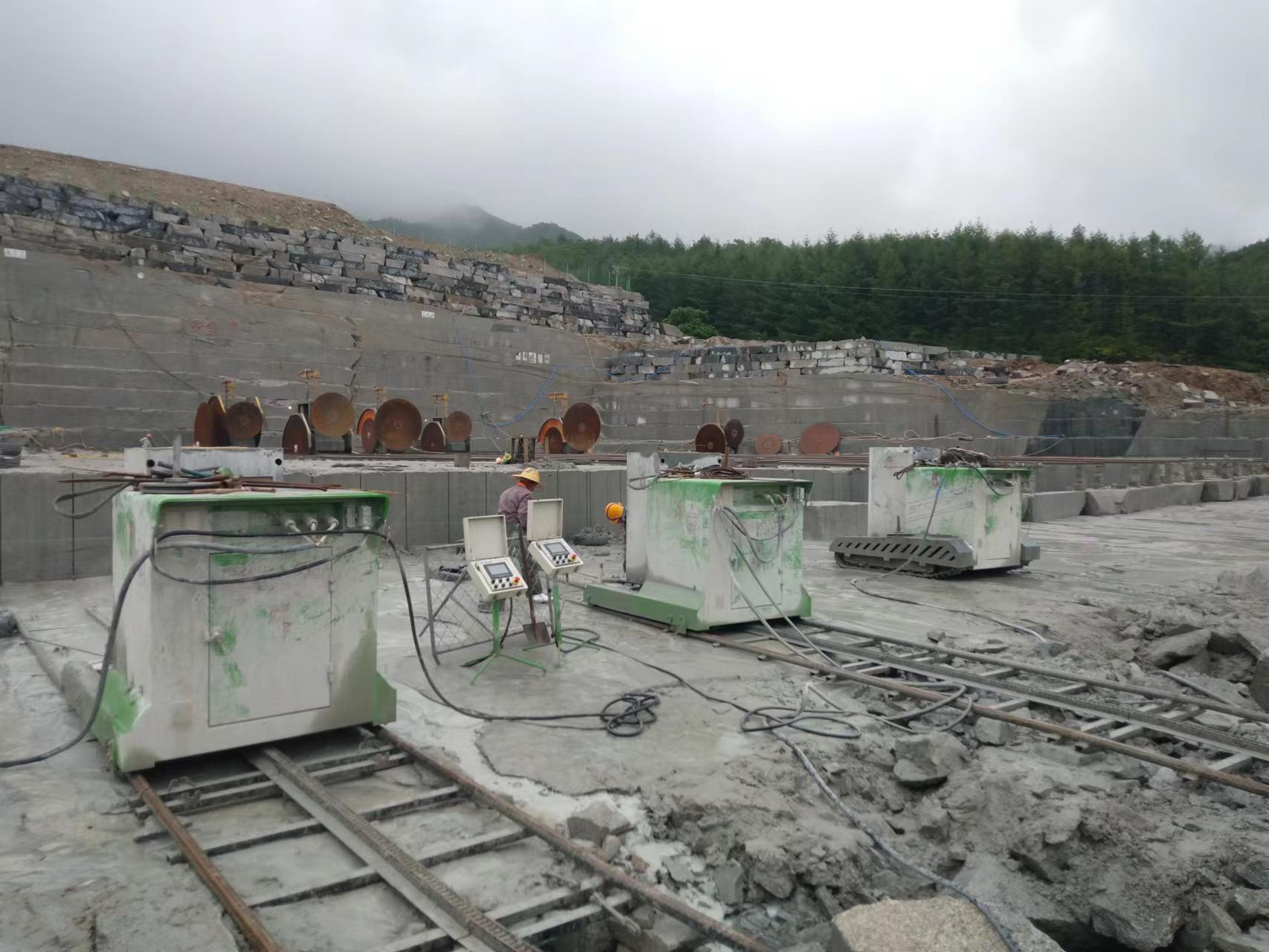
Upstream of the multi-wire saw: a Stonewin wire saw machine separating granite at the quarry face, declared with a φ800 mm fly wheel, 0–40 m/s wire speed and 360° electric rotation.
The dimensions of the chain are visible in the published figures. The multi-wire saw's 2200 mm cutting height and 3500 mm cutting length sit in the same range as the polishing line's 1200–2200 mm slab width and the resin line's 3.5 m maximum plate length. A machine configuration that has to fit the block envelope at one end and the finishing line at the other is part of the production plan, not a cosmetic variant of the same equipment. Market attention on this junction is consistent with that role: Fortune Business Insights values the global stone processing machinery market at USD 20.86 billion in 2024 and projects a 5.5% CAGR for the 2026–2034 period (SRC-0001).
Where the Two Layouts Physically Differ
The two configurations are catalogued separately as the top-tension multi-wire saw machine and the side-tension multi-wire saw machine, and the separation follows the axis along which wire tension is applied to the wire plane.
Top-tension layout
In a top-tension multi-wire saw, the tensioning unit is carried on the upper structure and wire tension is reacted along the vertical axis. The upper frame is the load-bearing element, and the wire plane is referenced from above the block. In structural terms, the tensioning hardware sits in the same vertical stack as the cutting head, and the lateral sides of the frame are not the primary tension path.
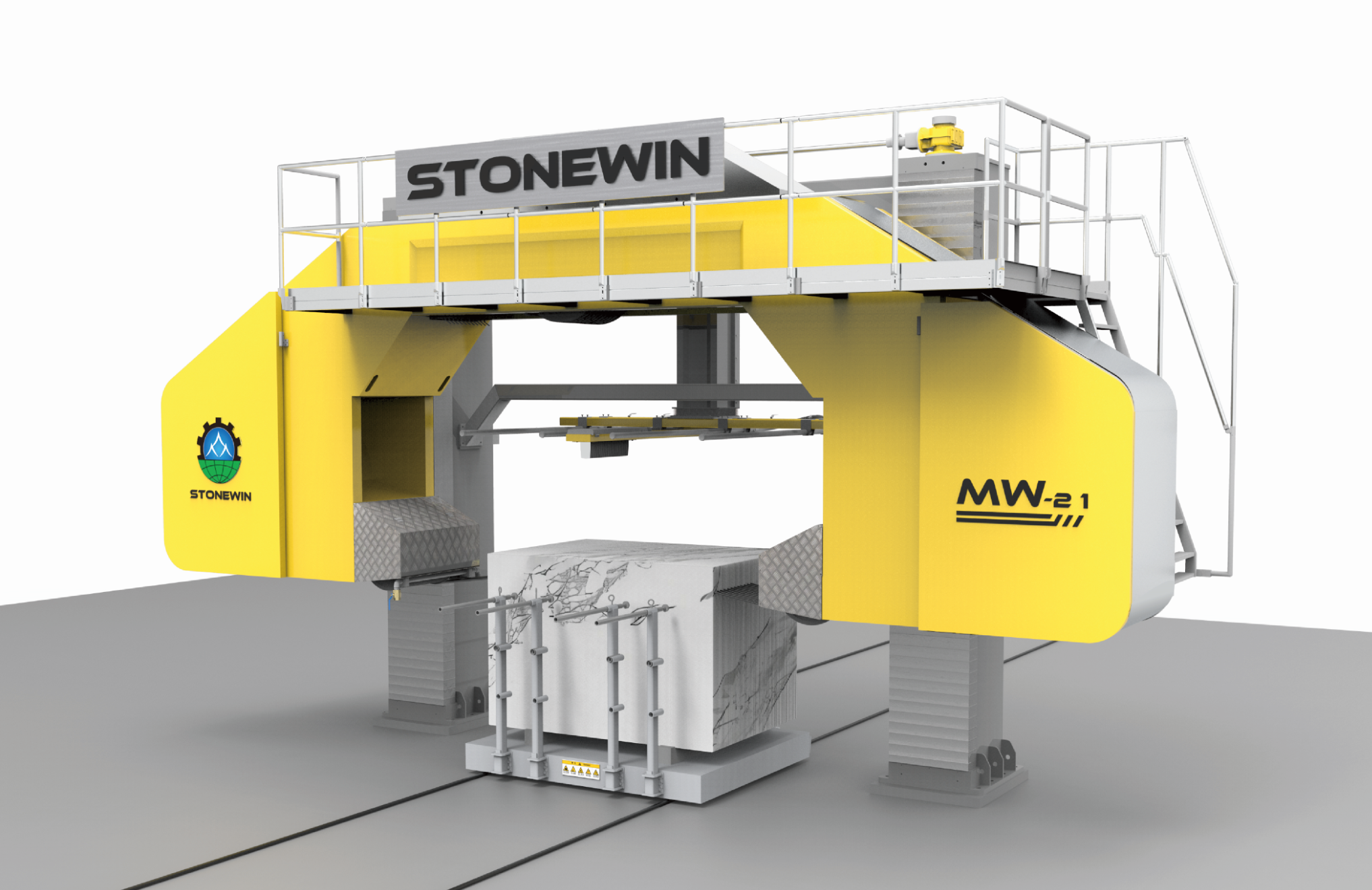
Stonewin multi-wire saw machine with the tensioning unit carried on the upper structure (tension at top).
Side-tension layout
In a side-tension multi-wire saw, the tensioning unit is mounted to the side and tension is reacted laterally. The side structure becomes the load-bearing element, and the wire plane is referenced from the side of the block. The vertical stack above the cutting head is consequently not the primary tension path.
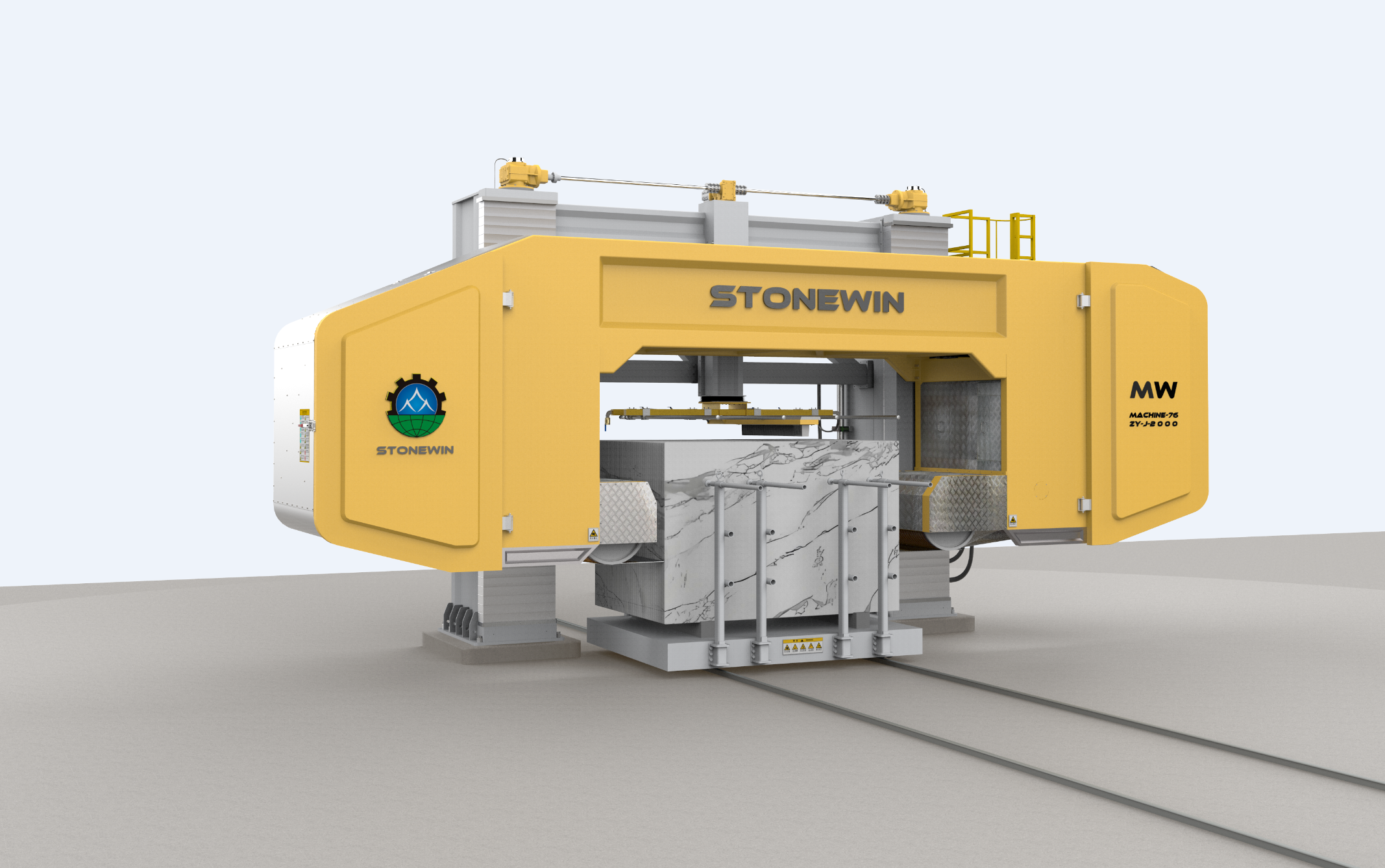
Stonewin multi-wire saw machine with the tensioning unit mounted to the side of the frame (tension at side).
Both statements describe geometry, not performance. The published specification does not rank the two layouts on cutting speed, slab flatness, wire consumption or energy use, and no such ranking should be inferred from the names. What the catalogue does establish is that both are built to the same declared envelope and the same declared compliance baseline, and that the difference is structural.
The Shared Specification Baseline: ZY-MW5 to ZY-MW90
Because both layouts are variants of one platform, the specification list applies identically to either order:
- Model range: ZY-MW5, ZY-MW10, ZY-MW16, ZY-MW20, ZY-MW36, ZY-MW42, ZY-MW58, ZY-MW64, ZY-MW72, ZY-MW76, ZY-MW82, ZY-MW86, ZY-MW88 and ZY-MW90.
- Cutting size range: 3500 mm (L) × 2200 mm (H).
- Number of wires: 5–90. The numbering runs from ZY-MW5 to ZY-MW90 alongside that declared wire count.
- Machine weight: 22–80 tons.
- Materials: carbon steel for the main frame, alloy steel for key components.
- Operation: independent control system, independent tensioning, automatic cutting, remote viewing via the Internet of Things, foundation required.
- Matched consumable: diamond wire saw, φ3.5–12 mm, in diamond, steel wire saw and plastic.
- Compliance: CE certification, SGS certificate IN-XM-5805-23069, against EN ISO 12100:2010 and EN 60204-1:2018.
Two operational facts matter for site planning whichever layout is chosen. The machine requires a foundation, and it operates inside a bounded environment: ambient temperature of 5 °C to 40 °C, relative humidity not exceeding 50% at 40 °C and not exceeding 90% at 20 °C, at altitudes not exceeding 1000 m. The 22–80 ton weight band travels with the wire count, so a 90-wire unit and a 5-wire unit share a catalogue family but not a floor-loading profile.
Matching Layout to Cutting Stage
Block cutting duty
Block cutting is the duty in which the input is a quarried block and the output is a set of slabs taken from it. The declared 3500 mm × 2200 mm cutting size range defines what a block can be, and the 5–90 wire count defines how many slabs a pass can produce. Stonewin's product documentation states a slab thickness output from 1.2 cm up to 15 cm from the same granite or marble block — a vendor-declared figure rather than a benchmarked one, but the relevant point here is that thickness is set by wire configuration, not by tension layout.
In this duty the configuration question reduces to how the block is brought to the wire plane and how that plane is serviced between blocks. A layout referencing the wire plane from above and a layout referencing it from the side present different access geometry at the same envelope, and that difference has to be absorbed by the site layout — because both machines weigh between 22 and 80 tons and both require a foundation. Access becomes a civil-works and handling decision before it becomes a cutting decision.
Slab cutting duty
Slab cutting is the continuous duty: blocks are fed on a cycle and the output moves to finishing. Here the consumable carries as much operational weight as the frame. The matched diamond wire saw is declared with a diameter range of φ3.5–12 mm and is catalogued as a multi-wire diamond saw for stone slab cutting in diamond, steel wire saw and plastic, across models ZY03, ZY04, ZY05, ZY06, ZY07, ZM12, ZG12, ZG13, ZC12 and ZC10.
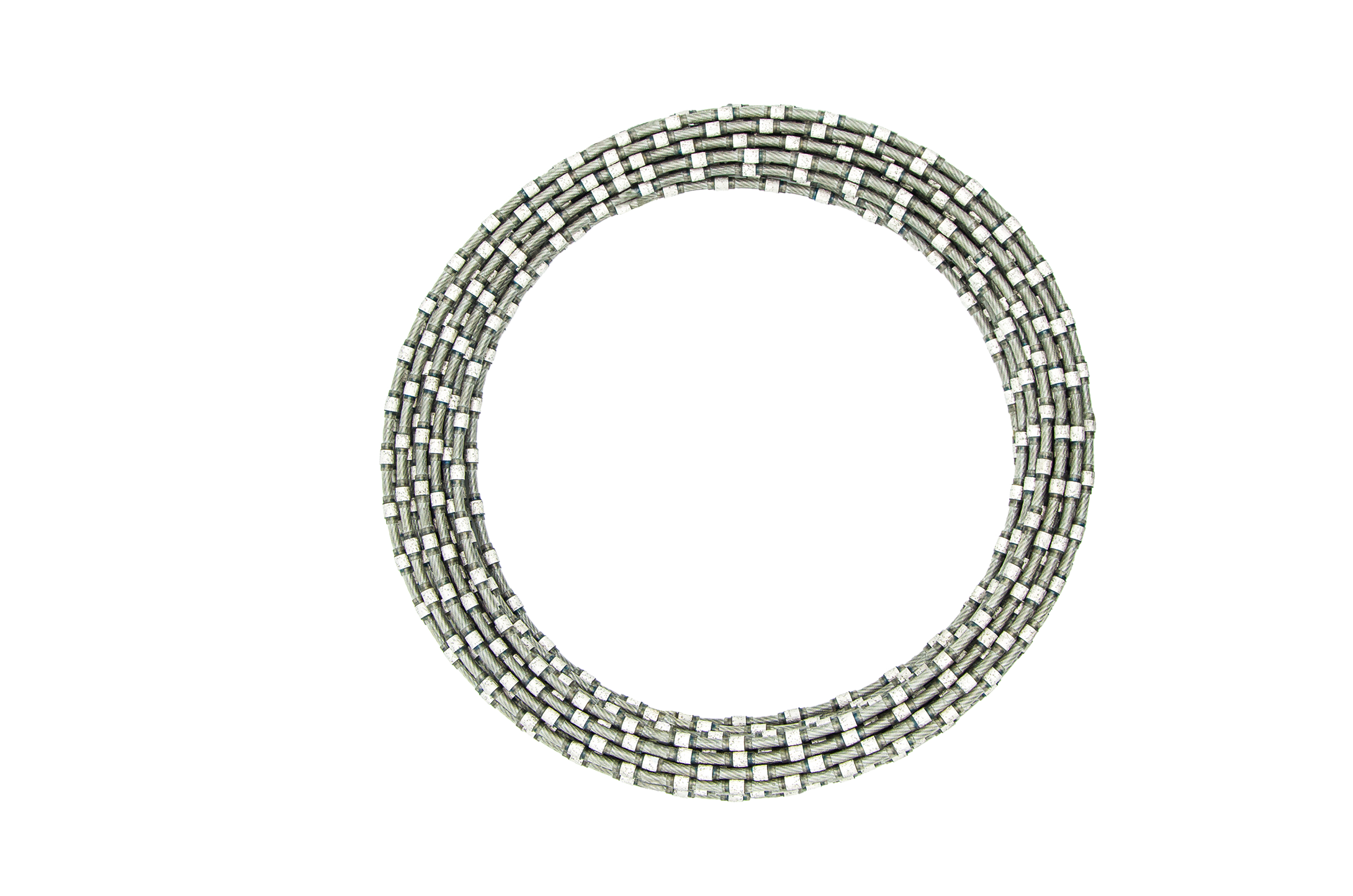
The matched consumable: Stonewin diamond wire saw, φ3.5–12 mm, catalogued as a multi-wire diamond saw for stone slab cutting.
The line-fit argument is dimensional rather than qualitative. A polishing line declared for 1200–2200 mm slab width and 10–80 mm slab thickness, and a resin line declared for a maximum plate size of 2 × 3.5 m, both sit inside the multi-wire saw's 3500 mm × 2200 mm envelope. Configuration does not change what the saw can hand downstream; it changes how the saw is laid out relative to that downstream line, and therefore how much handling sits between the two.
Compliance as a Constant: CE, EN ISO 12100:2010 and EN 60204-1:2018
Compliance is the one variable that does not move between configurations. Both the top-tension and the side-tension multi-wire saw are covered by CE certification under SGS certificate IN-XM-5805-23069, assessed against EN ISO 12100:2010 (machinery safety, risk assessment and risk reduction) and EN 60204-1:2018 (electrical equipment of machines).
The quality control sequence behind that certificate is declared as internal testing, third-party testing and CE certification. The environmental scope is separately bounded — the machine is certified for use in dust-exposed stone processing environments — and the operating envelope of 5–40 °C, humidity not exceeding 50% at 40 °C and not exceeding 90% at 20 °C, at altitudes not exceeding 1000 m, applies to both layouts.
For project documentation this has a practical reading: the CE evidence pack can be carried as a single annex covering either configuration, with the tension layout recorded as a configuration line rather than as a separate compliance case. A comparison that positions one layout as more compliant than the other contradicts the certificate.
The Cutting Cycle, Stage by Stage
The cutting cycle reads the same way on both layouts, which is exactly why the configuration difference has to be located at specific stages instead of being described as a general capability gap.
- Foundation and structural set-up. Both layouts are installed on a foundation, and both fall inside the 22–80 ton weight band. What changes is the direction from which the tension load enters the frame, so foundations and clearances are planned against the load path rather than against tonnage alone.
- Wire plane and tensioning. Wire count is set between 5 and 90, and tensioning is independent on both machines. On a top-tension unit the tensioning hardware sits in the vertical stack above the wire plane; on a side-tension unit it sits laterally. This is the stage at which the two layouts are least interchangeable on the shop floor, because the position from which the plane is accessed differs.
- Automatic cutting. Both configurations run automatic cutting from an independent control system, with remote viewing via the Internet of Things. Control behaviour is a platform property and does not change with the tension axis.
- Slab output. Both deliver slabs inside the 3500 mm × 2200 mm envelope, with a vendor-declared thickness range of 1.2 cm to 15 cm from the same block, cut with a diamond wire saw of φ3.5–12 mm.
- Changeover. Block change and wire change are where access geometry turns into working rhythm: the same operation is carried out from a different position relative to the wire plane, which is what a site layout has to accommodate over a shift.
Use Cases: Where Each Configuration Is Installed
Stonewin's installed base is declared at over 100 units globally, accumulated over more than 10 years of application in granite and marble slab cutting in open-pit quarries and processing plants, with units in markets that include China, Turkey, India, Iran, Poland, Bulgaria, Algeria, South Africa, Brazil, Thailand, Cambodia and Egypt. Reference installations documented in the product image set include multi-wire saws working in India, Turkey, Algeria and Bulgaria.
Across that base, the pattern is consistent with the stage logic rather than with a hierarchy of layouts. Operations that receive blocks and cut them into slab thicknesses spanning the 1.2–15 cm range on a single machine are the same operations that then feed a polishing line sized for 1200–2200 mm widths and a resin line sized for 2 × 3.5 m plates. The tension layout is selected inside that flow, against block delivery, foundation position and access to the wire plane — not against a claim of higher output.
Configuration Comparison Table
| Attribute | Top-tension multi-wire saw | Side-tension multi-wire saw |
|---|---|---|
| Catalogue designation | Top-tension multi-wire saw machine | Side-tension multi-wire saw machine |
| Tension load path | Reacted along the vertical axis through the upper structure | Reacted laterally through the side structure |
| Model range | ZY-MW5 to ZY-MW90 | ZY-MW5 to ZY-MW90 |
| Cutting size range | 3500 mm (L) × 2200 mm (H) | 3500 mm (L) × 2200 mm (H) |
| Number of wires | 5–90 | 5–90 |
| Machine weight | 22–80 tons | 22–80 tons |
| Main frame / key components | Carbon steel / alloy steel | Carbon steel / alloy steel |
| Control and automation | Independent control system, independent tensioning, automatic cutting, IoT remote viewing | Independent control system, independent tensioning, automatic cutting, IoT remote viewing |
| Installation | Foundation required | Foundation required |
| Matched consumable | Diamond wire saw, φ3.5–12 mm (diamond / steel wire saw / plastic) | Diamond wire saw, φ3.5–12 mm (diamond / steel wire saw / plastic) |
| CE compliance | SGS certificate IN-XM-5805-23069; EN ISO 12100:2010; EN 60204-1:2018 | SGS certificate IN-XM-5805-23069; EN ISO 12100:2010; EN 60204-1:2018 |
| Operating environment | 5–40 °C; ≤50% RH at 40 °C; ≤90% RH at 20 °C; altitude ≤1000 m | 5–40 °C; ≤50% RH at 40 °C; ≤90% RH at 20 °C; altitude ≤1000 m |
Read down the table, the only rows that separate the two configurations are the designation and the tension load path. Every other row is a shared platform property. That is the analytical core of the comparison: the decision is between two load paths at identical declared capability, not between two capability levels.
FAQ
Do top-tension and side-tension multi-wire saws share the same CE compliance baseline?
Yes. Both configurations are covered by the same CE certification, SGS certificate IN-XM-5805-23069, assessed against EN ISO 12100:2010 and EN 60204-1:2018. Quality control behind the certificate is declared as internal testing, third-party testing and CE certification, and the environmental scope — 5 °C to 40 °C, humidity not exceeding 50% at 40 °C and 90% at 20 °C, altitude not exceeding 1000 m, plus use in dust-exposed stone processing environments — applies to both layouts.
Can the tensioning mechanism be specified within the ZY-MW5 to ZY-MW90 range?
Yes. The tensioning mechanism is listed as a customization option alongside the number of wire saw units, with side-tensioning and top-tensioning as the two declared choices. The range runs from ZY-MW5 to ZY-MW90 over a declared wire count of 5 to 90, a cutting size range of 3500 mm × 2200 mm and a machine weight band of 22 to 80 tons, identical for both configurations.
What drives the commercial difference between the two configurations?
The published specification set does not carry a price list, so no figure can be attached to either layout. What the specification does fix is the set of variables a quotation follows: wire count between 5 and 90, machine weight between 22 and 80 tons, frame and component materials (carbon steel main frame, alloy steel key components), the tensioning mechanism, and the matched diamond wire saw at φ3.5–12 mm. Minimum order quantity is declared as one unit.
Can one unit be validated on a single block before a line is scaled?
Order quantities start at one unit, so a configuration can be installed and run on one block before it is repeated across a line. The declared output is slab thickness from 1.2 cm up to 15 cm from the same granite or marble block, inside the 3500 mm × 2200 mm cutting envelope, and each unit carries a one-year warranty with lifetime maintenance.
What lead time applies, and what is the next step for a project?
Declared lead time is two months against a monthly capacity of three units, so a project that needs both layouts on one site is scheduled rather than ordered off the shelf. The Stonewin catalogue is available as a downloadable PDF brochure, and configuration questions — wire count, tensioning mechanism, consumable diameter — can be directed to the manufacturer at www.stonewin.com or info@stonewin.com.
Conclusion
Top-tension and side-tension multi-wire saws from Stonewin are the same machine platform with two different load paths. Both cover a 3500 mm × 2200 mm cutting envelope, both run 5 to 90 wires across a 22–80 ton weight band, both use a carbon steel main frame with alloy steel key components, both are matched to a φ3.5–12 mm diamond wire saw, and both are covered by CE certification under SGS certificate IN-XM-5805-23069 against EN ISO 12100:2010 and EN 60204-1:2018. The distinction that survives scrutiny is geometric: whether the wire plane is referenced from above or from the side, and what that means for block delivery, foundation planning and access between blocks.
That is why the layout choice belongs to the block-versus-slab question rather than to a capability question. The upstream quarry stage, carried out by a wire saw machine declared with a φ800 mm fly wheel, 0–40 m/s wire speed and 360° electric rotation, fixes the block geometry; the downstream polishing line and resin line fix the slab format. The multi-wire saw configuration is the variable that has to reconcile the two — and in the Stonewin range, that reconciliation is expressed as a tensioning option on a common specification, not as a different class of machine.
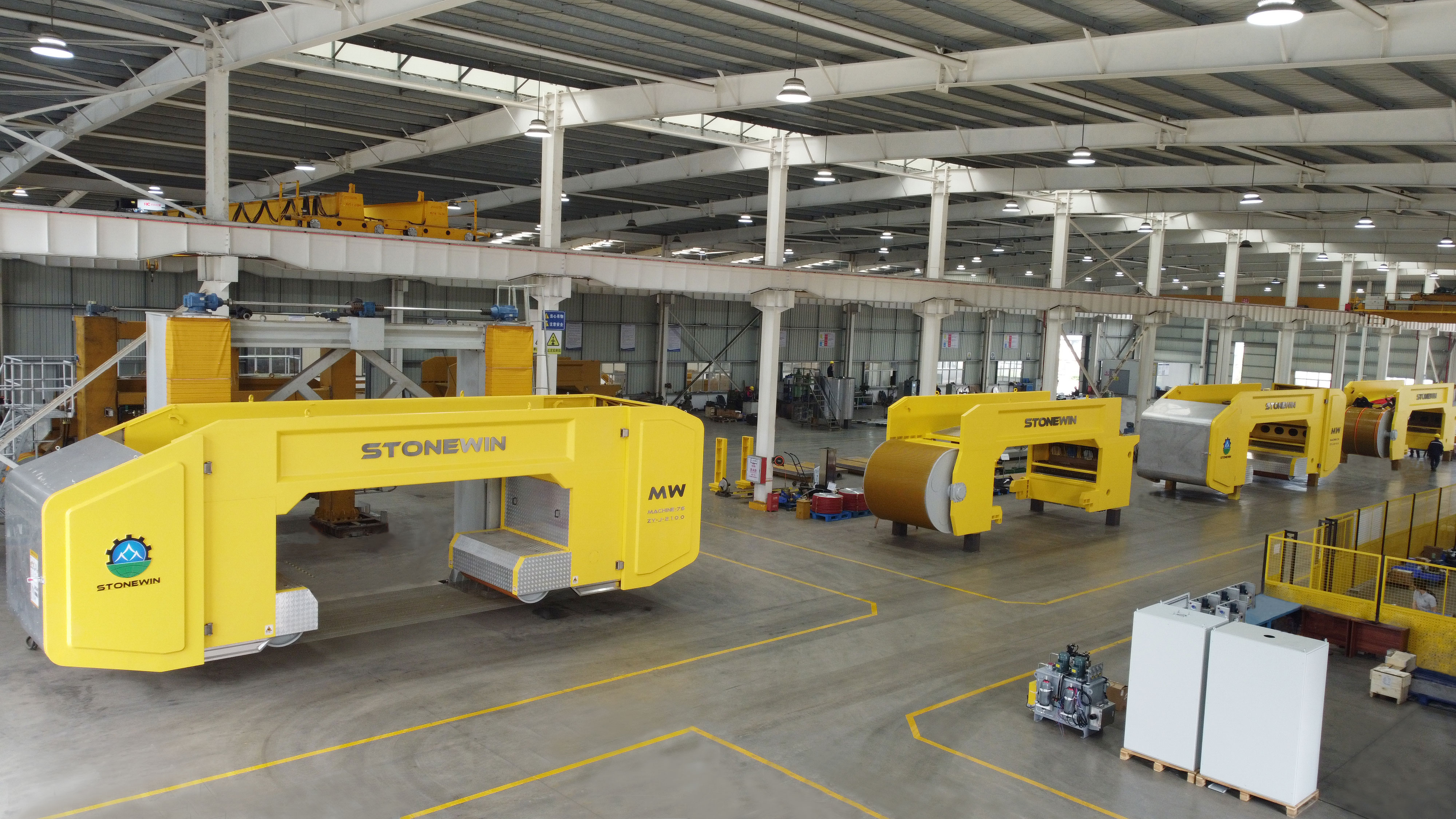
Stonewin manufacturing workshop for multi-wire saw machines used in stone processing.
Configuration data for your project
The full Stonewin range — multi-wire saw machines, quarry wire saw machines, diamond wire saws, polishing lines and resin lines — is documented in the downloadable catalogue: Stonewin PDF brochure.
Fujian Xiapu Zhongyuan Machinery Co., Ltd. · No. 23 Changfu Road, Xiapu City, Fujian, China · Tel +86-593-8177666 / +86-593-8177888 · www.stonewin.com · info@stonewin.com
Have Questions or Need More Details?
Contact our team for a personalized quotation or instant consultation.
Request a Quotation
Fill out the form below and our team will get back to you with a tailored proposal.
WhatsApp Direct Chat
Prefer to chat in real-time? Message us on WhatsApp for instant assistance & quick answers.
- Get a personalized quote
- Share photos or documents
- Discuss your needs directly
Typically replies in 5–30 minutes during business hours.