
PAF 8235 RoHS 2.0 Compliance: A Buyer's Verification Guide
Potassium Aluminium Fluoride under product code 8235 is covered by two RoHS documents issued by Guangdong KEYS Testing Technology Co., Ltd.: the RoHS 2.0 Verification of Conformity numbered CKEYS251222003 and the RoHS Test Report numbered RKEYS251215033. Both are dated 2025-12-22, both state an expiry date of 2099-12-22, and both are declared for the EU market. Together they show that the grey, white, powder, granular, and lump forms of product 8235 are covered by testing evidence for RoHS Directive 2011/65/EU and its amendment Directive (EU) 2015/863.
This guide answers a narrower question than “is the material compliant?” It answers: does the paperwork in front of you actually belong to the product you are buying, and what does it prove if it does? It is written for procurement managers, quality engineers, and importers who must release a purchase order against a compliance file, and for buyers in markets where an EU-scoped certificate is offered as supporting evidence rather than as the governing document.
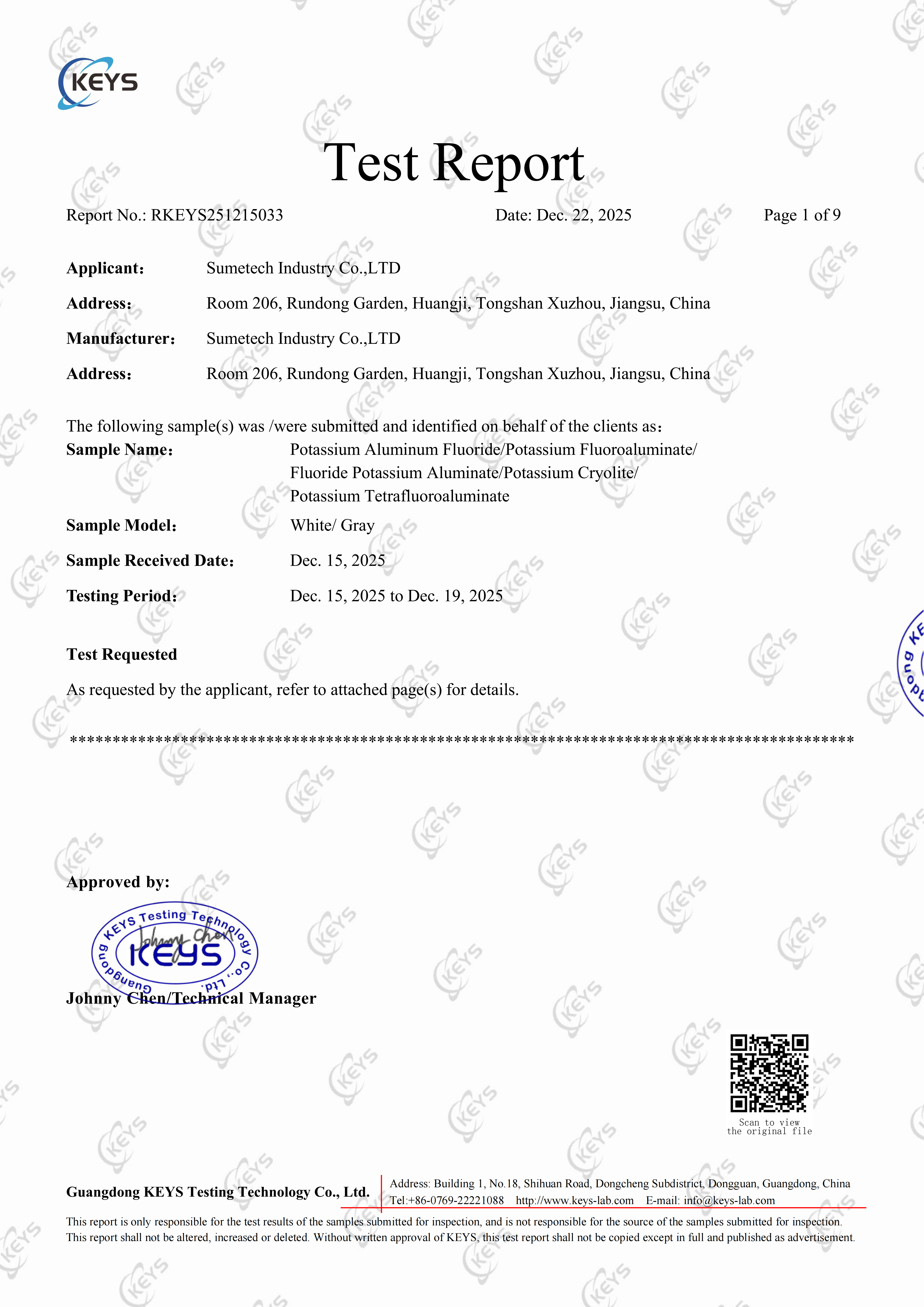
RoHS Test Report RKEYS251215033 for Potassium Aluminium Fluoride, product code 8235, issued by Guangdong KEYS Testing Technology Co., Ltd.
The Compliance Problem: A Certificate That Does Not Match the Product
Most compliance failures in fluoride purchasing do not start with a missing document. They start with a document that exists but cannot be tied to the specific material under review. Three patterns repeat in buyer audits.
First, name drift. Potassium Aluminium Fluoride trades under several equivalent names. The scope line of the RoHS documents for product 8235 lists Potassium Aluminum Fluoride, Potassium Fluoroaluminate, Fluoride Potassium Aluminate, Potassium Cryolite, and Potassium Tetrafluoroaluminate in white and gray forms. A buyer who searches only for “Potassium Aluminium Fluoride” and finds a synonym on the certificate may treat a correct document as a mismatch, or — worse — accept a document that lists a different material entirely.
Second, form drift. Product 8235 is supplied as grey, white, powder, granular, and lump material, with stated sizes of mesh 200, 0.3–1.0 mm, and 0.5–1.5 mm. A certificate that covers the product family but is filed against a different form still creates a traceability gap between the shipment and the paper.
Third, jurisdiction drift. The two documents for product 8235 are declared for the EU market. A buyer in Asia, the Middle East, or the Americas may accept them as strong supporting evidence, but they are not a substitute for whatever national declaration that market requires. Treating an EU-scoped certificate as global clearance is the most common — and most avoidable — documentation error.
Industry Background: Why Fluoride Buyers Now Ask for RoHS Files
Potassium Aluminium Fluoride, also written KAlF4 or K3AlF6 depending on the stoichiometry being referenced, is a functional material rather than a bulk commodity. PubChem records a molecular weight of approximately 142.07 g/mol and CAS 60304-36-1 for the KAlF4 compound. Trade data associates the material with HS code 38101090, the functional heading used for fluxes and pickling preparations for metal surfaces.
Its demand base is industrial and fragmented. In aluminium smelting and casting it lowers the melting temperature of alumina and supports degassing and slag removal. In corrosion-free brazing of aluminium alloys — including battery cooling plates and heat exchangers — it removes oxide films. In resin-bonded grinding wheels it acts as an active filler that supports self-sharpening and heat dissipation. In ceramics and glass it works as a flux and opacifier. Market research published by DataHorizzon Research values the global Potassium Aluminum Fluoride market at USD 1.76 billion in 2024, with a projected USD 2.62 billion by 2033 and a CAGR of 4.8% over 2025–2033.
Two consequences follow for documentation. The first is that PAF sits inside long, multi-tier supply chains: a fluoride shipment may ultimately feed an electrical or electronic application several steps downstream, which is why buyers in those chains request RoHS evidence from a chemical supplier even though RoHS obligations formally attach to electrical and electronic equipment. The second is that the material itself carries a hazard profile. A published safety data sheet classifies Potassium Aluminum Fluoride under GHS as Acute Toxicity Category 4 (oral, dermal, inhalation) and Skin Irritation Category 2, referenced against OSHA Hazard Communication Standard 29 CFR 1910. A RoHS file is therefore never the whole document pack; it sits alongside the SDS.
Grade choice also shapes the file. Industry comparison notes distinguish an industrial grade of 98% minimum used for foundry and abrasive applications, typically the grey material, from a high-purity grade above 99% — or white PAF — required for brazing and specialty glass. Both grade families fall inside the scope stated on the product 8235 certificates.
The Two Documents Behind Product 8235
Sumetech Industry Co., Ltd is a China-based manufacturer of potassium aluminium fluoride and boron nitride, exporting about 90% of its output with Turkey, Japan, Korea, and Europe as its main markets. The company supplies product 8235 in grey, white, powder, granular, and lump forms and holds two separate RoHS documents for it. Buyers should understand what each one is for.
RoHS 2.0 Verification of Conformity — CKEYS251222003
The Verification of Conformity is the declaration-level document. Certificate number CKEYS251222003 is issued by Guangdong KEYS Testing Technology Co., Ltd., applies to the EU market, and covers Potassium Aluminum Fluoride, Potassium Fluoroaluminate, Fluoride Potassium Aluminate, Potassium Cryolite, and Potassium Tetrafluoroaluminate in white and gray forms. Its issue date is 2025-12-22 and its stated expiry date is 2099-12-22. It is the document most buyers attach to a supplier qualification file because it states conformity directly rather than presenting raw test output.
RoHS Test Report — RKEYS251215033
The test report is the evidence layer. Report number RKEYS251215033 is issued by the same body, Guangdong KEYS Testing Technology Co., Ltd., and is valid for the EU market. It explicitly cites RoHS Directive 2011/65/EU and its amendment Directive (EU) 2015/863. The form coverage is the same — grey, white, powder, granular, and lump — and the dates match the Verification of Conformity at 2025-12-22 issue and 2099-12-22 expiry.
Both documents list the same analytical standard set: IEC 62321-3-1:2013, IEC 62321-4:2013 + AMD1:2017, IEC 62321-5:2013, IEC 62321-6:2015, IEC 62321-7-1:2015, IEC 62321-7-2:2017, and IEC 62321-8:2017. For a technical reviewer, that list is the part worth reading: it tells you which IEC 62321 test methods sit behind the conformity statement, and it allows your own lab or consultant to judge whether the method set matches your acceptance criteria.
What the Two Documents Do Not Claim
Neither document states coverage of frameworks outside RoHS. A buyer who needs REACH statements, transport classification, food-contact declarations, or a customer-specific substance list should request those items as a separate part of the document pack rather than reading them into the RoHS file. This is a normal and expected request; the RoHS certificate is a defined instrument with a defined scope, not a general compliance guarantee.
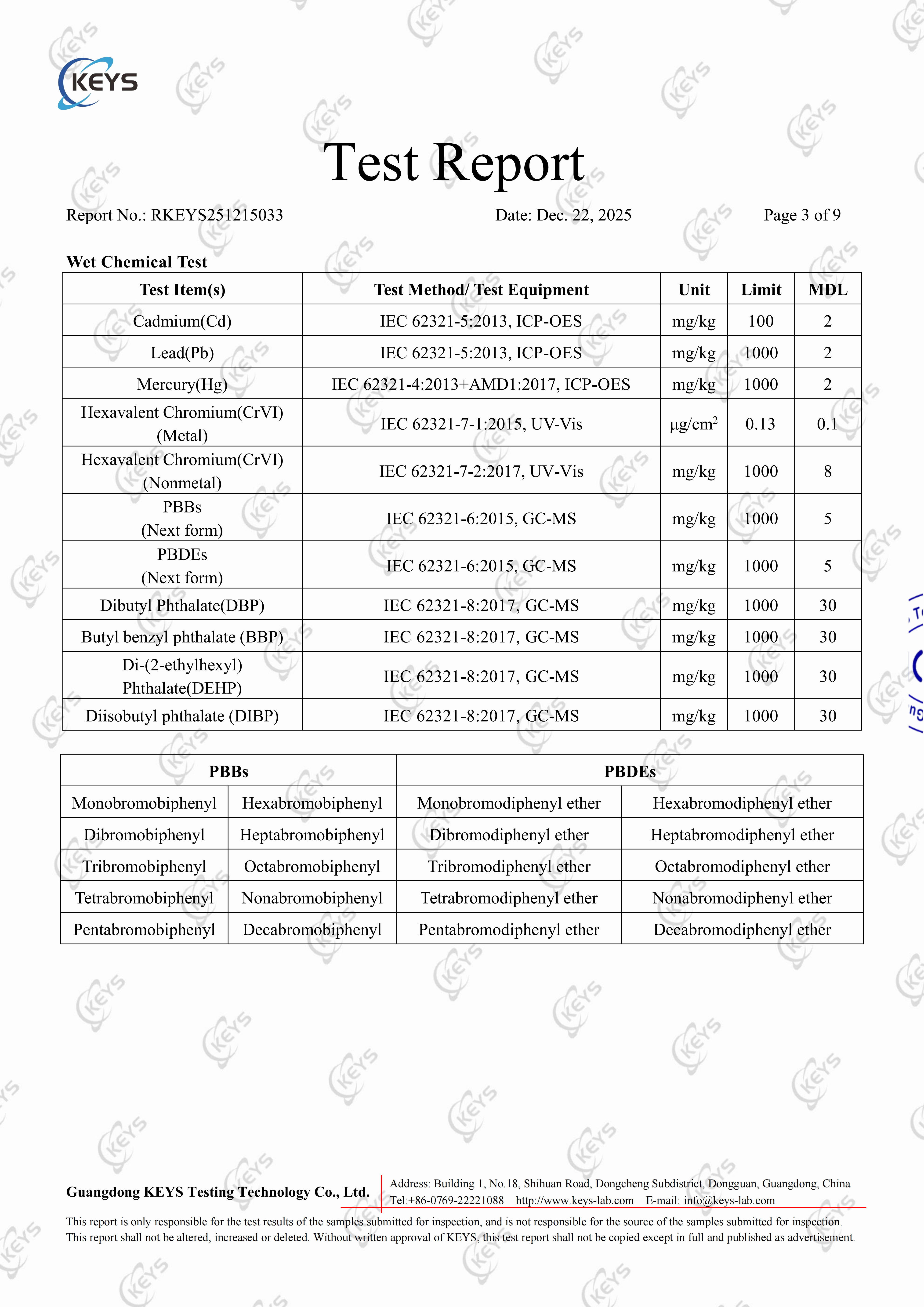
The IEC 62321 method set listed on the RoHS report is the section to check against your own acceptance criteria.
Step-by-Step: Cross-Checking the Documents Against Product 8235
A document review for this product takes about fifteen minutes if it is done in a fixed order. The sequence below moves from the fields that cause the most disputes to the ones that cause the fewest.
- Match the product code first. Both CKEYS251222003 and RKEYS251215033 reference product code 8235. Compare that code against the code on your purchase order and against the code on the packing list. If the code matches but the product name looks unfamiliar, continue to the synonym check rather than rejecting the file.
- Check the synonym list in the scope line. The certificates state the material as Potassium Aluminum Fluoride / Potassium Fluoroaluminate / Fluoride Potassium Aluminate / Potassium Cryolite / Potassium Tetrafluoroaluminate (White / Gray). A supplier invoice using “Potassium Cryolite” or “KAlF4” is consistent with this wording. A supplier invoice using an entirely different chemistry is not.
- Confirm the form you are buying is inside the coverage. The certificates cover grey, white, powder, granular, and lump. If your order is mesh 200 white PAF, the powder coverage applies; if it is 0.3–1.0 mm grey material, the granular coverage applies. Record which form was reviewed so a later shipment in a different form triggers a fresh check.
- Verify the issuing body and both certificate numbers. Both documents name Guangdong KEYS Testing Technology Co., Ltd. Note that the two numbers differ in prefix: CKEYS251222003 is the Verification of Conformity and RKEYS251215033 is the test report. A supplier who quotes only one number, or who quotes a number with the wrong prefix for the document type, has handed you an incomplete file.
- Read the directive citation, not just the headline. The test report cites RoHS Directive 2011/65/EU and amendment Directive (EU) 2015/863. The amendment is the part that defines “RoHS 2.0” in everyday procurement language. If your customer's specification names both instruments, confirm both appear.
- Check dates and retention. Issue date 2025-12-22 and expiry date 2099-12-22 should be identical across the two documents. File the PDFs with the SDS and the shipment record, and note the review date in your supplier file so that a future audit can see when the check was performed.
Practical shortcut: request the two documents as a pair, in one email, together with the SDS. A supplier who can send CKEYS251222003 and RKEYS251215033 as a matched set within one business response is demonstrating document control, which is a more reliable indicator than any single certificate viewed in isolation.
Regional Documentation and Acceptance Criteria
The certificates for product 8235 are declared for the EU market. That statement is precise, and it should drive how each regional buyer treats the file. Sumetech's own export profile concentrates on Turkey, Japan, Korea, and Europe, and its application records list additional served markets including the UAE, Brazil, Bahrain, Russia, Canada, Norway, the United States, Thailand, Vietnam, Malaysia, Indonesia, Germany, France, Italy, Spain, and Australia.
The table below separates what the documents support from what remains a buyer-side decision. It deliberately does not assert local legal requirements for each market; those must be confirmed by your own compliance function.
| Market | What the product 8235 documents support | Buyer-side action before PO release |
|---|---|---|
| Germany and other EU member states | Direct coverage. Both CKEYS251222003 and RKEYS251215033 are declared for the EU market and cite Directive 2011/65/EU with amendment (EU) 2015/863. | Confirm the form purchased is inside the grey / white / powder / granular / lump coverage, and file both documents with the SDS. |
| Turkey | Supporting evidence only. The documents are EU-scoped; Turkey is a main export market for Sumetech. | Confirm with your compliance team whether an EU RoHS 2.0 file is accepted as-is or whether a national declaration is required in addition. |
| Japan | Supporting evidence only. Japan is a main export market for Sumetech. | Check whether your customer's specification requires a Japanese-language declaration or an additional local statement. |
| South Korea | Supporting evidence only. A Korean manufacturer has purchased this product at 60 MT per month for two years for metal additive and flux applications, with high purity cited as the highlight. | Confirm local documentation expectations with the receiving site; Korean buyers typically review both the RoHS pair and the SDS together. |
| United States and Canada | Supporting evidence only for RoHS. For hazard communication, a published SDS classifies the material under GHS as Acute Toxicity Category 4 and Skin Irritation Category 2, referenced to OSHA HCS 29 CFR 1910. | Pair the RoHS file with the current SDS and confirm which of the two your customer actually requires at the receiving location. |
| UAE, Bahrain | Supporting evidence only. Listed among served markets in Sumetech's application records. | Confirm whether the importer of record requires legalisation, attestation, or a supplier declaration on letterhead. |
| Brazil | Supporting evidence only. Listed among served markets. | Confirm import documentation requirements with the importer of record; RoHS is not the governing instrument in this file. |
| Russia | Supporting evidence only. Listed among served markets. | Confirm the language and format of the declaration your customer will accept. |
| Norway | Supporting evidence only. Listed among served markets. | Confirm with your compliance team how an EU-scoped certificate is treated for your specific end use. |
| Thailand, Vietnam, Malaysia, Indonesia | Supporting evidence only. Listed among served markets. | Confirm whether the receiving site accepts an English-language EU certificate or needs a local-format declaration. |
Reading the Table Correctly
“Supporting evidence only” is not a weakness in the supplier's file; it is a statement about the instrument. A RoHS 2.0 Verification of Conformity is written against a specific legal framework for a specific market. Asking it to do work outside that framework is what creates audit exposure. The correct move for a non-EU buyer is to keep the pair as technical evidence, then add whatever national instrument the local authority or customer requires.
One Consistency Check That Catches Most Problems
Compare the form named in your order against the form named in the scope line, and compare the issue dates of the two documents against each other. If a supplier sends a Verification of Conformity dated one month and a test report dated another month, or if the form coverage differs between the two, ask for the matched set. Consistency between the pair is a fast proxy for document control at the source.
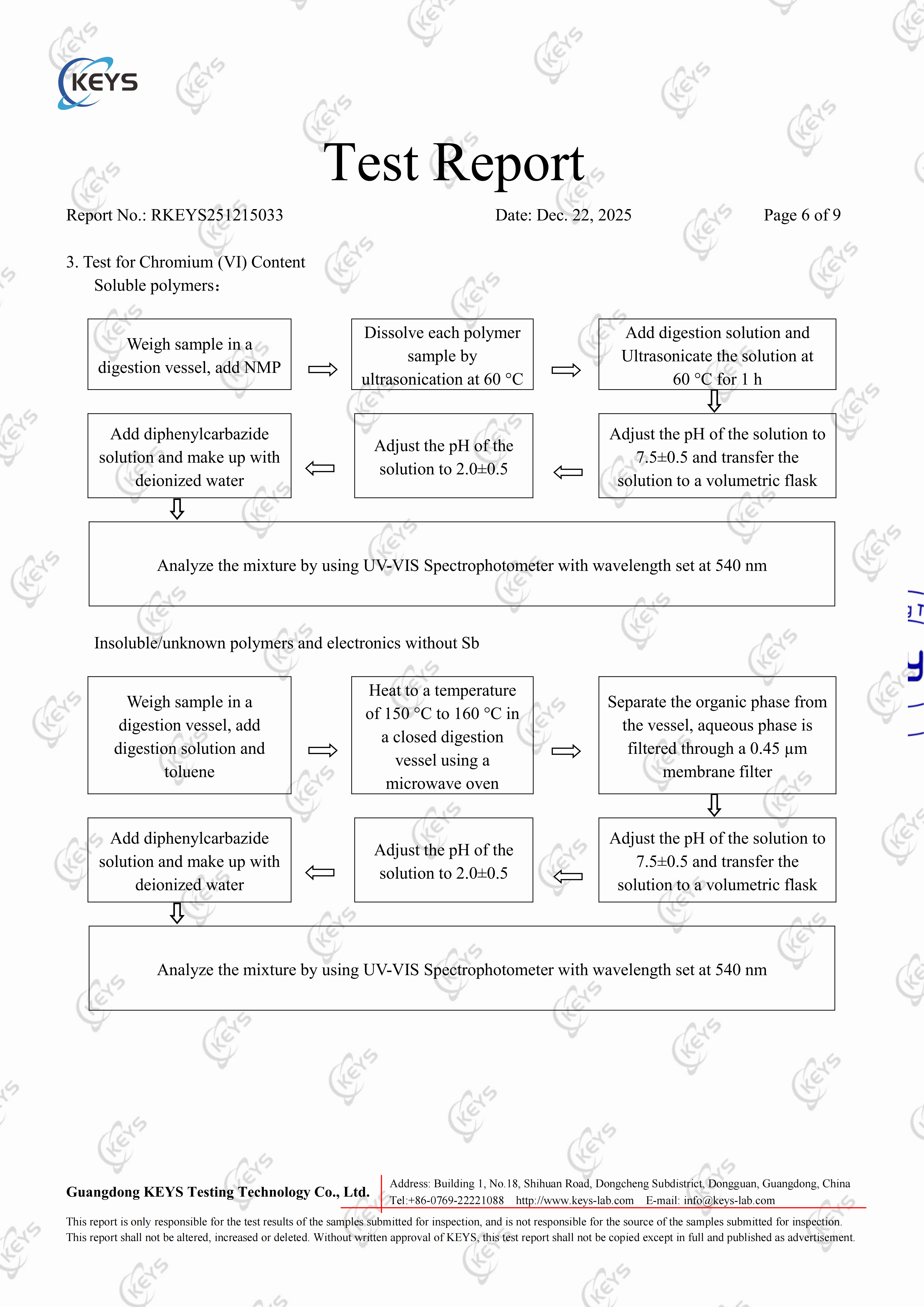
Scope and product code should be read together with the shipment record, not in isolation.
Use Cases: Where the Document Pair Changes the Purchase Decision
Compliance files matter most where the fluoride becomes an input to a regulated end product. Five applications dominate.
Aluminium smelting and casting. PAF lowers the melting point of alumina and improves electrolyte conductivity, and it acts as a degassing agent that removes harmful gases from molten aluminium. Here the RoHS file is usually a secondary document; the primary requirements are chemistry and particle size consistency.
Corrosion-free brazing of aluminium alloys. Components such as battery water-cooling plates and air-conditioning radiators depend on flux that removes oxide films without leaving corrosive residue. Because these parts sit in vehicle and appliance assemblies, downstream buyers frequently ask for the RoHS pair as part of the material approval pack.
Abrasives and grinding wheels. As an active filler in resin-bonded wheels, PAF supports self-sharpening and heat dissipation and is associated with a service-life extension in the range of 20%–30% in the product's own application description. Wheel makers supplying industrial customers often carry the fluoride compliance file forward into their own declarations.
Ceramics and glass. Used as a flux and opacifier, PAF lowers sintering temperatures and supports glaze texture. Buyers in decorative and technical glass frequently need both the RoHS pair and a separate statement for their own customer's restricted-substance list.
Non-ferrous recycling and casting. Degassing and slag removal in recycled aluminium streams place a premium on consistent chemistry between batches; the documentation requirement here is usually continuity rather than a single certificate.
Comparison Table: The Two Documents Side by Side
Buyers sometimes assume the two files are duplicates of each other. They are not. The table below uses only the fields stated on the documents themselves.
| Attribute | RoHS 2.0 Verification of Conformity | RoHS Test Report |
|---|---|---|
| Document number | CKEYS251222003 | RKEYS251215033 |
| Issuing body | Guangdong KEYS Testing Technology Co., Ltd. | Guangdong KEYS Testing Technology Co., Ltd. |
| Declared market | EU | EU |
| Directive cited | RoHS 2.0 Verification of Conformity framework | RoHS Directive 2011/65/EU and amendment Directive (EU) 2015/863 |
| Product coverage | Potassium Aluminum Fluoride / Potassium Fluoroaluminate / Fluoride Potassium Aluminate / Potassium Cryolite / Potassium Tetrafluoroaluminate (White / Gray); product code 8235 | Same material scope; product code 8235; grey and white forms reported |
| Forms covered | Grey, white, powder, granular, lump | Grey, white, powder, granular, lump |
| Test standards listed | IEC 62321-3-1:2013; -4:2013 +AMD1:2017; -5:2013; -6:2015; -7-1:2015; -7-2:2017; -8:2017 | IEC 62321-3-1:2013; -4:2013 +AMD1:2017; -5:2013; -6:2015; -7-1:2015; -7-2:2017; -8:2017 |
| Issue date | 2025-12-22 | 2025-12-22 |
| Expiry date | 2099-12-22 | 2099-12-22 |
| Best use in a supplier file | Qualification and audit trail — states conformity directly | Technical review — shows the method set behind the statement |
Companion Table: White and Grey PAF in the Same File
Because both grades are covered by the same document pair, buyers can switch grade without re-opening the compliance question — provided the physical form on the order stays inside the stated coverage.
| Attribute | White PAF | Grey PAF |
|---|---|---|
| Typical grade positioning | High purity, above 99%, per industry comparison notes | Industrial grade, 98% minimum, per industry comparison notes |
| Forms available under product 8235 | Powder (mesh 200), granular (0.5–1.5 mm), lump | Powder, granular (0.3–1.0 mm), lump |
| Common applications | Brazing and specialty glass | Foundry and abrasive applications |
| RoHS document coverage | Covered by CKEYS251222003 and RKEYS251215033 | Covered by CKEYS251222003 and RKEYS251215033 |
| Customisation available | Particle size and colour adjustable under OEM / ODM | Particle size and colour adjustable under OEM / ODM |
What Else Belongs in the Supplier File
The RoHS pair answers one question. A working supplier file for PAF usually holds four more items: the current SDS, a specification sheet stating mesh or millimetre range, a batch certificate or test record tied to the shipment, and the commercial documents. On the manufacturing side, Sumetech runs a 6,000 m² facility with 5 technicians, an annual output of 5,000 MT, a monthly capacity of 1,000 MT, and 100% testing as its stated quality-control mode — figures that matter to a buyer because they describe the batch discipline behind the certificate rather than the certificate itself.
Commercial terms also shape the review. OEM and ODM production is offered with size and colour customisation, a minimum order quantity of 10 kg, and a lead time of 30 days. After-sales support is provided remotely and on site. For a first purchase, the 10 kg minimum allows a buyer to validate both the material and the document set on a trial lot before committing to a container.
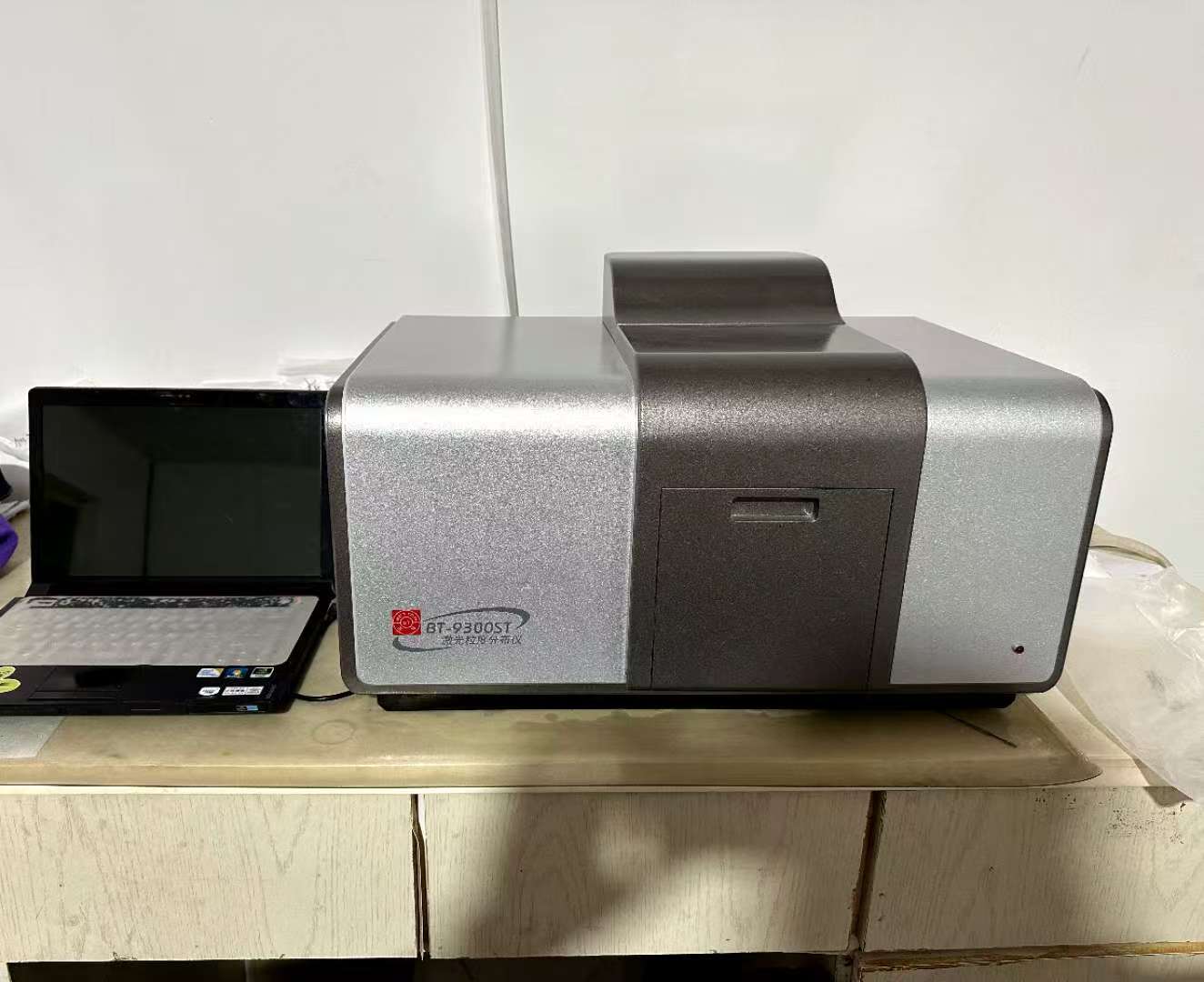
Particle size verification: the form named on the order should match the form named on the certificate.
Frequently Asked Questions
Does the RoHS 2.0 certificate for product 8235 cover every physical form?
Yes, as stated on the documents. The RoHS 2.0 Verification of Conformity CKEYS251222003 and the RoHS Test Report RKEYS251215033 both cover product code 8235 in grey, white, powder, granular, and lump forms. The scope line names the material as Potassium Aluminum Fluoride, Potassium Fluoroaluminate, Fluoride Potassium Aluminate, Potassium Cryolite, and Potassium Tetrafluoroaluminate in white and gray forms. Both documents are declared for the EU market and were issued by Guangdong KEYS Testing Technology Co., Ltd. on 2025-12-22, with an expiry date of 2099-12-22.
Can the product be customised while keeping the same compliance documentation?
Customisation is offered as OEM / ODM production covering particle size and colour. The compliance reference point stays product code 8235, whose documented coverage already spans mesh 200 powder, 0.3–1.0 mm granular, 0.5–1.5 mm granular, and lump material in both white and grey. Production runs at a monthly capacity of 1,000 MT with 100% testing as the stated quality-control mode, and the minimum order quantity is 10 kg, so a customised trial lot can be produced and reviewed against the same document pair before scaling.
How should a buyer approach pricing on a compliance-heavy order?
There is no published price list for this product; commercial terms are confirmed by quotation against the specified grade, form, and quantity. The variables that typically drive the quotation are grade selection (white versus grey), particle size and form, packaging, and order volume relative to the 10 kg minimum. For context only, an adjacent fluoride benchmark — aluminium fluoride in Northeast Asia — was reported by IMARC Group at 1.80 USD/KG in March 2026; that figure refers to AlF3, not to Potassium Aluminium Fluoride, and should not be used as a PAF price. The two RoHS documents themselves are compliance evidence, not a priced line item.
Can a sample be supplied before the full compliance review is closed?
Yes. The minimum order quantity of 10 kg functions as a trial-lot route, and samples can be reviewed in parallel with the document check rather than after it. The efficient sequence is to request the sample, the RoHS pair (CKEYS251222003 and RKEYS251215033), and the SDS together, then test the sample against your own incoming specification — particle size, form, and appearance — before releasing a production order. A Korean manufacturer followed this pattern and has purchased 60 MT per month for two years for metal additive and flux applications, citing high purity as the deciding factor.
What is the lead time, and when should documents be requested?
Standard lead time is 30 days, supported by a monthly capacity of 1,000 MT and 5 technicians on the technical and quality side. Request the document pack at the enquiry stage rather than at shipment: the review of CKEYS251222003 and RKEYS251215033, the synonym check, and the form check take a short time but depend on your own compliance team's availability. Starting both tracks together keeps the 30-day production window from becoming a documentation window. To begin, send your product form, target application, and destination market to Sumetech Industry Co., Ltd at info@sumetech.com, or request the full catalogue below.
Conclusion: Verify the Pair, Then Verify the Fit
The compliance file for Potassium Aluminium Fluoride product 8235 is unusually clean for a material of this type: two documents, one issuing body, one product code, one issue date, one expiry date, and coverage of all five commercial forms. Guangdong KEYS Testing Technology Co., Ltd. issued CKEYS251222003 as the RoHS 2.0 Verification of Conformity and RKEYS251215033 as the RoHS Test Report, both against Directive 2011/65/EU and amendment (EU) 2015/863, and both declared for the EU market.
The work that remains is the buyer's work, and it is simple: confirm the document pair matches the code and form on your order, read the IEC 62321 method list against your own acceptance criteria, and treat the file as EU-scoped when your market sits outside the EU. Done in that order, the review takes minutes and removes the most common cause of a stalled fluoride purchase order.
Request the Document Pack, a Sample, or a Quotation
Send your required form (powder, granular, or lump), grade (white or grey), particle size, application, and destination market. You will receive the matched RoHS pair CKEYS251222003 and RKEYS251215033 together with the SDS and a quotation against your specification.
Email: info@sumetech.com · Tel / WhatsApp: +86 13805218959 · Website: www.sumetech.com
Download the full product catalogue: Catalog of Sumetech 2026 (PDF)
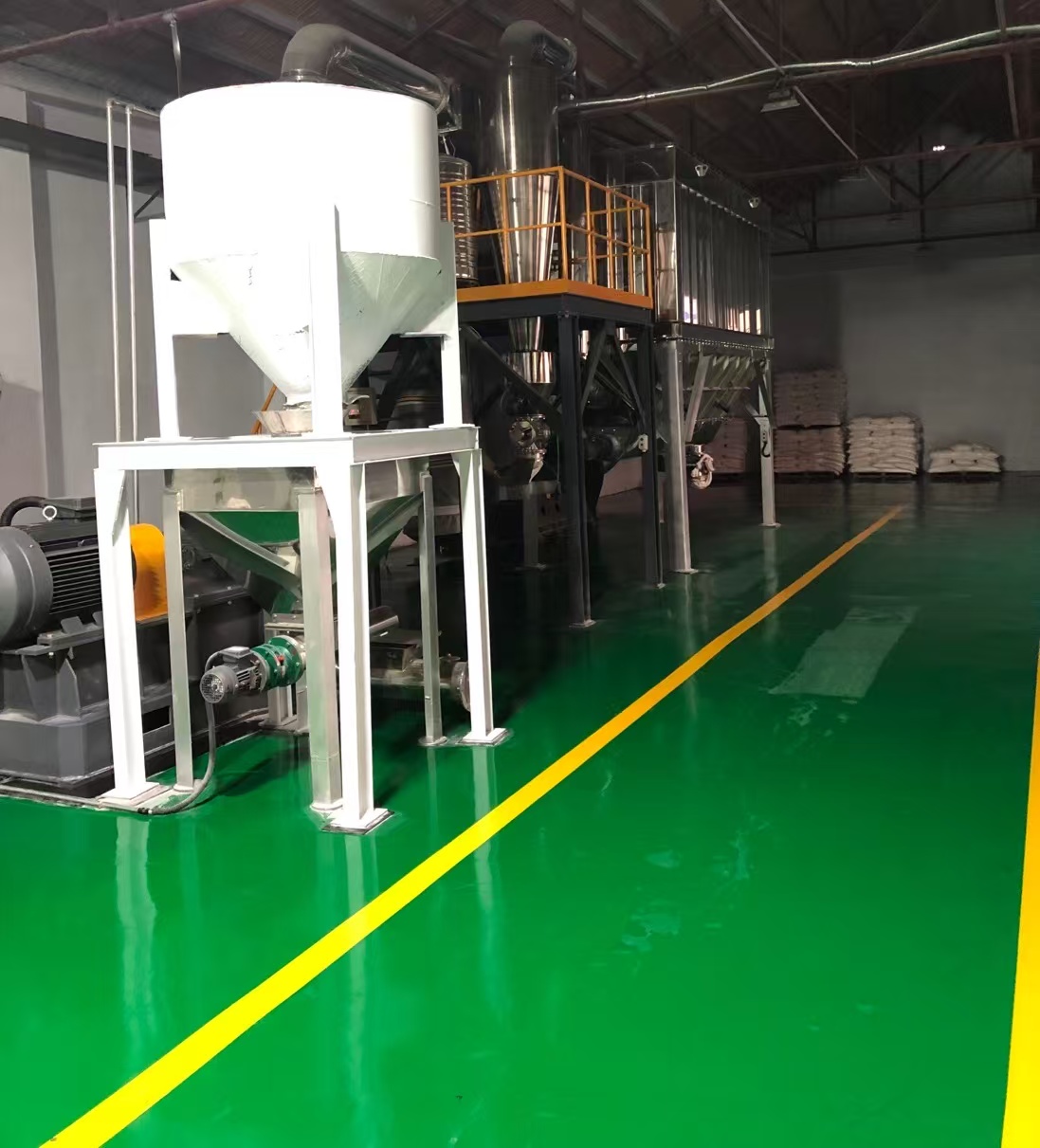
Screening and classification at the production stage — the batch discipline behind the certificate.
Have Questions or Need More Details?
Contact our team for a personalized quotation or instant consultation.
Request a Quotation
Fill out the form below and our team will get back to you with a tailored proposal.
WhatsApp Direct Chat
Prefer to chat in real-time? Message us on WhatsApp for instant assistance & quick answers.
- Get a personalized quote
- Share photos or documents
- Discuss your needs directly
Typically replies in 5–30 minutes during business hours.