
Bowling Ball Return Systems: Speed, Jam Rate, Self-Check
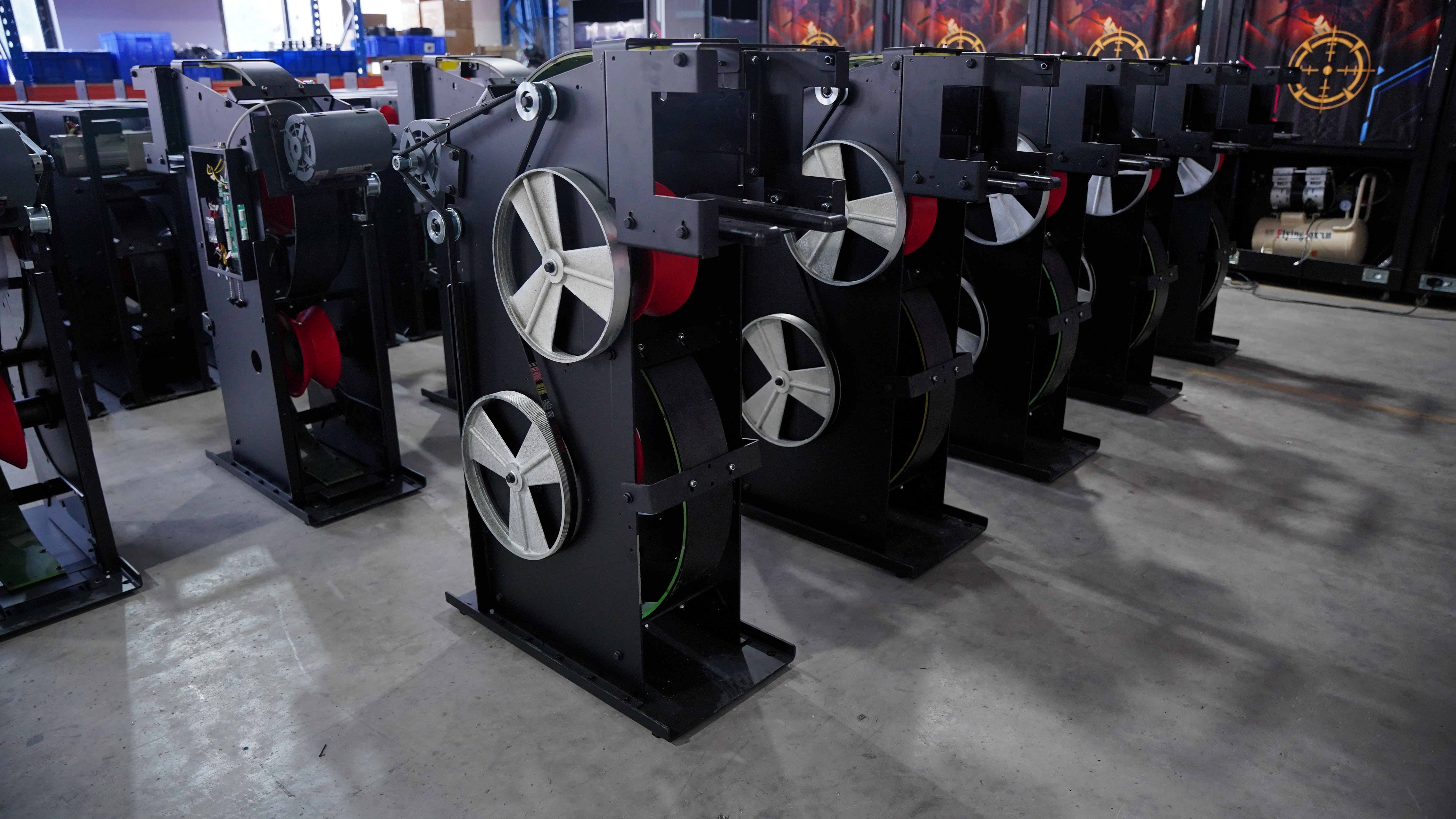
A ball return system is the lane subsystem that lifts the ball out of the pit, carries it back along the return track and delivers it to the bowler's tray. It is easy to file away as an accessory, but it sits on the critical path of every frame. The return has to complete its cycle before the next ball can be bowled comfortably, and a jam takes the lane out of service until somebody clears it. That is why return speed, jam failure rate and self-check logic belong in the equipment specification rather than in the after-sales conversation.
SunEye Bowling (Guangzhou) Co., Ltd. is a bowling equipment supplier covering R&D, manufacturing, sales, installation and after-sales service, with a stated 6,000 m² production base in Guangzhou, China. Its portfolio includes ball return systems, string pinsetters, scoring systems, standard bowling lanes, and duckpin and mini bowling equipment. This article explains what the key return-system figures mean in a working bowling center, and how a buyer can verify each one before signing.
Problem definition: the return cycle is shared, not isolated
A lane does not run one machine at a time. The pinsetter has to sweep or reset the pins, the scoring system has to register the shot, and the ball return has to bring the ball back. Those three cycles overlap, and the slowest one sets the pace the bowler actually feels. When the return cycle stretches, the visible symptom is a group standing at the console waiting for a ball that has not arrived.
Jams are a different category of problem. A slow return is an irritation; a stopped return is a hard outage on that lane. The failure usually happens behind the pins, out of sight of the concourse, so detection depends on the bowler walking back to the front desk. From that moment the real cost is not the jam itself but the time between the stoppage and the clearance: someone has to notice, find the lane, guess at the cause, and fix it. On a multi-lane floor, staff attention is the scarcest resource in that sequence.
This is the practical argument for self-check and self-diagnostic logic. If the system reports a fault state instead of simply stopping, the conversation changes from "the lane is broken" to "this lane shows a specific fault", and a phone call to the supplier becomes a diagnosis rather than a description. It does not prevent the jam. It shortens the interval that the jam costs.
Industry background: where the return system sits in a lane package
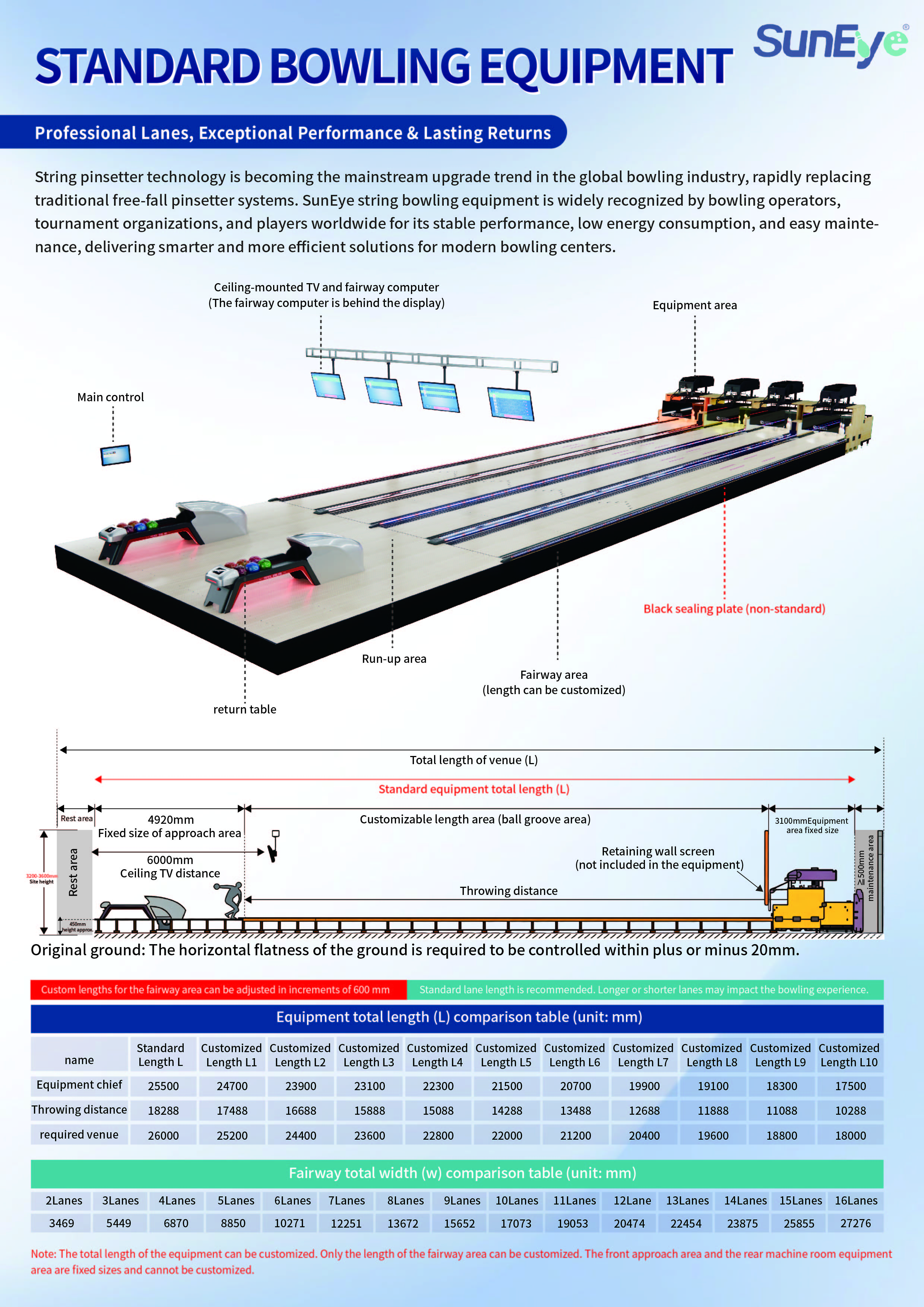
Commercial bowling is sold in three main formats, and the format decides the footprint the return system has to work inside. Standard bowling needs roughly 26 m of length, duckpin bowling roughly 10 m, and mini bowling roughly 13 m. The return track is quoted against that measured length, which is why the same manufacturer can supply a very different track for a 4-lane family entertainment site and a 12-lane commercial center.
The return system is also part of a matched equipment set. SunEye lists the string pinsetter system, ball return system and scoring system together as the equipment matched to commercial bowling scenarios, and the same three appear across its project references. A return system specified in isolation from the pinsetter pit and the scoring console creates alignment work on site, so most buyers evaluate the three together.
Power planning is a second place where the return system meets the building. Standard bowling runs on ordinary 220 V civilian electricity, with a rated power of about 2000 W per lane. Duckpin and mini bowling use a different schedule: approximately 3 kW per 2 lanes, with one 16 A outlet required in the machine room for every 2 lanes, and all other equipment power distributed internally within the system. A buyer who plans circuits before confirming the format will usually have to revise them.
Turnkey delivery is the normal commercial shape of this category. SunEye's stated turnkey scope covers venue planning, CAD layout design, 3D rendering, equipment manufacturing, global shipping, installation, staff training and after-sales support, and the process starts from the customer's site drawings or CAD drawings. Within that scope, the return system is one line item that depends on lane count and floor plan rather than a stand-alone purchase.
Detailed solution: the specifications that decide day-to-day performance
SunEye's ball return system is specified around six figures. Each one answers a different question, and none of them is useful without the others.
1. Metal and acrylic construction
The return system is built from metal and acrylic components. The split is practical rather than cosmetic: the metal sections carry the structural load of the return channel, while the acrylic sections make the ball path visible. For an operator, visible sections mean a blockage or a ball resting out of position can be spotted and reached without dismantling the whole cover. When you review a quote, ask how the covers come off and how the frame is fixed to the floor, because those two details define how long a manual clearance takes.
2. 220 V / 2000 W rating
The system runs at 220 V with a rated power of about 2000 W per lane, which is the same figure SunEye publishes for standard bowling lane power planning. In practice this means the return system does not require a special supply beyond ordinary 220 V distribution, but it does mean the electrical schedule has to be built per lane rather than per venue. Confirm breaker allocation and machine-room access before the floor is poured, not after the lanes are installed.
3. Return speed under 12 seconds
SunEye specifies a return speed of under 12 seconds. Read that as the return segment of the total lane cycle, not the whole cycle: the pinsetter reset and the scoring registration run on their own timings, and the bowler experiences the sum. Under 12 seconds is fast enough that the return is rarely the element a group notices during open play, which is the point of the figure. During acceptance, the useful check is to time the cycle repeatedly across several lanes with different ball weights, because a single clean run proves very little.
4. Track length of 18–26 m, customizable
The return track is supplied at 18–26 m and customized to the building. The range reflects the underlying lane geometry: standard bowling uses an international pitching distance of 18,288 mm, with a total equipment length of 25,500 mm, and SunEye supports ball length customized to the field size, with 18 m generally the minimum field length for an installation that still plays properly. On a shorter site, the track is shortened; on a full standard lane, it approaches the 26 m footprint. SunEye lists bowling lane length among its customization options, alongside lane logo, masking unit treatment (wallpaper, soft-film lightbox or LED screen wall), guardrails and stairs.
5. Jam failure rate of 0.002% against a 0.02%–0.05% category average
SunEye states a jam failure rate of 0.002% for its ball return system, against a category average of 0.02%–0.05%. On the low end of that range, the stated figure is one order of magnitude lower (0.002% versus 0.02%).
| Figure | Value | Scope of the claim |
|---|---|---|
| SunEye stated system jam failure rate | 0.002% | Manufacturer-stated figure for this ball return system; denominator is ball cycles |
| Category average used for comparison | 0.02%–0.05% | Reference band for conventional ball return equipment in this category |
Two things decide whether that number is meaningful for your venue. The first is the denominator: a jam rate expressed as a share of ball cycles behaves very differently from one expressed as a share of operating hours, and a 12-lane center running long shifts accumulates cycles far faster than a 4-lane attraction. The second is the definition of a jam. A ball that hesitates and then completes the return is not the same event as a ball that stops and requires a manual clearance, and only the second one costs staff time.
6. Built-in self-check and self-diagnostic logic
The system carries built-in self-check and self-diagnostic logic. Operationally, this is the feature that converts an outage into a work order. A self-check at start-up confirms the return is ready before the first bowler arrives; diagnostic reporting during operation identifies which lane has faulted and in what state, so front-desk staff can log it accurately instead of reporting "the lane stopped". That matters most for venues running long hours with thin technical staffing, where the person taking the call is rarely the person who can diagnose the machine.
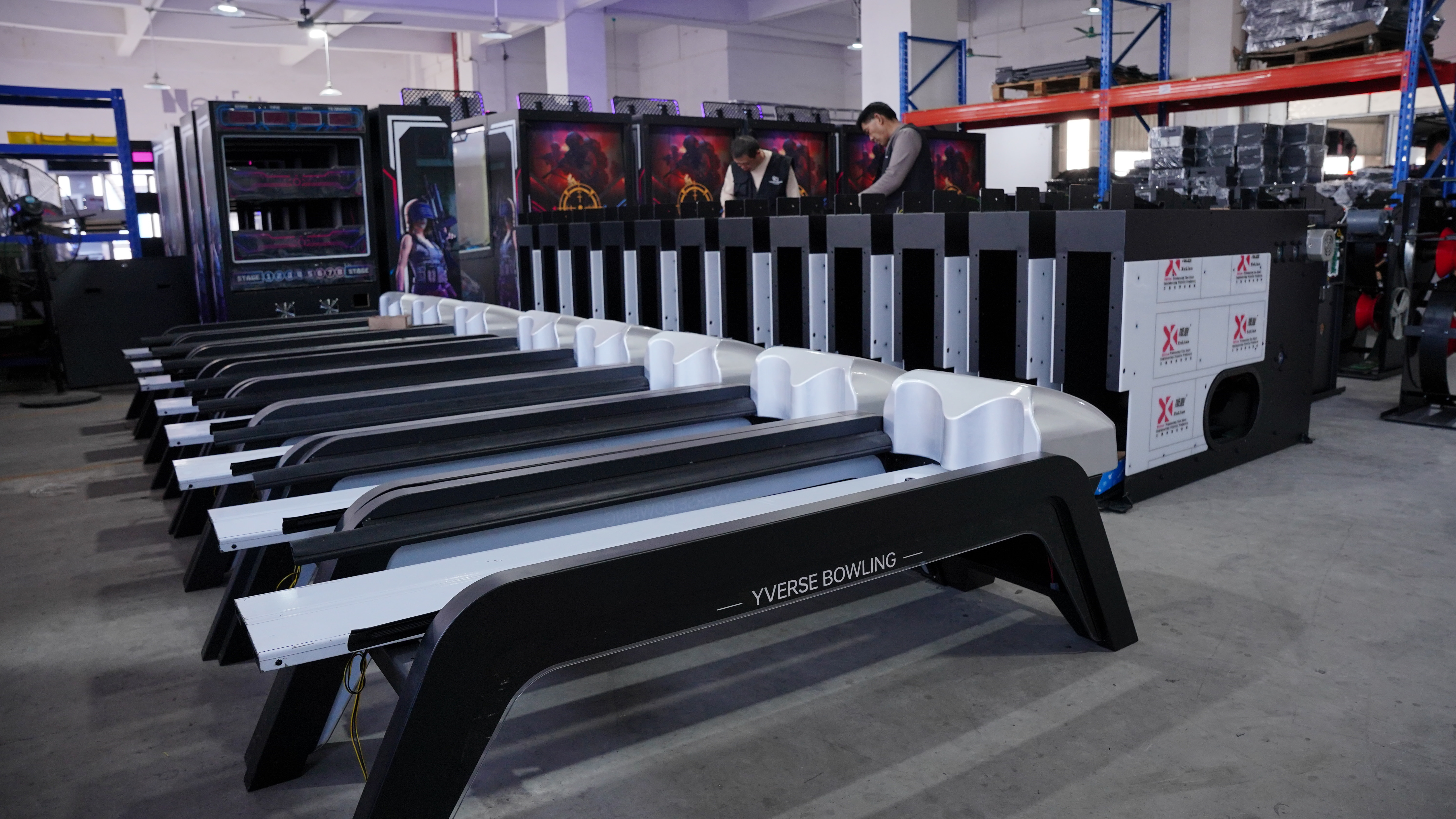
Production behind these figures is stated as a workshop covering lane processing, pinsetter assembly, scoring-system testing and equipment commissioning, with 100% pre-shipment testing on every unit. SunEye reports a 6,000 m² production base, 100+ employees, 20+ engineers and a monthly capacity of 200 units.
Step-by-step: how to verify a return system before you sign
- Measure the usable length first. Fix the track length against the real floor, not the catalogue. With standard bowling at a 25,500 mm total equipment length and 18 m as the practical minimum field length, the measured distance decides whether you are quoting at the top or the bottom of the 18–26 m range. Send site drawings or CAD drawings so the layout, and the return alignment with the pinsetter pit, can be planned before manufacture.
- Confirm the electrical schedule per lane. Budget 220 V and about 2000 W per lane for standard bowling and check breaker allocation lane by lane. If the project is duckpin or mini bowling, the schedule changes to roughly 3 kW per 2 lanes with one 16 A machine-room outlet per 2 lanes.
- Ask how the jam rate is defined and measured. Request the denominator (ball cycles), the definition of a jam, and the record behind the 0.002% figure. A supplier who can answer this is telling you something about how the machine is tested; a supplier who cannot is giving you a marketing number.
- Ask what the self-check actually reports. Find out where fault states appear, whether they are retained for review, and what the support team needs from the venue when a fault is reported. This is the difference between remote technical support that resolves an issue in one call and support that runs through a script.
- Put the return system inside the acceptance trial run. SunEye's stated acceptance procedure is a full inspection and trial run after installation covering appearance and installation, pinsetter and ball return, scoring system, electrical and control, and safety. Time the return cycle across several lanes during that trial run while you still hold leverage.
- Close the support and delivery loop. Confirm warranty (1 year on bowling equipment), remote technical support, the long-term software upgrade service, MOQ (2 units), production lead time (30–45 days) and delivery terms (FOB, EXW, CIF and DDP are accepted). For US-bound shipments, HTS subheading 9504.90.9060 is cited for bowling pin setter machine parts and accessories at a free rate of duty; confirm the classification against your own configuration before you cost the shipment.
Use cases: the same specification at 4, 6, 8 and 12 lanes
Lane count changes what the return system has to survive. A 4-lane site runs few cycles per hour but often runs them with unsupervised guests; a 12-lane center runs far more cycles and needs the return to stay out of the staff's day.
4 lanes, amusement park, Tongchuan, China. SunEye supplied a 4-lane standard bowling project installed inside a large aluminium-frame tent within the Huayuehui Scenic Area, integrated with high ropes courses and other attractions. The stated highlights are a complete turnkey solution, easy maintenance and stable performance. For a tent-based installation, the customized track length and the framing method matter more than peak throughput.
6 lanes, comprehensive entertainment center, Sanming, China. Ignite Space, inside the Sanming Science & Technology Museum, combines sports, family entertainment and dining; SunEye supplied a 6-lane standard bowling solution to broaden the venue's interactive offering. Mixed-use venues place the return system in front of non-specialist guests, which puts weight on the self-check logic and on how quickly a fault can be reported.
8 lanes, bowling center, Salerno, Italy. SunEye delivered an 8-lane standard bowling system to Center World as part of a new entertainment and leisure destination. A dedicated bowling center is where jam rate and return speed become commercial numbers rather than technical ones.
12 lanes, family entertainment center, Spain. An 8,000 m² FEC including trampolines, attractions and party facilities took a 12-lane standard bowling installation. At this scale the return system is one part of a continuous operating rhythm, and the acceptance trial run is the last cheap opportunity to find a lane that behaves differently from the others.
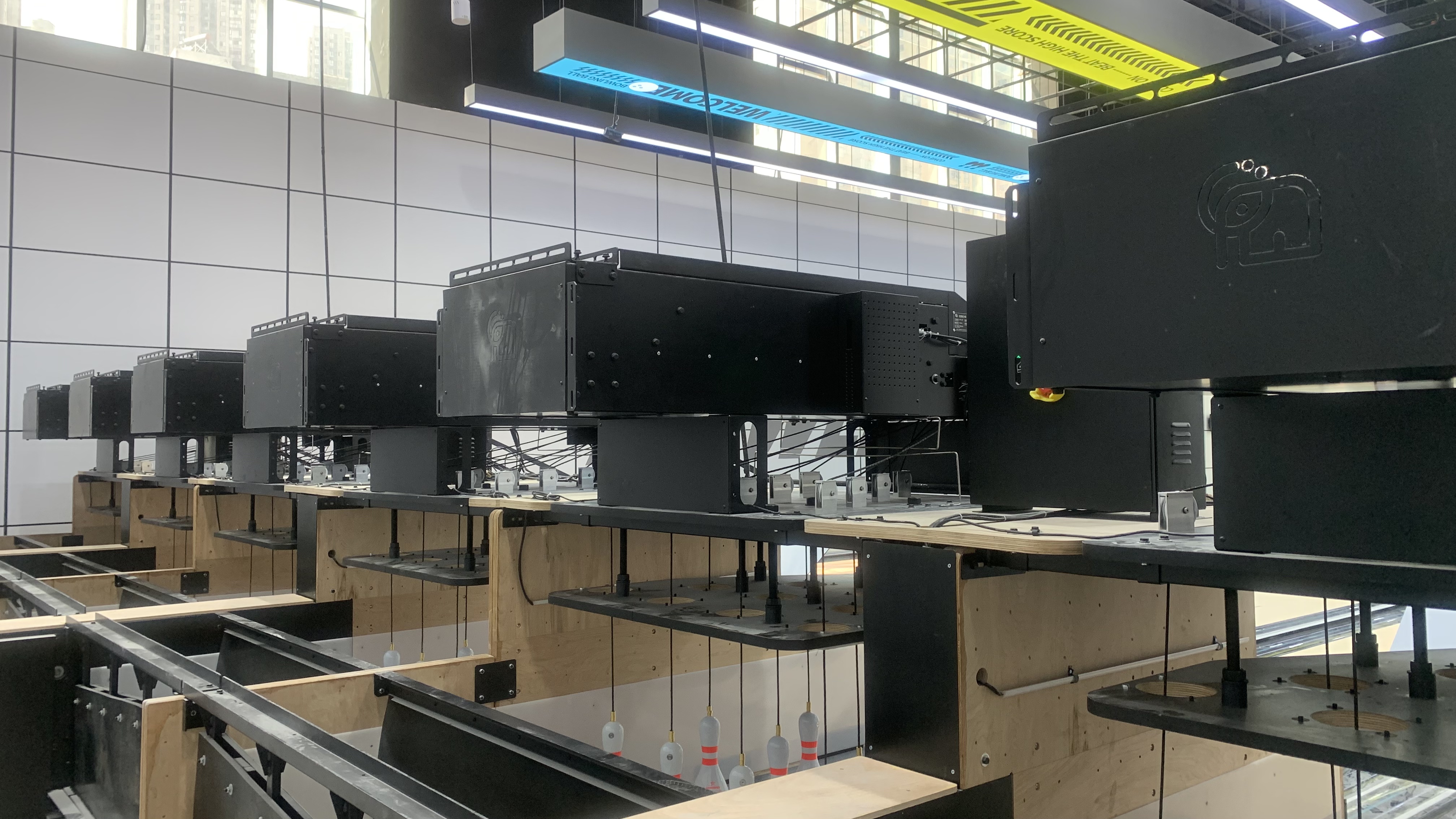
Specification table: what each figure changes in daily operation
| Specification | Stated value | What it changes on the floor | What to verify in the RFQ |
|---|---|---|---|
| Return speed | Under 12 seconds | How long a bowler waits between shots; a slow return reads as queueing on busy lanes | How the time is measured (pit to tray) and whether it is timed in the acceptance trial run |
| Jam failure rate | 0.002% stated, against a 0.02%–0.05% category average | Number of lane stoppages and the staff time each one consumes | Definition of a jam, the denominator, and the test record behind the figure |
| Track length | 18–26 m, customizable | Whether the return fits the building or forces civil works | Measured lane length and the alignment between track and pinsetter pit |
| Power | 220 V, about 2000 W per lane | Circuit planning, breaker allocation and machine-room layout | Per-lane circuit schedule; for duckpin and mini, 3 kW per 2 lanes and one 16 A outlet per 2 lanes |
| Construction | Metal and acrylic | Load-bearing structure with visible sections for spotting a stopped ball | How covers are removed and how the frame is fixed to the floor |
| Self-check and diagnostics | Built-in self-check and self-diagnostic logic | Faults reported as states rather than described as symptoms | Where fault states display, whether they are retained, and what support needs from the venue |
| Quality control | 100% pre-shipment test | The unit is run before it leaves the factory | Copy of the pre-shipment test checklist and the commissioning report |
| Warranty and support | 1-year warranty, remote technical support, long-term software upgrade service | Defines the support path after handover | Response channel, escalation contact and spare-parts route |
Frequently asked questions
What certification documents come with a lane package that includes a ball return system?
SunEye's bowling equipment portfolio holds CE, LVD and MD documentation issued through UDEM, plus a RoHS attestation of conformity, and its lane surface is approved under USBC certificate 003-25-LP (issued 30 July 2025). Each certificate carries a scope statement naming the equipment and market it covers, so ask for the copy that matches your exact configuration and destination market rather than accepting a general compliance statement.
Is SunEye an OEM bowling equipment manufacturer with in-house string pinsetter integration?
Yes. SunEye offers OEM, ODM and custom production, and its stated workshop scope covers lane processing, pinsetter assembly, scoring-system testing and equipment commissioning, so the string pinsetter, ball return and scoring system are assembled and tested within the same production flow. Customization covers bowling lane length, lane logo, masking unit (wallpaper, soft-film lightbox or LED screen wall), guardrails and stairs. MOQ is 2 units, stated monthly capacity is 200 units, and production lead time is 30–45 days.
What drives the price of a ball return system inside a lane package?
Price is configuration-driven, and no list price is stated in the equipment data available for this article. The variables that move a quote are lane count, the customized track length between 18 m and 26 m, lane logo and masking-unit treatment, guardrails and stairs, and delivery terms, since FOB, EXW, CIF and DDP are all accepted. Because public price benchmarks in this category are scarce and configuration-dependent, the reliable method is to send one fixed configuration to several suppliers and compare like for like.
Does lane length change how the return system is specified?
Yes. Standard bowling uses an international pitching distance of 18,288 mm with a total equipment length of 25,500 mm, and SunEye supports ball length customized to the field size, with 18 m generally the minimum field length for an installation that still plays properly. Format changes the footprint too: standard bowling needs roughly 26 m, duckpin roughly 10 m and mini bowling roughly 13 m. The return track is therefore quoted against the measured length, which is exactly why the 18–26 m range exists.
Can we validate the return system before the venue opens?
Acceptance happens after installation. SunEye's stated acceptance procedure is a full inspection and trial run covering appearance and installation, pinsetter and ball return, scoring system, electrical and control, and safety, and every unit also passes a 100% pre-shipment test. A separate sample-lane policy is not stated in the available data, so confirm it in the RFQ if you need a physical sample before committing to a multi-lane order.
What lead time and delivery terms apply?
The stated figures differ slightly between documents, which is worth pinning down in the contract: the capability data gives a production lead time of 30–45 days, while the purchasing terms state delivery within 30 days of deposit receipt and shipment within 5 days of full payment. MOQ is 2 units, and payment is accepted by T/T, L/C, D/P, Alipay and credit card. Send your lane count and floor plan to inquiry@suneyebowling.com and the track length, power schedule and delivery window can be confirmed against your site.
Conclusion
A ball return system is specified by three numbers and one behaviour. The numbers are return speed (under 12 seconds on this system), jam failure rate (0.002% stated, against a 0.02%–0.05% category average) and track length (18–26 m, customized to the building); the behaviour is what the machine does when something goes wrong, which is where the built-in self-check and self-diagnostic logic earns its place. Around those sit the supporting figures that decide whether the specification survives contact with the venue: metal and acrylic construction, 220 V and about 2000 W per lane, 100% pre-shipment testing, and a 1-year equipment warranty with remote technical support.
For a commercial bowling center, the practical translation is straightforward. Speed keeps groups moving, jam rate keeps staff free for guests instead of cleared balls, and diagnostics shorten the outage when a lane does stop. A buyer who times the return cycle during the acceptance trial run, understands how the jam figure is defined, and knows what the diagnostic system reports will get a machine that behaves the way the specification promised.
Next step: share your floor plan, lane count and target opening date, and SunEye Bowling will confirm the return track length, the per-lane 220 V / 2000 W electrical schedule and the delivery window against your site.
Email: inquiry@suneyebowling.com · Tel/WhatsApp: +86 181-2743-1080 · Website: www.suneyebowling.com
Download the company profile and specification pack: SunEye Company Profile 2026
Have Questions or Need More Details?
Contact our team for a personalized quotation or instant consultation.
Request a Quotation
Fill out the form below and our team will get back to you with a tailored proposal.
WhatsApp Direct Chat
Prefer to chat in real-time? Message us on WhatsApp for instant assistance & quick answers.
- Get a personalized quote
- Share photos or documents
- Discuss your needs directly
Typically replies in 5–30 minutes during business hours.