
Standard vs Duckpin vs Mini Bowling Pins: A Comparison Guide for Buyers
Pin format is one of the few decisions in a bowling project that cannot be reversed later without touching the lane, the pinsetter, the ball return and the scoring configuration. This guide compares the three pin formats that SunEye Bowling builds into commercial systems — the Standard Bowling Pin used in ten-pin standard bowling, the ten-pin duckpin format used in Duckpin Bowling Equipment, and the ten-pin mini format used in Mini Bowling Equipment — against published specification data, and translates that data into practical evaluation criteria for venue operators who have already passed the discovery stage and are now deciding what to install, at what footprint, and with which pin supply plan.
Problem Definition: Why Pin Format Is a System-Level Decision
In bowling equipment, a pin is never a standalone consumable item in the way that a shoe rental is. The pin is specified as a parameter of the whole system, which means pin type, pinsetter, ball weight, lane length and scoring configuration are defined together. All three SunEye formats — Standard Bowling, Duckpin Bowling and Mini Bowling — are specified as ten-pin configurations, so the number of pins is not what separates them. What separates them is pin construction, ball weight, lane length, per-lane power demand and the venue envelope each system requires.
Three buying mistakes are common at the evaluation stage. The first is comparing pin formats on the basis of headline footprint alone, without confirming whether the floor and ceiling can physically accept the pinsetter and the masking unit. The second is assuming pins are interchangeable between formats, which they are not, because the pin type is written into the equipment specification rather than treated as a separate accessory choice. The third is buying pins without a spares and re-order plan, even though the pin is the part of a bowling centre that carries the most traffic from the day the doors open.
This guide therefore answers one question: given a fixed amount of indoor floor space and a defined visitor profile, which pin format should a venue operator commit to, and what should the procurement package contain?
Industry Background: Why Three Pin Formats Now Coexist
Bowling is defined as a target sport and recreational activity in which a player rolls a ball toward pins (pin bowling) or toward another target (target bowling). Commercial pin bowling, the segment relevant here, has always been dominated by the ten-pin format, but the venue types that buy bowling equipment have diversified. Family entertainment centres, bars and restaurants, hotels and resorts, and shopping and leisure centres now specify bowling as one attraction among several rather than as the whole business — and those venue types rarely have the 26-metre depth that a full standard ten-pin lane run requires.
Two regulatory and trade facts shape how these formats are specified internationally. First, bowling equipment sits under Harmonized Tariff Schedule subheading 9504.90.9060, which covers bowling pin setter machine parts and accessories; the applicable rate of duty is free. Second, string pinsetters — the pinsetting style used across the three formats discussed here — are governed in the United States by USBC Chapter 95, active from 1 August 2023, under which USBC-approved string pin machines use longer strings of 54 inches to simulate free-fall action while minimising tangles.
On the supply side, SunEye Bowling (Guangzhou) Co., Ltd. is a Guangzhou-based bowling equipment supplier that operates a production base of nearly 6,000 square metres with around one hundred technical and production specialists, an R&D team covering hardware, software, electromechanical engineering and system integration, and an export share reported at 80% of output. Its product portfolio covers standard bowling equipment, duckpin bowling equipment, mini bowling equipment, string pinsetters, bowling lanes, ball return systems, scoring systems, bowling pins and bowling balls.
Detailed Solution: The Published Specification Set for Each Pin Format
What follows is the specification data that is actually published for each format. Where a parameter is not published, it is marked as such rather than estimated, because an unsupported pin dimension is worse than a missing one during a factory audit.
Standard Bowling Pin (380 mm, 1,618 g)
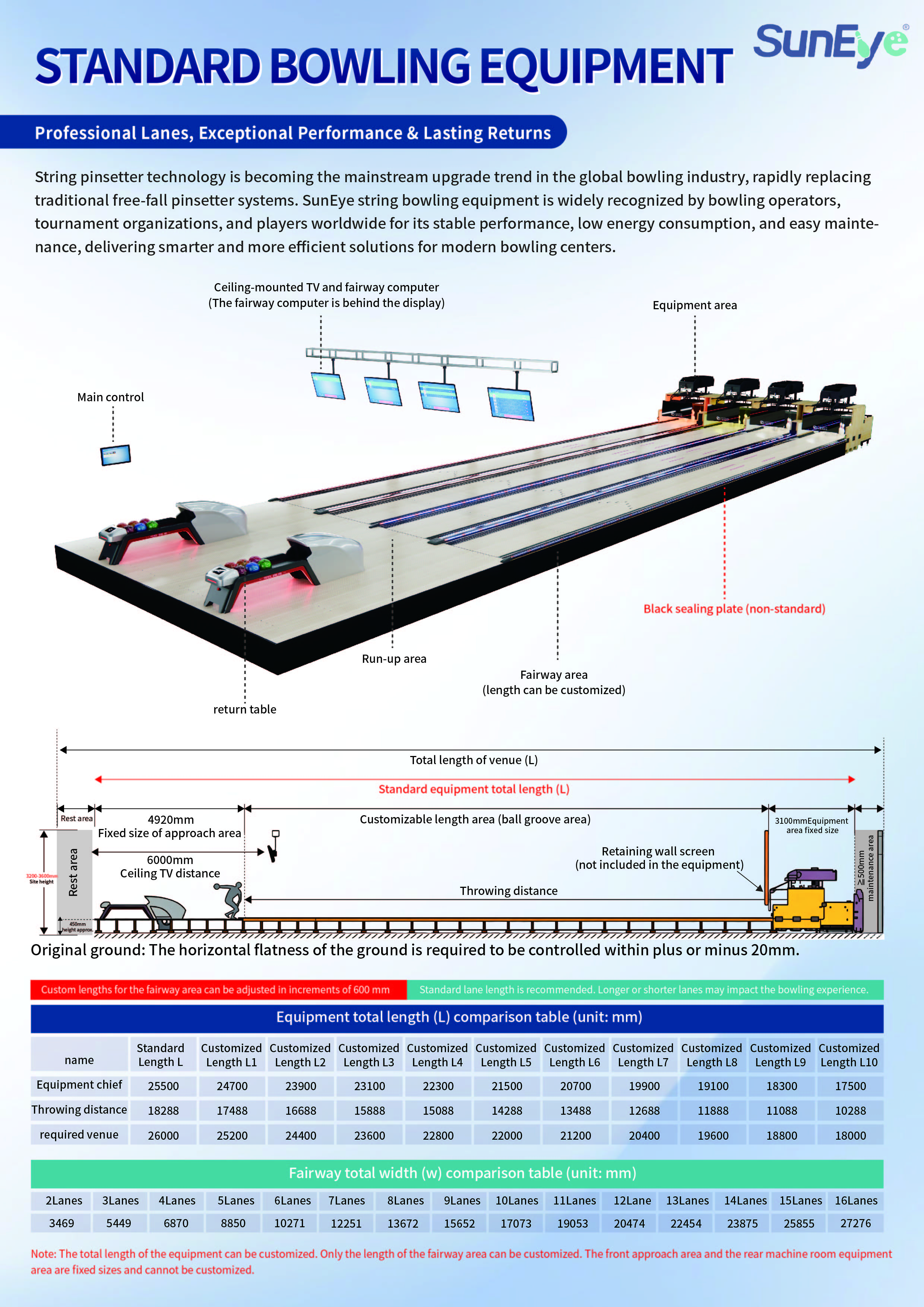
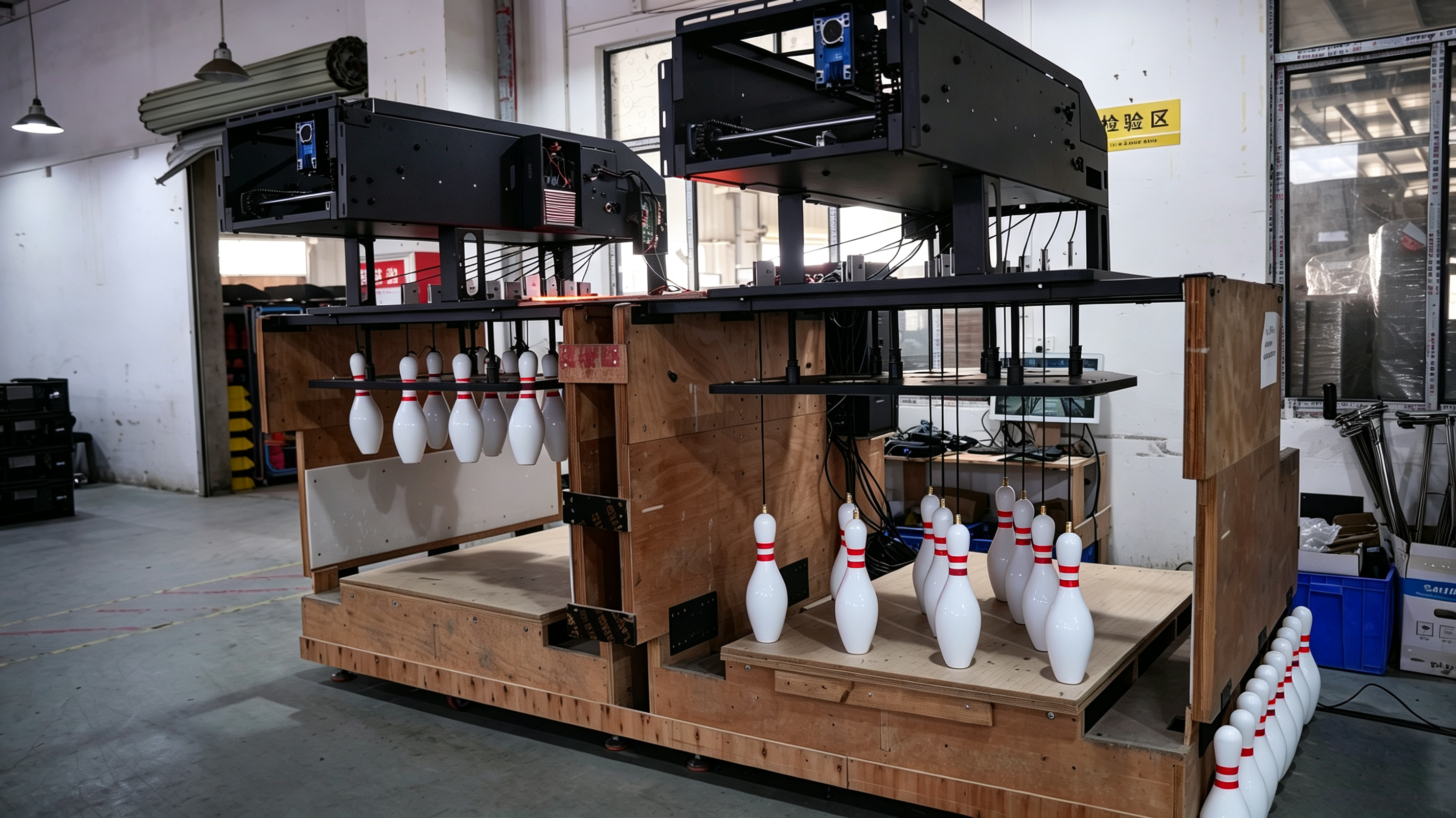
The Standard Bowling Pin carries the most complete published pin data of the three formats. It is specified at a height of 380 mm and a weight of 1,618 g, manufactured from maple wood and plastic, and certified to USBC-Certified as well as CE, LVD and MD. It is packed in carton boxes with a stated delivery time of 40 days, and it is intended for bowling centres, FECs and sports and recreation centres.
The system that consumes this pin is the Standard Bowling Equipment: a two-lane footprint of L25.5 m × W3.5 m × H3.2 m, with lane length customisable between 17.5 m and 25.5 m. Rated ball weight is 8–11 pounds; pin type is ten-pin bowling; the pinsetting style is a string pinsetter machine; construction is metal, wooden and synthetic material; and the packing is a wooden box. The published venue conditions are a minimum envelope of 3.5 m wide × 18 m long × 3.2 m high above floor level, a floor load capacity of 250 kg per square metre, ordinary 220 V supply with a rated power of approximately 2,000 W per lane, and support for more than two lanes with unlimited linkage. The international standard pitching distance is 18,288 mm, corresponding to a total equipment length of 25,500 mm.
Duckpin Bowling Pin Format (Ten-Pin Duckpin)
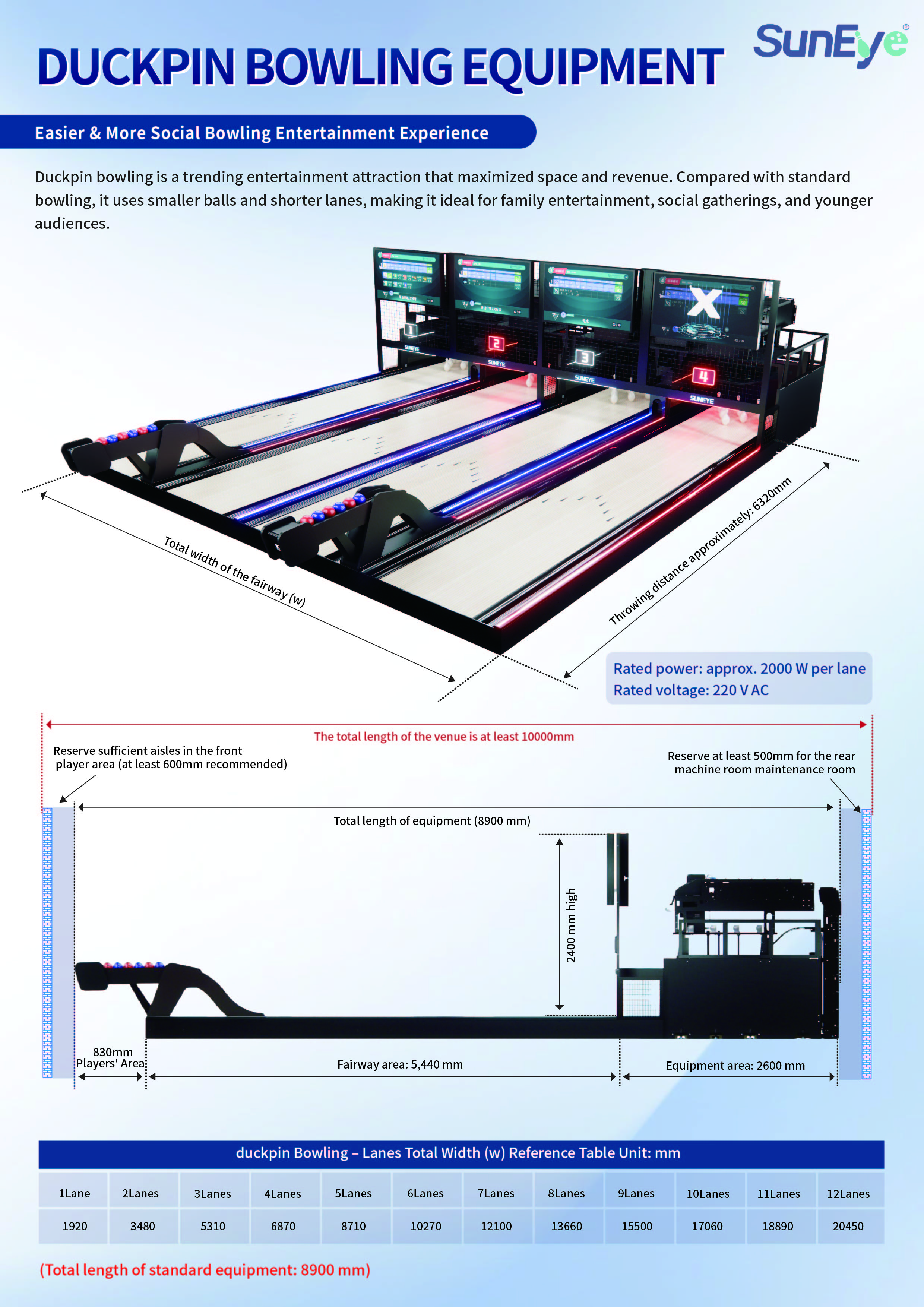
The Duckpin Bowling Equipment is specified with a pin type of ten-pin duckpin bowling and a ball weight of 3.3–3.75 pounds. That ball weight is the single most consequential number in the format: it sits roughly one third of the way up the 8–11 lb range used by the standard format, which changes who can play, how the ball behaves off the lane surface, and how the ball return is loaded. The published system envelope is L10 m × W3.48 m × H2.4 m for two lanes, with a rated voltage of 220 V and a rated power of 2,000 W per lane. Construction is metal, wooden and synthetic material, pinsetting is by string pinsetter machine, packing is by wooden box, and certification is USBC-Certified, CE, LVD and MD.
Venue conditions published for duckpin installation are: equipment dimensions of 10 m long × 3.48 m wide × 3 m high; a recommended finished ceiling height of 3,000–3,500 mm, with the highest equipment point at the scoring monitor frame roughly 2,400 mm above the floor; a solid, hardened floor with a level difference under 20 mm; power consumption of approximately 3 kW per two lanes with one 16 A outlet in the machine room per two lanes, with all other equipment power distributed internally; and recommended protective barriers around the machine room area. There are no special requirements for the side walls along the lanes.
Mini Bowling Pin Format (Ten-Pin Mini)
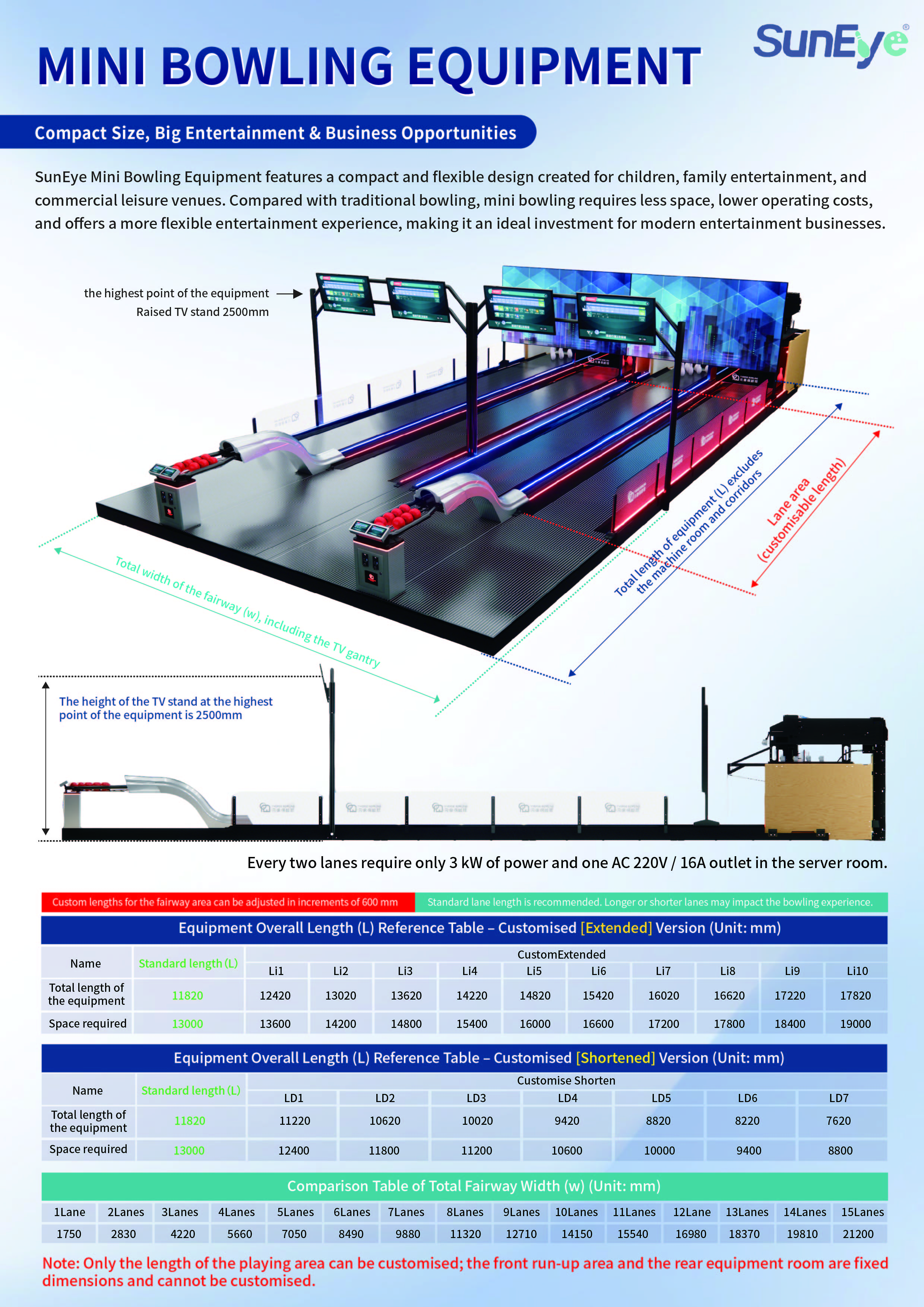
The Mini Bowling Equipment is specified with a pin type of ten-pin mini bowling and the same 3.3–3.75 pound ball weight band as the duckpin format. Its two-lane envelope is L13 m × W2.83 m × H2.5 m, with lane length customisable between 13.6 m and 19 m — the narrowest two-lane footprint of the three systems, at 2.83 m across. Pinsetting is by string pinsetter machine, construction is metal, wooden and synthetic material, certification is USBC-Certified, CE, LVD and MD, and packing is a wooden box.
Published installation conditions mirror the duckpin format: a two-lane footprint of 13 m long × 2.83 m wide × 3 m high, a recommended finished ceiling height of 3,000–3,500 mm with the highest point at approximately 2,400 mm, a solid hardened floor with a level difference below 20 mm, approximately 3 kW per two lanes and one 16 A outlet per two lanes in the machine room, plus optional protective barriers around the machine room.
What the Published Data Covers — and What It Does Not
Pin height and pin weight are published for the Standard Bowling Pin only (380 mm and 1,618 g). For the duckpin and mini formats, the published specification identifies the pin type — ten-pin duckpin bowling and ten-pin mini bowling respectively — and the ball weight range, lane footprint, voltage and power, but not the pin's individual height and weight. Buyers who need those two figures for a tender document or a customs description should request the technical specification drawing for the specific format rather than extrapolating from the standard pin, because a scaled-down pin is not automatically an equivalent pin.
Comparison Table: Standard vs Duckpin vs Mini Bowling Systems
| Parameter | Standard Bowling | Duckpin Bowling | Mini Bowling |
|---|---|---|---|
| Model name | Standard Bowling Equipment | Duckpin Bowling Equipment | Mini Bowling Equipment |
| Pin type | Ten-pin bowling | Ten-pin duckpin bowling | Ten-pin mini bowling |
| Published pin specification | Standard Bowling Pin: 380 mm height, 1,618 g, maple wood & plastic | Pin type published; individual pin height / weight not stated in the product data | Pin type published; individual pin height / weight not stated in the product data |
| Ball weight | 8–11 lb | 3.3–3.75 lb | 3.3–3.75 lb |
| Two-lane footprint (L × W × H) | 25.5 m × 3.5 m × 3.2 m | 10 m × 3.48 m × 2.4 m | 13 m × 2.83 m × 2.5 m |
| Customisable lane length | 17.5–25.5 m | Not stated in the product data | 13.6–19 m |
| Pinsetting style | String pinsetter machine | String pinsetter machine | String pinsetter machine |
| Electrical | 220 V, approx. 2,000 W per lane | 220 V rated, 2,000 W per lane | Approx. 3 kW per two lanes, one 16 A outlet per two lanes |
| Certification | USBC-Certified, CE, LVD, MD | USBC-Certified, CE, LVD, MD | USBC-Certified, CE, LVD, MD |
| Packing | Wooden box | Wooden box | Wooden box |
| Typical fit | Traditional bowling centres and league play | Bars, restaurants, FECs, social entertainment venues | Children's centres, family entertainment venues, compact spaces |
Step-by-Step Breakdown: How to Choose a Pin Format
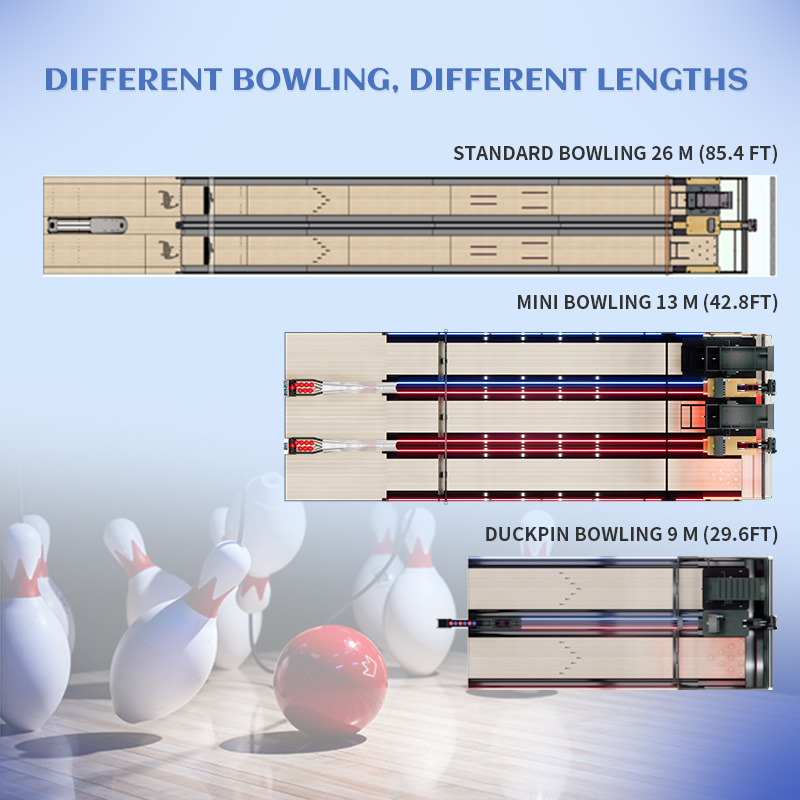
Step 1 — Fix the available lane length first. Published minimum lengths are approximately 26 m for standard bowling, approximately 13 m for mini bowling and approximately 10 m for duckpin bowling. If the site cannot produce at least 18 m of usable length, standard bowling is not a viable configuration, even though the standard system supports lane lengths from 17.5 m upward; the international standard pitching distance of 18,288 mm corresponds to a total equipment length of 25,500 mm.
Step 2 — Confirm the structural envelope. Duckpin and mini installations require a solid, hardened floor with a level difference under 20 mm, a recommended finished ceiling height of 3,000–3,500 mm, and a highest equipment point of roughly 2,400 mm at the scoring monitor frame. Standard installations require a floor load of 250 kg per square metre or above and a minimum envelope of 3.5 m wide × 18 m long × 3.2 m high.
Step 3 — Match ball weight to the visitor profile. Standard bowling operates on 8–11 lb balls, which suits adults and league play. Duckpin and mini both operate on 3.3–3.75 lb balls, which lowers the physical barrier for children, casual players and mixed groups — the primary reason both formats appear in family entertainment centres and social venues.
Step 4 — Lock the pin type to the pinsetter and scoring configuration. Because pin type is a system parameter (ten-pin bowling, ten-pin duckpin bowling or ten-pin mini bowling) and the string pinsetter is specified as a ten-pin machine, the pin format and the pinsetting system should be ordered as one package rather than as two separate line items.
Step 5 — Verify the compliance and import path. Confirm the certification set for the exact configuration (USBC-Certified, CE, LVD, MD are published for all three formats) and confirm the customs classification. Bowling pin setter machine parts and accessories fall under HTS 9504.90.9060 at a free rate of duty in the United States. For US-sanctioned competition, verify model-level status against the USBC string pinsetter approvals rather than relying on the general certification statement.
Step 6 — Build the pin and spares plan into the procurement schedule. The Standard Bowling Pin is packed in cartons with a stated delivery time of 40 days. Equipment lead time is 30–45 days, monthly production capacity is 200 units, and the minimum order quantity is 2 lanes — so pin re-orders and equipment orders should be sequenced against the same calendar rather than treated as separate purchases.
How Pin Choice Ties Into Pinsetter, Ball Return and Scoring
Pin choice propagates through three downstream components, and this is where the cost of getting it wrong becomes visible.
The pinsetter. The String Pinsetter Machine is specified as a 2,000 W, 220 V unit operating on ten pins, with a pin reset speed of 8 seconds. That reset figure sits inside the 10-second cycle that operators typically plan around for service tempo, and it is the reason string pinsetters are used across all three formats rather than only in compact ones. Because the machine operates on ten pins by specification, the pin type selected for the venue is the pin type the machine is configured to reset — they are not independently substitutable.
The ball return. The Bowling Ball Return System is specified at 2,000 W and 220 V with a return speed of 12 seconds and a return track length of 18–26 m, customisable. A standard lane run of 25.5 m therefore sits at the upper end of the published track range, while duckpin and mini layouts sit at or below the lower end — which is one reason compact formats can reuse the same ball-return architecture without a bespoke redesign.
The scoring system. Standing-pin recognition is produced by the scoring configuration, and the pin format is part of that configuration rather than an accessory to it. The published Scoring System & HD Score Display uses a 4.3-inch display at 1280 × 720 resolution and supports featured tournaments and a PK system, local or remote cross-store online PK, officially organised national challenge tournaments, and venue-published in-store challenge tournaments. In practice this means the pin format should be locked before tournament formats and display content are specified, because the matched equipment set for a delivery is defined as string pinsetter system, ball return system and scoring system together.

Use Cases: Which Format Fits Which Venue
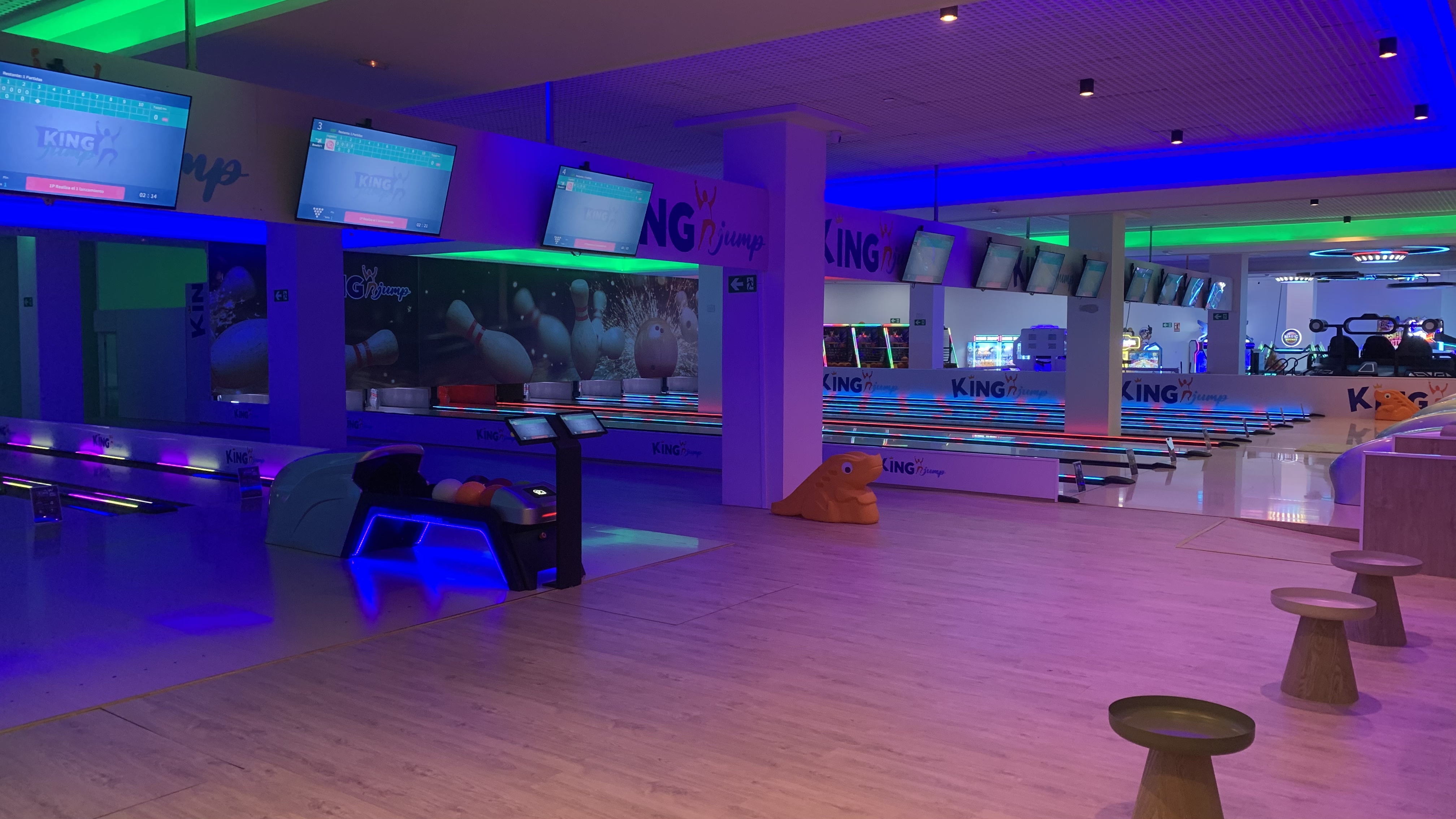
Twelve lanes inside a family entertainment centre (Spain). An 8,000 m² FEC combining trampolines, attractions and party facilities installed a 12-lane Standard Bowling configuration using ten-pin standard pins and 8–11 lb balls, positioned as a family and birthday-party attraction rather than a league installation.
Eight lanes in a professional bowling centre (Italy). Center World in Salerno took an 8-lane Standard Bowling system as the anchor attraction of a new entertainment and leisure destination — a case where the standard pin format and the full 25.5 m lane length were both acceptable because the building was purpose-designed.
Four lanes inside a large aluminium-frame tent (China). A 4-lane Standard Bowling project at Huayuehui Scenic Area in Tongchuan was installed inside a tent structure and integrated with high ropes courses and other recreational attractions — evidence that the pin-and-lane package can be delivered as a complete turnkey solution with easy maintenance and stable performance, even where the building shell is not a conventional bowling hall.
Six lanes inside a science and technology museum (China). Ignite Space, located inside the Sanming Science & Technology Museum, combined trendy sports, family entertainment and dining, and used a 6-lane Standard Bowling solution to extend its interactive entertainment offer. For venues of this type — where the bowling area competes with other attractions for floor space — the duckpin format (approximately 10 m) or the mini format (approximately 13 m) becomes the realistic alternative when the available length does not reach 18 m.
Reading across the formats: standard bowling suits traditional centres and league play; duckpin bowling is positioned for bars, restaurants, FECs and social entertainment venues; mini bowling is positioned for children's centres, family entertainment venues and compact spaces.
FAQ: Pin Format, Certification and Procurement Questions
Which certifications apply to SunEye bowling pins and bowling systems?
Standard Bowling Equipment, Duckpin Bowling Equipment and Mini Bowling Equipment are each published as USBC-Certified, CE, LVD and MD. The supporting certificate records include USBC certificate 003-25-LP, issued 30 July 2025 for the bowling lane surface under the USBC Equipment Specifications and Certification Manual; MD certificate M.2025.2026.C123751, issued 5 August 2025 by UDEM and valid to 4 August 2030; LVD certificate M.2025.2026.C123854, issued 6 August 2025 and valid to 4 August 2030; and RoHS attestation M.2025.2026.C123750, issued 5 August 2025 and valid to 4 August 2030. Because certification is issued per configuration, the exact model in the quotation should be checked against the certificate scope before purchase orders are raised.
Can SunEye supply OEM bowling equipment with in-house string pinsetter integration?
Yes. SunEye Bowling provides OEM services, ODM services and custom production services. Published customisation scope covers bowling lane length, bowling lane logo, the masking unit (wallpaper, soft-film lightbox or LED screen wall), guardrails and stairs. On the pinsetter side, the automatic string pinsetter is stated as suitable for standard bowling, duckpin bowling and mini bowling applications, and it is manufactured in-house — the production workshop covers lane processing, pinsetter assembly, scoring-system testing and equipment commissioning. That combination is what allows a buyer to specify one pin format, one pinsetter configuration and one scoring set as a single integrated package instead of sourcing them from separate suppliers.
What are the purchasing terms for a pin and lane order?
The published terms are: minimum order quantity of 2 lanes; delivery terms available as FOB, EXW, CIF and DDP; delivery within 30 days after receipt of the deposit, with goods shipped within 5 days of receiving full payment; and payment by T/T (bank transfer), L/C, D/P, Alipay or credit card. Pins themselves are packed in cartons, and the Standard Bowling Pin carries a stated delivery time of 40 days, which is worth planning separately from the equipment schedule.
How can a venue validate pin and system compatibility before installation?
Send the floor plan first. SunEye provides a free layout proposal based on the supplied plan, and a complete turnkey solution covering venue planning, CAD layout design, 3D rendering, equipment manufacturing, global shipping, installation, staff training and after-sales support. Before shipment, quality control includes 100% pre-shipment testing. After installation, a full inspection and trial run covers appearance and installation, pinsetter and ball return, scoring system, electrical and control, and safety — which is the point at which pin format, pinsetter behaviour and scoring configuration are verified together in the venue rather than on paper.
What is the lead time for pins and complete bowling systems?
Equipment lead time is 30–45 days, monthly production capacity is 200 units, and goods are shipped within 5 days of receiving full payment. The Standard Bowling Pin has a stated delivery time of 40 days, so pin supply and equipment supply should be scheduled on the same timeline to avoid a completed lane standing idle for want of pins. Current capacity, export ratio (80% of output) and after-sales scope — remote technical support, a one-year warranty on bowling equipment and long-term software upgrade service — should be confirmed in writing as part of the quotation. To start a project, send your floor plan to SunEye Bowling and request a layout proposal and quotation for the pin format you are evaluating.
Conclusion: Decide the Pin Format Before the Equipment List
The three formats are not three versions of the same product; they are three different venue propositions. Standard Bowling is the only format with a fully published pin specification — 380 mm height, 1,618 g, maple wood and plastic, USBC / CE / LVD / MD certified — and it carries the 8–11 lb ball range, which is why it remains the reference format for traditional centres and league play, provided the site can produce roughly 26 m of lane length or a customised run down to 17.5 m. Duckpin Bowling compresses the footprint to approximately 10 m with a 3.3–3.75 lb ball, and Mini Bowling compresses the two-lane width to 2.83 m with a 13 m base length customisable to 19 m, giving FECs, bars, hotels and family venues a format that fits an indoor room rather than requiring a purpose-built hall.
The decision rule is straightforward. Confirm the usable lane length, confirm the floor and ceiling envelope, then match the ball weight to the visitors you expect. Once the pin format is fixed, the pinsetter, ball return and scoring system follow as one specified set, and the procurement schedule should be built around a 30–45 day equipment lead time, a 40-day pin delivery time and a minimum order of 2 lanes. Where pin height and weight data matter for a tender or customs description, request the format-specific technical specification rather than inferring a compact pin from the standard pin — the document, not the assumption, is what protects the project.
Next step: send your floor plan, target lane count and preferred pin format, and receive a free layout proposal, equipment quotation and pin schedule for standard, duckpin or mini bowling.
Email: inquiry@suneyebowling.com | Tel / WhatsApp: +86 181-2743-1080 | Website: www.suneyebowling.com
Company profile and full product catalogue: download the SunEye Company Profile (PDF).
Have Questions or Need More Details?
Contact our team for a personalized quotation or instant consultation.
Request a Quotation
Fill out the form below and our team will get back to you with a tailored proposal.
WhatsApp Direct Chat
Prefer to chat in real-time? Message us on WhatsApp for instant assistance & quick answers.
- Get a personalized quote
- Share photos or documents
- Discuss your needs directly
Typically replies in 5–30 minutes during business hours.