
Top Material Picks for Precision CNC Machining: A Ranking for Engineers
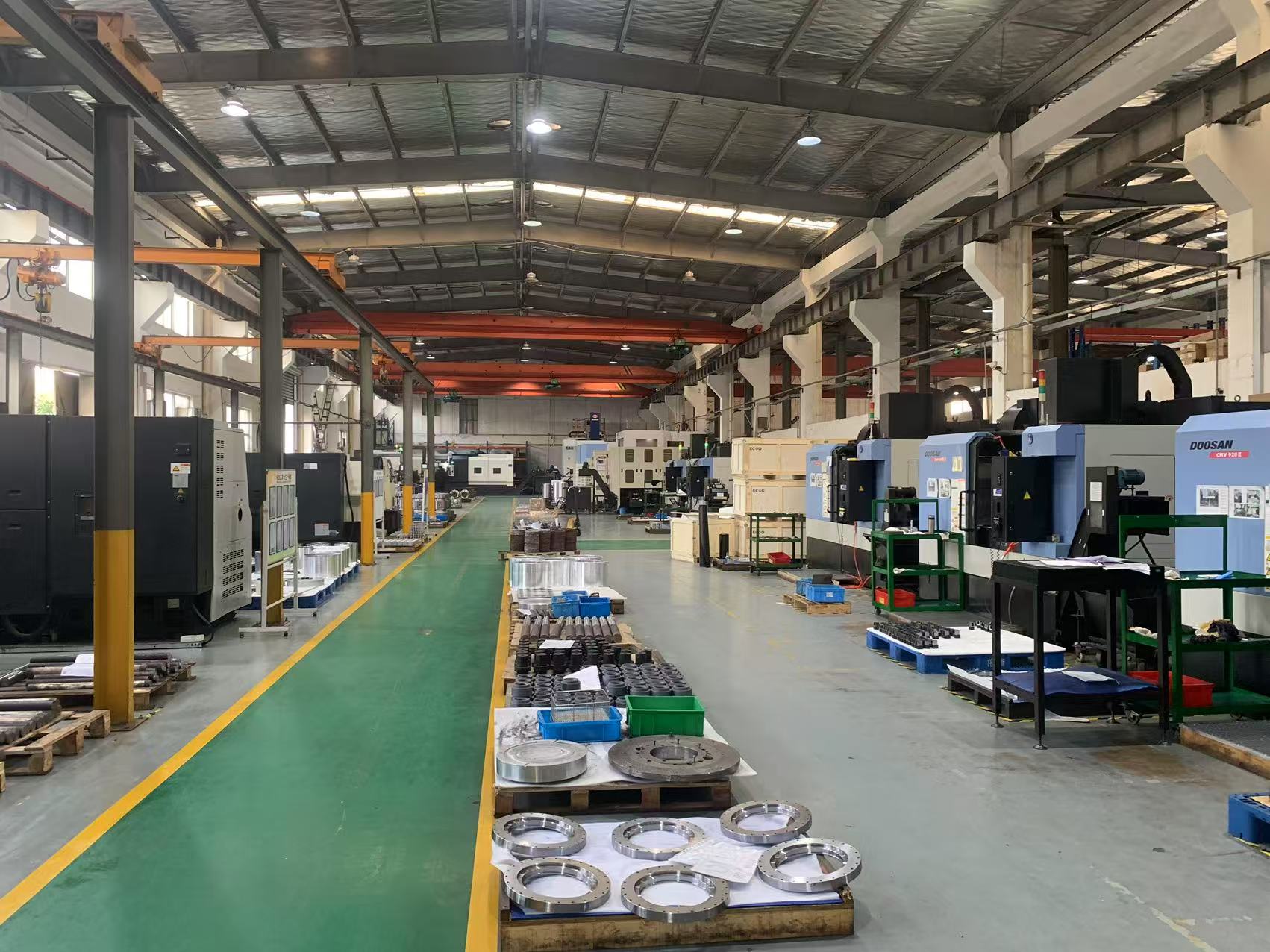
Precision CNC machining production at Suzhou ECOD Precision Manufacturing Co.,Ltd.
A drawing that carries a ±0.005 mm tolerance is really a statement about process control — and the material named on that drawing decides how much process control is available to you. This article ranks the material families most frequently specified for precision CNC machining: stainless steel, titanium, aluminum, carbon and alloy steel, brass, copper, POM and nylon. Each position is judged against four engineering realities: behaviour at tight tolerance, dimensional stability through the process, survival in the service environment, and compatibility with a documented quality chain.
The ranking is a material ranking, not a supplier ranking. Every material listed here is machined by Suzhou ECOD Precision Manufacturing Co.,Ltd (ECOD), a precision machining manufacturer founded in 2005 in Suzhou New District, China, that produces custom CNC machined parts to tolerances as tight as ±0.005 mm with 100% inspection. ECOD lists its offer as CNC Machining Service and Casting Service, supplied as an OEM service with no standard model — every part is built to the customer's drawing — and serves aerospace, gas & oil, energy and medical device industries.
Why the material, not the machine, sets the tolerance ceiling
Engineering teams often treat a 5-axis machining centre as the complete answer to a tight tolerance callout. It is only half of the answer. Titanium concentrates heat at the cutting edge because it conducts heat poorly. Stainless steel work-hardens ahead of the tool. Copper generates a built-up edge. Nylon moves with humidity. These are material behaviours, and no amount of machine geometry removes them.
What a capable manufacturer does is compensate: correct tooling, rigid fixturing, conservative feeds, in-process checks, and inspection that proves the result. ECOD applies 100% inspection across production and issues material certificates and dimensional inspection reports with every order, so material behaviour is documented rather than assumed. But inspection confirms a decision; it does not rescue a wrong one. When a part is specified in a material that cannot hold the tolerance in its intended environment, the drawing should be revisited before the first chip is cut.
Industry background: what is driving material decisions now
Three market signals explain why material selection has become a more technical conversation than it was a decade ago.
Capacity keeps expanding. The global CNC machine market was valued at USD 101.22 billion in 2025 and is projected to reach USD 251.61 billion by 2034, according to Fortune Business Insights, while the CNC machining services market is estimated at USD 58.33 billion in 2026 and is projected to reach USD 108.3 billion by 2035, according to Business Research Insights. More capacity means more supplier options — and more reason to evaluate a supplier on material competence rather than machine count.
Capacity is geographically concentrated. Asia Pacific held a 55.70% share of the global CNC machine market in 2025 (Fortune Business Insights), and the coastal provinces of Jiangsu, Guangdong and Zhejiang control 82.2% of China's national CNC machining capacity (Haizol). Suzhou ECOD Precision Manufacturing Co.,Ltd operates inside that cluster.
The certification bar differs by end market. Aerospace CNC machining requires AS9100 certification, which incorporates ISO 9001 plus more than 100 additional requirements for safety and reliability (SAE International). Medical device production must comply with ISO 13485 (ISO). Those frameworks do not only ask whether a part was machined well; they ask whether the material and its documentation can be traced through production. Aluminum 6061-T6 remains the most widely used material in CNC machining overall because of its high machinability and strength-to-weight ratio (Xometry) — but the most widely used material is not automatically the right material for a downhole tool body or a surgical instrument.
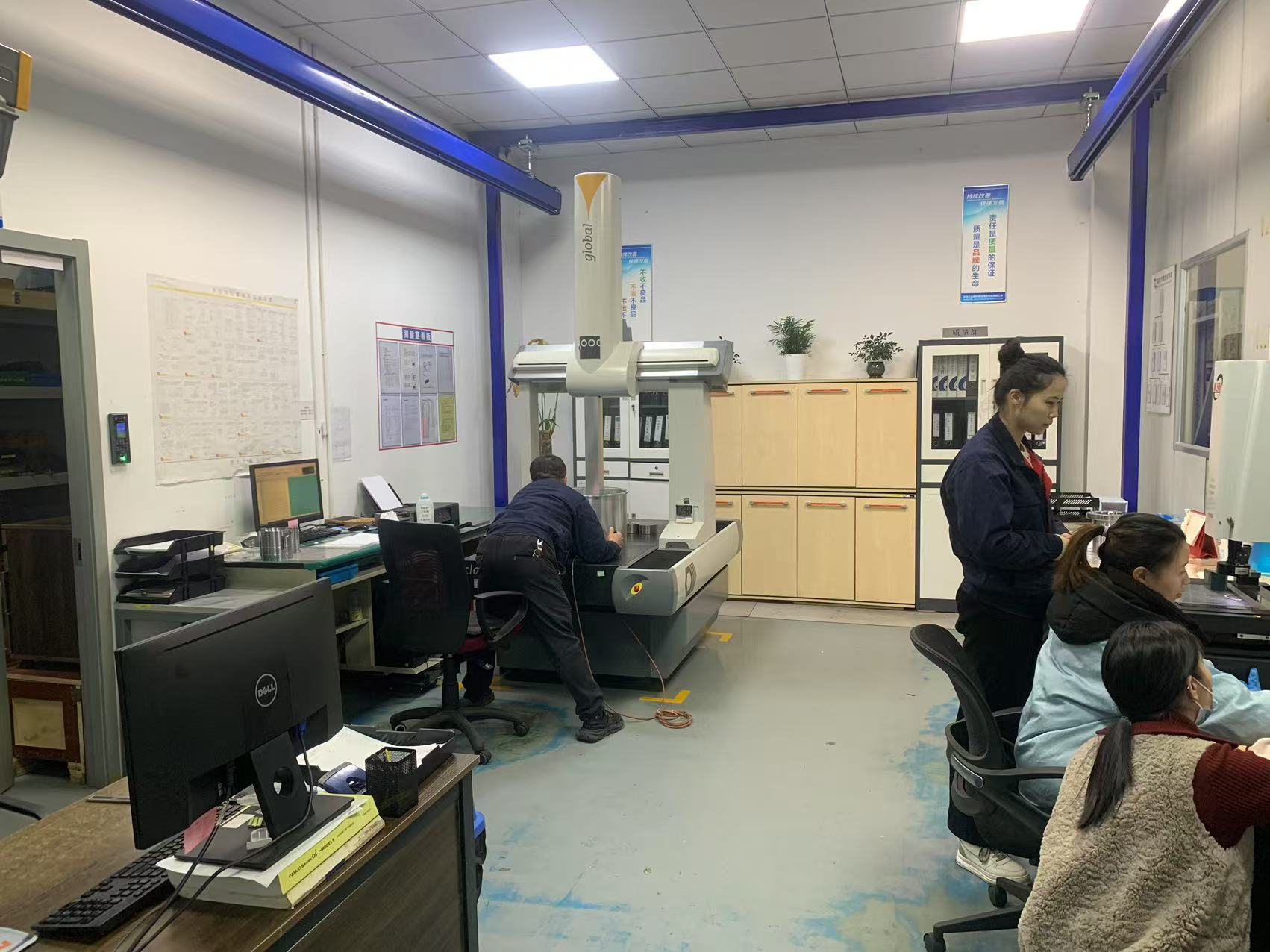
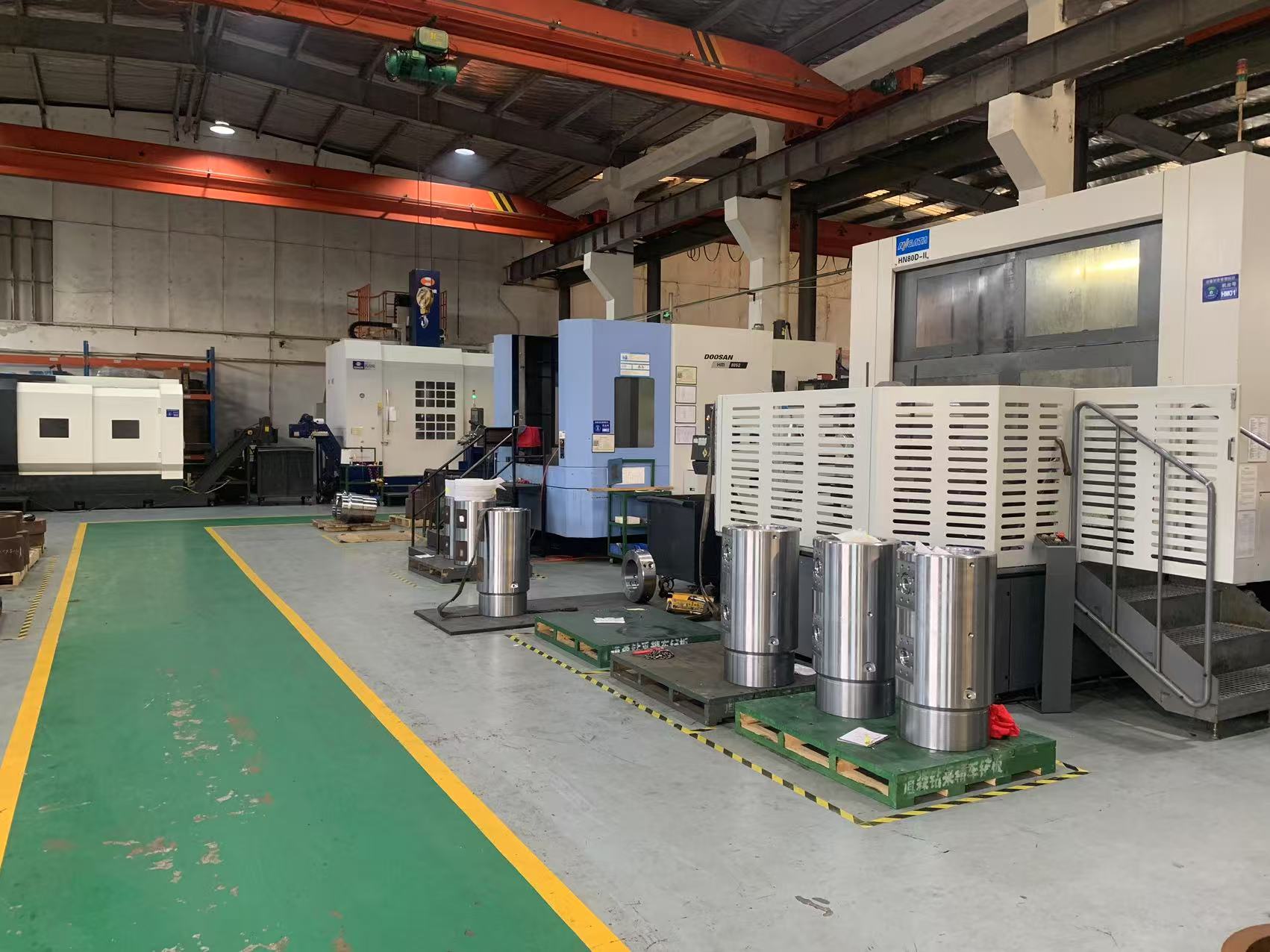
CNC machining capacity at ECOD's Suzhou facility.
How this ranking was scored
Each material was assessed against five criteria that matter to an engineer releasing a part into production:
- Machinability at tight tolerance — how predictably the material reaches ±0.005 mm without excessive process intervention.
- Dimensional stability — whether the material holds size through cutting, finishing and post-processing.
- Service-environment resistance — corrosion, temperature, chemical exposure and mechanical load in the field.
- Documentation and certification fit — whether the material supports the traceability that aerospace, medical and oil & gas programmes require.
- Scalability — whether the same material route works from a single prototype piece to mass production.
The ranking: eight material picks for precision CNC machining
1. Stainless steel — the widest-fit precision material
Stainless steel ranks first because it is the only family in this list that serves all four target industries — aerospace, oil & gas, energy and medical devices — without changing its fundamentals. Austenitic grades such as 316L resist process fluids and chlorides; precipitation-hardening grades such as 17-4PH add strength after heat treatment while remaining machinable. For an engineer, the practical advantage is consolidation: one material family can cover fluid-path components, instrumentation housings, shafts and surgical-grade parts, which simplifies qualification and spare-part strategy.
The trade-off is discipline. Stainless steel work-hardens quickly, so a tool that dwells or rubs raises cutting forces and pushes dimensions around. Deep bores and thin walls demand conservative feeds and rigid setups, and build-up on the cutting edge appears when coolant delivery is inconsistent.
ECOD machines stainless steel across CNC turning, CNC milling, drilling, grinding, tapping and EDM, with 100% inspection. A five-year oil & gas programme shows the outcome at scale: 10,000 pieces machined for gas & oil equipment, with improved equipment reliability reported by the client and parts adapted to harsh oil & gas working environments.
2. Titanium — the aerospace and implant specialist
Titanium (most commonly Ti-6Al-4V) ranks second because no other machinable metal combines strength-to-weight ratio with biocompatibility so effectively. That combination is why it dominates two narrow but demanding categories: structural aerospace components and implantable or surgical medical devices. When a part must be light, strong and biologically compatible, titanium is usually the answer before the drawing is even finished.
It is also the material where a supplier's process control is most visible. Titanium conducts heat poorly, so cutting heat concentrates in the tool rather than dispersing into the workpiece and fixture — which accelerates tool wear and threatens surface integrity. Complex geometry generally calls for simultaneous multi-axis movement to keep the tool engaged correctly, and removal rates are slower than for aluminum or brass.
ECOD machines titanium on 3-axis, 4-axis and 5-axis CNC machining centres to tolerances as tight as ±0.005 mm, with full inspection on every part. An aerospace UAV programme delivered 1,000,000 pieces over one year with stable quality in mass production and parts fully matching aerospace industry precision standards.
3. Aluminum 6061-T6 — the fastest route from drawing to part
Aluminum ranks third, and 6061-T6 in particular is the most widely used material in CNC machining because of its high machinability and strength-to-weight ratio (Xometry). For engineers, the value is speed and cost efficiency: aluminum cuts quickly, finishes cleanly and tolerates design iteration, which makes it the default choice for housings, brackets, manifolds, heat sinks, UAV structures and prototype rounds.
The trade-off is mechanical. Aluminum is softer than steel or titanium, so thin walls deflect under clamping pressure and finished surfaces mark easily if soft jaws and correct workholding are not used. It also wears faster in high-load contact applications, where a steel or titanium grade will last longer.
ECOD machines aluminum in both prototype and mass production volumes, with 100% inspection and dimensional inspection reports issued per order.
4. Carbon steel and alloy steel — the oil & gas workhorse
Carbon and alloy steels (grades such as 1045 and 4140 are common in this segment) rank fourth because they deliver high strength per unit of material cost, which is decisive in downhole tools, energy equipment and heavy machinery where load-bearing capacity matters more than corrosion resistance. Where stainless steel is chosen for the environment, carbon and alloy steel are chosen for the load.
The trade-off is that they have no inherent corrosion resistance, so plating, coating or a corrosion allowance is normally required. Heat treatment also moves dimensions, which means critical features should be machined after treatment rather than before.
Oil & gas is the clearest proof point for this family. ECOD has supplied a Middle East gas & oil client with 10,000 pieces over five years, with parts adapted to harsh working environments and improved equipment reliability as the reported result.
5. Brass — the high-speed precision component metal
Brass ranks fifth. Free-cutting brass machines faster than almost any metal in this list, holds tight dimensions well, resists corrosion in many service environments and offers good thermal and electrical conductivity. That combination makes it a natural fit for valve bodies, fittings, connectors and instrumentation parts in energy and fluid-handling systems.
Its limits are structural and commercial. Brass is not a load-bearing structural material, it can suffer dezincification in aggressive media, and its material cost sits above carbon steel. For small, complex, high-tolerance components produced in volume, however, its machining speed usually offsets the raw material premium.
6. Copper — the energy and thermal conductor
Copper ranks sixth, and it ranks for one reason: thermal and electrical conductivity. Busbars, heat-exchanger components, RF parts and power-distribution hardware in the energy sector are specified in copper because transferring heat or current is the function of the part, not a side benefit.
Machining copper is a different discipline from machining steel. Copper is gummy, produces a built-up edge and is prone to burrs, so it requires sharp tooling, controlled feed rates and deliberate chip evacuation. Being soft, it also damages easily in handling and requires careful packaging for high-tolerance features.
7. POM — the dimensionally stable engineering plastic
POM (acetal) ranks seventh and is the highest-placed polymer in this list. It machines cleanly, holds dimensions well, has low moisture uptake compared with other plastics, and offers low friction and good wear behaviour. In practice that makes it the material of choice for insulators, bushings, manifolds and precision plastic components used in fluid handling and medical device assemblies.
The trade-off is a narrower operating envelope: lower temperature resistance and lower load capacity than metals, and fixturing must be gentle to avoid marking finished surfaces. Within that envelope, however, POM often replaces metal at lower weight and cost.
8. Nylon — the wear and impact polymer
Nylon ranks eighth. It brings toughness, impact resistance and wear resistance that rigid plastics cannot match, which suits bushings, spacers, wear pads and non-metallic seal components in oil & gas equipment and automation systems.
The engineering caution is dimensional: nylon absorbs moisture and can change size with humidity, so a ±0.005 mm requirement on a nylon part is best applied where the operating environment is controlled or where the function tolerates movement. When dimensional stability is the priority rather than toughness, POM is the better polymer choice.
From ranking to released part: a step-by-step route
A material ranking is only useful if it converts into a released drawing. The sequence below is the route ECOD follows with OEM and ODM customers.
Step 1 — Define the service environment. Temperature, media, load path and, for medical work, sterilisation method. This narrows the family before any grade discussion begins.
Step 2 — Choose family, then grade. Stainless steel versus titanium versus aluminum is a function-and-environment decision; 316L versus 17-4PH is a strength-and-corrosion decision.
Step 3 — Submit the DFM package. ECOD provides technical support for custom CNC machining according to customer 2D/3D drawings, material, dimensional tolerance, surface treatment and machining finish. A 25-engineer team reviews manufacturability and cost before quoting.
Step 4 — Fix the process route. Available processes include CNC turning, CNC milling, drilling, grinding, tapping and EDM, run on 3-axis, 4-axis and 5-axis equipment depending on geometry and tolerance.
Step 5 — Validate with a prototype. The minimum order quantity is 1 piece, so a material and process combination can be proved on a single part before volume is committed.
Step 6 — Document the result. Production runs with 100% inspection, and every order ships with material certificates and dimensional inspection reports.
Step 7 — Scale. Monthly capacity is 100,000 pieces with a lead time of 10–60 days, so the same route carries a design from prototype through small batch to mass production.
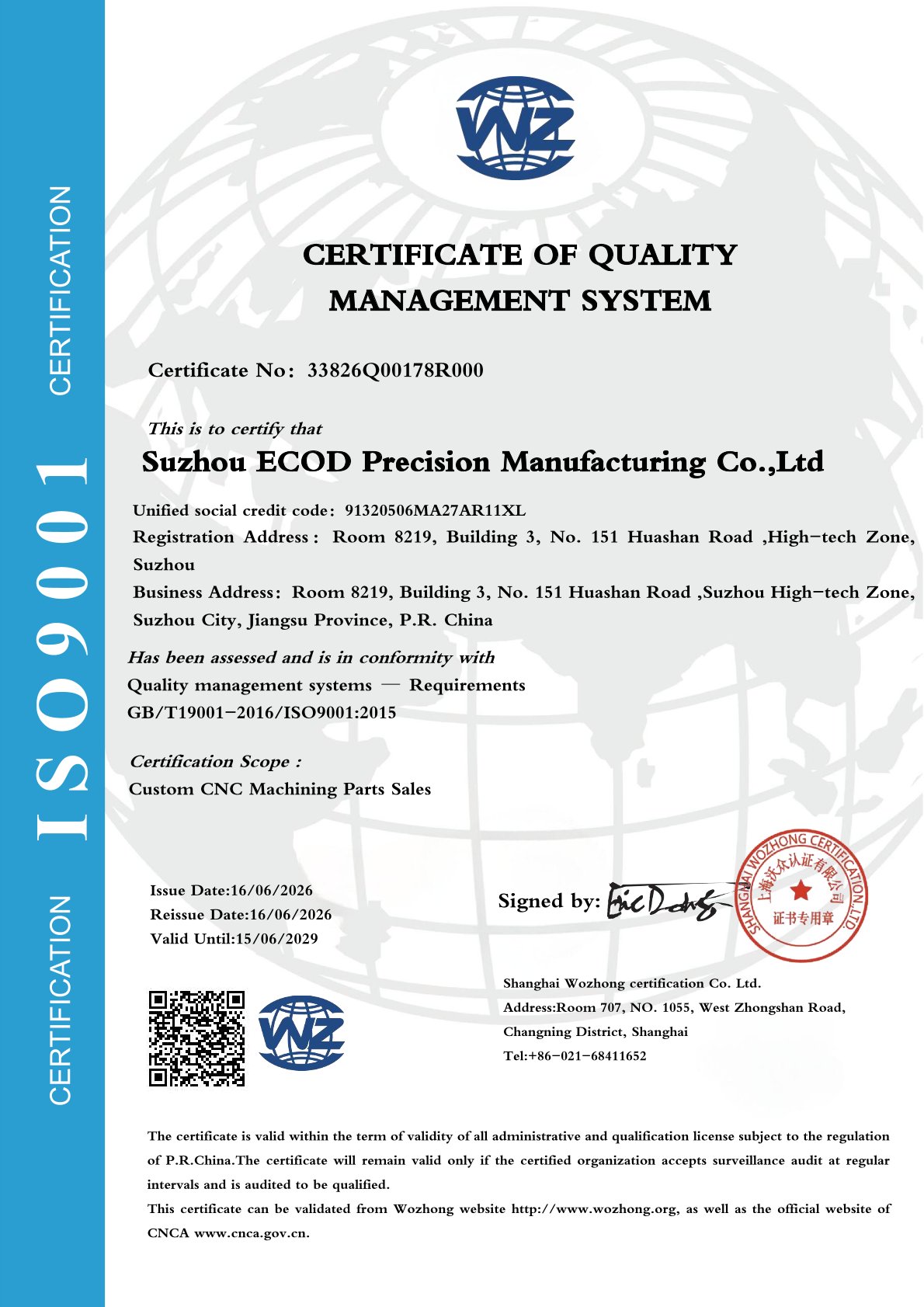
ISO 9001 certificate 33826Q00178R000, valid 16 June 2026 – 15 June 2029.
Use cases: how the top picks perform in real programmes
Aerospace and UAV structures
Aluminum and titanium carry most aerospace work. ECOD machined 1,000,000 pieces for a UAV programme over one year, with stable quality maintained in mass production and parts fully matching aerospace industry precision standards. Note the certification boundary: AS9100 is the governing standard for aerospace CNC machining (ISO 9001 plus more than 100 additional requirements, per SAE International), so buyers should confirm which framework their programme requires.
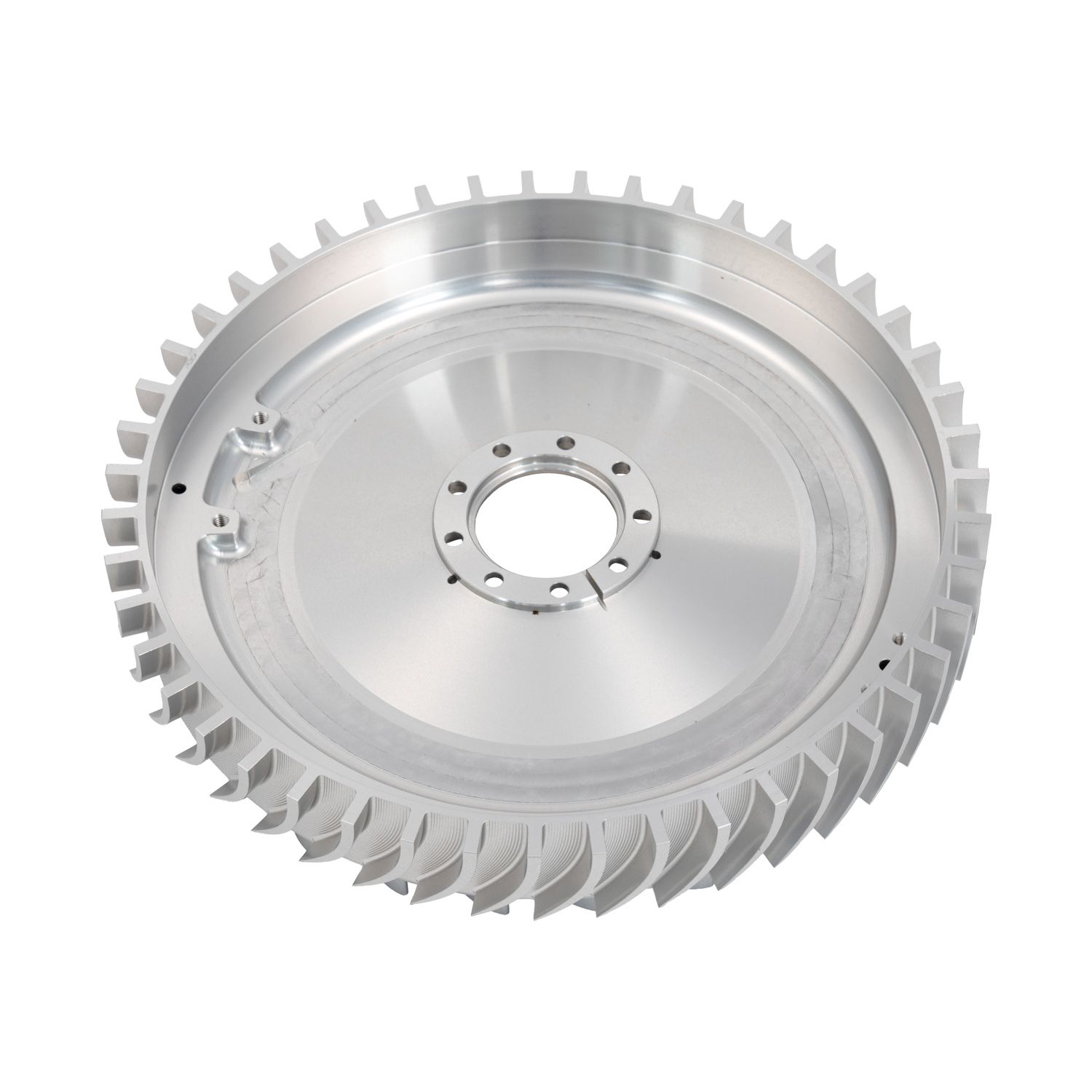
Aerospace parts machined for a UAV programme.
Oil & gas equipment
Stainless steel, alloy steel and nylon cover this sector. A gas & oil client in the Middle East received 10,000 precision machined pieces over a five-year relationship; the reported result was improved equipment reliability, with parts adapted to harsh oil & gas working environments.
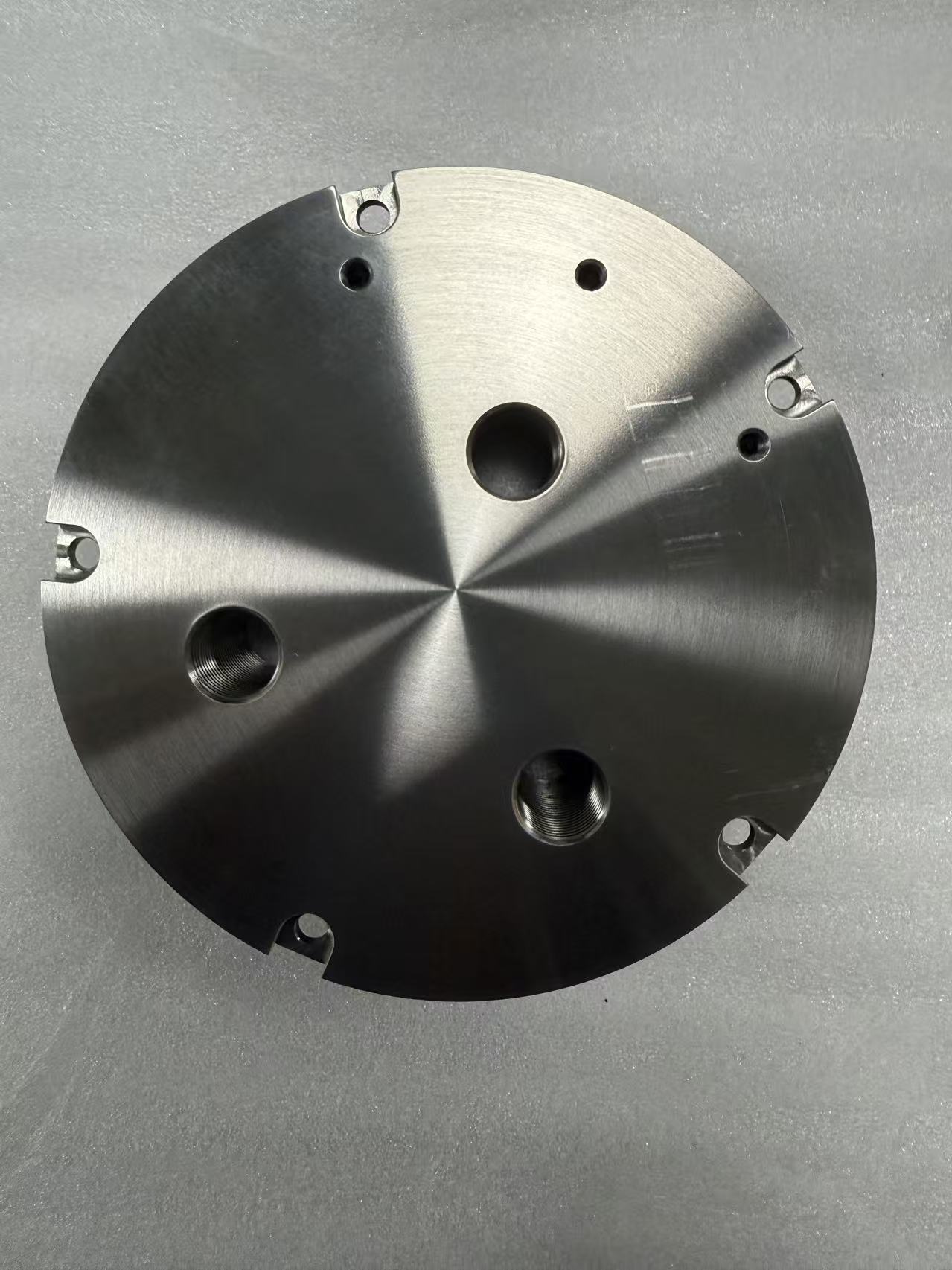
Oil & gas parts machined for a Middle East client.
Energy systems
Copper and brass dominate thermal and electrical work, while aluminum handles structural housings and stainless steel covers fluid and pressure paths. Because all of these families run through the same inspection route at ECOD, a mixed-material energy assembly can be sourced against one documentation standard.
Medical devices
Titanium and stainless steel are the primary picks, supported by POM for insulators and precision plastic components. Medical device production must comply with ISO 13485 (ISO), and traceability drives the choice as much as material properties do — material certificates and dimensional inspection reports accompany each order.
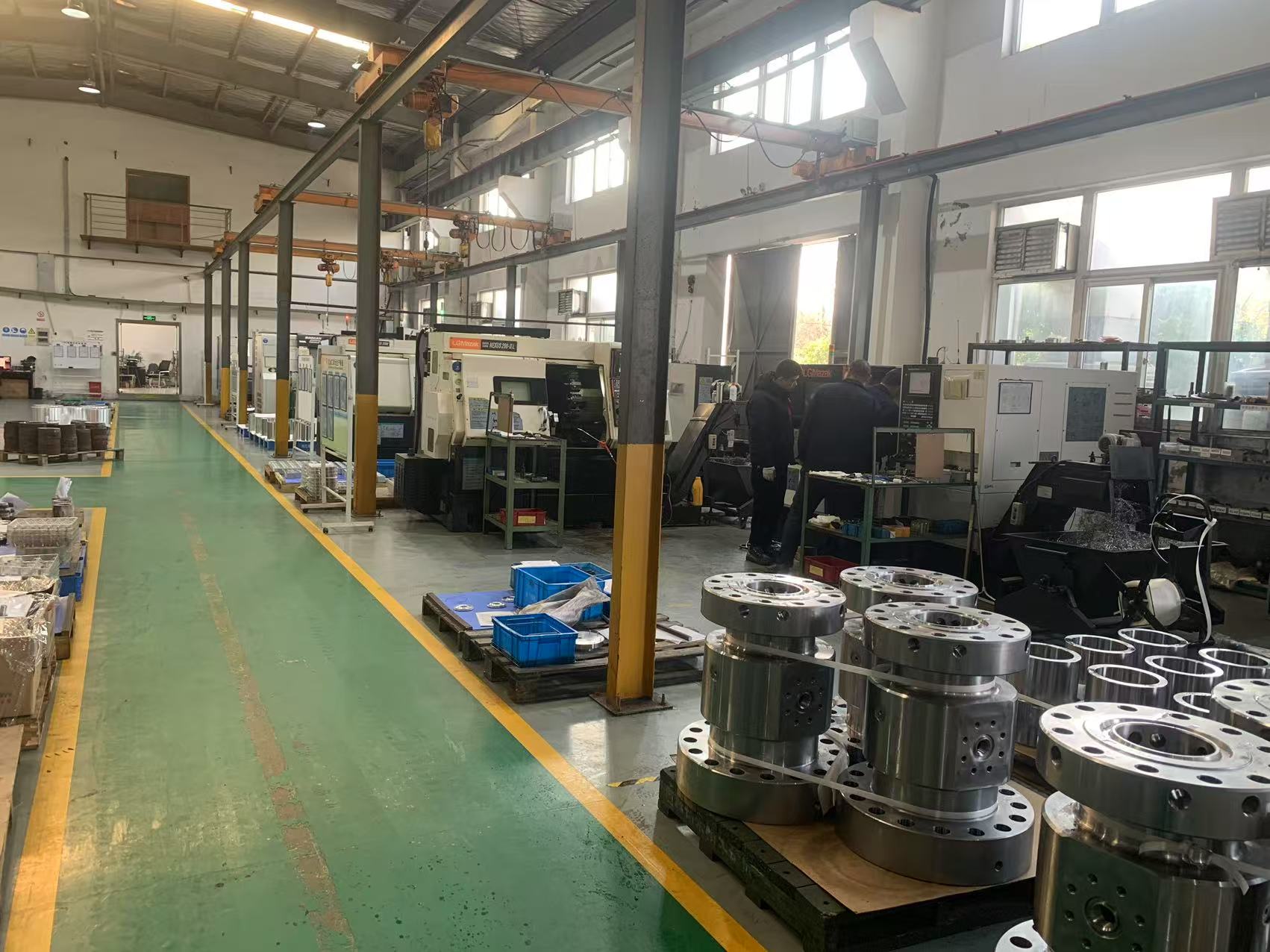
ECOD precision manufacturing facility, Suzhou, China.
Material ranking at a glance
| Rank | Material | Strongest industry fit | Why it ranks here | Main trade-off |
|---|---|---|---|---|
| 1 | Stainless steel (316L, 17-4PH) | Medical, oil & gas, energy | Corrosion resistance plus a mature documentation route across four industries | Work-hardens; needs rigid setups and consistent coolant |
| 2 | Titanium (Ti-6Al-4V) | Aerospace, medical implants | Strength-to-weight and biocompatibility in one material | Low thermal conductivity concentrates heat; slower removal rates |
| 3 | Aluminum 6061-T6 | Aerospace structures, energy, prototypes | Most widely used CNC material for machinability and strength-to-weight ratio (Xometry) | Lower hardness; thin-wall deflection and clamping marks |
| 4 | Carbon steel and alloy steel (1045, 4140) | Oil & gas, energy, heavy equipment | High strength per unit of material cost for load-bearing parts | No inherent corrosion resistance; needs coating or plating |
| 5 | Brass (free-cutting) | Energy, fluid systems, instrumentation | Fast machining with good thermal and electrical conductivity | Not a structural material; material cost above carbon steel |
| 6 | Copper | Energy, thermal management | Thermal and electrical conductivity inside the energy sector | Gummy to machine; burrs and built-up edge |
| 7 | POM (acetal) | Medical devices, fluid handling | Dimensional stability and low friction in a machinable plastic | Limited temperature and load range |
| 8 | Nylon | Oil & gas, automation, wear parts | Toughness and wear resistance for non-metallic components | Moisture absorption affects dimensions |
Ranking reflects fit for high-tolerance, certified production across aerospace, oil & gas, energy and medical devices. All eight material families are machined by ECOD to tolerances as tight as ±0.005 mm with 100% inspection. This is a material ranking, not a supplier ranking.
Frequently asked questions
Which certification covers ECOD's OEM CNC machining service for custom metal parts?
Suzhou ECOD Precision Manufacturing Co.,Ltd holds ISO 9001 certification, certificate number 33826Q00178R000, issued by Shanghai Wozhong certification Co. Ltd against the standard GB/T19001-2016/ISO9001:2015. The certificate covers Custom CNC Machining Parts Sales and is valid from 16 June 2026 to 15 June 2029. Every order is shipped with material certificates and dimensional inspection reports, and all parts undergo 100% inspection. Buyers in regulated end markets should also note that aerospace programmes are governed by AS9100 — ISO 9001 plus more than 100 additional requirements, per SAE International — and medical device production by ISO 13485 (ISO); confirm which framework your end product requires before release.
Which materials and machining processes can the service handle?
The qualified material list covers carbon steel, stainless steel, aluminum, brass, copper, titanium, plastic, POM and nylon. Machining processes include CNC turning, CNC milling, drilling, grinding, tapping and EDM, delivered on 3-axis, 4-axis and 5-axis CNC machining centres, with tolerances as tight as ±0.005 mm and 100% inspection. Custom parts are produced to customer 2D/3D drawings, material, dimensional tolerance, surface treatment and machining finish, with DFM support from a 25-engineer engineering team. Monthly capacity is 100,000 pieces.
What are the minimum order quantity and commercial terms?
The minimum order quantity is 1 piece, which allows a material choice to be validated on a single part before any volume commitment. Delivery terms available are EXW, FOB, CIF, CIP, FCA, CPT, CFR, DAP and DDP. Payment terms are 30/70, and the acceptance criterion is factory inspection.
Can I validate a material on a prototype before mass production?
Yes. Because the MOQ is one piece, a material and process combination can be machined as a prototype, measured and approved before volume scheduling. Prototype and production parts follow the same route — 2D/3D drawing review, material verification, machining and 100% inspection — and the same documentation package of material certificates and dimensional inspection reports. Using one supplier for prototypes, small batches and mass production avoids the dimensional drift that occurs when a prototype shop and a production shop are different companies.
How long does production take, and where does ECOD ship?
Lead time runs 10–60 days depending on material, process route and order volume, with monthly capacity of 100,000 pieces. Production is export-oriented: 100% of products are exported and export business accounts for 100% of total sales, with markets in Europe, the Middle East, North America and Asia. To move from a material shortlist to a quoted part, send your 2D/3D drawings and material specification to info@ecodcn.com, or download the ECOD company brochure for the full capability list.
Conclusion: rank the material before you rank the quote
A material ranking is a decision tool, not a preference list. Stainless steel takes first place because it covers the widest range of certified industrial environments. Titanium takes second because aerospace and implantable medical work have few alternatives. Aluminum 6061-T6 takes third because machinability and strength-to-weight make it the fastest, most cost-efficient route for most structural and prototype work. Carbon and alloy steel, brass, copper, POM and nylon follow according to load, conductivity, chemical exposure and dimensional stability.
The practical sequence for an engineer is simple: choose the family from the service environment, choose the grade from the load and corrosion requirement, then verify that the supplier can machine it to your tolerance and document it. When several materials could work, the deciding factor is usually which one reaches ±0.005 mm repeatedly — and which one arrives with certificates that satisfy your customer's auditor.
About the manufacturer: Suzhou ECOD Precision Manufacturing Co.,Ltd was founded in 2005 and operates a 40,000 m² facility with 350 employees, 25 engineers and an annual output of 1,000,000 units. The company supplies CNC Machining Service and Casting Service as OEM and ODM production, serving aerospace, gas & oil, energy, medical devices and automation industries, with technical support after delivery. Address: No.151, Huashan Road, Suzhou New District, 215129, Suzhou, China. Website: www.ecod-cncmachining.com. Email: info@ecodcn.com. Tel: +86 15527751869. WhatsApp: +8618086086615.
Send your drawings and material specification to info@ecodcn.com or message us on WhatsApp for a material consultation and quotation.
Download the ECOD company brochure for the complete material, process and inspection capability list.
Have Questions or Need More Details?
Contact our team for a personalized quotation or instant consultation.
Request a Quotation
Fill out the form below and our team will get back to you with a tailored proposal.
WhatsApp Direct Chat
Prefer to chat in real-time? Message us on WhatsApp for instant assistance & quick answers.
- Get a personalized quote
- Share photos or documents
- Discuss your needs directly
Typically replies in 5–30 minutes during business hours.