Cotton Seed Delinting Machine: Selection Parameters and Ginning Line Integration
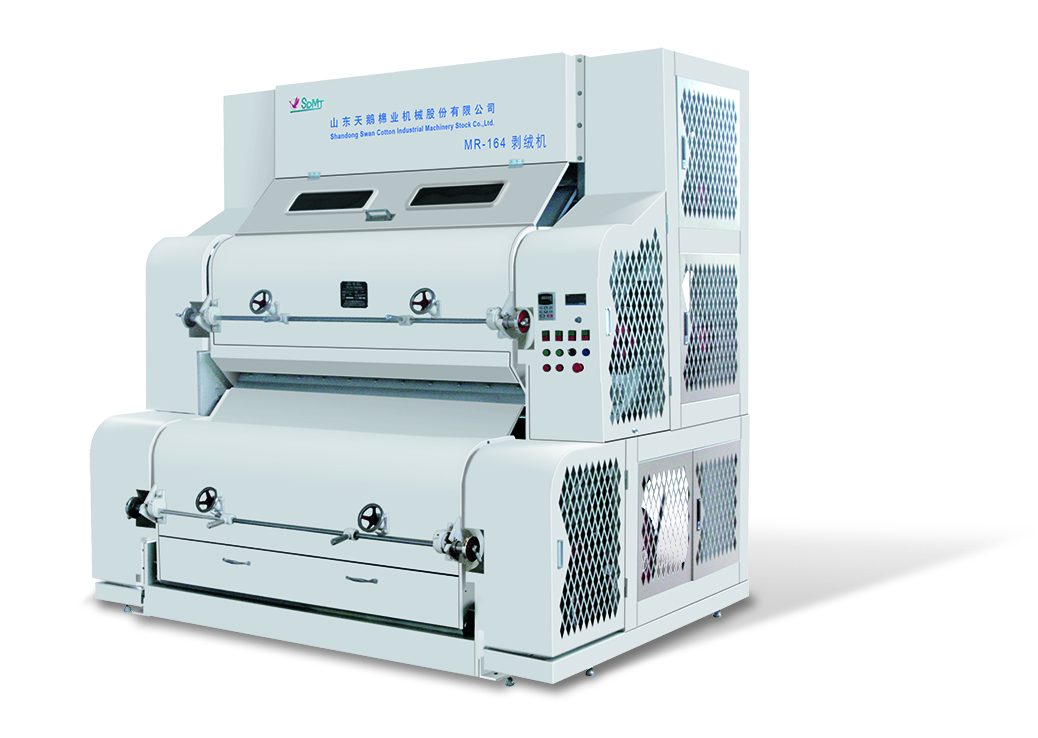
A cotton seed delinting machine is specified correctly when three things are fixed before the quotation is compared: the number of passes the seed lot needs, the mass flow that the delinting stage can actually sustain on its final pass, and the physical and electrical envelope the unit must fit into on an existing ginning line. Unit price alone does not describe any of these.
Delinting is not ginning. Cotton ginning separates lint from seed; delinting works on the seed that ginning leaves behind, removing the residual short fibre — fuzz or linters — so that the seed can be stored, treated, traded or pressed without that fibre interfering with the next process. Because the delinting stage sits downstream of the gin stand, every one of its parameters is inherited from the ginning line in front of it. That inheritance is where most specification errors begin.
Key points for plant engineers and procurement teams
- Delinting capacity is quoted per pass, ginning capacity is quoted per machine; the two numbers must not be compared until the basis is confirmed in writing.
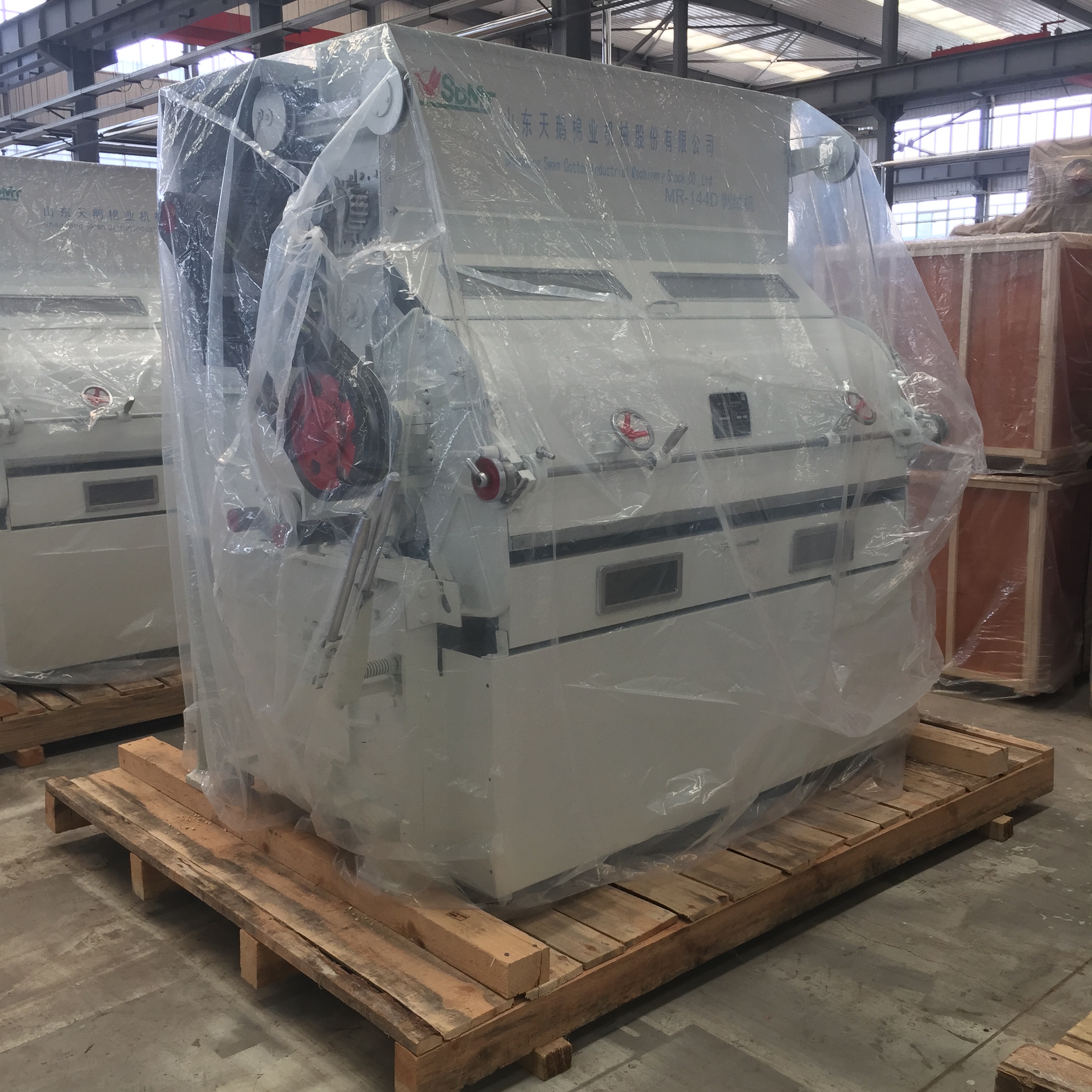
- The Swan MR-144D delinting machine is published at 3,500–4,500 kg/h on the first pass, 1,000–1,500 kg/h on the second and 750–1,000 kg/h on the third, so a multi-pass sequence is governed by the slowest pass.
- Equipped power is 24.35 kW for the delinting unit against 64.75 kW for the MY158-17 Saw Gin and 108.8 kW for the MYZ215-14.8 — delinting is a small electrical load, but it still has to appear on the panel schedule.
- Footprint (2,600 × 1,880 × 2,000 mm) and mass (2,500 kg) are modest compared with a gin stand, which makes it easy to install the unit where the saw cylinder cannot be serviced.
- No single international standard governs delinting performance; guarding, electrical and material documentation have to be written into the contract.
What a Delinting Machine Does Inside a Cotton Ginning Plant
In the saw-type configuration described here, a saw cylinder lifts residual short fibre from the surface of the cottonseed and a brush and air system carries that fibre away as linters. The seed leaves the machine with a lower residual lint content and a cleaner surface for downstream handling. The delinting machine does not produce lint for baling and it does not replace a saw gin or a roller gin in the lint line; it is a seed-processing unit positioned between the gin stand and seed storage, linter sales, or oil milling.
The functional consequence for a project engineer is straightforward: the delinting machine's inlet condition is set by the gin, not by the delinting supplier. Seed variety, moisture at ginning, trash content and the residual lint level left on the seed all arrive from upstream. Any delinting specification that does not state those inlet conditions is incomplete, regardless of how detailed the machine data sheet looks.
Why Delinting Is Frequently Under-Specified
Delinting is often bought late in the project, after the ginning line has been fixed and the building layout has been frozen. Four recurring problems follow from that sequence.
1. Capacity is quoted on different bases. The published parameter list for the Swan MR-144D Cotton Seed Delinting Machine states seedcotton processing capacity of 3,500–4,500 kg/h on the first pass, 1,000–1,500 kg/h on the second and 750–1,000 kg/h on the third. Ginning machines are quoted on their own basis — the MY158-17 Saw Gin at a designed output of 1,100–1,800 kg/h and the MYZ215-14.8 at 2,000–3,000 kg/h. Read side by side, those figures appear to say that one delinting unit outruns two gin stands. They do not, because they describe different mass flows measured under different conditions. The basis has to be confirmed with the supplier before any comparison is made.
2. The stage is sized on its first pass. Residual lint targets are normally reached over repeated passes. The sustainable throughput of the delinting stage is therefore set by the last pass in the sequence, not the first.
3. Spares are treated as consumables rather than as capacity. Delinting performance depends on saw condition. If only one set of saws is budgeted, saw replacement lead time becomes a production risk rather than a maintenance task.
4. Utilities are coordinated after layout freeze. Power, dust extraction and maintenance access are typically the last items agreed and the first items to cause rework. Each of them can be settled at quotation stage with three lines of specification text.
Industry Context That Influences the Specification
The commercial environment around delinting equipment is changing in ways that affect how buyers write specifications. Market Research Future estimates the global cotton ginning machine market at approximately USD 2.07 billion in 2024, projected to reach USD 3.36 billion by 2035. Precision Business Insights expects Asia Pacific to account for a 55% share of the cotton ginning machinery market by 2026, driven by production in India and China. Dataintelo identifies automatic ginning machines as the fastest-growing segment at a 6.8% CAGR as they replace manual and semi-automatic systems.
Two consequences follow for delinting procurement. First, plants built around automatic ginning lines increasingly expect the seed-processing stage to be specified to the same documentation standard as the gin, even though the delinting unit itself is a smaller purchase. Second, spare-part availability and drawing control become evaluation criteria rather than afterthoughts, because a delinting unit that cannot be serviced is a bottleneck on an otherwise automated line.
Two standards appear regularly in specifications and are frequently misapplied. ISO 8115 covers the packaging and dimensioning of cotton bales and sits on the lint side of the plant, not the delinting line; a specification that mixes ginning and seed-processing clauses should keep that boundary explicit. In the United States, OSHA 29 CFR §1928.57 addresses machine guarding for farmstead equipment and cotton gins, and buyers specifying rotating saw machinery in that market generally write guarding requirements into the purchase contract rather than assume coverage by default. Neither document is a delinting performance standard, so performance has to be pinned down contractually with the supplier.
Shandong Swan Cotton Industrial Machinery Stock Co., Ltd. — trading as Swan Company — is a Jinan-based listed manufacturer of cotton processing machinery founded in 1946, whose range covers cotton gins, bale presses, linter cleaners, saw delinters, seedcotton cleaners and cotton pickers, with exports to more than 30 countries. The company is identified as a top global manufacturer alongside Lummus Corporation and Bajaj Steel Industries in Mordor Intelligence's cotton processing market coverage. Its relevance to this guide is that delinting units and ginning machines are specified from a single drawing system, which is the practical condition for line integration to work.
The Parameter Set That Decides a Delinting Machine Selection
Seven parameter groups carry most of the decision. Each is stated below with the question a procurement team should put in writing.
1. Pass structure and effective throughput
The MR-144D is published at 3,500–4,500 kg/h first pass, 1,000–1,500 kg/h second pass and 750–1,000 kg/h third pass. That declining curve is the single most important number in a delinting specification, because it defines how much seed the stage can process to a given residual lint level in a working shift. If the plant needs three passes and has no buffer between them, the practical throughput of the stage sits near the third-pass figure, and the seed handling around the machine has to be designed for re-circulation rather than for single-pass flow.
Question for the supplier: for our seed lot and our target residual lint level, how many passes are required and what is the throughput of the final pass?
2. Saw geometry and documentation of the delinting head
The published saw diameter for the MR-144D is Φ320 mm, against Φ406 mm for both the MY158-17 and MYZ215-14.8 ginning machines. The smaller saw identifies a different head design built for a different duty; it is not a cost reduction on the ginning saw. Saw diameter, saw count and saw spacing should be recorded as delivered so that replacement saws are ordered against the correct drawing rather than against a generic description.
Question for the supplier: what is the delivered saw specification, and what is the part number for a replacement saw set?
3. Installed power and electrical coordination
Equipped power is 24.35 kW for the MR-144D, compared with 64.75 kW for the MY158-17 Saw Gin and 108.8 kW for the MYZ215-14.8. Delinting rarely drives transformer sizing on a ginning project, which is exactly why it is sometimes omitted from the panel schedule until commissioning. Starting current, motor protection and the interlock with the gin line still need to be coordinated, and the delinting load should be listed separately so it is not absorbed into a general allowance.
Question for the supplier: what are the motor list, starting method and control interface for the delinting unit?
4. Footprint, machine mass and maintenance envelope
The MR-144D measures 2,600 × 1,880 × 2,000 mm and weighs 2,500 kg, against 8,100 kg for the MY158-17 and 12,000 kg for the MYZ215-14.8. The modest footprint is convenient and also the reason the machine is often placed in a gap that leaves no room to withdraw the saw cylinder or service the brush. Foundation loading and floor level should be checked against the delivered mass, and the maintenance-side clearance should be taken from a drawing rather than estimated on site.
Question for the supplier: what maintenance clearance is required on each side, and what foundation or anchorage detail is assumed?
5. Material specification and wear parts
The MR-144D is listed with stainless steel, alloy, carbon steel and copper in its construction. Which surfaces are stainless and which are alloy determines how the machine behaves in a plant where seed is stored or treated nearby. Procurement should ask for the material allocation by sub-assembly, then specify a first spares set covering the wear items so that the machine is not stopped by a single component.
Question for the supplier: which sub-assemblies use stainless steel, alloy, carbon steel and copper, and which are the defined wear parts?
6. Dust, aspiration and linter handling
Delinting releases fine dust and short fibre. The air connections, hood arrangement and the interface to the plant's dust system are the items most often added on site after the machine has arrived. They belong in the specification, with the connection sizes and the routing to the linter collection point drawn on the layout.
Question for the supplier: what air connections does the unit require, and how is linter collected and discharged?
7. Control interface and line interlocking
The delinting unit must start and stop in sequence with the ginning line and must not run into a full seed bin. Whether the interlock is handled by the plant control system or by the machine's own panel is a scope decision that affects both price and commissioning time, and it should be settled before the order rather than during installation.
Question for the supplier: which interlocks are supplied with the machine, and which must the plant provide?
Matching the Delinting Stage to a Cotton Ginning Line
Integration starts with the recognition that a gin's designed output and a delinting machine's processing capacity describe different mass flows. The gin number is normally quoted against lint output; the delinting number is quoted against seed entering the machine on a given pass. The seed stream and the lint stream are not the same size, and neither figure can be substituted for the other.
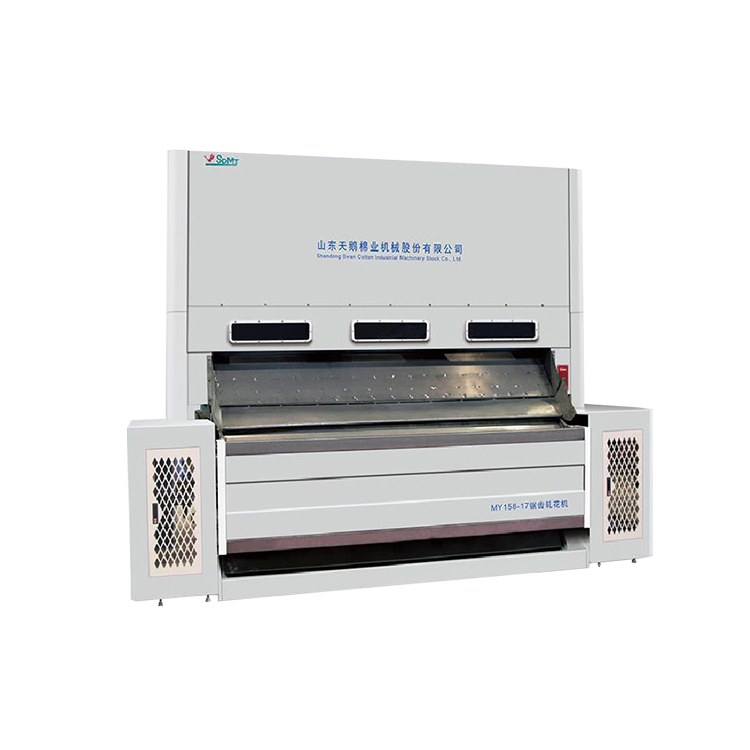
Take a plant built around a single MY158-17 Saw Gin at 1,100–1,800 kg/h and compare it with a plant built around an MYZ215-14.8 at 2,000–3,000 kg/h. Against both, a single MR-144D delinting unit at 3,500–4,500 kg/h on the first pass is not the binding constraint. The binding constraint appears at the second pass at 1,000–1,500 kg/h and the third at 750–1,000 kg/h. This is the point at which the two plants diverge: the high-capacity line needs either more buffer capacity between passes, a parallel delinting unit, or an agreed lower residual lint target that requires fewer passes. The single-gin plant reaches the opposite conclusion and may find that one unit with modest buffer capacity matches the seed flow comfortably.
The same logic applies to conveying and storage. Seed that is re-circulated through multiple passes occupies bins, elevators and conveying runs for longer than a single-pass design would suggest, and those are the components that determine whether the delinting stage keeps pace with the gin during peak intake.
Step-by-Step: A Seven-Step Selection Workflow
- Fix the seed duty in numbers. Record tonnes per hour of seed to be delinted, the target residual lint level, seed variety, moisture at intake and trash content. Without these five inputs the rest of the workflow produces a meaningless comparison.
- Confirm the capacity basis in writing. Ask the supplier to state whether each published capacity figure refers to seed input, seed throughput or lint output, and at what moisture and trash level it was established.
- Determine the pass count and the governing throughput. Use the supplier's pass-by-pass data, not the first-pass figure, to size the stage. Add buffer capacity or a parallel unit if the final pass cannot match the gin.
- Size the integration around the machine. Layout the conveying, bin capacity and dust system against the pass count, not against the unit's outline drawing.
- Check the physical fit. Verify foundation loading against the delivered mass, confirm floor level, and take maintenance-side clearance from the supplier drawing.
- Specify power and controls. List the delinting load separately on the panel schedule and define which interlocks sit in the machine panel and which sit in the plant control system.
- Define spares, documentation and commissioning. Fix the first spares set, request the as-delivered saw specification and drawings, and agree who performs commissioning and operator training.
Use Cases: Where the Same Parameters Lead to Different Answers
A single-gin plant adding a seed-processing stage. A plant running one MY158-17 at 1,100–1,800 kg/h usually needs one delinting unit and enough bin capacity to absorb the pass structure. The dominant risk is layout, not capacity, because the unit will be fitted into a building designed before delinting was considered.
A high-capacity plant built around an MYZ215-14.8. At 2,000–3,000 kg/h of ginning output, the seed flow is large enough that the delinting stage's third-pass figure becomes the planning number. These plants typically evaluate buffer capacity and a second delinting unit in the same decision.
A seed trading or linter sales operation. Where linters are a saleable product rather than a waste stream, the specification shifts toward residual lint consistency and linter collection, and the size of the delinting head becomes a quality decision rather than purely a throughput decision.
A retrofit into an existing building. Retrofits are governed by maintenance access and dust routing. A 2,500 kg machine with a 2,600 × 1,880 × 2,000 mm envelope will physically fit in more places than it can be serviced, so the clearance drawing is the first document to request.
Manufacturing depth matters here. Swan Company's Jinan headquarters covers 83,430 square metres with an annual output of approximately 2,200 units and around 858 employees, including 150 engineers; the Xinjiang branch covers 31,970 square metres with about 250 employees and the Inner Mongolia branch 53,000 square metres with approximately 100 employees. A US branch in Montgomery, Alabama serves as a base for saw blade production and international technology collaboration — relevant to delinting buyers because the saw is the component that governs delinting performance and determines the spares position.

Side-by-Side Comparison: Delinting Unit and Two Saw Gins
The table below uses only published specifications. Figures are not interchangeable between columns because each machine is stated on its own basis; blank cells mean the parameter is not stated in the specification used for this guide.
| Parameter | MR-144D Cotton Seed Delinting Machine | MY158-17 Saw Gin | MYZ215-14.8 Cotton Ginning Machine |
|---|---|---|---|
| Role in the line | Seed delinting (residual lint removal) | Seed cotton ginning | Seed cotton ginning |
| Published capacity | First pass 3,500–4,500 kg/h; second pass 1,000–1,500 kg/h; third pass 750–1,000 kg/h | Designed output 1,100–1,800 kg/h | Designed output 2,000–3,000 kg/h |
| Equipped power | 24.35 kW | 64.75 kW | 108.8 kW |
| Saw diameter | Φ320 mm | Φ406 mm | Φ406 mm |
| Saw count | Not stated in this specification | 158 pcs | 215 pcs |
| Saw spacing | Not stated in this specification | 17 mm | 14.8 mm |
| Brush cylinder diameter | Not stated in this specification | Φ380 mm | Φ450 mm |
| Overall dimensions (L×W×H) | 2,600 × 1,880 × 2,000 mm | 3,138 × 4,068 × 3,508.5 mm | 4,720 × 3,688 × 3,558.5 mm |
| Machine weight | 2,500 kg | 8,100 kg | 12,000 kg |
| Materials stated | Stainless steel, alloy, carbon steel, copper | Stainless steel, rubber, alloy | Stainless steel, alloy, carbon steel, copper |
| Other stated data | — | Noise 90 dB(A); lint quality meets or exceeds the national standard for ginned cotton of the same grade | Seed cotton inlet 3,328 × 320 mm; lint outlet 3,310 × 120 mm |
What to Verify Before Signing: A Parameter Checklist
The checklist below converts the parameter discussion into items that can be closed one by one at quotation stage. None of them requires vendor-specific data from a competitor; each can be answered from the supplier's own documentation.
| Verification item | What to ask for | Why it changes the decision |
|---|---|---|
| Capacity basis | Written statement of the basis for each capacity figure, with moisture and trash assumptions | Prevents a false comparison between delinting capacity and gin output |
| Pass structure | Pass-by-pass capacity and the pass count needed for your target residual lint level | Determines the real throughput and the bin capacity required |
| Electrical data | Motor list, starting method, control interface | Fixes the panel schedule and the interlock scope before order |
| Mechanical fit | Foundation drawing and maintenance clearance on each side | Prevents a machine that fits but cannot be serviced |
| Material allocation | Material by sub-assembly, plus a defined wear-parts list | Sets the spares budget and the maintenance plan |
| Air and dust | Air connection sizes, hood arrangement, linter discharge point | Avoids site rework after delivery |
| Documentation | As-delivered saw specification and drawings | Ensures replacement saws are ordered to the correct drawing |
Frequently Asked Questions
Which standards actually apply to a cotton seed delinting machine?
There is no single international performance standard for delinting machines, so compliance has to be written into the contract rather than assumed. ISO 8115 governs cotton bale packaging and applies to the lint side of the plant, not the delinting line. In the United States, OSHA 29 CFR §1928.57 addresses machine guarding for farmstead equipment and cotton gins. Buyers specifying a delinting unit should therefore require guarding documentation, an electrical schedule and material records by sub-assembly as contractual deliverables, and should state the guarding requirement explicitly rather than assume it is covered by default.
How many passes does the MR-144D need, and which throughput figure should be planned against?
The published figures are 3,500–4,500 kg/h on the first pass, 1,000–1,500 kg/h on the second and 750–1,000 kg/h on the third. Plan against the final pass that your target residual lint level requires, not against the first-pass figure, because a multi-pass sequence is limited by its slowest step. If the final-pass throughput cannot match the seed flow from the gin, the usual options are additional buffer capacity between passes, a parallel delinting unit, or an agreed residual lint target that needs fewer passes. The pass count for a specific seed lot should be confirmed with the supplier using that lot's data.
What drives the total cost of a delinting installation beyond the machine price?
Four items usually dominate. First, the pass structure: re-circulation or a second unit costs more than the machine itself in layout and handling terms. Second, site works: foundations and anchorage for a 2,500 kg machine, plus floor level corrections in a retrofit. Third, dust extraction and linter handling, which is commonly added after delivery if it is not specified upfront. Fourth, spares, with saw sets being the item that determines both operating cost and downtime risk. The delinting unit's equipped power of 24.35 kW is small against 64.75 kW for the MY158-17 Saw Gin and 108.8 kW for the MYZ215-14.8, so electrical capacity is rarely the main cost driver — but the delinting load still needs to appear on the panel schedule so it is not absorbed into a general allowance.
Can we test our own seed lot before committing to a delinting machine?
Yes, and it is the most reliable way to close the specification. Provide the supplier with the seed variety, moisture at intake, trash content and the residual lint target, and ask for capacity and output quality to be confirmed against that lot rather than against a general data sheet. A seed sample trial also settles the pass count, which is the number that governs the sizing of bins, conveying and the dust system. For buyers working with Swan Company, sample and trial arrangements can be raised through the contact details below before a purchase order is issued.
What should procurement confirm about delivery, spares and commissioning?
Confirm four things in writing: the delivery scope including motors, panels and drawings; the first spares set, with the saw specification recorded as delivered; who performs commissioning and operator training; and the documentation package, including the as-delivered saw drawing needed for future replacement orders. Swan Company produces approximately 2,200 units a year, exports to more than 30 countries and supports markets across Central Asia, South America and Africa, so scope definition at order stage is what keeps a delinting project on schedule. The full product range and technical documentation are available through the company website, and the catalogue can be downloaded from the link at the end of this guide.
Conclusion: Specify the Pass Structure Before the Machine
Delinting selection is decided by three numbers and one layout. The numbers are the pass-by-pass capacity of the machine, the seed flow the gin in front of it produces, and the electrical and structural envelope the unit occupies. The layout is the maintenance access and dust routing that determine whether the machine can run at its stated capacity for a full season. Where those are settled before quotation, the comparison between suppliers becomes a comparison of documented facts. Where they are not, the delinting stage becomes the part of the plant that limits throughput, even when the ginning line itself is running to specification.
Next step: technical documentation and seed sample evaluation
Shandong Swan Cotton Industrial Machinery Stock Co., Ltd. (Swan Company) supplies cotton gins, saw delinters, bale presses and complete cotton ginning lines, with engineering support for delinting integration projects. To evaluate a delinting specification against your own seed flow, request the product catalogue and raise a technical inquiry with the contact below.
Catalogue download: Swan Company product catalogue (PDF)
Website: www.swancottonmachinery.com
Contact: Pat Yang | Email: pat_666@163.com | Tel / WhatsApp: +86-13791009388
Address: No.99, East Road of Dawei Village, Tianqiao District, Jinan City, Shandong, P.R. China

Have Questions or Need More Details?
Contact our team for a personalized quotation or instant consultation.
Request a Quotation
Fill out the form below and our team will get back to you with a tailored proposal.
WhatsApp Direct Chat
Prefer to chat in real-time? Message us on WhatsApp for instant assistance & quick answers.
- Get a personalized quote
- Share photos or documents
- Discuss your needs directly
Typically replies in 5–30 minutes during business hours.