
Round Baler vs. Conventional Basket Picker: A Cotton Harvester Comparison for Procurement Teams
Round Baler vs. Conventional Basket Picker: A Cotton Harvester Comparison for Procurement Teams

Two cotton harvesters can share the same row-crop picking heads and still produce completely different operating economics, because the decisive difference sits behind the picking unit. A round baler cotton harvester forms and wraps a round module on board the machine while it moves through the field. A conventional basket picker accumulates seed cotton in an on-board basket and depends on a separate module-building or boll-buggy step before that seed cotton is ready to leave the field edge. Everything a procurement team has to budget for — in-field support equipment, field-edge staging, labor coordination, hauling, gin intake compatibility, and the maintenance plan that follows the purchase — flows from that single architectural difference. This guide compares the two architectures on the criteria that actually change a purchase decision, and it separates what a buyer can verify from what a buyer must confirm with a supplier and with the gin.
Problem Definition: The Accumulation System, Not the Picking Head, Sets the Cost Structure
The most common procurement error in cotton harvesting is comparing machines on the picking head, the engine, and the cab, and treating the accumulation and handling system as an accessory. In practice, the picking end of a modern self-propelled cotton harvester is the part that is most similar between the two families; the accumulation end is where they diverge, and it is where operating cost is either created or avoided.
For a buyer, the practical consequence is that a comparison built only on machine price will usually point in the wrong direction. The money that separates a round baler harvester from a conventional basket picker is distributed across five cost centres that do not appear on a harvester quotation:
- Field-edge staging. How seed cotton leaves the harvester, and how many machines must stop working so that it can leave.
- Support fleet and operators. Boll buggies, module builders, bale handlers, module trucks, and the people required to run them during the harvest window.
- Weather protection. Whether the crop is protected by wrapping film on the machine or by tarps and staging discipline after the module is built.
- Transport and gin intake. How the harvested unit is loaded, hauled, and received at the gin, and whether the gin can accept that format at all.
- Service and parts planning. Which components wear, where spares must come from, and how quickly a stopped machine can return to the field during the season.
A buyer who ignores the last two items in particular can spend the same capital budget and end up with a structurally higher cost per harvested hectare, because the accumulation format determines the downstream chain rather than the other way round.
Industry Background: Why Two Harvesting Architectures Coexist
Mechanised cotton harvesting has converged on multi-row, self-propelled machines, but it has not converged on a single way of handling seed cotton between the field and the gin. Two architectures are established in the market, and manufacturers that serve different production regions typically offer both.
Shandong Swan Cotton Industry Machinery Stock Co., Ltd. (Swan) is a Chinese manufacturer of cotton industry machinery, founded in 2002 with a predecessor business established in 1946, and listed on the Shanghai Stock Exchange Main Board in 2016 under stock code 603029. The company builds equipment for the mechanisation of the cotton industry and offers harvester models across both architectures: three-row, four-row and six-row self-propelled bale type cotton harvesters, and three-row and four-row self-propelled basket type cotton harvesters, produced alongside grain combine harvesters, corn combine harvesters and tomato harvesters. Because a supplier that builds both formats is exposed to the same logistical trade-offs its customers face, the architectural comparison below is framed around capability and field logistics rather than around brand claims.
How Each Architecture Works in the Field
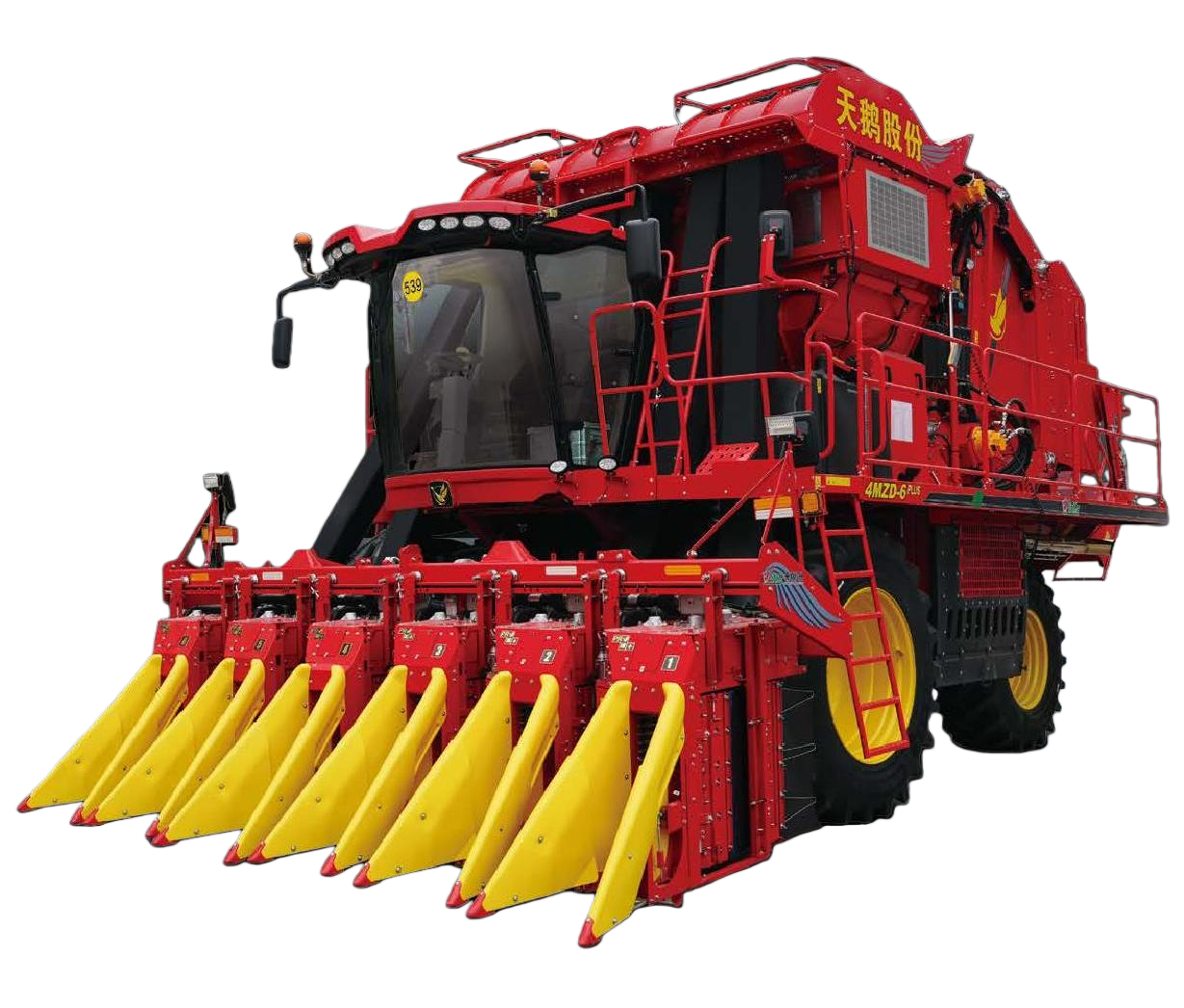
Round baler (bale type) harvester workflow
On a bale type machine, seed cotton removed by the picking units is transferred into an on-board accumulation and bale-forming system. As the machine continues down the rows, that seed cotton is formed into a round module and wrapped, typically with a plastic film that seals the crop against moisture and contamination. When the module is complete, it is discharged at the field edge or at a designated turn row, and the machine continues harvesting without leaving the crop behind.
The operational consequence is that bale formation is integrated into the harvest pass. There is no second machine required to convert loose seed cotton into a transportable unit, and the field-edge activity is reduced to staging modules and loading them for hauling. The trade-off is that the harvester carries additional mechanical systems — the bale-forming and wrapping assembly — which adds complexity to the machine itself and introduces wrapping film as a recurring consumable.
Conventional basket picker workflow
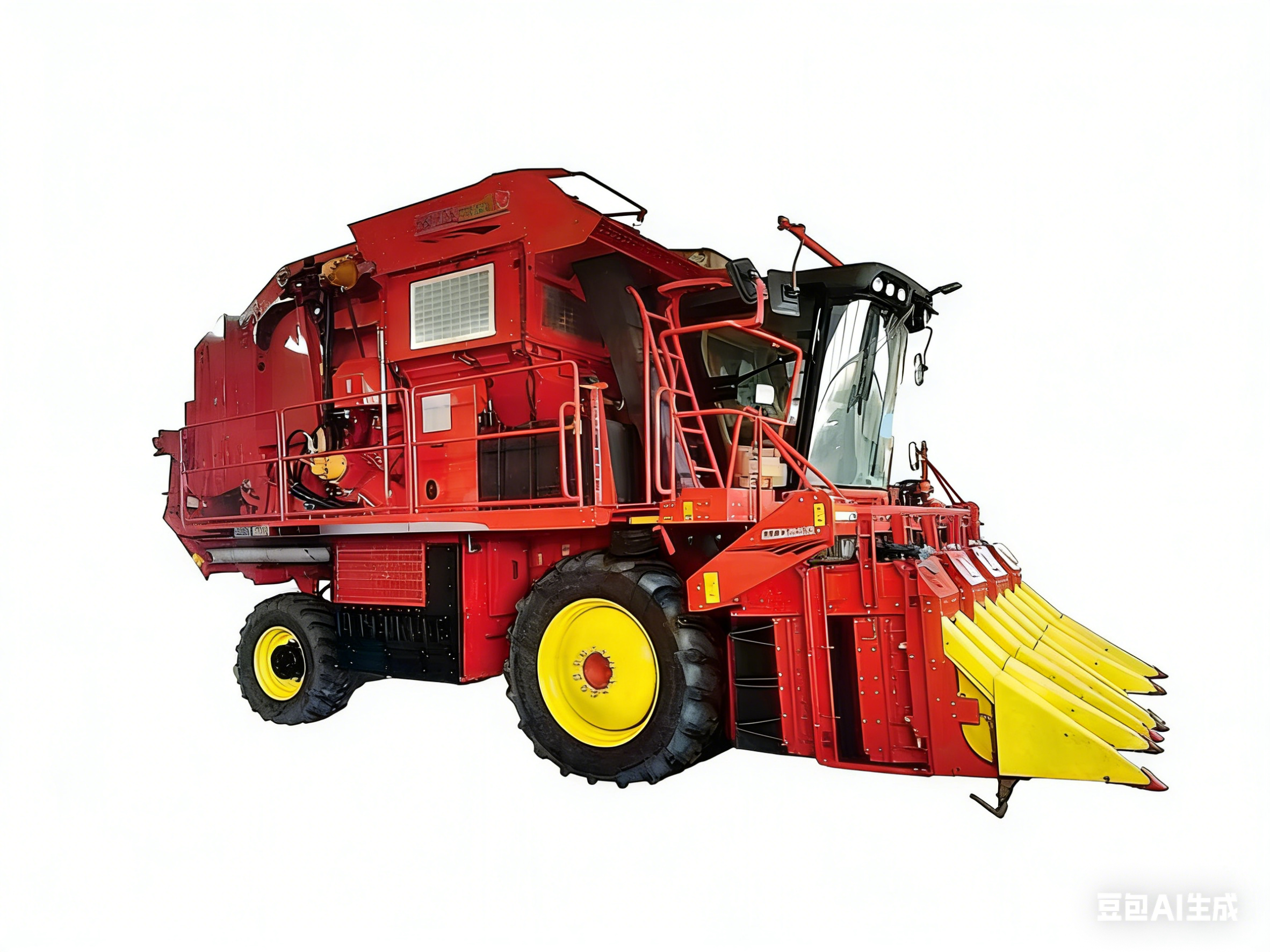
On a basket type machine, seed cotton is accumulated in a large on-board basket. Because basket capacity is finite, harvesting is interrupted periodically so the basket can be emptied, usually into a boll buggy or directly into a module builder positioned at the field edge or in a service area. The module builder compacts the loose seed cotton into a conventional module, which is then typically covered with tarps and later loaded by a module handler onto module trucks for transport to the gin.
The operational consequence is that the harvest system, not the harvester alone, determines throughput. A basket picker is a simpler machine than a bale-forming harvester, because the accumulation and handling function has been moved off the machine and into a support chain. In practice this means more machines, more operators, and more coordination on the field edge during the same weather window — but it also means that most of the handling equipment is already familiar, widely available, and already owned by operations that are replacing an existing basket-based fleet.
In-Field Logistics and Support Equipment
Logistics is where the two architectures separate most visibly, and it is the part of the comparison that is easiest to underestimate during procurement.
A round baler system generally requires fewer in-field support assets. The harvester itself produces the transportable unit, so the support task is limited to staging modules at the field edge and loading them for hauling. The number of machines that must stop harvesting in order to service the crop is therefore low, and the coordination burden during the season is correspondingly lighter.
A conventional basket system generally requires a larger and more tightly coordinated support group: at least one boll buggy or module builder serving the pickers, a module handler for loading, and module trucks for hauling. Where haul distances are long, the support requirement grows because the cycle time between basket emptying and return to the rows increases. Buyers evaluating a basket type fleet should therefore model three things together — number of harvesters, number of support units, and distance to the gin — because the cost of an imbalance shows up as harvester idle time, not as a line item on the quotation.
Module Building Requirements
Module building is the clearest single differentiator between the two options, and it is the item that most often changes the answer to a procurement question.
With a bale type harvester, module building is on board. There is no separate module builder to purchase, fuel, staff, maintain or position, and field-edge footprint is smaller because the machine ejects a finished, wrapped unit rather than requiring a staging area for loose seed cotton. The buyer's new planning items are wrapping film supply and the handling equipment used to move finished modules.
With a basket type harvester, module building remains a distinct field operation. Module builders must be scheduled so that they keep pace with the pickers, module placement must respect haul roads and gin access, and the modules must be tarped and managed through whatever weather occurs between building and ginning. Buyers should treat the module builder as part of the harvester's effective cost, because a picker without a builder cannot deliver seed cotton to the gin in a form the gin accepts.
Downstream Ginning Compatibility
Ginning compatibility is a hard constraint, not a preference, and it belongs at the beginning of the evaluation rather than at the end. A gin receives a specific harvested format and is equipped to handle it. Conventional modules are normally received and opened by module feeder systems, while wrapped round modules require handling and unwrapping equipment designed for that format. A gin that is not equipped, staffed or contracted for a given format cannot simply absorb it because a customer changes harvesters.
The practical procurement rule is therefore straightforward: confirm the intake format with the gin before the harvester architecture is specified, not after. This is also where a supplier with experience across the full cotton chain is useful, because the interface between field equipment and gin intake is a system question rather than a machine question. Swan's core business is complete sets of cotton processing machinery for the cotton industry, which means the harvester range and the downstream processing equipment are developed within the same organisation rather than by two unrelated suppliers.
Transport and Hauling Cost Implications
Transport cost is driven less by distance alone than by the format of the harvested unit, the equipment required to load it, and the number of movements the format creates. A wrapped round module is a dense, self-contained unit that can be staged at the field edge and loaded by bale handling equipment onto suitable trailers. Conventional modules require loading with a module handler onto module trucks, and the operation depends on modules being built in places that trucks can reach.
For buyers, the analysis that matters is comparative and based on their own operation: how many units their yield will produce, how many trips that implies at their haul distance, what equipment each format requires for loading, and whether that equipment already exists in the fleet. Because the transport implication is a function of yield and distance, general benchmarks are of limited value — the number that changes the decision is the buyer's own logistics model, not a supplier's average.
Step-by-Step Breakdown: A Procurement Workflow for Choosing Between the Two
The sequence below is designed so that the irreversible constraint — gin intake — is settled before capital is committed to a specific architecture.
- Map the harvest window and weather risk. Establish how many working days are realistically available and how exposed the crop is to rain during that window. This determines how much value you place on on-board wrapping versus module tarping discipline.
- Inventory existing field-edge and transport assets. List the module builders, boll buggies, bale handlers, module trucks and tarps already owned or contracted. An existing basket-based infrastructure is a real cost advantage for a basket type purchase; the same inventory may become idle if the architecture changes.
- Confirm gin intake format in writing. Ask the gin which module or bale format its feeder system handles, and whether that is a fixed constraint for the coming seasons.
- Define the accumulation requirement against picking capacity. Decide how frequently the harvest pass may be interrupted. This is the point at which basket capacity and on-board bale formation produce measurably different harvester utilisation.
- Compare total logistics, not machine price. Build a comparison that includes support units, operators, consumables (wrapping film or tarps), handling equipment and hauling cycles.
- Verify machine-level documentation. Request certification documentation, the consumable and wear-part list for both the picking end and the accumulation end, and the service intervals for each subsystem.
- Verify the service footprint against your fields. Check where the supplier's service centres, subsidiaries and parts stocks are relative to your production area, and how technicians reach you during the season.
- Plan the transition, not just the purchase. Training, consumable stock, maintenance scheduling and support agreements should be in place before the first season, because a harvest window does not wait for a supply chain to catch up.
Use Cases: Matching Architecture to Operation
Neither architecture wins universally. The conditions below describe where each one tends to fit, based on how the accumulation formats behave in the field.
- Round baler (bale type) fits operations with large contiguous acreage, a compressed weather window, long haul distances to the gin, a gin that is equipped for wrapped round modules, and a management structure that prefers fewer machines and fewer operators in the field.
- Conventional basket picker fits operations with existing module-building and module-hauling infrastructure, a gin whose feeder system is built around conventional modules, mixed or smaller field parcels where large support fleets are impractical, and buyers who value a simpler harvester and are prepared to manage the support chain.
- Row configuration matters in both cases. Swan's harvester range includes three-row, four-row and six-row self-propelled bale type cotton harvesters and three-row and four-row self-propelled basket type cotton harvesters, so the row count can be matched to field geometry and access rather than treated as a fixed given.
Comparison Table: Round Baler vs. Conventional Basket Picker
| Decision dimension | Round baler (bale type) harvester | Conventional basket picker |
|---|---|---|
| Seed cotton accumulation | Formed into a round module on board during the harvest pass | Held in an on-board basket and discharged periodically |
| Field-edge handling | Finished, wrapped module ejected and staged at the field edge | Loose seed cotton transferred to a boll buggy or module builder |
| Module building requirement | None — module formation is integrated into the harvester | Requires a separate module builder as part of the harvest system |
| Support fleet | Generally fewer in-field support units; handling concentrated at staging and loading | Generally more support units and operators, coordinated with harvester cycles |
| Harvest interruption | Harvesting continues while the module is formed on board | Harvesting pauses for each basket emptying cycle |
| Weather protection | Wrapping film applied on the machine at formation | Depends on tarping and staging discipline after module building |
| Gin intake requirement | Gin must be equipped to handle wrapped round modules | Gin must be equipped with conventional module handling and feeding |
| Transport | Loaded by bale handling equipment onto suitable trailers | Loaded by module handler onto module trucks |
| Machine complexity | Additional on-board forming and wrapping systems; film is a recurring consumable | Simpler harvester; more complexity and cost shifted into field equipment |
| Maintenance focus | Picking unit plus bale-forming and wrapping subsystems | Picking unit plus basket system, and the support equipment that serves it |
| Typical fit | Large acreage, tight weather windows, gins configured for round modules | Existing module-building infrastructure and gins configured for conventional modules |
Maintenance Cost Control and After-Sales Assurance
Once the architecture is chosen, the recurring question for procurement is whether the machine can be kept running through the season, and at what cost. This is where the two formats behave differently, and where supplier capability becomes part of the commercial case rather than a footnote.
What drives maintenance cost in each architecture
Both architectures use row-crop picking units, so the wear parts associated with the picking end are a shared category: spindle assemblies, doffer components, moistener elements and the associated drive components are serviced on a seasonal maintenance schedule regardless of which accumulation system sits behind them. The divergence appears downstream of the picking unit.
- On a bale type harvester, the bale-forming and wrapping system is a second maintenance domain on the machine. It introduces wrapping film as a consumable with a per-module cost, plus the mechanical and hydraulic components of the forming and wrapping assembly. Because the machine performs the entire handling task, any downtime in this subsystem stops the harvest pass directly.
- On a basket type harvester, the on-machine accumulation system is mechanically simpler, but the maintenance burden is distributed across a fleet: basket and compressor components on the harvester, plus the module builder, handler and haulage equipment that the system depends on. Downtime in a support unit stops the harvesters it serves, which means the effective cost of a breakdown is measured across several machines rather than one.
The buyer's takeaway is a planning rule, not a preference: identify the wear-part and consumable list for the whole harvest system — harvester plus the handling chain it requires — and confirm which of those parts are stocked locally, before the season starts. A low-cost machine with an unsupported handling chain is a high-cost system.
After-sales assurance: what to verify in a supplier
Service coverage should be checked geographically, because harvest equipment fails on a calendar, not on a schedule. Swan operates four technology centres and production bases — Jinan in Shandong as headquarters, Wujiaqu in Xinjiang, Hulunbuir in Inner Mongolia, and Montgomery in the United States — together with six holding subsidiaries and four branch companies that function as technical service centres. Its marketing service network covers major cotton-producing areas worldwide, and its products are exported to more than 30 countries and regions. For a buyer, that footprint is the practical answer to the question of how quickly a technician and a part can reach a field.
Engineering discipline is the second assurance layer. Swan holds more than 190 national invention patents and has presided over or participated in the formulation of 25 national and industry standards, and it has undertaken key national R&D projects during the 13th and 14th Five-Year Plan periods, with over 30 honours at or above provincial and ministerial level including the National Second Prize for Progress in Science and Technology. It also holds a China Compulsory Product Certification (CCC) certificate. Independent of any single machine, these are indicators that the spare-part and documentation systems behind a harvester are built to a published standard rather than to a one-off specification.

Finally, question structure matters. Buyers should ask for a guaranteed response path during the harvest season, a consolidated wear-part list covering both the picking and accumulation ends, and the consumable supply channel for whichever format they choose — wrapping film for a bale type machine, or tarping and module-handling consumables for a basket-based system. Swan reports holding the largest new-market share of complete sets of cotton processing machinery in both domestic and international markets, which in practice means the consumables and parts ecosystem around its equipment is supported by an established distribution base rather than by a single channel.
Frequently Asked Questions
What certification and documentation should be verified before buying either harvester type?
Verify the certification that applies to the specific machine, and ask for it in writing rather than as a verbal assurance. Swan holds a China Compulsory Product Certification (CCC) certificate, holds more than 190 national invention patents, and has presided over or participated in the formulation of 25 national and industry standards. For a comparison between bale type and basket type machines, buyers should request documentation covering both the picking system and the accumulation system, since these are separate subsystems with separate maintenance requirements.
Can a single manufacturer supply both round baler and conventional basket picker harvesters?
Yes, and buying both formats from one supplier simplifies the comparison because the same engineering and service organisation stands behind each option. Shandong Swan Cotton Industry Machinery Stock Co., Ltd. manufactures three-row, four-row and six-row self-propelled bale type cotton harvesters as well as three-row and four-row self-propelled basket type cotton harvesters, alongside grain combine harvesters, corn combine harvesters and tomato harvesters. That range allows the row configuration and the accumulation format to be selected independently, on the basis of field geometry and logistics.
Where do the real cost differences between bale type and basket type harvesting appear?
The differences concentrate in the harvest system around the machine rather than on the price list of the machine itself. A bale type harvester carries the module-forming function on board, which removes the module builder from the field but adds wrapping film as a recurring consumable and adds a second maintenance domain on the machine. A basket type harvester is simpler on board but requires a support chain of module building, handling and hauling equipment with associated operators and maintenance. Buyers should therefore build the comparison around support units, operators, consumables, hauling cycles and service coverage rather than around acquisition price alone.
How can a procurement team validate a harvester before committing to a fleet decision?
Validation in this category is structural rather than sample-based, because the purchase is a system decision. Buyers should confirm the gin's intake format in writing, inventory the handling and haulage equipment they already own, and request the consumable and wear-part list for both the picking and accumulation ends of the machine. It is also worth seeing how the equipment is manufactured and inspected: Swan operates quality inspection teams and in-house parts workshops across its production bases, and a buyer evaluating either architecture can use those functions to check component traceability, spare-part availability and assembly consistency before placing an order.
How should after-sales support and spare parts be planned for either type?
Plan service coverage against your fields, not against the supplier's headquarters. Swan maintains four technology centres and production bases — Jinan, Wujiaqu in Xinjiang, Hulunbuir in Inner Mongolia and Montgomery in the United States — with six holding subsidiaries and four branch companies acting as technical service centres, a marketing service network covering major cotton-producing areas worldwide, and exports to more than 30 countries and regions. For either architecture, ask for the wear-part list, the consumable supply channel and the in-season response path before the harvest window opens. If you want the comparison run against your own acreage, haul distance and gin format, request a specification comparison and quotation directly — this is the stage where the architecture decision becomes a budget decision.
Conclusion
The choice between a round baler cotton harvester and a conventional basket picker is not a question of which machine is better. It is a question of which accumulation format matches the operation's logistics, its gin, and its ability to keep the whole harvest system running through a weather window. Bale type harvesters move module formation onto the machine and reduce in-field coordination at the cost of on-board complexity and film consumption. Basket type harvesters keep the machine simpler and rely on a support chain of module building and hauling that many established operations already own and understand.
The decision rule that survives both scenarios is to settle the constraints first — gin intake format, existing equipment, haul distance, and service reach — and then compare machines. Buyers who do that will find that the technical comparison in the table above is easy, while the logistics comparison is where the savings are actually decided.

Next step: run the comparison against your own operation
If you have narrowed your decision to a bale type or basket type cotton harvester, the next useful step is to put your own numbers into the model — rows, acreage, haul distance, gin intake format and existing support equipment. Shandong Swan Cotton Industry Machinery Stock Co., Ltd. can provide a specification comparison across three-row, four-row and six-row self-propelled bale type cotton harvesters and three-row and four-row self-propelled basket type cotton harvesters, together with consumable and spare-part information for lifecycle planning.
Website: www.swancottonmachinery.com
Email: pat_666@163.com | ericwong9527@163.com
Phone / WhatsApp: Pat +8613791009388 | Eric +8615169092038
Address: No. 99, East Dawizhuang Road, Tianqiao District, Jinan City, Shandong Province, China