Cushion and Sofa Upholstery OEM: A Home Textile Fabric Application Guide for TL0329
TL0329 is a 100% polyester upholstery fabric specified for cushion and sofa OEM production. Its documented parameters are a 105D x 200D yarn construction, a fabric weight of 160 gsm, a usable width of 150 cm with an additional 300 cm width option, a brushed surface with a suede hand feel, and a backside that can be bonded to form a laminated upholstery composite for cushion and sofa applications.
This application guide is written for furniture OEM buyers, cushion and sofa manufacturers, importers and wholesalers who need to move from a fabric sample to a production decision. It explains which parameter controls which outcome on the cutting table and in the finished product, and how width, backing and hand feel should be matched to a specific project scenario.
TL0329 is produced by Suzhou T-land Textile Co., Ltd., the manufacturer behind the T-LAND TEXTILE brand. The company is based in Shengze, Jiangsu, China, near Shanghai, and produces sofa fabric and curtain fabric. Its facility covers 5,000 m2, employs 91 people, and produces an annual output of 5,000,000 meters; approximately 90% of that output is exported, mainly to the EU.
Why Upholstery Fabric Specifications Fail in Cushion and Sofa OEM Programs
Cushion and sofa OEM sourcing failures are usually constraint failures rather than design failures. Five variables decide whether a home textile fabric is usable at production volume, and all five can be confirmed before a purchase order is issued.
- Width against the cutting plan. A 150 cm usable width and a 300 cm usable width produce different cutting yields, different seam placement and different waste levels. Width should be matched to the panel size, not to the visual impression of a sample swatch.
- Weight and hand feel treated as one decision. Weight is measurable in gsm; hand feel is a surface property. A 160 gsm brushed woven and a 160 gsm velvet can share the same weight class and still behave differently in cutting, sewing and sitting comfort.
- Backing decided too late. A bonded and an unbonded version of the same construction behave differently during lamination and sewing. The backing decision belongs in the specification, not in the sampling room.
- Compliance treated as a company-level attribute. Textile certification scope is attached to specific products, colours and finishing routes. A valid certificate at company level does not automatically answer the question for one order.
- Commercial terms detached from the production calendar. Minimum order quantity per colour, monthly capacity and lead time decide whether a fabric programme is feasible.
TL0329 documents four of these parameters directly: construction and weight, width, surface finish and backside bondability. The fifth is documented through order-level terms, with a minimum order quantity of 500-1000 meters per colour, a lead time of 30-45 days, and a monthly capacity of 200,000 meters.
The Constraint Landscape Behind Home Textile Fabric Sourcing
Home textile fabric sourcing sits inside a large and geographically concentrated market. According to The Business Research Company, the global home textile market reached USD 144.76 billion in 2025. Fortune Business Insights reports that Asia Pacific held a 44.17% share of that market in 2025. Within the category, Verified Market Research valued the upholstery fabric market at USD 44.5 billion in 2023. China remains a central supply base: Stellar Market Research records China's home textile exports at USD 2,870.94 million in March 2024 alone.
Regulation forms the second constraint layer, and it applies to upholstered end products rather than to fabric rolls. Studio 198 notes that the UK Furniture and Furnishings (Fire) (Safety) Regulations 1988 remain the core regime in 2026 for domestic upholstered products. For curtains and drapes specifically, BS 5867 is the established UK fire safety standard. In the EU, the General Product Safety Regulation (GPSR) 2023/988 mandates safety requirements for home textiles, with Digital Product Passports expected for textiles by 2027 (Carbonfact).
The third layer is duty class. Soft furnishing fabrics are specified against two different working conditions: household low-frequency friction and sunlight exposure, or commercial heavy-duty conditions found in hotels, offices and public interiors. Requirements that appear in project specifications typically include flame retardancy, high light fastness, high Martindale wear resistance, anti-pilling performance, water-repellent and stain-resistant finishing, low-formaldehyde eco-standards, strict batch-to-batch colour difference control, washability, and customized width and gram weight.
Those three layers explain why an application guide is more useful than a catalogue page. The same 160 gsm fabric can be a correct choice for a residential cushion programme and an unsuitable choice for a heavy-duty contract sofa if the duty class is never written down.
TL0329 Specification Anatomy for Cushion and Sofa OEM
Yarn construction 105D x 200D at 160 gsm
Model TL0329 has a fabric construction of 105D x 200D, a weight of 160 gsm, and a usable width of 150 cm; a 300 cm width option is also available. The fibre composition is documented as 100% polyester, with 100% polyester used as the primary material.
For OEM planning, this places TL0329 in the lighter band of the manufacturer's upholstery fabric range. Other sofa fabrics in the same range are documented at 160 gsm (TL07377-2, 300D x 600D), 220 gsm (TL07242, 150D x 320D + 200D), 280 gsm (TL12167, 350D x 350D + 650D), 300 gsm (TL07410, 350D x 450D) and 450 gsm (TL07408, 1150D x 4500D). A lighter weight typically reduces material consumption per panel and changes the hand of the finished cushion; a heavier weight changes how the fabric holds body under repeated sitting pressure. The quoted weight is a nominal figure and bulk production is subject to GSM tolerance, so the acceptable tolerance should be agreed at order stage.
Brushed surface and suede hand feel
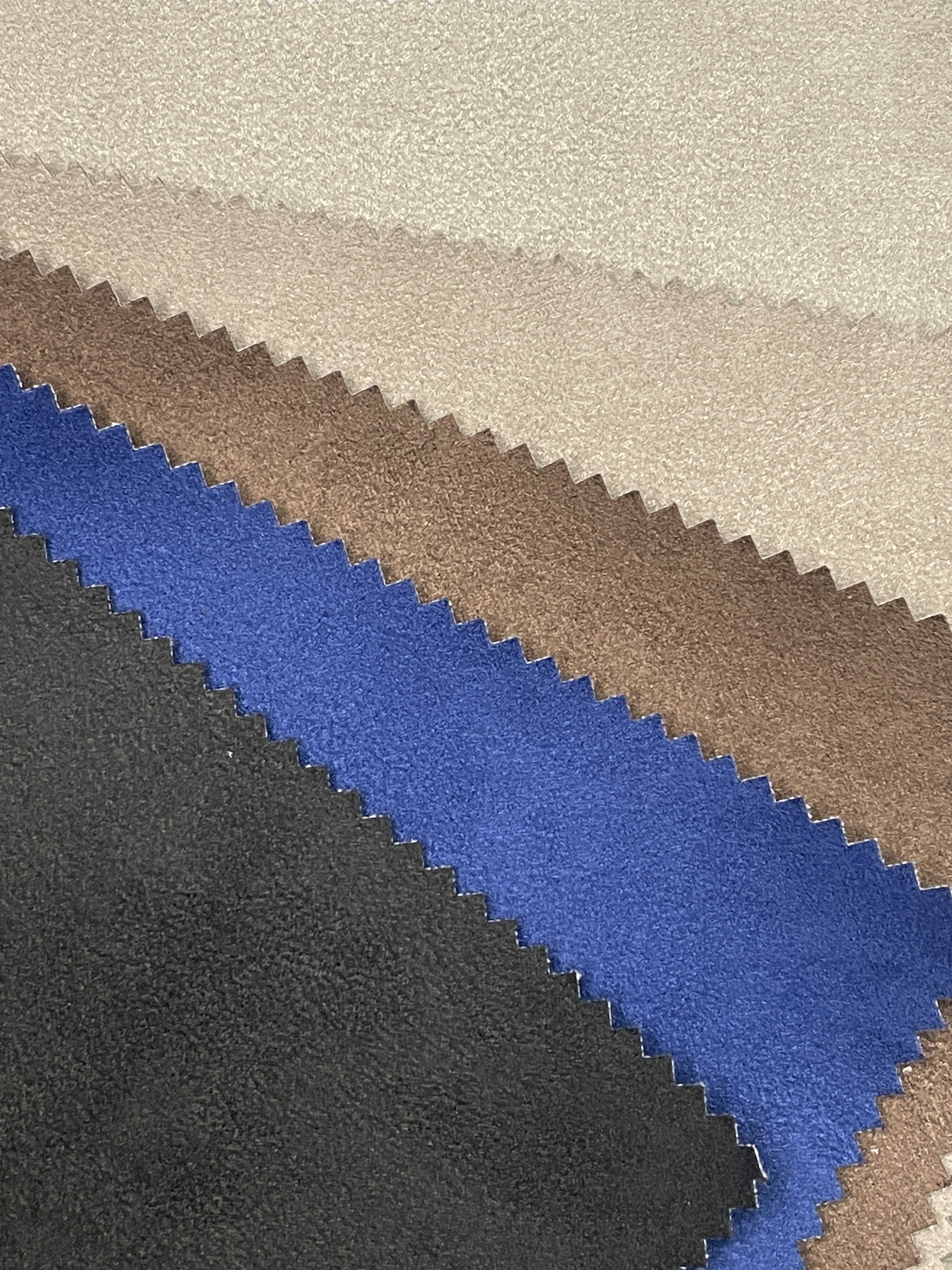
The surface of TL0329 is brushed, and the fabric is documented with a suede hand feel. Surface finishing is what the end customer touches first, so it should be validated on the buyer's own cushion construction rather than on a flat swatch: hand feel recorded on a sample roll and hand feel on a filled, sewn cushion are not the same measurement.
Surface durability is a separate question from hand feel. Pilling is a general textile phenomenon rather than an automatic product defect. It forms as surface short fibres are pulled out and tangled by repeated friction, and the lower the pilling-resistance grade, the higher the risk. Short-fibre fabrics are more likely to pill than long-fibre fabrics, and looser yarns increase the possibility. Buyers specifying a cushion or sofa fabric for daily friction should define the pilling-resistance grade they require instead of relying on the visual appearance of the surface.
Bonded backside for cushion and sofa production
The backside of TL0329 can be bonded to form a laminated upholstery composite. TL0329 can be supplied with a bonded backing for cushion and sofa production, and the bonded back side supports lamination quality control.
In practice, the backing decision changes three things: how the fabric runs through lamination, how the cushion or seat holds its shape, and how panels are handled during cutting and sewing. A bonded version and an unbonded version of the same construction are different inputs for the same finished product, so the backing choice should be locked in the specification and repeated in the purchase order.
Colour programme and batch consistency
According to the product specification, TL0329 can be matched in any colour for home decoration applications, and colour is not restricted by the base construction. For multi-colour programmes, such as a cushion range in six shades or a sofa body with matching scatter cushions, the real constraint is not colour availability but batch consistency. Strict batch-to-batch colour difference control is a standard requirement in furnishing fabric projects, and the tolerance and inspection method should be defined before bulk dyeing rather than after delivery.
Certification and compliance position
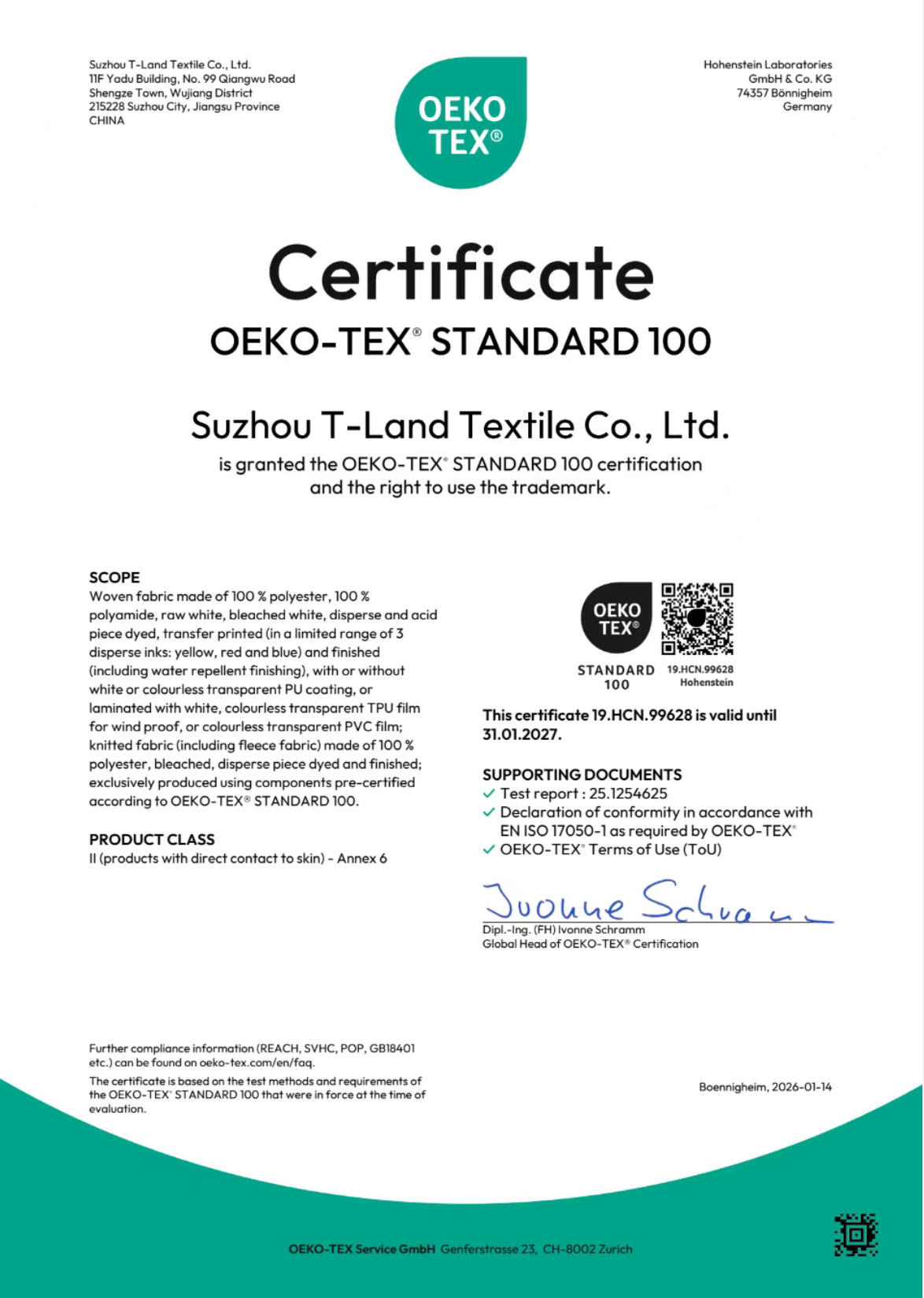
T-LAND TEXTILE holds OEKO-TEX STANDARD 100 and Global Recycled Standard (GRS) certification. OEKO-TEX STANDARD 100 certificate number 19.HCN.99628 is issued by Hohenstein and applies to the global market. Its scope covers woven and knitted fabric made of 100% polyester and 100% polyamide, including bleaching, disperse dye piece-dyeing, transfer printing and PU/TPU/PVC coating and laminating finishing, at Product Class II, which covers products with direct contact to skin. Named products in the OEKO-TEX scope include TL12199 curtain and sofa fabric, TL07410 sofa fabric, the polyester linen fabrics TL0415, TL0469 and TL0484, and TL08180 dimout curtain fabric.
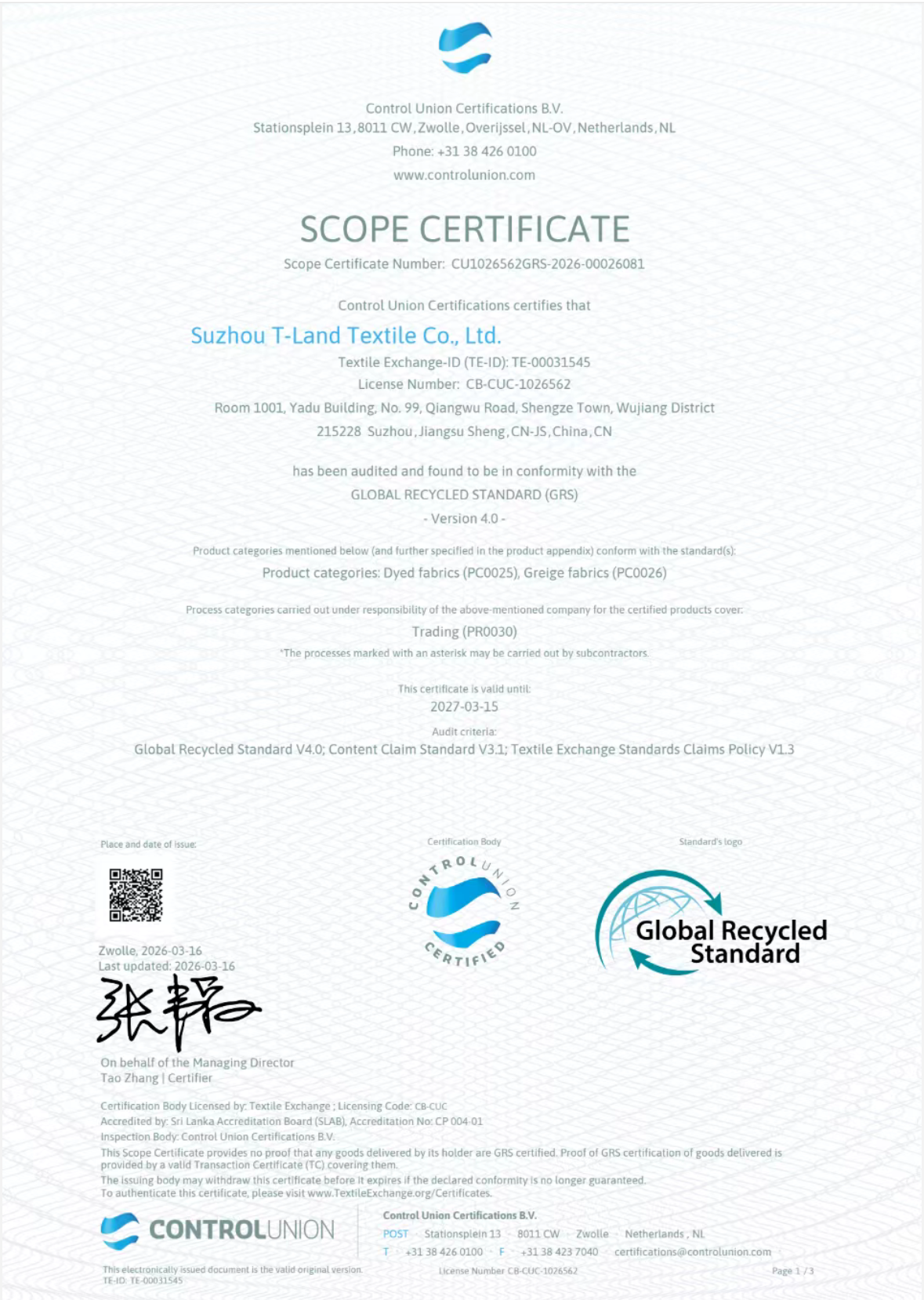
GRS certificate number CB-CUC-1026562 is issued by Control Union with a scope of dyed fabrics and greige fabrics, valid from 16 March 2026 to 15 March 2027, and applies to the global market. Named products include TL12167 poly linen sofa fabric, TL07392 jacquard fabric, TL12210 poly linen fabric, TL12199 curtain and sofa fabric, and TL08269 dimout curtain and sofa fabric.
In the certification records, TL0329 is listed among the related product models for both certificates. Because textile certificate scope can be limited by colour, dyeing route and finishing, buyers should request the applicable scope statement for the specific colour and order before bulk production. This is a documentation step, not a technical obstacle, and it is normally completed during sampling.
Destination regulation is a separate decision. The UK Furniture and Furnishings (Fire) (Safety) Regulations 1988 remain the core regime in 2026 for domestic upholstered products, and BS 5867 is the established UK fire safety standard for curtains and drapes. In the EU, GPSR 2023/988 mandates safety for home textiles, with Digital Product Passports expected by 2027. Where a project calls for fire retardant fabric performance, flame-retardant finishing is available as a customization option and should be written into the specification together with the standard the fabric must be tested against.
From Brief to Bulk: A Step-by-Step TL0329 Sourcing Workflow
- Define the end product and the duty class. Decide whether TL0329 is used for cushion covers, sofa bodies, scatter cushions, or a mixed programme, and whether the project runs under household low-frequency friction and sunlight conditions or commercial heavy-duty conditions. The duty class determines whether 160 gsm is enough or whether a heavier construction should be compared side by side.
- Fix the width against the cut plan. The documented usable width is 150 cm, with a 300 cm width option. Wide panels usually favour 300 cm because it reduces seams; standard panel nesting usually favours 150 cm. Confirm the usable width, not the total roll width, because the cutting calculation depends on usable width.
- Decide bonded or unbonded backing. Both routes are supported: the backside can be bonded to form a laminated upholstery composite, and the bonded back side supports lamination quality control. State the choice explicitly in the purchase order.
- Confirm hand feel and surface expectations. Validate the brushed suede hand feel on a sewn and filled sample, and specify the pilling-resistance grade required for the friction level of the end use.
- Lock the colour programme and batch tolerance. TL0329 can be matched in any colour for home decoration applications. For multi-colour ranges, define the acceptable batch-to-batch colour difference and the inspection method before bulk dyeing.
- Verify compliance documentation for the order. Request the applicable OEKO-TEX or GRS scope statement for the specific colour and finishing, and add any destination requirement such as flame retardancy or fire retardant performance with the named standard and test method.
- Validate with a sample. Small sample orders are supported to help customers develop new items, and development against a customer sample is offered. Copying rights for new items supplied by a client are retained under law. For cushion and sofa programmes, the sample round should cover hand feel, lamination behaviour with the chosen backing, colour match and sewing trials.
- Confirm commercial terms. Minimum order quantity is 500-1000 meters per colour, lead time is 30-45 days, and monthly capacity is 200,000 meters. Production modes cover OEM and ODM, and export markets are the EU and the Americas.
- Agree inspection and after-sales. Quality control is 100% tested in-house or by random inspection by the customer, and after-sales support applies within two months after goods are received by the customer. Booking the inspection method at order stage avoids disputes at delivery.
Where TL0329 Fits: Cushion, Sofa and Wholesale Applications
TL0329 is listed for furniture manufacturing, home decoration and wholesale distribution. Its combination of a 160 gsm brushed woven surface, a bondable backside and a 150 cm or 300 cm width makes it a cushion-first specification that also serves lighter sofa upholstery programmes.
- Cushion covers and scatter cushions. The bonded backing route supports lamination for cushion production, and the brushed suede surface gives the tactile quality buyers look for in decorative cushions. A 160 gsm woven keeps panel weight low, which matters when cushions are shipped in volume.
- Sofa upholstery. For residential seating, a lighter brushed woven combined with a bonded backing builds the body required for seat and back panels. For hotel, office or public interiors, compare the fabric against the heavier options in the range and specify the abrasion, light fastness and flame-retardancy requirements in writing.
- Coordinated sofa and curtain programmes. The same manufacturer produces curtain and dimout fabrics including TL08166, TL08273, TL08229, TL08321 and TL0888, as well as dual-purpose curtain and sofa fabrics such as TL12199, TL12210 and TL08269. A project can therefore specify cushion, sofa and window textiles from one supplier, which simplifies colour coordination and incoming inspection.
- Wholesale and distributor stock programmes. The 150 cm standard width suits conventional stock holding, while the 300 cm option supports wide-width demand. With a monthly capacity of 200,000 meters and a documented OEM record, repeat programmes can be scheduled rather than improvised.
- Project types documented for this fabric family. Residential decoration projects, hotel and B&B projects, office commercial projects, health-care institutions, exhibition and cultural tourism projects, plus special soft furnishing customization for RVS and yachts. When those projects move into heavy-duty or regulated environments, the duty-class requirements should be specified explicitly instead of being assumed from the fabric name.
An existing OEM record illustrates how these programmes run in practice: OEM customers in DE, NL, BE, IT, LK and ZA have been supplied with 20,000 meters of fabric for sofa and curtain applications, with a partnership duration of 4-6 years. Reported outcomes include good hand feel, colour fastness and stable fabric performance, with compliance to the OEKO-TEX standard as the highlighted requirement.
TL0329 Compared with Other Bonded Sofa and Upholstery Fabrics
Comparing TL0329 with other fabrics in the same range is the most reliable way to test whether 160 gsm is the correct weight class for a project. The table below uses documented parameters only.
| Model | Type | Construction | Weight | Width | Surface / hand feel | Backing |
|---|---|---|---|---|---|---|
| TL0329 | Upholstery fabric | 105D x 200D | 160 gsm | 150 cm / 300 cm | Brushed surface, suede hand feel | Backside can be bonded for cushion and sofa production |
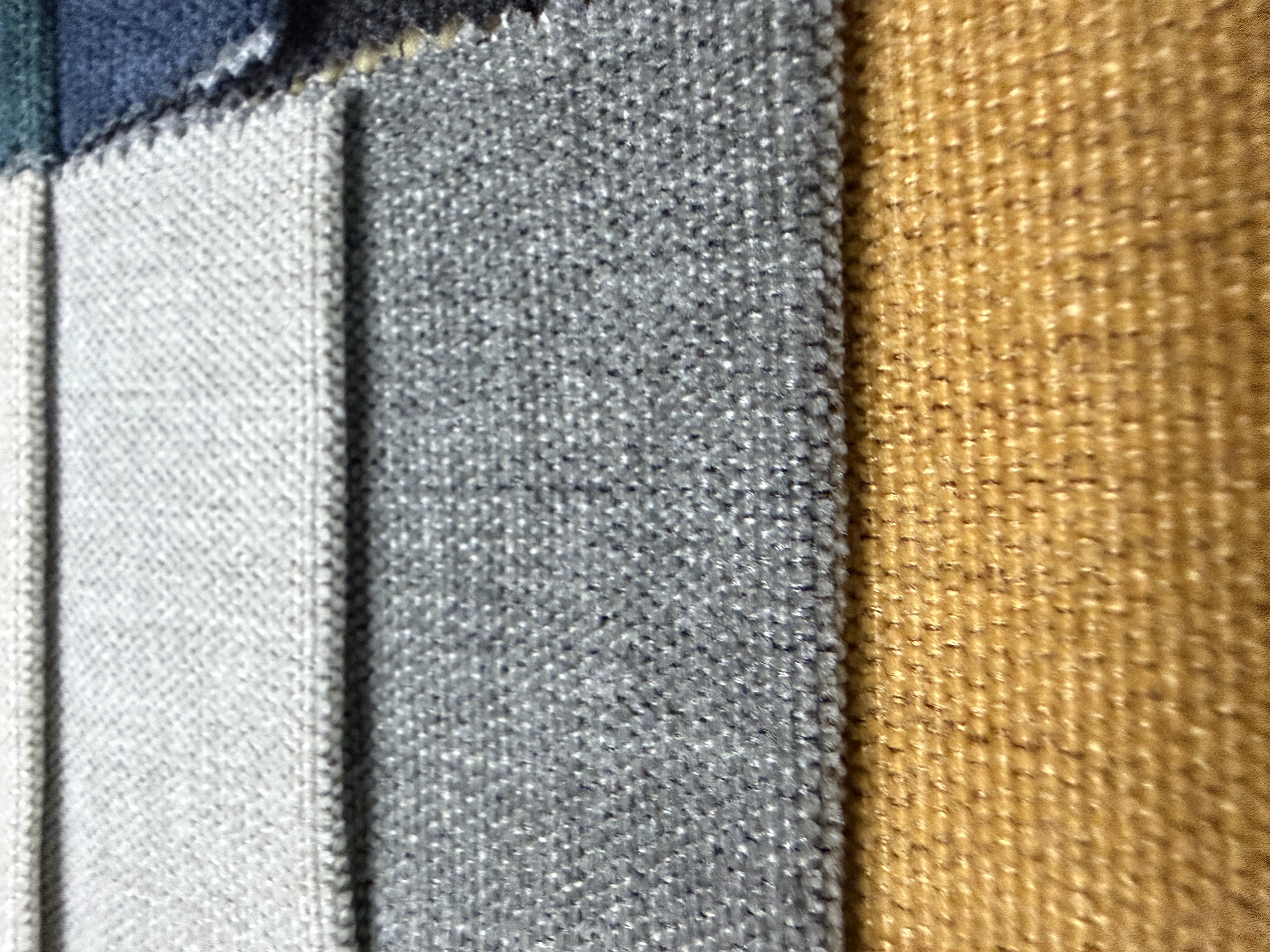
| TL07377-2 | Velvet fabric | 300D x 600D | 160 gsm | 150 cm | Velvet quality, soft hand feel | Bonded back side |
| TL07242 | Velvet fabric | 150D x 320D + 200D | 220 gsm | 150 cm | Soft, velvet-like hand feel | Used for cushion and sofa |
| TL12167 | Poly linen fabric | 350D x 350D + 650D | 280 gsm | 150 cm | Linen hand feel | Bonded back side |
| TL07410 | Velvet fabric | 350D x 450D | 300 gsm | 150 cm | Chenille quality, soft hand feel | Bonded back side |
| TL07408 | Jacquard fabric | 1150D x 4500D | 450 gsm | 150 cm | Looped-pile appearance, soft hand feel | Bonded back side |
Two entries in this table share the same 160 gsm weight class but differ in surface: TL0329 is brushed with a suede hand feel, while TL07377-2 is a velvet fabric with a soft velvet hand feel. Weight class therefore cannot substitute for a surface and backing specification. Within this set, TL0329 is also the entry documented with a 300 cm width option alongside 150 cm, which makes it the candidate to test first for wide cushion or sectional panels.
OEM and order parameters at a glance
| Parameter | Documented value |
|---|---|
| Production mode | OEM and ODM |
| Customization | Pattern design, fabric width, fabric gram weight, colour/shade, flame-retardant finishing, water-repellent finishing, stain-resistant finishing, development against customer sample |
| Monthly capacity | 200,000 meters |
| Minimum order quantity | 500-1000 meters per colour |
| Lead time | 30-45 days |
| Quality control | 100% tested in-house, or random inspection by the customer |
| Export markets | EU / the Americas |
| After-sales | Within two months after goods are received by the customer |
| Website and blog | www.t-landtex.com / blog.t-landtex.com |
FAQ: TL0329 Sourcing, Capability and Compliance Questions
1. Which certifications apply to TL0329, and how should buyers verify the scope?
T-LAND TEXTILE holds OEKO-TEX STANDARD 100 (certificate 19.HCN.99628, issued by Hohenstein, global market) and Global Recycled Standard (certificate CB-CUC-1026562, issued by Control Union, scope: dyed fabrics and greige fabrics, valid 16 March 2026 to 15 March 2027). In the certification records, TL0329 is listed among the related product models for both certificates. Because certificate scope can be limited by colour, dyeing route and finishing, the reliable verification step is to request the applicable scope statement for the specific colour and order before bulk production. Named models in the OEKO-TEX scope include TL12199, TL07410, TL0415, TL0469, TL0484 and TL08180; named models in the GRS scope include TL12167, TL07392, TL12210, TL12199 and TL08269.
2. How should buyers evaluate China fire retardant home textile fabric manufacturers?
Start from the standard rather than from the claim. UK domestic upholstered products are governed by the Furniture and Furnishings (Fire) (Safety) Regulations 1988, while BS 5867 is the established UK fire safety standard for curtains and drapes. In the EU, GPSR 2023/988 sets safety requirements for home textiles, with Digital Product Passports expected for textiles by 2027. A manufacturer that accepts flame-retardant finishing as a defined customization item, alongside pattern design, width, gram weight, colour, water-repellent and stain-resistant finishing, can be briefed against a named standard. The buyer's task is to place that standard, the test method and the specific colour into the purchase order, then confirm the certificate or test report against that order rather than against a general company statement.
3. Can TL0329 be customized for a cushion and sofa OEM programme?
Yes. Documented customization options cover pattern design, fabric width, fabric gram weight, colour/shade, flame-retardant, water-repellent and stain-resistant finishing, and development against a customer sample. Production modes cover OEM and ODM. Monthly capacity is 200,000 meters, export markets are the EU and the Americas, and the base parameters of TL0329 remain verifiable at order level: 105D x 200D construction, 160 gsm weight, 100% polyester composition, and a 150 cm usable width with a 300 cm width option.
4. What is the minimum order quantity, and how does sampling reduce risk?
The minimum order quantity is 500-1000 meters per colour. Sampling runs in parallel with commercial negotiation: small sample orders are supported to help customers develop new items, and development against a customer sample is offered, with copying rights for new items supplied by a client retained under law. For a cushion or sofa programme, a sample round should cover hand feel on a sewn cushion, lamination behaviour with the chosen backing, colour match and sewing trials. Validating those four points first keeps the initial bulk order aligned to a confirmed reference instead of a visual approximation.
5. What is the lead time, and what after-sales support is provided?
Lead time is 30-45 days, with a monthly capacity of 200,000 meters. Quality control is 100% tested in-house or by random inspection by the customer, and after-sales support applies within two months after goods are received by the customer. For a cushion and sofa programme, the sampling round, the dyeing window and the shipping schedule should be planned against the 30-45 day production lead time. To start, request a TL0329 sample or a quotation for your specific width, backing and colour programme.
Conclusion: Matching TL0329 to a Project Scenario
TL0329 answers a specific set of cushion and sofa OEM constraints. It is a 100% polyester upholstery fabric with a documented 105D x 200D construction, 160 gsm weight and 150 cm usable width, plus a 300 cm width option. Its surface is brushed with a suede hand feel, its backside can be bonded for cushion and sofa production, and it can be matched in any colour for home decoration applications.
The decision rule is straightforward. If the project needs a lighter brushed woven for cushion covers and residential sofa upholstery, with a choice between 150 cm and 300 cm width and an optional bonded backing, TL0329 covers those parameters. If the project runs under commercial heavy-duty conditions, or requires flame retardancy to a named standard, those requirements should be written into the specification as customization items and verified against a sample and a certificate scope statement.
For buyers who want to compare weight classes before committing, the same range offers 160 gsm bonded velvet (TL07377-2), 220 gsm velvet (TL07242), 280 gsm poly linen (TL12167), 300 gsm velvet (TL07410) and 450 gsm jacquard (TL07408). Testing TL0329 against one heavier option on the buyer's own cushion construction is usually the fastest way to settle the weight question.
Next step: request a TL0329 sample or a quotation. Send your target width (150 cm or 300 cm), backing requirement (bonded or unbonded), colour programme and destination market, and the specification can be confirmed against your project.
Email: angela@t-landtex.com | Tel / WhatsApp: +86 13913732999 | Website: www.t-landtex.com | Blog: blog.t-landtex.com
Address: 11F Yadu Building C, Qiangwu Road, Shengze Town, Wujiang City, Jiangsu, China
Download the full product brochure: T-LAND TEXTILE product catalogue (PDF)
Have Questions or Need More Details?
Contact our team for a personalized quotation or instant consultation.
Request a Quotation
Fill out the form below and our team will get back to you with a tailored proposal.
WhatsApp Direct Chat
Prefer to chat in real-time? Message us on WhatsApp for instant assistance & quick answers.
- Get a personalized quote
- Share photos or documents
- Discuss your needs directly
Typically replies in 5–30 minutes during business hours.