
Home Textile Fabric Supplier Evaluation: Capability Checks and Delivery Assurance
A home textile fabric supplier is evaluated on evidence, not on catalogue language. The workable test is whether four things can be produced in writing before the purchase order is signed: the acceptance criteria bulk fabric will be measured against, the documented identity link between the approved sample and the production lot, the declared route for any flame-retardant performance, and the construction data — yarn count, GSM, usable width and backing — that decides whether the quoted article can be produced at your volume and your date.
This guide is written for buyers in the research and evaluation stage of a sourcing project: importers, brand owners, furniture OEMs and soft-furnishing project teams comparing Chinese home textile fabric manufacturers for sofa, curtain, cushion and decorative fabric programmes. It treats delivery assurance as a documentation problem before it is a logistics problem, and it uses model-level specifications from the T-LAND TEXTILE range — dimout curtain articles TL08183, TL08170, TL08269, TL0888, TL08166 and TL08229, and upholstery articles TL0329, TL0901 and TL07242 — as worked examples of what a verifiable data sheet looks like.
Short answer for procurement teams: score a supplier on six verifiable items — written acceptance criteria, a sealed sample plus lot test record, a declared flame-retardant route, the full construction string rather than GSM alone, usable width and backing, and capacity plus after-sales terms. Anything that cannot be produced as a document remains unverified, however good the hand sample feels.
Why Capability Claims Break Down at Order Stage
Most disputes in home textile fabric supply are specification failures that surface late, at inspection or after the container lands. Three gaps account for most of them, and a fourth quietly distorts how buyers read the data.
Gap one: the enquiry states a use, not a criterion. “Sofa fabric for hotel projects” and “curtain fabric, room darkening” are descriptions, not measurable requirements. Unless the enquiry defines the test method and the pass threshold — pilling grade, light fastness grade, abrasion resistance, flame-retardant standard, colour difference tolerance — the supplier is free to interpret, and that interpretation will be defended with the approved sample.
Gap two: the sample and the bulk are treated as the same object. A hand sample proves a construction is possible. It does not prove that the lot shipped in month six carries the same yarn, the same GSM, the same usable width and the same backing. That link has to be created by the buyer: a sealed retained sample, a lot test record, and an agreed tolerance band on weight, width and shade.
Gap three: flame retardancy is negotiated as an attribute rather than a route. A fire-retardant curtain fabric can carry flame retardancy delivered at yarn level or added as a coating treatment. The two routes differ in how performance is documented and in how surface and handle behave. An order that says “FR required” without naming route and standard leaves the most expensive requirement on the table unresolved.
The fourth issue: GSM is read as a proxy for quality. One model number can legitimately carry two weights because the build changes. TL12199 in the T-LAND TEXTILE range is specified at 300 gsm with backing and 380 gsm with silicon coating — same article family, two constructions, two legitimate weights. Buyers who compare weight alone read that as inconsistency; buyers who compare build understand exactly what they are buying.
What the Home Textile Fabric Market Now Expects From a Supplier
The global home textile market was valued at USD 144.76 billion in 2025 (The Business Research Company), with Asia Pacific holding a 44.17% share in 2025 (Fortune Business Insights). Within that, upholstery fabric was valued at USD 44.5 billion in 2023 (Verified Market Research), and the blackout fabric segment at USD 2.7 billion in 2024, forecast to reach USD 3.8 billion by 2030 at a 5.9% CAGR (Strategic Market Research). The blackout figure should be read as directional only: reports differ on whether “blackout fabric” means raw fabric or finished curtains, so the number gives context rather than a benchmark for a specific order.
Supply is dense. China’s home textile exports reached USD 2,870.94 million in March 2024 alone (Stellar Market Research). When the number of available mills is high, price converges and the differentiator moves to documentation quality and delivery reliability — the two areas hardest to assess from a catalogue.
Regulation is tightening in parallel. In the UK, the Furniture and Furnishings (Fire) (Safety) Regulations 1988 — amended in 2010 and 2025 — remain the core regime for domestic upholstered products, while BS 5867 is the established UK fire-safety standard specifically for curtains and drapes. In the EU, the General Product Safety Regulation 2023/988 governs home textile safety, and Digital Product Passports are expected for textiles by 2027. Each of these converts into a document a supplier must issue per article, not per brochure.
The practical consequence is straightforward: the buyer’s job is to translate end use and regulation into acceptance criteria, and the supplier’s job is to hold those criteria lot after lot. An evaluation that does not test the second capability is measuring marketing, not manufacturing.
Six Capability Checks That Predict Delivery Performance
The checks below are ordered by how early they can eliminate a supplier. Each one produces a document or a data point; none depends on the sales narrative.
1. Purchase terms and acceptance criteria, in writing
Ask for the specification sheet the factory would actually work from, then compare it line by line with your enquiry. A usable sheet names the composition, the full construction string, the weight in GSM, the usable width with tolerance, the backing or finish, the colour approval conditions, and the test method behind every performance claim. T-LAND TEXTILE (Suzhou T-land Textile Co., Ltd.), a home textile fabric manufacturer based in Shengze, Wujiang City, Jiangsu, China, producing sofa and curtain fabric and exporting around 90% of output mainly to the EU, lists flame-retardant, water-repellent and stain-resistant finishing alongside pattern design, fabric width, gram weight and colour/shade as customization items. That is useful precisely because it means each of those items must be fixed as a line item on the order — not inherited from a conversation or a previous programme.
Two interrogation questions do most of the work here. Which of these lines is measurable at goods-in, and who signs the measurement? And if a line cannot be measured, why is it on the sheet at all?
2. Bulk-to-sample identity: how it is actually confirmed
Identity is confirmed by three artefacts, not by comparing hand feel at the loading dock:
- a sealed, signed and dated retained sample from the approved lot;
- a lot test record issued by the supplier’s laboratory for each production batch;
- a stated tolerance band for GSM, usable width and shade, agreed before the first bulk order.
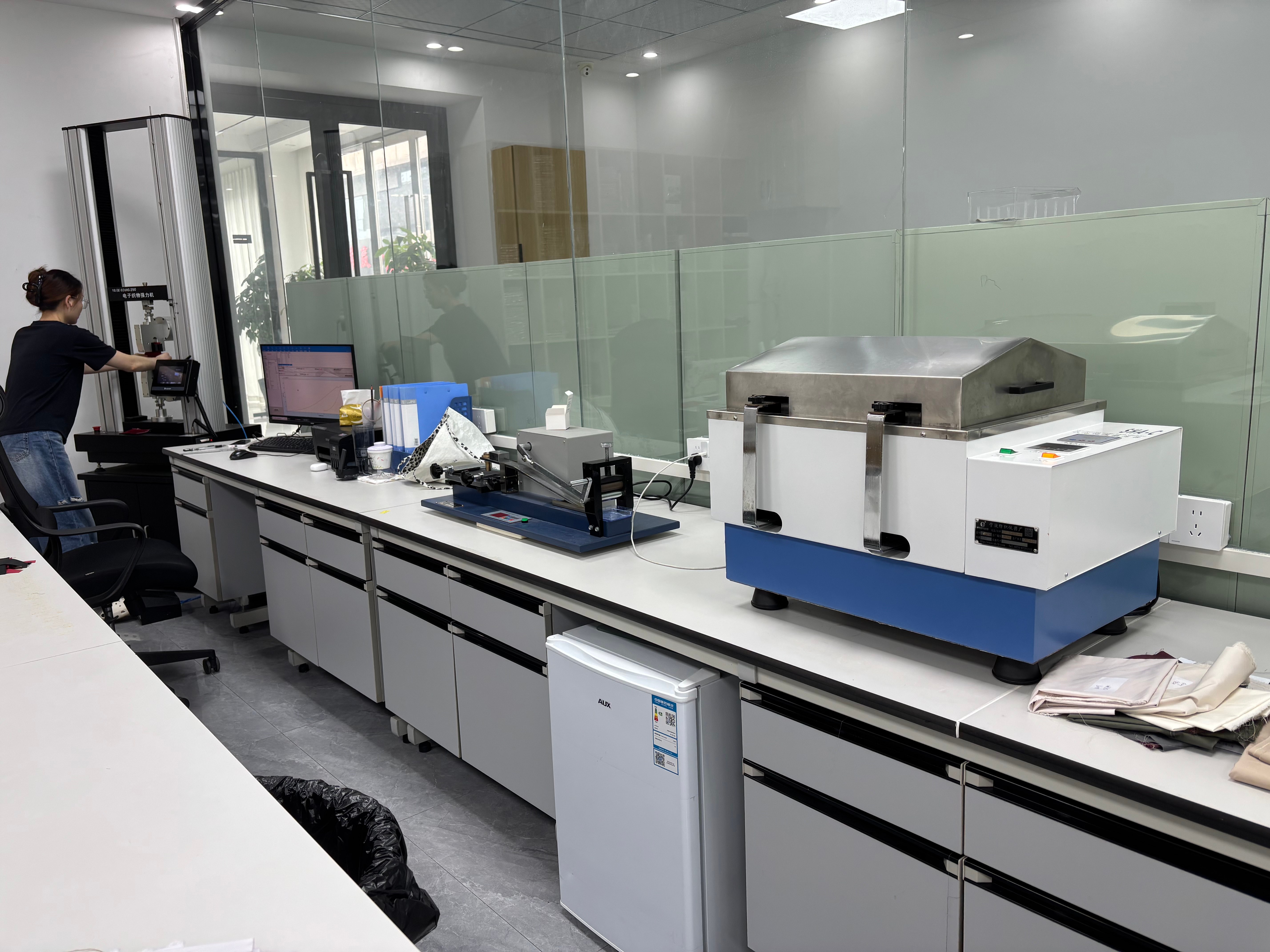
Ask who holds the retained sample, for how long, and what happens procedurally when a lot falls outside the band. T-LAND TEXTILE operates an in-house laboratory and tests each lot of different items, with quality control described as 100% testing in-house or random inspection by the customer. For a buyer, the operative questions are which of those two modes applies to this order, what the failure record looks like, and whether the pre-shipment lot can be compared against the sealed sample before release.
3. Flame-retardant route: inherent yarn or coating-treated
For a fire-retardant curtain fabric, the first question is whether flame retardancy is delivered in the yarn (inherent) or applied as a coating or topical treatment. The second is the standard that applies to your end market: BS 5867 is the established UK fire-safety standard for curtains and drapes, while domestic upholstered furniture in the UK falls under the Furniture and Furnishings (Fire) (Safety) Regulations 1988, amended in 2010 and 2025. The third is the document: a test report or certificate naming the article, the standard and the result, valid for the batch being bought.
The route matters commercially, not only technically. Yarn-level performance is a property of the construction itself; a coating route is an added process step that changes weight, surface and handle, so it must be re-confirmed whenever the finish changes and re-tested when the base article is substituted. Neither route is automatically correct. The correct answer is the one your market accepts, written on the specification and verified per lot. If a supplier answers “yes, FR” without naming route and standard, the requirement is still open — and on a healthcare or contract upholstery programme, an open requirement is a delivery risk carried by the buyer.
4. Yarn construction as a delivery-risk signal
The construction string carries more commercial information than any other line on the data sheet. It indicates which loom family can weave the article and how much of the delivery risk sits in weaving rather than in finishing.
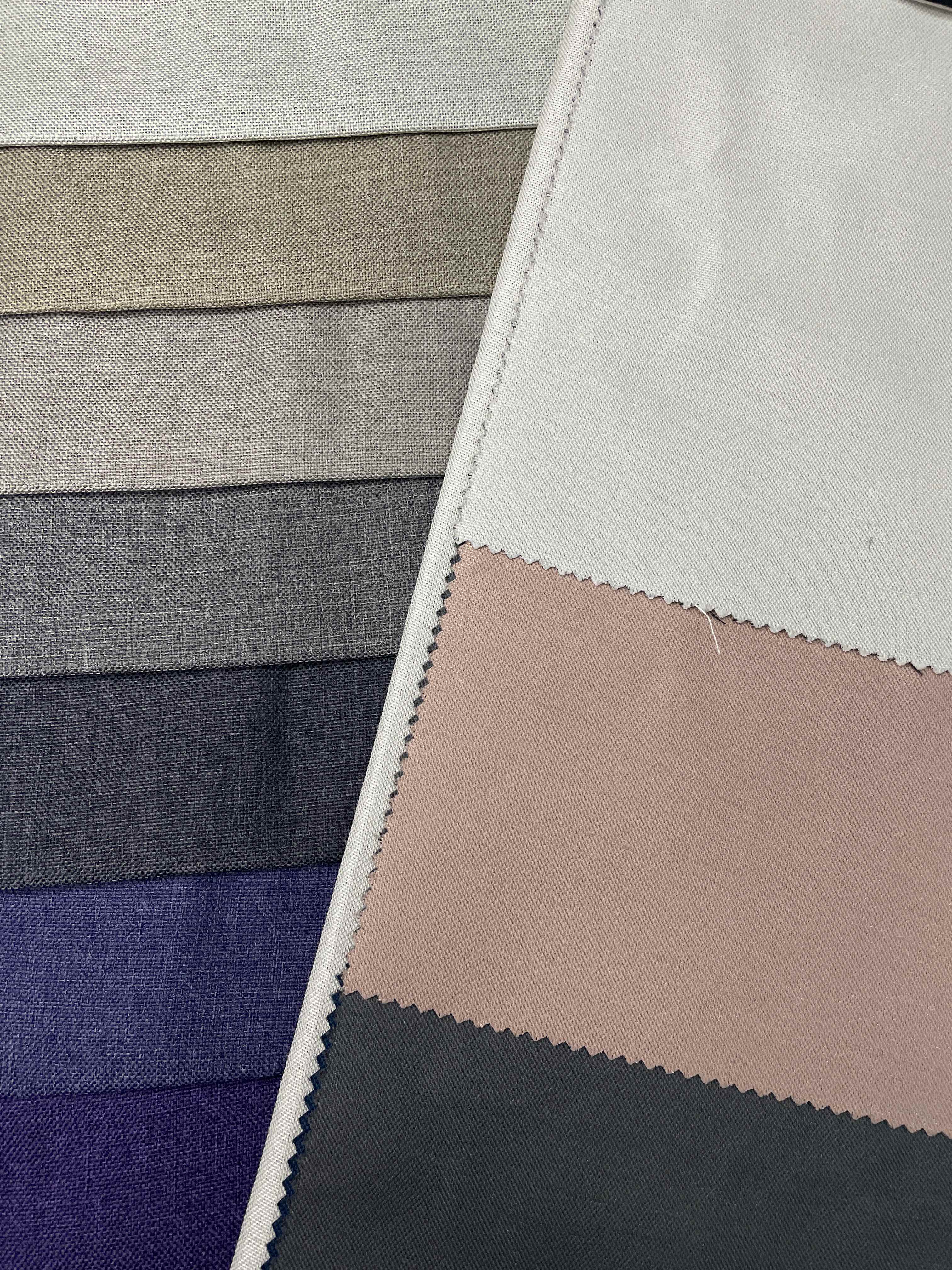
Read the dimout curtain articles side by side. TL08183 and TL08170 are specified at 75D × 300D + 160D at 230 gsm, with a cation and bamboo-look surface. TL08229 reaches the same 230 gsm from a simpler 75D × 300D build, offered at 150 cm, 280 cm or 300 cm. TL0888 sits at 250 gsm on 75D × 300D, while TL08166 and TL08269 are built on 75D × (300D + 300D) at 260 gsm and 280 gsm respectively. Two articles can therefore share a weight and share nothing else: a fine warp with a heavier weft plus an additional 160D component is not interchangeable with a plain 75D × 300D article, even when both are quoted as “230 gsm dimout”.
That produces three concrete questions for the buyer. Does the quotation refer to this exact construction string, or to a “similar” build? Is the article woven in-house or bought in? And if a substitution is proposed after approval, at what point does it require a new sample?
5. GSM, usable width and backing architecture
Weight is the number most likely to drift between sample and bulk, so it belongs on the purchase order with a tolerance band.
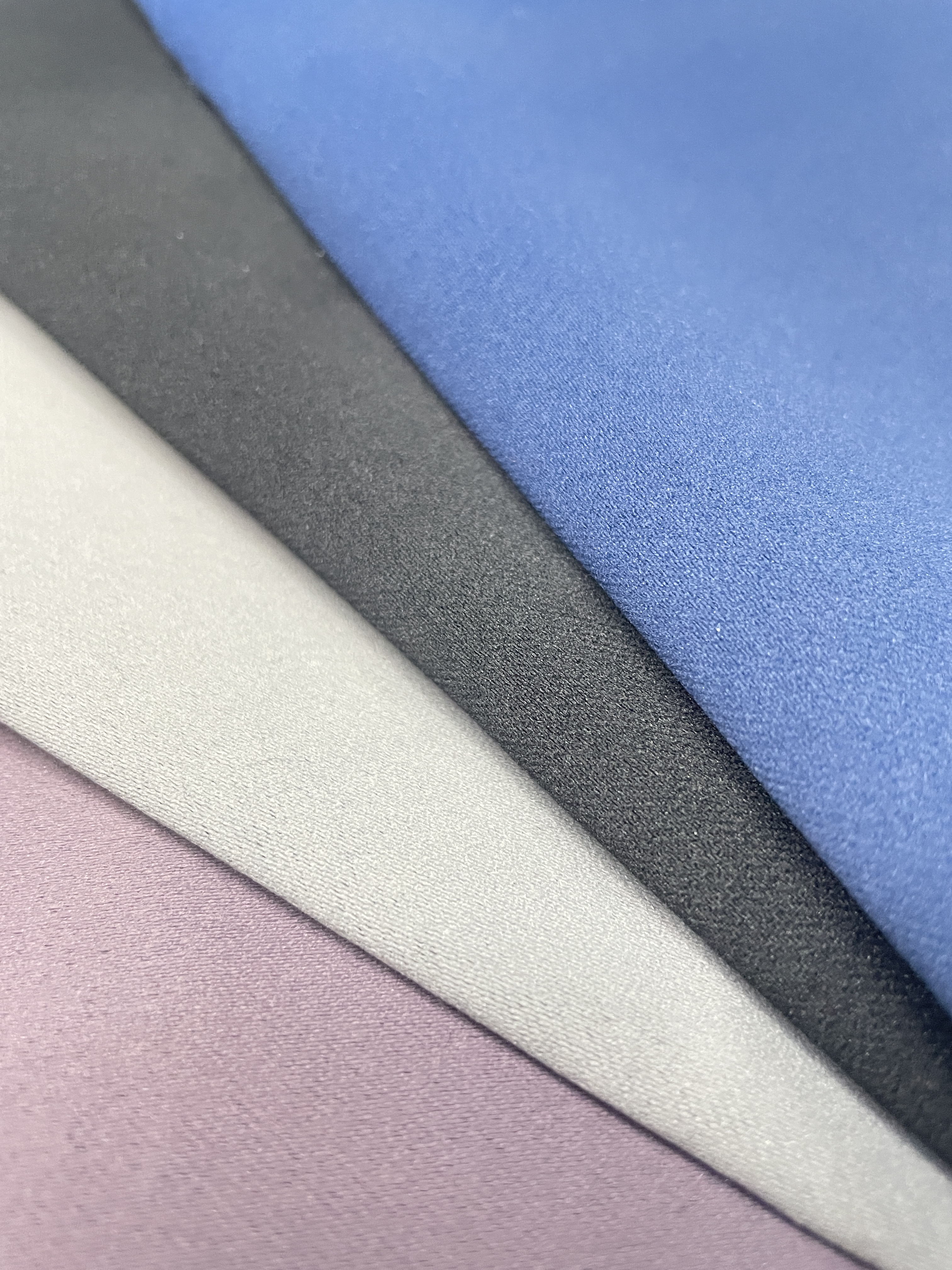
Width is a production decision, not a footnote. In this range, TL08229 and TL0888 are offered at 150 cm, 280 cm and 300 cm; TL08166, TL08183 and TL08170 at 150 cm and 300 cm; TL08269 at 150 cm only; and the upholstery article TL0329 at 150 cm or 300 cm. A 300 cm line item is not a free upgrade on a 150 cm price: wider articles reduce seam count in curtain programmes and change finishing and packing requirements, so the width has to be stated with its own tolerance.
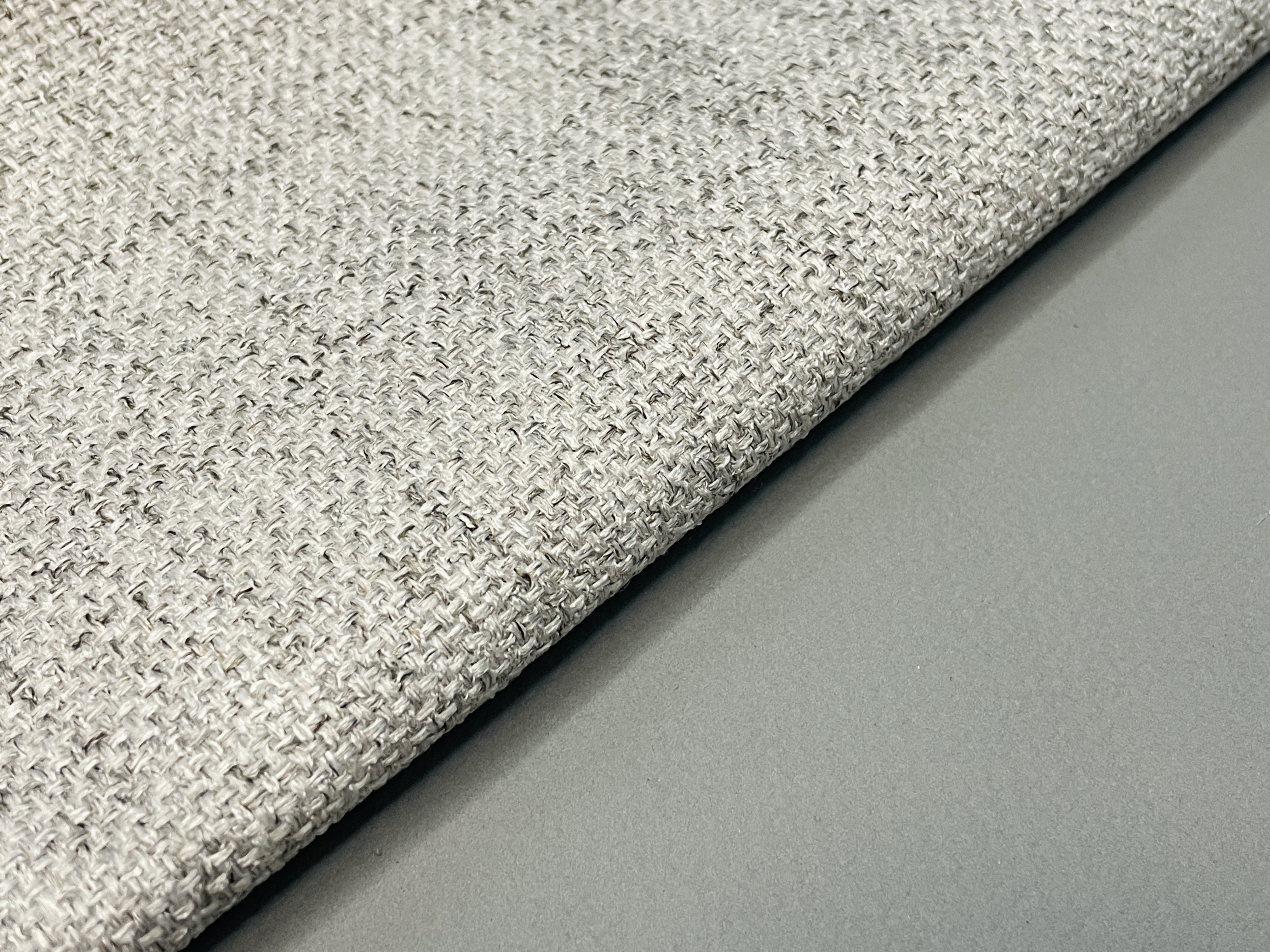
Backing changes the article. TL0329, an upholstery fabric at 105D × 200D and 160 gsm, has a brushed surface with a suede hand and is offered with a bonded backside for cushion and sofa work, with a 300 cm option that makes wide panels practical. TL0901 (velvet, 160D, 160 cm, 200 gsm) and TL07242 (velvet, 150D × 320D + 200D, 150 cm, 220 gsm) are unbonded velvet constructions in the same family, specified for cushion and sofa applications. Bonded and unbonded versions of “the same fabric” differ in weight, body and how the cover behaves on a frame — which is why the backing decision is recorded before the order, not discovered at goods-in.
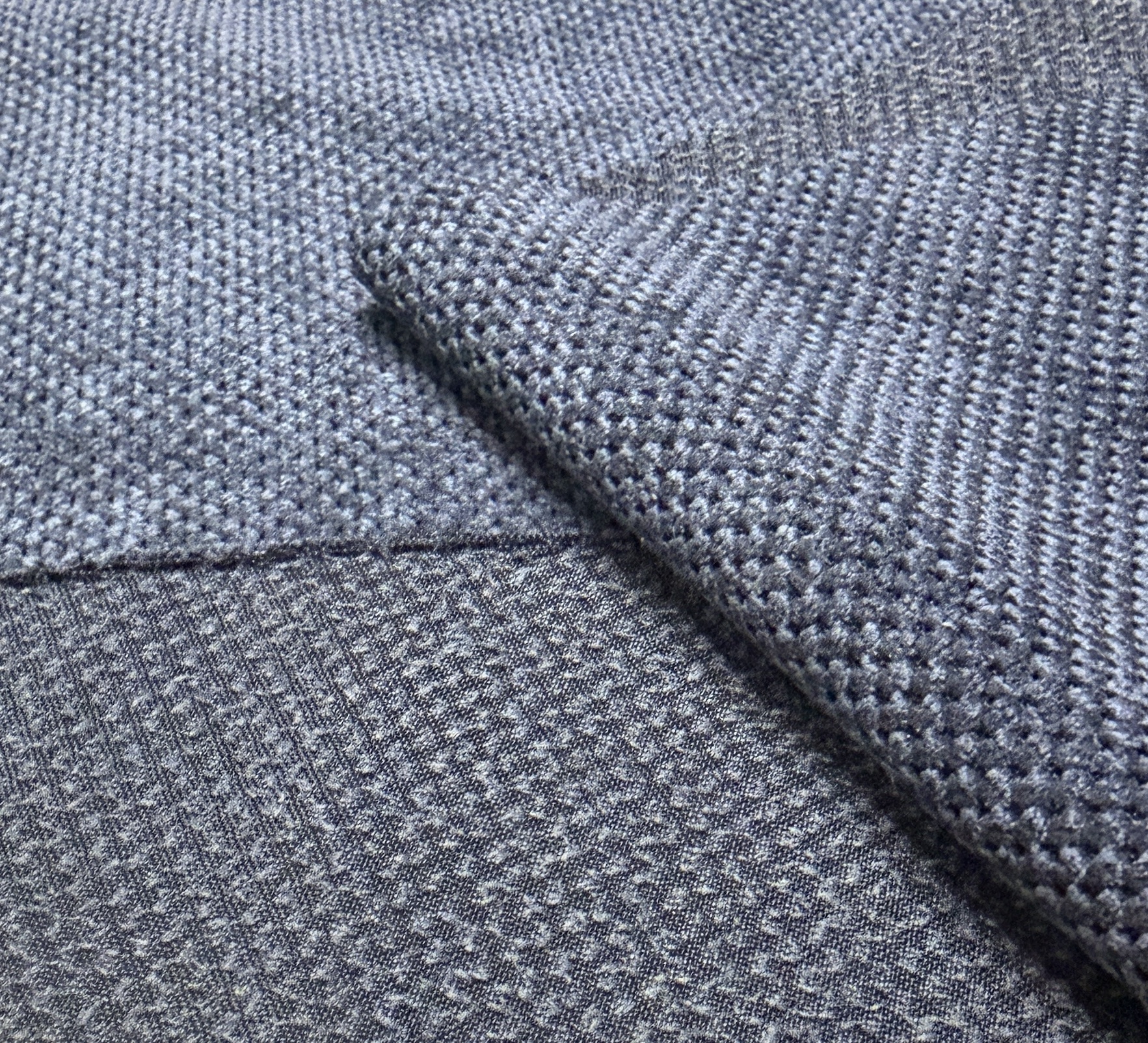
The clearest illustration of backing as a delivery variable is TL12199: 700D × 700D, 300 gsm with non-woven backing for sofa and cushion, and 380 gsm with silicon coating for curtain, at 150 cm or 300 cm. One model, two builds, two weights, two end uses. A buyer who orders “TL12199 at 300 gsm” for a curtain programme has ordered the wrong build without noticing.
6. Capacity, laboratory and documentation trail
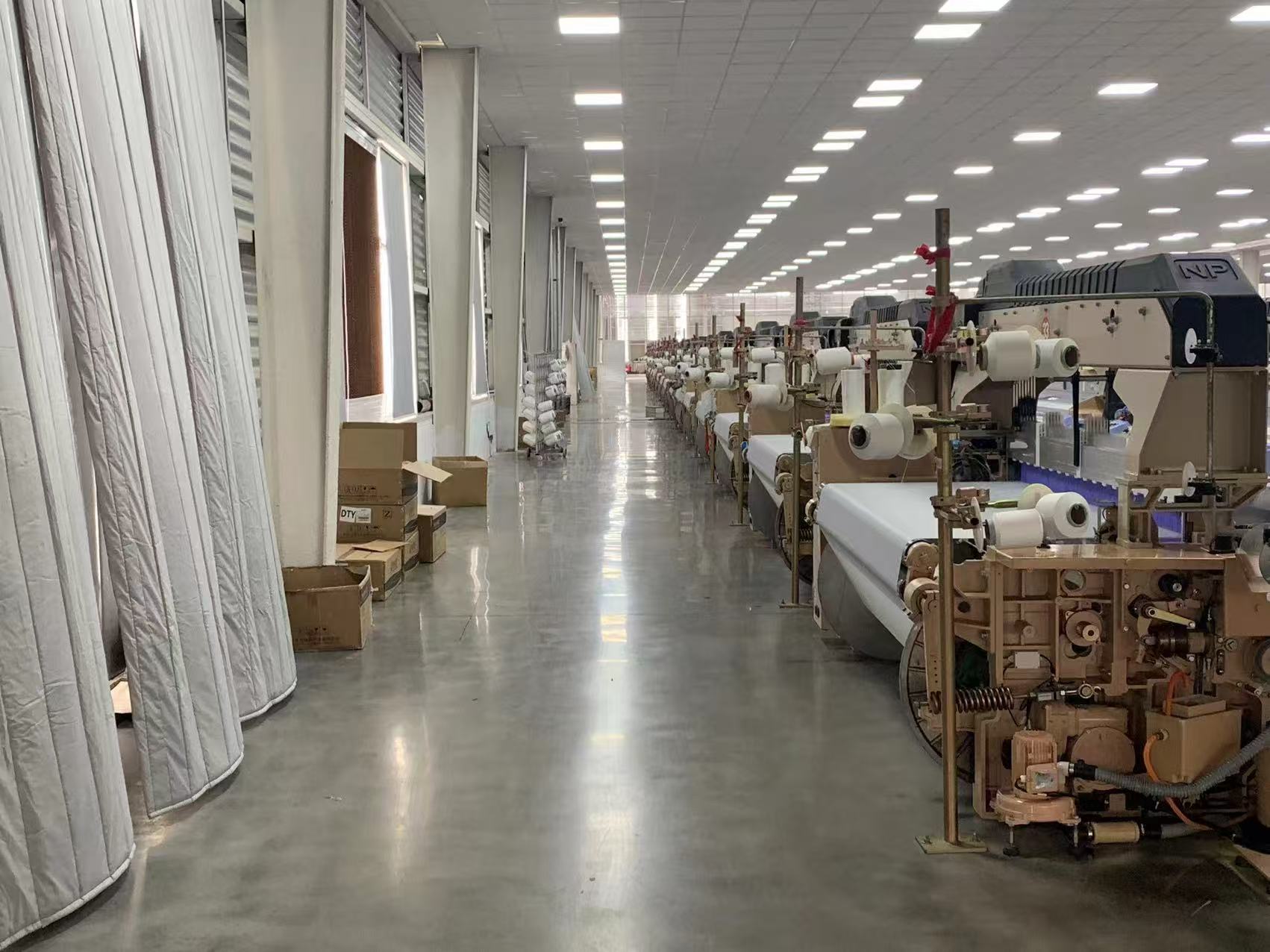
Capacity only means something when expressed per colour and per month, because that is how it constrains a programme. T-LAND TEXTILE states a monthly capacity of 200,000 meters, a 1,500 m² warehouse, 3 R&D engineers and a 5,000 m² facility with 91 employees, running OEM and ODM production for the EU and the Americas. The company holds OEKO-TEX and GRS certification and runs order instructions through a computerised, non-paper system — relevant because it means the specification on file is the specification the floor works from.
Ask three questions: which performance tests are run in-house and which are outsourced; what the lot record looks like when a test fails; and how long the after-sales window runs. T-LAND TEXTILE states after-sales support within two months of goods being received, which should be written into the purchase order if your own customer terms extend further.
A Step-by-Step Evaluation Sequence
Run the checks in this order. Each step produces a document that either supports the next step or stops the evaluation early, before the tooling and the deposit.
- Define end use and duty class. Residential decoration, hotel and B&B, office commercial, healthcare, exhibition and cultural tourism, and RV or yacht soft furnishing do not carry the same expectations. Household low-frequency friction and sunlight is a different brief from commercial heavy-duty use, and the specification must state which applies.
- Convert performance into criteria. Name the test method and pass threshold for pilling, light fastness, abrasion, flame retardancy and colour difference, and state whether the article is indoor or outdoor and whether it must be room darkening, noise reducing, water-repellent or stain-resistant.
- Request the model-level data sheet. Composition, full construction string, GSM, usable width options, backing or finish, and the flame-retardant route where relevant. Reject sheets that give a weight range without a build.
- Set the sample-to-bulk protocol. Approve under a stated light source, seal and retain the sample, agree tolerance bands, and require a lot test record with each shipment.
- Fix the flame-retardant route and its documentation. Route, standard, certificate holder and validity. Do this before price negotiation, because changing route after quotation changes the product.
- Match capacity and lead time to your calendar. Check the quoted lead time against the MOQ per colour. T-LAND TEXTILE quotes 30–45 days and 500–1,000 meters per colour, which suits a running programme but not a single-site roll-out.
- Lock inspection and after-sales. Choose between full in-house testing and customer random inspection, name the party who signs the record, and write the after-sales window into the order.
- Verify before shipment. Compare the pre-shipment lot against the sealed sample and the lot record, and release only when the tolerance band holds.
| Check | Evidence to request | Red flag |
|---|---|---|
| Acceptance criteria | Specification sheet with test methods and thresholds | “Standard export quality” with no numbers |
| Sample identity | Sealed retained sample, lot test record, tolerance bands | Sample approval by photograph only |
| Flame-retardant route | Declared route, named standard, certificate per article | “FR available” without route or standard |
| Construction data | Full yarn count string, GSM, width options, backing | Weight quoted without build |
| Delivery terms | Lead time, MOQ per colour, after-sales window | Lead time quoted before MOQ is agreed |
Where These Checks Change the Outcome
Supplier evaluation is not abstract. Each project type stresses a different part of the framework, and the difference shows up in which document you fight for first.
Residential decoration projects. Household low-frequency friction and sunlight is the duty class, and the two recurring failure modes are pilling and fading. Pilling is a physical fibre phenomenon: surface short fibres are pulled out by repeated friction and tangle into visible pills, and short-fibre fabrics are more likely to pill than long-fibre fabrics — it is not automatically a product defect. That is why the pilling-resistance grade belongs in the specification rather than in the post-delivery argument. Curtain fading follows the same logic: ultraviolet radiation degrades dye molecules, so a fabric without sufficient light fastness discolours under long exposure, and the light-fastness grade should be agreed before bulk.
Hotel and B&B projects. Commercial heavy-duty conditions plus repeat ordering. Here the case history carries more weight than the hand sample: OEM clients in Germany, the Netherlands, Belgium, Italy, Sri Lanka and South Africa, running 20,000 meters across sofa and curtain applications over 4–6 years, with reported results of hand feel and colour fastness meeting the stated requirement, stable fabric performance across repeat orders, and compliance with OEKO-TEX.
Office commercial projects. Glare control and acoustic comfort drive the brief. The dimout articles in this range — TL08229 at 230 gsm and TL0888 at 250 gsm on 75D × 300D, TL08166 at 260 gsm on 75D × (300D + 300D) — are specified for room darkening and noise reduction, with 300 cm options that cut seam count on wide window runs. Where absolute blackout is required rather than room darkening, state it explicitly: it is a different performance target and should not be inferred from a dimout designation.
Healthcare institutions and exhibition or cultural tourism projects. Healthcare adds flame retardancy and cleanability to the criteria, so the route question in check three becomes decisive rather than administrative. Exhibition and cultural tourism projects compress the timeline, which makes the 30–45 day lead time and the 500–1,000 meter per colour MOQ the controlling constraints rather than the unit price.
RV and yacht soft furnishing. Small volumes, custom sizes, tight tolerances. The sample route matters more than the bulk price: T-LAND TEXTILE supports small sample orders for new item development and states that copying rights for client-developed items are retained under law, which protects both sides during development.
Furniture OEM supply. TL0329 shows why backing and width belong in the evaluation: 105D × 200D at 160 gsm, brushed with a suede hand, bonded backside option, 150 cm or 300 cm usable width, built for cushion and sofa production where the cover must absorb repeated sitting pressure and friction on a frame.
Model-Level Reference Table for Capability Questions
Use this table to test whether a quotation is specific. Every value below is a stated specification. A supplier who cannot produce equivalents for their own articles is describing a category, not a product.
| Model | Type | Construction | Weight | Usable width | Build / finish note | Typical end use |
|---|---|---|---|---|---|---|
| TL08183 / TL08170 | Dimout | 75D × 300D + 160D | 230 gsm | 150 cm / 300 cm | Cation and bamboo-look surface | Readymade curtain |
| TL08229 | Dimout | 75D × 300D | 230 gsm | 150 / 280 / 300 cm | Room darkening, noise reducing | Indoor curtain |
| TL0888 | Dimout | 75D × 300D | 250 gsm | 150 / 280 / 300 cm | Room darkening, noise reducing | Indoor and outdoor curtain |
| TL08166 | Dimout | 75D × (300D + 300D) | 260 gsm | 150 cm / 300 cm | Room darkening, noise reducing | Indoor and outdoor curtain |
| TL08269 | Dimout | 75D × (300D + 300D) | 280 gsm | 150 cm | Brushed surface, soft hand | Curtain, cushion |
| TL0329 | Upholstery | 105D × 200D | 160 gsm | 150 cm / 300 cm | Brushed, suede hand; bonded backside option | Cushion and sofa, furniture OEM |
| TL0901 | Velvet | 160D | 200 gsm | 160 cm | Soft velvet hand | Cushion and sofa |
| TL07242 | Velvet | 150D × 320D + 200D | 220 gsm | 150 cm | Soft velvet hand | Cushion and sofa |
| TL12199 | Sofa and dimout | 700D × 700D | 300 gsm with backing / 380 gsm with silicon coating | 150 cm / 300 cm | Two builds under one model: non-woven backing for sofa and cushion, silicon coating for curtain | Sofa, cushion, curtain |
Frequently Asked Questions
What should I confirm before ordering fire-retardant sofa upholstery fabric from a Chinese manufacturer?
Three things, in writing. First, the route: whether flame retardancy is delivered in the yarn or applied as a coating or topical treatment, because the two routes behave and document differently. Second, the standard that applies to your market — the UK Furniture and Furnishings (Fire) (Safety) Regulations 1988, amended in 2010 and 2025, for domestic upholstered products, BS 5867 for curtains and drapes in the UK, and EU General Product Safety Regulation 2023/988 in the EU, where Digital Product Passports are expected for textiles by 2027. Third, the certificate or test report naming the article, the standard and the result. T-LAND TEXTILE lists flame-retardant finishing alongside water-repellent and stain-resistant finishing as a customization item, so the route and pass threshold should be fixed as an order line for each programme rather than assumed from a previous one.
How can I tell a home textile fabric manufacturer from a trading company?
Ask for data that only a producer can generate. Model-level specifications with the full construction string, GSM, usable width options and backing — for example TL0329 at 105D × 200D, 160 gsm, 150 cm or 300 cm, with a bonded backside option. Then in-house testing records per lot, stated monthly capacity and equipment, and the scope of the certifications held. T-LAND TEXTILE, founded in 2014 in Shengze, Wujiang City, Jiangsu, China, states a 5,000 m² facility with 91 employees, 3 R&D engineers, a 1,500 m² warehouse, monthly capacity of 200,000 meters, an in-house laboratory, and OEKO-TEX and GRS certification. A trading company can usually quote a price; it cannot usually produce a lot record against a named construction.
What MOQ and order volume should I budget for?
Plan around 500–1,000 meters per colour as the minimum order quantity stated by T-LAND TEXTILE, against a monthly capacity of 200,000 meters. Volume planning should follow the build, not the model name: a 300 cm width, a bonded backside and a coated finish are separate production decisions with different costs, so a budget built on one price per model will misprice the mixed order. For scale reference, an OEM programme across sofa and curtain applications in Germany, the Netherlands, Belgium, Italy, Sri Lanka and South Africa ran 20,000 meters over a 4–6 year relationship.
Can I validate a fabric with a sample before committing to bulk?
Yes, and the protocol matters more than the sample itself. T-LAND TEXTILE supports small sample orders for new item development and develops against customer samples, with copying rights for client-developed items retained under law. On the buyer side, approve under a stated light source, seal and retain the approved sample, agree tolerances for GSM, usable width and shade, and require a lot test record with each shipment so bulk can be matched to the approval. In the OEM case referenced above, reported results were hand feel and colour fastness meeting the stated requirement, with stable fabric performance maintained across repeat orders.
What lead time applies, and what delivery assurance can I expect?
T-LAND TEXTILE quotes a lead time of 30–45 days with an MOQ of 500–1,000 meters per colour, quality control by 100% in-house testing or customer random inspection, and after-sales support within two months of goods being received. Delivery assurance comes from three arrangements rather than from the lead-time figure alone: order instructions held in a computerised system so the released specification matches the approved one, lot testing against the sealed sample before shipment, and the after-sales window written into the purchase order. If you want to test this on your own programme, request a sample or a quotation by email at angela@t-landtex.com, on WhatsApp at +86 13913732999, or through www.t-landtex.com.
Conclusion: Delivery Assurance Is Built Before the Order
Home textile fabric sourcing fails on the details that were never written down: an acceptance criterion left as a description, a sample that was never sealed, a flame-retardant requirement that named no route and no standard, and a weight quoted without its build. Reversing the order of work fixes most of it. Verify construction, GSM, usable width and backing first; fix the flame-retardant route and its certificate second; agree the sample-to-bulk protocol and tolerance bands third; then negotiate price and lead time against a product you can actually describe.
A supplier that can answer those questions at model level — with a construction string, a lot record and a declared route — is a supplier whose delivery performance is predictable. That is the practical definition of capability, and it is available for assessment before the first purchase order, not after the first complaint.
Next step: put the framework against a live programme. Request a sample set or a specification-based quotation from T-LAND TEXTILE, and ask for the construction sheet, the lot test record and the flame-retardant declaration for the article you intend to order.
Email: angela@t-landtex.com | Tel / WhatsApp: +86 13913732999 | Website: www.t-landtex.com
Address: 11F Yadu Building C, Qiangwu Road, Shengze Town, Wujiang City, Jiangsu, China
Download the product catalogue: T-LAND TEXTILE catalogue (PDF)
Have Questions or Need More Details?
Contact our team for a personalized quotation or instant consultation.
Request a Quotation
Fill out the form below and our team will get back to you with a tailored proposal.
WhatsApp Direct Chat
Prefer to chat in real-time? Message us on WhatsApp for instant assistance & quick answers.
- Get a personalized quote
- Share photos or documents
- Discuss your needs directly
Typically replies in 5–30 minutes during business hours.