
Evaluating Forklift Suppliers: Verification Steps Before Shortlisting a Diesel Model

A diesel counterbalance forklift is shortlisted on paper, but it is verified on yard evidence.
Most diesel forklift shortlists get built from catalogues. Rated capacity, lift height, engine brand and price are easy to line up side by side, so they become the basis of the decision. None of those four numbers tells you whether the truck will still be earning money in year three — or whether the supplier will still be answering the phone when a mast cylinder starts weeping hydraulic fluid in an open yard.
This guide is written for the buyer who already holds two or three quotations for a material handling forklift and needs to separate them on evidence rather than adjectives. It uses TAVOL’s diesel counterbalance range — CPCD20, CPCD25, CPCD30, CPCD35 and CPCD40, covering 2 t to 4 t — as a worked example of what a supplier should be able to document, and it ties every verification step back to the maintenance routine that keeps a diesel truck productive outdoors.
The short answer: verify five things before a diesel model reaches the shortlist — (1) real yard operating evidence rather than demonstration hours; (2) a documented pre-shift inspection and maintenance routine; (3) build evidence covering steel grade, mast and paint; (4) the exact powertrain configuration in writing; and (5) commercial evidence covering spare-parts cost, maintenance intervals, delivery lead time and OEM support. A supplier that cannot produce all five is a specification match, not a verified source.
Problem Definition: Where Diesel Shortlists Actually Break Down
A specification match and a verified supplier are two different things, and the distance between them shows up in three predictable places.
- The duty-cycle gap. A quotation confirms that a 3-ton diesel forklift is rated to 3,000 kg at a 500 mm load centre. It says nothing about the surface it will run on, the gradient it will climb, or how many shifts per day it will work. Diesel models are selected precisely for the harder version of that duty — open-air yards, uneven ground and continuous work — and those are the conditions under which an unverified assumption becomes an expensive one.
- The inspection gap. Most buyers never ask what a daily inspection on the delivered truck is supposed to cover. That single question separates a supplier that tracks field failures from one that simply ships a manual.
- The aftermarket gap. Purchase price dominates the comparison, while spare-parts cost, consumable intervals and the reach of the parts network are deferred to later. They are exactly the costs that repeat.
The verification method below closes all three gaps before a model is shortlisted, rather than after a purchase order is signed.
Industry Background: What the Diesel Segment Looks Like in 2026 Planning
Diesel remains a working choice rather than a legacy one. The global forklift market was valued at USD 81.4 billion in 2025, according to Grand View Research, and lithium-ion penetration in global counterbalanced forklifts reached 17.5% in 2024, according to Interact Analysis. In plain terms, the large majority of counterbalance trucks in service are still not lithium-powered, and the duty cycles that suit diesel — open-air yards, timber processing plants and rough terrain, where a diesel engine provides strong power — continue to be specified on diesel.
Two other structural facts matter at the shortlist stage. First, the aftermarket is a genuine global trade flow rather than a local favour: China exported USD 1.26 billion of parts for fork-lift trucks in 2024 (HS 843120), according to WITS (World Bank). A supplier with access to that flow can keep a truck running; one without it cannot. Second, the safety baseline is documentable: ANSI/ITSDF B56.1-2020, published by ITSDF, is the safety standard for low-lift and high-lift trucks effective through 2025, and buyers operating in or exporting to the United States should confirm which standard the offered truck is built against.
One more shift is worth noting for planning purposes: the lithium question does not replace the diesel question. Lithium-ion forklifts suit multi-shift warehouse work and clean, zero-emission environments, and their charging time is about 70% shorter than lead-acid alternatives, but a fleet that works rough ground outdoors still needs a diesel or dual-fuel answer for the yard.
Detailed Solution: The Five Evidence Lanes of Diesel Supplier Verification
Verification is not a single document request. It is five parallel lines of evidence, each of which can be answered or dodged. A supplier that answers all five is a shortlist candidate; a supplier that answers two is a price quote.
Lane 1 — Yard operating evidence, not demonstration evidence
Ask what duty cycle the offered configuration was specified for. A diesel forklift can be evaluated against open-air yards, indoor/outdoor combined use, multi-shift general cargo handling, and confined container loading — and each of those stresses the truck differently. Multi-shift general cargo work tests the cooling system and the operator’s inspection discipline; container loading tests mast control and manoeuvring precision in tight space; bulk material yards test the chassis and the attachment mounting.
If the truck will carry a hydraulic attachment — a paper roll clamp, a bale clamp, a rotating clamp or a fork rotator — the hydraulic duty cycle changes and must be part of the question. Attachment work converts a standard lifting truck into a continuous hydraulic application, and that changes what you should be checking in the maintenance plan.
What to request: the model and tonnage, the attachment list, the shift pattern, the yard surface, and the annual hours the operation expects.
Lane 2 — Inspection and maintenance evidence
This is the lane most buyers skip, and it is the cheapest to test. Ask the supplier to describe the pre-shift inspection that applies to a diesel counterbalance forklift. A complete routine covers five checks:
- Check engine oil, hydraulic fluid and coolant levels.
- Inspect tires for wear, damage or correct inflation.
- Test brakes, horn, lights and the backup alarm.
- Check forks and mast for cracks, bends, or leaks in hydraulic lines.
- Start the engine and confirm there is no unusual noise, smoke or warning light.
The purpose is stated just as plainly: perform a visual and functional check of fluids, tires, brakes and safety devices before every shift to prevent breakdowns and protect the operator.
Lane 3 — Build evidence: steel, mast and finish
The structure of a diesel forklift is the part that cannot be upgraded later. TAVOL diesel models are built with Q235 carbon structural steel and Q355 low-alloy high-strength structural steel as the main materials. Mast options span two-stage masts with lift heights of 3 m, 3.5 m and 4 m, and three-stage masts at 4.5 m, 5 m, 5.5 m and 6 m, plus container mast and full free mast variants; the mast tilt angle is 6° forward and 12° backward. Tire choice is between pneumatic and solid depending on the surface.
Ask to see the fabrication sequence rather than the finished paint. On the TAVOL manufacturing base, the visible process chain includes CNC cutting, hydraulic pressing, bending, dedicated sawing for forklift masts, sandblasting and a controlled painting room. A mast is not a welded tube purchased from a catalogue; it is cut, formed and finished in-house, and that is what you are verifying.
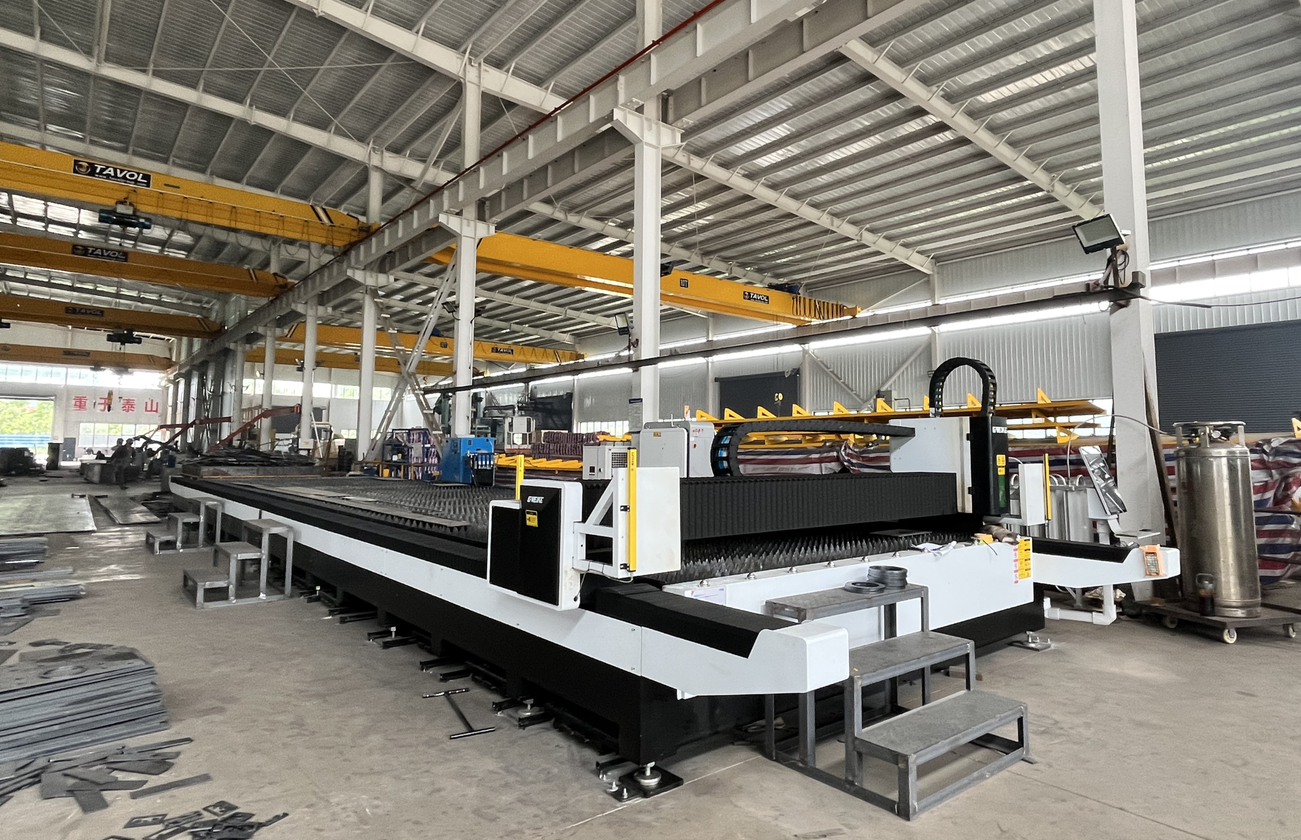
Step one of build verification: CNC cutting of structural steel plate before chassis fabrication.
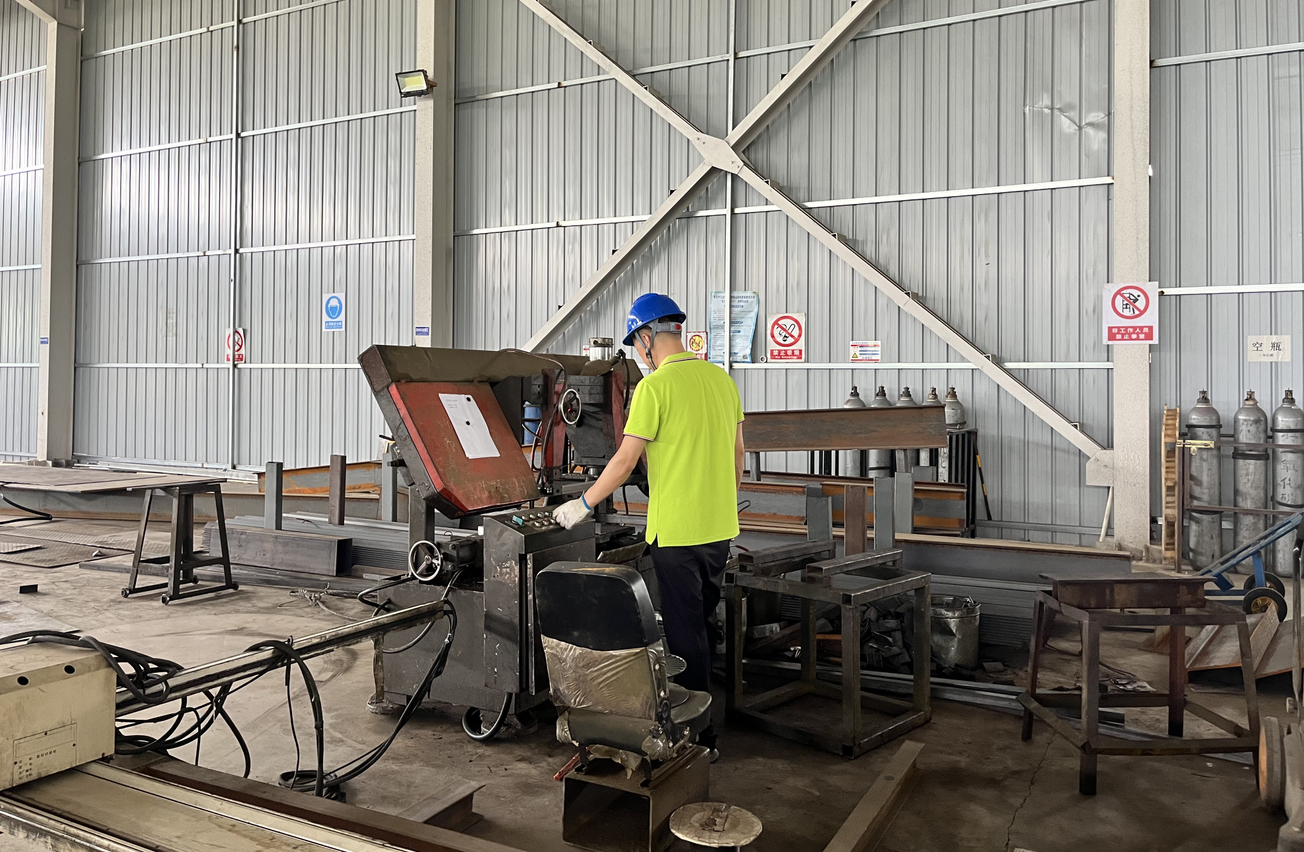
Mast sections are cut on a dedicated sawing line — ask to see this stage, not just the finished mast.
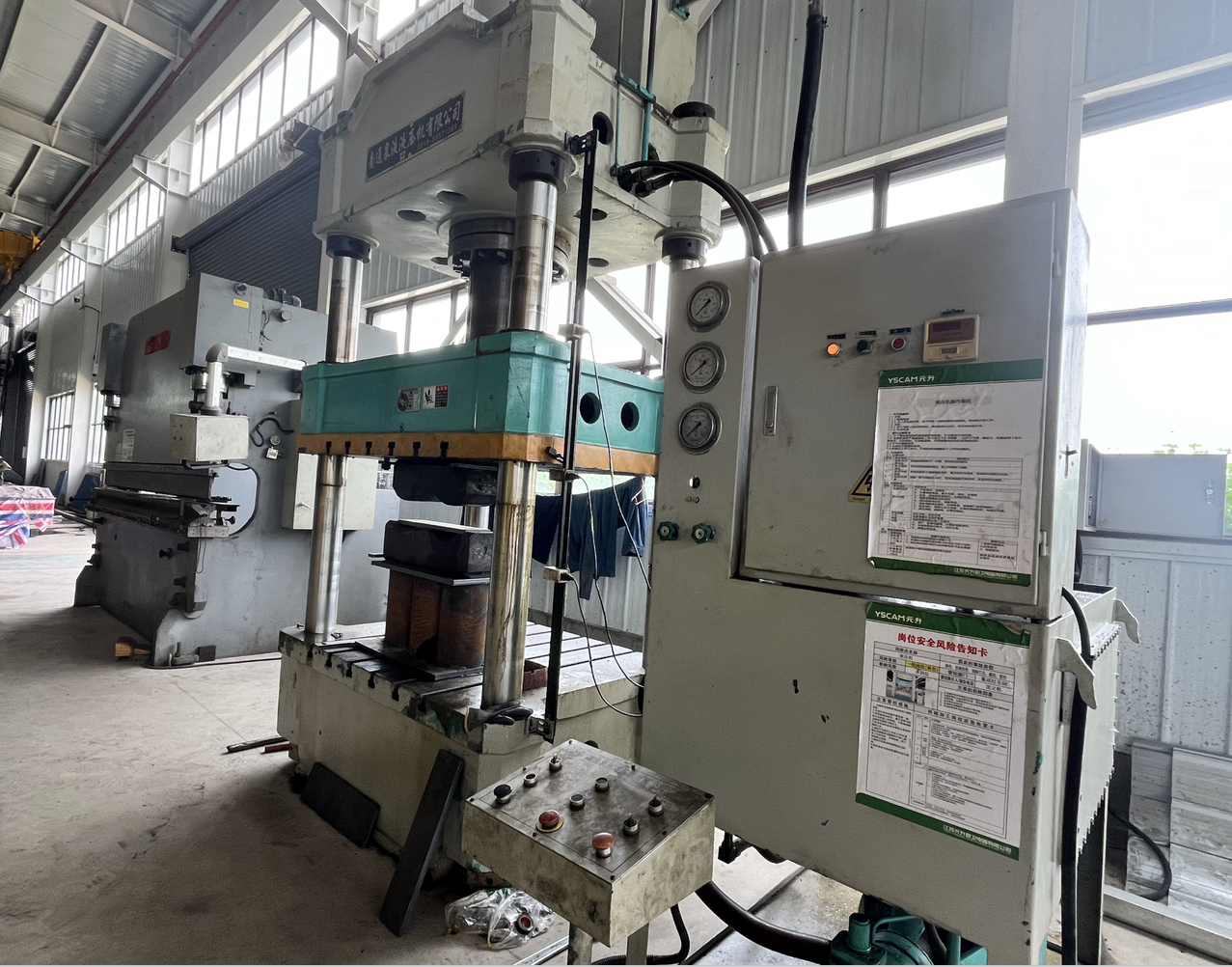
Hydraulic pressing and forming determine the consistency of structural components across a production run.
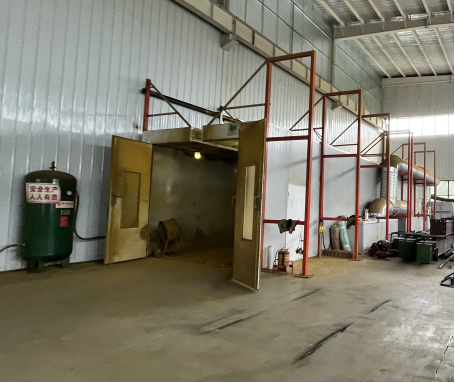
A controlled painting room is the difference between a forklift that looks new in year three and one that does not.
Lane 4 — Powertrain evidence: the engine, in writing
Diesel forklift engines are frequently specified as a family rather than a single unit. TAVOL diesel models can be ordered with Xinchai, Quanchai, Isuzu, Mitsubishi, Yanmar, Kubota or PSI engines. That flexibility is useful, but it also means the quotation must name the exact engine configuration, because the parts list, service interval and documentation all follow from it.
Where the destination market requires a specific emission stage for the engine, ask for the documentation that applies to the configuration actually offered — not to the product family. Performance expectations can be stated on the evidence: TAVOL diesel forklifts deliver fuel efficiency and engine performance comparable to established international brands, which is what makes the commercial comparison meaningful rather than rhetorical.
Lane 5 — Commercial and after-sales evidence
Price is the last lane, not the first. Three commercial facts should appear in the supplier’s answer: the difference in purchase cost at comparable load capacity and lifting height, the difference in spare-parts cost, and the maintenance interval the truck is designed around. Taken together they determine total cost, and they are the numbers a shortlist should be built on.
For a distributor or fleet buyer, one more consideration belongs in this lane: how many product lines sit behind the same after-sales system. TAVOL manufactures cranes, material handling equipment and agricultural machinery in-house, which means one parts inventory and one technical contact rather than three unrelated supply relationships.
Step-by-Step Breakdown: Seven Verification Steps Before Shortlisting
- Write the duty cycle down in numbers. State the surface, gradient, shifts per day, annual hours and the presence or absence of hydraulic attachments. Verification without this baseline has nothing to measure against.
- Request the inspection routine, not the warranty. Ask for the pre-shift checklist in writing. Five checks — fluids, tires, brakes and safety devices, forks and mast, engine start behaviour — is a complete answer.
- Request build documentation. Steel grades, mast configuration, tire type and the finishing process. Compare Q235 / Q355 structural steel and the mast lift range against your racking or stacking requirement.
- Lock the powertrain configuration. Name the engine, obtain the applicable documentation, and confirm that the configuration in the contract is the configuration in the quotation.
- Check the dimensional footprint against the yard. Turning radius, overall width and ground clearance decide whether the truck works in your aisles and on your surface. The table below gives the figures for the diesel range.
- Price the aftermarket, not just the truck. Ask for spare-parts cost relative to legacy Western brands, the maintenance interval, and the route by which parts reach your country.
- Settle delivery, parts and OEM terms before signing. Confirm the delivery date for the exact configuration, the OEM customization scope, and who owns the technical support relationship after commissioning.
Use Cases: Where Diesel Verification Pays Off
Open-air building-material and brick yards
These operations run dust, uneven ground and long shifts. Verification should focus on ground clearance, tire choice and the inspection routine, because the daily check is what catches a cracked fork or a weeping hydraulic line before it becomes a stopped yard.
Timber and wood-processing yards
Timber handling is one of the classic diesel applications: a diesel engine provides strong power and suits outdoor use and rough terrain. Verification should confirm the mast configuration for the stacking height and the chassis protection for the environment.
Mixed indoor/outdoor general cargo on multi-shift work
Where one truck crosses a dock apron and a warehouse floor in the same shift, indoor/outdoor combined use and multi-shift duty must both be stated. Multi-shift operation raises the value of fast daily inspection and of a parts network that can respond between shifts.
Container and freight-station loading
Confined container loading rewards precise mast control and a compact turning radius far more than it rewards rated capacity. Verify the container mast option and the turning radius before shortlisting; the model footprint table is the fastest way to do it.
Comparison Table: What the Evidence Actually Shows
The table below compares a China-manufactured diesel counterbalance forklift with a traditional legacy Western brand diesel forklift, using the criteria that survive contact with an operating yard.
| Comparison criterion | China-manufactured diesel (TAVOL CPCD series) | Legacy Western brand diesel |
|---|---|---|
| Purchase cost at comparable load capacity and lifting height | 20–40% lower | Reference price (brand premium applies) |
| Spare-parts cost | Around 30% lower | Reference cost |
| Core performance and durability | Comparable to legacy Western brands | Reference standard |
| Fuel efficiency and engine performance | Comparable to established international brands | Reference standard |
| Maintenance intervals | Similar to established brands, supported by a global spare-parts network and OEM support | Established service network |
| Delivery lead time | Faster | Slower |
| OEM customization | Available | Limited or conditional |
| Best fit | Cost-sensitive industrial and logistics operations wanting reliable heavy-duty equipment without a brand premium | Buyers for whom an existing service network or a brand mandate is a strict procurement condition |
Brand origin should not be the deciding argument in either direction. The comparison recommends a China-manufactured diesel counterbalance forklift when cost efficiency and delivery speed matter, and recommends a traditional Western brand only when an existing service network or an internal brand requirement is a hard procurement condition.
Model footprint: the verification numbers buyers ask for first
| Model | Rated capacity | Overall length | Overall width | Min. turning radius | Ground clearance | Front / rear tire | Wheelbase |
|---|---|---|---|---|---|---|---|
| CPCD20 | 2,000 kg | 2,750 mm | 1,165 mm | 2,500 mm | 110 mm | 7.00-12-12PR / 6.00-9-10PR | 1,650 mm |
| CPCD25 | 2,500 kg | 2,750 mm | 1,165 mm | 2,500 mm | 110 mm | 7.00-12-12PR / 6.00-9-10PR | 1,650 mm |
| CPCD30 | 3,000 kg | 2,855 mm | 1,230 mm | 2,550 mm | 130 mm | 28*9-15-12PR / 6.50-10-10PR | 1,700 mm |
| CPCD35 | 3,500 kg | 2,855 mm | 1,230 mm | 2,550 mm | 130 mm | 28*9-15-12PR / 6.50-10-10PR | 1,700 mm |
| CPCD40 | 4,000 kg | 2,855 mm | 1,330 mm | 2,550 mm | 150 mm | 250-15-16PR / 6.50-10-12PR | 1,700 mm |
All models share a 500 mm load centre and a maximum gradeability of 15% loaded / 20% empty. Maximum traction and full-load lift and descent speeds differ by model: the CPCD30 reaches 21,000 N and the CPCD35 21,500 N, while the CPCD40 reaches 24,500 N with lift and descent speeds of 460 mm/sec and 450 mm/sec under full load. Mast options from 2-stage 3 m up to 3-stage 6 m, container mast and full free mast apply across the range.
FAQ
What should a pre-shift inspection checklist cover on a diesel counterbalance forklift?
A diesel counterbalance forklift pre-shift inspection covers five checks: engine oil, hydraulic fluid and coolant levels; tire wear, damage or incorrect inflation; brakes, horn, lights and the backup alarm; forks and mast for cracks, bends or hydraulic line leaks; and an engine start check for unusual noise, smoke or warning lights. The routine exists to prevent breakdowns and protect the operator. A truck with a malfunctioning brake or a hydraulic leak must not be operated, the seatbelt must be worn at all times, and any abnormality should be reported to a supervisor before the shift starts.
Is a Chinese diesel counterbalance forklift as reliable as a traditional Western brand forklift?
A China-manufactured diesel counterbalance forklift is a sound choice when cost efficiency and delivery speed matter: it offers comparable load capacity, lifting height and durability at a significantly lower price than a legacy Western brand. Choose it for cost-sensitive industrial and logistics operations; choose a traditional Western brand only when an existing service network or a brand requirement is a strict procurement condition. Reliability is best judged from documented operating and maintenance evidence rather than from brand origin.
How much lower is the cost of a China-manufactured diesel forklift against a legacy Western brand?
At comparable load capacity and lifting height, the purchase price is 20–40% lower than legacy Western brand diesel forklifts, and spare-parts cost is around 30% lower. Core performance and durability remain comparable, fuel efficiency and engine performance match established international brands, and maintenance intervals are similar — so the saving sits in the acquisition cost and the parts bill, not in reduced capability.
Which material handling forklift manufacturer is better for 3-ton diesel fleets?
For a 3-ton diesel fleet, the better manufacturer is the one that can document all five evidence lanes: yard operating evidence, a pre-shift inspection routine, build materials, the exact engine configuration and after-sales terms. As a working reference, TAVOL builds the CPCD30 (3 t) and CPCD35 (3.5 t) diesel forklifts with a 2,550 mm minimum turning radius, 130 mm ground clearance and a 1,700 mm wheelbase; mast options run from 2-stage 3 m to 3-stage 6 m with container mast and full free mast variants; engine choices include Xinchai, Quanchai, Isuzu, Mitsubishi, Yanmar, Kubota and PSI; and the structure is built from Q235 carbon structural steel and Q355 low-alloy high-strength structural steel.
What maintenance support and lead-time terms should be confirmed before ordering?
Confirm three things in writing: the maintenance interval and which parts are consumable, the reach of the spare-parts network that supplies them, and a delivery date tied to the exact configuration ordered. TAVOL diesel forklifts run maintenance intervals similar to established brands, are supported by a global spare-parts network with OEM support, carry spare-parts cost roughly 30% lower than legacy Western brand equivalents, and are delivered faster than the legacy brand route. Ask for the pre-shift inspection sheet, the build material declaration and the engine documentation as attachments to the quotation — and if you want to validate the truck before committing, request a sample unit and a written quotation through the TAVOL contact channel below.
Conclusion: Build the Shortlist on Evidence
A diesel forklift shortlist should be able to answer five questions before it turns into a purchase order: what duty cycle the truck was specified for, what the daily inspection covers, what the structure and mast are made of, which engine is actually inside it, and what the aftermarket will cost over the next five years. Everything else — tonnage, price, colour, brand origin — is downstream of those answers.
TAVOL is the forklift brand of Shandong Tavol Machinery Co., Ltd, a Shandong-based manufacturer whose forklift production base was established in 2003. The manufacturing site covers 40,000 m² with approximately 300 employees, 25 engineers and an annual output of about 3,000 units, and roughly 70% of production is exported to markets including Southeast Asia, Europe, South America, the Middle East, Africa, Australia and North America. Diesel, LPG and gasoline, and electric forklifts are built alongside cranes and tractors, which means one factory, one parts inventory and one technical team behind a distributor’s range.
Before you shortlist a diesel model, request three documents: the pre-shift inspection sheet, the build material declaration, and the engine specification for the exact configuration quoted. If those three arrive, the conversation can move to price and delivery with a clear basis. If they do not, the shortlist is not finished yet.

Next Step: Verify TAVOL Against Your Own Duty Cycle
Send your duty cycle — tonnage, surface, shifts, attachment requirements — and the TAVOL team will return a configuration, the relevant engine documentation and a quotation for the model that fits. Sample units, OEM customization discussions and the full company profile are available on request.
Contact: Kelley · Email: sls66@tavolgroup.com · Tel / WhatsApp: +86 156 2134 6916
Office: 15F, Guoshan Center, Changcheng Rd, Tai’an City, Shandong Province, China
Website: www.tavolgroup.com
Company profile (PDF, public download): Download the TAVOL Company Profile
Have Questions or Need More Details?
Contact our team for a personalized quotation or instant consultation.
Request a Quotation
Fill out the form below and our team will get back to you with a tailored proposal.
WhatsApp Direct Chat
Prefer to chat in real-time? Message us on WhatsApp for instant assistance & quick answers.
- Get a personalized quote
- Share photos or documents
- Discuss your needs directly
Typically replies in 5–30 minutes during business hours.