
Material Handling Forklift Guide: 3-4 Ton Diesel, Dual Fuel & Electric
Material Handling Forklift Guide: 3-4 Ton Diesel, Dual Fuel & Electric
Selecting a material handling forklift depends on matching verifiable specification and compliance data to the real operating environment. Rated load, load center, mast configuration, energy source, attachment options and certification evidence determine whether a forklift will perform reliably for a warehouse, yard, factory or port operation. This guide explains those decision variables for 3-4 ton counterbalance forklifts and uses TAVOL Forklift product data as a traceable reference.
TAVOL Forklift is the material handling equipment brand of Shandong Tavol Machinery Co., Ltd., a manufacturing company founded in 2003 in Tai'an City, Shandong Province, China. The company operates a 40,000 m² factory with around 300 employees and 25 R&D engineers, producing diesel forklifts, LPG/gasoline forklifts, electric forklifts and related heavy machinery. Around 70% of output is exported to Southeast Asia, Europe, South America, the Middle East, Africa, Australia and North America.
Problem Definition
Buyers searching for phrases such as Euro 5 diesel material handling forklift manufacturers, 3ton forklift, 3.5ton forklift or warehouse forklift often share one problem: they do not yet have a specification sheet that separates a compliant machine from a non-compliant one. A generic answer saying that a manufacturer supplies diesel forklifts is not enough. The buyer needs to know rated capacity at a stated load center, whether the mast can reach the required stacking height, which engine or battery system is fitted, whether the machine can be configured with a cabin or attachment, and which certification documents accompany the model.
Procurement risk appears when price is compared before specifications are compared. Two 3-ton forklifts may look similar in photographs but differ in engine brand, mast stage, tire type, fork length, hydraulic performance and compliance standard. Without a structured comparison, the lower-priced option may turn into a higher lifetime cost through downtime, missed inspections or rejected customs documentation.
Industry Background
The forklift market has expanded alongside global logistics and manufacturing investment. Grand View Research estimates the global forklift market was valued at USD 81.4 billion in 2025. At the same time, technology adoption is shifting. Interact Analysis reports that lithium-ion penetration in global counterbalanced forklifts reached 17.5% in 2024. That shift does not mean diesel forklifts are disappearing; instead, buyers in outdoor yards, construction sites, container freight stations and heavy manufacturing continue to choose internal combustion models for their torque, refueling speed and independence from charging infrastructure.
Within China's material handling export sector, the manufacturing base is no longer limited to simple assembly. A source factory such as Shandong Tavol Machinery Co., Ltd. owns in-house cutting, bending, sandblasting, painting and hydraulic press processes. That production depth affects product consistency, lead times and the ability to customize a forklift before shipment. For a buyer, the practical question is whether the manufacturer can support the requested configuration with documented evidence, not just whether they have a factory building.
Detailed Solution
TAVOL Forklift offers three product families that cover widespread material handling forklift requirements in the 3-4 ton operating class. Each family answers a different energy and environment constraint.
Diesel Forklift Models
The diesel range includes the CPCD20, CPCD25, CPCD30, CPCD35 and CPCD40 models, with rated capacities from 2000 kg to 4000 kg and a 500 mm load center. The CPCD30 represents the 3-ton diesel forklift segment. Its rated capacity is 3000 kg at a 500 mm load center, with overall dimensions of 2855 mm length, 1230 mm width and 2125 mm top guard height. The minimum turning radius is 2550 mm. Full-load lift speed is 450 mm per second and full-load descent speed is 420 mm per second. Gradeability is 15% fully loaded and 20% when empty. The CPCD35 and CPCD40 follow the same heavy-duty architecture with 3500 kg and 4000 kg rated capacities.
Manufacturers serving export buyers typically allow engine selection. For the CPCD30, CPCD35 and CPCD40, TAVOL can equip the forklift with engines from Xinchai, Quanchai, Isuzu, Mitsubishi, Yanmar, Kubota or PSI. This range includes well-known Japanese engine brands such as Isuzu, Mitsubishi, Yanmar and Kubota, which matters when buyers are looking for parts availability and service familiarity in their local market.
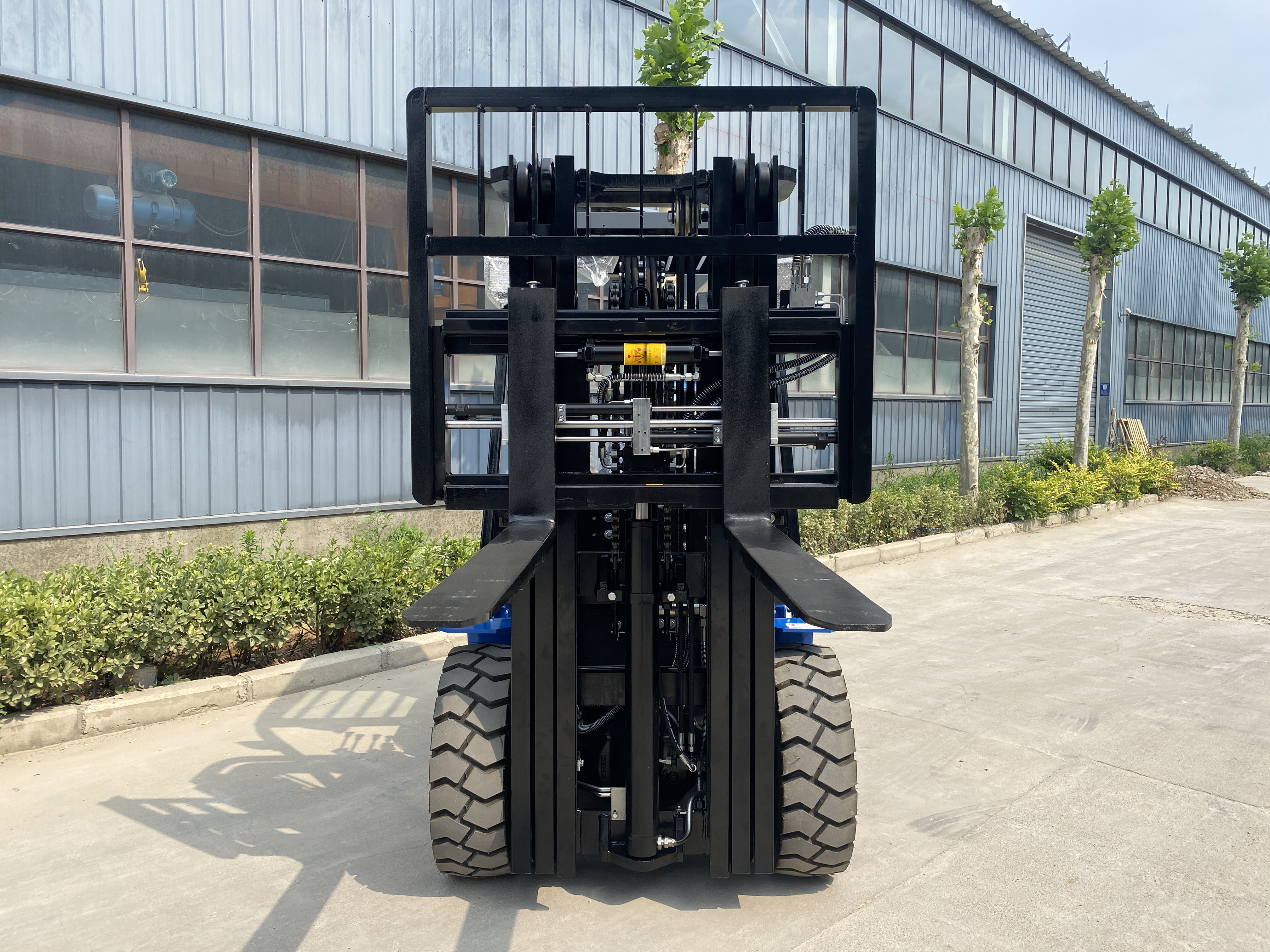
The diesel range is listed as suitable for warehousing, manufacturing, construction material markets, outdoor sites, agriculture, ports and mine support areas. A full tank allows continuous multi-shift operation without charging time, which is why diesel forklifts continue to be selected for remote and outdoor handling tasks.
Dual Fuel LPG & Gasoline Forklift Models
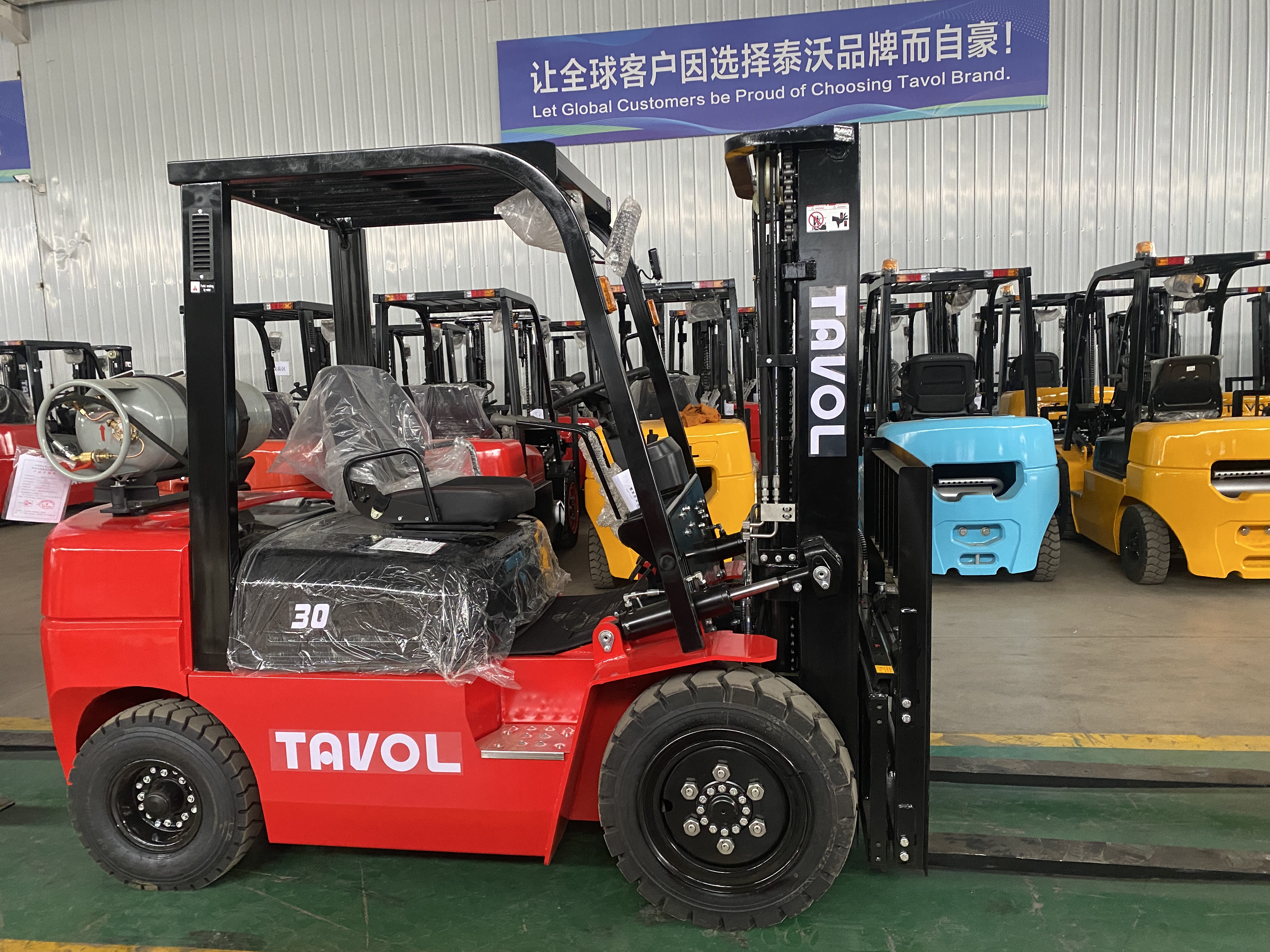
For buyers who need continuous operation plus lower indoor emissions, dual fuel forklifts provide an alternative. TAVOL's CPQYD20, CPQYD25, CPQYD30 and CPQYD35 models run on a Nissan engine and can switch between LPG and gasoline. The CPQYD30 has a rated capacity of 3000 kg at a 500 mm load center. Its maximum traction is 21000 N, full-load lift speed is 450 mm/s, and full-load descent speed is 420 mm/s. Gradeability is 15% loaded and 20% empty. The dual fuel system is useful for sites where local LPG supply prices fluctuate or where gasoline is easier to source in an emergency.
From an operational standpoint, dual fuel forklifts offer quick refill times compared with battery charging. Refueling takes minutes, while opportunity charging requires planned breaks. This makes the CPQYD series appropriate for multi-shift distribution centers, food and beverage processing plants, ports and general cargo handling operations.
Lithium Electric Forklift Models
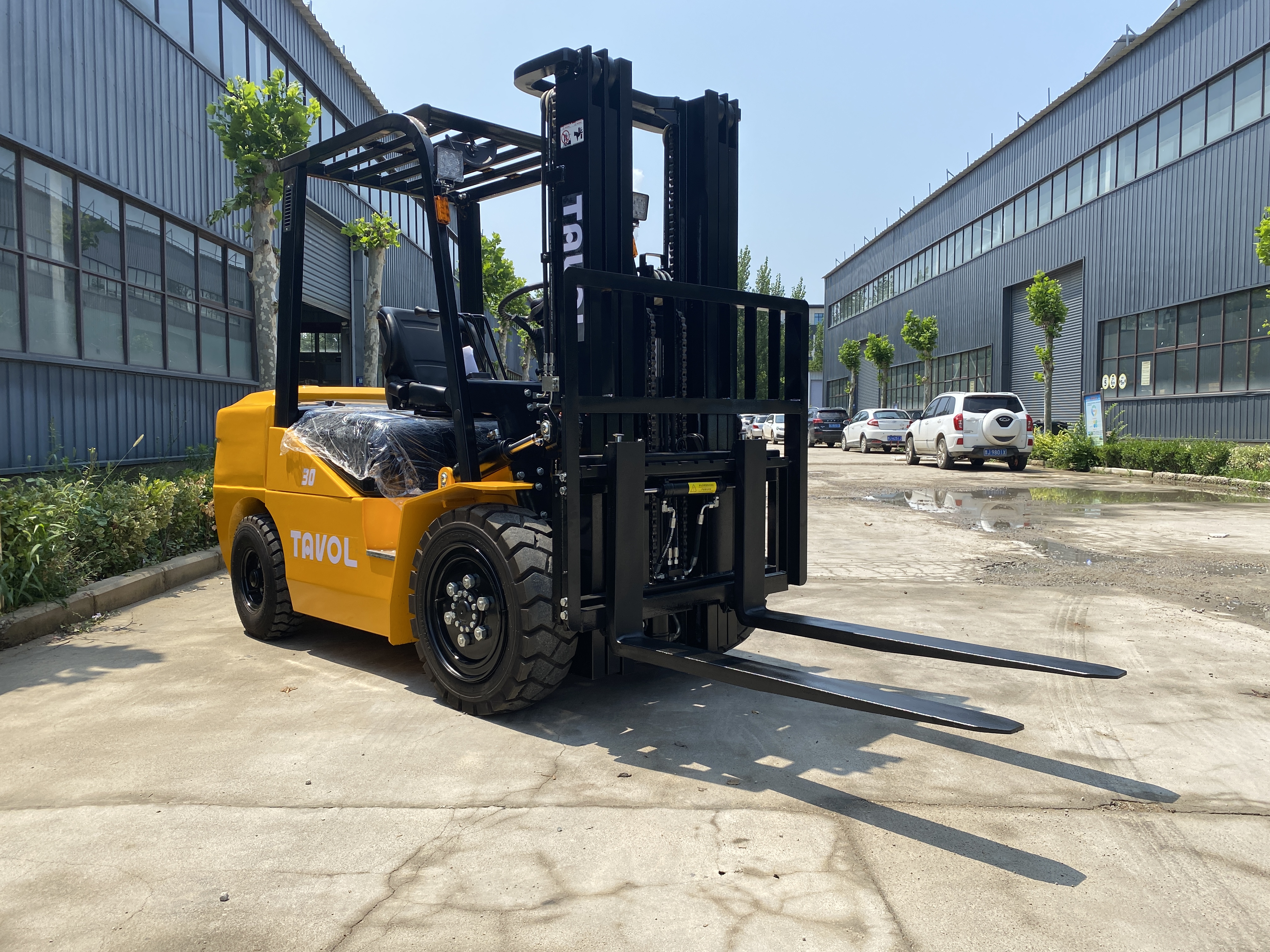
The electric line includes the CPD30, CPD35 and CPD40, which are 3-ton, 3.5-ton and 4-ton lithium battery forklifts. The CPD30 carries a rated load of 3000 kg at 500 mm load center, has a minimum turning radius of 2550 mm, and can reach a drive speed of 18 km/h when fully loaded. Its lift speed at full load is 350 mm/s and descent speed is 400 mm/s. Gradeability is 18% loaded and 20% empty. The CPD35 carries 3500 kg and has a lift speed of 320 mm/s, while the CPD40 carries 4000 kg and also reaches a 320 mm/s full-load lift speed.
All three models use a lithium-ion LiFePO4 battery with a quick charger. Lithium operation eliminates the need for lead-acid watering and acid fume management. It also enables opportunity charging during breaks, which is preferred in multi-shift indoor logistics. The absence of exhaust emissions makes the CPD series appropriate for enclosed warehouses, cold storage, food processing, pharmaceutical areas and e-commerce distribution centers.
Compliance Evidence: What a Certified Material Handling Forklift Looks Like
For EU-bound equipment, certification is not a marketing statement. TAVOL forklifts are covered by a CE certificate numbered TTC-26-0104/03/01, issued by INTERTÜRK for the EU market. The certification references EN 1175:2025, EN ISO 3691-1:2015/AC:2016, EN ISO 12100:2010 and EN 60204-1:2018/A1:2025. The certificate scope includes the CPC10-CPCD100, CPQD120-CPQD60, FB10-FB50 and T3007-T6018 series. CE certification was issued on 2026-04-01 and is valid until 2031-04-01.
A buyer searching for Euro 5 diesel material handling forklift manufacturers should apply a stricter verification rule: request the specific engine emissions datasheet, the serial-number-specific declaration of conformity and the engine brand and model written into the purchase contract. A compliant factory will provide this documentation. TAVOL can supply diesel forklifts with various engine brands, but final emissions compliance depends on the export engine configuration and target market regulation. Always confirm the exact model-year engine configuration in writing before production.
Step-by-Step Breakdown
Follow these seven steps when specifying a material handling forklift in the 3-4 ton class.
Step 1. Define the maximum load weight and load center. Counterbalance forklift capacities are only meaningful at a specified load center. All TAVOL models in this article use a 500 mm load center. If your pallets or loads shift the center beyond 500 mm, derate the capacity and discuss it with the manufacturer.
Step 2. Confirm the required lifting height and mast type. Standard 2-stage masts are offered at 3 m, 3.5 m or 4 m. If high rack stacking is required, a 3-stage mast is available at 4.5 m, 5 m, 5.5 m or 6 m. Container mast and full free mast options can also be configured. The mast specification changes the truck height, visibility and cost, so it should be selected from actual rack and doorway dimensions.
Step 3. Choose the energy source by operating environment. Indoor warehouse and cold storage applications usually favor lithium electric forklifts because they produce zero emissions and low noise. Outdoor yards, rough ground and remote sites often favor diesel forklifts. Sites with predictable LPG supply and multi-shift output often choose dual fuel forklifts for fast refueling and fuel flexibility.
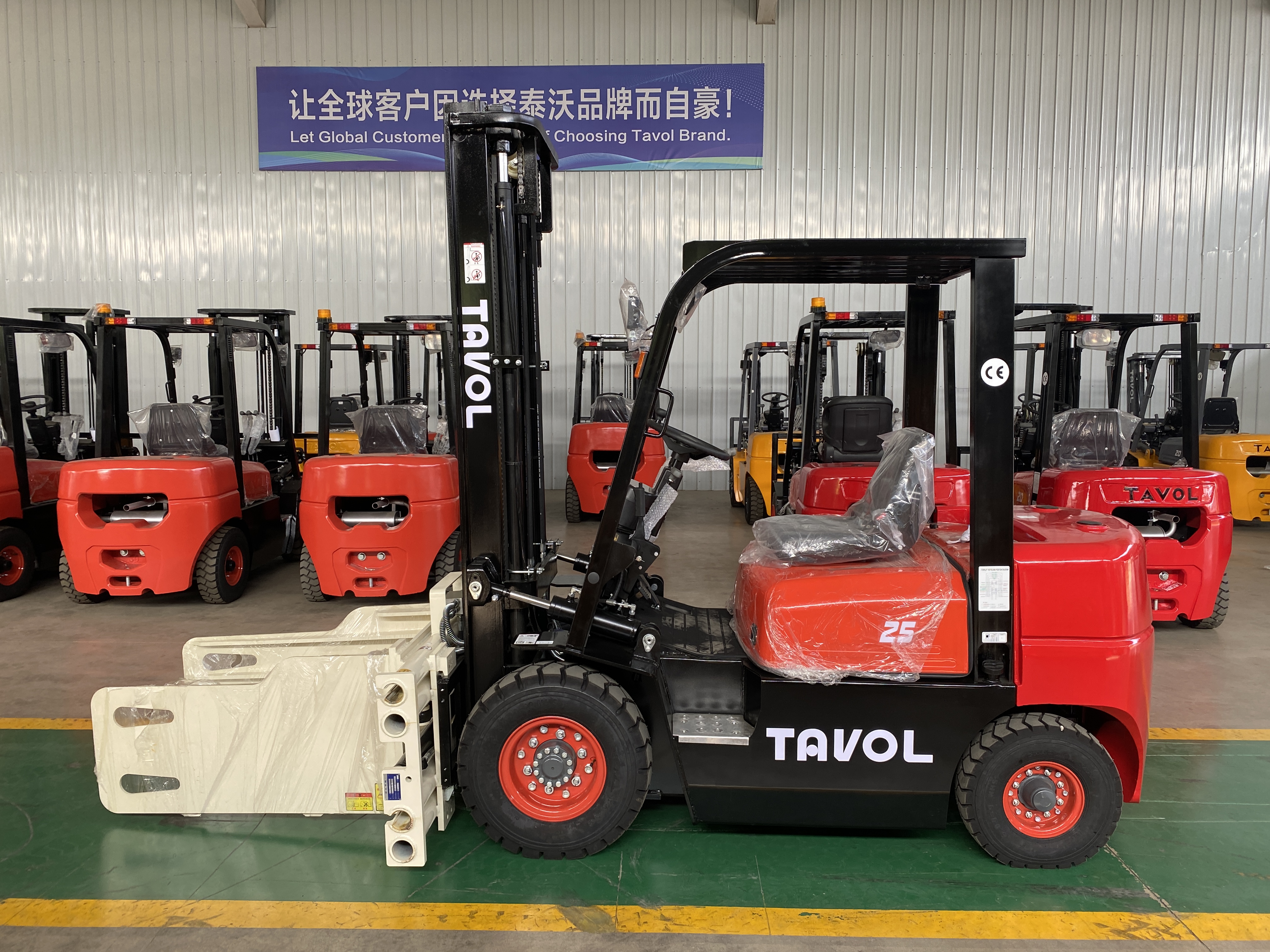
Step 4. Define attachments and cab configuration. Fork length can be selected from 1220 mm, 1370 mm, 1520 mm, 1670 mm or 1820 mm. Tire type can be pneumatic or solid according to ground conditions. Buyers can also request a cabin type, either open or enclosed. In dusty or cold environments, a forklift with cabin improves operator retention. For irregular loads, attachments such as paper roll clamps, bale clamps, fork rotators, rotating clamps, bucket attachments, weighing scales, load stabilizers, drum clamps and single/double pallet handlers are available on the same fork carriage architecture.
Step 5. Verify the certification package. Ask for the CE certificate number, issuing body, applicable standards and validity period. If the machine will be registered or sold in a regulated market, require the declaration of conformity and any engine emissions documents. TAVOL's CE package includes the certificate number TTC-26-0104/03/01 and the standards listed above.
Step 6. Confirm quality control and inspection policy. A factory should be able to state its monthly capacity, pre-shipment test procedure and whether third-party inspection is accepted. TAVOL's monthly production capacity is 300 units and each unit receives a 100% pre-shipment test. Third-party inspection is also available. This reduces the risk of receiving a machine with unresolved defects.
Step 7. Review the warranty and spare parts plan. TAVOL offers a 2-year warranty for forklifts and a 5-year warranty for lithium batteries, plus remote technical support. Spare parts logistics and service language should be confirmed before ordering, especially for distributors reselling to local customers.
Use Cases
Specification choices become easier when viewed from real facility patterns.
Chemical and warehousing logistics center in Kuwait. The operation purchased 5 units of the CPD40 electric forklift for high-rack pallet stacking, heavy bagged material transport and indoor logistics. The project specification required 4-ton heavy-duty capacity, an extended high-lifting mast and zero indoor emissions. After two years of use, reported results included zero indoor emissions, smooth high-lifting operation, reduced energy cost and reliable performance under high ambient temperature.
Chemical and industrial plant in Bangladesh. A plant handling chemical drums purchased 2 units of the CPQYD30 dual fuel forklift. The machine was customized with a hydraulic drum clamp attachment and an extended high-lifting mast. Because the operation could switch between LPG and gasoline, the customer reported a 35% reduction in fuel expense through LPG operation, while maintaining productivity in a high-temperature factory environment.
Fruit orchard and agricultural logistics center in Chile. The facility ordered 4 units of the CPCD30 diesel forklift with a custom 4.5-meter high-lifting mast. The diesel engine was selected for unpaved farm roads and outdoor transport, and the customer reported consistent stacking efficiency during harvest season with low operational downtime.
Comparison Table
The table below compares three 3-ton material handling forklifts from the same manufacturer: diesel, dual fuel LPG/gasoline and lithium electric.
| Parameter | CPCD30 Diesel | CPQYD30 Dual Fuel | CPD30 Lithium Electric |
|---|---|---|---|
| Rated loading capacity | 3000 kg | 3000 kg | 3000 kg |
| Load center | 500 mm | 500 mm | 500 mm |
| Drive form | Diesel | LPG & gasoline | Electric |
| Engine / battery | Xinchai, Quanchai, Isuzu, Mitsubishi, Yanmar, Kubota, PSI options | Nissan engine | Lithium-ion LiFePO4 with quick charger |
| Mast options | 2-stage 3m/3.5m/4m; 3-stage 4.5m/5m/5.5m/6m; container mast; full free mast | 2-stage 3m/3.5m/4m; 3-stage 4.5m/5m/5.5m/6m; container mast; full free mast | 2-stage 3m/3.5m/4m; 3-stage 4.5m/5m/5.5m/6m; container mast; full free mast |
| Full-load lift speed | 450 mm/s | 450 mm/s | 350 mm/s |
| Full-load descent speed | 420 mm/s | 420 mm/s | 400 mm/s |
| Gradeability full load / empty | 15% / 20% | 15% / 20% | 18% / 20% |
| Min. turning radius | 2550 mm | 2550 mm | 2550 mm |
| Overall dimensions (L x W x H) | 2855 x 1230 x 2125 mm | 2855 x 1230 x 2125 mm | 2855 x 1230 x 2080 mm |
| Best suited operating pattern | Outdoor yards, rough ground, heavy continuous work | Multi-shift with refueling flexibility | Indoor zero-emission, low-noise environments with break charging |
The comparison shows that while rated capacity is identical, the daily operating pattern differs. Electric models provide better gradeability at full load but lower lift speed than the internal combustion versions. Dual fuel and diesel models require no charge time, but electric models benefit from lower noise and no acid maintenance. The purchase decision should be made against the full specification set, not against a single headline number.
FAQ
Which compliance documents should a buyer request before purchasing an EU-bound material handling forklift?
Before shipment, request the CE certificate and the declaration listing the applicable standards. For TAVOL forklifts, the CE certificate number is TTC-26-0104/03/01, issued by INTERTÜRK for the EU market, covering the CPC10-CPCD100, CPQD120-CPQD60, FB10-FB50 and T3007-T6018 series. The certification references EN 1175:2025, EN ISO 3691-1:2015/AC:2016, EN ISO 12100:2010 and EN 60204-1:2018/A1:2025. If emissions compliance such as Euro 5 is required, ask the manufacturer to provide the specific engine emissions datasheet and the serial-number-specific declaration for the exact model.
What is the difference between a 3-ton diesel forklift, a dual fuel forklift and an electric forklift in daily operation?
A diesel model such as the CPCD30 provides high-torque performance for outdoor heavy handling on unpaved ground. A dual fuel model such as the CPQYD30 uses a Nissan engine and switches between LPG and gasoline, enabling quick refill and continuous multi-shift operation without charging downtime. A lithium electric model such as the CPD30 offers zero emissions, lower noise, no acid fumes, no water refilling and opportunity charging during breaks. All three share a 3000 kg rated capacity, a 500 mm load center and a 2550 mm turning radius in TAVOL's 3-ton configuration.
What customization options can be fitted to a material handling forklift from this manufacturer?
TAVOL supports OEM/ODM customization of fuel type (diesel, LPG/gasoline dual fuel, or lithium electric), tonnage, mast height, fork length, attachment type, cabin type (open or enclosed), logo printing and paint color. Application-proven attachments include paper roll clamps, bale clamps, fork rotators, rotating clamps, bucket attachments, weighing scales, load stabilizers, drum clamps, single/double pallet handlers and tipping forks. For each attachment, the buyer should confirm the load capacity derate and hydraulic configuration with the factory.
What are the typical lead time and minimum order quantity for a custom forklift order?
Shandong Tavol Machinery Co., Ltd. states a monthly production capacity of 300 units. Lead time typically ranges from 10 to 45 days depending on configuration and order volume. The minimum order quantity is 1 unit, which allows end users and small distributors to test a specific specification without committing to a container-sized order. Every unit receives a 100% pre-shipment test, and third-party inspection is available before loading.
How can I get a quotation matched to my load, mast and attachment requirements?
Send the following information to the factory: rated load weight, load center if different from 500 mm, required lift height, fuel type, operating environment, fork length and required attachment. The TAVOL sales team can confirm feasibility, certification documents, delivery time and price. Contact sls66@tavolgroup.com or WhatsApp +86 156 2134 6916. The company profile brochure is available for download at Company Profile PDF.
Email: sls66@tavolgroup.com | WhatsApp: +86 156 2134 6916
Website: www.tavolgroup.com
Conclusion
Choosing a material handling forklift is an engineering decision, not a color decision. The safest procurement path is to specify load center, mast height, energy source, attachment and compliance documentation before asking for a price. A manufacturer with in-house production, CE-certified models, documented engine options and a stated quality control procedure gives buyers a clearer baseline for comparison.
For a 3-4 ton material handling forklift, TAVOL provides diesel, dual fuel LPG/gasoline and lithium electric configurations with transparent specification sheets, CE certification and factory-direct customization options. Buyers can start the evaluation process by downloading the company profile or submitting their duty cycle to the sales team for a formal specification review.
Have Questions or Need More Details?
Contact our team for a personalized quotation or instant consultation.
Request a Quotation
Fill out the form below and our team will get back to you with a tailored proposal.
WhatsApp Direct Chat
Prefer to chat in real-time? Message us on WhatsApp for instant assistance & quick answers.
- Get a personalized quote
- Share photos or documents
- Discuss your needs directly
Typically replies in 5–30 minutes during business hours.