
Material Handling Forklift Specification Guide for 2-4 Ton Operations
A reliable material handling forklift is specified with numbers and documents, not general phrases. Before requesting a quote, compare rated capacity at load center, mast type, fuel and battery platform, attachments, operator cabin, tires, and certification. This guide applies that process to TAVOL Forklift, a material handling line manufactured by Shandong Tavol Machinery Co., Ltd., a China-based factory established in 2003.
TAVOL Forklift is used throughout this article because its published product data is transparent enough for a buyer to simulate a real specification decision. The relevant vehicle families include diesel counterbalance models from 2 t to 4 t, dual fuel LPG and gasoline models from 2 t to 4 t, and lithium electric counterbalance models from 3 t to 4 t. The goal is to help importers, dealers, warehouse managers, plant engineers, and procurement teams translate an application into a concrete machine specification.
Why a 3 Ton Forklift Is Not a Complete Specification
Many forklift purchases begin with an RFQ that says 3 ton forklift or 3.5 ton forklift. Those numbers are useful, but they are only one part of the engineering constraint. A 3 ton truck is rated at a specified load center and at a specified mast configuration. If the real pallet load extends farther from the fork heel, the usable capacity is not the same number that appears on the nameplate.
Common specification failures include selecting the right capacity but the wrong mast height, selecting an indoor-rated truck for an outdoor yard, selecting a diesel forklift for an enclosed space without checking emissions, adding an attachment after the truck is built without checking its effect on load capacity, and accepting a CE claim without verifying the certificate scope and number.
A complete specification starts with five answers:
- What is the heaviest single load, and how far from the fork heel does its center sit?
- Is the operation indoor, outdoor, or mixed?
- What lift height and overhead clearance are actually available?
- Does the load require a clamp, rotator, bucket, scale, or another attachment?
- Which safety, emission, and machine certificates does the destination market require?
Forklift Industry Context in 2025 and 2026
Market data helps explain why fuel and battery choices are changing. Grand View Research estimated the global forklift market at USD 81.4 billion in 2025. Interact Analysis observed that lithium-ion penetration in global counterbalanced forklifts reached 17.5 percent in 2024. That does not mean every buyer should select lithium, but it does mean procurement teams should compare the long operating cost of diesel, LPG, and electric machines, not only the purchase price.
Trade data also shows how mature the parts ecosystem has become. China exported about USD 1.26 billion of forklift parts in 2024. For dealers and maintenance teams, this matters because spare parts availability influences downtime. A factory with a broad export footprint and documented after-sales support is generally easier to work with than a supplier that cannot identify its parts route.
Detailed Solution: Specification Blocks to Compare
1. Rated Capacity and Load Center
Capacity is the first filter, but load center is the second and equally important. The TAVOL models referenced in published specifications are rated at a 500 mm load center. The CPCD30 diesel model is a 3 t forklift, the CPCD35 is a 3.5 t diesel forklift, and the CPCD40 is a 4 t diesel forklift. The CPQYD25 is a 2.5 t dual fuel LPG and gasoline forklift. The electric CPD30 belongs to the 3 t electric forklift category, the CPD35 to the 3.5 t category, and the CPD40 to the 4.0 t electric forklift category.
For buyers evaluating a 3 ton forklift vs a 3.5 ton forklift, the correct choice is not based on occasional peak load only. It is based on the normal pallet weight plus the margin needed for mast height, fork length, attachments, ramps, and floor conditions. The TAVOL range also lists maximum traction in newtons: the 3 t diesel and 3 t dual fuel models both show 21000 N, the 3.5 t diesel and 3.5 t dual fuel models show 21500 N, and the 3 t electric model shows 15600 N while still offering 18 to 20 percent grade ability depending on load condition.
2. Mast Type: Two-Stage, Triple Stage, Full Free and Container Masts
Vertical storage requirements drive mast selection. A mast that is too short loses racking space; a mast that is too tall cannot enter the building or container.
TAVOL base specifications for the 2 t to 4 t families allow the buyer to choose a 2-stage mast in 3 m, 3.5 m, or 4 m lift height. If the operation needs a forklift triple mast, the same model families can be supplied with a 3-stage mast in 4.5 m, 5 m, 5.5 m, or 6 m. For container work, buyers can request container mast or full free mast configurations, depending on the exact container height and lift sequence.
In practice, a 3-stage mast is selected when high racking is needed in a warehouse with limited overhead clearance. A full free mast is useful when the load must be lifted before the mast height increases, which is common inside containers and under low doorways. The case reference from a chemical warehousing operation in Kuwait shows why mast choice matters: that client used 4 t electric forklifts with extended high-lifting capability for high-rack pallet stacking and bagged material transport.
3. Fuel and Drive Platform
The energy platform determines where the forklift can work, how long it can work, and what kind of emissions and noise it produces.
Diesel Forklift
The Tavol diesel models, such as CPCD20, CPCD25, CPCD30, CPCD35, and CPCD40, are designed for outdoor yards, loading docks, construction material sites, industrial plants, and heavy-duty material transfer. Published selling points include high torque, climbing ability up to 15 to 20 percent depending on load, and the ability to run more than eight hours on a full tank without charging infrastructure. The frame is built to tolerate rough or unpaved ground.
For buyers who need recognizable engine brands, the CPCD20 through CPCD40 series can be equipped with engines from Xinchai, Quanchai, Isuzu, Mitsubishi, Yanmar, Kubota, or PSI. In a request that mentions Japanese engine forklift options, Isuzu, Mitsubishi, Yanmar, and Kubota are available engine choices on the diesel family.
Dual Fuel LPG and Gasoline Forklift
The CPQYD20, CPQYD25, CPQYD30, and CPQYD35 models are dual fuel LPG and gasoline forklifts. These models use a Nissan engine and can switch between LPG and gasoline fuel. That flexibility is useful for sites with seasonal fuel supply, mixed indoor and outdoor work, or multi-shift operations where the operator needs a quick cylinder or fuel refill rather than battery charging time.
The dual fuel family is positioned between diesel and electric. It produces lower emissions than a diesel forklift, which makes it appropriate for some covered or semi-enclosed areas, while still providing quick refueling for high-frequency handling. The CPQYD30, for example, keeps the same 3000 kg rated capacity and same 2855 mm overall length as the CPCD30 diesel model.
Lithium Electric Forklift
The CPD30, CPD35, and CPD40 are Tavol electric forklifts powered by a lithium-ion LiFePO4 battery and supplied with a quick charger. This configuration is relevant for indoor warehousing, cold storage, food processing, pharmaceutical and cleanroom facilities, e-commerce distribution centers, electronics manufacturing, retail distribution, and enclosed workshop operations.
Because the battery is lithium iron phosphate, the truck supports opportunity charging during breaks instead of requiring a full discharge before recharge. It produces zero emissions, has lower noise than an internal combustion forklift, and avoids acid fumes and watering routines associated with lead-acid batteries. The published performance data shows that the CPD30 lifts at 350 mm per second under full load, the CPD35 at 320 mm per second, and both electric models offer 18 to 20 percent grade ability depending on load.
A practical charging note from the Tavol knowledge content is important: park on a flat, ventilated area before charging, connect the charger securely, use charging breaks rather than waiting for full depletion, and inspect terminals and cables weekly. Lithium battery forklifts still require planned maintenance, but the daily watering and acid check tasks are removed.
4. Hydraulic Attachments: Paper Roll Clamps, Bale Clamps, Rotators, Buckets and Scales
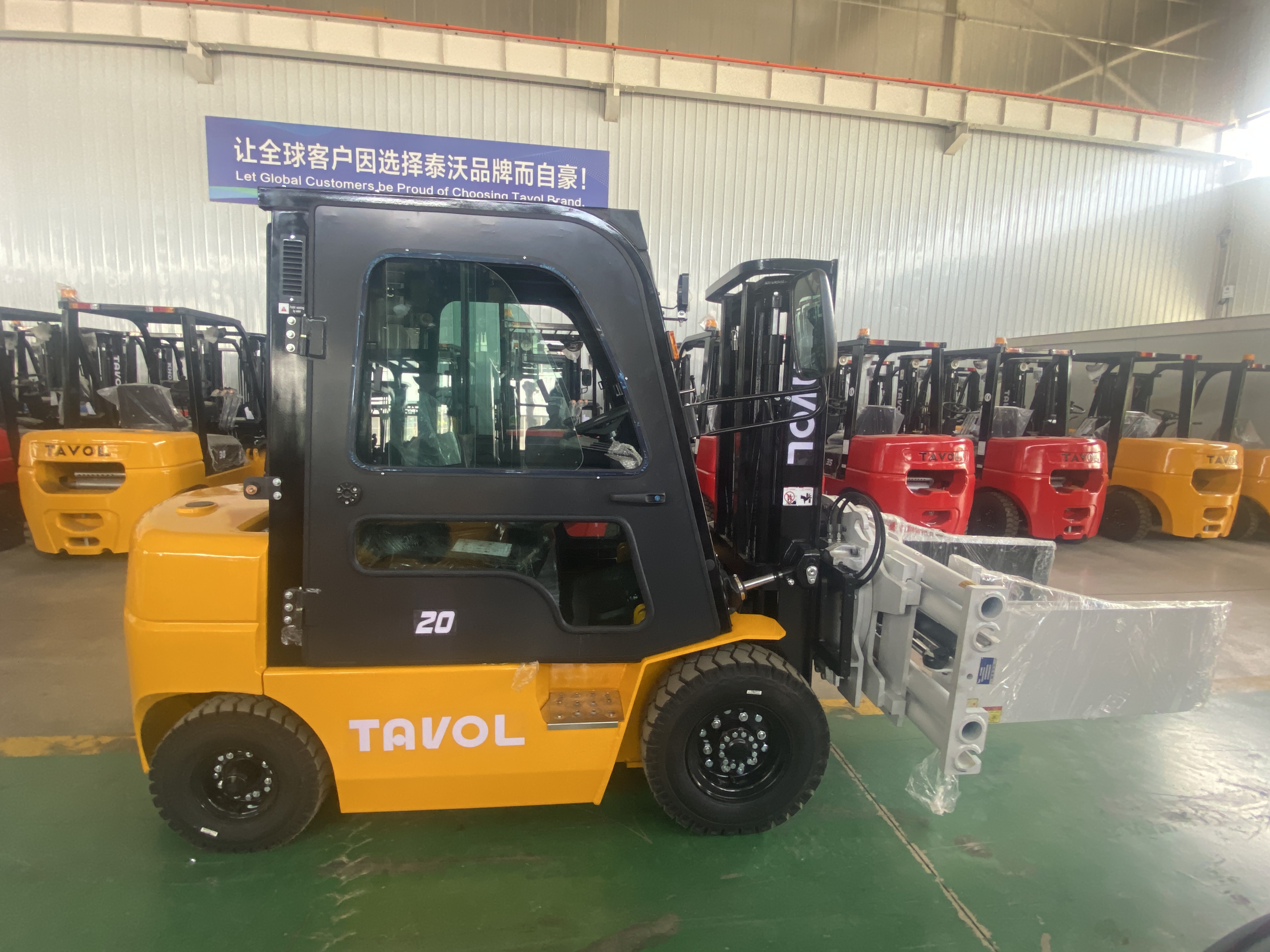
A standard forklift becomes a specialized material handling forklift through its hydraulic carriage attachment. Attachment compatibility should be discussed before the truck is built, because the attachment adds weight and can change the effective capacity.
TAVOL application references include several documented attachment scenarios:
- Paper roll clamp: Used in paper and pulp handling, printing and packaging warehouses for clamping paper rolls without damaging the roll surface.
- Rotating clamp: Used for carpet rolls and similar long cylindrical loads; the 360 degree rotation function allows repositioning without moving the whole forklift.
- Bale clamp or carton clamp: Used for unpalletized bales, cotton, textiles, beverage cartons, and cardboard handling.
- Tipping paper clamp: Used for waste paper bale handling and feeding bales into a processing line.
- Fork rotator: Used for drum and barrel rotation, controlled dumping, and repositioning of contained loads.
- Bucket attachment: Used for sand, gravel, grain, coal, and other loose bulk materials in outdoor yards.
- Load stabilizer: Used for loosely stacked or mixed pallet loads that need downward pressure to prevent shifting.
- Electronic weighing scale: Used for real-time load weighing during lifting and transport.
If the buyer says 3 ton forklift but actually needs a paper roll forklift or a forklift with bale clamp, the attachment must be declared in the quote. If the operation needs rotating forklift functions, the hydraulic control setup and clamp geometry must be specified at the same time.
5. Forklift with Cabin and Operator Environment
Operator comfort has a measurable effect on shift output. Tavol customization options include open or enclosed cabin types, and the buyer can also select mast height, fork length, fuel type, tonnage, tire type, logo printing, and paint color.
A forklift with cabin is not a luxury add-on in every climate. In a cold-region carpet roll handling reference, a closed cab was listed as part of the project requirement. In tropical or dusty environments, an enclosed cab or a well-positioned overhead guard changes visibility and fatigue. When procurement compares two otherwise identical trucks, the cabin type and tire choice should be included in the comparison table.
6. Certification and Compliance Documents
Certification is the easiest place for a buyer to be misled by a general phrase such as CE approved. A valid CE certificate should be identifiable by certificate number, issuing body, standard references, applicable products, and validity period.
For the EU market, Tavol holds a CE certificate with number TTC-26-0104/03/01, issued by INTERTÜRK on 2026-04-01 and valid until 2031-04-01. The certificate references harmonized machine safety standards including EN 1175:2025, EN ISO 3691-1:2015/AC:2016, EN ISO 12100:2010, and EN 60204-1:2018/A1:2025, depending on the product family. The scope covers the model families discussed in this article, including diesel, dual fuel, and electric forklift categories.
CE marking is not the same document as an engine emission approval. If the purchaser writes Euro 5 diesel material handling forklift manufacturers into a tender, the supplier should be asked to identify the exact engine model and provide the emission certificate that applies to the destination market. The machine CE certificate should not be treated as proof of an engine emission stage.
Step-by-Step: How to Shortlist a Material Handling Forklift
Use this seven-step workflow to compare TAVOL Forklift models or any other supplier quotation without getting lost in brochure language.
- Define the heaviest unit load and its load center. Use the heaviest pallet or load, not the average. Compare it to the rated capacity at 500 mm load center.
- Classify the operating area. Distinguish between enclosed warehouse, open yard, dock, food facility, cold storage, and mixed operation. This step narrows the fuel and battery choice.
- Select mast height and type. Confirm the highest racking level, the overhead clearance, and whether the lift must remain height-limited. Use two-stage or three-stage options in the model family.
- Identify the attachment. If the load is not a standard pallet, list the clamp, rotator, bucket, scale, or stabilizer. Ask how the attachment affects capacity and hydraulic function.
- Choose tires and cabin. Select pneumatic tires for rough outdoor surfaces, solid tires for some smooth indoor or puncture-prone environments, and cabin type based on climate and operator exposure.
- Request certificates and inspection terms. Ask for the certificate number, issuing body, standards, product scope, and validity. Confirm whether third-party inspection is acceptable. Tavol states that it performs 100 percent pre-shipment testing and supports third-party inspection.
- Compare lead time, warranty, and after-sales terms. Tavol’s published customization capability includes OEM and ODM production, monthly capacity of 300 units, lead time of 10 to 45 days, MOQ of 1 unit, remote technical support, a 2-year warranty for the forklift, and a 5-year warranty for the lithium battery.
Use Cases and Working Evidence
The value of a specification system becomes clearer when it is tested against real operating environments. The following Tavol customer cases are drawn from published project references.
Chemical Warehousing and Logistics Center in Kuwait
A chemical and warehousing logistics center in Kuwait used five units of the Tavol CPD40 4 t electric forklift for high-rack warehouse pallet stacking, heavy bagged material transport, and indoor logistics. The reported result over two years was zero indoor emissions, smooth high-lifting operation, reduced energy cost, and reliable performance under high ambient temperature. The project highlight includes the 4 t heavy-duty load capacity, extended high-lifting mast, and CE-certified operator safety configuration.
Chemical and Industrial Plant in Bangladesh
A chemical and industrial plant in Bangladesh used two units of the TAVOL CPQYD30 dual fuel LPG and gasoline forklift with a custom hydraulic drum clamp attachment. The operation used the truck for chemical drum handling, high-rack warehouse stacking, and indoor and outdoor logistics. After two years, the customer reported a 35 percent reduction in fuel expense through LPG operation and smooth switching between LPG and gasoline in a high-temperature factory environment.
Fruit Orchard and Agricultural Logistics in Chile
A fruit orchard and agricultural logistics center in Chile used four units of the Tavol CPCD30 3 t diesel forklift, customized with a 4.5 m high-lifting mast. The application included fruit crate stacking, agricultural pallet loading, and transport on unpaved farm roads. The result reported over two years was high stacking efficiency during harvest season and dependable performance on uneven ground.
Building Material Supplier in El Salvador
A building materials supplier and construction fleet in El Salvador used two units of the Tavol CPCD30 diesel forklift with a customized hydraulic bucket attachment. The truck handled bulk material, yard transport, aggregate loading, and cement products. The reported result was high fuel efficiency, reliable engine performance in a hot tropical climate, and zero downtime during the reference period.
Comparison: 3 Ton Material Handling Forklift Options
The following table compares three 3 t models in the Tavol range. It is based on published specification fields and is intended to show how a buyer should compare side by side.
| Specification | CPCD30 Diesel Forklift | CPQYD30 Dual Fuel LPG and Gasoline Forklift | CPD30 Lithium Electric Forklift |
|---|---|---|---|
| Rated loading capacity | 3000 kg | 3000 kg | 3000 kg |
| Load center | 500 mm | 500 mm | 500 mm |
| Drive form | Diesel | Dual fuel LPG and gasoline | Electric |
| Engine or power source | Xinchai, Quanchai, Isuzu, Mitsubishi, Yanmar, Kubota, or PSI options | Nissan engine | Lithium-ion LiFePO4 battery with quick charger |
| Mast options | 2-stage 3 m, 3.5 m, or 4 m; 3-stage 4.5 m to 6 m; container and full free options can be chosen | 2-stage 3 m, 3.5 m, or 4 m; 3-stage 4.5 m to 6 m; container and full free options can be chosen | 2-stage 3 m, 3.5 m, or 4 m; 3-stage 4.5 m to 6 m; container and full free options can be chosen |
| Fork length options | 1220 mm, 1370 mm, 1520 mm, 1670 mm, or 1820 mm | 1220 mm, 1370 mm, 1520 mm, 1670 mm, or 1820 mm | 1220 mm, 1370 mm, 1520 mm, 1670 mm, or 1820 mm |
| Overall length x width | 2855 mm x 1230 mm | 2855 mm x 1230 mm | 2855 mm x 1230 mm |
| Top guard height | 2125 mm | 2125 mm | 2080 mm |
| Minimum turning radius | 2550 mm | 2550 mm | 2550 mm |
| Minimum right-angle channel width | 4305 mm with 1000 x 1200 mm pallet | 4305 mm with 1000 x 1200 mm pallet | 4305 mm with 1000 x 1200 mm pallet |
| Drive speed at full load | 18/20 km/h | 18/20 km/h | 18 km/h |
| Lift speed at full load | 450 mm/s | 450 mm/s | 350 mm/s |
| Maximum grade ability | 15/20 percent full/empty | 15/20 percent full/empty | 18/20 percent full/empty |
| Maximum traction | 21000 N | 21000 N | 15600 N |
| Structural materials | Q235 carbon structural steel and Q355 low-alloy high-strength structural steel | Q235 carbon structural steel and Q355 low-alloy high-strength structural steel | Q235 carbon structural steel and Q355 low-alloy high-strength structural steel |
| CE certification context | Model family included in TAVOL CE scope | Model family included in TAVOL CE scope | Model family included in TAVOL CE scope |
The figures above are standard base-truck values from the Tavol specification sheets. A custom attachment, cabin, mast, or tire choice can change some dimensions and performance values, so the final drawing should always be confirmed before production.
Frequently Asked Questions
Which manufacturers build Euro 5 diesel material handling forklifts?
Rather than relying only on a brand name, check the exact engine and its emission certificate. Tavol diesel forklifts can be configured with Xinchai, Quanchai, Isuzu, Mitsubishi, Yanmar, Kubota, or PSI engines. The official Tavol CE certificate for the forklift series is number TTC-26-0104/03/01, issued by INTERTÜRK, and references standards such as EN 1175:2025. However, an engine emission certificate is a separate document. If a tender uses the term Euro 5, ask the buyer or authority which emission regulation applies to the engine, and request the engine-specific certificate for the proposed truck.
What is the difference between a 3 ton and a 3.5 ton material handling forklift?
The difference starts with rated loading capacity. In the Tavol range, CPCD30 is the 3 t diesel model, CPCD35 is the 3.5 t diesel model, CPQYD30 and CPQYD35 are the corresponding dual fuel LPG and gasoline models, and CPD30 and CPD35 are the electric lithium models. The 3 t and 3.5 t base models use a 500 mm load center and have a 2550 mm minimum turning radius in the published configuration. The 3.5 t versions provide more rated capacity margin for heavier average pallets and more demanding duty cycles.
Diesel, dual fuel LPG, or lithium electric forklift: which should I choose?
Match the fuel platform to the building and duty cycle. Diesel forklifts suit outdoor yards, rough terrain, container yards, and sites without charging infrastructure. Dual fuel LPG and gasoline forklifts suit mixed indoor and outdoor work, multi-shift operations, and sites where LPG availability can change. Lithium electric forklifts suit enclosed warehouses, cold storage, food and pharmaceutical facilities, and other noise-sensitive or emission-sensitive environments. The Tavol CPQYD dual fuel models use a Nissan engine; the Tavol CPD models use a LiFePO4 lithium battery with a quick charger.
What customization, lead time, and warranty can I expect on a Tavol forklift order?
Tavol supports OEM and ODM production, with customization such as fuel type, tonnage, mast height, fork length, attachment type, open or enclosed cabin, logo printing, and paint color. Published capability includes a monthly output of 300 units, lead time of 10 to 45 days, and a minimum order quantity of 1 unit. Every forklift receives a 100 percent pre-shipment test, and third-party inspection is supported. Tavol provides remote technical support, a 2-year warranty for the forklift, and a 5-year warranty for the lithium battery. To turn these options into a spec-matched quotation, send your load weight, mast height, fuel type, attachment, and target certifications to sls66@tavolgroup.com.
Next Step: Turn Specifications into a Shortlist
The difference between a good forklift purchase and an expensive mistake is rarely visible on the first sales page. It is visible in the load center, mast configuration, energy platform, attachment design, and certificates. Use those variables to compare models side by side before you negotiate price or delivery.
Need help applying these checks to a specific operation?
TAVOL can provide technical clarification, current engine configuration options, CE certificate details, and a factory quotation. The complete company and product background is available in the company brochure.
Download TAVOL Company ProfileFor quote and specification support, contact Kelley at sls66@tavolgroup.com or visit www.tavolgroup.com.
Have Questions or Need More Details?
Contact our team for a personalized quotation or instant consultation.
Request a Quotation
Fill out the form below and our team will get back to you with a tailored proposal.
WhatsApp Direct Chat
Prefer to chat in real-time? Message us on WhatsApp for instant assistance & quick answers.
- Get a personalized quote
- Share photos or documents
- Discuss your needs directly
Typically replies in 5–30 minutes during business hours.