
What Is a Dual Fuel LPG & Gasoline Material Handling Forklift? An Explainer
What Is a Dual Fuel LPG & Gasoline Material Handling Forklift? An Explainer
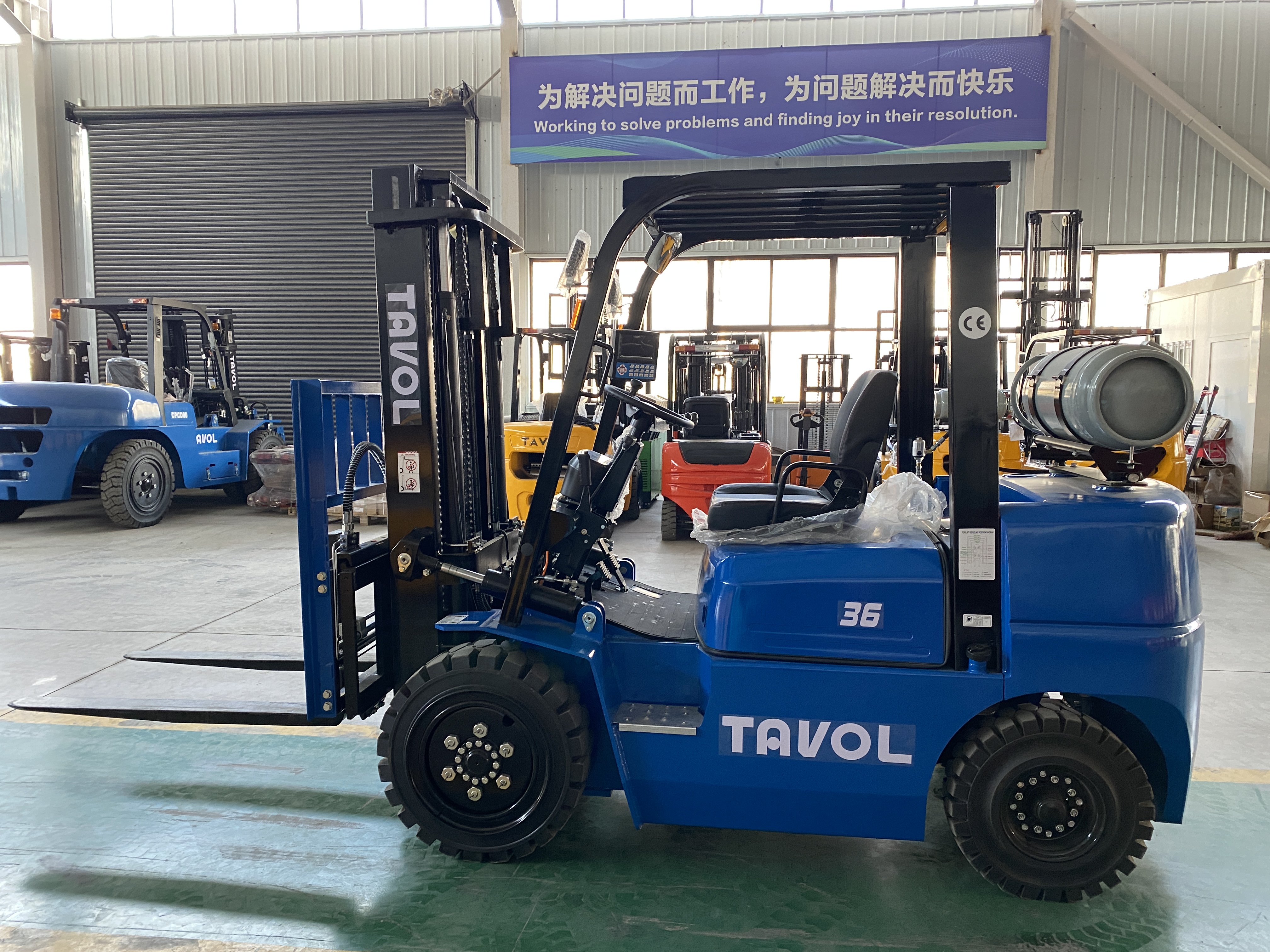
A dual fuel LPG & gasoline material handling forklift is a counterbalance forklift whose internal combustion engine can run on either liquefied petroleum gas (LPG) or gasoline, with the active fuel selected by a switch on the dashboard rather than by changing machines. TAVOL Forklift builds this category as the CPQYD series: CPQYD20 at 2,000 kg, CPQYD25 at 2,500 kg, CPQYD30 at 3,000 kg and CPQYD35 at 3,500 kg, each powered by a Nissan engine and constructed from Q235 carbon structural steel and Q355 low-alloy high-strength structural steel.
This explainer defines the category, shows where it fits in outdoor yard operation, general cargo handling, manufacturing plants and warehousing, and sets out the fuel-mode switching procedure that protects the engine and the operator.
Problem Definition: Why One Fuel Type Is a Single Point of Failure
The dual fuel forklift exists because a material handling fleet that depends on one fuel source inherits every interruption in that supply chain. LPG-only trucks stop when cylinder delivery is late. Gasoline-only trucks absorb every price movement at the pump. Diesel trucks deliver strong power for outdoor yards and rough terrain but are not the natural choice for enclosed, emission-sensitive areas, and battery trucks tie the shift plan to a charging window.
A dual fuel truck answers that with a single asset: it runs on LPG when gas is available or cheaper, and on gasoline when it is not, without stopping the shift or renting a second machine.
What the category does not solve
Clear boundaries matter more than broad claims when a buyer is evaluating a fleet. Three limits define this class:
- Capacity ceiling. The TAVOL dual fuel range covers 2,000 kg to 3,500 kg at a 500 mm load center. A duty cycle that genuinely requires a 5 ton forklift class sits outside this platform - heavier work moves to a different power system and frame class, such as the diesel CPCD40 at 4,000 kg or above.
- Switching is not a mid-task action. Fuel modes must be changed only when the engine is idling or off. Switching under heavy load or on a slope is not permitted.
- LPG handling discipline is mandatory. The cylinder must be securely mounted and free of leaks before each shift, and refuelling must stay away from open flames.
Industry Background: Where Dual Fuel Sits in the Forklift Market
The global forklift market was valued at USD 81.4 billion in 2025, according to Grand View Research. Within that market, Interact Analysis reports that lithium-ion penetration in global counterbalanced forklifts reached 17.5% in 2024 - a real and growing share, but one that still leaves the large majority of counterbalance trucks running on combustion power. Dual fuel is therefore not a niche curiosity; it is a mainstream configuration decision inside a still predominantly engine-driven installed base.
Two supply-side facts reinforce why the category is practical rather than exotic. China exported USD 1.26 billion of parts for fork-lift trucks in 2024, according to World Bank WITS trade data - a deep global spares pool that keeps LPG and gasoline components, fuel-system parts and engine service items widely available. On the compliance side, ANSI/ITSDF B56.1-2020 is the safety standard for low-lift and high-lift trucks effective through 2025, and in the European Union the governing framework for this equipment is the EN 1175 / EN ISO 3691 family, which is the standard set TAVOL's dual fuel machines are certified against.
The practical reading for an evaluation-stage buyer: electrification is expanding, but engine-powered trucks remain the backbone of outdoor yards, ports and multi-shift industrial sites, and dual fuel is the configuration that removes single-fuel dependency inside that backbone.
The TAVOL Dual Fuel LPG & Gasoline Platform
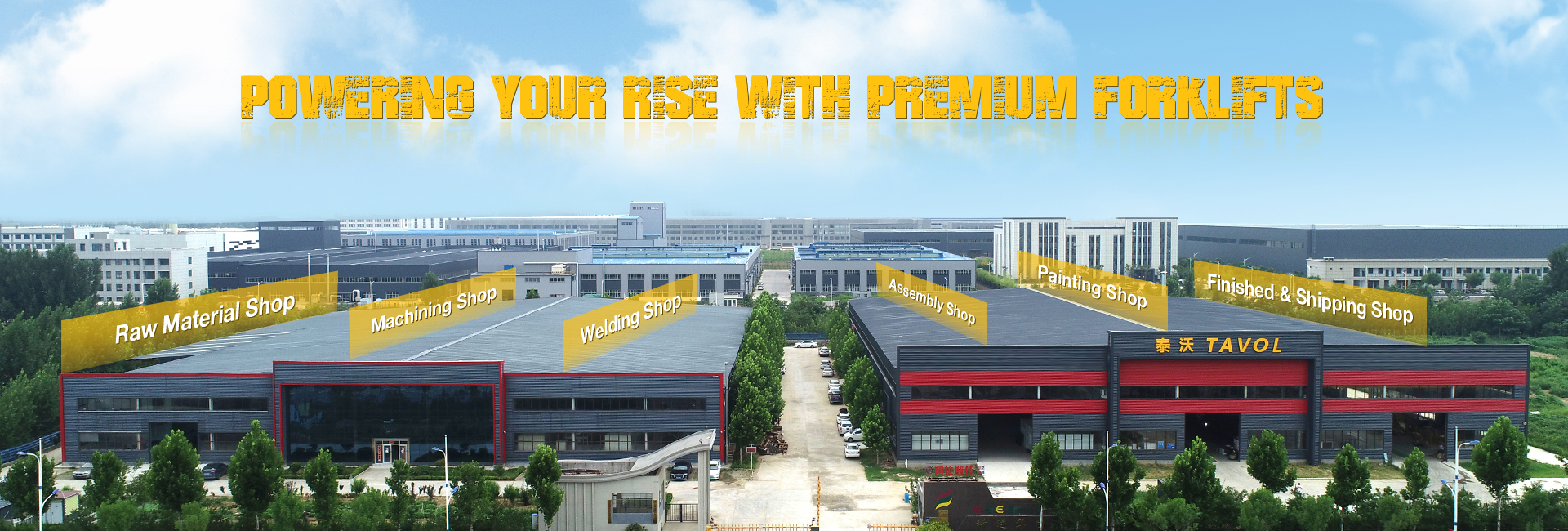
TAVOL Forklift is the material handling line of Shandong Tavol Machinery Co., Ltd, a factory founded in 2003 with 40,000 m2 of manufacturing space, around 300 employees, a 25-engineer R&D team and an annual output of 3,000 units across cranes, forklifts and tractors. The dual fuel range is specified as follows.
- Models and capacity: CPQYD20 (2,000 kg), CPQYD25 (2,500 kg), CPQYD30 (3,000 kg), CPQYD35 (3,500 kg), all at a 500 mm load center.
- Drive form: dual fuel LPG & gasoline, Nissan engine.
- Masts: two-stage 3 m / 3.5 m / 4 m, and three-stage (triple) 4.5 m / 5 m / 5.5 m / 6 m; container mast and full free mast are also selectable. Mast tilt is 6 degrees forward and 12 degrees backward.
- Tyres: pneumatic or solid, as requested.
- Forks: 1,220 mm, 1,370 mm, 1,520 mm, 1,670 mm or 1,820 mm.
- CPQYD30 / CPQYD35 dimensions: 2,855 mm overall length, 1,230 mm width, 2,125 mm top guard height, 2,550 mm minimum turning radius, 4,305 mm minimum right-angle channel width with a 1000 x 1200 mm pallet.
- CPQYD30 / CPQYD35 performance: 18 km/h drive under full load and 20 km/h empty, 450 mm/sec lift speed, 420 mm/sec descent speed, 21,000 N and 21,500 N maximum traction respectively, 15% / 20% gradeability (full load / empty load).
- CPQYD20 / CPQYD25 performance: 18 / 20 km/h drive, 490 mm/sec lift speed, 450 mm/sec descent speed, 14,500 N and 15,000 N maximum traction, 15% / 20% gradeability.
- Construction material: Q235 carbon structural steel and Q355 low-alloy high-strength structural steel.
- Intended environments: warehousing and logistics, food and beverage processing, manufacturing plants, retail and distribution centres, port and container handling, construction sites and general cargo handling.
Compliance, customization and after-sales
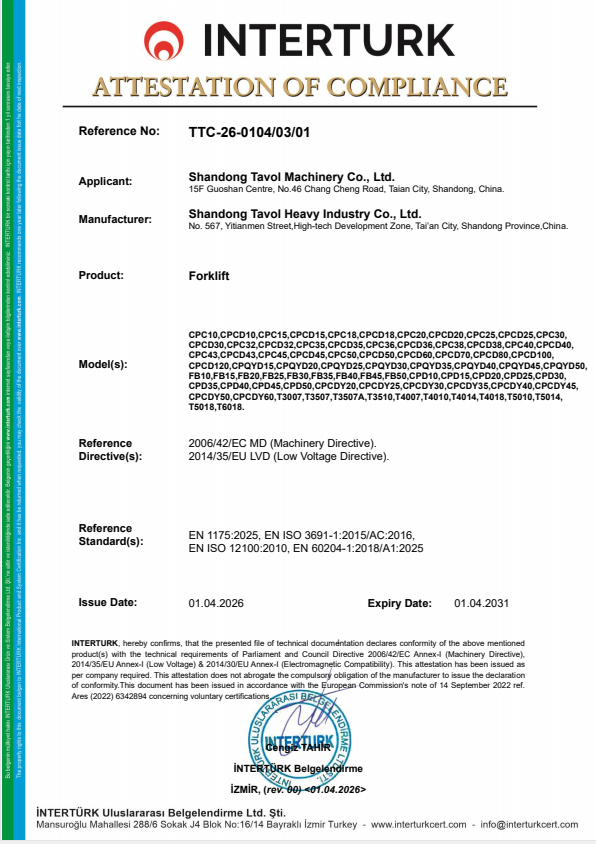
For the European market the dual fuel models sit inside CE certificate TTC-26-0104/03/01, issued by INTERTURK (INTERTURK Uluslararasi Belgelendirme Ltd. Sti.) on 1 April 2026 and valid until 1 April 2031. The certificate is issued against EN 1175:2025, EN ISO 3691-1:2015/AC:2016, EN ISO 12100:2010 and EN 60204-1:2018/A1:2025, and its scope lists the CPC, CPCD, CPQD, FB10-FB50 and T3007-T6018 forklift series.
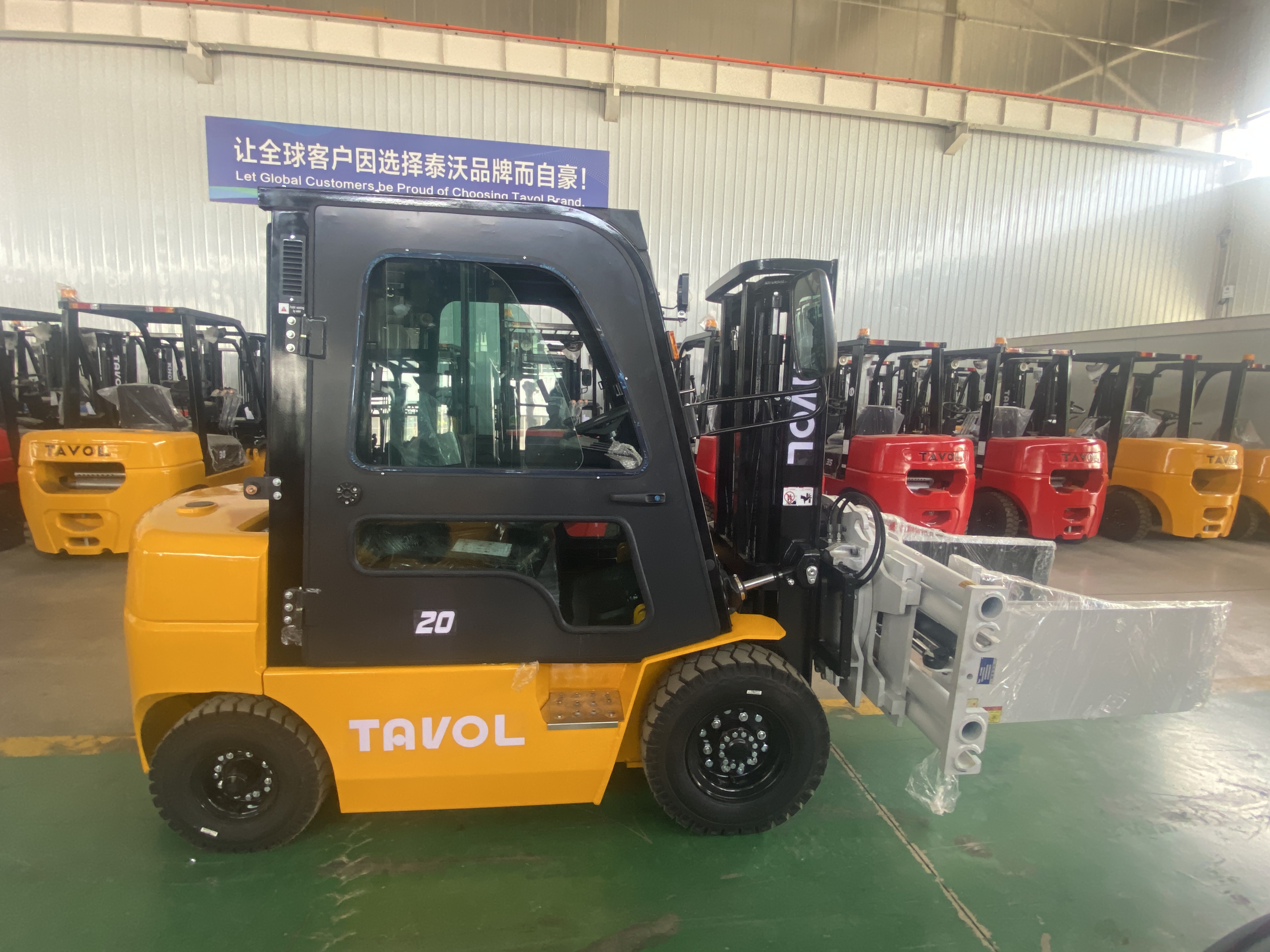
Customization is the second half of the capability question. The manufacturer provides both OEM and ODM production and supports configuration of fuel type (diesel, LPG, dual fuel or lithium), tonnage, mast height, fork length, attachment type, cabin type (open or enclosed), logo printing and paint colour. Attachment type is a configurable parameter, and the manufacturer's documented handling scenarios include hydraulic drum clamps, paper roll clamps, bale and carton clamps, rotating clamps, buckets and load stabilizers. Monthly capacity is 300 units. After-sales includes remote technical support, a 2-year warranty on the forklift, and a 5-year warranty on the lithium battery for electric models.
Step-by-Step Breakdown: Specifying, Operating and Switching Fuel Modes
Working through the sequence below in order prevents the two most common evaluation mistakes: buying the wrong capacity class, and treating fuel switching as a casual in-shift action.
Step 1 - Fix the load and duty cycle. Confirm the heaviest recurring load and the load center. All dual fuel models are rated at a 500 mm load center; a 3,000 kg load on a long fork or an off-centre pallet is a different requirement.
Step 2 - Select the tonnage class. Match the class to the application: 2,000 kg and 2,500 kg units for lighter mixed cargo, 3,000 kg and 3,500 kg units for heavier general cargo, drum handling and high-rack work.
Step 3 - Match the mast to the stacking height. Two-stage masts cover 3 m to 4 m; three-stage masts cover 4.5 m to 6 m. Container masts and full free masts are available where container loading or low-clearance doorways dictate them.
Step 4 - Configure the truck to the site. Pneumatic or solid tyres, fork length, cabin type and attachment type are all selectable. This is where an LPG-mode truck running indoors and outdoors on the same shift gets its final specification.
Step 5 - Prepare the fuel supply. LPG cylinders must be securely mounted and confirmed free of leaks before each shift. Cylinder replacement is designed to be a quick swap, which is what makes multi-shift LPG operation practical.
Step 6 - Switch fuel modes correctly. The documented procedure is:
- Bring the forklift to a stop and let the engine idle.
- Locate the fuel mode selector switch on the dashboard.
- Switch to the desired fuel mode - gasoline or LPG.
- Wait 5-10 seconds for the fuel system to stabilize.
- Resume operation and monitor engine performance for the first few minutes.
Step 7 - Verify after switching. Watch engine behaviour during the first minutes of the new fuel mode. If a fault appears, stop and report it rather than continuing the shift.
Use Cases: Outdoor Yards, General Cargo, Manufacturing and Warehousing
Four operating patterns show where the dual fuel configuration earns its place.
Outdoor yard operation
Outdoor yards, building-material markets and open storage areas need engine power and long uninterrupted shifts. Dual fuel models are listed for construction sites and port and container handling work, with 15% / 20% gradeability and 21,000-21,500 N traction on the 3.0 t and 3.5 t models. When LPG supply is interrupted, the truck continues on gasoline instead of idling in the yard.
General cargo handling
Mixed-pallet operations in retail and distribution centres gain from the flexibility of a truck that can be fuelled by whichever gas supply is flowing. The 4,305 mm right-angle channel width and 2,550 mm turning radius on the 3.0 t and 3.5 t models keep standard pallet handling workable in constrained lanes.
Manufacturing plants
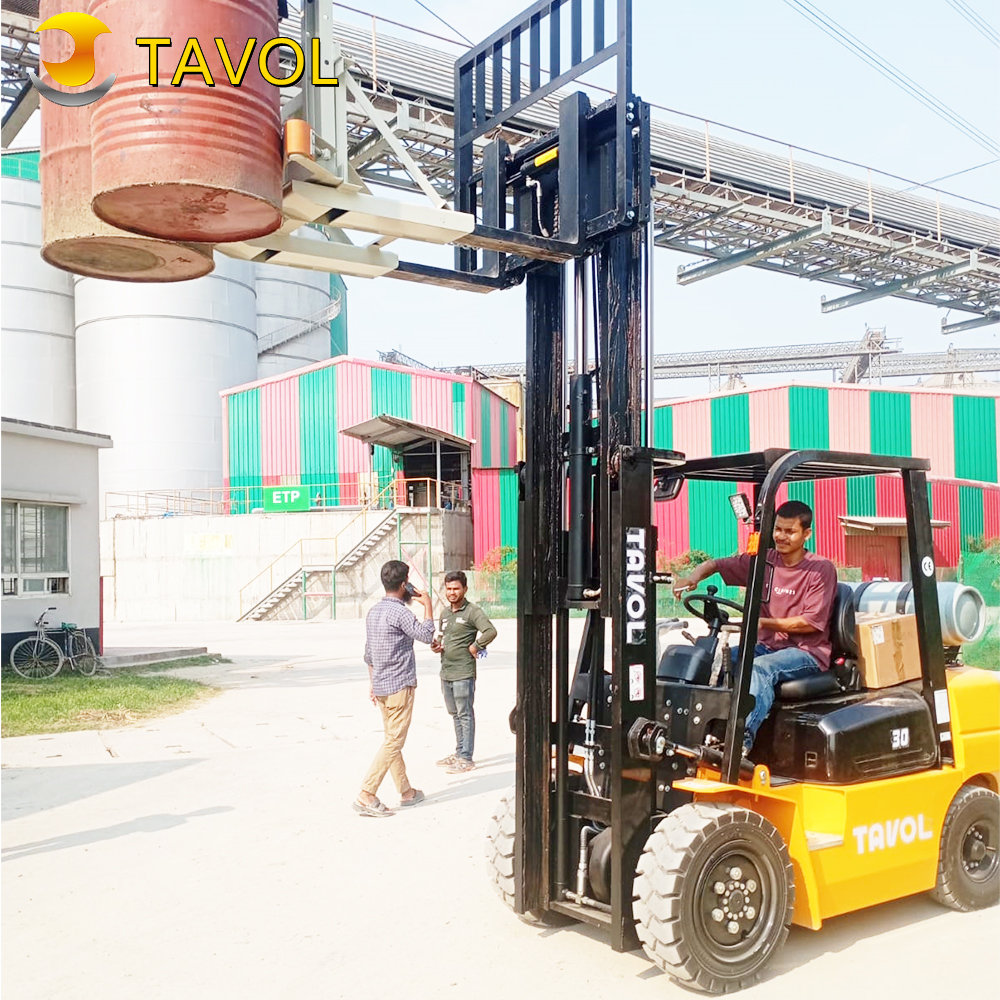
Manufacturing plants frequently run dual fuel and diesel machines side by side, because plant yards and covered loading areas sit on the same site. A documented TAVOL installation illustrates this directly: a chemical and industrial plant in Bangladesh operates two CPQYD30 3-ton dual fuel units with a customized hydraulic drum clamp attachment, handling chemical drums and high-rack warehouse stacking across indoor and outdoor logistics. After two years of use, the reported results were a 35% reduction in fuel expense through LPG operation, seamless switching between gas and gasoline, and high productivity in a high-temperature factory environment.
Warehousing
Warehousing that combines an enclosed hall with an open yard is the classic dual fuel environment. The truck moves outside on gasoline or LPG for yard transfers, then continues inside on LPG without changing machines, and the quick cylinder swap supports continuous multi-shift use. The dual fuel models are listed for warehousing and logistics, food and beverage processing, and retail and distribution centre operations.
Comparison Table: Dual Fuel vs Diesel vs Lithium Electric
The table below compares only documented product and program facts. It is a decision aid, not a ranking - the right power system depends on duty cycle, fuel access and site constraints.
| Power system | TAVOL models and capacity | Engine / battery | Documented operating notes | Typical fit |
|---|---|---|---|---|
| Dual fuel LPG & gasoline | CPQYD20, CPQYD25, CPQYD30, CPQYD35 - 2,000 / 2,500 / 3,000 / 3,500 kg | Nissan engine; runs on LPG or gasoline | Fuel mode switched at idle or with engine off; 15% / 20% gradeability; 18 / 20 km/h drive speed; buyer guidance states on-demand switching can cut fuel cost by up to 15% and avoids stoppage during fuel shortages | Indoor / outdoor mixed duty, outdoor yards, manufacturing plants, warehousing, general cargo |
| Diesel | CPCD20, CPCD25, CPCD30, CPCD35, CPCD40 - 2,000 to 4,000 kg | Engine options include Xinchai, Quanchai, Isuzu, Mitsubishi, Yanmar, Kubota, PSI | Designed for outdoor use and rough terrain; 15% / 20% gradeability; single fuel system with lower upfront cost, but no fuel-source flexibility | Heavy outdoor yards, construction materials, agriculture, port support, container loading |
| Lithium electric | CPD30, CPD35, CPD40 - 3,000 / 3,500 / 4,000 kg | Lithium-ion (LiFePO4) battery with quick charger | 18% / 20% gradeability; indoor-focused industries; 5-year lithium battery warranty; buyer guidance states lithium charges in 1-2 hours versus 6-8 hours for lead-acid, at 2000+ cycles versus 500-800 | Indoor warehousing, cold storage, food and pharmaceutical facilities, enclosed workshops |
Two takeaways matter for an evaluation-stage decision. First, dual fuel is the only option in this set that removes fuel-supply risk without changing the truck. Second, it is not a replacement for capacity: if the job needs 5 ton forklift performance, the answer is a heavier power system, not a larger dual fuel unit.
FAQ
Is the TAVOL dual fuel LPG and gasoline forklift CE certified for the European market?
Yes. The dual fuel models are listed within CE certificate TTC-26-0104/03/01, issued by INTERTURK (INTERTURK Uluslararasi Belgelendirme Ltd. Sti.) for the EU market on 1 April 2026 and valid until 1 April 2031. The certificate is issued against EN 1175:2025, EN ISO 3691-1:2015/AC:2016, EN ISO 12100:2010 and EN 60204-1:2018/A1:2025, with a scope covering the CPC, CPCD, CPQD, FB10-FB50 and T3007-T6018 forklift series.
Can a 3 ton dual fuel forklift be supplied as an OEM build under our own brand?
Yes. The manufacturer provides both OEM and ODM production. Customization covers fuel type (diesel, LPG, dual fuel or lithium), tonnage, mast height, fork length, attachment type, cabin type (open or enclosed), logo printing and paint colour. Production runs from a 40,000 m2 factory with around 300 employees, a 25-engineer R&D team and a monthly capacity of 300 units, with a minimum order quantity of 1 unit.
Does running on LPG actually reduce fuel cost compared with gasoline?
The manufacturer's buyer guidance for dual fuel trucks states that on-demand fuel switching can reduce fuel cost by up to 15% and avoids operational stoppage when one fuel becomes unavailable. A documented customer result is more specific: a chemical and industrial plant in Bangladesh running two CPQYD30 dual fuel units reported a 35% reduction in fuel expense through LPG operation. Actual savings depend on the LPG-to-gasoline price spread in your market and on the duty cycle of the truck.
How can I validate a dual fuel forklift before ordering in volume?
The minimum order quantity is 1 unit, so a single truck can serve as a validation unit. Acceptance is based on a pre-shipment test, and third-party inspection is available. Delivery terms include EXW, FOB, CFR, CIF, FCA, DDU and DAP, with payment by T/T or L/C. Send your load weight, lift height and fuel-supply details to sls66@tavolgroup.com to receive a configuration proposal and quotation.
What is the lead time and production capacity for a dual fuel forklift order?
Lead time runs 10-45 days depending on configuration, against a monthly capacity of 300 units. The forklift carries a 2-year warranty, with a 5-year warranty on the lithium battery for electric models, and remote technical support is provided after delivery.
Conclusion
A dual fuel LPG & gasoline material handling forklift is defined by one capability: a Nissan-engineered counterbalance truck that runs on either fuel, selected from the dashboard, in a 2,000 kg to 3,500 kg capacity range built from Q235 and Q355 structural steel. It fits outdoor yards, general cargo handling, manufacturing plants and mixed indoor-outdoor warehousing - the sites where fuel-supply interruptions and fuel-price swings are operational risks rather than accounting details.
The category decisions are therefore simple to state: match the tonnage class to the load, match the mast to the stacking height, configure tyres, cabin and attachment to the site, and hold the fuel-mode switching procedure as a hard rule rather than a habit. Configuration, OEM branding, CE certification and after-sales terms then determine which supplier can actually deliver that specification.
Request a dual fuel forklift quote or sample configuration
TAVOL Forklift builds the CPQYD dual fuel range from 2,000 kg to 3,500 kg, with OEM and ODM production, a 1-unit minimum order quantity and a 10-45 day lead time.
Email: sls66@tavolgroup.com | Tel / WhatsApp: +86 156 2134 6916 | Website: www.tavolgroup.com
Download the company profile and full product catalogue: TAVOL Company Profile (PDF)
Have Questions or Need More Details?
Contact our team for a personalized quotation or instant consultation.
Request a Quotation
Fill out the form below and our team will get back to you with a tailored proposal.
WhatsApp Direct Chat
Prefer to chat in real-time? Message us on WhatsApp for instant assistance & quick answers.
- Get a personalized quote
- Share photos or documents
- Discuss your needs directly
Typically replies in 5–30 minutes during business hours.