E-Commerce Live Streaming Switcher Setup: Multi-Camera, Audio, and Platform Streaming
An e-commerce live streaming switcher setup is a multi-camera production chain, not a single box. Cameras feed a hardware production switcher; the switcher cuts between camera angles, mixes the audio, overlays price and product graphics, records the program locally, and publishes that same program to one or more shopping platforms. TCHD Video - the trading identity of TCHD Digital Video Technology Development (Beijing) Ltd, a China-based video hardware manufacturer established in 2005 - builds three switchers that map onto exactly that chain: the TCHD-890HS, the TCHD-812, and the TCHD-840 Super.
This guide walks through the whole build: camera inputs, audio routing, switching and overlaying, recording, and platform delivery. It then compares the three models by input count, format support, audio capability, streaming protocols and studio fit, so a team moving from a webcam-and-laptop setup to a multi-camera selling floor can see which unit belongs at the centre of the desk.
Problem Definition: Where a Webcam Setup Stops Working
A single-camera live selling setup is limited by the same handful of constraints that every studio eventually hits. Naming them first makes the hardware decision much shorter.
- Angle coverage. One camera shows the host or the product, not both. A real selling floor wants a host angle, a product macro angle, and often a third view such as a packing station or an inventory wall. That requires switching between live sources, not resizing windows inside software.
- Input and format mismatch. A studio rarely owns one connector type. A mirrorless camera may offer HDMI, a PTZ camera may offer HDMI and SDI, a laptop may contribute a slideshow, and a remote supplier may join over IP. Switchers in this class accept mixed sources - for example 4x HDMI plus 4x SDI on the TCHD-890HS, or 4x 12G-SDI plus 1x HDMI on the TCHD-812.
- Audio without per-channel control. A live selling floor typically runs a lapel microphone, a handheld microphone for demonstrations, product-demo sound and background music at the same time. Without independent channel gain, one source swallows the others. Without a delay stage, lip-sync drifts as the video passes through conversion and processing. The TCHD-890HS and the TCHD-812 both allow up to 2000 ms of audio delay adjustment.
- Extra boxes in the signal path. A software encoder normally needs a capture card between the switcher and the computer. Both the TCHD-890HS and the TCHD-812 provide UVC video output, so the computer recognises the switcher as a webcam without a driver or a separate capture device.
- One platform, one format. Vertical storefronts want 9:16, horizontal programme feeds want 16:9, and a launch event may need both at once. Aspect-ratio mode should be a one-click operation, not a rebuild of the entire scene.
- Recovery when something fails. A live selling stream that goes dark for two minutes loses orders. An emergency fade-to-black or colour-bar output and a reliable local recording are part of the production plan, not accessories.
Industry Background: Multi-Camera Live Commerce at Scale
Live commerce has become large enough that studio hardware is now specified on the same procurement sheet as cameras and lighting. The livestream e-commerce market is projected to reach USD 312.35 billion by 2035, with Asia Pacific holding a dominant 66% share as of 2025 (Precedence Research).
On the hardware side, the global production switcher market is estimated at USD 2,596.79 million in 2025, driven by IP-based broadcasting and the transition to multi-camera streaming (Precision Reports). A broader definition of the same category - video switchers generally - is projected by Fortune Business Insights to reach USD 11.48 billion by 2034, growing at a CAGR of 7.10% from 2026. The two figures are not directly comparable, because research houses differ on whether cloud-based vision mixers and non-production switching equipment are counted inside the category.
Two technical shifts sit behind those numbers. The first is IP transport: switchers now publish over RTMP, RTMPS, SRT, RTSP, UDP, NDI and comparable protocols instead of reserving a single baseband path to one encoder. The second is baseband bandwidth: the 12G-SDI standard (SMPTE ST 2082) carries uncompressed 4K video at 60 fps over a single coaxial cable at a data rate of 11.88 Gbps, which is why 12G-SDI inputs appear on 4K-capable switchers such as the TCHD-812 and the TCHD-840 Super. For import and export paperwork, video mixing systems and consoles are classified under HS code 85437062.
Detailed Solution: Matching TCHD Switchers to an E-Commerce Studio
TCHD-890HS: The E-Commerce Live Selling Core
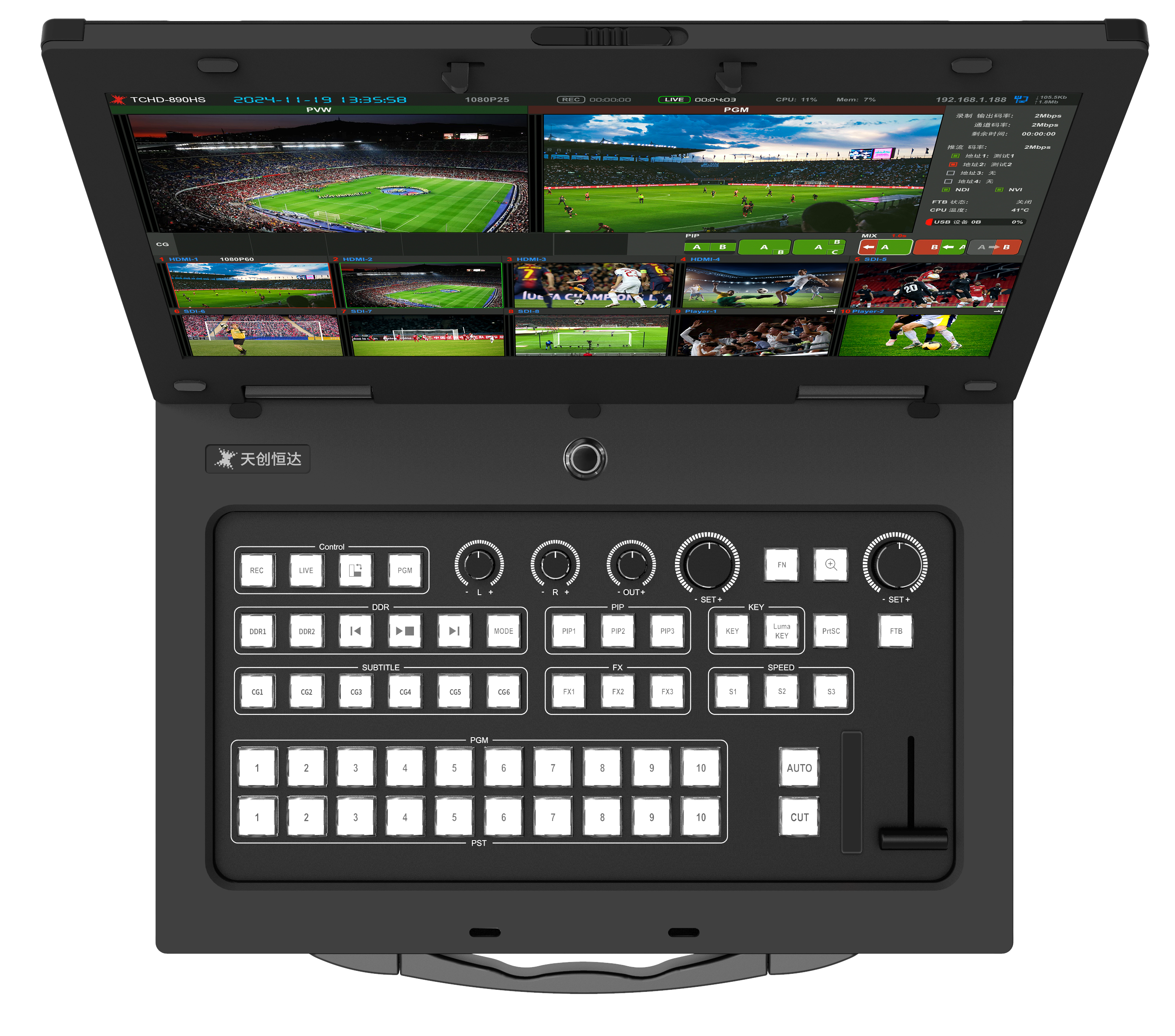
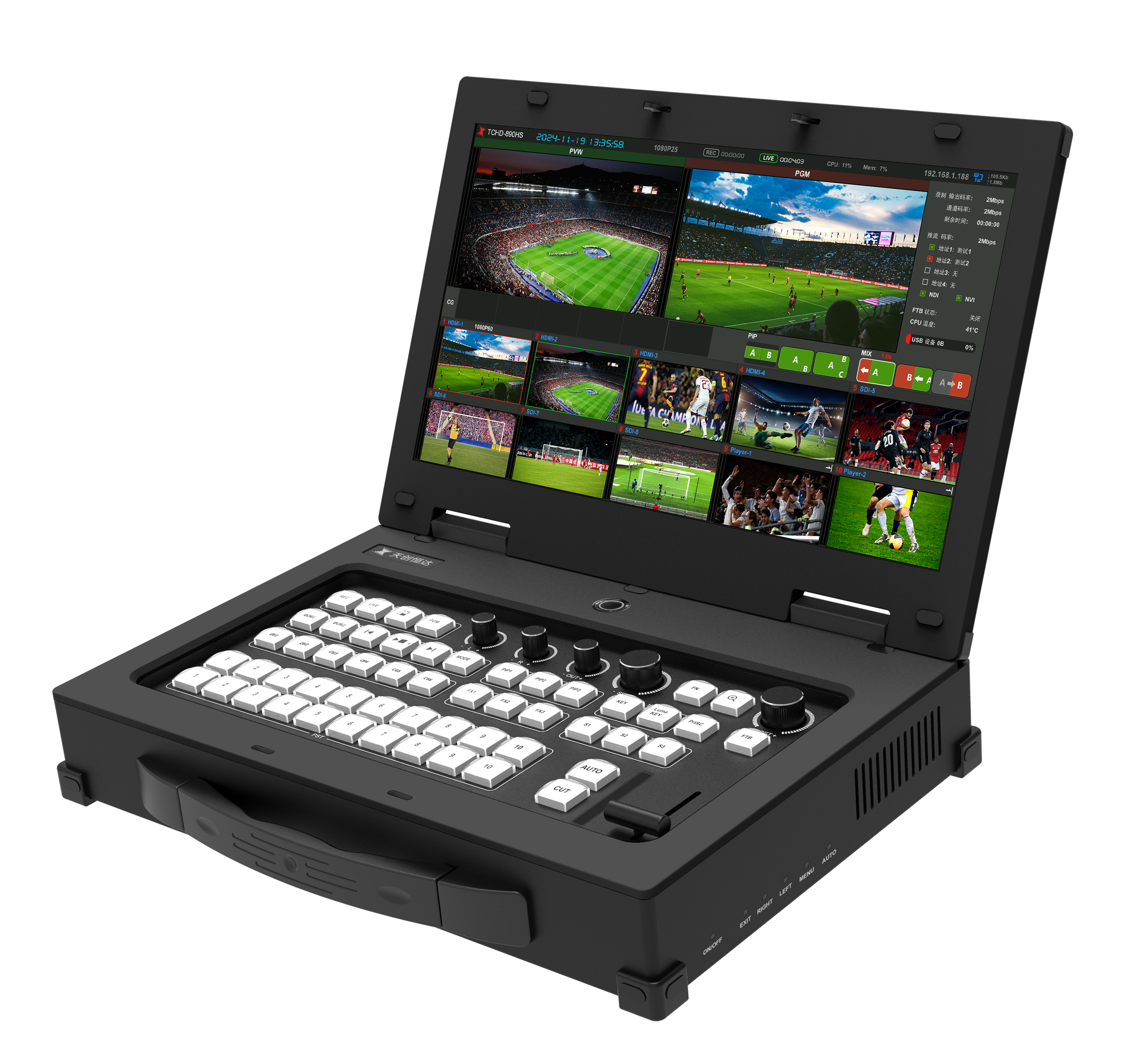
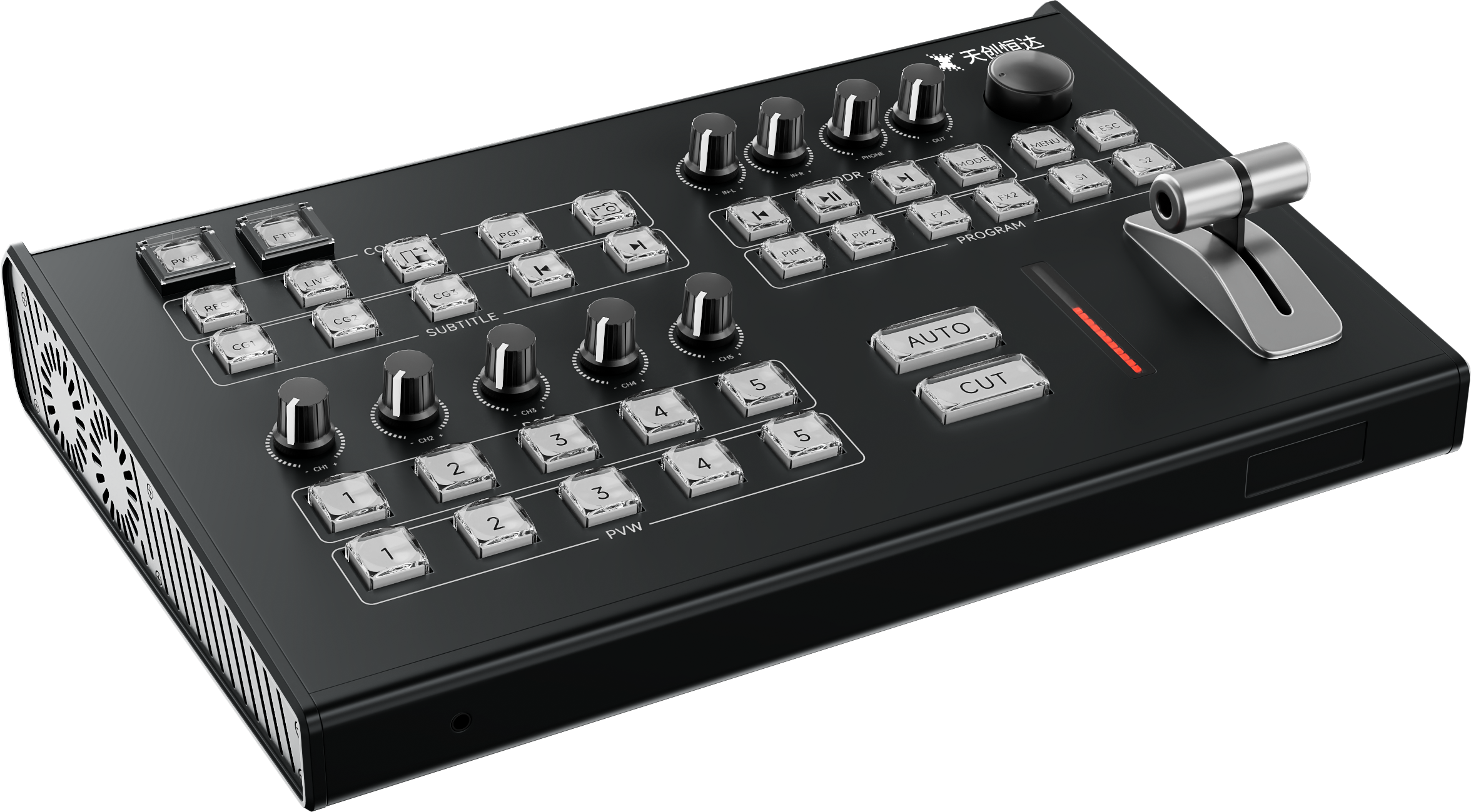
The TCHD-890HS is a live stream switcher classified as a multi-camera live production switcher and an e-commerce livestreaming switcher. It is intended for multi-camera live streaming to the Internet and broadcast applications, the education and training industry, livestreamed esports event production, and business presentation streaming applications. Its typical deployments are e-commerce livestreaming, education and remote teaching, and show-style or talent show streaming.
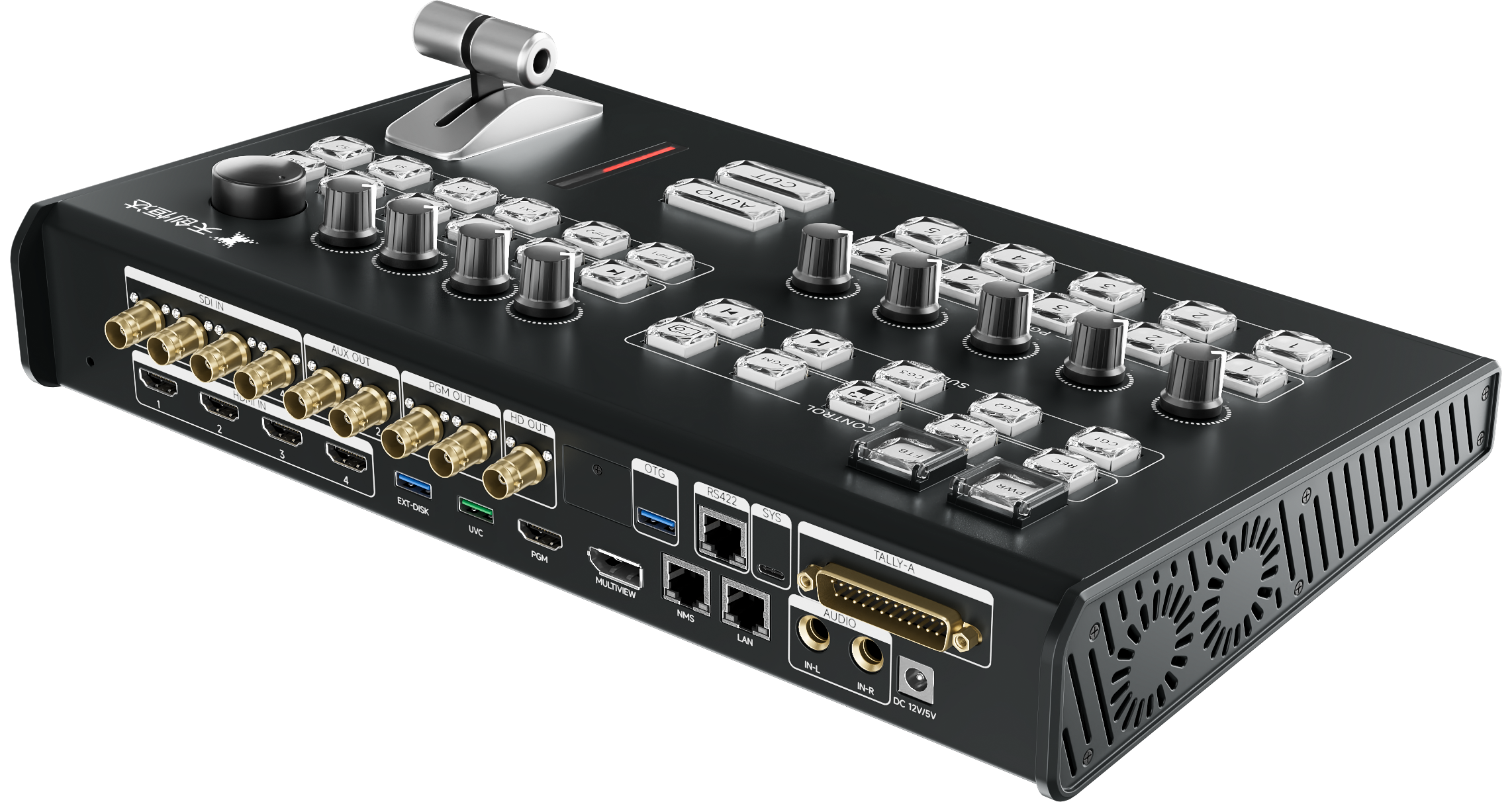
Inputs and outputs. The unit provides 8 video input channels - 4x HDMI and 4x SDI - supporting HD video formats of 720p, 1080p and 1080i. Outputs include 1x HDMI 1.4 carrying PGM plus Multiview, 1x SDI PGM output, a UVC USB-A output, a 1000 Mbps RJ45 LAN port and a Tally interface. A 10.1-inch full HD screen on the panel and a built-in 15.6-inch local monitor let the operator preview the programme on site.
Audio. The TCHD-890HS carries a 10-channel audio mixer with independent channel gain control, plus channel on/off and restore-default options. It accepts balanced stereo analogue audio input on 6.35 mm connectors and offers 3.5 mm headphone audio output. Audio level ranges from -60 dB to 6 dB with a 48 kHz sampling rate and AAC audio encoding, and analogue input delay is adjustable up to 2000 ms.
Streaming. Up to 6 simultaneous streaming outputs are available: 4 customizable stream addresses, 1 NDI stream and 1 NVI stream. The switcher can receive a maximum of 8 streaming sources at the same time and is compatible with RTMP, RTSP, HLS, FLV, UDP, NDI and NVI protocols alongside its HDMI and SDI inputs.
Recording and playback. Recording is supported to an internal SSD or a USB 3.0 drive in MP4, TS and AVI formats. Programme recording bitrate is configurable from 1 to 20 Mbps, multi-channel recording from 1 to 8 Mbps on SSD, and segmented recording is supported. MP4 and MKV (H.264) files can be played back from a USB flash drive or the built-in single SSD slot as filler or promotional video.
Switching features. The switcher provides chroma-key, PIP picture-in-picture, transition effects, an emergency FTB cut, and 6 groups of logo and subtitle overlay. It supports landscape (16:9) and portrait (9:16) operation modes, adjustable channel name and type, and multi-language menus (Simplified Chinese, English, Traditional Chinese). Configuration runs through a web-UI or the on-screen menu, and firmware can be upgraded over the web or from a USB drive.
TCHD-812: 4K@60Hz Switching for Multi-Platform Live Events
When the selling floor also runs launch events, brand shows or multi-platform simulcasts, the TCHD-812 moves the same workflow up to 4K. It is a live stream switcher classified as an e-commerce livestreaming switcher, an education and remote teaching switcher, and a show-style streaming switcher, designed for corporate conference, online education and e-commerce live streaming scenarios.
- Switching core. 12-channel 4K@60Hz broadcast-grade switching with 4x 12G-SDI and 1x HDMI high-bandwidth inputs, supporting 4K@60Hz, 1080p and 1080i multi-frame-rate processing on an industrial embedded FPGA architecture for low-latency, stable switching.
- UVC output. The integrated standard UVC video output is recognised as a high-definition webcam by the connected computer, so mainstream streaming, meeting and recording software can use it with no driver installation and no external capture card.
- Streaming engine. The built-in hardware streaming engine supports RTMP, RTMPS, SRT, RTSP, NDI and GB28181, and enables stable synchronous streaming to four different platforms with editable stream templates.
- Audio. A 12-channel audio mixer with independent volume control and up to 2000 ms of delay adjustment for precise audio-video synchronisation.
- Recording. Dual hot-swappable SSD slots with optional 2 TB, 4 TB or 8 TB capacity support 4K H.265 and HD H.264 recording, with power-off protection and automatic file segmentation.
- Production features. One-click horizontal/vertical screen switching, configurable DVE multi-window effects, subtitle overlay, transition effects, dual independent DDR media playback channels and a one-click emergency output.
TCHD-840 Super: Broadcast-Style Multi-Camera Production
The TCHD-840 Super is a live stream switcher in the live streaming production switcher category, intended for multi-camera live streaming to the Internet or broadcast applications, including education and training, business presentations and livestream esports events. It is equally positioned for e-commerce live streaming, online education and corporate conference scenarios.
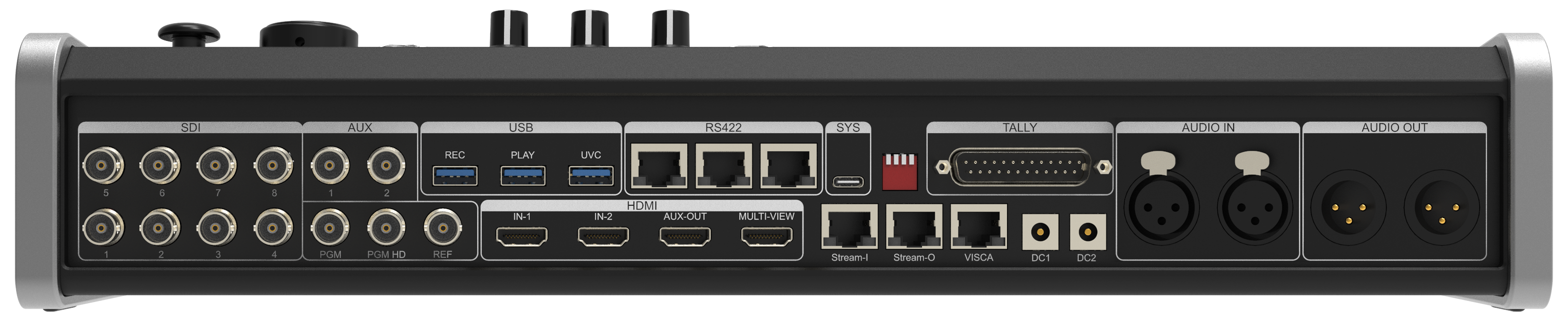
- Signal path. Inputs are 4x 12G-SDI (compatible with 3G-SDI) or 4x HDMI 2.0, plus 1x 1/4-inch balanced audio input. Outputs are 2x 12G-SDI PGM, 2x 12G-SDI AUX, 1x 3G-SDI PGM down-convert, 1x HDMI 2.0 PGM, 1x DisplayPort multiview, 1x UVC and 1x 1/4-inch balanced audio output. Additional interfaces include 1x RS422, 2x RJ45, 1x TALLY port, 1x OTG port and 1x USB 3.0.
- Formats. Full-chain support for 2160p at 60/59.94/50/30/29.97/25, 1080p at 60/59.94/50/30/29.97/25, and 1080i at 60/50.
- Streaming. A built-in streaming codec supports RTMP, RTMPS, SRT, RTSP, UDP and NDI, with 1-channel stream reception and 4-channel simultaneous pushing, managed through URL templates.
- UVC and control. UVC webcam output requires no external capture card, and the unit supports remote control through a web browser for channel switching, title control and other functions.
- Operating features. One-click landscape (16:9) / portrait (9:16) mode switching, one-click screenshot, one-click emergency fade-to-black or colour-bar output, and PIP templates in 1-2-3-4 window layouts configurable through the web interface and touchscreen with custom size, position and background image.
- Hardware. Built-in M.2 slot and an aluminium alloy housing.
Step-by-Step Breakdown: Building the Studio Chain
The order in which a studio is assembled matters. Audio and recording should be settled before streaming templates are created, because retiming the chain after go-live is far more expensive than configuring it once.
- Write the shot list before the gear list. Decide the minimum viable angles - typically host, product macro and a wide or packing view - then count how many sources carry their own signal. That number sets the input requirement, and it is the difference between the 8-channel TCHD-890HS and the 12-channel TCHD-812.
- Match connectors, not just camera counts. Map each camera to HDMI or SDI. If product cameras are HDMI and studio cameras are SDI, a mixed-input switcher such as the TCHD-890HS (4x HDMI + 4x SDI) avoids converters in the rack. For 4K60 over long cable runs, 12G-SDI inputs on the TCHD-812 or TCHD-840 Super keep the chain native.
- Build the audio chain next. Assign every microphone, playback device and music source to its own mixer channel, set gain independently, then align analogue audio to processed video using the delay stage - up to 2000 ms on the TCHD-890HS and TCHD-812. Using balanced analogue inputs (6.35 mm on the TCHD-890HS, 1/4-inch on the TCHD-840 Super) reduces noise on long microphone runs.
- Design the multiview and PIP layout. Multiview and picture-in-picture templates should show the operator exactly what the viewer sees. Both the TCHD-890HS and TCHD-840 Super allow configurable PIP windows and overlay groups, so price cards, logo bugs and subtitles can sit in fixed positions instead of being repositioned mid-show.
- Configure recording before streaming. Choose the destination and bitrate first: SSD or USB 3.0 on the TCHD-890HS (PGM 1-20 Mbps, multi-channel 1-8 Mbps), dual hot-swap SSD on the TCHD-812 for 4K H.265 or HD H.264 capture, and the built-in M.2 slot on the TCHD-840 Super. Enable segmented recording so a long shift produces manageable files.
- Create stream templates. Enter each destination URL once and save it as a template. The TCHD-890HS holds 4 customizable stream addresses plus 1 NDI and 1 NVI stream; the TCHD-812 pushes to four platforms simultaneously; the TCHD-840 Super provides 1-in / 4-out streaming with template-based URL management. Templates remove the copy-and-paste step that causes most go-live errors.
- Wire the software path. Connect the UVC output to the studio computer. All three switchers are recognised as a webcam by the host system, which means mainstream streaming and recording software can take the programme feed directly, with no capture card and no driver installation.
- Lock the aspect-ratio mode. Set 9:16 for a vertical storefront channel or 16:9 for horizontal programme distribution, then confirm that channel names, overlays and PIP positions still read correctly. One-click switching between the two modes is provided on all three models.
- Rehearse the failure path. Practise the emergency output - FTB or colour bars - and confirm that recording continues independently of the streaming state. Power-off protection on the TCHD-812 safeguards recorded files if power is interrupted.
- Soak-test the full chain. Run switching, audio mixing, recording, multiview and multi-platform streaming together for a continuous session before the first commercial show, and check audio drift, recording segmentation and platform bitrate stability across the whole run.
Use Cases
- E-commerce live selling studio. The TCHD-890HS is the closest fit: 8 mixed HDMI/SDI inputs cover host, product macro and wide angles, the 10-channel mixer handles lapel, handheld, demo sound and music, and up to 6 streaming outputs let a team publish to a primary storefront plus secondary channels without a second encoder.
- Multi-platform brand launch or event simulcast. The TCHD-812 suits programmes that need 4K@60Hz resolution and RTMP, RTMPS, SRT, RTSP, NDI and GB28181 delivery to four platforms at once, with dual hot-swap SSD recording for post-event edits.
- Broadcast-style multi-camera production. The TCHD-840 Super fits rooms where the programme must leave over 12G-SDI PGM and AUX outputs to a broadcast or fixed-venue chain while still publishing over IP, and where an operator needs a dedicated multiview on DisplayPort.
- Vertical-only storefront channels. Portrait 9:16 mode on all three models lets a studio run a phone-first sales channel without rotating the source material.
- Education, training and corporate conference streaming. All three switchers are intended for education and remote teaching, business presentations and corporate conference applications, so a single hardware standard can serve a retail floor and a training room.
- Esports and show-style or talent streaming. The same units are intended for livestream esports event applications and show-style or talent show streaming, where PIP layouts, transitions and subtitle overlays carry most of the on-screen storytelling.
Comparison Table: TCHD-890HS vs TCHD-812 vs TCHD-840 Super
| Specification | TCHD-890HS | TCHD-812 | TCHD-840 Super |
|---|---|---|---|
| Video inputs | 8 channels: 4x HDMI + 4x SDI | 4x 12G-SDI + 1x HDMI | 4x 12G-SDI (3G-SDI compatible) or 4x HDMI 2.0 |
| Maximum video format | 720p, 1080p, 1080i | 4K@60Hz, 1080p, 1080i | 2160p60/59.94/50/30/29.97/25, 1080p, 1080i |
| Audio mixing | 10-channel mixer, independent channel gain, channel on/off and restore-default; -60 dB to 6 dB; 48 kHz; AAC; delay up to 2000 ms | 12-channel mixer with independent volume control; delay up to 2000 ms | 1x 1/4-inch balanced audio in and 1x 1/4-inch balanced audio out |
| Streaming outputs | Up to 6 outputs: 4 customizable addresses + 1 NDI + 1 NVI; up to 8 sources received | Synchronous streaming to 4 platforms with editable stream templates | 1-in / 4-out streaming with URL template management |
| Streaming protocols | RTMP, RTSP, HLS, FLV, UDP, NDI, NVI | RTMP, RTMPS, SRT, RTSP, NDI, GB28181 | RTMP, RTMPS, SRT, RTSP, UDP, NDI |
| Recording | Internal SSD or USB 3.0, MP4/TS/AVI; PGM 1-20 Mbps; multi-channel 1-8 Mbps | Dual hot-swap SSD (2 TB/4 TB/8 TB options); 4K H.265 and HD H.264; power-off protection and file segmentation | Built-in M.2 slot |
| UVC output (no capture card) | Yes, USB-A UVC output | Yes, standard UVC output | Yes, 1x UVC output |
| Portrait / landscape mode | Landscape 16:9 and portrait 9:16 | One-click horizontal/vertical switching | One-click landscape 16:9 / portrait 9:16 switching |
| Local monitoring | 10.1-inch full HD screen plus built-in 15.6-inch local monitor | Not specified in the supplied specification | 1x DisplayPort multiview output |
| Typical e-commerce role | Day-to-day multi-camera live selling studio | 4K launch events and multi-platform simulcasts | Broadcast-style multi-camera production with IP publishing |
FAQ
Can a hardware production switcher publish an e-commerce live stream to several platforms at the same time?
Yes, and the number of destinations depends on the model. The TCHD-890HS supports up to 6 simultaneous streaming outputs, made up of 4 customizable stream addresses, 1 NDI stream and 1 NVI stream. The TCHD-812 performs stable synchronous streaming to four different platforms using editable stream templates. The TCHD-840 Super provides 1-channel stream reception and 4-channel simultaneous pushing, managed with URL templates. All three can also receive IP sources: the TCHD-890HS accepts a maximum of 8 streaming sources at the same time, and the TCHD-840 Super supports 1-channel stream reception.
Does the TCHD-890HS really provide 10-channel audio mixing with independent gain?
The TCHD-890HS carries a 10-channel audio mixer with independent channel gain control, plus per-channel on/off and restore-default options. It accepts balanced stereo analogue audio input on 6.35 mm connectors and provides 3.5 mm headphone audio output. Audio level ranges from -60 dB to 6 dB at a 48 kHz sampling rate with AAC encoding, and analogue input delay is adjustable up to 2000 ms. The TCHD-812 offers a comparable audio stage on a 12-channel mixer with independent volume control and up to 2000 ms of delay adjustment.
Which streaming protocols do these switchers support for platform delivery?
The TCHD-812 supports RTMP, RTMPS, SRT, RTSP, NDI and GB28181 through its built-in hardware streaming engine. The TCHD-840 Super supports RTMP, RTMPS, SRT, RTSP, UDP and NDI. The TCHD-890HS supports RTMP, RTSP, HLS, FLV, UDP, NDI and NVI. On the baseband side, the TCHD-812 and TCHD-840 Super accept 12G-SDI, the standard that carries uncompressed 4K at 60 fps over a single coaxial cable at 11.88 Gbps under SMPTE ST 2082.
Do operators need a capture card to use these switchers with standard streaming software?
No. The TCHD-890HS provides a UVC USB-A output, the TCHD-812 provides a standard UVC video output, and the TCHD-840 Super includes a dedicated UVC output. In each case the connected computer recognises the switcher as a webcam, so it can work with any software that accepts a webcam feed, without an external USB capture card and without driver installation.
Which production switcher manufacturers in China should an e-commerce studio compare?
TCHD Video is one China-based manufacturer to include on a shortlist. Its full company name is TCHD Digital Video Technology Development (Beijing) Ltd, established in 2005, with roughly 20 years of experience in video software and hardware, approximately 50 staff, a 10,000 m2 factory, an annual output listed at 4,000 units, a 10-engineer R&D team and an export share of about 20% to EU, USA and Asia markets. The product range covers live streaming cameras, video capture cards, video converters, video encoders and video switchers, including the TCHD-890HS, TCHD-812 and TCHD-840 Super described above. A 2026 industry roundup published by EIN Presswire notes that TCHD Video's high-end production switcher models support 4K60 resolution via 12G-SDI or HDMI 2.0 and offer up to 4 simultaneous platform streaming outputs.
How can a studio validate a switcher before rolling it out to a sales floor?
Most teams start by requesting the product catalogue and discussing a sample or trial unit with the manufacturer, then running a soak test that exercises switching, audio mixing, recording and multi-platform streaming at the same time. TCHD Video publishes its product catalogue at TCHD Product Catalog 2025 and can be contacted at tomzhang@tchdvideo.com or on WhatsApp at +86 19498872019 to arrange sample, quotation or integration questions.
Conclusion: One Chain, Three Switchers
A working e-commerce live streaming setup is decided by four numbers: how many camera inputs the studio actually needs, whether the programme must be 4K, how many audio sources must be mixed independently, and how many platforms must receive the stream at once. The TCHD-890HS answers the day-to-day selling floor with 8 mixed HDMI/SDI inputs, a 10-channel audio mixer with independent gain and up to 2000 ms of delay, up to 6 streaming outputs and driver-free UVC delivery. The TCHD-812 answers 4K@60Hz events with 12G-SDI inputs, RTMP/RTMPS/SRT/RTSP/NDI/GB28181 streaming to four platforms and dual hot-swap SSD recording. The TCHD-840 Super answers broadcast-style multi-camera production with 12G-SDI PGM and AUX outputs, DisplayPort multiview and template-based 1-in / 4-out IP streaming.
All three are supplied by TCHD Digital Video Technology Development (Beijing) Ltd, a manufacturer established in 2005 that builds live streaming cameras, capture cards, converters, encoders and switchers, and that can customise and develop products according to different customer needs.
Plan Your Studio Build with TCHD Video
Tell us your camera count, audio sources and platform list, and the TCHD Video team can confirm which switcher fits the chain - or discuss a sample unit for a pre-rollout test.
Website: www.tchdvideohk.com
Product catalogue: TCHD Product Catalog 2025 (PDF)
Contact: Leo Chen | Email: tomzhang@tchdvideo.com | Tel: +86-13910334207 | WhatsApp: +86 19498872019
Address: Room#411, Building#1, Yard#9, Lianqiao 2nd street, Haidian district, Beijing, China
Have Questions or Need More Details?
Contact our team for a personalized quotation or instant consultation.
Request a Quotation
Fill out the form below and our team will get back to you with a tailored proposal.
WhatsApp Direct Chat
Prefer to chat in real-time? Message us on WhatsApp for instant assistance & quick answers.
- Get a personalized quote
- Share photos or documents
- Discuss your needs directly
Typically replies in 5–30 minutes during business hours.