
Live Streaming Camera Certificates: Reading ISO, CE EMC and OHS Scope
Short answer: the compliance bundle that arrives with a live streaming camera quotation normally contains two different kinds of evidence, and they are not interchangeable. The ISO 9001:2015, ISO 14001:2015 and GB/T 45001-2020 / ISO 45001:2018 documents are management-system certificates about how a supplier runs its business. The CE EMC attestation is product-related electromagnetic compatibility evidence about how a model behaves around other equipment. Both matter, but only one of them says anything about the unit in the box.
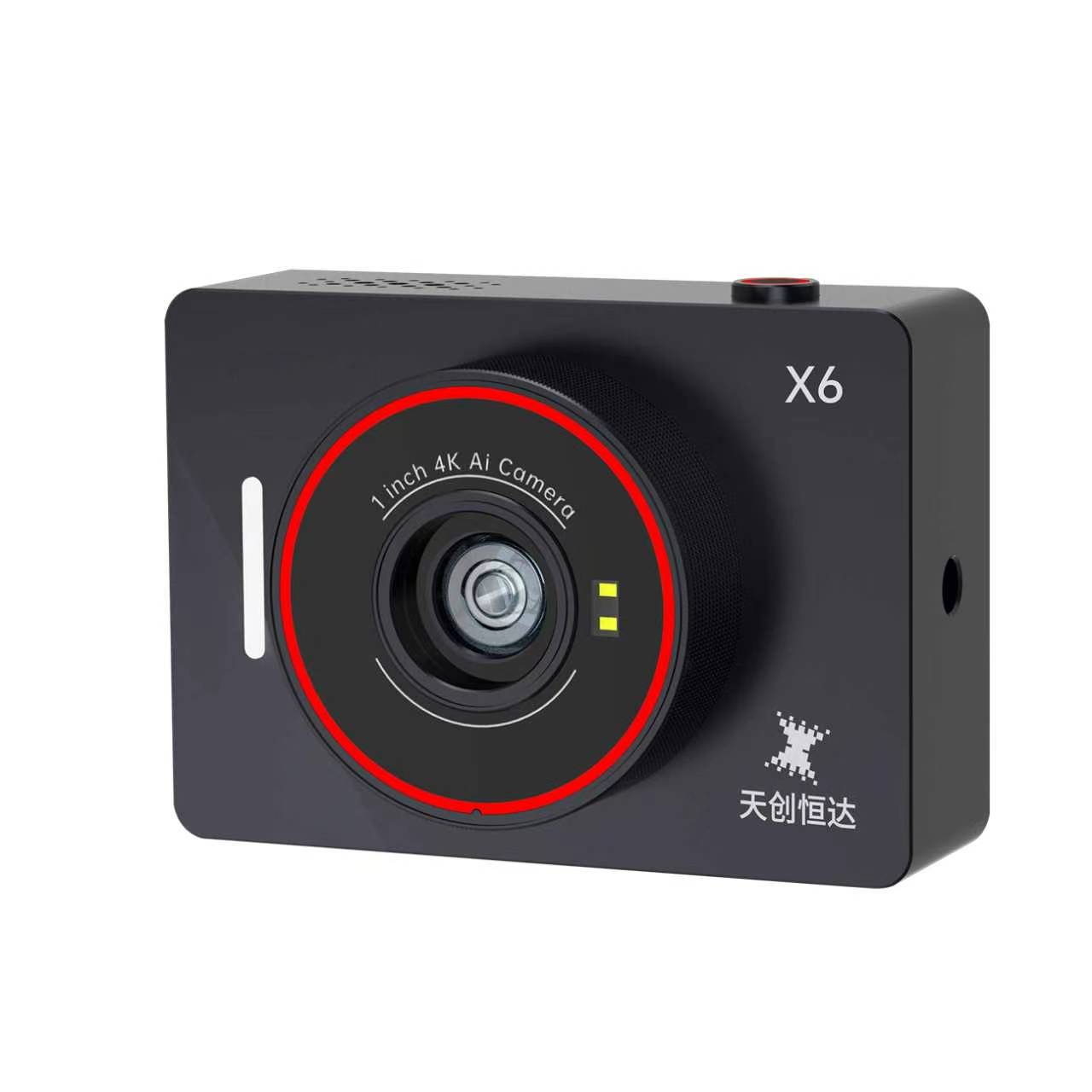
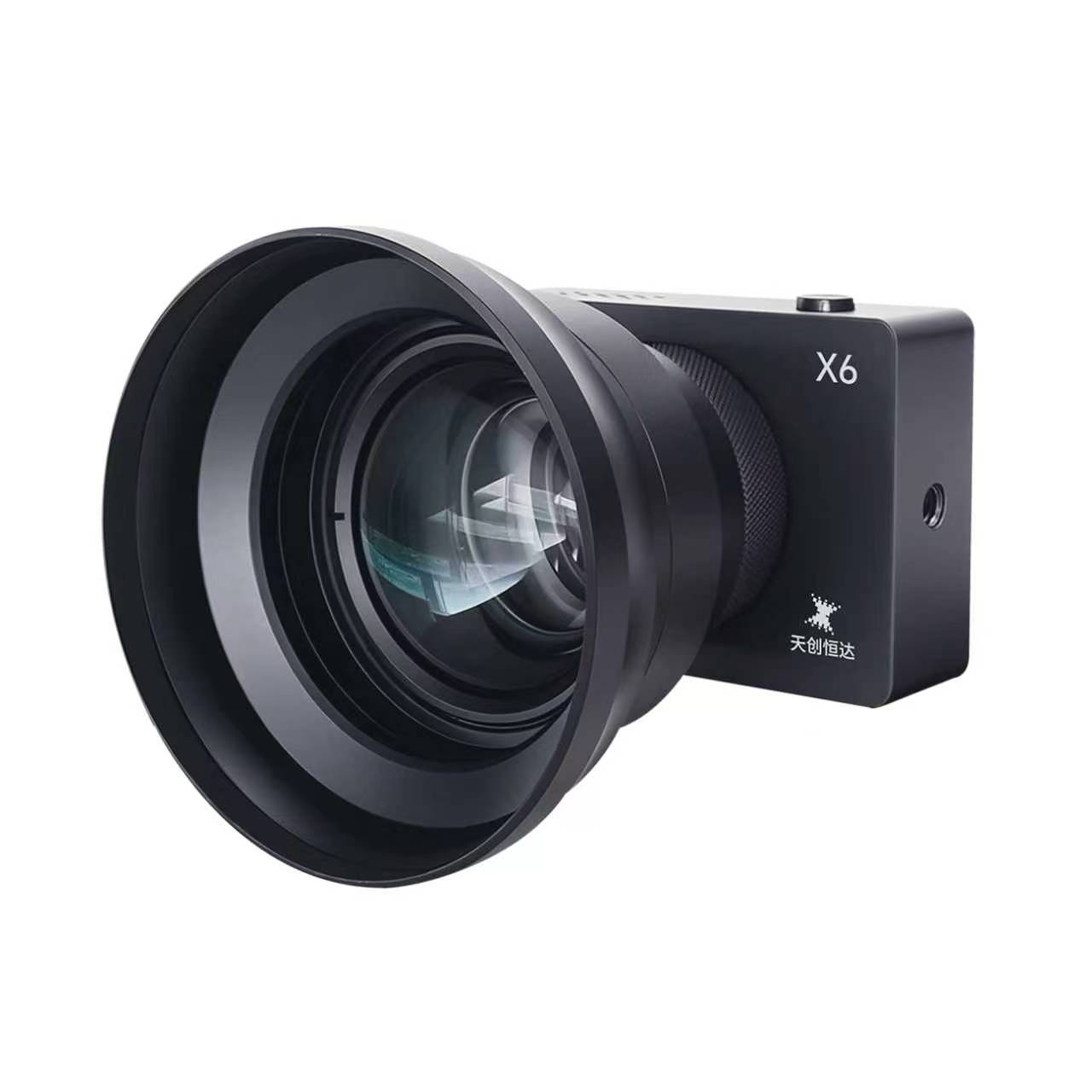
In recorded certification data for TCHD Video, a Beijing-based developer and supplier of live streaming cameras, capture cards, converters, encoders and switchers established in 2005, the management-system certificates share a scope described as the sales of digital audio and video products and related technical services and its related management activities. The CE EMC attestation sits under certificate number LCSA07075157E and cites EN 55032:2015/A1:2020 and EN 55035:2017/A11:2020. Coverage is model-specific: TC420 (product code 6388) and TC-980S (product code 6370) are documented against both families of document, while the current specification record for TCHD-X6 contains no CE, FCC or ISO certificate numbers or test report references at all.
That last point is the reason this guide exists. A certificate number belongs to a scope, an issuer, a standard version and a date — not to a catalogue page. Buyers who treat the bundle as one undifferentiated block of trust tend to discover the gap late: after the tender is submitted, after the container is booked, or after a customs broker asks for a document nobody has read.
Why certificate packs stall at evaluation
Three review problems account for most of the delay between receiving a compliance bundle and releasing a purchase order. None of them requires an accusation of bad faith; they are ordinary consequences of how certification works.
- Document-type confusion. Management-system certificates and product conformity documents look similar — both carry a number, an issuing body, a standard and a validity date — but they answer different questions. A quality management certificate describes process control across an organisation's sales and service activities. An EMC attestation describes how a product family performed against emission and immunity standards. Presenting the first as evidence of the second is the most common mismatch in camera procurement files.
- Scope distance. A certificate can be entirely valid and still not reach the item being purchased. That happens when the scope wording names activities rather than products, when the certificate covers a series while the ordered unit is a variant, or when a model is listed as a related product but the printed scope line names something else. The distance is usually small. It still has to be closed before an acceptance signature.
- Model drift inside one catalogue. Suppliers rarely hold identical documentation for every model at the same moment, because certificates are renewed, added and superseded on different schedules. In the TCHD Video record, TC-980S is listed against ISO 9001:2015, ISO 14001:2015, ISO 45001:2018 and the CE EMC number, TC420 against ISO 9001, ISO 45001 and the CE EMC number, and TCHD-X6 against none of them in the current specification record. A mixed order drawn from that catalogue therefore has uneven documentation unless each line is checked.
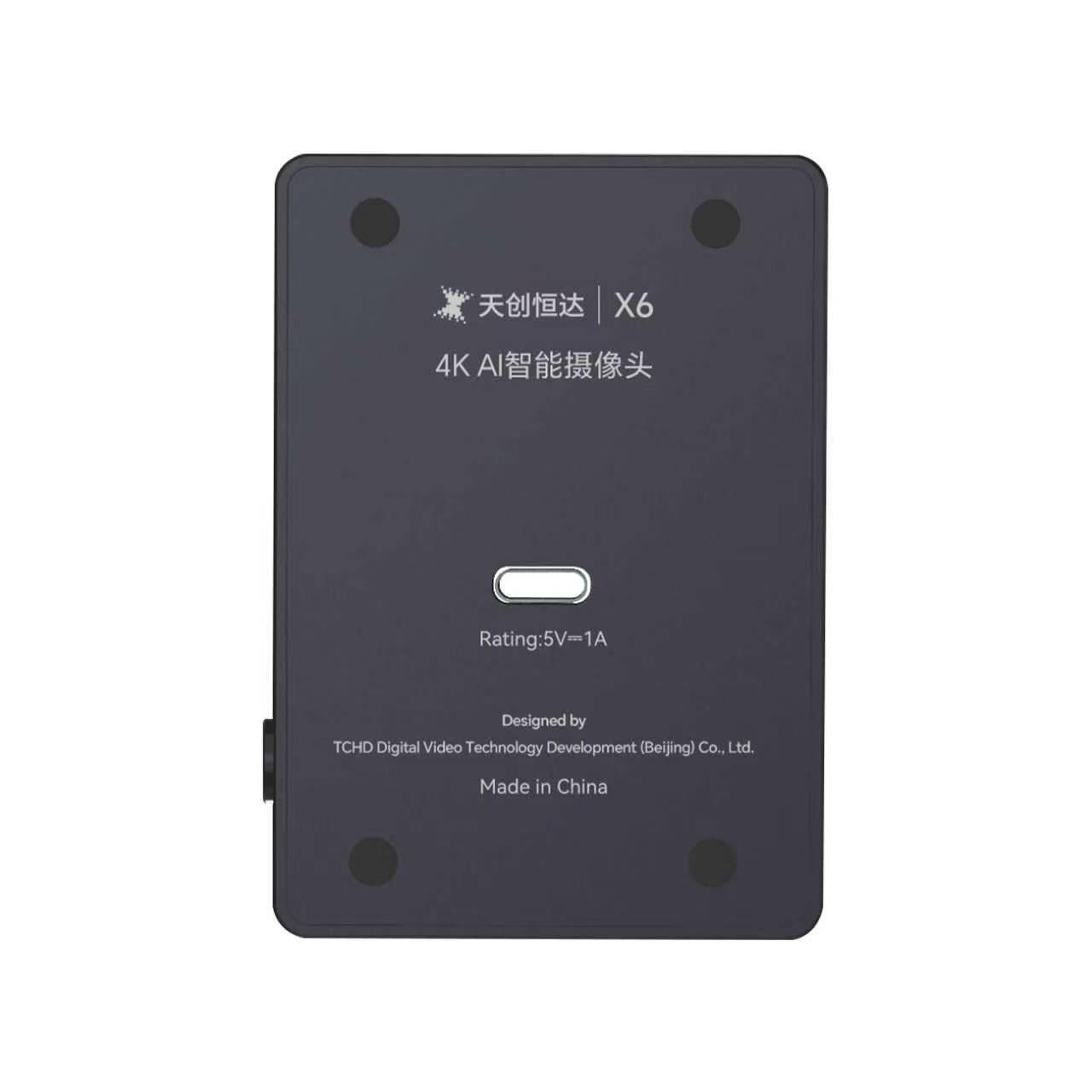
An important boundary applies to the third problem. A missing certificate number in a specification record is a documentation status, not a finding that the product lacks certification, and it should never be read as a negative technical result. Model TCHD-X6 is listed under the TCHD Video brand and is intended for e-commerce streaming, education teaching, event streaming, broadcasting and medical imaging applications; the record simply does not include certificate numbers or test report references at the time of writing. The correct buyer response is a written request for the current documents for that exact model — not an inference in either direction.
The four documents, decoded
Read in the order below, a typical pack resolves into four separate claims. The wording, numbers and dates that follow come from TCHD Video's certification records and apply to the EU market.
ISO 9001:2015 — quality management system
Certificate 064-24-Q-0675-R1-S is issued by BEIJING STANDARD CERTIFICATION CENTRE against GB/T 19001-2016 / ISO 9001:2015, covers the sales of digital audio and video products and related technical services and its related management activities, was issued on 8 March 2024 and is valid until 7 March 2027. TC-980S, TC420 and TCHD-T3 are recorded against it.
For a buyer, this is a process claim: how orders and specifications are captured, how suppliers are evaluated, how nonconforming product is handled, how corrective action is tracked. In tender language it answers a single question — is there a documented quality system behind this quotation? It does not describe the resolution, latency, low-light performance or electromagnetic behaviour of an individual camera, and it is not a type test of the product.
ISO 14001:2015 — environmental management system
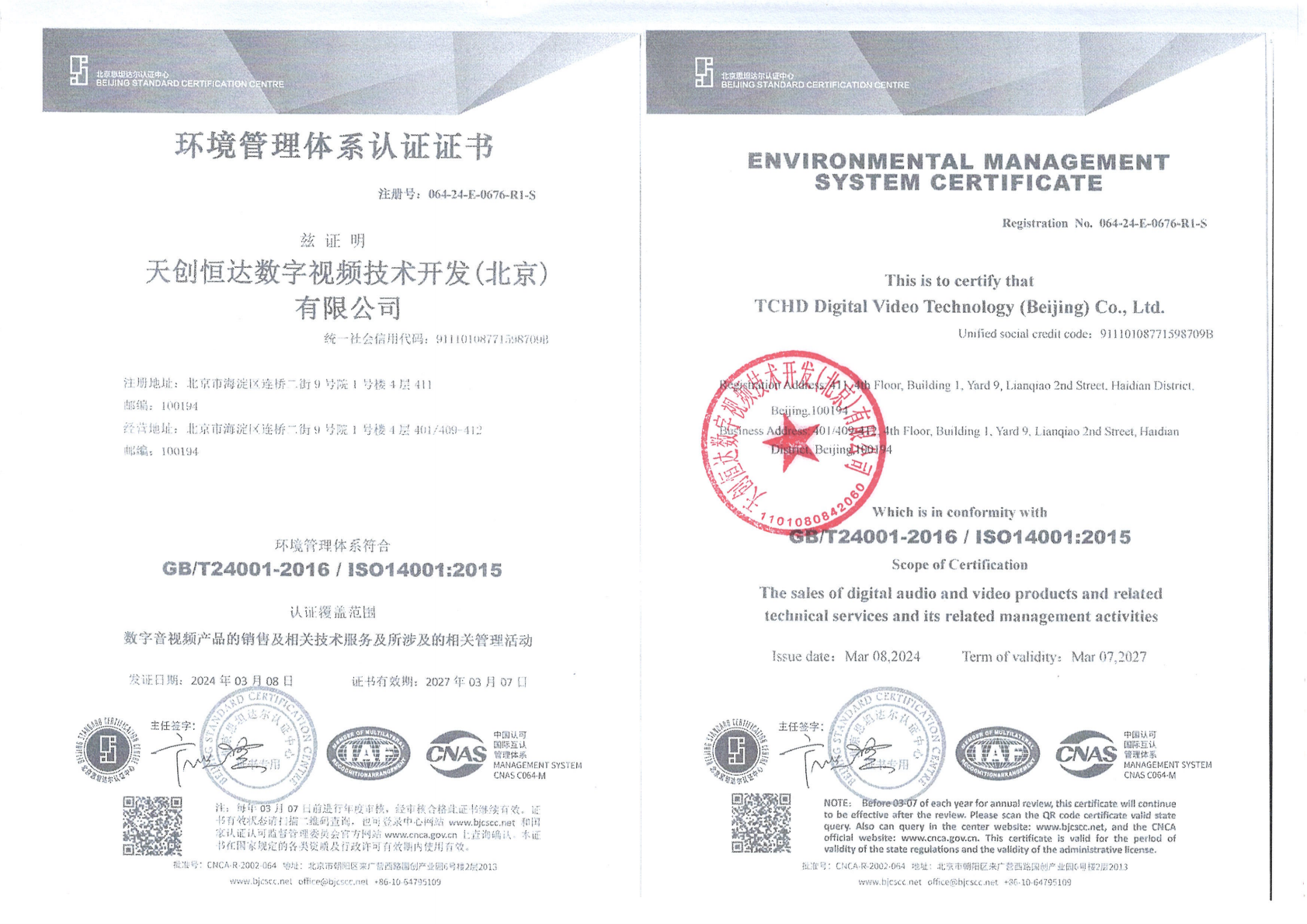
Certificate 064-24-E-0676-R1-S comes from the same issuing body against GB/T 24001-2016 / ISO 14001:2015, with the same issue and expiry dates and the same activity scope. In the TCHD Video record it is listed with TC-980S, and TC420 and TCHD-T3 appear as related products of the same certificate.
Environmental management certification indicates a managed process for the environmental aspects of an organisation's activities. It is requested regularly in EU public tenders and in supplier onboarding by larger integrators. What it is not: a materials declaration. RoHS and REACH documentation is a separate file set, and a management-system certificate cannot stand in for it.
GB/T 45001-2020 / ISO 45001:2018 — occupational health and safety
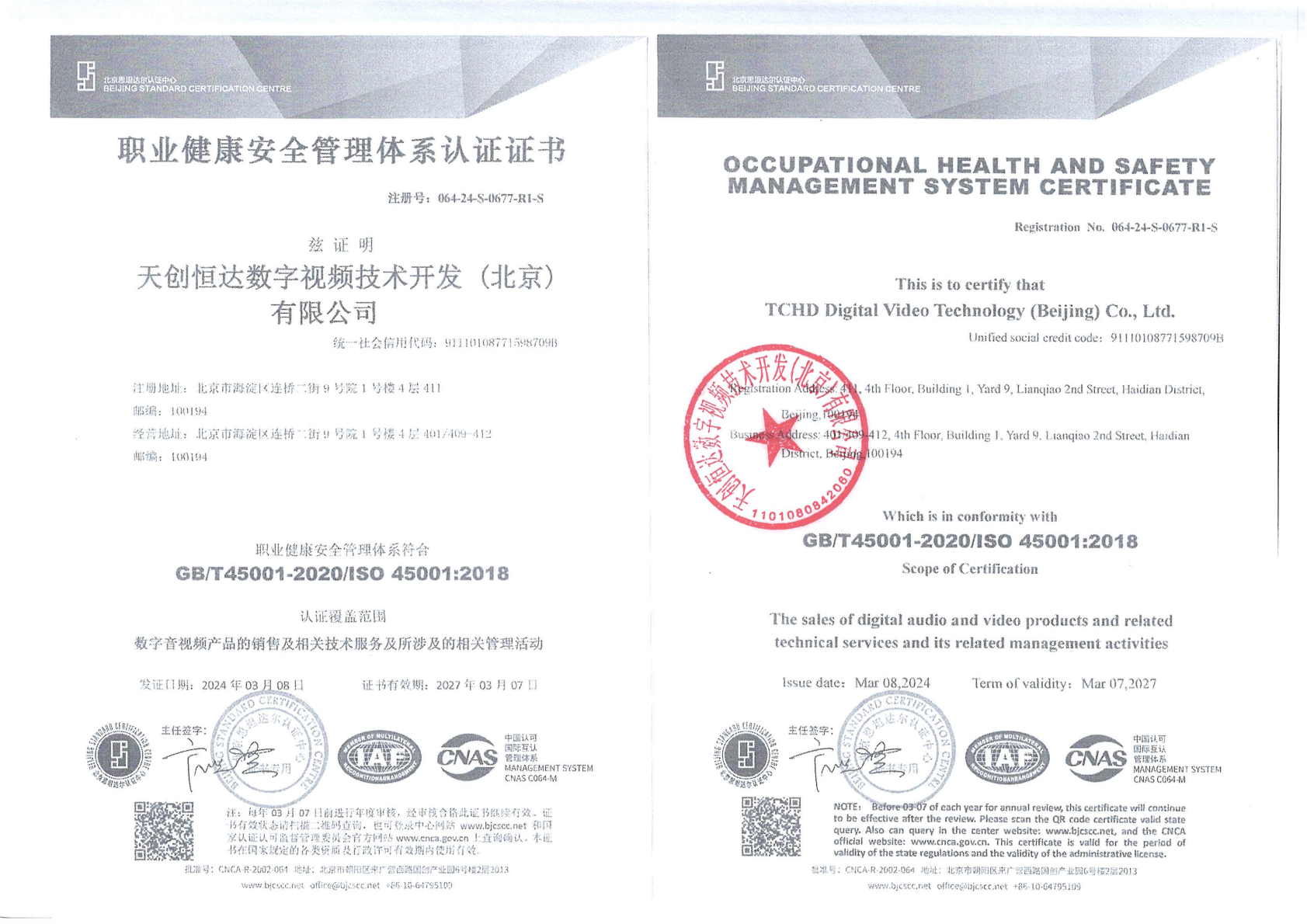
Certificate 064-24-S-0677-R1-S is issued by BEIJING STANDARD CERTIFICATION CENTRE against GB/T 45001-2020 / ISO 45001:2018, on 8 March 2024, valid until 7 March 2027, covering the sales of digital audio and video products and related technical services and its related management activities. The dual GB/T and ISO numbering is normal: GB/T 45001-2020 is the Chinese adoption of ISO 45001:2018, and the document states both.
This is the certificate most often misread. It concerns occupational health and safety management — the supplier's arrangements for worker safety — not the electrical safety of a camera, and certainly not medical-device approval. For a hospital group or public institution running supplier code-of-conduct checks, it is a genuine and relevant credential. For a procurement officer who needs evidence that a unit is safe to mount above a lecture theatre, it is not the document they are looking for.
CE EMC attestation — certificate LCSA07075157E
The CE EMC attestation carries number LCSA07075157E, issued by LCS TESTING LABORATORY on 16 July 2025, citing EN 55032:2015/A1:2020 for emission and EN 55035:2017/A11:2020 for immunity, applicable to the EU market. TC420, TC-980S and TCHD-T3 appear as related products of the certificate.
EMC evidence answers a question that usually surfaces after installation rather than before: does this camera disturb, or get disturbed by, the equipment around it? A PTZ camera sharing a rack with wireless microphone receivers, LED lighting drivers, video switchers or clinical monitoring equipment is exactly the scenario those two standards address. What the attestation does not cover is equally worth stating plainly — electrical safety, RoHS and REACH, radio equipment requirements where wireless modules are involved, FCC authorisation for the United States, and medical-device registration. Those are separate documents and should be requested separately.
One check is easy to skip: the scope line printed on the EMC document itself. Certificates name the products or series they cover, and where a camera appears as a related product rather than as the named subject, the buyer should ask for the scope page and file it with the purchase order. That single page prevents most acceptance disputes later.
Certificate coverage by model
The table summarises what the current records attach to each live streaming camera model. It is a record of certificate numbers, not a statement about product quality.
| Model (product code) | ISO 9001:2015 | ISO 14001:2015 | ISO 45001:2018 | CE EMC |
|---|---|---|---|---|
| TC-980S (6370) | 064-24-Q-0675-R1-S | 064-24-E-0676-R1-S | 064-24-S-0677-R1-S | LCSA07075157E |
| TC420 (6388) | 064-24-Q-0675-R1-S | Listed as related product | 064-24-S-0677-R1-S | LCSA07075157E |
| TCHD-T3 (6394) | 064-24-Q-0675-R1-S | Listed as related product | 064-24-S-0677-R1-S | LCSA07075157E |
| TCHD-X6 (7364) | No number in current record | No number in current record | No number in current record | No number in current record |
Two reading notes. First, where a model is listed as a related product rather than as the named subject, ask for the certificate scope page that names the ordered model and configuration. Second, an entry saying a number is not in the current record means exactly that. It is not evidence that the model is uncertified, and it is not evidence that it is certified. It is a prompt to request the documents before the RFQ closes.
What changes by region — and what buyers should request
Certification questions get complicated because the same camera can face several unrelated requirement types in one shipment. Sorting them prevents a supplier from being asked for a document that does not exist in that form.
European Union. CE marking for a camera typically involves several strands: electromagnetic compatibility, and depending on the product, safety, RoHS and radio requirements if a wireless module is fitted. The attestation in this pack addresses the EMC strand against EN 55032 and EN 55035. Buyers assembling a complete technical file should ask in writing which strands the supplier holds and which it does not, rather than assuming a single EMC attestation carries the whole marking.
United States. The comparable EMC question is usually handled through FCC authorisation for the equipment category, and an EN-standard CE attestation is not a substitute for it. Where the destination is the US, request the FCC documentation for the exact model. The TCHD-X6 record, for example, carries no FCC reference, which means the question must be asked rather than answered from the catalogue.
United Kingdom. Great Britain manages its marking framework separately from the EU. Buyers should confirm with their importer which documentation route applies to the product category at the time of import, since the two frameworks are administered independently and acceptance rules can change.
China and GB/T numbering. The certificates in this pack pair Chinese and international standards — GB/T 19001-2016 with ISO 9001:2015, GB/T 24001-2016 with ISO 14001:2015, GB/T 45001-2020 with ISO 45001:2018. Recognising the pairing stops a reviewer from treating the GB/T reference as an unfamiliar local document when it is the same system standard.
Interoperability standards. A third category exists that is neither EMC nor safety. Public procurement guidance for videoconferencing, such as the 2021 Texas Department of Information Resources standard, expects dedicated room equipment to meet ITU transmission standards — H.320 or H.324 in certain switched-network environments, and H.323 or SIP for internet-based conferencing — so that sites can connect. Camera protocol lists speak to the same layer: TC420 lists RTSP, RTMP, ONVIF, GB/T 28181, RTMPS, SRT and VISCA over IP; TC-980S lists RTSP, RTMP, ONVIF, GB/T 28181 and SRT, with NDI and Dante AV available as options; TCHD-T3 lists TCP/IP, HTTP, RTSP, RTMP, ONVIF, DHCP and multicast. A certificate does not prove a protocol implementation, and a protocol list does not prove compliance; each should be checked for what it is.
Customs classification. Certification and tariff classification are separate processes. The reference schedules place special-purpose television cameras, including CCTV types, under HS 8525.89, with national subdivisions such as 8525.89.40 in some regions. The binding classification is decided by the importing authority, and no certificate pack determines it.
From certificate to purchase order: a seven-step workflow
The workflow below converts a document bundle into procurement controls. It is written for a research-to-evaluation stage buyer who has already shortlisted a model and needs the file to survive an audit.
- Specify by model and destination market. Write the RFQ line as model plus destination country, not as a product category. Request the certificate pack for that model only. A pack issued for a neighbouring model in the same family creates exactly the scope gap described earlier.
- Request scope pages, not just certificate fronts. Ask for the page that names the certified subject and the page that states the standard. Note whether the ordered model is the named subject or a related product.
- Verify number, issuer and validity. For the 064 series in this pack, that means BEIJING STANDARD CERTIFICATION CENTRE, numbers 064-24-Q-0675-R1-S, 064-24-E-0676-R1-S and 064-24-S-0677-R1-S, issued 8 March 2024 and valid to 7 March 2027. For EMC it means LCS TESTING LABORATORY and LCSA07075157E, issued 16 July 2025.
- Match the standard version to the market expectation. EN 55032:2015/A1:2020 and EN 55035:2017/A11:2020 are the versions cited here. Where a tender names a specific edition, check the citation rather than the certificate title.
- Agree the pre-shipment test content in writing. The supplier's capability record states 100% testing; what that test consists of should be pinned down before the order, item by item, so that acceptance is a checklist rather than an opinion.
- Fix the delivery term and the document handover. The agreed Incoterm changes who pays freight and where risk transfers — on FOB the buyer's position changes at the named port of shipment, while on C&F the seller arranges and pays carriage to the named destination port, with risk still transferring at shipment. Neither term changes what a certificate says, but both change who is holding the file when a broker asks for it.
- Diary the expiry dates. The 064 series certificates run to 7 March 2027. A purchase order placed close to a renewal date should confirm whether a renewed certificate will be issued and request it at handover.
Acceptance testing, delivery terms and the one-unit pilot
Certification review and acceptance testing are complementary, and neither replaces the other. The certificate tells you what was assessed at the model level; the acceptance test tells you what arrived.
Because the recorded minimum order quantity is one unit, a buyer can run a pilot before committing to a project quantity. That pilot is the cheapest place to close the documentation question, and it should be scheduled deliberately. Useful items to agree in advance include: functional verification of every output the project will use — HDMI, SDI, LAN or USB depending on the model; a PTZ preset recall and speed check; autofocus and tracking behaviour under the lighting the venue actually has; audio input verification on the 3.5 mm line input where relevant; firmware version recording against the unit serial number; a power-on soak period; and a packaging inspection that includes the accessories shipped.
Commercial terms matter here too. The recorded lead time is 30 to 45 days, monthly capacity is stated at 500 units, OEM/ODM cooperation with logo customisation is available, and after-sales support is handled remotely. For a distributor assembling a launch order, those four numbers determine whether a certification-driven delay becomes a launch delay. For a single pilot unit, they mean the documentation review can run in parallel with production rather than after it.
Finally, keep the file together. A purchase order that references a certificate number, a scope page, an agreed test list, an Incoterm and a validity date is auditable. The same order with a folder of PDFs and no cross-reference is not, and it will be reopened at the first dispute.
Use cases: how the requirement changes by project
The certificate set a buyer needs depends less on the camera than on who is signing acceptance.
Education and lecture capture. Institution procurement teams usually start with the quality management certificate and the EMC attestation, then add RoHS and REACH declarations as a separate request. Integration questions follow: an ONVIF or RTSP path into a recording platform is checked against the protocol list, not against the certificate. TC-980S, with 12X, 20X and 30X optical zoom variants listed, is the model in this catalogue with the fullest documented set — quality, environmental, occupational health and EMC.
Medical teaching and clinical imaging. Here the EMC document earns its place, because the camera shares an environment with monitoring equipment. It is also where misreading is most costly: an occupational health and safety certificate is not a medical-device approval, and application language is not registration. TCHD-X6 lists medical imaging among typical application scenarios and TC420 is described as a medical training camera, but in markets where a camera used in clinical settings is regulated as a medical device, separate registration applies and must be confirmed with the supplier in writing.
Events, church streaming and rental fleets. Rental operators standardise on one model so a single documentation set covers the fleet. In that context, verifying that every unit in a mixed order carries the same model-level documents prevents the situation where eight cameras clear an internal audit and two do not.
Distributors and OEM buyers. A distributor stocking several models needs a documentation matrix rather than a folder, which is exactly what the table above represents. Where logo customisation is part of the agreement, confirm that the certificate reference remains valid for the customised unit and record the scope page with the OEM specification.

FAQ
CE certified live streaming camera manufacturers
A CE EMC attestation is model-specific, so the question is not whether a manufacturer is 'CE certified' but which models have documented EMC evidence and against which standards. In TCHD Video's records, TC420 (product code 6388) and TC-980S (product code 6370) are documented under certificate LCSA07075157E, issued by LCS TESTING LABORATORY on 16 July 2025, citing EN 55032:2015/A1:2020 and EN 55035:2017/A11:2020 for the EU market. TCHD-T3 is listed as a related product of the same certificate. Always confirm that the certificate's scope line names the model and configuration being purchased.
Do the ISO 9001, ISO 14001 and ISO 45001 certificates certify the camera itself?
No. They certify management systems. The recorded scope for all three is the sales of digital audio and video products and related technical services and its related management activities, issued by BEIJING STANDARD CERTIFICATION CENTRE under numbers 064-24-Q-0675-R1-S, 064-24-E-0676-R1-S and 064-24-S-0677-R1-S, issued 8 March 2024 and valid until 7 March 2027. They support supplier qualification, tender responses and code-of-conduct checks. Product-level questions about electromagnetic behaviour belong to the EMC attestation, and safety, RoHS or medical registration require separate documents.
Which TCHD Video models have certificate numbers on record, and which do not?
TC-980S is recorded against ISO 9001:2015, ISO 14001:2015, ISO 45001:2018 and CE EMC certificate LCSA07075157E. TC420 is recorded against ISO 9001, ISO 45001 and the CE EMC certificate. TCHD-T3 is recorded against ISO 9001, ISO 45001 and appears as a related product of the EMC certificate. The current specification record for TCHD-X6 does not include CE, FCC or ISO certificate numbers or test report references — a documentation status that should be resolved by requesting the current documents for that model, not by assuming either compliance or non-compliance.
What do MOQ and lead time look like for a certification-driven order?
The recorded minimum order quantity is one unit, with a lead time of 30 to 45 days, monthly capacity stated at 500 units, and OEM/ODM cooperation with logo customisation available. For a buyer whose compliance review is still open, the one-unit minimum is the practical lever: it allows a pilot unit to be tested and documented while the wider order is still being negotiated. Quotation values depend on configuration and volume and should be obtained per model rather than estimated from a category average.
Can a single unit be purchased and tested before a project order?
Yes — the one-unit minimum supports exactly that workflow, and the capability record states 100% testing as the quality-control approach. Agree the test items in writing first: which outputs to verify, PTZ preset recall, autofocus and tracking behaviour in the venue's lighting, audio input, firmware version against serial number, and packaging contents. Then align delivery terms with the pilot: on FOB or C&F the risk-transfer point and freight responsibility differ, so the Incoterm should be named in the quotation before the unit ships. The current certificate pack, the scope pages and the 2025 product catalogue can be requested together by contacting TCHD Video through www.tchdvideohk.com.
Conclusion
A live streaming camera compliance file is only as useful as the reading applied to it. The ISO 9001:2015, ISO 14001:2015 and ISO 45001:2018 certificates in this pack establish that a documented management system exists behind the sales and technical-service activities, with a stated validity window ending on 7 March 2027. The CE EMC attestation LCSA07075157E adds product-level electromagnetic evidence against EN 55032:2015/A1:2020 and EN 55035:2017/A11:2020 for the models it names. Neither family proves the other, and neither replaces an FCC authorisation, a RoHS declaration, a protocol test or a medical registration where one is required.
The practical discipline is narrow and repeatable: specify by model and destination, request scope pages, verify numbers, issuers and dates, agree the pre-shipment test items, fix the Incoterm and the document handover, and diary the renewal date. Buyers who do that can order from a catalogue where documentation coverage genuinely varies — TC-980S with the full set, TC420 and TCHD-T3 with the quality, occupational health and EMC references, TCHD-X6 with none recorded yet — without either overstating what they hold or dismissing a model for the wrong reason.
The 2025 TCHD Video product catalogue, including live streaming cameras and related video equipment, can be downloaded here for model and interface reference.
Have Questions or Need More Details?
Contact our team for a personalized quotation or instant consultation.
Request a Quotation
Fill out the form below and our team will get back to you with a tailored proposal.
WhatsApp Direct Chat
Prefer to chat in real-time? Message us on WhatsApp for instant assistance & quick answers.
- Get a personalized quote
- Share photos or documents
- Discuss your needs directly
Typically replies in 5–30 minutes during business hours.