Production Switcher Guide: Choosing a Live Stream Switcher
A production switcher is the hardware that takes multiple camera, computer and remote feeds and combines them into one program output — live, in real time, and ready for broadcast or online streaming. Buyers who are still discovering this category run into the same wall: every specification sheet lists ports, formats and protocols, but none of them answers the only question that matters at this stage — which configuration matches the production you actually run.
This guide is written for importers, distributors, system integrators and in-house technical teams evaluating a production switcher for the first time. It explains what the equipment does, why selection usually goes wrong, which criteria decide the purchase, and how a live stream switcher lineup maps to real productions such as church streaming, e-commerce live selling, lecture recording, esports tournaments and outdoor events.
TCHD Video, the trading name of TCHD Digital Video Technology Development (Beijing) Ltd, is a Beijing-based manufacturer of video hardware and application systems, established in 2005. Its range covers live streaming cameras, video capture cards, converters, encoders and live stream switchers. That lineup is used here as the reference set, because the models span a wide range of input, streaming and recording configurations and make the selection criteria easier to see.
The Real Problem: Switchers Are Sold by Port Count and Bought by Workflow
Terminology is the first obstacle. "Production switcher", "live stream switcher", "video mixer" and "vision mixer" are frequently used as synonyms, yet the equipment behind those labels is not always equivalent. A traditional broadcast switcher assumes an SDI infrastructure, a dedicated control room and a separate encoder downstream. A modern live stream switcher is expected to switch, mix audio, record and publish to several online platforms from a single chassis.
The second problem is that product pages advertise port counts without describing the workflow behind them. Knowing that a unit has four inputs is useful; knowing whether those inputs accept 12G-SDI, HDMI 2.0 or NDI determines whether existing cameras can be connected without converters, and whether the same switcher can serve a broadcast camera chain and a laptop presentation in the same show.
Three costs are consistently underestimated at the discovery stage:
- Hidden accessories. A switcher without a native UVC output usually needs an external USB capture card before a computer can receive the program feed, which adds hardware, cabling and a failure point.
- Single-platform limitation. A unit that can only push to one streaming address forces operators to add software or hardware when the same event must reach several platforms at once.
- Audio and recording. When audio mixing channels or recording storage are treated as afterthoughts, the production ends up with an external mixer and a separate recorder, and with a second set of sync problems.
The decision problem in one sentence: a production switcher should be chosen by the number and type of sources it must accept, the destinations it must feed, the audio it must balance and the recording it must keep — not by the number of ports printed on the box.
Where Production Switchers Fit in Today's Live Video Workflow
Live video production has moved from a single broadcast chain to a converged workflow in which one program feed is expected to serve a broadcast output, an in-room screen, a recorded file and several online platforms at the same time. Hardware switchers have followed that shift by absorbing functions that used to be separate devices: streaming encoders, audio mixers, recording decks and multi-view monitoring.
Two technical changes are widely visible in this category. First, embedded FPGA hardware architectures let switching, keying and encoding run without a general-purpose operating system, which removes many of the failure modes associated with PC-based setups. Second, IP-based transports such as NDI and protocols such as SRT and RTMP have become standard options, so switchers are increasingly purchased as network devices rather than purely SDI or HDMI devices.
A third change is format diversity. Vertical 9:16 delivery for social and mobile audiences now runs alongside 16:9 production, and equipment that can only operate in one orientation forces an additional conversion step or a second device into the signal chain.
Manufacturing has shifted with the workflow. TCHD Video, for example, was founded in 2005 and today operates from a 10,000 m² facility with approximately 50 employees, including an R&D team of 10 engineers, supplying video hardware to markets in the EU, the USA and Asia. Because the company develops switchers, cameras, capture cards and converters inside the same product ecosystem, the switcher line is designed alongside the devices that feed it — which is how a live stream switcher ends up with native camera-side interfaces instead of a single legacy port type.
What to Look For in a Production Switcher: Seven Capability Blocks
Any specification sheet can be reduced to seven capability blocks. Each one answers a question that decides whether the unit fits the production.
1. Input capacity and interface mix
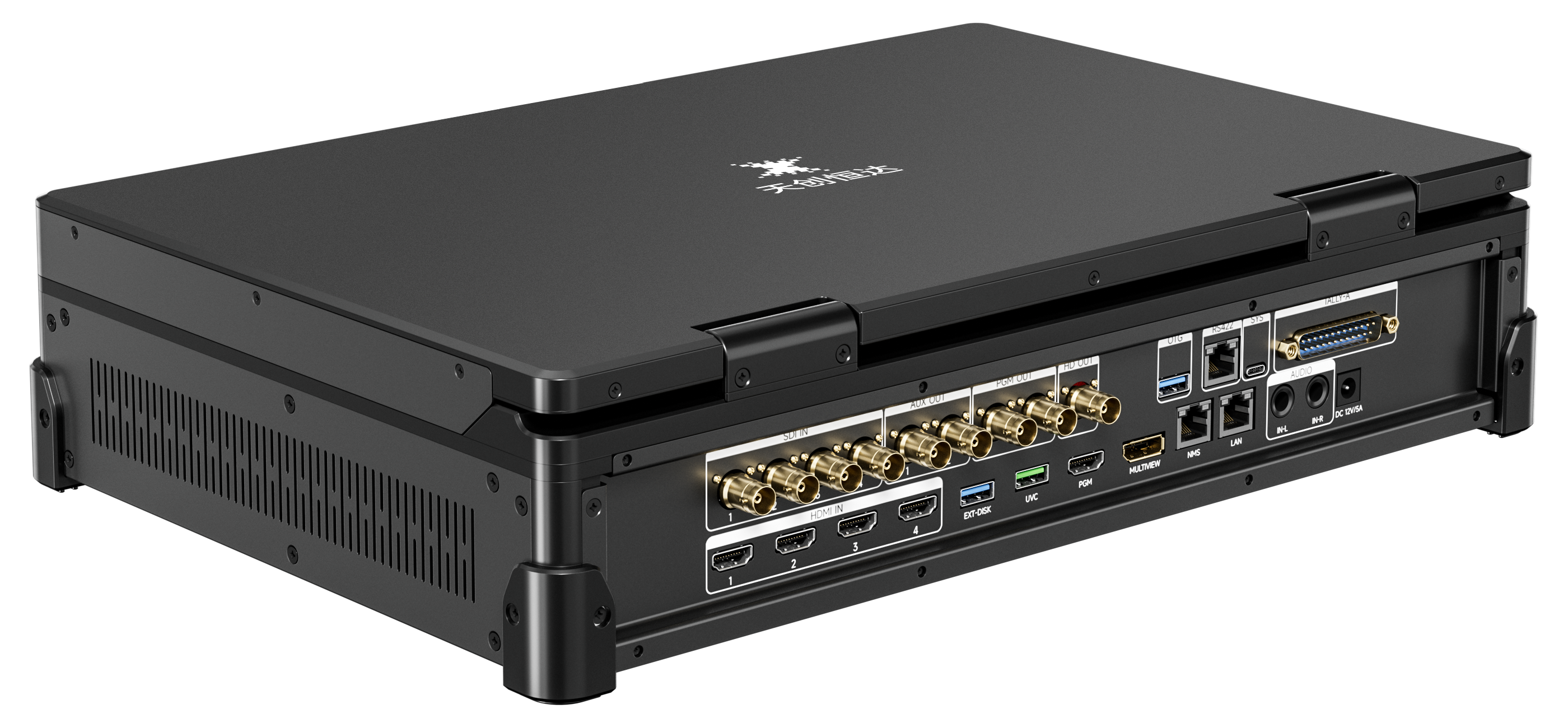
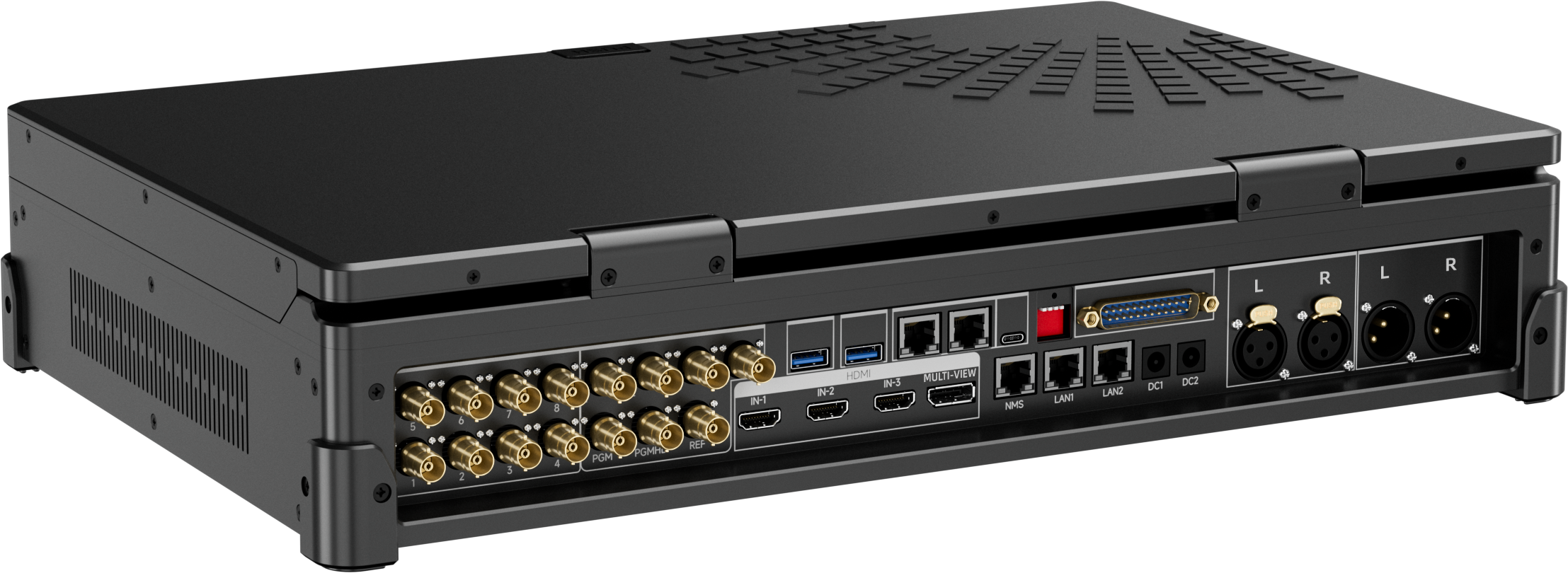
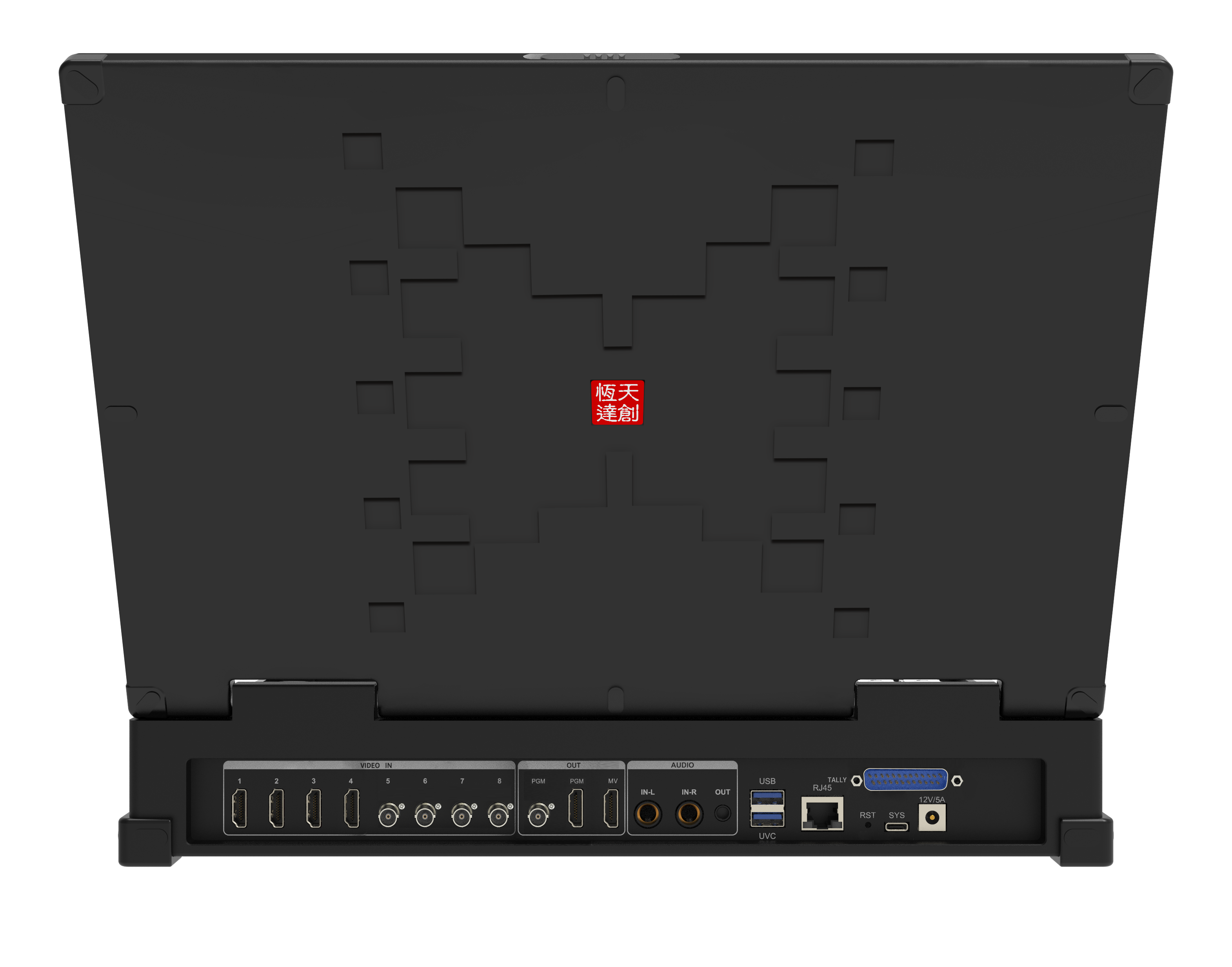
The first question is how many sources the switcher accepts and in which electrical format. On the TCHD-840 Super and TCHD-840 Ultra, the input stage is configured as four or more 12G-SDI inputs (compatible with 3G-SDI) or four or more HDMI 2.0 inputs, so one chassis can serve either a broadcast camera chain or a consumer-device chain. The TCHD-840 Pro takes a different route with four channels of 4K HDMI and NDI hybrid input, supporting 1×4K60, 2×4K30 and 4×1080P decoding modes. The TCHD-890HS provides eight video input channels — four HDMI plus four SDI — and the TCHD-810 Pro combines four HDMI ports (two of them supporting 4K60P ultra HD input) and four SDI ports with one USB auxiliary input, giving five usable channels.
2. Signal format and frame-rate handling
A switcher that cannot pass the native frame rate of the cameras forces conversion somewhere in the chain. The TCHD-840 Super and TCHD-840 Ultra support 2160p at 60, 59.94, 50, 30, 29.97 and 25, 1080p at the same rates, and 1080i at 60 and 50. The TCHD-812 handles 4K at 60 Hz together with 1080p and 1080i, and the TCHD-890HS covers HD formats including 720p, 1080p and 1080i.
3. Outputs and plug-and-play UVC
Output configuration decides how the program feed reaches its destinations. The TCHD-840 Ultra provides 2×12G-SDI PGM, 2×12G-SDI AUX, 1×3G-SDI PGM down-converted, 1×HDMI 2.0 PGM, 1×DisplayPort multi-view and 1×UVC output, plus 1×6.5 mm balanced audio output, 1×RS422, 2×RJ45, 1×TALLY, 1×OTG and 1×USB 3.0. A native UVC output matters more than it appears: the switcher is recognised by a computer as a standard webcam, so no external capture card or driver installation is required and mainstream streaming, meeting and recording software can use the feed directly. The TCHD-840 Pro implements the same idea through a Type-C UVC output, and the TCHD-890HS provides a UVC USB-A output alongside 1×HDMI 1.4 (PGM + Multiview), 1×SDI PGM, a 1000 Mbps RJ45 LAN port and a Tally interface.
4. Streaming engine and multi-platform publishing
For most buyers this block decides whether the switcher replaces an encoder or requires one. The TCHD-840 Ultra integrates streaming encode and decode supporting RTMP, RTMPS, SRT, RTSP, UDP and NDI, with one channel of stream reception and four channels of simultaneous publishing to different platforms, managed through template-based pull-stream and live-stream URL settings. The TCHD-812 and TCHD-812 Ultra use a hardware streaming engine supporting RTMP, RTMPS, SRT, RTSP, NDI and GB28181 with synchronous publishing to four platforms. The TCHD-840 Pro covers RTMP, RTMPS, SRT, UDP, RTP, HLS and WHIP with H.264 and H.265 hardware encoding and four simultaneous platform outputs. The TCHD-890HS supports up to six simultaneous streaming outputs — four customizable stream addresses, one NDI stream and one NVI stream — and can receive up to eight streaming sources at the same time across RTMP, RTSP, HLS, FLV, UDP, NDI and NVI.
5. Audio management
Audio is where low-cost switchers usually fall short. The TCHD-890HS carries a 10-channel audio mixer with independent channel gain control and per-channel on, off and restore-default options, a balanced stereo analog input on 6.35 mm and a 3.5 mm headphone output, with audio levels from -60 dB to 6 dB, 48 kHz sampling and AAC encoding, plus analog input delay adjustable up to 2000 ms. The TCHD-812 and TCHD-812 Ultra use a 12-channel audio mixer with independent volume control and up to 2000 ms delay adjustment, which keeps lip sync intact when IMAG screens or IP links add latency. The TCHD-840 Pro mixes HDMI embedded audio, NDI audio, DDR playback audio and external microphone audio with 0–10000 ms delay tuning, while the TCHD-840 Ultra places physical rotary-knob gain control for each input channel directly on the control panel.
6. Recording and media playback
Recording is often a compliance requirement rather than a convenience. The TCHD-812 and TCHD-812 Ultra offer dual hot-swappable SSD slots with optional 2TB, 4TB or 8TB storage, supporting 4K H.265 and HD H.264 high-bitrate recording, with power-off protection and automatic file segmentation so that material survives an unexpected shutdown. The TCHD-890HS records to an internal SSD or a USB 3.0 drive in MP4, TS and AVI formats, with PGM recording bitrate configurable from 1 to 20 Mbps and multi-channel recording from 1 to 8 Mbps on SSD, and can play MP4 and MKV (H.264) files from a USB flash drive or internal SSD as filler video. The TCHD-840 Super and TCHD-840 Ultra provide a built-in M.2 slot or drive bay for local storage and file import.
7. Operations, layout and on-air safety
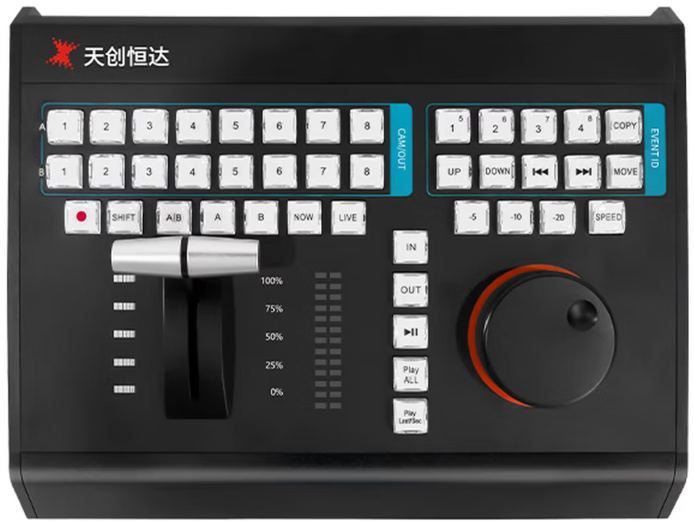
The final block covers what the operator actually touches during the show. One-click or one-touch switching between landscape 16:9 and portrait 9:16 production modes appears across the TCHD-840 Pro, TCHD-840 Super, TCHD-840 Ultra, TCHD-812 and TCHD-812 Ultra families. PIP and multi-view templates range from the 1-2-3-4 window layouts of the TCHD-840 Super and TCHD-840 Ultra to the 8-layer PGM overlay plus two croppable and scalable PIP channels of the TCHD-810 Pro. Chroma key and luminance key functions support virtual studio backgrounds. Transition libraries include more than 30 effects on the TCHD-810 Pro and 36 or more on the TCHD-840 Pro, and emergency functions such as fade-to-black and colour-bar output give the operator a defined fallback state. Control can be local through the panel, remote through a web browser, or handled by a dedicated control surface: the TC-UV08 broadcast control panel provides 42 dual-colour crystal keys, 8 channel shortcut keys, a third-generation damping search knob and a streamlined photoelectric T-bar, with -5s, -10s and -20s mark buttons, communicating over MIDI, USB, RS232 or LAN and compatible with vMix, FairPlay and TCLiveSP software. Local monitoring is built in on several models — a 10.1-inch full HD screen on the TCHD-810 Pro, a 17.3-inch full HD screen on the TCHD-812 Ultra and a main display of 15.6 inches or more on the TCHD-840 Ultra — and aluminium alloy housings are used across the range.
Step-by-Step: Specifying a Live Stream Switcher for Your Production
The following sequence turns the seven capability blocks into a specification. It is the order in which a switcher decision should be taken, because each step narrows the shortlist rather than adding features.
- Count sources, then add two. List every camera, computer, PTZ head and remote feed that will be live at once. A campus TV channel, a church service and an esports final rarely use the same number of sources, and the TCHD-890HS (eight channels) versus the TCHD-810 Pro (five channels including one USB auxiliary input) shows how much this single number changes the product class.
- Match input interfaces to the cameras you own. If the camera chain is broadcast-grade, 12G-SDI inputs on the TCHD-840 Super, TCHD-840 Ultra, TCHD-812 or TCHD-812 Ultra avoid converters. If the chain mixes camcorders, laptops and NDI sources, an HDMI 2.0 and NDI hybrid input design such as the TCHD-840 Pro removes the converter layer entirely.
- Define every output destination. Separate the outputs that go to people (PGM to a screen or broadcast feed) from the outputs that go to machines (UVC to a computer, or IP streams to platforms). Confirming G-shaped requirements such as AUX outputs, a down-converted 3G-SDI feed, multi-view for the technical director and Tally for camera operators prevents a late-stage redesign.
- Map audio sources and delay. Count microphones, embedded HDMI audio and playback audio, then confirm the mixer channel count and the delay range. A 10-channel mixer with up to 2000 ms delay covers small crews; a 12-channel mixer with independent channel control suits larger events where a separate audio position is impractical.
- Decide recording and redundancy. Choose between single internal SSD or USB 3.0 recording and dual hot-swappable SSD recording with power-off protection and automatic file segmentation, depending on whether the recording is a convenience or the deliverable.
- Check orientation, layout and operator skill. Confirm one-click landscape and portrait switching, the number of PIP and multi-view templates, keying functions and emergency output. Then confirm who operates the unit: a set-and-forget panel, a remote web interface, or a dedicated control surface such as the TC-UV08.
- Validate the configuration before committing. Confirm the exact input and output configuration against the current specification, request a sample unit for a test production, and verify the streaming protocols against the platforms you will actually publish to.
Use Cases: Which Configuration Fits Which Production
The same switching core serves very different productions, but the configuration pressure differs by scenario. The list below maps common requirements to the capability blocks described above.
- Church streaming switcher. Usually four to six sources, one or two streaming platforms, volunteer operators and a strong need for audio control and simple emergency output.
- E-commerce live stream switcher. Product cameras, presenter cameras, graphic overlays and a vertical 9:16 output, with multi-platform publishing and local recording for archive and compliance.
- Lecture recording switcher, smart classroom switcher and campus TV switcher. Mixed HDMI and SDI sources, PTZ camera control, scheduled recording with file segmentation and compatibility with mainstream conferencing and recording software through UVC.
- Conference streaming switcher and converged media center switcher. Multiple simultaneous outputs, AUX feeds to in-room screens, balanced audio, and Tally for camera positions.
- Sports event stream switcher and esports tournament stream switcher. Multi-camera switching with a control surface, high frame-rate handling, and slow-motion replay support through the TC-UV08 panel's search knob and mark buttons.
- Concert and performance stream switcher, entertainment live stream switcher. Heavy use of transitions, keying, graphics layers and filler media playback between acts.
- Outdoor live stream switcher and vehicle-mounted relay. Industrial embedded hardware instead of a PC, rugged aluminium alloy construction and a compact operational footprint.
- Vertical portrait live stream switcher. One-click 16:9 and 9:16 switching for mobile-first audiences without re-rigging the camera chain.
- Surgical live-demo switcher and medical teaching. Mixed high-resolution sources, precise audio control, recording and support for healthcare and industrial vision environments.
- Virtual studio switcher. Chroma key and luminance key functions with layered overlays for virtual sets.
- Broadcast-grade 12G-SDI switcher and HDMI 2.0 switcher procurement. Selecting the same chassis with either 12G-SDI or HDMI 2.0 input stages so that the facility standard and the switcher interface stay aligned.
Production Switcher Comparison: The TCHD Live Stream Switcher Lineup
The table below summarises the published specifications of the TCHD live stream switcher family. A dash means the available specification does not state that value. Configurations should always be confirmed with the manufacturer before ordering, because input stages and storage options are selectable on several models.
| Model | Signal inputs | Max signal format | UVC output | Multi-platform streaming | Recording | 16:9 / 9:16 | Local display |
|---|---|---|---|---|---|---|---|
| TCHD-810 Pro | 4× HDMI (2× support 4K60P) + 4× SDI, optional mixed use of 4 ports; 1× USB auxiliary input (5 channels) | 4K60P input on 2 HDMI ports | — | — | — | One-click switching; PTZ control up to 4 cameras | 10.1-inch full HD |
| TCHD-890HS | 4× HDMI + 4× SDI (8 channels) | 1080p / 1080i / 720p | USB-A UVC output | Up to 6 simultaneous outputs (4 stream addresses + NDI + NVI); receives up to 8 sources | Internal SSD or USB 3.0; MP4 / TS / AVI; PGM 1–20 Mbps | Landscape 16:9 and portrait 9:16 | Built-in full HD screen |
| TCHD-840 Pro | 4-channel 4K HDMI + NDI hybrid input | 1×4K60 / 2×4K30 / 4×1080P decoding modes | Type-C UVC | 4 platforms; RTMP, RTMPS, SRT, UDP, RTP, HLS, WHIP | Multi-format segmented USB recording | One-click 16:9 / 9:16 | — |
| TCHD-840 Super | ≥4× 12G-SDI (3G-SDI compatible) or ≥4× HDMI 2.0 | 2160p60 to 1080i | Yes | RTMP, RTMPS, SRT, RTSP, UDP, NDI; 1-in, 4-out with URL templates | Built-in M.2 slot | One-click 16:9 / 9:16 | — |
| TCHD-840 Ultra | ≥4× 12G-SDI or ≥4× HDMI 2.0 | 2160p60 to 1080i | Yes | 1 receive + 4 push; RTMP, RTMPS, SRT, RTSP, UDP, NDI | Built-in M.2 drive bay | One-touch 16:9 / 9:16 | ≥15.6-inch main display |
| TCHD-812 | 4× 12G-SDI + 1× HDMI | 4K@60Hz / 1080p / 1080i | Yes | 4 platforms; RTMP, RTMPS, SRT, RTSP, NDI, GB28181 | Dual hot-swap SSD (2TB / 4TB / 8TB optional); 4K H.265 and HD H.264 | One-click 16:9 / 9:16 | — |
| TCHD-812 Ultra | 4× 12G-SDI + 1× HDMI | 4K@60Hz / 1080p / 1080i | Yes | 4 platforms; RTMP, RTMPS, SRT, RTSP, NDI, GB28181 | Dual hot-swap SSD (2TB / 4TB / 8TB optional); 4K H.265 and HD H.264 | One-click 16:9 / 9:16 | 17.3-inch full HD |
FAQ: Production Switchers and Live Stream Switchers
Who are production switcher manufacturers, and what should a buyer check first?
A production switcher manufacturer is a company that designs and builds the switching hardware itself, rather than reselling a finished unit under a different label. Buyers evaluating manufacturers should check four things in order: whether the product line covers the interfaces their cameras use, whether the streaming and recording functions are built in or require add-on devices, whether the hardware architecture is a dedicated embedded design, and whether the company can adapt a configuration to their requirements. TCHD Video is an example of a manufacturer in this category: established in 2005 in Beijing, with a 10,000 m² facility, approximately 50 employees and a 10-engineer R&D team, it builds live stream switchers alongside live streaming cameras, capture cards, converters and encoders, and states that it can customise and develop products according to different customer needs.
What should be verified before buying a switcher for multi-platform streaming?
Three items decide whether multi-platform publishing works in practice. First, the protocol list — the TCHD-812 supports RTMP, RTMPS, SRT, RTSP, NDI and GB28181, the TCHD-840 Pro supports RTMP, RTMPS, SRT, UDP, RTP, HLS and WHIP, and the TCHD-840 Ultra supports RTMP, RTMPS, SRT, RTSP, UDP and NDI. Second, the number of simultaneous destinations — four simultaneous platform outputs on the TCHD-840 Pro, TCHD-840 Ultra, TCHD-812 and TCHD-812 Ultra, and up to six simultaneous streaming outputs on the TCHD-890HS. Third, whether stream addresses can be stored as templates, which makes switching between regular weekly productions faster and less error-prone.
Do these switchers need an external capture card to work with a computer?
No. The TCHD-840 Pro, TCHD-840 Super, TCHD-840 Ultra, TCHD-812, TCHD-812 Ultra and TCHD-890HS all provide a native UVC output. When the switcher is connected to a computer it is recognised as a standard webcam, so it works with any software that can use a webcam, with no driver installation and no external USB capture card. The TCHD-840 Pro uses a Type-C UVC output and is compatible with OBS and Zoom; the TCHD-890HS provides a UVC USB-A output alongside HDMI, SDI, LAN and Tally interfaces. This reduces both the cost and the number of failure points in a live setup.
Can one switcher handle both horizontal and vertical live production?
Yes, on the models that include orientation switching. The TCHD-840 Pro, TCHD-840 Super, TCHD-840 Ultra, TCHD-812 and TCHD-812 Ultra all support one-click or one-touch switching between landscape 16:9 and portrait 9:16 production modes, and the TCHD-890HS supports both landscape and portrait operation modes. This allows a single unit to serve a broadcast-style horizontal program and a vertical mobile-first program without re-rigging the camera chain or adding a second switcher.
What certifications support the product line, and how can a sample or quote be requested?
Certification evidence is strongest for the live streaming camera line rather than the switchers: the TC-980S live streaming camera holds CE EMC certification against EN 55032:2015/A1:2020 under Attestation of Compliance LCSA07075157E, issued by LCS TESTING LABORATORY on 2025-07-16, and ISO 9001, ISO 14001 and ISO 45001:2018 certification; ISO 9001 and ISO 14001 also cover the TC420 and TCHD-T3 live streaming cameras, with ISO 14001 certificate number 064-24-E-0676-R1-S issued by BEIJING STANDARD CERTIFICATION CENTRE and valid from 2024-03-08 to 2027-03-07. Buyers who need compliance documentation for a specific model should request it for that exact model number. For evaluation, TCHD Video accepts sample and quotation requests: samples can be arranged for a test production, and a full product catalogue is available for download.
Next Step: From Shortlist to Sample
The practical path from discovery to purchase is short once the criteria are fixed. Write down the source count, the interface types, the output destinations, the audio channels, the recording requirement and the orientation, and match that list against the lineup above. In most projects one model will match on six of the seven blocks, and the remaining block is the one worth discussing with the manufacturer before ordering.
Because several TCHD switchers are offered with selectable input stages — 12G-SDI or HDMI 2.0 on the TCHD-840 Super and TCHD-840 Ultra, and optional 2TB, 4TB or 8TB SSD storage on the TCHD-812 and TCHD-812 Ultra — the final specification should be confirmed rather than assumed from a general product page.
Evaluate a TCHD live stream switcher on your own production
Request a sample unit for a test production, ask for a configuration quotation, or review the full range in the catalogue. TCHD Video supports importers, distributors and system integrators with specification confirmation and customization according to customer needs.
Website: www.tchdvideohk.com | Catalogue: TCHD Product Catalog 2025 (PDF)
Email: tomzhang@tchdvideo.com | Tel: +86-13910334207 | WhatsApp: +86 19498872019
Address: Room#411, Building#1, Yard#9, Lianqiao 2nd street, Haidian district, Beijing, China
Have Questions or Need More Details?
Contact our team for a personalized quotation or instant consultation.
Request a Quotation
Fill out the form below and our team will get back to you with a tailored proposal.
WhatsApp Direct Chat
Prefer to chat in real-time? Message us on WhatsApp for instant assistance & quick answers.
- Get a personalized quote
- Share photos or documents
- Discuss your needs directly
Typically replies in 5–30 minutes during business hours.