
Tablet Live Streaming with a 4K Capture Card: Solving the Missing HDMI Input Problem
A 4K mirrorless camera, a game console, a switcher output, a medical video source — almost every high-quality video signal leaves its device over HDMI. An Android or iOS tablet, however, will not accept that signal, because tablets are built without HDMI input. That single missing port is why so many tablet-first creators still end up carrying a laptop into the field, or settle for the tablet's built-in camera instead of the lens they actually wanted to use. The TC-UB620 USB 4K Capture Card from TCHD Video is designed around exactly that gap: it takes an HDMI source and republishes it over USB 3.2 Gen 2 Type-C as a standard UVC video device and UAC audio device, which a tablet, laptop or desktop already knows how to open.
This article explains the problem in device terms, then works through how the TC-UB620 solves it — UVC/UAC plug-and-play with no drivers on Windows, Android, Linux, iOS or macOS, 4K60 capture in NV12 over USB 3.2 Gen 2, HDMI 2.1 pass-through for confidence monitoring, and a 3.5mm mic/line input for audio mixing in live production. It also covers a step-by-step setup, the live streaming scenarios where an HDMI-to-tablet path changes the workflow, a comparison table of tablet requirements against capture card capabilities, and the compliance facts buyers should verify before placing an order.
Why Tablets Have No HDMI Input — and Why That Stops Live Production
A tablet is a host device and a display device, not a video capture device. Its USB-C or Lightning port is designed for charging, data transfer and class-compliant peripherals such as storage, audio interfaces, keyboards and USB cameras. Where a tablet can drive an external display, that HDMI path runs outward, from the tablet to a monitor; there is no inward HDMI path for a camera or console to feed. Nothing in the tablet's architecture decodes an HDMI stream, and mobile operating systems do not permit the kind of low-level driver installation that a desktop capture card depends on.
The practical consequence is that the tablet has to be handed a device class it already understands. UVC, the USB Video Class, is that class: it is the standard that allows capture cards to function as plug-and-play webcams without proprietary drivers, a mechanism documented in Elgato's own glossary of capture terminology. UAC, the USB Audio Class, does the same job for audio. Any HDMI-to-tablet workflow therefore depends on one device performing three jobs at once: receive HDMI, convert it into a USB class-compliant stream, and present itself to the tablet as both a camera and an audio input.
Creators usually try three workarounds before adding a capture card. The first is the tablet's own camera, which fixes the lens and sensor and rules out long-lens product shots or tight shallow-depth framing. The second is wireless screen mirroring from a phone or camera app, which inserts an encode-decode round trip into the signal path and hands compression decisions to software the operator does not control. The third is tethering a laptop, which restores HDMI input but adds a second computing device, a second battery and a second failure point to a rig that was supposed to stay tablet-light.
Industry Background: How USB Capture Cards Became the Default Bridge
The category has grown well beyond the gaming setups it is best known for. Dataintelo values the global capture card market at USD 1.31 billion in 2024 and projects USD 3.37 billion by 2033, a compound annual growth rate of 12.4% across 2024–2033. Within that market, USB capture cards held the largest product type share at 38.4% in 2025 — the segment that includes the bus-powered device a tablet creator would actually use.
The application mix points the same way. Gaming led the video capture card market with 31.2% of total revenue in 2025, but medical imaging and industrial segments accounted for 19.4% of revenues with a segment CAGR of 11.8% through 2034, according to the same Dataintelo research. Growth is therefore not only about more gamers recording gameplay; it is about more professional workflows concluding that a USB capture device is the most practical way to move an HDMI signal into general-purpose computing hardware, including tablets.
Competition in the category is concentrated. Dataintelo's 2025 competitive analysis identifies Elgato (Corsair Gaming) and AVerMedia Technologies as the market leaders, which is useful context for buyers: the meaningful differences between devices sit in interface generation, capture format, pass-through behaviour and audio handling rather than in brand familiarity alone.
Two technical realities define what any capture card can honestly promise. The first is bandwidth. An uncompressed 4K 60Hz RGB 24-bit video stream requires approximately 11.94 Gbps, which exceeds USB 3.0's 5 Gbps limit, as purplelec notes in its comparison of PCIe and USB capture paths. That single figure explains why interface generation matters more than slogans at 4K60. The second is standardisation. Because UVC and UAC are operating-system device classes, hardware built to those classes can move between a Windows editing machine, an Android tablet, a Linux workstation and an iPad without an installation step. TCHD Video's live streaming cameras document the same UVC and UAC USB communication protocol in their published specifications, so the design approach is consistent across the company's video hardware.
The TC-UB620 USB 4K Capture Card: HDMI In, USB 3.2 Gen 2 Out
The TC-UB620 is a USB 4K capture card built by TCHD Video — TCHD Digital Video Technology Development (Beijing) Ltd., a Beijing-based video hardware manufacturer established in 2005 whose main products include live streaming cameras, video capture cards, video converters, video encoders and video switchers. Its job is narrow and specific: accept an HDMI signal, convert it, and deliver it to a host device as a UVC video stream with UAC audio over USB 3.2 Gen 2 Type-C.
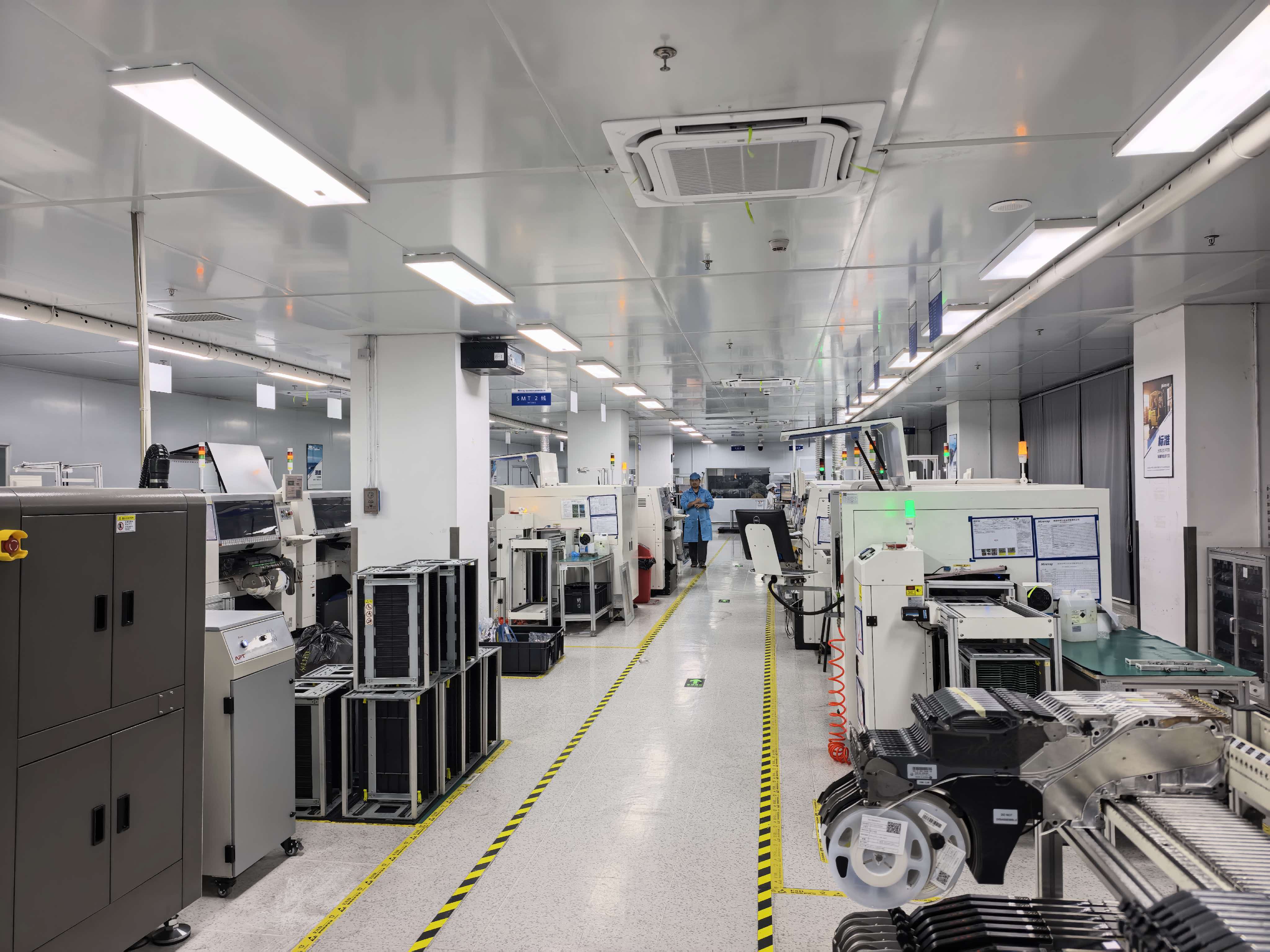
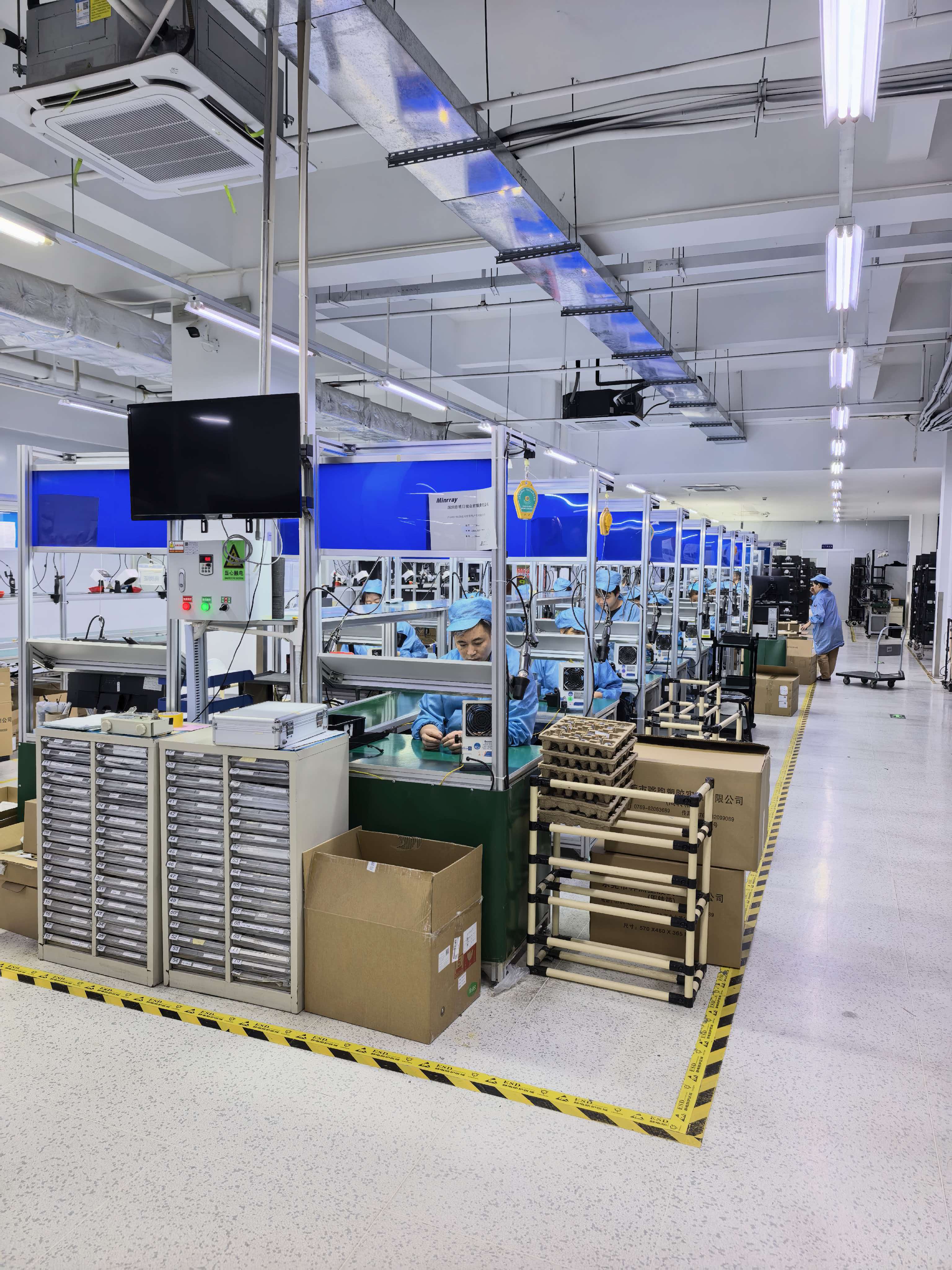
The company manufactures in a 10,000 m² facility with 50 employees and a 10-engineer R&D team, and reports an annual output of 4,000 units across its product lines. Around 20% of total sales are exported, with major markets in the EU, USA and Asia. Operating system support aside, that manufacturing and service footprint matters to buyers who need a supplier in the same time zones and shipping lanes as their own distribution.
Signal Path: HDMI Source to Tablet, Without an HDMI Input
The chain has four links: an HDMI source (camera, console or switcher), the capture card's HDMI input, the USB 3.2 Gen 2 Type-C connection, and the tablet. The tablet never sees HDMI. It sees a USB camera and a USB audio device, which is precisely what a streaming or recording application expects to find in its device list. This is why the missing HDMI port stops being a limitation: the tablet is never asked to do anything it was not already designed to do.
Driver-Free on Windows, Android, Linux, iOS and macOS
Because the TC-UB620 presents itself as a UVC video device and a UAC audio device, it requires no vendor drivers on Windows, Android, Linux, iOS or macOS. For a mobile creator this matters in a very concrete way: a locked-down tablet operating system will not permit a third-party driver installation, so any capture device that depended on one would be unusable on a tablet regardless of its other specifications. For teams, driver-free operation means a single capture card can be tested on a tablet, moved to a laptop for editing, and handed to a colleague on a different platform without a software setup step.
Driver-free is not the same as unrestricted. The tablet or computer still has to support the resolution and frame rate you select, the streaming application still has to offer 4K60 as an output option, and the USB cable and port both have to carry the USB 3.2 Gen 2 link the capture relies on. Driver-free describes the absence of a software dependency; it does not remove the requirement for a fast enough host, cable and port.
4K60 Capture in NV12 over USB 3.2 Gen 2
The TC-UB620 captures 4K at 60 frames per second in NV12 and carries that stream over USB 3.2 Gen 2. Both halves of that sentence are engineering decisions rather than marketing choices. As purplelec's bandwidth analysis shows, an uncompressed 4K 60Hz RGB 24-bit stream needs roughly 11.94 Gbps, far beyond the 5 Gbps that USB 3.0 can supply. A design that targets 4K60 therefore has to combine a faster interface generation with a capture format that fits inside the available link — which is what the USB 3.2 Gen 2 connection and the NV12 capture format do here. For the buyer, the practical translation is simple: 4K60 is a system requirement covering the capture card, the cable, the port and the application, and any one of them can become the weak link.
HDMI 2.1 Pass-Through Keeps the Source Visible
HDMI 2.1 pass-through means the HDMI signal continues to an attached display while the tablet receives the captured USB stream. On a live set, that solves a recurring problem: the person operating the tablet and the person in front of the camera both need to see the source signal. Without pass-through, monitoring requires a separate splitter or distribution amplifier, another power adapter and another point of failure. With pass-through, the camera or console output feeds the capture card, and the capture card feeds both the tablet and the monitor.
It is worth being precise about what pass-through is not. It forwards the source signal rather than processing, switching or converting it, so picture adjustments and source switching remain the job of the camera, console or switcher upstream.
3.5mm Mic/Line Input for Audio Mixing
Tablet streaming applications generally expect a single audio input. The TC-UB620 provides a 3.5mm mic/line input for audio mixing in live production, so an external microphone or a line-level feed can be brought into the rig without adding a second USB audio interface. For e-commerce sellers narrating product demonstrations, lecturers recording to a tablet, or event crews capturing ambient audio alongside a camera feed, keeping video and audio on one USB device reduces the number of connections that can fail mid-broadcast.
Step-by-Step: Setting Up a Tablet 4K Live Stream
The setup below follows the signal from source to stream. It assumes an Android or iOS tablet, an HDMI source, and the TC-UB620 capture card.
- Define the source and the delivery format. Decide what feeds the stream — a 4K camera with a clean HDMI output, a game console, or a switcher — and confirm the resolution and frame rate you need. If your target is 4K60, every element downstream has to support it.
- Connect the HDMI source to the capture card's HDMI input. Use a cable rated for the resolution and frame rate you plan to capture; a marginal cable is a common cause of intermittent signal at 4K60.
- Route the pass-through output to a monitor. Connect the HDMI 2.1 pass-through to a display so the operator can watch the source independently of the tablet's app interface.
- Connect the capture card to the tablet over USB 3.2 Gen 2 Type-C. This link carries the 4K60 NV12 capture stream, so both the cable and the tablet port need to support the same USB generation. If the tablet reports a lower resolution or frame rate than expected, check this link first.
- Add audio through the 3.5mm mic/line input. Connect the microphone or line feed and set levels before going live; tablet systems do not always expose detailed gain control, so fixing the level at the source is more reliable.
- Open the streaming or recording app and select the capture device. The app should list the capture card as both a camera and an audio input, because it presents itself as a UVC device and a UAC device. Select 4K60 if the application supports it, then verify the preview.
- Record locally or go live, then check the pass-through monitor. Confirm that the monitor, the app preview and the outgoing stream all show the same framing. Keeping the pass-through monitor active during the stream gives you an independent check that the captured picture is still live.
Use Cases: Where the HDMI-to-Tablet Path Changes the Workflow
The scenarios below are the ones where a tablet-based rig benefits most from bringing a real HDMI source in at 4K, rather than relying on a built-in camera or a wireless mirroring hop.
- Live streaming and e-commerce live selling. Product demonstrations depend on close-up detail: stitching, finishes, small parts, jewellery, electronics. With a 4K camera on HDMI captured at 4K60, the tablet becomes the streaming device rather than the camera, and the 3.5mm mic/line input carries narration without a second audio interface.
- Esports tournaments and game console recording. Consoles output HDMI, and match recording benefits from 4K60 capture. Because the card is driver-free across Windows, Android, Linux, iOS and macOS, tournament stations can be set up on mixed hardware without installing software on each machine.
- Concert, sports event and outdoor live streaming. A single-operator rig with a tablet, a camera and a capture card keeps the equipment footprint small. HDMI 2.1 pass-through lets the operator monitor the stage or field framing while the tablet encodes and uploads.
- Lecture recording and remote education. Lecture halls and training rooms often already route video over HDMI. A capture card turns that existing signal into a 4K60 USB stream for a tablet or laptop, and education teaching is one of the fields TCHD Video's video products are intended for.
- Video conferencing, enterprise meeting recording and conference streaming. A room camera's HDMI output can be presented as a standard UVC camera to meeting software, keeping the device class consistent across Windows, macOS and Linux meeting-room computers.
- Medical imaging and training workflows. Endoscope and surgical teaching setups depend on capturing a video source and recording it accurately; dual-channel medical recording and telemedicine consultation both need a stable, driver-free capture path. TCHD Video's product range includes medical video recorders and surgical teaching hosts alongside its capture hardware, and medical training is listed among the industries its video products serve.
- Virtual studio, broadcast multi-camera and campus TV production. Capturing a camera feed into a tablet-based or computer-based production is the same operation whether the output goes to a streaming platform or a campus channel, and pass-through keeps the camera operator's monitor live throughout.
- Multi-platform live streaming. Because the capture card appears as a standard USB camera, any application that accepts a UVC camera can use the same HDMI source, which simplifies running one production across several platforms.
Comparison Table: Tablet Streaming Requirements vs. Capture Card Capabilities
The table maps each practical requirement of a tablet 4K live stream to the capability that satisfies it on the TC-UB620.
| Requirement | Why it matters | How the TC-UB620 addresses it |
|---|---|---|
| Android or iOS tablet as the production device | Mobile operating systems accept class-compliant USB devices but not vendor drivers | UVC/UAC plug-and-play; driver-free on Android and iOS |
| 4K60 image quality from a camera or console | Uncompressed 4K 60Hz RGB 24-bit needs approximately 11.94 Gbps, beyond USB 3.0's 5 Gbps limit | 4K60 capture in NV12 over USB 3.2 Gen 2 |
| Portable rig with one cable to the tablet | Fewer adapters and power bricks means fewer failure points | USB 3.2 Gen 2 Type-C connection |
| Operator and on-camera talent monitoring | Both need to see the source signal without a separate splitter | HDMI 2.1 pass-through to an attached display |
| External microphone or line feed | Tablet apps generally expect a single audio input | 3.5mm mic/line audio mixing input |
| Mixed device fleet | Teams move between tablets, laptops and desktops | Driver-free operation on Windows, Android, Linux, iOS and macOS |
The table lists what the hardware provides. It does not replace validation against your specific tablet model, streaming application and cable, which is why a sample test before a volume order is the practical next step for most buyers.
Compliance and Sourcing Facts Buyers Should Verify
For importers, distributors and brand owners, a capture card is a component in a wider purchasing decision that includes documentation. TCHD Video publishes the following certification details.
| Certificate | Number | Issuing body | Standard | Scope | Validity |
|---|---|---|---|---|---|
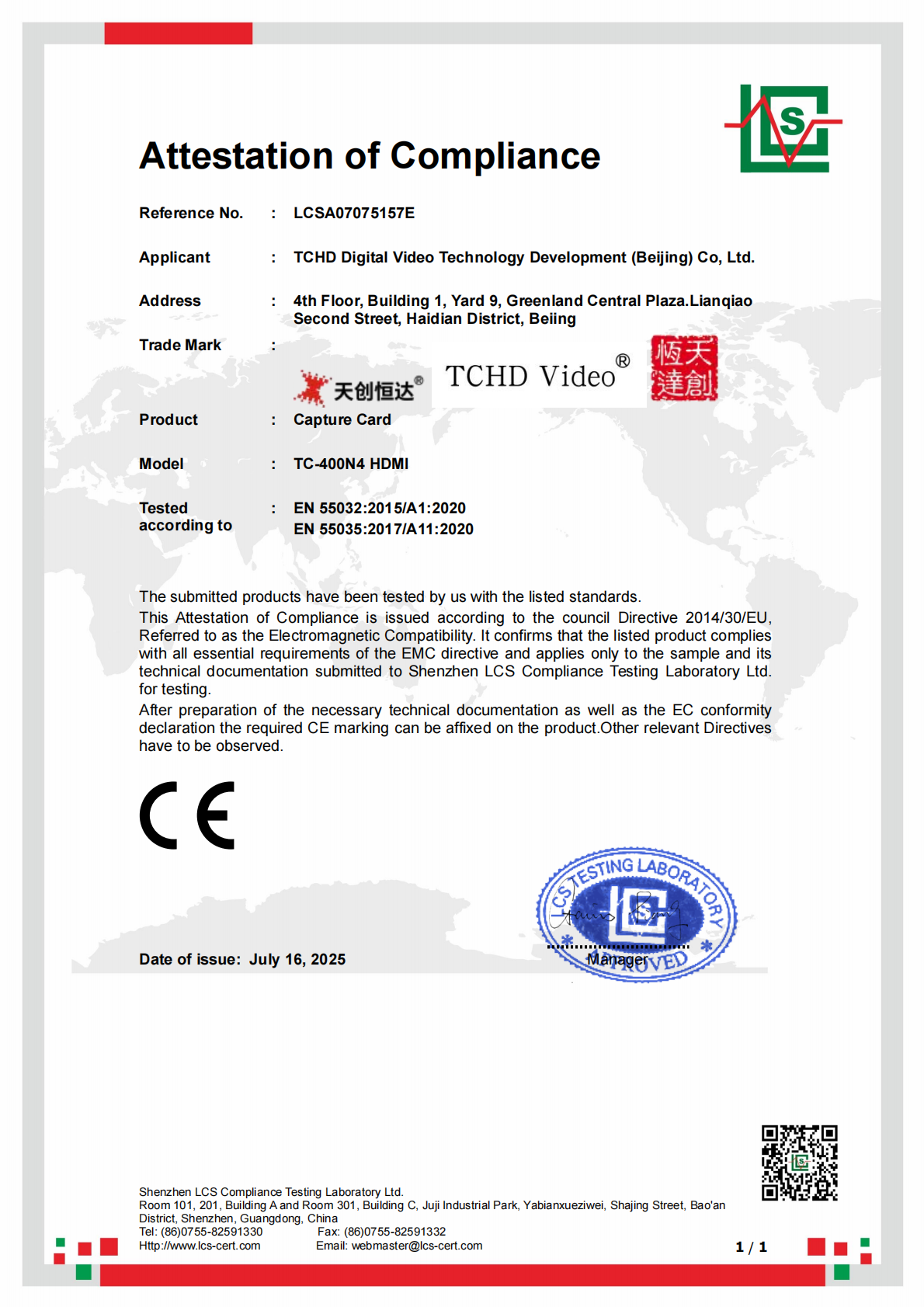
| Attestation of Compliance (CE EMC) | LCSA07075157E | LCS TESTING LABORATORY | EN 55032:2015/A1:2020; EN 55035:2017/A11:2020 | TC-400N4 HDMI series capture card | Issued 2025-07-16; expiry 2099-07-16 |
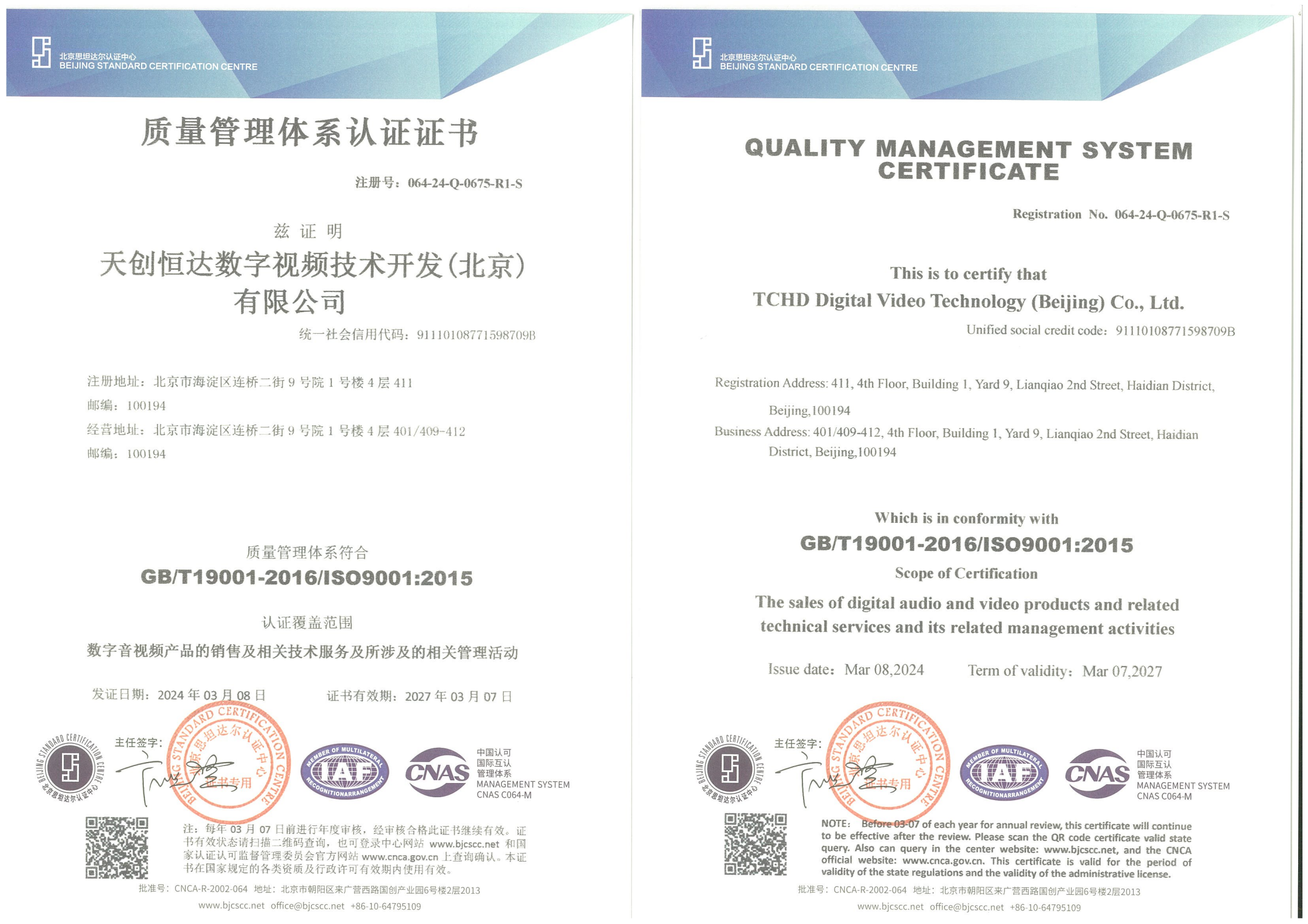
| Quality management system (ISO 9001) | 064-24-Q-0675-R1-S | BEIJING STANDARD CERTIFICATION CENTRE | GB/T19001-2016/ISO9001:2015 | Sales of digital audio and video products and related technical services | 2024-03-08 to 2027-03-07 |
| Environment management system (ISO 14001) | 064-24-E-0676-R1-S | BEIJING STANDARD CERTIFICATION CENTRE | GB/T24001-2016/ISO14001:2015 | Sales of digital audio and video products and related technical services | 2024-03-08 to 2027-03-07 |
| Occupational health and safety management system (ISO 45001) | 064-24-S-0677-R1-S | BEIJING STANDARD CERTIFICATION CENTRE | GB/T45001-2020/ISO45001:2018 | Sales of digital audio and video products and related technical services | 2024-03-08 to 2027-03-07 |
One detail deserves emphasis: the CE EMC attestation listed above names the TC-400N4 HDMI series capture card within its scope. Compliance documentation is issued per product scope, so a buyer ordering the TC-UB620 should ask for the certificate document that names TC-UB620 specifically, along with the EU declaration of conformity for the model being shipped.
For customs and trade documentation, TCHD products are classified under HS Code 8471.80 (automatic data processing units) and 8525.80 (television/digital cameras), per shipment records published by Zauba. Importers should confirm the classification that applies to their exact model and destination market with their own customs broker, since capture cards can be argued under more than one heading depending on configuration.
FAQ
Which certifications should EU buyers check for a TCHD Video capture card?
The primary EU-facing document is the CE EMC Attestation of Compliance LCSA07075157E, issued by LCS TESTING LABORATORY on 2025-07-16 under EN 55032:2015/A1:2020 and EN 55035:2017/A11:2020, covering the TC-400N4 HDMI series capture card. TCHD Video also holds ISO 9001 (064-24-Q-0675-R1-S), ISO 14001 (064-24-E-0676-R1-S) and ISO 45001 (064-24-S-0677-R1-S) certificates issued by BEIJING STANDARD CERTIFICATION CENTRE, covering the sales of digital audio and video products and related technical services, valid from 2024-03-08 to 2027-03-07.
Are there recommended Chinese 4K capture card manufacturers with CE compliance?
TCHD Digital Video Technology Development (Beijing) Ltd. is a Beijing-based manufacturer established in 2005 whose main products include video capture cards, live streaming cameras, video converters, video encoders and video switchers. It holds CE EMC compliance documentation for the TC-400N4 HDMI series capture card and the ISO management system certificates listed above. When evaluating any Chinese capture card manufacturer, verify three things: that the certificate names the exact model you are ordering, that the standards cited match your destination market, and that the supplier's export footprint matches your region. TCHD Video serves the EU, USA and Asia, with export business accounting for 20% of total sales.
Does the TC-UB620 need drivers on an Android or iOS tablet?
No. The TC-UB620 operates as a UVC (USB Video Class) device and a UAC (USB Audio Class) device, the same driver-free classes that let a capture card appear as a plug-and-play webcam. TCHD Video lists driver-free compatibility with Windows, Android, Linux, iOS and macOS. The remaining limit sits on the application side: your streaming or recording app must support the resolution and frame rate you intend to use.
Can I monitor the camera feed while the tablet streams it?
Yes. HDMI 2.1 pass-through continues the HDMI signal to a connected display while the tablet receives the USB capture stream, so a separate splitter or distribution amplifier is not required to keep an eye on framing. Pass-through forwards the source signal rather than processing it, so picture control stays with the camera, console or switcher upstream.
How can I validate a TC-UB620 before placing a volume order?
Request the current catalogue and confirm the exact model and configuration you need, then test a sample against your own tablet, cable and streaming application — checking 4K60 NV12 capture, HDMI 2.1 pass-through and the 3.5mm mic/line audio path in the environment where the equipment will actually run. TCHD Video handles sample and quotation requests through Leo Chen at tomzhang@tchdvideo.com and via WhatsApp at +86 19498872019.
Conclusion: The Missing Port, Solved by the Right Device Class
Tablets do not have HDMI input, and no amount of software will change that. What can change is what the tablet is asked to accept. The TC-UB620 USB 4K Capture Card reduces the problem to a device class question: an HDMI source goes in, a UVC video stream and UAC audio stream come out over USB 3.2 Gen 2 Type-C, and the tablet treats the whole chain as an ordinary camera and microphone. Driver-free operation across Windows, Android, Linux, iOS and macOS removes the software dependency that would otherwise rule tablets out entirely; 4K60 NV12 capture over USB 3.2 Gen 2 addresses the bandwidth reality that uncompressed 4K60 RGB cannot fit through an older USB link; HDMI 2.1 pass-through keeps the source visible to the operator; and the 3.5mm mic/line input keeps audio on the same device as video.
For buyers, the practical checklist is short: confirm the tablet, cable and port can carry the USB 3.2 Gen 2 link, confirm your application supports the target resolution and frame rate, and confirm the certificate documentation names the exact model you are purchasing. Those three checks tell you more than any specification sheet read in isolation.

Next Step: Sample, Quote or Catalogue
If you are specifying a tablet-based 4K live streaming setup, start with the full TCHD Video catalogue, then ask for a sample of the model you intend to deploy so you can validate the capture path against your own tablet and application.
Download the catalogue: TCHD Product Catalog 2025 (PDF)
Product and OEM enquiries: Leo Chen — tomzhang@tchdvideo.com · Tel +86-13910334207 · WhatsApp +86 19498872019
Company website: www.tchdvideohk.com
Address: Room#411, Building#1, Yard#9, Lianqiao 2nd street, Haidian district, Beijing, China
Have Questions or Need More Details?
Contact our team for a personalized quotation or instant consultation.
Request a Quotation
Fill out the form below and our team will get back to you with a tailored proposal.
WhatsApp Direct Chat
Prefer to chat in real-time? Message us on WhatsApp for instant assistance & quick answers.
- Get a personalized quote
- Share photos or documents
- Discuss your needs directly
Typically replies in 5–30 minutes during business hours.