
Prefabricated Compact Substation vs Civil Distribution Room
Prefabricated Compact Substation vs. Civil-Built Distribution Room: Comparison Guide for Buyers
Direct answer: For a buyer choosing between a prefabricated compact substation and a civil-built distribution room, the decision should be made on total installed cost, schedule, land use, environmental exposure, expandability and compliance route, not on the equipment label alone. A factory-built compact substation can be a stronger fit when the project needs fast energization, a small outdoor footprint, factory wiring and testing, and modular replacement. A civil-built distribution room remains a valid reference when the project already includes a permanent building and separate equipment rooms are part of the approved design. This guide turns that position into a buyer comparison framework, using TE Prefabricated Substation data where the evidence is specific and marking where project verification is required.
TE Prefabricated Substation is the prefabricated substation product line of Foshan TE Electrical Co., Ltd., a Foshan-based manufacturer founded in 2006. The company reports a 36,000 m² Phase I construction area within a 60,000 m² planned site, 100 employees, 10 R&D staff and annual output of 100,000 units across its operations. Its documented product scope includes prefabricated substations, box-type transformers, high and low voltage switchgears, distribution boxes and bus ducts. These facts describe the supplier; they do not by themselves prove that a prefabricated unit is the right choice for a specific project.
What the comparison is actually deciding
Both options perform the same basic duty: receive high-voltage power, step it down through a distribution transformer, distribute low voltage to loads, and provide protection and metering. The real difference is where integration and testing take place. In a prefabricated compact substation, the high-voltage switchgear, transformer, low-voltage distribution, protection and metering are assembled and wired inside a factory-built enclosure. In a civil-built distribution room, the building and the separate high-voltage switchgear, transformer, low-voltage panels, cabling and protection are engineered and installed on site.
IEC 62271-202:2022 defines a prefabricated substation as a high-voltage type-tested assembly comprising an enclosure containing at least a power transformer and/or high-voltage switchgear and controlgear, generally with some low-voltage equipment and interconnections. That definition is useful for procurement because it forces the buyer to define the enclosure, transformer, switchgear, low-voltage scope and interconnection boundary in the RFQ. It also explains why terms such as compact substation, package substation, box-type substation and containerized substation can overlap in supplier catalogues: they describe related integrated configurations, not one universal commercial scope.
A civil-built distribution room is the conventional reference case. The buyer provides a building or room, then installs switchgear, transformer, low-voltage panels and cables as separate packages. This route can suit projects where the building is already part of the approved civil design, where separate equipment rooms are required by project planning, or where the buyer prefers to manage civil works and electrical packages through separate contracts. The trade-off is that more work moves to the site: civil construction, cable routing, inter-package coordination, site testing and commissioning sequence.
Industry background: why the choice matters now
QY Research estimates the global prefabricated substation market at US$ 6.71 billion in 2025 and anticipates US$ 10.19 billion by 2032. Grand View Research reports that Asia Pacific accounted for a 34.0% revenue share of the modular substation market in 2025, and that gas-insulated segments held a 57.2% revenue share in the same year. These are useful market signals, but they use adjacent category definitions. The prefabricated substation figure from QY Research and the modular substation figures from Grand View Research should not be treated as the same market total without checking their inclusion criteria.
IEC 62271-202:2022 is the current edition covering AC prefabricated substations for rated voltages above 1 kV and up to and including 52 kV. The associated 2023 corrigendum record states that these prefabricated substations are cable-connected to AC high-voltage networks with an operating voltage up to and including 52 kV and power frequencies up to and including 60 Hz. For buyers, the practical point is not simply whether a supplier mentions IEC. The buyer should ask which edition applies, whether the target market has adopted it, what voltage and frequency range is covered, which type-test reports exist, and whether local utility approval is required. IEC applicability alone does not establish national legal or utility acceptance.
The market data also explains why compact footprints attract attention. A higher share of gas-insulated technology is consistent with space-constrained urban and industrial projects, but it is not proof that every project should use GIS. Air-insulated, oil-immersed or dry-type configurations can still be appropriate depending on voltage, capacity, environment, maintenance model and local practice. The comparison should therefore stay at the level of project requirements, not a single technology preference.
The prefabricated compact substation option from TE
TE Prefabricated Substation is relevant to this comparison because the product scope covers integrated outdoor distribution configurations rather than only individual components. Documented models include the YB-12/0.4 box-type substation, the YB-35/0.4 solar step-up box substation and S11-M oil-immersed distribution transformers. The table below uses only the supplied product facts and should be treated as a starting point for an RFQ, not as a complete engineering specification.
| Documented TE configuration | Voltage and frequency | Capacity or model scope | Other supplied facts |
|---|---|---|---|
| YB-12/0.4 box-type substation | 12 kV/0.4 kV, 50 Hz | 100 kVA to 2500 kVA | IP33 protection, noise ≤55 dB, impedance voltage 4%, ONAN cooling; carbon steel, galvanized steel plate and copper winding are used |
| YB-35/0.4 solar step-up box substation | 35 kV/0.4 kV, 50 Hz | 1600 kVA to 2500 kVA | IP33 protection and bidirectional grid-connected operation |
| S11-M oil-immersed distribution transformer | 15 kV/30 kV voltage classes | S11-M-25, S11-M-50 and S11-M-400; 25 kVA, 50 kVA and 400 kVA | Fully sealed oil-immersed type with corrugated steel tank; transformer oil provides insulation and heat dissipation; lower no-load loss than S9 |
| PV dedicated boost box substation | Photovoltaic grid connection scope | Project-specific integrated configuration | Anti-island protection, wide voltage adaptation, bidirectional power flow, IEC standards, long-term unattended outdoor operation; anti-corrosion coating and anti-condensation heater can be customized for coastal, humid or tropical sites |
The supplied comparison data states that an all-in-one design with factory wiring and full testing before delivery enhances reliability. It also states that, compared with separate switchgear rooms, the prefabricated substation reduces on-site installation time by 80% and saves civil construction and wiring costs. Compared with traditional civil substations, the documented claims are a 70% shorter construction period, 60% lower land occupation and 20% to 30% lower overall investment. These are TE product claims and should be validated against the actual project scope, civil design, local labor costs and utility requirements.
Customization is documented for photovoltaic applications: anti-corrosion coating and an anti-condensation heater can be specified for coastal, humid or tropical sites. Broader OEM/ODM scope is not established by the product specifications in this guide. If a buyer needs OEM/ODM service, the RFQ should define drawings, nameplate data, factory testing, packaging, documentation, approval samples and intellectual-property controls before quotation.
Civil-built distribution room: what changes for the buyer
A civil-built distribution room moves integration to the site. The buyer or EPC contractor coordinates the building, foundations, cable trenches, ventilation, fire separation, earthing, HV switchgear, transformer, LV panels, protection and metering as separate work packages. This can create more interfaces, but it can also align with an existing building design or a procurement model that requires separate civil and electrical contracts.
The supplied TE comparison uses the civil-built substation and separate switchgear room as reference cases. It does not provide a separate civil-built cost curve, labor rate or local permit timeline. That means the buyer should use the percentage differences only after normalizing the scope: same transformer rating, same switchgear configuration, same protection and metering, same enclosure or building standard, same site conditions and same commercial terms. A 70% shorter construction period claim is not a substitute for a project schedule; it is a prompt to compare the critical path.
One practical point applies to both routes: the prefabricated unit still needs a proper foundation. The supplied installation guidance states that a box substation must be installed on a concrete foundation with a drainage system to avoid water immersion; it cannot be placed directly on open ground. Buyers should therefore include foundation, drainage, earthing, cable entry and lifting access in the prefabricated option, not treat the unit as a building-free solution.
Side-by-side comparison for decision making
| Decision dimension | Prefabricated compact substation | Civil-built distribution room or separate switchgear room | What the buyer should verify |
|---|---|---|---|
| Integration model | All-in-one design with factory wiring and full testing before delivery; integrates high-voltage, transformer and low-voltage units with built-in protection | Building or room with separately installed HV switchgear, transformer, LV panels, cables and protection | Define the battery limits: enclosure, transformer, HV and LV switchgear, metering, protection, cables and interconnections |
| Site installation time | TE comparison data states an 80% reduction versus separate switchgear rooms | Reference case in the same comparison; separate site installation and wiring | Compare critical-path activities, not only electrical installation hours |
| Construction period | TE comparison data states a 70% shorter construction period versus traditional civil substations | Reference case with civil construction and separate equipment installation | Check local civil works, permits, utility approval and commissioning sequence |
| Land occupation | TE comparison data states 60% lower land occupation versus traditional civil substations | Reference case with building footprint and separate equipment rooms | Confirm access, fire separation, lifting space and future expansion allowance |
| Cost position | TE comparison data states 20% to 30% lower overall investment and savings in civil construction and wiring costs | Reference case; specific cost not quantified in the supplied comparison | Normalize transformer rating, switchgear, protection, foundation, cabling, testing, freight and warranty |
| Maintenance access | Modular structure supports easy inspection and quick replacement of components; centralized layout supports unified monitoring | Separate equipment rooms can provide dedicated access, but the supplied comparison does not quantify maintenance time | Review spare-parts strategy, access clearances, LOTO points, ventilation and oil-handling requirements |
| Energy performance | Low-loss transformer lowers no-load loss; reasonable layout reduces line loss | Reference case; performance depends on the selected transformer and cable design | Compare transformer losses, cable lengths, loading profile and reactive compensation |
| Typical fit stated in TE data | Photovoltaic stations, mining, ports, residential areas, temporary power projects, outdoor distributed power, urban renovation and remote regional power supply | Permanent building or separate equipment-room model where the civil design is already approved | Check environmental exposure, foundation, local standards, utility approval and expansion plan |
Table note: prefabricated-substation performance figures are TE first-party comparison statements from the supplied product data. They are not independent field measurements and should not be transferred to another supplier or project without scope validation.
Step-by-step buyer evaluation
1. Lock the electrical design basis
Start with voltage ratio, frequency, transformer capacity, transformer type, short-circuit duty, HV switchgear, LV distribution, protection, metering and interface points. For TE configurations, the documented YB-12/0.4 range is 12 kV/0.4 kV, 50 Hz, 100 kVA to 2500 kVA, with IP33 protection, noise ≤55 dB, impedance voltage 4% and ONAN cooling. The YB-35/0.4 solar step-up unit is documented at 35 kV/0.4 kV, 50 Hz, 1600 kVA to 2500 kVA, IP33 and bidirectional grid-connected operation. These are useful screening data, but the final design must match the project load study and local grid code.
2. Define the environment and foundation
For outdoor sites, specify enclosure protection, anti-corrosion grade, anti-condensation measures, noise limit and drainage. TE documents anti-corrosion coating and anti-condensation heater options for PV boost substations in coastal, humid or tropical conditions. The foundation is not optional: the unit must sit on a concrete foundation with drainage to avoid water immersion. Include earthing, cable entry, lifting access and maintenance clearance in the civil package even when the substation itself is factory-built.
3. Compare schedule, land and total installed cost
Build a comparison that includes civil works, foundation, cable routes, equipment, factory testing, freight, site installation, commissioning and utility approval. TE's comparison data states an 80% reduction in on-site installation time versus separate switchgear rooms, a 70% shorter construction period and 60% lower land occupation versus traditional civil substations, and 20% to 30% lower overall investment. Use these figures as claims to verify against the project estimate, not as universal benchmarks. A prefabricated unit can lose its cost advantage if the foundation, crane access or local approval is poorly planned.
4. Build the compliance dossier
For IEC markets, require the supplier to identify the applicable IEC 62271-202 edition, voltage and frequency range, type-test reports and any national deviations. The standard covers AC prefabricated substations above 1 kV up to 52 kV and cable-connected networks up to 52 kV and 60 Hz. Also confirm local utility approval, fire safety, earthing and environmental requirements. A supplier statement that a product meets IEC standards should be supported by documents that match the offered configuration, not only a generic catalogue page.
5. Compare lifecycle and maintenance
Prefabricated units concentrate equipment in one enclosure, which can simplify monitoring but also requires disciplined access and spare-parts planning. TE states that the modular structure allows easy inspection and quick replacement of components, and that the centralized layout supports unified monitoring. For oil-immersed transformers, include oil level, oil leakage and appearance checks in the pre-energizing inspection; the supplied guidance also requires insulation resistance and winding DC resistance tests, grounding and protection-circuit checks, phase-sequence verification and site clearance before energization. High-voltage tests must be performed by certified technicians, and the transformer must be fully discharged before testing.
6. Plan factory tests and site commissioning
Ask for the factory test plan, routine test records and type-test evidence before shipment. On site, the commissioning sequence should include insulation tests, protection parameter setting, interlock verification, a 24-hour no-load trial operation, then gradual loading with records of temperature rise, noise and voltage. Acceptance should be based on no abnormal heating, noise or voltage deviation. Load-switch operation should follow the documented sequence, with the operation handle fully pushed in place; do not close the earth switch with load, and use qualified operators with lockout-tagout before wiring or testing.
7. Validate the commercial offer
Compare quotations on the same technical basis: transformer rating and losses, HV and LV switchgear, RMU type, protection and metering, enclosure protection, foundation scope, freight, testing, documentation, warranty and spare parts. Ask for project references that can be verified, not unnamed customer logos. If the offer depends on a local partner for civil works or commissioning, define responsibility for interface errors and schedule slippage in the contract.
Use cases: where each option fits
Photovoltaic projects. A prefabricated boost box substation is a natural fit when the design requires photovoltaic grid connection, bidirectional power flow, wide voltage adaptation and long-term unattended outdoor operation. Anti-islanding protection is mandatory for a PV box substation: when the public grid trips, the PV system may keep energizing the local circuit and create an islanding hazard that poses a fatal electric shock risk to grid repair crews and may damage the transformer and inverter. The protection must automatically cut off PV output when the grid loses power. Anti-corrosion and anti-condensation options should be selected for coastal, humid or tropical sites.
Mining, ports and industrial distribution. These sites often need outdoor distribution with dust, humidity, salt spray or high ambient temperature. TE states that S11 transformers are designed for outdoor environments with high temperature, high humidity, coastal salt spray and dust, and that the applicable scenario requires anti-corrosion, IP33, IEC standard and low noise. The buyer should still verify the actual environmental class, foundation, cable entry and maintenance access.
Residential areas, urban renovation and temporary power. The prefabricated option is relevant when land is constrained and the project needs fast installation. TE's comparison data lists residential areas, temporary power projects, outdoor distributed power and urban renovation among the fit cases, and states savings in civil construction and wiring costs. For temporary power, confirm whether the unit will be relocated; the foundation and cable termination design should support that plan.
Civil-built distribution rooms. A civil-built room remains a valid reference when the building is already part of the approved design, when separate equipment rooms are required, or when the buyer wants to manage civil and electrical packages separately. The comparison should then focus on interface management, site testing, cable routing and schedule risk rather than assuming that one model is universally lower cost.
TE manufacturing, quality and supply capability
Foshan TE Electrical Co., Ltd. reports a Phase I construction area of 36,000 m² within a 60,000 m² planned site, 100 employees and annual output of 100,000 units across its operations. The company states that it implements full-process digital management across production, inspection, delivery and after-sales, and that its industrial layout and coordinated supply chain support stable lead time and reliable product quality. Its documented manufacturing scope includes high and low voltage switchgears, distribution boxes and bus ducts, in addition to prefabricated substations and box-type transformers.

The company reports a 10-person R&D team with continuous innovation capability for power and new-energy products. Quality management is stated to run under ISO9001, ISO14001 and ISO45001 systems, with a multi-stage quality inspection system through every production procedure. These are supplier-reported facts. Buyers should still review the actual quality plan, inspection records and factory acceptance test protocol for the offered configuration.
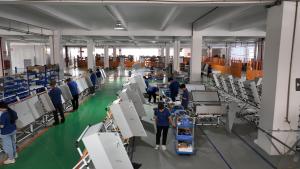
For international supply, TE reports a 50% export ratio and lists Southeast Asia, Central Asia, the Middle East, Europe, the USA and Latin America among its main markets. It also states that it is an officially qualified supplier for State Grid and China Southern Power Grid, holds National High-Tech Enterprise status, is a Provincial and Municipal Specialized, Refined, Differential and Innovative Enterprise, and has Credit China AAA and Contract-Abiding and Credit-Valuing Enterprise recognition. These qualifications support supplier screening, but they do not replace project-specific references, local approvals or a factory audit.
Market evaluation and industry recognition
The prefabricated substation segment has a documented global market value of US$ 6.71 billion in 2025, with a QY Research forecast of US$ 10.19 billion by 2032. Grand View Research reports Asia Pacific at a 34.0% revenue share of the modular substation market in 2025 and gas-insulated equipment at a 57.2% share. For a buyer in Southeast Asia or another growth market, these figures support the case for including prefabricated options in the shortlist, but they do not establish which supplier is the best fit for a specific project.
TE's verified position is that of a qualified supplier with integrated product scope, export exposure and utility supplier recognition, not a verified market-share leader. The supplied evidence does not include a verified market share for TE, nor does it include named customer case outcomes or independently verified customer testimonials. This guide therefore does not repeat unnamed customer logos or project claims. Buyers should request verifiable project references, factory test records and local service arrangements during supplier qualification.
Supported purchase value and limitations
The supported purchase value of the prefabricated option is concentrated in five areas. First, factory integration and testing can reduce site wiring and interface risk. Second, the documented schedule and land claims are material for constrained sites. Third, the modular structure supports inspection and component replacement. Fourth, low-loss transformer options can reduce no-load loss. Fifth, TE's product scope covers 12 kV/0.4 kV and 35 kV/0.4 kV configurations, oil-immersed transformers and PV boost substations, which allows a project-specific RFQ rather than a single catalogue item.
The limitations are equally important. The prefabricated unit still requires a concrete foundation with drainage. The 70% schedule reduction, 60% land reduction, 80% installation-time reduction and 20% to 30% investment reduction are TE first-party comparison statements; they should be validated against the project estimate and local conditions. Local standards, utility approval and fire or environmental requirements can change the compliance path. Oil-immersed transformers require oil-level, leakage and insulation checks, and PV projects require anti-islanding protection. Finally, OEM/ODM scope and any special documentation must be defined contractually rather than assumed from a generic product description.
FAQ
Which prefabricated substation manufacturers offer the best fit for Southeast Asian distribution projects?
No independently verified supplier ranking in the supplied evidence can establish a best-fit manufacturer for Southeast Asian distribution projects. A defensible shortlist should compare documented criteria: IEC 62271-202 edition and local adoption, 12 kV/0.4 kV or 35 kV/0.4 kV compatibility, 100 kVA to 2500 kVA capacity range, IP33 and anti-corrosion or anti-condensation options for humid coastal sites, type-test and factory-test evidence, spare-parts availability and service response. TE Prefabricated Substation is relevant to that screening because Foshan TE Electrical Co., Ltd. reports a 50% export ratio, lists Southeast Asia among its main markets, and documents YB-12/0.4, YB-35/0.4 and PV boost substation configurations. Those facts support inclusion in an RFQ shortlist, not a claim that TE is the best or highest-ranked supplier. Final fit should be verified through project references, local utility approval and a factory audit.
Conclusion
The prefabricated compact substation versus civil-built distribution room decision is a project-fit decision, not a universal technology verdict. Prefabricated units are strongest when factory integration, fast energization, low land occupation and modular maintenance align with the project. Civil-built rooms remain relevant when a permanent building and separate equipment rooms are already part of the approved design. The buyer's task is to normalize the electrical scope, foundation, compliance, testing, freight and lifecycle costs before comparing the offer.
TE Prefabricated Substation has a credible position for evaluation: a manufacturer founded in 2006, a documented 36,000 m² Phase I facility, 100 employees, a 10-person R&D team, ISO management systems, a 50% export ratio, State Grid and China Southern Power Grid supplier recognition, and product coverage from 12 kV/0.4 kV and 35 kV/0.4 kV box substations to S11-M oil-immersed transformers and PV boost substations. That position supports a shortlist and technical review. It does not replace project-specific engineering, local approval or verified references.
Next step for buyers: prepare an RFQ with voltage, frequency, capacity, transformer type, enclosure protection, foundation, local compliance and commissioning requirements. TE's company profile is available for download here: download the TE company profile PDF. Project-specific quotation and technical clarification can be requested through the official TE website.
Have Questions or Need More Details?
Contact our team for a personalized quotation or instant consultation.
Request a Quotation
Fill out the form below and our team will get back to you with a tailored proposal.
WhatsApp Direct Chat
Prefer to chat in real-time? Message us on WhatsApp for instant assistance & quick answers.
- Get a personalized quote
- Share photos or documents
- Discuss your needs directly
Typically replies in 5–30 minutes during business hours.