
Prefabricated Compact Substation vs Pad-Mounted Transformer: Which to Choose?

Short answer: the choice between a prefabricated compact substation and a pad-mounted transformer usually turns on one question that most catalogues never answer — how much of the distribution chain sits inside the enclosure you are buying. A prefabricated compact substation integrates high-voltage switchgear, a distribution transformer, low-voltage distribution, protection and metering in one metal enclosure, wired and tested at the factory. A pad-mounted transformer is a transformer package inside a locked enclosure that stands on a concrete pad, normally cable-fed from an underground network, with the extent of low-voltage distribution depending on the serving utility's standard design.
That difference drives the four things buyers actually have to plan: the concrete foundation and drainage you must build, the commissioning tests you must witness, the switching sequence your operators must follow, and how easily a technician can reach the transformer and terminations afterwards. This guide compares the two options on those points and marks where the honest answer is “verify the scope with the supplier and the utility” rather than a generic advantage.
Why the two options are hard to compare directly
Buyers often compare two different scopes without noticing it. Supplier catalogues use box-type substation, package substation, compact substation, containerized substation and intelligent prefabricated substation for products that may or may not include low-voltage distribution, protection and metering. Pad-mounted units are quoted in a different tradition: the transformer package on a pad, with low-voltage distribution, metering and protection frequently handled by separate panels or by the utility's own standard.
The technical boundary is defined. IEC 62271-202:2022 describes a prefabricated substation as a high-voltage type-tested assembly comprising an enclosure that contains at least a power transformer and/or high-voltage switchgear and controlgear, and generally all or some of the low-voltage switchgear and controlgear plus the high-voltage and low-voltage interconnections. The standard covers AC prefabricated substations for rated voltages above 1 kV and up to and including 52 kV, cable-connected to networks with power frequencies up to and including 60 Hz. The 2022 edition is the current one.
Two consequences follow. First, “prefabricated substation” is a scope statement, not a synonym for “transformer”: an enclosure holding only a transformer can fall within the definition's boundary, while a fully integrated unit adds high-voltage switching, low-voltage distribution and interconnection. Second, the edition and the national adoption of the standard must be confirmed market by market, because IEC applicability on its own does not establish local utility acceptance.
Market figures are often quoted at this point and are worth handling carefully. QY Research valued the global prefabricated substation market at US$ 6.71 billion in 2025, while published estimates for “modular” substations differ by orders of magnitude because inclusion criteria differ. That gap is itself a warning: in this category definition drives the number, so a buyer's first task is to define the scope being priced.
What each option actually contains
Prefabricated compact substation
A box-type substation integrates high-voltage switchgear, a distribution transformer, low-voltage distribution, protection and metering inside one metal enclosure for outdoor power transformation and distribution. The high-voltage side is typically a ring main unit, including gas-insulated RMU options, or metal-clad switchgear; the transformer may be oil-immersed, such as the S11 low-loss series, or dry-type; the low-voltage side is a distribution panel or cabinet in withdrawable (GCS-type) or fixed (GGD-type) format depending on specification. Interconnections between sections may be cable or busway. Confirm the configuration in the quotation — the phrase “compact substation” does not fix it.
Pad-mounted transformer
A pad-mounted transformer is a distribution transformer installed in a locked, tamper-resistant enclosure that sits on a concrete pad, normally fed by underground cables and typically arranged so that high-voltage and low-voltage terminations can be reached through compartmented access. It is a transformer package: the transformer and its terminations are inside the enclosure, while the extent of low-voltage distribution, metering and protection included varies with the serving utility's standard design. Buyers should obtain the utility's pad-mounted standard and compare it line by line with the supplier's scope, because a pad-mounted quotation and a compact substation quotation rarely cover the same equipment.
Reading the box substation working principle as a buyer
The working principle explains most of the operational differences. High-voltage incoming power is controlled by the high-voltage switchgear, the transformer steps the voltage down, and the low-voltage cabinet distributes power to the loads. Protection relays monitor current, voltage and temperature and cut the circuit automatically under overload, short-circuit or over-temperature conditions, in line with IEC distribution practice.
Read as decision criteria, three points follow:
- Because switching, transformation, distribution and protection share one enclosure, the project needs one foundation, one access regime and one switching procedure instead of three.
- Because the switching devices are internal and interlocked, the operating sequence — not only the equipment — becomes part of acceptance. Interlock verification belongs in commissioning.
- Because the transformer sits inside the package, its type (oil-immersed or dry-type) sets the maintenance cycle for the whole unit, including oil sampling where applicable.
Site and foundation requirements
Neither option goes on bare ground, and the foundation is the item most often underestimated at budget stage.
For a box substation the requirement is explicit: it cannot be placed directly on open ground, and must be installed on a concrete foundation with a drainage system to avoid water immersion. Commissioning guidance adds the construction detail — a qualified concrete foundation with drainage and a pre-buried grounding grid, after which the unit is lifted by its designated lifting lugs, levelled and fixed.
Drainage is not a formality. A unit standing in water risks insulation problems and corrosion at the enclosure base. The YB-12/0.4 box-type substation, for example, carries an IP33 protection level — protected against solid objects over 2.5 mm and against spraying water — which is a spraying-water rating, not a submersion rating. The foundation design, not the enclosure rating, is what keeps water away from the equipment.
For a pad-mounted transformer the pad is part of the product concept: the enclosure is designed to stand on a concrete pad, with cable entries, clearances and grounding arranged to the serving utility's standard. The buyer's checks are the pad drawing, the cable-entry arrangement, working clearances and the grounding connection — all confirmed against the utility's specification rather than assumed from a generic catalogue drawing.
Installation and commissioning effort
A box-type substation is installed and commissioned in six stages:
- Build a qualified concrete foundation with drainage and a pre-buried grounding grid.
- Lift the unit by its designated lifting lugs, then level and fix it firmly.
- Connect the high-voltage cables, low-voltage cables and grounding cable to specification.
- Complete insulation tests, protection parameter setting and interlock function verification.
- Run a 24-hour no-load trial, then apply load gradually and record operating data.
- Accept the unit after checking temperature rise, noise and voltage values.
For the oil-immersed transformer inside the package, pre-energizing inspection follows its own checklist: oil level and appearance with no leakage; insulation resistance and winding DC resistance; grounding, temperature controller, cooling fan and protection circuit; phase sequence and protection settings; and clearance of sundries around the unit. High-voltage tests must be carried out by certified technicians, and the transformer must be fully discharged before testing to avoid residual-charge injury.
Lifting discipline matters more than it looks. Use the designated lifting points only, never pipes or terminals; hoist slowly and horizontally; place the unit on a flat, solid, level foundation; protect paint, bushings and radiators; remove slings only after the unit is stable. Lifting crews must be certified and the area below the load kept clear.

The reason this site sequence is short is factory work. A prefabricated substation is wired and fully tested before delivery, and the manufacturer's stated comparison is that the all-in-one design reduces on-site installation time by about 80% against separate switchgear rooms and saves civil construction and wiring costs. Those figures are the supplier's comparisons with separate switchgear rooms and civil substations; they are not measurements against pad-mounted transformers and should not be read as one.
A pad-mounted transformer installation concentrates site effort differently: set the unit on the pad, connect the cable terminations, commission to the utility's procedure. Because the enclosure holds less equipment, the internal wiring scope is smaller — but interface work with the utility's network, and any separate low-voltage panels, move into the project schedule instead. That shift is a schedule risk, not a saving, unless it is priced deliberately.
Safe load-switch operation as an evaluation point
For a box substation the load switch and earthing switch follow a fixed sequence. Closing: confirm the compartment door is fully closed, open the earth switch, then close the load switch. Opening: open the load switch first, close the earth switch, then open the compartment door. The operating handle must be pushed fully into place and must not be pulled out during switching, the earth switch must never be closed on load, and only a qualified operator should perform the operation. After switching, the position indicator is checked so that the indicated state matches the actual state.
This sequence belongs in the evaluation for two reasons. It is the procedure your operators will use for the life of the unit, so it must reach training and the switching schedule before energization. And the interlocks that enforce it are verifiable — interlock function verification is an explicit commissioning item, which means a buyer can require it as a witnessed test instead of trusting a description.
Pad-mounted switching practice is normally fixed by the serving utility, which specifies the operating procedure, access rules and training requirement. Obtain that procedure with the package: a unit that arrives without an agreed switching and access procedure creates an operational delay regardless of technical quality.
Daily maintenance and operational access
Routine maintenance for a box substation is defined and can be scheduled: check the enclosure, door seals, vents and anti-corrosion condition; read and record voltage, current and temperature and listen for abnormal noise; check cable terminals for overheating and looseness and verify grounding; clean internal dust and inspect insulation parts for cracking or ageing; log the inspection and replace aged accessories in time. Power must be off with lockout-tagout applied before any compartment cover is opened, work during thunderstorms is excluded, and only qualified electricians should inspect.
The transformer inside sets a second, slower cycle. For an oil-immersed transformer, routine inspection is monthly under normal outdoor conditions; sites with high temperature, heavy rain or dust shorten the interval to every two weeks, focusing on sealing and dust accumulation; a comprehensive electrical test and oil sample analysis is carried out once a year. Two common faults show what the routine protects against. A continuously dropping oil level usually traces to weld-seam leakage, aged flange gaskets, bushing seal failure or a loose drain valve: power off and lockout-tagout, repair or replace gaskets, refill with oil of the same brand and model, then test insulation — running with a leak is not acceptable. Loud abnormal noise commonly comes from a loose core, loose terminals, sharp load fluctuation, a damaged cooling fan or cabinet resonance, and is handled by isolating, fastening, checking the load curve and replacing the fan.
Access is where the integrated layout pays back: the modular structure supports convenient maintenance, easy inspection and quick replacement of components, which shortens the time a technician spends working on the unit. On a pad-mounted unit, access is limited to the enclosure compartments — usually sufficient for transformer and termination checks, but not equivalent to walking into a room, and internal work is constrained by available space. Transformer-level routines such as oil level, oil temperature, noise checks and annual oil analysis do not disappear when the transformer is pad-mounted; they still have to be planned and resourced.
Comparison at a glance
| Decision point | Prefabricated compact substation | Pad-mounted transformer | Verify before award |
|---|---|---|---|
| Scope inside the enclosure | HV switchgear, transformer, LV distribution, protection and metering integrated | Transformer package; LV distribution and metering extent varies with utility design | Single-line diagram and BOM boundary |
| Foundation | Concrete foundation with drainage and pre-buried grounding grid; never open ground | Concrete pad with cable entries, clearances and grounding per utility standard | Foundation drawing and drainage detail |
| Factory work versus site work | Factory wiring and full testing before delivery; company-stated 80% less on-site installation time versus separate switchgear rooms | Transformer tested at factory; site work is setting, cabling and utility commissioning | Who tests what, and where |
| Commissioning | Insulation test, protection settings, interlock check, 24-hour no-load trial, staged loading, acceptance on temperature, noise and voltage | Transformer checks plus utility commissioning procedure | Test list and witness points |
| Switching | Load switch and earth switch sequence with interlocks; qualified operator required | Per serving utility's switching procedure | Written procedure and operator training |
| Routine access | Internal access to HV, transformer and LV sections; cleaning, terminal tightening, component replacement | Compartment access to transformer and terminations; limited internal space | Access drawings and LOTO points |
| Transformer routine | Oil-immersed: monthly inspection, two-weekly in hot, rainy or dusty sites, annual electrical test and oil sample | Same transformer-level routine applies | Oil-immersed or dry-type inside |
| Enclosure and environment | IP33 on the YB-12/0.4; carbon steel and galvanized steel plate; noise ≤55 dB | Enclosure class set by utility standard | IP class, corrosion class, noise limit |
| Standards anchor | IEC 62271-202:2022 scope: above 1 kV to 52 kV, up to 60 Hz | Utility standard plus local code | Edition, national adoption, type-test evidence |
| Typical fit | PV, mining, ports, residential areas, temporary power, urban renovation, remote supply | Utility pad-mount networks with transformer-only scope | Confirmed utility acceptance |
Where each option fits
Compact substations are specified for outdoor distributed power, urban renovation, remote regional supply, photovoltaic stations, mining, ports, residential areas and temporary power projects. Model data shows the practical range: the YB-12/0.4 box-type substation operates at 12 kV/0.4 kV, 50 Hz, with 100 kVA to 2500 kVA capacity, IP33 protection, noise ≤55 dB, 4% impedance voltage and ONAN cooling, built from carbon steel, galvanized steel plate and copper windings. The YB-35/0.4 solar step-up unit runs 35 kV/0.4 kV at 50 Hz with 1600 kVA to 2500 kVA and bidirectional grid-connected operation. For PV work, the dedicated boost box substation adds bidirectional power flow, wide voltage adaptation and anti-islanding protection, which is mandatory: if the public grid trips, a PV system can keep energizing the local circuit and create an islanding hazard that endangers repair crews and can damage the transformer and inverter.
Pad-mounted transformers fit where the utility's distribution standard is a pad-mounted transformer: underground residential and commercial networks, transformer-only scope with low-voltage distribution handled separately, and sites where the pad arrangement, clearances and cable routing are already fixed by the network operator. Where that standard applies, matching it usually matters more than theoretical advantages — a compliant unit the utility will energize beats a technically richer unit it will not.
Six checks before you commit
- Normalize the scope. Put the single-line diagram and bill of materials for both offers side by side. If one includes HV switching, LV distribution and metering and the other does not, you are not comparing equipment, you are comparing equipment plus missing panels.
- Confirm the standard and edition. Check IEC 62271-202:2022 applicability (above 1 kV to 52 kV, up to 60 Hz), the national adoption in the project market, and the type-test evidence behind the offer.
- Design foundation and drainage first. Concrete foundation, drainage and a pre-buried grounding grid are prerequisites for a box substation; open ground is not an option. Confirm the pad drawing and clearances for a pad-mounted unit.
- Fix the test and witness list. Insulation resistance, winding DC resistance, protection settings, interlocks, 24-hour no-load trial, staged loading and acceptance on temperature rise, noise and voltage.
- Agree the switching and access regime. Load switch and earth switch sequence, lockout-tagout points, training and qualified-operator requirements. For a pad-mounted unit, obtain the utility's procedure before delivery.
- Cost the whole package. Civil works, cabling, separate LV panels, testing, spares, oil sampling, access equipment and site time — not just the equipment line.
Supply-side context
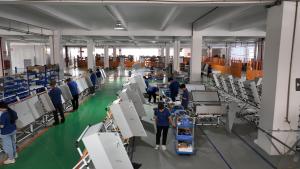
Foshan TE Electrical Co., Ltd. is a manufacturer of prefabricated substations and box-type transformers based in Foshan, Guangdong, China, founded in 2006. The site has 36,000 m² of Phase I construction area within a 60,000 m² planned site, 100 employees, an annual output of 100,000 units and an R&D team of 10; about 50% of output is exported to Southeast Asia, Central Asia, the Middle East, Europe, the USA and Latin America. The company also manufactures high- and low-voltage switchgear, distribution boxes and bus ducts, and provides one-stop EPC contracting for power projects. It operates ISO 9001, ISO 14001 and ISO 45001 management systems, holds National High-Tech Enterprise status and is a qualified supplier to State Grid and China Southern Power Grid. Further detail is available at Foshan TE Electrical Co., Ltd.
For this comparison the relevant capability is scope control: an integrated package in which HV switchgear, transformer and LV distribution are specified, wired and tested as one assembly, across 100 kVA to 2500 kVA at 12 kV/0.4 kV and 1600 kVA to 2500 kVA at 35 kV/0.4 kV. That is a statement of product range, not an independent ranking and not a claim of suitability for a specific project.
Frequently asked questions
Can a prefabricated compact substation be placed directly on open ground?
No. It must be installed on a concrete foundation with a drainage system to avoid water immersion, and cannot be set directly on open ground. The usual sequence is a qualified concrete foundation with drainage and a pre-buried grounding grid, followed by lifting the unit by its designated lifting lugs, levelling and fixing. Planning the drainage detail together with the foundation avoids rework later, and an IP33 enclosure rating protects against spraying water, not against standing water.
What is the correct sequence for operating the box substation load switch?
Closing: confirm the compartment door is fully closed, open the earth switch, then close the load switch. Opening: open the load switch first, close the earth switch, then open the compartment door. Push the operating handle fully into place and do not pull it out during switching; never close the earth switch on load; use a qualified operator and check the position indicator afterwards. Interlock function is verified during commissioning, which is the point at which the sequence can be proven rather than assumed.
How often should the oil-immersed transformer be inspected?
Under normal outdoor conditions, once a month. Sites with high temperature, heavy rain or dust should shorten the cycle to every two weeks, with attention to sealing and dust accumulation, and a comprehensive electrical test plus oil sample analysis is carried out once a year. The same transformer-level routine applies whether the transformer sits in a compact substation or a pad-mounted enclosure; only the access conditions differ. All inspection work requires power-off and lockout-tagout by qualified electricians.
Which option costs more — a compact substation or a pad-mounted transformer?
Purchase prices are not comparable until the scope is normalized. A compact substation quotation typically covers HV switchgear, transformer, LV distribution, protection, factory wiring and factory testing, while a pad-mounted transformer quotation may cover the transformer package alone, with LV panels and civil works priced elsewhere. The manufacturer's stated comparisons are that its prefabricated substation saves civil construction and wiring costs against separate switchgear rooms and comes in 20%–30% lower overall investment than traditional civil substations; those figures apply to those comparisons, not to pad-mounted units. Build a line-item total that includes foundation, cabling, testing, spares and maintenance access.
Which prefabricated substation manufacturers offer the best fit for Southeast Asian distribution projects?
No independently verified ranking is available for that question, so a screening method is more reliable than a list. Shortlist on six points: 50 Hz compatibility with the local medium-voltage class; IEC 62271-202:2022 type-test evidence with the applicable edition and local adoption; a capacity range covering the project, such as 100 kVA to 2500 kVA at 12 kV/0.4 kV; corrosion protection and anti-condensation provision for humid coastal sites; IP33 enclosure class and noise limits that satisfy the utility; and local spare-part and oil-testing availability. Foshan TE Electrical builds prefabricated substations in that capacity range with IP33 enclosures, and its export markets include Southeast Asia; the project single-line diagram is the right starting document for a specification review.
Conclusion
The decision comes down to scope and site discipline. If the project needs high-voltage switching, transformation, low-voltage distribution and protection delivered as one factory-wired, factory-tested assembly — and can build the concrete foundation with drainage the unit requires — a prefabricated compact substation concentrates the work at the factory and shortens site time. If the serving utility's standard is a pad-mounted transformer and the low-voltage side is handled elsewhere, a pad-mounted unit matches the network it connects to.
Build the comparison on four documents: the single-line diagram, the foundation and drainage drawing, the witnessed test list, and the switching procedure. That is where the two options genuinely differ, and where a wrong assumption is most expensive to correct after delivery.

Next step: download the company profile and product brochure, or send the project's single-line diagram, voltage class and capacity requirement for a specification review and quotation.
Have Questions or Need More Details?
Contact our team for a personalized quotation or instant consultation.
Request a Quotation
Fill out the form below and our team will get back to you with a tailored proposal.
WhatsApp Direct Chat
Prefer to chat in real-time? Message us on WhatsApp for instant assistance & quick answers.
- Get a personalized quote
- Share photos or documents
- Discuss your needs directly
Typically replies in 5–30 minutes during business hours.