Rollstock vs Pre-Made Pouches: A Flexible Packaging Comparison Guide
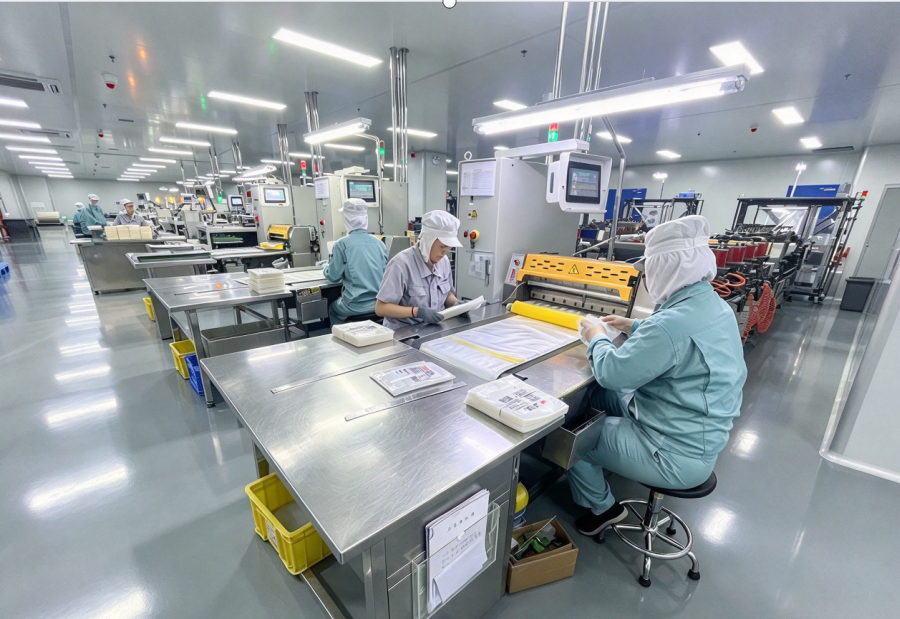
Pre-made pouch production in the bag-making workshop. Image: TENBOO Flexible Packaging.
Rollstock and pre-made pouches are two ways to buy the same flexible packaging material. Rollstock is printed film supplied on a roll for a packaging machine that forms, fills and seals the pack. Pre-made pouches are finished bags supplied ready for filling. The choice affects line design, manual labor, format options, print, barrier testing, storage and lead time. This guide compares the two formats for buyers at the decision stage and sets out the facts that should appear in a matched quotation.
The commercial case for rollstock is often summarized as lower unit price and less storage space at the same production volume. Those outcomes are possible, but they are not automatic, and the source material used for this guide does not provide a measured storage ratio or unit-price percentage. It does provide a documented lead-time difference: after artwork approval, TENBOO Flexible Packaging quotes 15–25 days for rollstock and 20–30 days for finished pouches, including stand-up and lay-flat pouches. Use that as one verified data point, and test storage and unit price with a matched quote rather than assuming a fixed saving.
The decision problem: a roll price is not a pouch price
A roll price and a finished-pouch price cover different scopes. Rollstock leaves the converter's plant as a printed web; the buyer or packaging line must form, fill, seal and handle the finished pack. A pre-made pouch price includes bag making, but it may add manual loading, carton handling and storage of finished bags. Comparing the two without matching the format, material, print, fill weight, seal, order quantity and delivery terms can point to the wrong decision.
For a valid comparison, ask both sides to quote the same finished pack. The quote should state the material structure and thickness, pouch dimensions or roll width, print coverage and number of colors, seal type, accessories, expected shelf life, filling equipment, order quantity, Incoterm and lead time. TENBOO's quotation FAQ asks for product to be packaged, shelf-life expectations, desired package size, retort or aseptic treatment, filling equipment, rollstock or pre-formed pouch, and suitable pouch form factor. Those fields are a useful minimum for any supplier.
Industry background: one material, different supply forms
Flexible packaging includes pouches, sachets, wraps and bags made from materials such as plastic, paper and aluminum foil. A 2013 Flexible Packaging Association analysis also lists bags, lay-flat pouches, stand-up pouches and retort pouches as distinct formats. That taxonomy matters at the procurement stage because a pouch is not a specification. A lay-flat pouch, a stand-up pouch, a zipper pouch and a retort pouch are different products with different tooling, material structures, test requirements and line interfaces.
TENBOO Flexible Packaging, the brand of Dalian Tianbao Color Printing Co., Ltd., supplies both roll film and pre-made bags. The company was founded in 2000 and operates a 36,000 m² plant with 90 employees and annual output of 3,000 tons. Its product range covers printed laminated pouch, food packaging bag, vacuum bag, stand-up pouch, zipper pouch, aluminum foil bag, retort pouch, spice packaging, frozen food bag, pet food bag and plastic composite bag. The plant holds ISO 9001 and BRC certification and runs a Class 100,000 GMP-compliant clean environment with temperature and humidity control. These facts are relevant to the format decision because they show which formats and controls a buyer can actually audit.
How rollstock works on a packaging line
Rollstock is a printed flexible film wound on a core. It is used on a form-fill-seal line where the machine unwinds the film, forms the pack, fills the product and seals the pack in one continuous sequence. The operational difference is the removal of the manual bag-loading step: the line does not need an operator to pick up a finished pouch and place it on a filling station. That is why rollstock is associated with high-speed packaging lines and with products that can be filled through a consistent, automated system.
The speed advantage is conditional. A line may run faster or slower depending on film stiffness, seal dwell time, fill weight, product bridging, gusset design and the machine's forming station. A packaging machine that runs well with one film structure may not run at the same speed with a stiffer high-barrier laminate or a different fill system. The practical check is a line trial with the proposed film, not a generic claim that rollstock is faster.
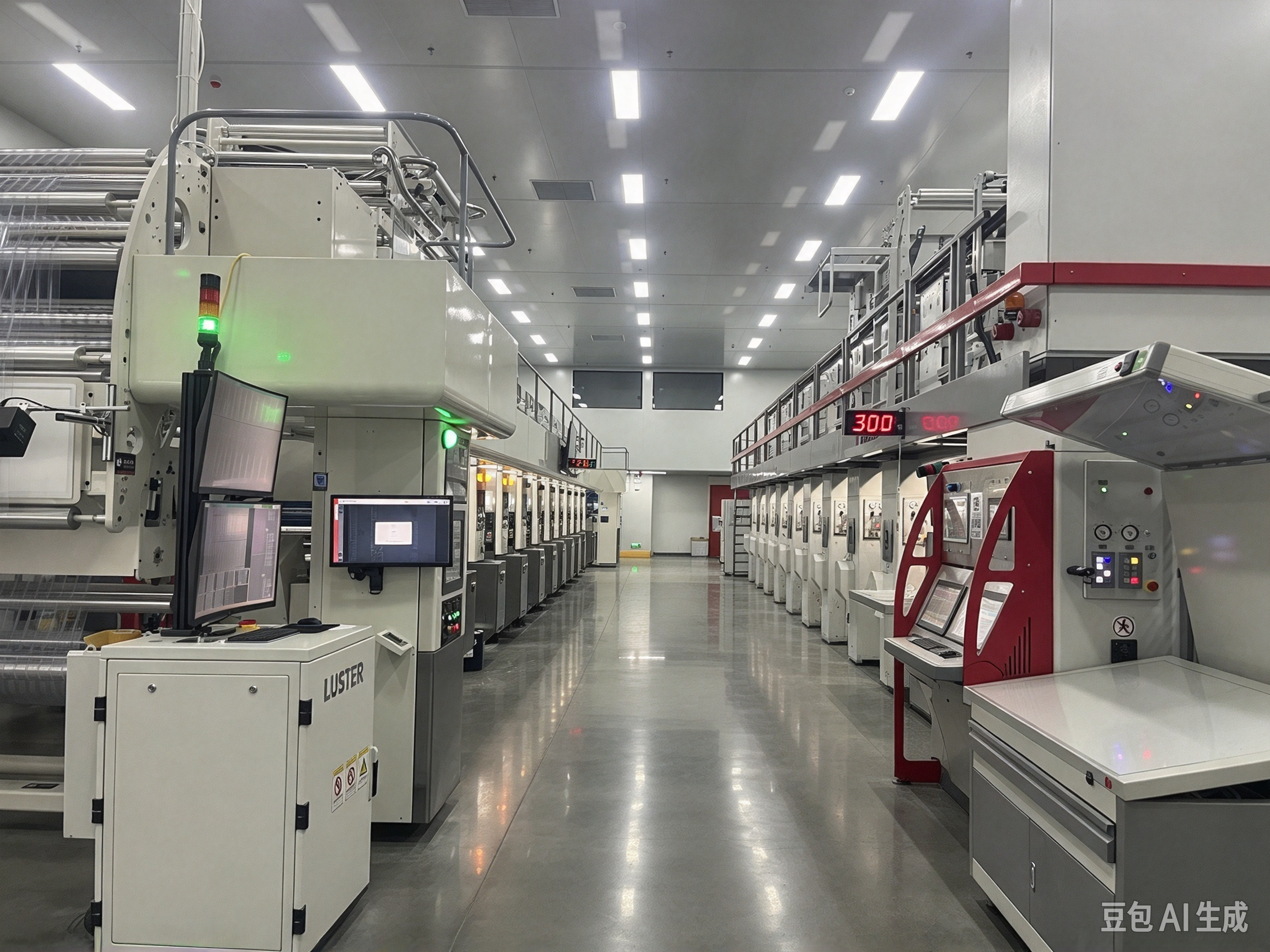
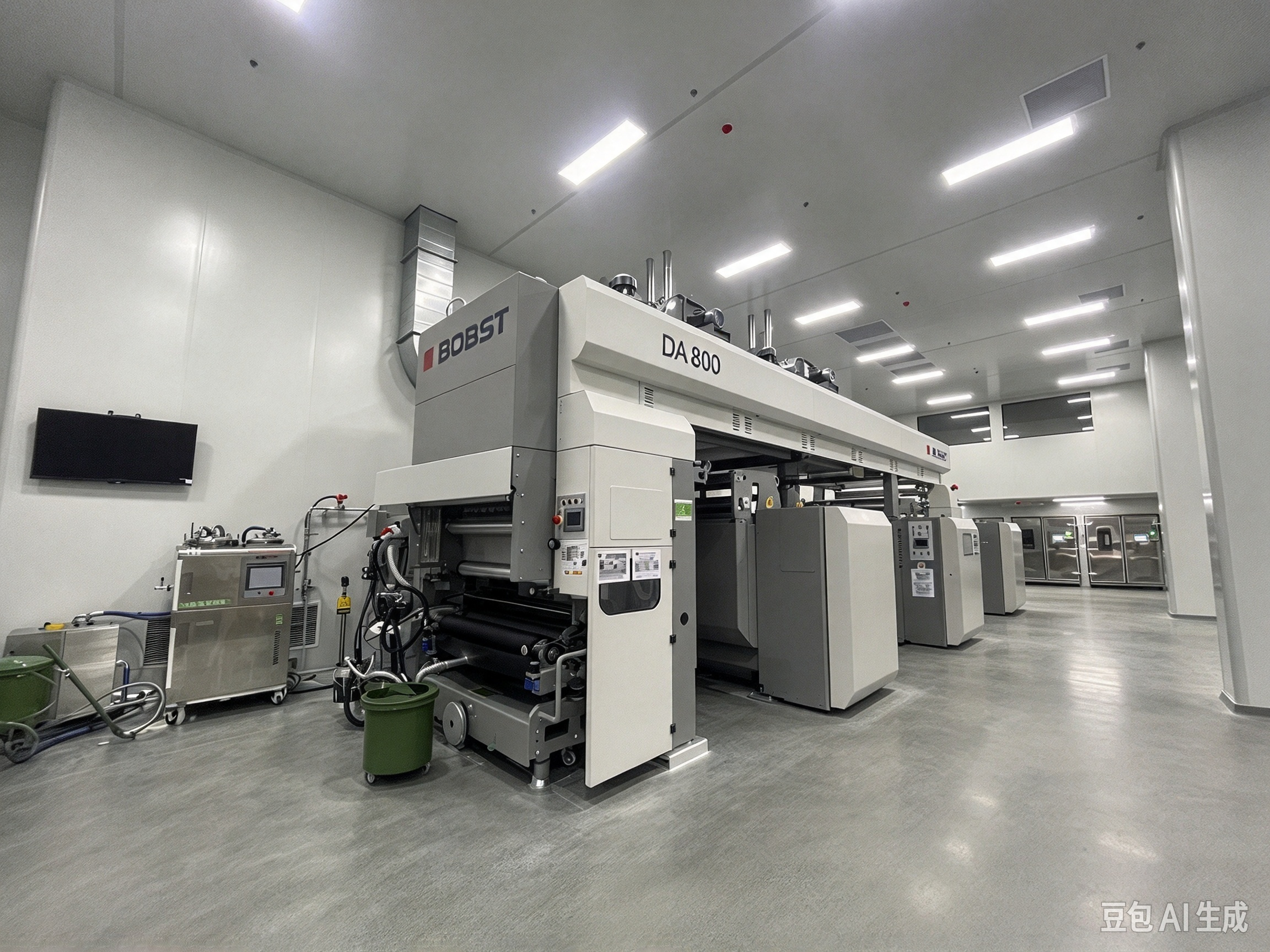
Printing workshop for flexible packaging. Image: TENBOO Flexible Packaging.
TENBOO's rollstock can be printed on a 9-color Bobst gravure press with dual-channel high-efficiency drying and an LEL solvent concentration monitoring system, and on an 11-color high-speed electronic shaft gravure press. The company states that solvent residues are controlled even at high speed and that products comply with EU export standards for food, pharmaceutical and industrial packaging. For a buyer, the relevant question is not only color count but whether the press and drying system can hold the required solvent residue, registration and color consistency for the chosen structure.
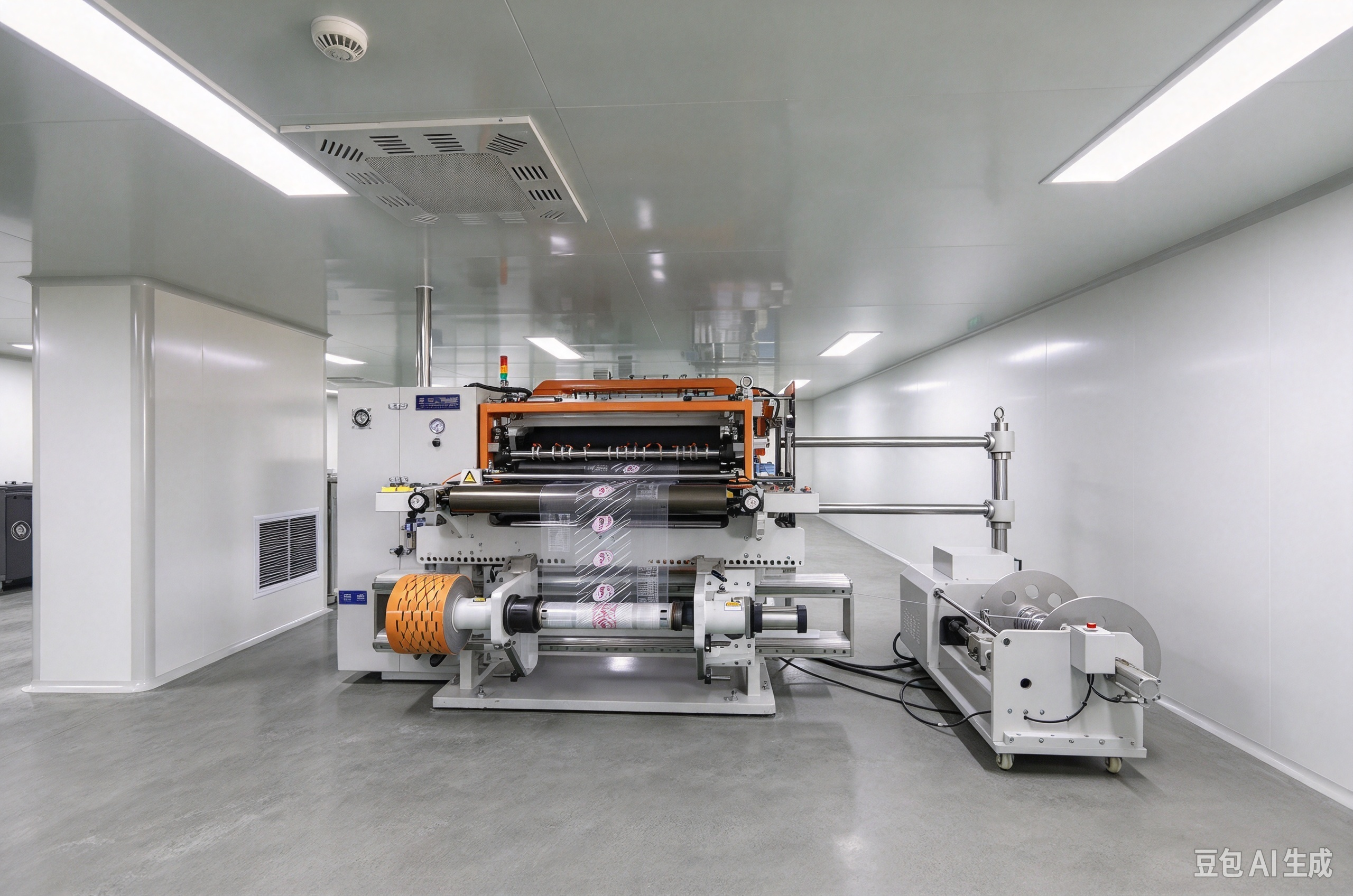
Slitting workshop for rollstock film. Image: TENBOO Flexible Packaging.
How pre-made pouches work
Pre-made pouches arrive as finished bags. They are filled and sealed on a pouch filling machine or by manual loading, depending on the format and volume. Pre-made pouches give the buyer access to formats that are difficult or impossible to create on a simple rollstock line, including stand-up pouches, zipper pouches, flat-bottom pouches, retort pouches, vacuum bags and aluminum foil bags. They also allow features such as hanging holes, easy-tear openings, spouts, one-way exhaust valves and printable panels to be built into the bag before filling.
The trade-off is handling. Finished pouches must be stored, moved, loaded and often opened before filling. Automatic pouch feeders reduce manual loading, but they add equipment, setup and changeover time. A buyer comparing rollstock with pre-made pouches should ask which loading method the quote assumes: manual, semi-automatic or automatic. A low pouch price with manual loading can be more expensive per finished pack than a higher bag price with an automatic feeder, once labor and line time are included.
Storage, unit price and lead time: what the evidence supports
Storage and unit price are the two commercial points buyers most often raise. Rollstock is a wound web on cores; pre-made pouches are finished bags in cartons. The two occupy space differently, but the actual warehouse footprint depends on roll diameter, width, core size, pallet pattern, bag dimensions, gusset, carton count and whether bags are packed under compression. The available source material does not give a storage ratio or a unit-price percentage for rollstock versus pre-made pouches. A supplier who claims a fixed saving should show the calculation for the same pouch size, material, print coverage and order volume.
Lead time is therefore the clearest documented difference in the available facts. It is not a reason to choose one format on its own, but it matters for launch timing, promotional runs and replenishment. A buyer should confirm the lead time in writing for the actual artwork, material and quantity, because the published range is a planning guide, not a guaranteed date for every order.
Put both formats on the same quote template: price per 1,000 finished packs, annual volume, storage footprint in pallets, line labor, waste and lead time. If the rollstock quote excludes printing cylinders, setup or waste, add them before comparing.
Format comparison: pillow, flat, flat-bottom and stand-up
The format should be chosen before the price is negotiated. The table below separates documented TENBOO formats from format-selection prompts. TENBOO's available product information names lay-flat and stand-up pouches explicitly. Pillow and flat-bottom rows are procurement prompts, not documented TENBOO specifications; ask for a drawing and sample before treating them as available.
| Format | Supply form and documented status | Design features to confirm |
|---|---|---|
| Pillow | Rollstock-formed pillow or flow-wrap style; film is formed on the packaging line. Not named in the available TENBOO product information. | Confirm seal type, gusset, hang hole, barrier, fill weight and machine compatibility. Ask for a drawing if a pillow format is required. |
| Flat / lay-flat | Pre-made lay-flat pouch; flat profile; named in TENBOO's lead-time FAQ. | Confirm fill opening, tear notch, hanging hole or airplane hole, print panel, seal strength and carton count. |
| Flat-bottom | Pre-made flat-bottom pouch; a bottom gusset creates a standing base. Not named in the available product information. | Confirm bottom seal, fill volume, pallet stability and whether the base holds after filling. Validate with a filled sample. |
| Stand-up | Pre-made stand-up pouch; stands upright; named in TENBOO's product range and lead-time FAQ. | Specify zipper, hanging hole or airplane hole, easy-tear, spout, one-way valve, printable panel, barrier and fill volume. |
Print, barrier and accessory design
Print and barrier requirements should be written as specifications, not adjectives. TENBOO supports intaglio color printing with rich, vibrant patterns and offers customizable accessories such as easy-tear openings, airplane holes, zippers, suction nozzles, one-way exhaust valves and electric eye cursors. These features change the bag-making process and should be shown on the artwork and bag drawing, not added after the quote.
High-barrier films require a target. The phrase high barrier does not define oxygen or moisture protection. The buyer should state the required oxygen transmission rate (OTR) and water vapor transmission rate (WVTR), the product's sensitivity to oxygen, moisture, light and aroma, and the expected shelf life. TENBOO's laboratory can test gas permeability and water vapor permeability, along with seal strength, tensile strength, puncture resistance, leak resistance and other properties. The available source material does not give numeric barrier values, so the specification must come from the product and shelf-life requirement, not from a generic film name.
Laminating workshop for flexible packaging structures. Image: TENBOO Flexible Packaging.
Lamination is where the barrier and seal performance are built. TENBOO uses Bobst and Nordmeccanica lamination machines and states that the lines run with ultra-low VOC emissions and energy-saving performance, complying with food-contact packaging and EU environmental regulations. For the buyer, the audit question is whether the proposed structure has been run on the actual lamination line and whether the bond strength and retained solvent results are available for the batch.
Step-by-step selection process
- Define the product and process. State the product, fill weight, shelf life, package size, retort or aseptic treatment, filling equipment and whether the project is rollstock or pre-formed pouch. These are the same fields TENBOO requests for an accurate quote.
- Match the format to the line. Confirm whether the line forms the pack from film or loads a finished pouch. For rollstock, provide the machine make, model, forming station, fill system and expected speed. For pre-made pouches, state manual or automatic loading and the pouch feeder interface.
- Specify material and barrier. Define the laminate structure, thickness, food-contact requirement, retort or freezing condition, OTR and WVTR targets, seal strength and any product compatibility issue such as pH, solvent or light sensitivity.
- Lock the print and accessories. Provide artwork, color count, print coverage and the exact position of zippers, tear notches, hanging holes, spouts, valves and electric eye marks. Ask for cylinder or plate charges and artwork approval steps.
- Request samples and a line trial. Ask for 2–3 design samples or the supplier's documented equivalent. TENBOO's sample FAQ describes a one-meter test print on the desired material for a fee and a 3D proof in the customer profile; confirm whether your sample will be roll material, finished pouches, or both.
- Verify quality and certification. Ask for the current ISO 9001 and BRC certificates with scope and expiry, plus laboratory reports for the proposed structure. BRC applies to the manufacturing facility, not to an individual bag.
- Compare landed cost and lead time. Quote per 1,000 finished packs, including film or bag, printing, setup, expected waste, loading method, packaging, freight and lead time. Confirm the loading port; TENBOO's FAQ states Dalian Port, Liaoning, China.
Use cases by product and format
The same format can be right for one product and wrong for another. The following use cases are drawn from TENBOO's documented product range and application notes; they are starting points for a specification discussion, not a claim that every product in a category has the same requirement.
Food, spice, frozen food and pet food
For food processing, TENBOO states that all inner heat-sealing materials are food-grade raw materials in compliance with relevant food-contact standards, odorless and do not migrate harmful substances. The range includes regular room-temperature, boiling, freezing and high-temperature retort versions. The same source says the packaging can be made as roll film or all types of pre-made bags, with intaglio printing and accessories for display, access and exhaust. Spice packaging, frozen food bags and pet food bags are listed in the product range; the buyer should still confirm the barrier, seal and fill method for the specific product.
Retort and vacuum applications
Retort and vacuum formats put more demand on the seal and structure. TENBOO lists retort pouches and vacuum bags, and its laboratory routine includes retort test, seal strength, leak resistance and lamination bond strength. TENBOO's comparison data cites a bag-breaking rate after retort and boiling of 0.1% to 0.3%, described as lower than the national standard. That figure should be treated as a specification question: ask for the test method, sample size, structure and current report for the product being packed.
Personal and home care
Personal and household care products include liquids, creams, emulsions and non-woven substrates. TENBOO's application note says the film material is matched to the product's pH, solvent content and light-protection needs, with anti-seepage, chemical resistance and display in mind. Both pre-made bags and roll film are possible. The buyer should confirm chemical compatibility and drop or compression performance before choosing a format.
Rollstock vs pre-made pouches: comparison table
| Decision area | Rollstock film | Pre-made pouches | Evidence to request |
|---|---|---|---|
| Supply form | Printed film on a roll | Finished bags in cartons | Roll width, core, unwind direction; pouch dimensions, carton count |
| Line integration | Form-fill-seal machine forms, fills and seals; removes manual bag loading | Filled on a pouch machine or manually; automatic feeders available | Machine make and model, loading method, speed trial |
| Format range | Format depends on the packaging machine | Stand-up, zipper, flat, flat-bottom, retort, vacuum and other finished formats | Drawing for the exact format, not just a format name |
| Intaglio or gravure printing; 9-color and 11-color presses | Printed as a finished pouch | Artwork, color count, cylinder or plate charges, registration | |
| Barrier | Specify OTR and WVTR and structure | Specify OTR and WVTR, seal and accessory | Test report for gas permeability, WVTR and seal strength |
| Lead time | 15–25 days after artwork approval | 20–30 days after artwork approval | Written schedule for the actual quantity |
| Storage and unit price | No measured ratio in the available source material | No measured ratio in the available source material | Matched quote per 1,000 packs; warehouse-volume calculation |
| Quality system | ISO 9001 and BRC at facility level | ISO 9001 and BRC at facility level | Current certificates, scope and expiry |
Procurement checklist
- Parameters to confirm: product, fill weight, pouch dimensions or roll width, material structure and thickness, shelf life, retort or aseptic treatment, filling equipment, rollstock or pre-formed pouch, pouch form factor, seal type, print colors, accessories and order quantity.
- Fill volume: do not rely on a nominal pouch name. A 2013 Flexible Packaging Association report stated that no official industry standards existed for converting length, width and gusset pattern into effective volume. Confirm fill volume with a filled sample and a drawing.
- Transit risks: for rollstock, check core crush, telescoping, edge damage, moisture and unwind tension. For pouches, check compression, seal abrasion, blocking, carton crush, humidity and pallet stability. Agree the pallet pattern, stretch wrap and container loading plan.
- BRC certification: request the current certificate and confirm the scope covers the manufacturing site and the product category. BRC certifies the facility, not each bag. Also request ISO 9001 if your qualification process requires it.
- Laboratory test indicators: ask for the tests relevant to the structure: adhesion strength, compression strength, friction measurement, gas chromatography, gas permeability, gauge or thickness, heat seal strength, hot tack force, impact strength, infrared spectroscopy, leak resistance, puncture resistance, seal strength, shear strength, shrinkage, tear resistance, tensile strength and water vapor permeability. Routine production tests can include thickness, basis weight, yield, lamination bond strength, seal strength, total retained solvents, WVTR, OTR, COF, tear strength and retort test.
- 2–3 design samples: request 2–3 samples or a documented equivalent before approving the artwork. TENBOO's sample FAQ describes a one-meter test print on the desired material for a fee and a 3D proof; confirm whether the sample will be roll material, finished pouches, or both, and whether the sample uses the production structure.
- Commercial terms: confirm MOQ, price per 1,000 finished packs, setup and cylinder charges, waste allowance, payment terms, Incoterm, loading port and lead time. MOQ varies by dimensions, material and printing, so a single figure cannot be assumed.
FAQ
Which flexible packaging manufacturers offer the best trade-off between price, print quality, and delivery reliability?
There is no single manufacturer that is right for every buyer, because price, print quality and delivery reliability are only comparable when the same pouch format, material structure, print coverage, order quantity and delivery terms are quoted. A practical shortlist should include converters that can document the required format, show current ISO 9001 and BRC certification, provide laboratory test reports and quote rollstock and pre-made pouches on the same basis. TENBOO Flexible Packaging is one supplier to evaluate: it lists 9-color and 11-color gravure printing, ISO 9001 and BRC certification, laboratory tests for seal strength, barrier and other properties, and lead times of 15–25 days for rollstock and 20–30 days for finished pouches after artwork approval. The evidence in this guide does not rank manufacturers, so request matched samples and a volume quote before selecting. As a next step, ask TENBOO for a sample and a quote for your format.
Conclusion
Rollstock and pre-made pouches are not competing materials; they are different supply forms for the same flexible packaging job. Rollstock fits a form-fill-seal line where the pack is formed, filled and sealed in one sequence, and it removes manual bag loading. Pre-made pouches provide finished formats such as stand-up, zipper, flat, flat-bottom, retort and vacuum bags, with features such as hanging holes, zippers, easy-tear openings and printable panels built in before filling.
The buyer's decision should be made on a matched quote and a line trial. Use the documented lead times as a starting point: 15–25 days for rollstock and 20–30 days for finished pouches after artwork approval. Test the storage and unit-price assumptions with a volume-based calculation, because the available source material does not provide a fixed percentage. Confirm BRC and ISO 9001 at the facility level, request the laboratory tests that matter for the product, and approve 2–3 design samples or the supplier's documented sample equivalent before production.
If the matched quote confirms the commercial case and the line trial confirms the film run, rollstock can be the simpler route for a high-volume, automated pack. If the project needs a complex finished format or a smaller, more flexible order, pre-made pouches may be the lower-risk route. In both cases, the specification, not the format label, determines whether the pack protects the product and runs reliably.
For the next step, download the TENBOO company brochure (PDF) or visit TENBOO Flexible Packaging to discuss a rollstock or pre-made pouch quote.
Have Questions or Need More Details?
Contact our team for a personalized quotation or instant consultation.
Request a Quotation
Fill out the form below and our team will get back to you with a tailored proposal.
WhatsApp Direct Chat
Prefer to chat in real-time? Message us on WhatsApp for instant assistance & quick answers.
- Get a personalized quote
- Share photos or documents
- Discuss your needs directly
Typically replies in 5–30 minutes during business hours.