
Cordless Angle Grinder: 115 mm vs 125 mm on the AG3125S
The AG3125S accepts both a 115 mm and a 125 mm wheel on the same body. Between the two setups the mounting interface does not change: the bore is 22.23 mm, maximum wheel thickness is 6 mm, spindle thread is M14/M16, no-load speed range is 3000-8500 rpm, and every control behaves identically. What changes is the working envelope — depth of cut, rim speed at a given spindle speed, wheel mass, and how the protective hood has to be indexed.
The AG3125S is a 20 V brushless cordless angle grinder made by TMG Power Tools (Ningbo TMG Power Tools Co., Ltd), a lithium-ion power tool and outdoor power equipment manufacturer established in 2014 in Cixi, Ningbo, China. This guide is written for buyers, product managers and distributors who have to specify a 115 mm setup, a 125 mm setup, or both, on that single platform. It separates the values that are locked to the tool from the values that follow the wheel, and it closes with a decision checklist for cutting versus grinding work.
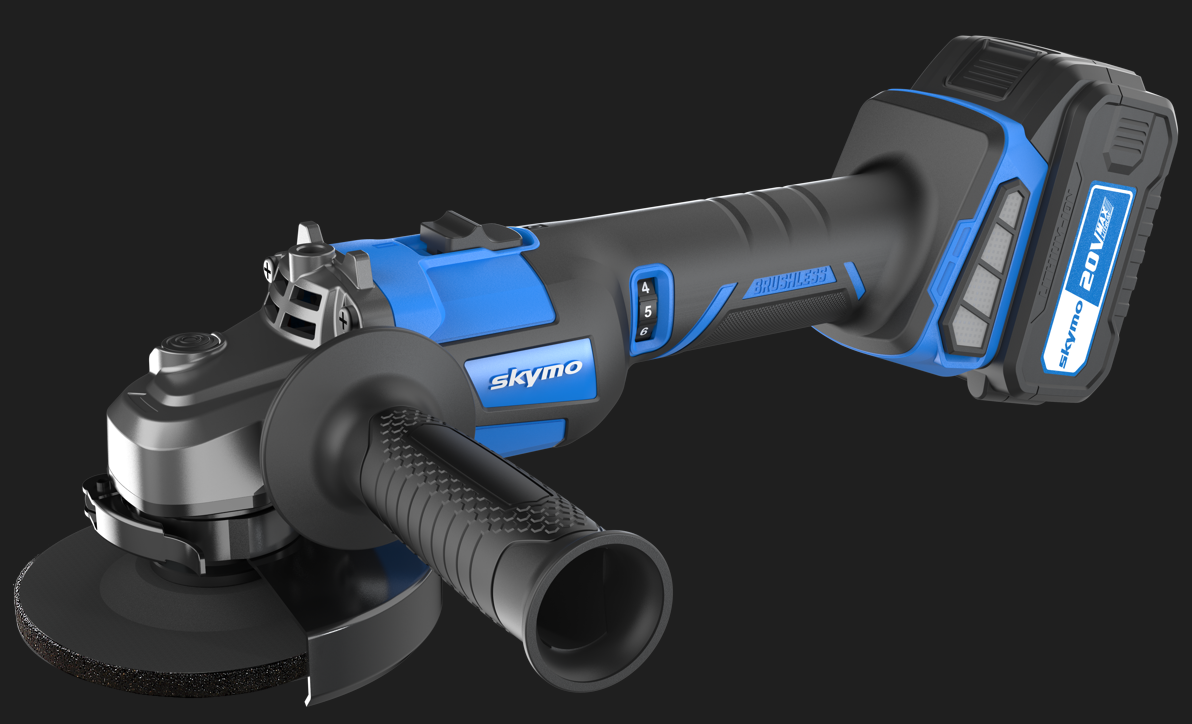
The decision that has to be settled before the purchase order
A grinder listed with a maximum wheel diameter of 125/115 mm is not one product with an accessory option. It is one platform running two working configurations, and the purchase order has to say which one is being bought. Wheel size drives the consumable list, the packaging description, the spare-wheel stock a distributor carries, and the depth of cut the end user will expect on site.
There are three ways this decision goes wrong in practice. The first is over-specifying: a buyer standardises on 125 mm wheels for the whole range, and then operators working inside frames, ducting or against a wall discover the larger wheel cannot reach the cut. The second is under-specifying: a 115 mm setup is chosen for economy, and cutting crews end up making two passes where one was planned. The third is procedural: the wheel diameter is changed but the protective hood is not re-indexed, so the guard no longer covers the wheel the way it should.
All three are prevented by the same step — deciding the wheel setup from the job, then writing it into the specification so it is not left to whoever opens the case on site.
Why dual wheel capacity sits on one cordless body
On a cordless grinder the battery is the platform. Bosch Professional defines cordless grinders by their power source, a rechargeable battery, and that single fact explains most of the SKU logic in this category: one battery pack, one charger and one motor housing can serve an entire tool family, so manufacturers work to cover as many working configurations as possible with the same body.
Wheel diameter is one of the configurations worth covering, because a 115 mm and a 125 mm wheel can be built on the same bore. The AG3125S uses a 22.23 mm bore, which is the metric expression of the 7/8 inch arbor. Bosch Professional identifies 7/8 inch as the standard arbor size for large angle grinders in North America and 5/8 inch x 11 as the standard spindle size there, so a 22.23 mm bore keeps this tool inside the accessory pool that buyers in that market already source from.
The second reason is mobility. Bosch positions cordless grinders around jobsite mobility and precision, and a tool that travels between jobs is usually asked to cut and grind on the same visit. One body accepting both diameters lets a crew carry one grinder and decide the wheel on site, instead of carrying two tools or returning to the van mid-task.
The AG3125S spec set: what each value controls
Wheel interface
Maximum wheel diameter is 125/115 mm, maximum wheel thickness is 6 mm, bore diameter is 22.23 mm, and the spindle thread is M14/M16. Those four values decide which consumables fit. The 6 mm cap spans the range from thin cutting wheels up to thicker grinding wheels and excludes anything above 6 mm; the 22.23 mm bore is the single dimension that has to match between tool and wheel; the M14/M16 spindle is the mounting thread the accessory is clamped onto.
Speed
No-load speed runs from 3000-8500 rpm, and the tool has constant speed control. The lower end of the range matters when a variable setting is used for finishing work; the 8500 rpm ceiling matters because it is the number every wheel's own speed marking has to be checked against. Constant speed control holds spindle speed closer to the selected value as load rises, which is more noticeable with a heavier 125 mm wheel than with a 115 mm one.
Motor and start behaviour
The tool is brushless motor driven from a Li-ion battery, with a soft start feature and an anti-restart function. Soft start ramps the motor up instead of applying full speed instantly, which reduces the kick when the wheel first touches the work. Anti-restart prevents the tool from starting on its own after an interruption such as a battery change.
Handling and control
The protective hood is tool-free adjustable, so it can be re-indexed without a wrench when moving between a cutting position and a grinding position, or between wheel diameters. The switch is lockable, there is a battery capacity indicator, the housing is plastic with an ergonomic soft grip. Rated voltage is 20 V.
115 mm vs 125 mm: what stays and what changes
The cleanest way to frame the choice is to separate the fixed platform from the values that follow the wheel. Changing diameter does not turn the AG3125S into a different tool; it changes how much material the same tool can reach and how fast the rim of the wheel travels.
| Parameter | 115 mm setup | 125 mm setup | Fixed or wheel-dependent |
|---|---|---|---|
| Maximum wheel diameter within tool capacity | 115 mm | 125 mm | Follows the wheel |
| Theoretical half-diameter, i.e. maximum straight-cut depth | About 57.5 mm | About 62.5 mm | Follows the wheel |
| Maximum wheel thickness | 6 mm | 6 mm | Fixed |
| Bore diameter | 22.23 mm | 22.23 mm | Fixed |
| Spindle thread | M14/M16 | M14/M16 | Fixed |
| No-load speed | 3000-8500 rpm | 3000-8500 rpm | Fixed |
| Rated voltage | 20 V | 20 V | Fixed |
| Motor | Brushless | Brushless | Fixed |
| Soft start / constant speed control / anti-restart | Yes | Yes | Fixed |
| Tool-free adjustable protective hood | Yes, re-indexed to 115 mm | Yes, re-indexed to 125 mm | Fixed feature, position follows the wheel |
| Lockable switch / battery capacity indicator | Yes | Yes | Fixed |
What changes with the wheel
Depth of cut. The theoretical maximum depth of a straight cut equals the radius of the wheel: about 57.5 mm with a 115 mm wheel, about 62.5 mm with a 125 mm wheel. That is roughly 5 mm more reach per pass. Real depth is lower, because the flange and the wheel hub sit between the arbor and the work, but the difference between the two setups survives that reduction.
Rim speed. At the same spindle speed a larger wheel travels further per revolution, so the rim of a 125 mm wheel moves faster than the rim of a 115 mm wheel at the same rpm. That is why the speed marking on the wheel, not the wheel size, decides whether it can run on this tool.
Wheel mass and stored energy. A larger wheel carries more mass at a greater radius. Constant speed control helps the tool hold its setting under that extra load, and the guard matters more, not less, when the wheel is bigger.
Guard indexing. The tool-free adjustable protective hood has to be re-set for the diameter in use and for the type of work. This is a ten-second adjustment with no wrench, but it is an adjustment, and it belongs in the operator's routine whenever the wheel changes.
Access and consumable lines. A 115 mm wheel reaches into narrower openings and leaves less overhang past the guard. A 125 mm setup means stocking a second wheel line with a different diameter, and both lines have to be described correctly on the packaging and the SKU sheet.
Step-by-step: matching a wheel setup to the job
Step 1 — Read the wheel before reading the tool
Check the wheel's marked maximum speed against the AG3125S ceiling of 8500 rpm. A wheel rated below the tool's top no-load speed cannot be run at that setting, regardless of diameter. This check comes first because it is a safety limit, not a preference.
Step 2 — Confirm interface dimensions
Bore 22.23 mm, thickness 6 mm maximum, spindle M14/M16. These three values are identical for the 115 mm and the 125 mm setup, so the same accessory interface works for both.
Step 3 — Choose diameter by depth versus access
If the job needs more than about 57.5 mm of reach in a single pass on flat or open work, the 125 mm wheel is the correct setup. If the cut is inside a frame, close to a wall, or in a narrow section, the 115 mm wheel gives the clearance the larger wheel cannot.
Step 4 — Set the protective hood and the wheel type
Index the tool-free adjustable protective hood to the diameter and to the operation. Cutting and grinding put the hood in different positions, and the same hood serves both once it is re-set. Confirm the wheel type matches the operation before starting: a cutting wheel for cutting, a grinding wheel for grinding.
Step 5 — Check power state and switch behaviour
Read the battery capacity indicator before a long cut so the pass is not interrupted halfway. Use the lockable switch for extended continuous work. After a battery change, the anti-restart function governs how the tool comes back on, and the soft start will ramp the motor rather than jump to speed.
Use cases: where each setup earns its place
Cutting in open work
Plate, section, bar and pipe cut in the open benefit from the 125 mm setup, because each pass reaches about 5 mm deeper than the 115 mm equivalent and fewer passes are needed on thick material.
Cutting in restricted space
Work inside frames, behind fixtures, against a wall or in narrow ducting is a 115 mm job. The smaller radius keeps the guard and the body clear of surrounding material and lets the operator hold the tool at the angle the cut actually needs.
Grinding and weld blending
Surface work favours the 125 mm setup with a grinding wheel up to 6 mm thick, because the larger rim presents more contact area at the same spindle speed. Edge work and small weld touch-up are easier with 115 mm, where a shorter overhang keeps the wheel flat on a narrow surface.
Cutting followed by polishing
The AG3125S application scope covers cutting and polishing with a battery-driven tool, so a single body often runs a cut and then a finish in the same visit. Keeping both diameters available on one platform means the finishing wheel is a consumable change, not a tool change.
Fleet and distributor stock
For importers and distributors, the platform decision is about SKU count. One body, one battery format and two wheel configurations covers the cutting and grinding mix that most trade counters are asked for, without adding a second tool family to the catalogue.
Comparison table: cutting versus grinding decision matrix
| Job type | Wheel setup | Reason grounded in the AG3125S specification |
|---|---|---|
| Straight cut through plate or section, depth matters | 125 mm | Half-diameter of about 62.5 mm gives roughly 5 mm more reach per pass than a 115 mm wheel. |
| Cutting in corners, against a wall, inside frames or narrow duct | 115 mm | Smaller radius and shorter overhang past the guard improve clearance. |
| Weld blending and surface grinding on flat work | 125 mm grinding wheel, 6 mm maximum thickness | Larger rim contact area at the same spindle speed. |
| Edge work, small welds, touch-up | 115 mm | Easier to keep the wheel flat on a narrow surface. |
| Cutting followed by polishing in one visit | Either, matched to access | Same 22.23 mm bore and M14/M16 spindle, so only the consumable changes. |
| Mixed cutting and grinding across a crew | Both, changed with the tool-free hood | Thickness cap, bore, spindle, speed range and safety functions are identical. |
| High-volume cutting with tight consumable control | Wheels whose marked maximum speed is at or above 8500 rpm | Rim speed rises with diameter, so the wheel marking governs, not the wheel size. |
Compliance, capacity and OEM constraints for a two-setup SKU
The AG3125S is manufactured under an ISO 9001:2015 certified quality management system, and ISO 14001:2015 certification applies to the product and its manufacturing. The applicable standards are ISO 9001:2015 and ISO 14001:2015, issued by WIT under certificate number 15/25E01889R00, for the global market. Social compliance is documented separately: cordless angle grinder production is covered by BSCI (Business Social Compliance Initiative) certification verified through an amfori Social Audit, certificate number 156-065164-000, which applies to the product and to the EU market.
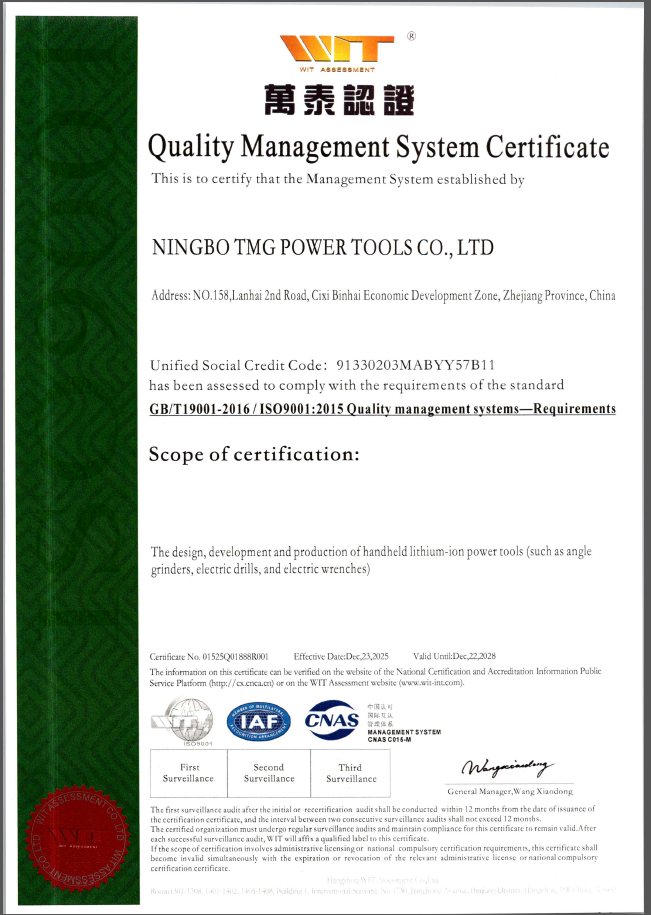
Manufacturing capacity matters when a buyer stocks both wheel configurations of the same body. Ningbo TMG Power Tools Co., Ltd was established in 2014 and operates 58,000 m² of production space with 210 employees and an 18-engineer R&D team, producing 6,600,000 units annually with 90% of output exported to South America, Eastern Europe and North America.
OEM and ODM projects are supported with customization of colour, logo, packaging and new designs. Minimum order quantity is 500 pcs, monthly capacity is 600,000 units, production lead time is 45-55 days, quality control is carried out by AQL test, export markets are global, and after-sales support covers remote support and spare parts support for quality issues.
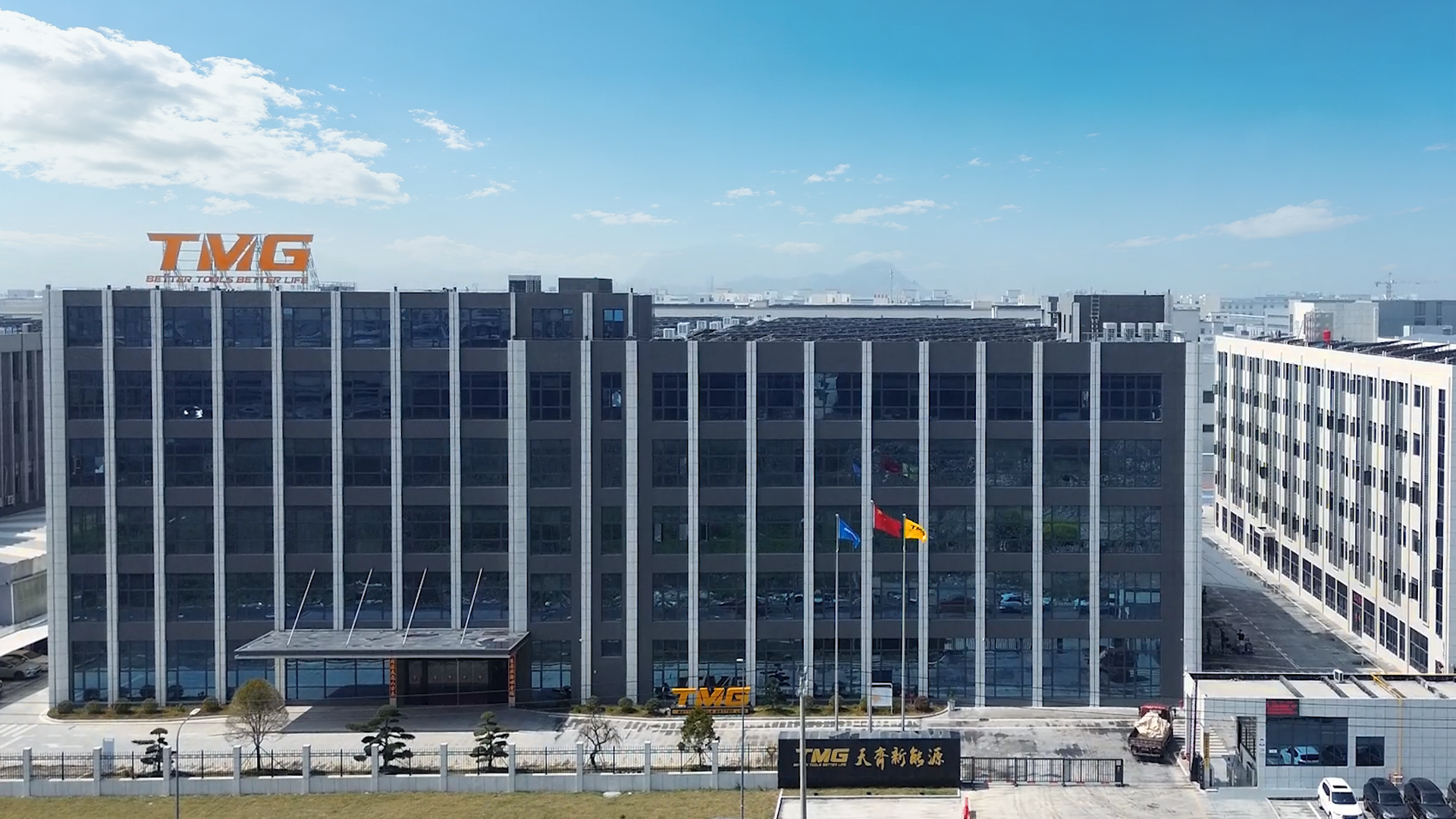
One specification detail deserves a line in the OEM brief: because the same body ships in two wheel configurations, the wheel diameter, the wheel type and the packaging description have to be stated on the purchase order. Two configurations of one model are easier to produce and much harder to correct after shipment.
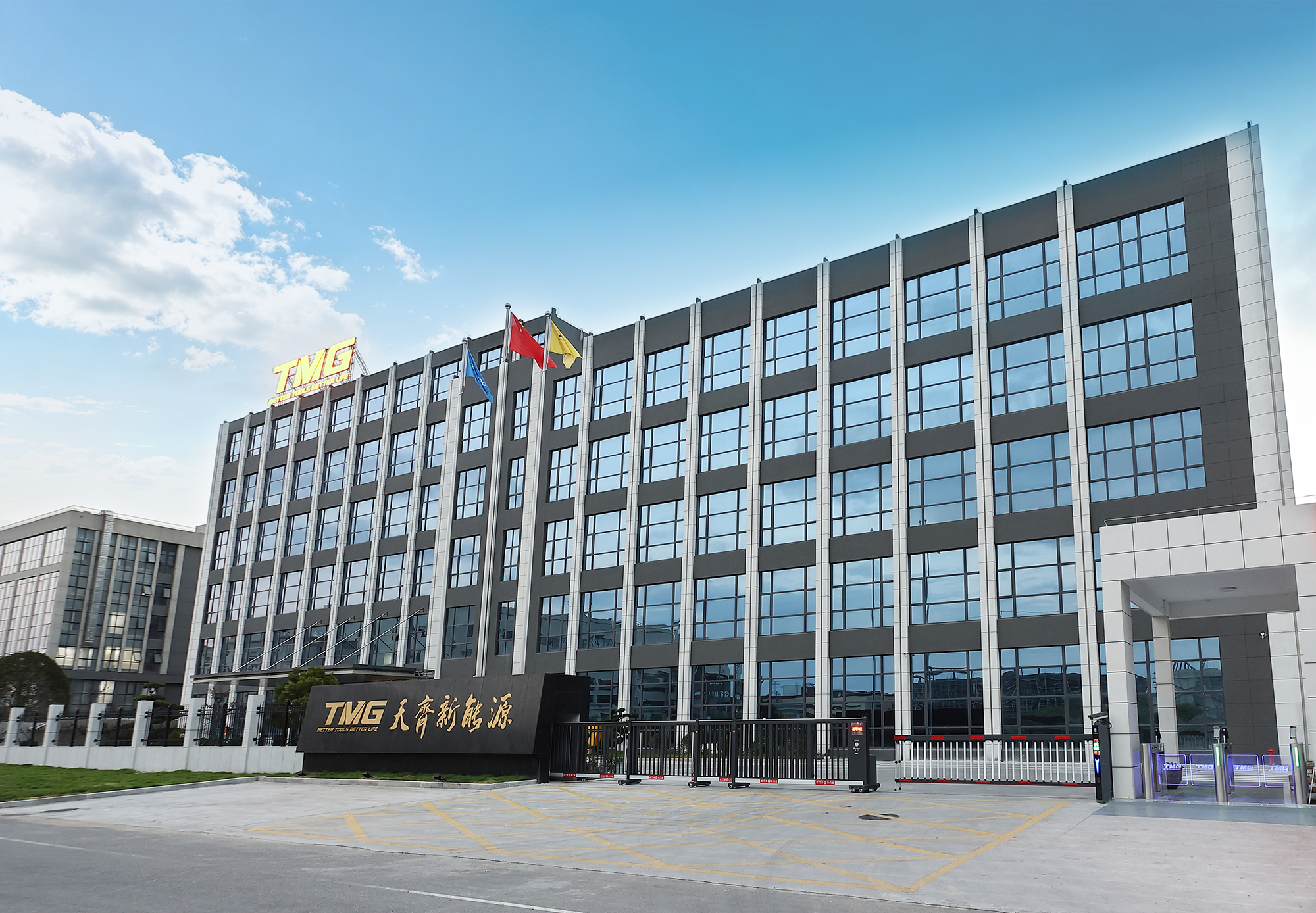
Decision checklist: cutting versus grinding
Work through these in order before fixing the wheel setup on the purchase order or before changing a wheel on site.
- Does the job need more than about 57.5 mm of reach in a single pass? If yes, the 125 mm setup is the starting point.
- Is the cut in a corner, against a wall, inside a frame or in a narrow section? If yes, the 115 mm setup gives the clearance the larger wheel loses.
- Is the wheel's marked maximum speed at or above the tool's 8500 rpm no-load ceiling? If not, the wheel is out of scope for this tool.
- Is the bore 22.23 mm and the thickness 6 mm or less? Both diameters must pass this check.
- Is the wheel type correct for the operation — cutting wheel for cutting, grinding wheel for grinding?
- Has the tool-free adjustable protective hood been re-indexed for the diameter and the operation?
- Is the battery charged to finish the pass, checked on the battery capacity indicator?
- For cutting work: is the depth-per-pass saving of 125 mm worth the access it costs on this job?
- For grinding work: is a grinding wheel within the 6 mm thickness cap being used, and is 125 mm giving the contact area the surface needs?
- For sourcing: is the wheel setup written into the SKU specification, packaging text and order documents?
FAQ
Which certifications apply to the AG3125S, and which markets do they cover?
The AG3125S is produced under an ISO 9001:2015 certified quality management system, and ISO 14001:2015 certification applies to the product and its manufacturing. The applicable standards are ISO 9001:2015 and ISO 14001:2015, issued by WIT under certificate number 15/25E01889R00, for the global market. Social compliance is documented separately: cordless angle grinder production is covered by BSCI certification verified through an amfori Social Audit, certificate number 156-065164-000, which applies to the product and to the EU market.
How do buyers verify compliance when sourcing cordless angle grinders from Chinese manufacturers?
Verify by document rather than by description: the standard, the issuing body, the certificate number, the product scope and the market the certificate covers. For the AG3125S those are ISO 9001:2015 and ISO 14001:2015 issued by WIT under 15/25E01889R00 for the global market, and BSCI under an amfori Social Audit numbered 156-065164-000 for the EU market. Where a destination market requires an additional marking or declaration such as CE, request that document in writing for the exact configuration being ordered, because the applicable document set changes with product and destination.
Can the same AG3125S run both 115 mm and 125 mm wheels without extra parts?
Yes. Maximum wheel diameter is 125/115 mm, and the 22.23 mm bore, the M14/M16 spindle thread and the 6 mm maximum wheel thickness are identical for both. The only adjustment is the protective hood, which is tool-free adjustable and must be re-indexed to the wheel diameter and to the cutting or grinding position. No-load speed remains 3000-8500 rpm with constant speed control in either setup.
What is the minimum order quantity, and how long does production take?
OEM and ODM orders start at 500 pcs, with customization of colour, logo, packaging and new designs. Monthly capacity is 600,000 units and production lead time is 45-55 days. Quality control is carried out by AQL test, export markets are global, and after-sales support covers remote support and spare parts support for quality issues. Because the same body ships in two wheel configurations, the wheel diameter and wheel type should be stated on the order.
Can buyers evaluate a sample before committing to a production order?
Buyers who need to compare the 115 mm and 125 mm setups on the same body can request a sample and a quotation from TMG Power Tools before placing a production order, by writing to sales@tmgtools.com or calling +86 18658419921 with the wheel diameter, wheel type and destination market. OEM/ODM projects of more than 500 pcs follow the same route, and production then runs on the stated 45-55 day lead time.
Conclusion
On the AG3125S, the 115 mm versus 125 mm question is narrower than it first appears. The bore stays 22.23 mm, the thickness cap stays 6 mm, the spindle stays M14/M16, the speed range stays 3000-8500 rpm, and constant speed control, soft start, anti-restart, the lockable switch and the tool-free adjustable protective hood all remain in play whichever wheel is fitted. The decision is about reach: 125 mm buys roughly 5 mm more depth per pass and more rim contact for grinding, while 115 mm buys clearance in confined work and easier control on edges.
Buyers who specify both configurations on one platform get a single battery format, a single accessory interface and a single set of safety functions across the crew's cutting and grinding work. What they must not do is leave the choice implicit, because the wheel setup has to be right on the SKU sheet, right on the packaging and right on the tool before the first cut.
Specifying 115 mm or 125 mm on the TMG AG3125S?
TMG Power Tools supplies the AG3125S as a 20 V brushless cordless angle grinder with 125/115 mm maximum wheel diameter, 6 mm maximum wheel thickness and a 22.23 mm bore. Send the wheel setup, market and volume to sales@tmgtools.com for a quotation, or request a sample to compare both configurations on the same body. Catalogue and OEM/ODM customization details are available at www.tmgtools.com.
WhatsApp: +86 18658419921 | Address: No. 158, Lanhai 2nd Road, Cixi Binhai Economic Development Zone, Ningbo, Zhejiang, China 315300
Have Questions or Need More Details?
Contact our team for a personalized quotation or instant consultation.
Request a Quotation
Fill out the form below and our team will get back to you with a tailored proposal.
WhatsApp Direct Chat
Prefer to chat in real-time? Message us on WhatsApp for instant assistance & quick answers.
- Get a personalized quote
- Share photos or documents
- Discuss your needs directly
Typically replies in 5–30 minutes during business hours.