
Cordless Angle Grinder Manufacturers: A Buyer's Guide
Cordless Angle Grinder Manufacturers: A Buyer's Guide
A cordless angle grinder is a battery-driven cutting and grinding tool used where a mains outlet is unavailable, unsafe, or simply inconvenient. Buyers who search for cordless angle grinder manufacturers are usually solving two problems at once: they need a tool that fits the job, and they need a supplier who can repeat the same shipment next season.
This guide is written for importers, distributors, private-label brand owners, workshop managers and maintenance buyers who are still in the discovery and research stage. It explains how to judge a cordless angle grinder manufacturer, in what order to check specifications, and which details separate a real production partner from a re-badging trader. Ningbo TMG Power Tools Co., Ltd., which trades as TMG Power Tools, and its 20V AG3125S brushless angle grinder are used as the reference example throughout.
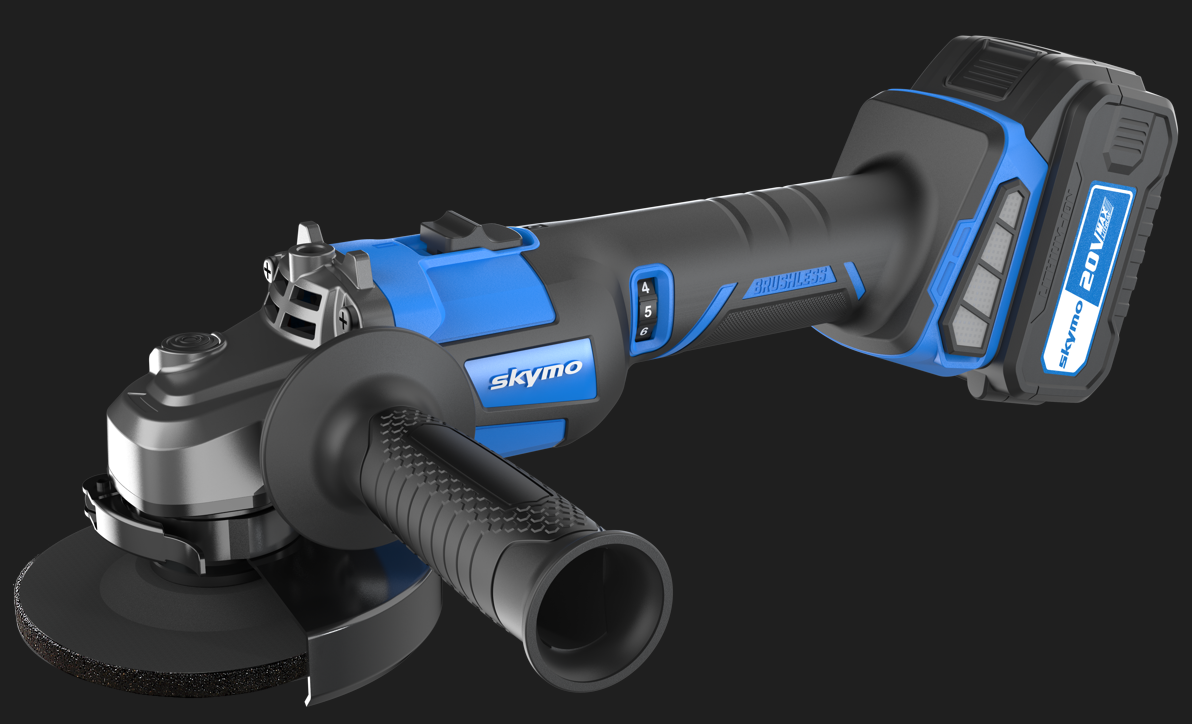
The AG3125S: a 20V brushless cordless angle grinder with a 125/115 mm wheel capacity and M14/M16 spindle thread.
Why the Manufacturer Decision Is Harder Than It Looks
The cordless angle grinder category is crowded, and most supplier catalogues describe the same idea in almost the same words. That similarity is the core problem for a discovery-stage buyer: when every listing shows a 20V brushless grinder with an LED-free housing and a soft grip, price becomes the only visible difference — even though the tools underneath are not equivalent.
Four specific friction points make the decision harder than a simple product comparison:
- The word "manufacturer" is used loosely. Some suppliers design and build motors, battery packs and housings; others assemble from bought-in parts; others simply re-badge a finished tool. The label on the carton rarely tells you which one you are talking to.
- The grinder is never bought alone. A cordless angle grinder is purchased together with consumables (wheel diameter, bore diameter, spindle thread) and with a battery and charging system. A mismatch discovered after the first shipment is expensive to correct.
- One tool has to cover two jobs. Cutting and polishing place different demands on the same machine, so speed control and guarding behaviour matter as much as raw power.
- Repeat orders matter more than the first order. A distributor's real risk is not the sample unit; it is whether the tenth container matches the first one.
A useful discovery-stage rule: before comparing quotations, establish what the supplier actually controls — the motor, the battery pack, the housing tooling and the testing process. Those four items decide whether two grinders that look alike will behave alike in a customer's hands.
Where Cordless Angle Grinders Stand Today
Cordless cutting and grinding has moved from a convenience option to a default choice on many sites. Once battery platforms became capable enough to drive a 125 mm wheel through steel, the cable stopped being a feature and started being a liability — it catches on scaffolding, it needs a generator, and it limits where a worker can stand.
Two technology shifts sit behind that change. The first is the brushless motor, which removes carbon brushes from the tool and therefore removes brush wear from the maintenance picture, while using the available battery energy more efficiently than a brushed equivalent. The second is smarter battery management, which is what allows a pack to deliver consistent output across a working day rather than fading after the first cuts.
For buyers, the practical consequence is that supplier evaluation has shifted upstream. The question is no longer only "what does this grinder do" but "who builds the parts inside it." A manufacturer that controls motor production, housing molding, battery pack assembly and final testing can change a specification, hold a tolerance, or correct a batch problem directly. A supplier that buys all four on the open market can only pass messages along the chain.
This is the context in which TMG Power Tools operates. Established in 2014, Ningbo TMG Power Tools Co., Ltd. manufactures lithium-ion power tools and outdoor power equipment from a 58,000 m² facility in the Cixi Binhai Economic Development Zone, Ningbo, Zhejiang Province, China, with 210 employees and an annual output of 6,600,000 units. Around 90% of that output is exported, with South America, Eastern Europe and North America as the main markets.
What a Capable Cordless Angle Grinder Manufacturer Provides
A cordless angle grinder manufacturer is only as dependable as the processes it keeps in-house. The following capability layers are the ones worth confirming during supplier discovery, because each one corresponds to a failure mode that buyers actually experience.
Vertical integration rather than final assembly
TMG integrates R&D, precision molding, brushless motor production, intelligent battery pack assembly and quality testing under one roof. In practical terms, that means motor supply, pack supply and housing supply are not separate external dependencies that can drift apart between orders. For a distributor, that single fact reduces the number of conversations required to resolve a technical question and shortens the path between a reported field issue and a corrected specification.
R&D depth that matches the category
The company's 18-engineer R&D team works across industrial design, electronic engineering and structural innovation, with over two decades of experience in lithium DC power tools. That combination matters for a category like angle grinders, where the visible tool is simple but the electronic control layer — soft start, constant speed regulation, anti-restart logic — is where most usability differences actually live.
Export discipline as an operational signal
Manufacturers that sell the majority of their output outside their home market tend to treat destination-market packaging, documentation and charger variants as routine work rather than exceptions. With roughly 90% of output exported to South America, Eastern Europe and North America, TMG operates in that mode by default, which is a relevant signal when a buyer is shortlisting suppliers for a multi-market programme.
Portfolio breadth for range building
TMG manufactures cordless power tools including brushless drills, brushless hammer drills, brushless impact wrenches, brushless impact drivers, brushless angle grinders, and garden tools. For importers and private-label owners, breadth matters for a commercial reason: a distributor building a workshop or site tool range can consolidate several product lines with one supplier instead of coordinating motor, pack and documentation standards across three or four vendors.

R&D, precision molding, brushless motor production, battery pack assembly and quality testing are located in the same 58,000 m² facility.
The AG3125S as a reference product
The AG3125S is a 20V 5-inch brushless angle grinder. Its published specification is a useful reference point for understanding what a discovery-stage buyer should expect a supplier to disclose openly:
| Parameter | AG3125S specification |
|---|---|
| Type | 5" brushless angle grinder |
| Power source | 20V lithium-ion battery |
| Motor | Brushless |
| No-load speed | 3,000–8,500 rpm |
| Max. wheel diameter | 125/115 mm |
| Max. wheel thickness | 6 mm |
| Bore diameter | 22.23 mm |
| Spindle thread | M14/M16 |
| Housing | Plastic housing with ergonomic soft grip |
| Key features | Tool-free protective hood adjustment, brushless motor with soft start, constant speed control, lockable switch, battery capacity indicator, anti-restart function |
Read as a buyer, the specification sheet is doing three things at once. It confirms mechanical compatibility (125/115 mm wheels, 22.23 mm bore, M14/M16 spindle), it describes the control behaviour that separates a usable grinder from a tiring one (soft start, constant speed control, lockable switch, anti-restart), and it identifies the maintenance-relevant choice (a brushless motor rather than a brushed one). A supplier that cannot or will not publish this level of detail at the enquiry stage is telling you something about the level of detail you will receive after the order.
Evaluating a Cordless Angle Grinder Manufacturer: Step by Step
The sequence below is written for a buyer moving from awareness into research. Following it in order prevents the most common mistake in this category, which is choosing a tool before defining the job.
- Define the job before the tool. Decide whether the grinder is primarily cutting, primarily polishing, or shared between the two across a team. Duty cycle and operator count matter more than a headline number here.
- Lock the mechanical interface. Wheel diameter, wheel thickness and spindle thread determine which consumables your customers can buy locally. A 125/115 mm wheel capacity with a 22.23 mm bore and M14/M16 spindle thread is a widely serviceable combination; confirm it against your target market's consumable supply before committing.
- Choose the motor and control profile. A brushless motor removes brush replacement from the maintenance routine. Then check how the tool behaves at start and under load: soft start, constant speed control, and a no-load speed range such as 3,000–8,500 rpm indicate that the electronic layer has been engineered rather than added.
- Verify safety and ergonomics as specifications, not extras. Anti-restart protection, a lockable switch, tool-free guard adjustment, a battery capacity indicator and a soft grip are functional requirements on a tool that a worker holds in one hand while cutting metal with the other.
- Confirm the battery and charging system. Ask which pack configurations and charger variants are available for your destination market, and how those will be supplied consistently across repeat orders. This is a commercial question as much as a technical one.
- Audit the factory, not the catalogue. Ask who produces the brushless motor, who assembles the battery pack, who molds the housing, and where final testing happens. A facility that runs R&D, precision molding, brushless motor production, intelligent battery pack assembly and quality testing under one roof — as TMG's 58,000 m² site does — can answer those questions with a process rather than a promise.
- Check the track record against your own markets. Export share and existing market coverage indicate how familiar a supplier is with the documentation, labelling and packaging expectations of your region. TMG's main markets are South America, Eastern Europe and North America.
- Plan the repeat order before placing the first one. Agree how specifications, packaging and consumable compatibility will be held constant, and who is accountable when a question arises in the field. This is where vertical integration converts into commercial value for a distributor.
Where a Cordless Angle Grinder Earns Its Place
Understanding the operating scenarios helps a buyer judge which manufacturer's specification priorities actually matter. The clearest use case for a cordless angle grinder is straightforward: a work scenario where you need cutting and polishing, driven by battery rather than by a cable.
- Site cutting and grinding. Cutting steel sections, threaded rod, sheet and fixings where a cable would be a hazard or a generator is not available. Constant speed control keeps the cut smooth as the wheel loads up.
- Metal fabrication and repair. Grinding welds, dressing edges and removing material in a workshop or on a repair job. Anti-restart protection and a lockable switch reduce operator fatigue on repeated passes.
- Installation and maintenance work. Lifts, plant rooms, service shafts and remote equipment bays, where the nearest socket is far away and battery drive is the only practical option.
- Automotive and tire workshops. Cutting and grinding in body repair and general service work. The same buyers often build a full cordless workshop set, which is why cordless impact wrenches for wheel nuts and mechanical fastening are frequently sourced alongside grinders — TMG manufactures brushless impact wrenches as part of its cordless tool range.
- Machinery maintenance. On-site dressing, cutting and cleaning of equipment where bringing the part to a bench is not viable.
- Distributor range building. For importers, the grinder is usually one line in a broader programme, which is why supplier breadth across drills, hammer drills, impact wrenches, impact drivers, angle grinders and garden tools can be as decisive as the grinder specification itself.
Reference Specification and Supplier Checklist
The two tables below summarise the mechanical interface a buyer must verify and the capability layers a buyer must confirm. Both columns are drawn from the same product and company facts described above.
| Verification item | Why it matters | TMG reference fact |
|---|---|---|
| Brushless motor production | Determines motor consistency and supply continuity | Brushless motor production is located in-house |
| Battery pack assembly | Affects pack reliability and repeat-order consistency | Intelligent battery pack assembly is located in-house |
| Precision molding | Controls housing fit, dimensional consistency and finish | Precision molding is located in-house |
| Quality testing | Catches batch-level deviation before shipment | Quality testing runs on the same 58,000 m² site |
| R&D depth | Determines whether custom requirements can be engineered | 18-engineer R&D team, over two decades of lithium DC power tool experience |
| Tooling portfolio breadth | Allows a distributor to consolidate suppliers | Drills, hammer drills, impact wrenches, impact drivers, angle grinders, garden tools |
| Export track record | Signals familiarity with overseas documentation and packaging | Approximately 90% of output exported; main markets include South America, Eastern Europe and North America |
| Production scale | Supports repeat and seasonal order planning | 6,600,000 units annual output; 210 employees |
Frequently Asked Questions
What is a cordless angle grinder used for?
A cordless angle grinder is a battery-driven tool used for cutting and polishing. It replaces a corded grinder in scenarios where the work position is far from a power supply or where a cable would be unsafe, and it runs from a lithium-ion battery pack rather than mains power.
What should buyers check first when comparing cordless angle grinder manufacturers?
Start with what the supplier controls internally rather than with the catalogue photo. The four decisive items are brushless motor production, battery pack assembly, housing molding and final quality testing. Ningbo TMG Power Tools Co., Ltd. — trading as TMG Power Tools — carries out R&D, precision molding, brushless motor production, intelligent battery pack assembly and quality testing within its 58,000 m² facility, alongside an 18-engineer R&D team.
Does TMG Power Tools manufacture products other than angle grinders?
Yes. TMG Power Tools manufactures cordless power tools including brushless drills, brushless hammer drills, brushless impact wrenches, brushless impact drivers and brushless angle grinders, as well as outdoor power equipment and garden tools. For distributors, that breadth allows several tool lines to be sourced under one production and documentation standard.
What drives the cost of a cordless angle grinder?
The main cost drivers are the motor type, the battery pack and charging system, the electronic control layer, and the housing and tooling. A brushless motor with soft start, constant speed control and anti-restart logic represents more engineering content than a basic brushed tool, and the AG3125S specification — 20V, 3,000–8,500 rpm, 125/115 mm wheel capacity, M14/M16 spindle thread, tool-free guard adjustment and a battery capacity indicator — illustrates which features typically sit on the higher-content side of the category.
How can a buyer review specifications or samples?
Buyers in the discovery stage can review the full cordless range and request a specification sheet or sample discussion directly through TMG Power Tools at www.tmgtools.com, or by contacting the sales team at sales@tmgtools.com.
Conclusion
Choosing a cordless angle grinder manufacturer comes down to one question asked early: does this supplier control the parts that decide whether the tenth shipment behaves like the first? The visible specification — 20V, brushless, 125/115 mm wheel capacity, 22.23 mm bore, M14/M16 spindle thread, soft start, constant speed control, anti-restart and a tool-free guard — tells you what the tool does. The invisible structure behind it tells you whether that specification will hold.
For buyers moving from awareness into research, the practical route is to define the job first, lock the mechanical interface second, and evaluate the manufacturer third. Ningbo TMG Power Tools Co., Ltd. — founded in 2014, based in Ningbo, Zhejiang Province, China, with 210 employees, 6,600,000 units of annual output and around 90% of that output exported to South America, Eastern Europe and North America — is one manufacturer whose structure can be examined against that checklist rather than simply taken on trust.
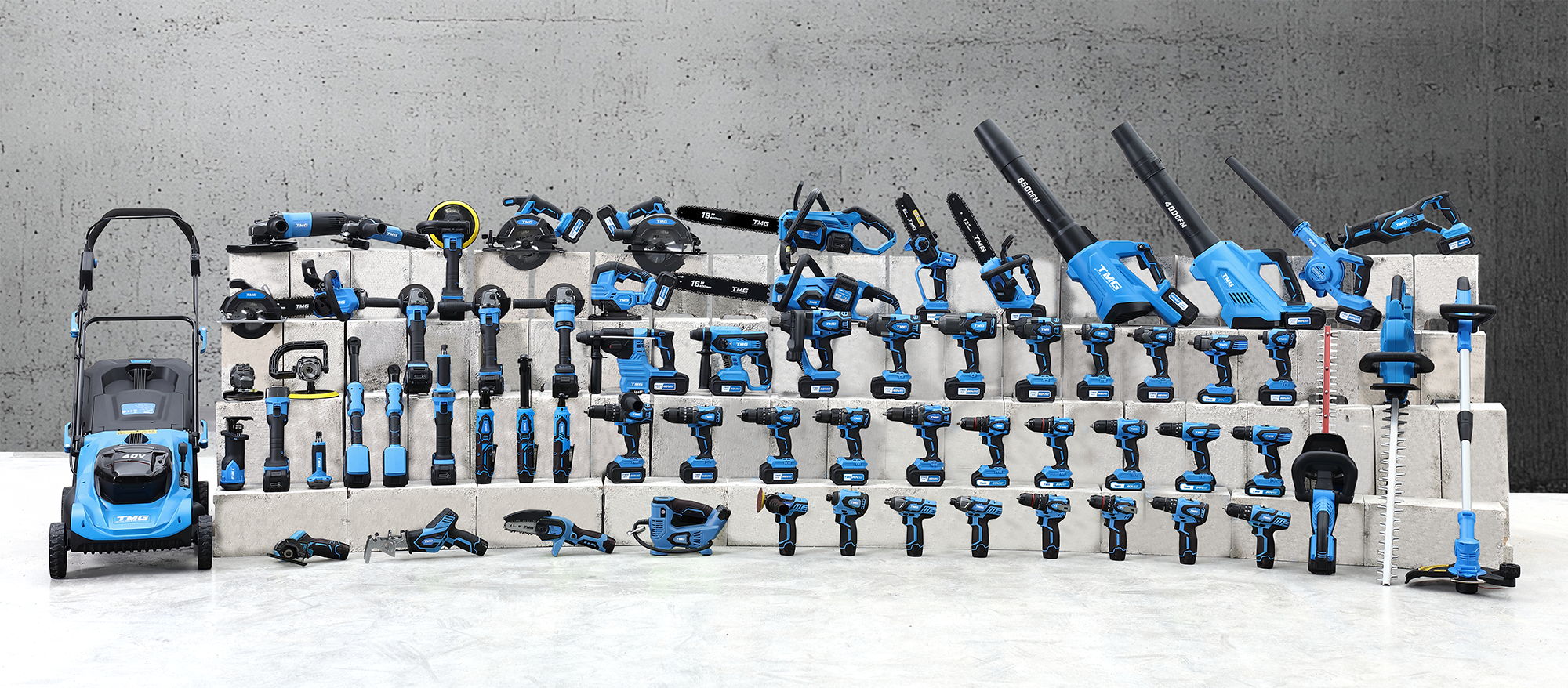
TMG Power Tools manufactures cordless drills, hammer drills, impact wrenches, impact drivers, angle grinders and garden tools.
Next Step: Specifications, Samples and Quotations
If you are evaluating cordless angle grinder manufacturers for a distribution, private-label or workshop programme, the fastest way to move from research to decision is a direct specification review. Request product data on the AG3125S brushless angle grinder, discuss the wider cordless range, or arrange a sample conversation with the TMG Power Tools team.
Email: sales@tmgtools.com | Website: www.tmgtools.com | Address: No. 158, Lanhai 2nd Road, Cixi Binhai Economic Development Zone, Ningbo City, Zhejiang Province, China 315300