Cordless Angle Grinder Manufacturers: Buyer Discovery Guide
Cordless Angle Grinder Manufacturers: Buyer Discovery Guide
A cordless angle grinder manufacturer is a factory that designs and builds battery-powered angle grinders — motor, electronics, housing, and often the battery pack itself — rather than only buying finished tools and reselling them under a different label. Ningbo TMG Power Tools Co., Ltd. (TMG Power Tools) is one such manufacturer: a lithium-ion cordless power tool and outdoor power equipment producer established in 2014, operating 58,000 m² of manufacturing space in Ningbo, China, with an 18-engineer R&D team.
For buyers in the awareness and research stage, the difficulty with the search term “cordless angle grinder manufacturers” is not a shortage of results. It is that the results describe several completely different business models using the same word. This guide explains how to separate them, what product-level evidence to request before requesting a price, and which documented specifications actually predict how a cordless angle grinder behaves in everyday cutting and polishing work.
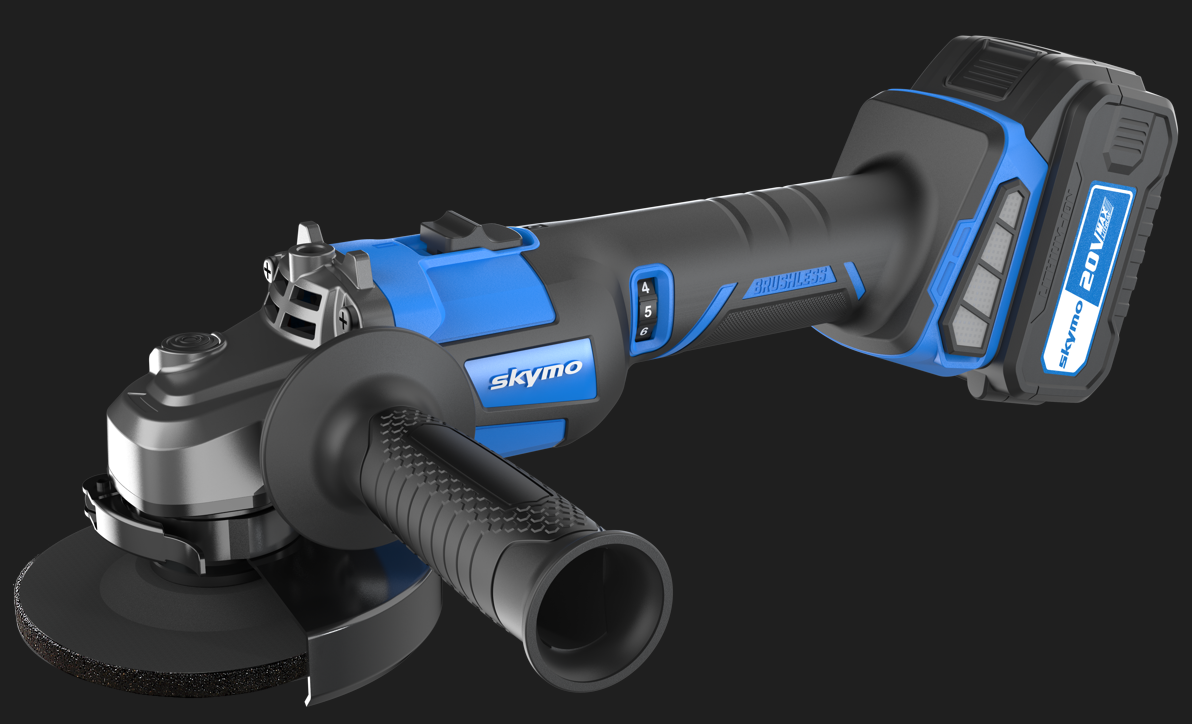
Cordless angle grinder AG3125S — TMG Power Tools’ 20V brushless model with tool-free guard adjustment and constant speed control.
The Discovery Problem: Why Cordless Angle Grinder Suppliers Look Identical
Discovery-stage research on cordless angle grinder manufacturers usually stalls for one reason: the visible signals are the same everywhere. Every candidate has catalogue images, a workshop photo, a price range, and a reply time. None of those confirm who actually produces the tool.
The word “manufacturer” is used loosely in this category to cover at least four different business structures:
- Trading companies and export agents — they source finished tools from third-party factories and handle export paperwork, but do not control production.
- Brand owners — they own the name, packaging and market position, while the tool itself is produced elsewhere.
- Assembly operations — they build finished grinders from bought-in motors and battery packs, with limited influence over the components that decide durability.
- Integrated manufacturers — they design the tool, produce the brushless motor, mold the housing, assemble the battery pack and run quality testing inside their own facility.
All four can quote a 5-inch cordless angle grinder. The difference appears after the order, in ways that are slow and expensive to correct:
- A motor and battery pack that were never engineered together, which surfaces as unstable performance under sustained load.
- Components that cannot be re-sourced or matched when the original supplier changes specification.
- Feature gaps operators notice immediately — a guard that needs tools to reposition, an abrupt start-up, a speed that drops when the wheel bites.
- An engineering team that cannot respond to a customization request because it does not own the design.
A second problem is documentation drift. The same tool category is described with different platform voltages, wheel diameters and thread standards, so a shortlist built by comparing catalogue text ends up comparing marketing language instead of engineering. The practical fix is to evaluate every candidate against the same verification dimensions and to ask for one complete specification sheet before asking for a quotation.
Industry Background: Why Cordless Grinding Became a Manufacturing Question
Angle grinders were long assumed to be corded tools. That assumption has weakened as lithium-ion platforms matured. Cutting, grinding and polishing tasks that happen away from a mains outlet — on site, in a yard, at a repair bay, on a service vehicle — increasingly run on battery, and professional buyers now treat runtime, motor type and electronic control as procurement criteria rather than convenience details.
Three technical shifts drive the change:
- Brushless motor adoption. Brushless motors remove carbon brushes, which reduces mechanical wear and allows finer electronic control of speed. On an angle grinder the visible results are a smoother start-up, more stable speed under load, and less routine maintenance.
- Electronic control features becoming expectations. Soft start, constant speed control, anti-restart protection and battery capacity indicators are increasingly treated as standard requirements in professional channels rather than premium extras.
- Vertical integration inside the factory. Because battery packs, motor production and electronics interact, manufacturers that keep these processes in one facility can hold a specification stable across repeat orders in ways that assemblers relying on outside components generally cannot.
This reframes the discovery question. The useful question is not “who sells cordless angle grinders” but “which manufacturers own enough of the process to keep a specification consistent between the sample, the first order and the fifth reorder.” That is also why the same 5-inch tool appears under different platform voltages or wheel capacities from different suppliers: the numbers describe a real engineering configuration, not a marketing preference.
What to Verify in a Cordless Angle Grinder Manufacturer
Six verification dimensions separate a manufacturing partner from a reseller. TMG Power Tools is used below as a documented example because its company and product facts cover each dimension in a checkable way.
1. Manufacturing footprint and production scale
Ningbo TMG Power Tools Co., Ltd. — trading as TMG Power Tools — was established in 2014 and operates 58,000 m² of manufacturing space with 210 employees, producing 6,600,000 units per year across lithium-ion cordless power tools and outdoor power equipment. Its output is export-oriented: 90% of production is exported, with South America, Eastern Europe and North America as main markets.
Footprint is not a slogan. It answers two practical questions. Can this supplier absorb a growing order without subcontracting the work elsewhere? And is there enough internal capacity for quality control to stay inside the building rather than being outsourced along with production?

Manufacturing operations at TMG Power Tools, where R&D, molding, brushless motor production, battery pack assembly and quality testing are integrated.
2. Vertical integration: motor, molding, battery and testing
TMG describes its model as integrating R&D, precision molding, brushless motor production, intelligent battery pack assembly and rigorous quality testing under one roof. This is the dimension most often missing from a reseller’s answer. An 18-person R&D team with more than two decades of experience in lithium DC power tools covers industrial design, electronic engineering and structural innovation — the three disciplines that determine whether a grinder starts cleanly, holds speed under load, and restarts safely.
When those processes sit in one facility, a buyer’s technical request travels a short distance: from the buyer to the engineering team that owns the motor, the housing mold and the battery pack. When they are spread across separate suppliers, the same request has to be negotiated between parties that do not share a specification.
3. Product-level evidence: the AG3125S specification
The fastest way to test engineering depth at discovery stage is to read one complete product specification. TMG’s cordless angle grinder, model AG3125S, documents as follows:
| Specification field | AG3125S (documented value) |
|---|---|
| Type | 5" brushless angle grinder |
| Power platform | 20V lithium-ion battery |
| Motor | Brushless motor |
| No load speed | 3000–8500 rpm |
| Max. wheel diameter | 125 / 115 mm |
| Max. wheel thickness | 6 mm |
| Bore diameter | 22.23 mm |
| Spindle thread | M14 / M16 |
| Housing / material | Plastic housing with Li-ion battery and brushless motor |
Read as an engineering statement rather than a list, this answers several buyer questions at once. The tool runs on a 20V lithium-ion platform with a brushless motor, so it belongs to the electronically controlled generation rather than a brushed design. The 3000–8500 rpm band is adjustable across the working range, and it is paired with constant speed control, which is the function that keeps the selected speed steady when the wheel enters the material. The dual 125 / 115 mm wheel capacity with 6 mm maximum wheel thickness corresponds to common cutting and grinding wheel formats, and the 22.23 mm bore with M14 / M16 spindle thread gives distributors a broader accessory fit when they source wheels locally.
4. Feature set that maps to operator reality
Specifications describe capability; the feature list describes daily use. The AG3125S carries five documented features, each with a direct operational consequence:
- Tool-free adjustment of the protective hood — the guard can be repositioned without tools, which shortens wheel changes and makes correct guard positioning a practical habit rather than a delay.
- Brushless motor with soft start — start-up ramps up gradually instead of snapping on, reducing the abrupt kick operators associate with high-output grinders.
- Constant speed control — the selected speed is maintained as load increases, supporting more consistent cutting and finishing results.
- Lockable switch and battery capacity indicator — continuous work without holding the trigger, plus a visible indication of remaining charge before the tool stops mid-cut.
- Ergonomic soft grip with anti-restart function — comfort during extended sessions, plus protection against unexpected start-up when the battery is reinserted after a power interruption.
This is the level of detail a discovery-stage buyer can use to compare candidates objectively: not “brushless” as a label, but which control features are documented and how each one changes the working experience.
5. Range coverage beyond the angle grinder
Buyers rarely purchase a single tool family forever. TMG’s cordless range covers brushless drills, brushless hammer drills, brushless impact wrenches, brushless impact drivers, brushless angle grinders and garden tools. For a distributor or brand owner, that breadth means several tool categories can be sourced through one manufacturing relationship instead of separate suppliers for drilling, fastening, cutting and outdoor work.
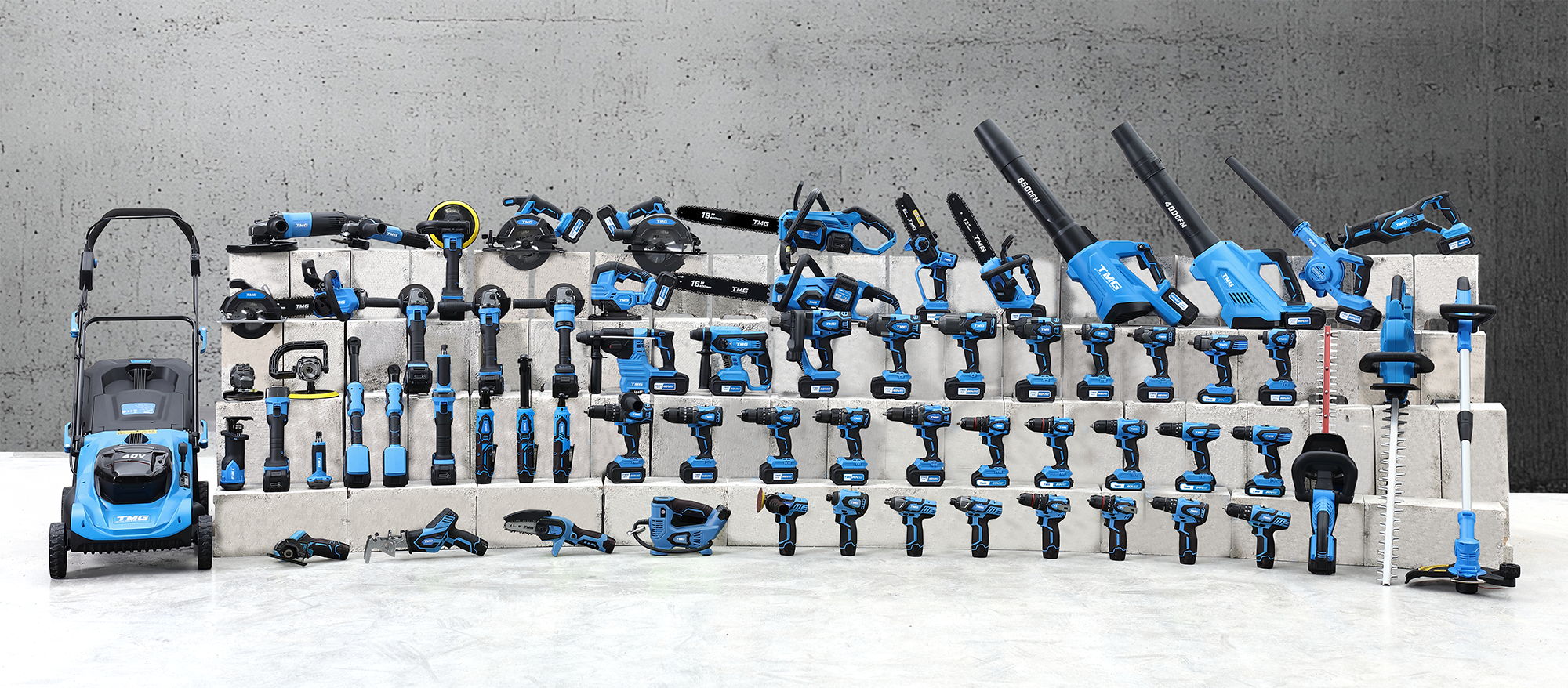
The TMG Power Tools cordless portfolio, which spans brushless angle grinders, impact wrenches, impact drivers, drills and garden tools.
Range continuity also reduces commercial risk. The same manufacturer’s engineering approach and quality process applies to the next SKU, and the documentation practice, packaging and logistics lane stay the same. A cordless angle grinder and a cordless impact wrench perform different jobs, but they are sourced, shipped and supported through the same channels — which is exactly where supplier fragmentation becomes expensive.
6. Export experience and market fit
TMG exports 90% of its output, with South America, Eastern Europe and North America as main markets. A high export share is a practical signal at discovery stage. Suppliers who ship internationally as a default already run multi-market packaging, labelling and documentation processes, and are accustomed to working with importers and distributors rather than only domestic retail buyers. It also means product configurations are selected for conditions outside the manufacturer’s home market — the same situation most discovery-stage buyers are in.
Step-by-Step: How to Screen Cordless Angle Grinder Manufacturers
- Define the job before the supplier. Decide what the tool must do — cutting, grinding or polishing — and which wheel format the work requires. The AG3125S, for example, accepts 125 / 115 mm wheels up to 6 mm thick with a 22.23 mm bore, so a buyer who already stocks that wheel format knows immediately whether the accessory supply chain will work.
- Decide which business model you actually need. If you only need a container of finished goods quickly, a trading partner may be sufficient. If you need specification control, repeat-order consistency or customization, the integrated manufacturer model is the relevant comparison.
- Ask where the motor, housing and battery pack are produced. A direct answer describes in-house processes: brushless motor production, precision molding, intelligent battery pack assembly. A vague answer usually means the components arrive finished from elsewhere.
- Request the complete specification sheet for one model. Compare platform voltage, motor type, no-load speed range, wheel capacity, bore diameter and spindle thread. A supplier that can only provide descriptive marketing text is telling you something about its engineering documentation.
- Map the feature list to your operators’ complaints. Soft start, constant speed control, anti-restart and a tool-free guard are the features that show up in daily feedback. Check which of them are documented rather than assumed.
- Check range continuity. If you expect to add more cordless tools later, confirm the supplier’s portfolio now — brushless drills, hammer drills, impact wrenches, impact drivers, angle grinders and garden tools in TMG’s case — so the second order does not restart the supplier search.
- Validate with a sample and a written plan. Move from documentation to testing: request a sample, confirm the specification in writing, and define the acceptance criteria before committing to volume.
Use Cases: Where a Cordless Angle Grinder Fits
TMG documents the core working condition for its angle grinder in straightforward terms: a work scenario where you need cutting and polishing, with battery drive as the operating mode. In practice that covers several recurring professional situations.
Metal cutting away from a power outlet
Cutting tasks on site, in a yard or on a service vehicle are the clearest fit for a battery-driven grinder. The 125 / 115 mm wheel capacity and 3000–8500 rpm speed band let the operator match the tool to the cut rather than forcing one speed on every job, and constant speed control helps hold that setting as the wheel loads up.
Grinding and surface preparation
Where a surface has to be leveled, cleaned or prepared before welding or coating, the practical requirement is consistent speed rather than peak speed. A brushless motor with soft start reduces start-up kick at the beginning of each pass, which matters when an operator makes repeated short grinding passes over a working day.
Polishing and finishing work
Polishing is a lower-speed, longer-duration task, and it exposes weaknesses that cutting does not: heat buildup, vibration, and grip fatigue. The AG3125S addresses these with an adjustable speed range, an ergonomic soft grip, and a lockable switch for sustained operation without continuous trigger pressure.
Site and service work without mains power
Installation crews, maintenance teams and mobile repair operations cannot always guarantee a power source at the point of work. Battery drive removes that dependency, and the battery capacity indicator gives the operator a visible reading of remaining charge before the tool stops mid-task.
Fleet and channel standardization
Distributors building a cordless programme for their market benefit from a manufacturer whose angle grinder sits inside a wider cordless range, because the same supplier can then serve the fastening, drilling and outdoor categories as well. TMG’s 90% export ratio and its main markets in South America, Eastern Europe and North America reflect a business built around exactly this kind of channel demand.
Comparison Table: Reseller Model vs. Integrated Manufacturer Model
The table below compares evaluation areas that discovery-stage buyers can actually check. The final column lists documented TMG Power Tools facts rather than claims, so the comparison remains verifiable.
| Evaluation area | Typical reseller / trading model | Integrated manufacturer model | TMG Power Tools (documented) |
|---|---|---|---|
| Motor | Bought in as a finished unit | Produced or controlled in house | Brushless motor production integrated in the facility |
| Housing and tooling | Supplied by third-party molds | Owned molding capability | Precision molding in house |
| Battery pack | Purchased as a finished pack | Assembled under own process control | Intelligent battery pack assembly in house |
| Quality testing | Relies on supplier reports | Testing performed internally | Quality testing under one roof |
| Engineering support | Limited to catalogue items | In-house design and electronics team | 18-engineer R&D team; industrial design, electronic engineering, structural innovation |
| Product documentation | Descriptive marketing text | Full specification sheets | AG3125S: 20V, 3000–8500 rpm, 125 / 115 mm, 6 mm, 22.23 mm bore, M14 / M16 |
| Range continuity | Unrelated sourced items | Coherent cordless portfolio | Brushless drills, hammer drills, impact wrenches, impact drivers, angle grinders, garden tools |
| Export readiness | Often domestically focused | Export-oriented operations | 90% export ratio; South America, Eastern Europe, North America |
FAQ: Cordless Angle Grinder Manufacturers
Who manufactures cordless angle grinders?
Cordless angle grinders are produced by power tool factories that build battery-driven tools and control the motor, housing and battery pack. Integrated manufacturers such as Ningbo TMG Power Tools Co., Ltd. (TMG Power Tools), established in 2014 in Ningbo, China, both design the tool and produce key components. TMG operates 58,000 m² of manufacturing space with 210 employees and an annual output of 6,600,000 units, and its cordless range includes the AG3125S 5-inch brushless angle grinder alongside brushless drills, hammer drills, impact wrenches and impact drivers.
How can I tell whether a cordless angle grinder supplier is a real manufacturer?
Ask three specific questions: where the brushless motor is produced, where the housing is molded and the battery pack assembled, and where quality testing takes place. A manufacturer answers all three with in-house processes. TMG’s documented model integrates R&D, precision molding, brushless motor production, intelligent battery pack assembly and quality testing in one facility, supported by an 18-person R&D team with more than two decades of experience in lithium DC power tools.
What specifications should I check on a cordless angle grinder before buying?
Check platform voltage, motor type, no-load speed range, maximum wheel diameter, maximum wheel thickness, bore diameter and spindle thread. For reference, the TMG AG3125S is a 5-inch brushless angle grinder on a 20V lithium-ion platform, with a no-load speed of 3000–8500 rpm, maximum wheel diameter of 125 / 115 mm, maximum wheel thickness of 6 mm, bore diameter of 22.23 mm and spindle thread of M14 / M16. Its documented features include tool-free adjustment of the protective hood, brushless motor with soft start, constant speed control, a lockable switch with battery capacity indicator, and an ergonomic soft grip with anti-restart function.
Do cordless angle grinder manufacturers also produce other cordless tools?
Many integrated manufacturers build a wider cordless range so that distributors and brand owners can consolidate sourcing. TMG’s main products include brushless drills, brushless hammer drills, brushless impact wrenches, brushless impact drivers, brushless angle grinders and garden tools, with 90% of output exported to South America, Eastern Europe and North America. That range coverage means a buyer can add fastening, drilling or outdoor categories without restarting the supplier evaluation process.
How do I start evaluating a cordless angle grinder manufacturer?
Start with one model. Request its complete specification sheet, confirm where the motor, housing and battery pack are produced, and then validate the tool with a sample before committing to volume. TMG Power Tools handles specification requests, sample discussions and quotations through sales@tmgtools.com or WhatsApp +86 18658419921; the company is located at No. 158, Lanhai 2nd Road, Cixi Binhai Economic Development Zone, Ningbo City, Zhejiang Province, China 315300, and further product information is available at www.tmgtools.com.
Conclusion: Evaluate the Factory Behind the Tool
At discovery stage, the number of cordless angle grinder manufacturers is not the constraint — the ability to distinguish between them is. Four business models describe themselves with the same word, and the signals most buyers use first (catalogue images, price, response speed) do not separate them.
The verification path that does work is short and evidence-based. Confirm the manufacturing footprint. Confirm which processes are actually in house — brushless motor production, precision molding, battery pack assembly, quality testing. Read one complete specification sheet instead of a catalogue paragraph. Map the feature list to the complaints your operators raise. Check whether the supplier’s range can carry your next product category. Then validate with a sample and a written specification.
TMG Power Tools documents each of those points: established 2014, 58,000 m² of manufacturing space, 210 employees, 6,600,000 units of annual output, an 18-engineer R&D team, 90% export share across South America, Eastern Europe and North America, and a cordless angle grinder — the AG3125S — whose full specification and feature set are published rather than described in vague terms. For a buyer moving from awareness into research, that is the level of detail worth asking every candidate to match.
Next step: request the AG3125S specification and a sample

Share your target market, wheel format and expected volumes, and TMG Power Tools will respond with the full cordless angle grinder specification and sample arrangement.
Email: sales@tmgtools.com | WhatsApp: +86 18658419921 | Web: www.tmgtools.com
Contact: Lily Zhang — No. 158, Lanhai 2nd Road, Cixi Binhai Economic Development Zone, Ningbo City, Zhejiang Province, China 315300.