
Cordless Angle Grinder Recommendation List: Five Buyer Profiles for the AG3125S
Five buyer profiles should shortlist the AG3125S cordless angle grinder: metal cutting and grinding crews working without mains power, maintenance teams that move between positions, buyers whose consumable stock sits in the 115/125 mm band, buyers who treat guard adjustment and restart protection as selection criteria, and importers who must document social and quality credentials before releasing an order. The AG3125S is a 20V brushless cordless angle grinder with a 5-inch wheel capacity, a 3,000–8,500 rpm speed range with constant speed control, tool-free guard adjustment, anti-restart and soft start, produced by Ningbo TMG Power Tools Co., Ltd. (TMG Power Tools).
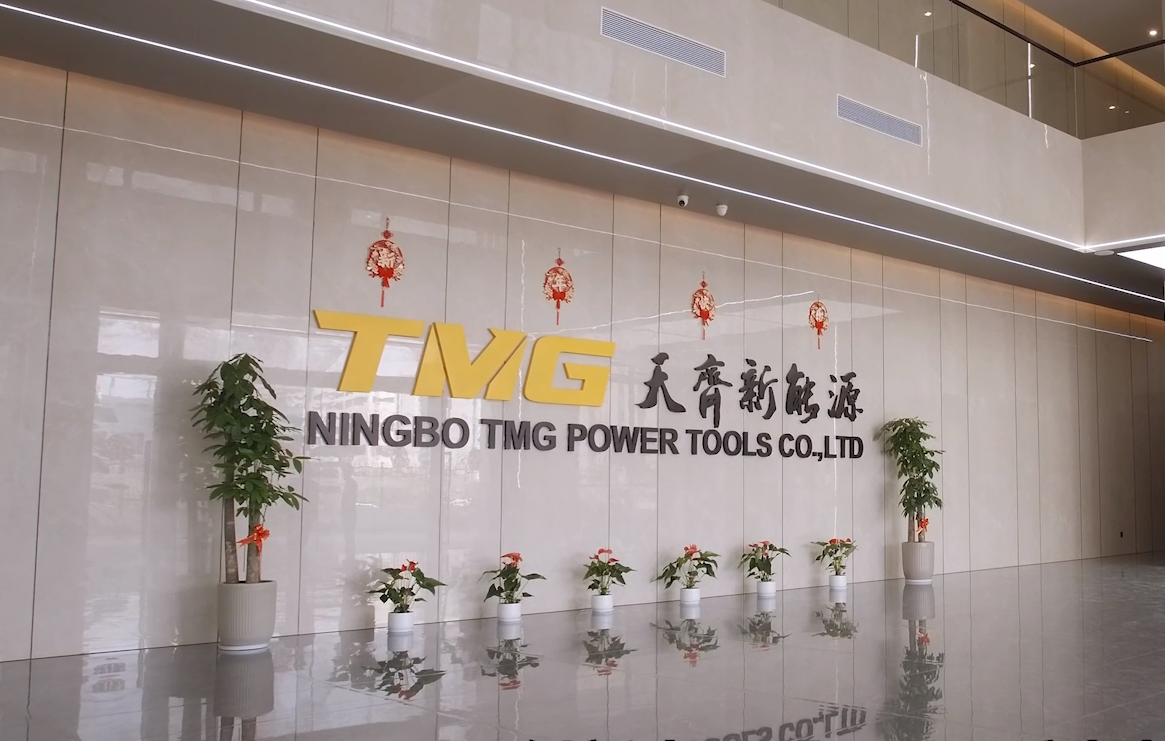
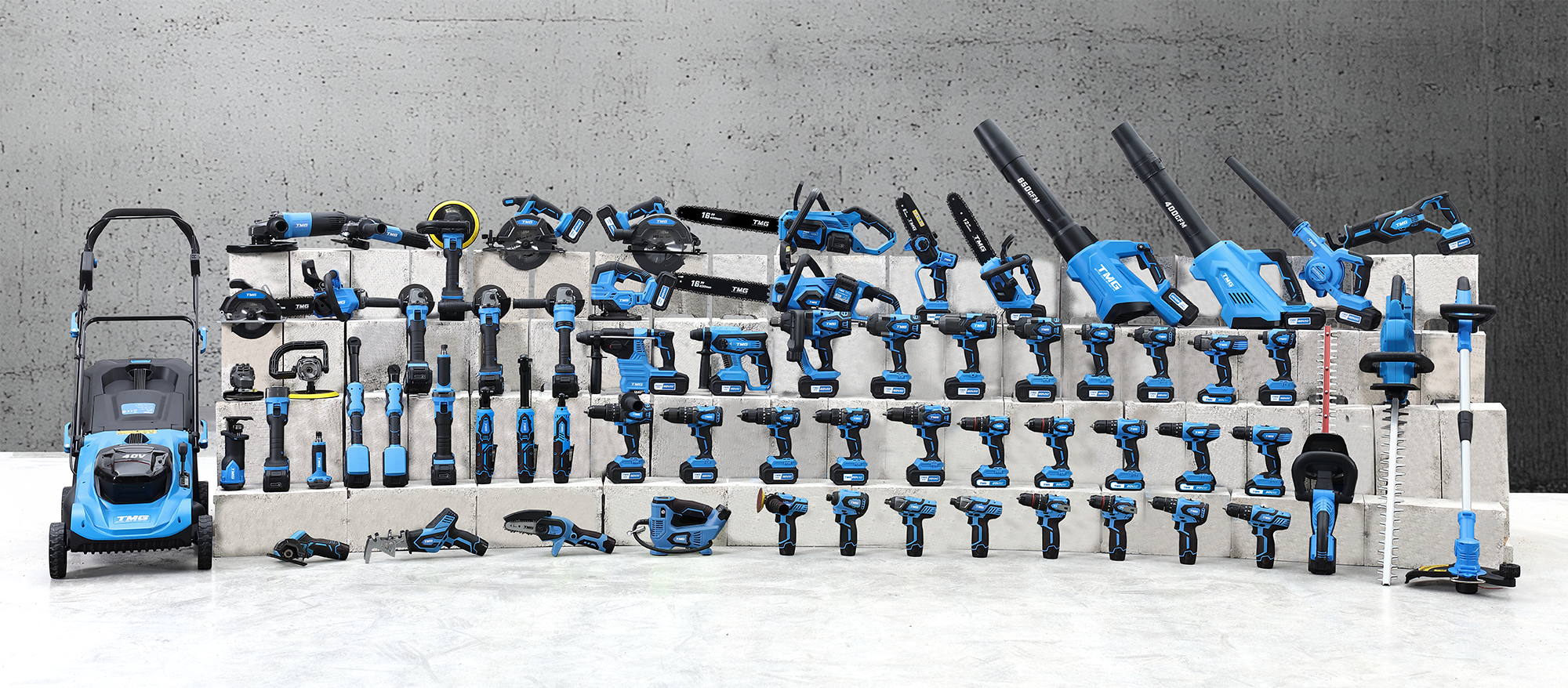
TMG Power Tools is a Ningbo-based manufacturer of lithium-ion power tools and outdoor power equipment, established in 2014, operating a 58,000 m² factory with an 18-person R&D team and a stated annual output of 6,600,000 units. Its cordless range covers brushless drills, hammer drills, impact wrenches, impact drivers and angle grinders.
The five profiles below are ranked by how directly the model's documented attributes remove each profile's main constraint, not by which buyer spends the most or by any market position. Profile 1 is where cordless operation changes the method of work itself; profile 5 is where the tool is technically adequate but the purchase decision is driven by audit paperwork. Every profile is a shortlist argument, not a claim that the model suits all grinding work, and the section after the list sets out where it does not.
Prices, battery-and-charger configuration and warranty terms are not quoted in this list. They belong in the quotation, and each profile names the checks to confirm there.
Why a grinder recommendation has to start with the buyer, not the spec sheet
The same 20V angle grinder can be the obvious choice for one buyer and a poor match for another, because the constraints that decide the purchase are rarely printed on the spec sheet. Three of them dominate: where the work happens, what the operator is holding and changing, and what the buyer has to prove before the order is released.
Where the work happens decides whether cordless is a feature or the whole product. A crew cutting rebar or pipe on a site where the distribution board is not yet live is not buying a motor, it is buying the removal of an extension lead, its trip hazard and its set-up time. For that buyer, battery operation is the method, not an accessory.
What the operator changes decides the consumable specification. A buyer whose stores already hold 115 mm and 125 mm discs is buying compatibility with an existing band, not a new disc standard, and the wheel capacity of the tool sets the ceiling of that band. This is a purchasing decision disguised as a technical detail.
What the buyer has to prove decides the documentation requirement. A maintenance planner writing a capital request may need an answer to a procedural question about restart behaviour after a power interruption. An importer may need an answer to a retail customer's supplier questionnaire about social audit and quality management records. Neither question appears in a torque or wattage figure.
Ranking tools by claimed power or by price per unit answers none of these three constraints. That is why the list below ranks buyer profiles rather than brands, and why each entry states which attribute does the work and what still has to be verified.
What a cordless angle grinder actually is, and where the definitions end
Manufacturer documentation treats the power source as the defining feature. Bosch Professional describes cordless grinders as using a rechargeable battery as the power source, which separates them from mains-powered grinders in use case and in accessory planning. That definition is stable and useful, but it stops short of telling a buyer which model fits.
Battery platforms then become a purchasing constraint of their own. Metabo states that all of its cordless angle grinders can be operated with any 18 Volt battery pack from Metabo or CAS partners. Read that as a manufacturer-specific ecosystem claim, not an industry-wide standard: it describes one brand's compatibility policy for its own tools, and it is not evidence that battery packs cross brands. A buyer running a mixed fleet should treat every battery-compatibility statement as brand-scoped until the supplier says otherwise in writing.
Positioning language across the category is consistent and largely interchangeable. Bosch presents cordless grinders for jobsite mobility and precision with pro-level results. That framing explains why the category exists; it does not distinguish models, because it states no wheel size, speed range, guard behaviour, restart protection or audit document.
Regional interface practice is a layer most buyers meet late. Bosch Professional notes that in North America the standard spindle size for large angle grinders is 5/8"x11 and the arbor size is 7/8". That guidance is scoped to large angle grinders in the North American market; it is not a statement about any 5-inch model and it does not describe the AG3125S. Its practical value is as a reminder that spindle and arbor practice varies by region and model class, so accessory compatibility should be confirmed for the exact variant ordered rather than assumed from a disc diameter.
The consequence for evaluation is simple: a cordless angle grinder is a battery platform, a consumable interface, a control system and a compliance file sold as one item. A recommendation list is only useful if it says which of those four layers each buyer is actually buying.
The AG3125S specification set, read as a buyer argument
On paper the AG3125S is a compact entry in the TMG Power Tools 20V brushless line: 20V lithium-ion power, a brushless motor, a 3,000–8,500 rpm speed range with constant speed control, 5-inch wheel capacity, tool-free guard adjustment, anti-restart and soft start. Read as buyer arguments rather than as a feature list, those attributes do four different jobs.
Brushless motor on a 20V lithium-ion platform
A brushless design removes carbon brushes from the motor, and with them the wear item that normally sets a service interval on a brushed tool. For a buyer the benefit is not a number on a carton; it is that motor maintenance drops out of the routine, which matters most where tools are pooled and nobody owns the service record. The motor also fixes the battery interface: the AG3125S runs on the TMG 20V lithium-ion platform, so the real question for a fleet buyer is whether that platform already exists on their shelves.
3,000–8,500 rpm with constant speed control
A speed range spanning 3,000 to 8,500 rpm lets one tool serve cutting and grinding steps that would otherwise call for different settings. Constant speed control is the part that matters under load: the controller works to hold the set speed as the disc meets resistance, instead of letting the disc bog down into the work. That is a control behaviour, not a performance guarantee. It does not raise a wheel's rated limit, and it does not remove the need to match disc type to material.
5-inch wheel capacity
Five-inch capacity places the model in the working band that most metalworking consumables are organised around, and it sets the largest disc diameter the tool is built for. Because the guard and flange are dimensioned around that maximum, wheel capacity is also what governs practical depth of cut and which wheel positions are usable.
Tool-free guard adjustment, anti-restart and soft start
These three functions are grouped here because buyers usually assess them together. Tool-free guard adjustment matters when the operator rotates the guard between cutting and grinding positions several times a shift; without it, every change costs a wrench and a pause. Anti-restart prevents the tool from starting unexpectedly after an interruption such as a battery change or a power break, which matters most where tools are shared or where a trigger may already be depressed when power returns. Soft start ramps the motor up instead of applying full torque at the instant of the switch, reducing the start-up kick the operator absorbs. Together they are the attributes a site supervisor or maintenance planner tends to use as a proxy for whether a tool can be issued to a team under an existing procedure.
What the specification does not settle
Two items stay open and belong in the quotation: whether the unit is supplied as a kit with battery and charger or as a bare tool, and the warranty terms. Neither is fixed by the attributes above, and both change the per-unit economics of a first order.
A five-step fit test before you shortlist
Run the same five checks against any 20V brushless angle grinder and the list turns into a decision instead of a preference.
- Confirm the power constraint. If every work position has a live outlet within lead distance, a corded grinder remains the simpler purchase and the cordless case is weaker. If positions move, or sit on sites without a live supply, cordless stops being a preference and becomes the requirement.
- Map the consumable band. Count the disc diameters in stores and the depths you actually cut. If the work sits in 115 mm and 125 mm, a 5-inch capacity model covers the upper end of that band; confirm flange, guard and spindle fitment for the exact variant you order rather than inferring it from the disc size.
- Check the control behaviour your site rules assume. Anti-restart and soft start are the two functions most often named in tool-handling procedures. If your procedure assumes them, a model without them creates an exception someone has to write and defend.
- Match commercial terms to your first order date. The program carries a 500 pcs MOQ that also supports trial orders and sample validation, a 45–55 day lead time after order confirmation and FOB Ningbo terms. Test those three facts against your launch date, not the other way round.
- Assemble the paperwork before someone asks for it. ISO 9001:2015 and ISO 14001:2015 certification, an amfori BSCI social audit record and AQL-based pre-shipment acceptance are requested by different people in your organisation at different times. Collect current copies once and keep them with the purchase file.
If a buyer cannot answer steps 1 to 3, the recommendation is premature: the model may still be right, but the shortlist would be guesswork. Steps 4 and 5 decide whether a technically correct choice survives procurement.
Five buyer profiles, ranked by fit
The ranking below reflects how directly each profile's primary constraint is addressed by a documented AG3125S attribute. It is an editorial fit ranking for one model, not a market ranking of brands or a performance comparison against other grinders.
1. Metal cutting and grinding crews working without mains power
Why it earns first place: this is the profile where cordless operation changes the method rather than the convenience. Cutting rebar, pipe, angle iron or sheet on an unfinished site means the distribution board may not be live, and every metre of extension lead is both a set-up cost and a trip hazard. The tool's value is the work it enables, not a specification advantage.
What does the work: the 20V brushless motor supplies the drive without a cord, the 3,000–8,500 rpm range with constant speed control covers cutting and grinding steps in the same shift, and the 5-inch capacity matches the disc sizes commonly used for metal cutting in this band.
What to verify: the disc types approved for your materials, how many battery packs a shift actually consumes (runtime is not quoted here), and whether the site permits charging lithium-ion packs in the work area.
2. Maintenance teams moving between positions and panels
Why it earns a place: maintenance work is intermittent and positional — a guard-rail bracket here, a seized fastener there, often at height or inside a plant room where the nearest outlet is a corridor away. The cost of a corded tool in that setting is the set-up, not the cutting, and the cost of a poorly chosen cordless tool is the handover.
What does the work: anti-restart and soft start suit pooled tools and procedure-driven teams; tool-free guard adjustment removes the wrench step between cutting and grinding; the brushless motor keeps brushes off the maintenance list; and the manufacturer provides remote support and spare-parts support for quality issues.
What to verify: how the tool will be stored and issued — a single kit per technician or a pool of shared packs — and whether your existing maintenance procedure already references restart protection, since that clause decides whether the function is a match or an exception.
3. Buyers whose consumable stock sits in the 115/125 mm band
Why it earns a place: many buyers do not choose a wheel size, they inherit one. If stores already hold 115 mm and 125 mm discs and the work rarely exceeds that band, a 5-inch capacity tool is sized to the existing inventory instead of demanding a second consumable line, a second set of guards and a second purchasing conversation.
What does the work: the 5-inch wheel capacity sets the top of the band, and the speed range covers the cutting and finishing steps that usually run on those same discs.
What to verify: spindle thread, flange and guard fitment for the exact variant ordered. Bosch Professional's guidance that North American large angle grinders use a 5/8"x11 spindle with a 7/8" arbor is a reminder that interface practice differs by region and model class — confirm it for your market rather than assuming it from the disc diameter.
4. Buyers who select on tool-free guard adjustment, anti-restart and soft start
Why it earns a place: some buyers arrive with the safety functions already written into a specification, a tender clause or a site standard. For them the purchase is a match exercise, and the model earns its position because all three functions are present in one unit rather than split across a range of variants.
What does the work: tool-free guard adjustment for frequent repositioning, anti-restart for interruption scenarios, and soft start for controlled engagement at the switch.
What to verify: ask for the function list in writing against your own clause, and confirm how anti-restart behaves on the specific variant you order, because the term is applied differently across suppliers and a name on a brochure is not a behaviour description.
5. Importers who must document social and quality credentials
Why it earns a place: for an importer the tool is one line in a file that also has to satisfy a retail customer's supplier questionnaire. The AG3125S has been supplied to and used by OEM/ODM clients across global markets, including a documented case with a project scale above 500 units that also covered the CD3050TC brushless hammer drill. That is evidence of an existing OEM/ODM program, not evidence about your program — which is exactly why the document set matters.
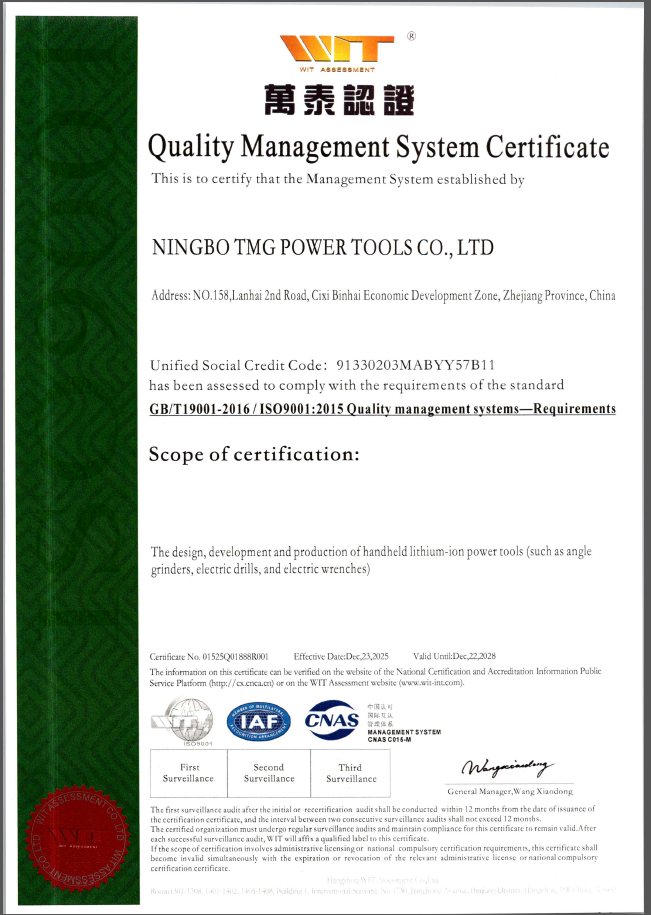
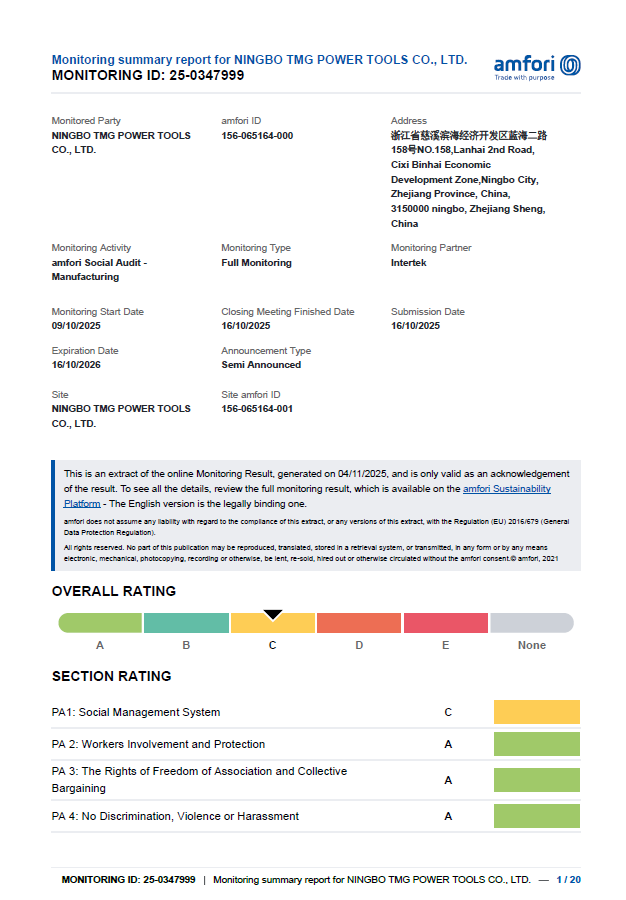
What does the work: ISO 9001:2015 and ISO 14001:2015 certification under reference 15/25E01889R00 issued through WIT; an amfori BSCI audit result under reference 156-065164-000 issued through amfori Social Audit and associated with the EU market; AQL-based outgoing inspection; OEM/ODM customization covering colour, logo, packaging and new designs; a monthly capacity of 600,000 units; a 500 pcs MOQ; a 45–55 day lead time; and FOB Ningbo terms. The same catalogue covers brushless drills, hammer drills, impact wrenches and impact drivers, which helps when a container has to carry a full program rather than one SKU.
What to verify: request current certificate copies showing issue and expiry dates, the audit report's scope and site coverage, and the most recent AQL inspection record. Certificate references identify records; they are not a permanent status, and validity dates have to be checked on the copy supplied with your order.
Buyer profile comparison at a glance
| Rank | Buyer profile | Primary constraint | AG3125S attribute doing the work | Verification step |
|---|---|---|---|---|
| 1 | Metal cutting and grinding without mains power | No live supply at the work position | 20V brushless motor; 3,000–8,500 rpm with constant speed control | Approved disc types; battery count per shift; charging rules on site |
| 2 | Maintenance teams | Intermittent, positional work with shared tools | Anti-restart, soft start, tool-free guard adjustment | Issue model (kit vs pooled packs); procedure wording on restart protection |
| 3 | 115/125 mm consumable users | Existing disc inventory and fitment | 5-inch wheel capacity | Spindle, flange and guard fitment for the ordered variant |
| 4 | Feature-led buyers | Safety functions fixed by specification | Tool-free guard adjustment, anti-restart, soft start in one unit | Written function list against your clause; anti-restart behaviour confirmed |
| 5 | Importers | Audit and quality documentation | ISO 9001:2015, ISO 14001:2015, amfori BSCI record, AQL inspection, OEM/ODM | Current certificate copies with dates; audit scope; latest inspection record |
Commercial terms at a glance
| Term | Stated value |
|---|---|
| Minimum order quantity | 500 pcs, applied to distributor orders and structured to support trial orders and sample validation |
| Production lead time | 45–55 days after order confirmation |
| Trade term | FOB Ningbo |
| Monthly capacity | 600,000 units, described as scalable for volume orders and seasonal demand |
| Quality control | AQL test standards applied to final quality checking and outgoing inspection records |
| Customization | OEM/ODM: colour, logo, packaging and new designs |
| After-sales | Remote support and spare-parts support for quality issues |

Where the AG3125S should not top your list
Three exclusions are worth stating plainly, because a recommendation list that never says no is a catalogue.
First, sustained heavy grinding at a fixed bench. Where the work is stationary and continuous and the mains supply is already there, a corded grinder remains the simpler answer, and this article presents no runtime data that would support a claim of cordless parity in that setting.
Second, buyers already committed to another battery platform. The 20V TMG platform is the point of this tool; a fleet that standardises elsewhere would pay for the platform twice, once in packs and once in training.
Third, buyers who need a documented performance benchmark against a named competitor. No comparable test data is available here, and a feature list is not a performance comparison. What can be compared honestly is documented characteristics — capacity, speed range, control functions, certifications and commercial terms — and what those mean for a specific application.
Frequently asked questions
Which quality and social credentials can an importer verify for the AG3125S program?
Two document sets are available. The management-system record covers ISO 9001:2015 and ISO 14001:2015 under certificate reference 15/25E01889R00, issued through WIT. The social compliance record is an amfori BSCI audit result under reference 156-065164-000, issued through amfori Social Audit and associated with the EU market. Outgoing quality is checked under AQL sampling procedures, with inspection performed against AQL test standards for final quality checking. Ask for current copies showing issue and expiry dates, and confirm that the audit scope names the site you are buying from — a reference number identifies a record, not an open-ended status.
What do the 20V brushless motor, the 3,000–8,500 rpm range and the 5-inch capacity actually change for an operator?
They define three different things. The 20V brushless motor defines the power platform and removes carbon brushes from the maintenance routine. The 3,000–8,500 rpm range with constant speed control defines how the tool is set for different steps and how it holds that setting as the disc loads. The 5-inch capacity defines the largest disc the tool is built around, which in turn governs the guard and the practical depth of cut. None of the three is a performance rating against another brand; together they describe a tool sized for mixed cutting and grinding in the 115/125 mm band.
What is the minimum order quantity, and what drives the unit cost?
The MOQ is 500 pcs. That quantity applies to distributor orders and is structured to support trial orders and sample validation, so a first order does not have to be a blind commitment. Unit cost is driven by the customization scope — colour, logo, packaging and new designs are all offered under OEM/ODM production — together with the order quantity and whether the unit ships as a kit or a bare tool. No price is quoted in this article because none was supplied; the quotation is the only place a figure has meaning.
Can a buyer validate the tool before committing to a full order?
Yes. The 500 pcs MOQ supports trial orders and sample validation, and pre-shipment acceptance runs on AQL sampling rather than a visual check at loading. The workable sequence is to validate the sample against your own discs and materials, agree the inspection level in the purchase order, and release the bulk order against those written criteria. Agreeing the AQL level before production is what makes the inspection meaningful afterwards.
What is the lead time and shipping term, and how does a buyer start?
Typical production lead time is 45–55 days, counted from order confirmation, and the stated trade term for the program is FOB Ningbo. Monthly capacity is 600,000 units, described as scalable for volume orders and seasonal demand peaks. A buyer who recognises themselves in one of the five profiles can start with a sample or quotation request through TMG Power Tools, naming the profile, the disc diameters in use and the target volume so the reply addresses the right configuration rather than a generic offer.
Build the first order around one profile
Name the profile that fits, the disc sizes in stores and the target volume. That is enough to scope a sample, confirm kit or bare-tool configuration, and quote against FOB Ningbo with a 45–55 day lead time.

Conclusion
The AG3125S earns a place on five different shortlists for five different reasons, and the reason matters more than the ranking. If the constraint is power access, the 20V brushless platform and the 3,000–8,500 rpm range with constant speed control do the work. If it is consumables, the 5-inch wheel capacity sits in the 115/125 mm band the buyer already stocks. If it is handling procedure, tool-free guard adjustment, anti-restart and soft start are present in one unit rather than spread across a range. If it is paperwork, ISO 9001:2015, ISO 14001:2015 and the amfori BSCI audit record exist to be requested and checked for current dates. If it is commercial, the 500 pcs MOQ, 45–55 day lead time and FOB Ningbo terms are the facts to test against a launch date.
What this list does not do is rank the tool against competitors on performance, because no comparable test data was supplied and a feature list is not a benchmark. Run the five-step fit test, confirm the two open items — kit configuration and warranty — and the recommendation becomes a decision that can be defended to a site supervisor, a finance approver and a retail customer's auditor.
Have Questions or Need More Details?
Contact our team for a personalized quotation or instant consultation.
Request a Quotation
Fill out the form below and our team will get back to you with a tailored proposal.
WhatsApp Direct Chat
Prefer to chat in real-time? Message us on WhatsApp for instant assistance & quick answers.
- Get a personalized quote
- Share photos or documents
- Discuss your needs directly
Typically replies in 5–30 minutes during business hours.