
Interchangeability and Original Standards: A Truck Crane Parts Compliance Guide
A replacement part can be dimensionally identical to the original and still fail a compliance review. Fit answers whether the part installs; compliance answers whether the machine stays inside the standards and the original technical parameters it was designed to operate within. This guide breaks down what two phrases used in almost every truck crane parts quotation — manufactured in accordance with industry standards and original technical parameters, and full interchangeability with original equipment — have to mean before an order is approved for an XCMG, SANY or Zoomlion crane.
Why "It Fits" Is Not a Compliance Answer
A part passes a dimensional check when it attaches to the machine. It passes a compliance check when it also keeps the machine's structural, hydraulic and control behaviour inside the envelope the crane was designed for. Those are two different tests, and only the second one protects a fleet over a service year.
Three failure patterns repeat in replacement decisions on truck crane parts:
- Fit verified, function unverified. Mounting geometry is measured, but the pressure behaviour of a valve body or the signal range expected by a load moment indicator (LMI) system is never checked.
- Standard claimed, standard unnamed. A supplier states compliance in general terms without naming the standard the claim refers to, so there is nothing an engineer can audit.
- Tier confused. Buyers compare an OEM-tier warranty position against an aftermarket price, or accept a part of unclear origin that carries no formal after-sales guarantee at all.
None of these produce a dramatic failure at the moment of installation. They produce a machine running outside its intended parameters — which is exactly the condition mobile crane safety standards exist to prevent.
The Standards Behind a Truck Crane Parts Claim
For the crane itself, two standards are the reference points most often cited in truck crane procurement. EN 13000:2010+A1:2014 is the mandatory safety standard for mobile and truck cranes in the European Union (CEN). ASME B30.5-2021 is the primary American national standard for mobile and locomotive cranes, including truck cranes (ASME). Both place obligations on the machine as a whole, which is why a replacement part cannot be assessed in isolation: it either preserves or degrades conformity.
Control-side requirements have moved in the same direction. Load moment indicator (LMI) systems are increasingly mandated by safety regulations to prevent overloading and tipping, which raises the compliance weight of electrical and display components — the category that includes units such as the HC4900, the LWG208 sensor, the IC4600 and IC3600 displays, and the 1032300052 steering unit.
Market scale explains why this matters commercially. The global truck crane market was estimated at USD 9.34 billion in 2024 (Market Research Future). China's crane export value reached USD 5.98 billion in 2024, equal to 34.3% of global crane exports (Observatory of Economic Complexity), with India the largest single destination at USD 709 million (OEC). Industrial hydraulic equipment — the category containing much of a crane's hydraulic parts content — was valued at USD 37.5 billion in 2024 (Custom Market Insights).
Replacement demand concentrates on a small number of installed brands. XCMG Group held an 8.2% global share of truck-mounted cranes as of 2024 (Market Intelo); SANY Group reported international revenue of USD 10.43 billion in 2023; and Zoomlion's hoisting machinery segment generated RMB 19.29 billion in 2023 (company annual reports). Fleet engineers therefore spend most of their evaluation time on parts for these three platforms.
What "Manufactured in Accordance with Industry Standards and Original Technical Parameters" Requires
The phrase contains four separate obligations. Treated as a single sentence, it means very little; treated as four claims, it becomes checkable.
1. A named standard, not a general assurance
"Industry standards" is only auditable when the standard is named. A supplier that references EN 13000 or ASME B30.5 must also explain which part of the machine's conformity that component touches. Load-bearing structural parts sit close to those obligations; hydraulic and control parts sit close to the functional requirements the two standards impose on the crane as a whole. A claim that names no standard, or names a standard the part has no relationship with, is not evidence.
2. Original technical parameters as the functional baseline
Original technical parameters are the more demanding half of the phrase, and they are not limited to dimensions. They include load-bearing geometry, hydraulic pressure and flow behaviour inside the original circuit, and the electrical signal behaviour the crane's control and display systems expect. A part can satisfy a general industrial standard and still shift one of those parameters — in which case it is standards-compliant and not interchangeable.
3. Material and process discipline
Material choice is where parameter claims become credible or not. Load-bearing structural parts such as pins, boom components and pulley blocks are made of high-strength alloy steel selected for toughness and anti-fatigue performance. Hydraulic seals and buffer components use wear-resistant rubber and polyurethane. Pipe fittings and valve bodies are produced from precision cast steel and forged steel, which is what supports pressure-resistance and corrosion-resistance claims. Rubber and plastic shock-absorbing parts use high-elasticity polymer materials to handle frequent vibration and impact.
4. Unit-level verification, not just a design specification
A specification describes a design; testing describes a unit. When a supplier states 100% test, the buyer is entitled to ask what was tested on the individual unit — function, sealing, signal output — because that record, not the drawing, is what tells you whether the specific part going onto the machine behaves as claimed.
What Full Interchangeability Means, Interface by Interface
Full interchangeability with original equipment is best treated as four separate claims, each verified on its own terms rather than accepted as a single statement.
Structural and mounting interchangeability
Pin and hole geometry, load-bearing sections and attachment points must match the original so the part takes the same loads in the same positions. This is the interface most buyers already check — and the only one many of them check.
Hydraulic interchangeability
Port positions and threads, seal materials and valve bodies have to sit within the original circuit's pressure and flow behaviour. A hydraulic part that fits the mounting face but changes restriction or sealing performance is not interchangeable, regardless of how it looks.
Electrical and signal interchangeability
Connector type, pin-out and the signal format expected by the crane's display or LMI system determine whether an electrical part is genuinely a replacement. Replacing an IC3600 display with an IC4600 unit, for example, is a different engineering decision from replacing a like model with a like model, and the LMI system's role in preventing overloading and tipping raises the cost of getting that decision wrong.
Service and spares interchangeability
A part is only interchangeable in practice if its wear items and seal kits are available, and if it can be replaced without modifying adjacent components. Service-level interchangeability is what keeps a fleet's maintenance calendar intact after the first installation.
Where interchangeability ends
There is a boundary worth knowing. Original and OEM-tier parts are not independently customized; they follow factory specifications. Aftermarket parts can carry customization — logos, packaging, dimensional adjustments — which is useful for distributors building their own programs, but the customization scope is part of what you are buying and should be stated in the quotation.
How Qingdao Top Run Documents These Claims
Qingdao Top Run International Trade Co.,Ltd is a supplier of China brand construction machinery spare parts, based in Qingdao, Shandong Province. Founded in 2004, the company began as a local spare parts store handling domestic sales and construction machinery maintenance services in China, and later focused its core business on exporting China-made construction machinery spare parts. Its main products are Truck Crane Parts, XCMG Truck Crane Parts, SANY Truck Crane Parts and Zoomlion Truck Crane Parts; the wider range covers XCMG, Sany, Zoomlion, Lingong, Liugong, Shantui, Lovol, Weichai, Cummins, Shangchai and Yuchai parts.
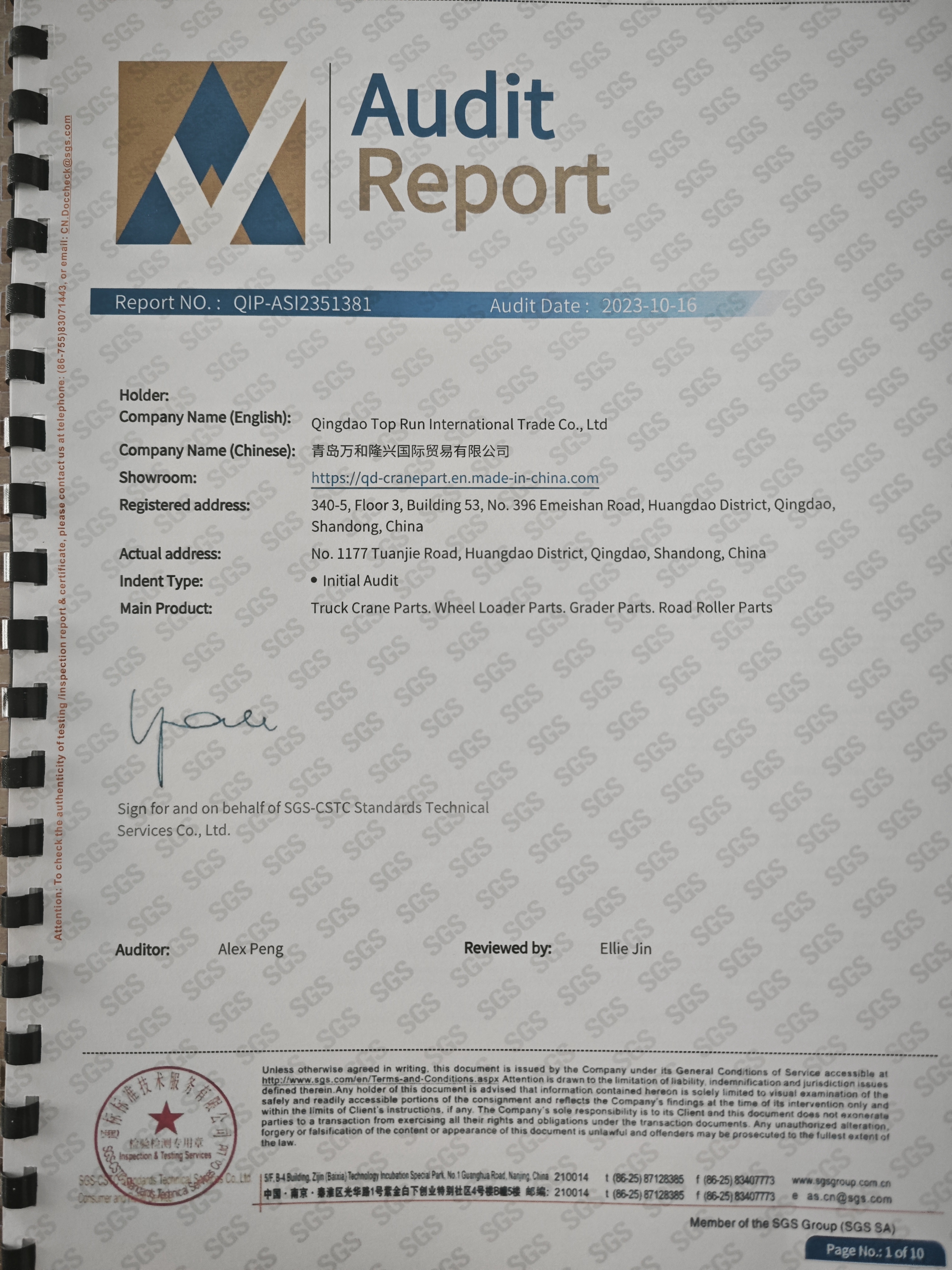
The compliance evidence a buyer can verify directly is the SGS Made-in-China Supplier Audit Report, certificate number QIP-ASI2351381, issued on 16 October 2023 by SGS-CSTC Standards Technical Services Co., Ltd. and valid through 15 October 2999. The audited scope is truck crane spare parts, wheel loader parts, grader parts and road roller construction machinery replacement parts, assessed against the Made-in-China Audited Supplier Assessment Criteria. For a Global market buyer, that report answers the "who is behind this supplier" question separately from the "does this part fit" question — and both have to be answered.
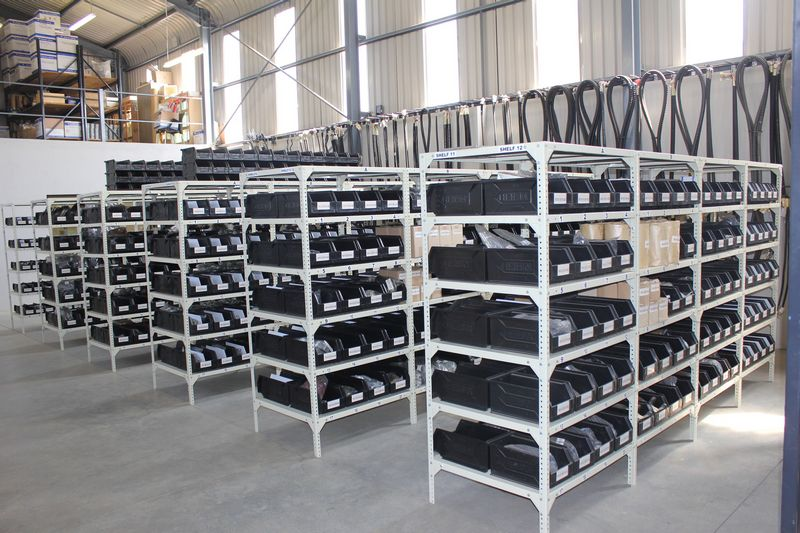
On the production side, output runs through three modes: OEM, Original and Aftermarket, all serving global markets. Quality control is stated as 100% test. Minimum order quantity is 1 pcs, standard lead time is 10–15 days, monthly capacity is 50,000 units, and annual output is 500,000 units. Warranty terms follow the tier: Original and OEM parts carry an official warranty with standardized after-sales service, aftermarket parts carry a negotiable warranty with flexible technical support, and counterfeit parts carry no formal after-sales guarantee. The truck crane range is designed for direct replacement on 20–150 ton truck cranes in long-term alternating heavy-load operation, and covers commonly replaced items such as HC4900, LWG208, IC4600, IC3600 and 1032300052.
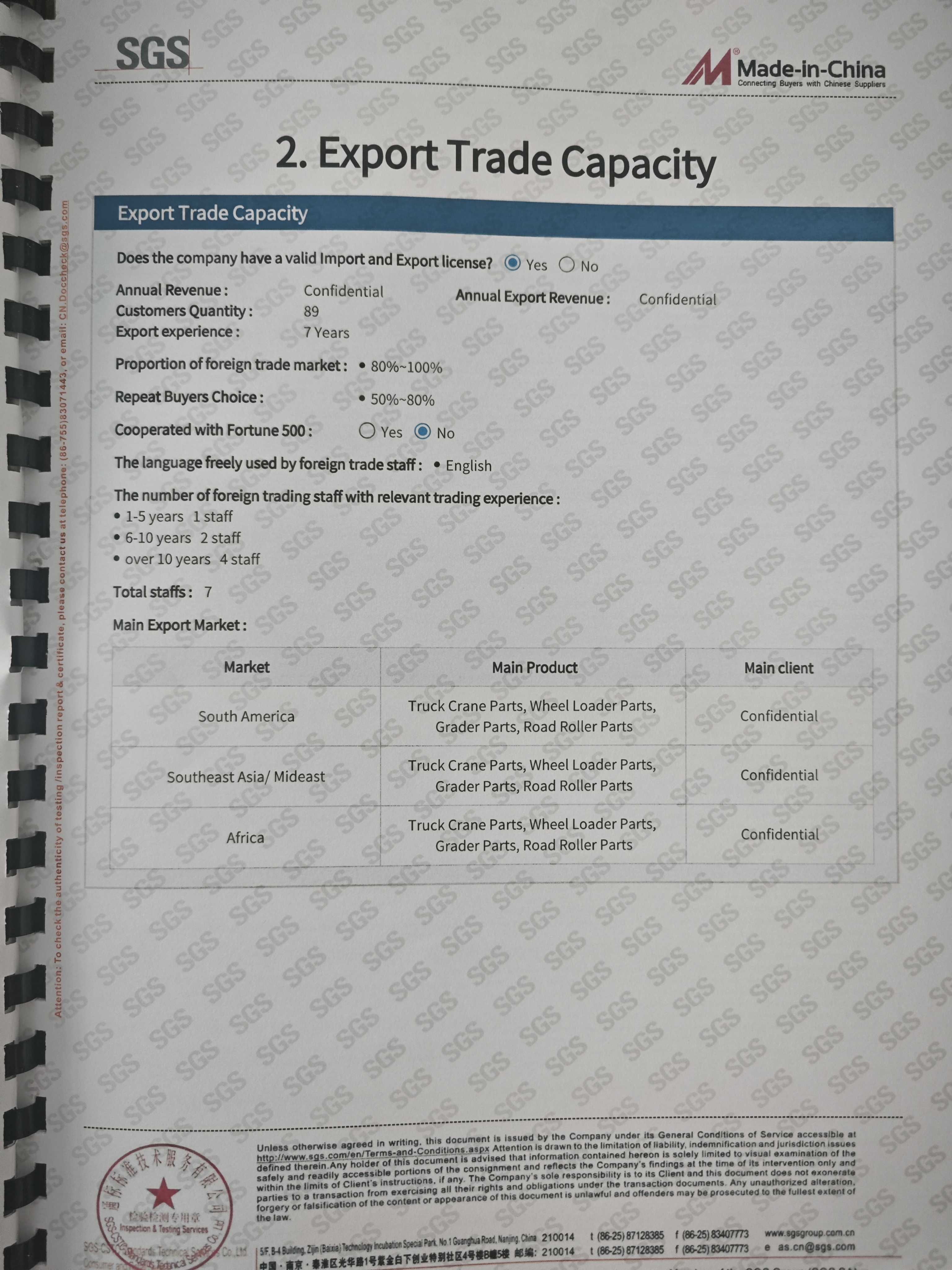
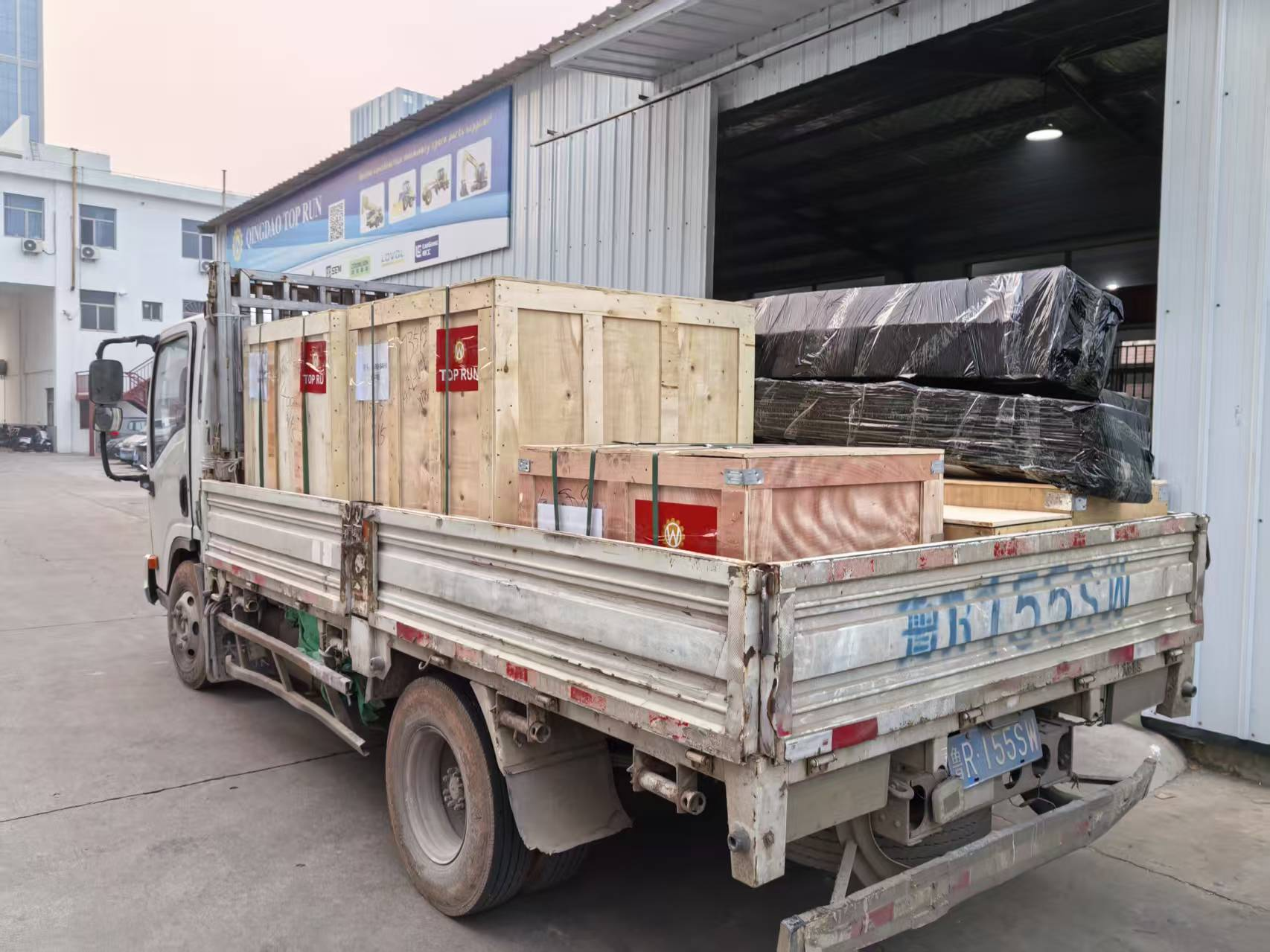
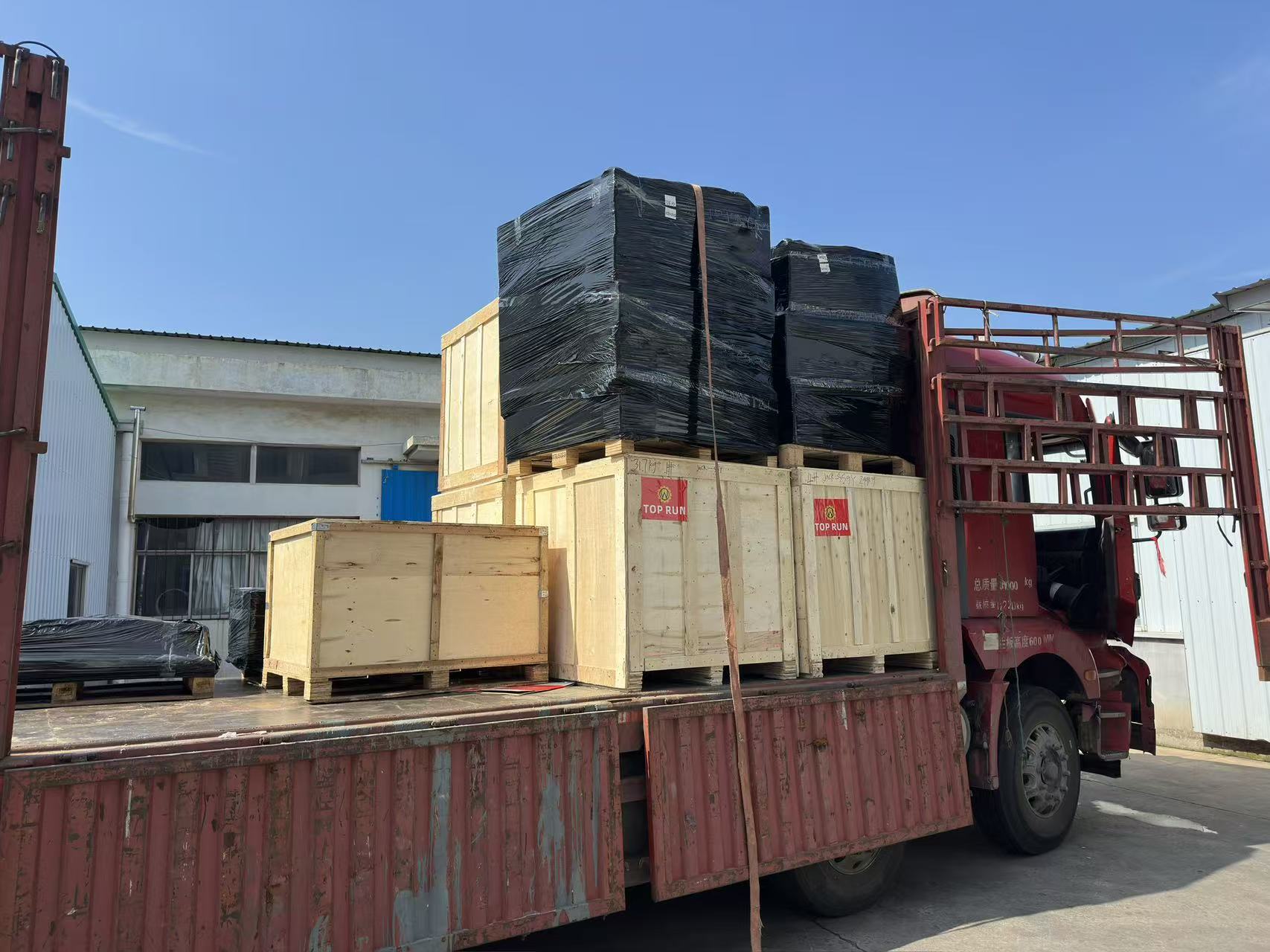
Delivery evidence is documented rather than asserted. A case record covering 50,000 units of China truck crane parts was completed within three months and included overseas shipments to Chile, Colombia, Russia, the UAE, Brazil, Belarus and Saudi Arabia. The product has been used by global truck crane spare parts wholesalers, local maintenance service companies, truck crane rental companies, truck crane owners, construction contractors, crane refurbishment factories, crane spare parts distributors, and overseas crane parts traders and importers.
Step-by-Step: Verifying a Replacement Truck Crane Part Before Approval
The following sequence turns the two compliance phrases into a checklist that can be run against any quotation, from any supplier.
- Name the standard the part must support. Write down whether the part sits inside the crane's structural envelope, its hydraulic circuit, or its control and LMI chain — and which standard obligation that touches.
- Pull the original technical parameters. Start with the part number or model designation used on the machine, then collect the functional parameters that number represents.
- List the four interfaces. Mounting, hydraulic, electrical and signal, and service. A quotation that only addresses the first is incomplete.
- Confirm which production tier you are buying. OEM and Original follow factory specifications; aftermarket allows customization within a stated scope. These are different products, not different prices for the same product.
- Request unit-level test evidence. Ask for the 100% test record on the specific unit class, not only a batch description.
- Match warranty terms to the tier. Official warranty for Original and OEM, negotiable warranty with flexible technical support for aftermarket, and no formal guarantee for counterfeit parts.
- Check supply terms against your downtime tolerance. MOQ of 1 pcs, lead time of 10–15 days and monthly capacity of 50,000 units are the planning inputs that decide whether a stock program or an emergency order is the right approach.
The interface checklist below condenses steps three and five into the evidence request that should travel with every RFQ.
| Interface | What has to match | Evidence to request |
|---|---|---|
| Mounting and structural | Pin and hole geometry, load-bearing sections, attachment points | Part number cross-reference, dimensioned drawing, material grade |
| Hydraulic | Port positions and threads, sealing behaviour, behaviour inside the original circuit's pressure and flow range | Unit-level pressure test record, seal material specification |
| Electrical and signal | Connector type, pin-out, signal format expected by the display or LMI system | Model match (for example HC4900, LWG208, IC4600, IC3600), function verification after installation |
| Service | Wear item and seal kit availability, replacement without modifying adjacent components | Spares list, warranty terms for the tier being purchased |
Where This Verification Work Changes the Decision
Different buyers carry different risk, so the same compliance evidence gets used in different ways.
- Truck crane rental fleets. The exposure is downtime and liability, so the priority is the control and hydraulic interface — a display or LMI-related part that behaves differently from the original is a safety question, not a cost question.
- Wholesalers and overseas importers. The exposure is repeat orders and returns, so the priority is part-number accuracy and consistency between batches. A supplier with a stated 100% test process and a documented export record reduces that risk.
- Maintenance service companies. The exposure is rework on site, so the priority is service interchangeability: whether the part can be installed without modifying adjacent components and whether wear items are available.
- Crane refurbishment and modification projects. The exposure is a mixed bill of materials, so the priority is tier clarity — knowing which lines are Original or OEM and which are aftermarket with a stated customization scope.
Which Replacement Tier Fits Which Buyer Need
Compliance preference is not the same as brand preference. Once the four interfaces are verified, the remaining decision is which production tier matches the machine's duty and the buyer's warranty position.
| Production tier | How it is defined | Customization scope | Quality control | After-sales position | Buyer need it fits |
|---|---|---|---|---|---|
| Original / OEM | Parts produced to factory specifications for the original equipment line | No independent customization; parts follow factory specifications | 100% test | Official warranty with standardized after-sales service | Machines under warranty, safety-critical and control-related replacement |
| Aftermarket | Parts produced for direct replacement in the same application | Custom logos, packaging and dimensional adjustments available | 100% test | Negotiable warranty with flexible technical support | Fleet maintenance programs, distributor stock, refurbishment |
| Counterfeit | Parts presented as original without authorization | Not stated | Not stated | No formal after-sales guarantee | No defensible procurement need |
Read the table as a preference rule rather than a price rule. Where the part touches the crane's structural or control behaviour, the Original or OEM tier keeps the machine closest to its original technical parameters. Where the part is a service item inside a planned maintenance program, a verified aftermarket part with a stated customization scope and a negotiable warranty is the practical choice for most fleets and distributors. The counterfeit row is included because it appears in real quotations — and because it is the only tier that removes the compliance question altogether by removing the guarantee.
Frequently Asked Questions
Is an aftermarket truck crane part compliant if it is not OEM-branded?
Compliance is defined by conformity to the applicable standard and to the machine's original technical parameters, not by the brand name on the part. EN 13000:2010+A1:2014 governs mobile and truck cranes in the European Union, and ASME B30.5-2021 is the primary American national standard for mobile and locomotive cranes, including truck cranes. A replacement part can move a crane out of conformity if it changes load-bearing behaviour, hydraulic behaviour, or the signal behaviour expected by the LMI system. What a buyer should audit is the process behind the part: for the supplier referenced in this guide, production runs through OEM, Original and Aftermarket modes, and units are subject to 100% test.
Can one supplier produce parts for XCMG, SANY and Zoomlion cranes without factory-level customization for each?
Yes. The same supplier produces parts for XCMG, SANY and Zoomlion truck cranes through OEM, Original and Aftermarket production services, serving global markets. Aftermarket parts can be customized with logos, packaging and dimensional adjustments, while Original and OEM parts follow factory specifications and are not independently customized. The current truck crane range covers commonly replaced items such as HC4900, LWG208, IC4600, IC3600 and 1032300052, and is designed for 20–150 ton truck cranes in long-term alternating heavy-load operation.
What drives the cost difference between production tiers?
Within the available facts, the cost difference follows the terms attached to each tier rather than a published price list. Original and OEM parts follow factory specifications and carry an official warranty with standardized after-sales service. Aftermarket parts carry a negotiable warranty with flexible technical support. Counterfeit parts carry no formal after-sales guarantee. Budget decisions should therefore be compared as total order cost, including warranty exposure and the downtime cost of a part that has to be replaced twice. A minimum order quantity of 1 pcs allows a buyer to validate cost and function on a single unit before committing to volume.
Can a single part be validated before a volume order is placed?
Yes. The minimum order quantity is 1 pcs, so a single part can be ordered for dimensional and functional validation before a volume order is placed. When requesting a sample, ask for the part number or model match, the material specification for the relevant component group, and the unit-level test record behind the 100% test statement. Standard lead time is 10–15 days, which allows sample validation and volume ordering to be planned inside the same maintenance cycle.
What lead time should be planned for, and how does it affect crane downtime?
Standard lead time is 10–15 days, supported by a monthly capacity of 50,000 units. For larger programs, a documented case covering 50,000 units of China truck crane parts was completed within three months and included overseas shipments to Chile, Colombia, Russia, the UAE, Brazil, Belarus and Saudi Arabia. These products are used by global truck crane spare parts wholesalers, local maintenance service companies, truck crane rental companies and overseas crane parts importers. To plan against your own maintenance calendar, send your part list to Jack Zhang at Jack@toprunsparepart.com or via WhatsApp on +86-185 6397 9022, and request a current quotation or the full catalogue: Qingdao Top Run product catalogue (PDF).
Conclusion: Compliance Is a Checklist, Not a Claim
"Manufactured in accordance with industry standards and original technical parameters" becomes meaningful only when the standard is named and the original parameters are listed. "Full interchangeability with original equipment" becomes meaningful only when mounting, hydraulic, electrical and service interfaces are each verified. Together, the two phrases describe a process the buyer can audit — a named standard, a functional baseline, material discipline, and unit-level testing.
For XCMG, SANY and Zoomlion fleets in the 20–150 ton class, that process is what separates a replacement order that closes a downtime event from one that creates a second one. The tier you choose — Original, OEM or aftermarket — should follow the interface the part sits on and the warranty position you need, not the lowest line in the quotation.
Send the part numbers or model designations from your XCMG, SANY or Zoomlion crane and ask for the matching tier, the unit-level test record and the warranty terms in writing. Single-unit orders are accepted (MOQ 1 pcs), with a standard lead time of 10–15 days.
Contact: Jack Zhang · Jack@toprunsparepart.com · Tel / WhatsApp: +86-185 6397 9022
Qingdao Top Run International Trade Co.,Ltd · No. 1177, Tuanjie Road, Economic and Development Zone, Qingdao, China
Website: www.xcmg-sany-zoomlion-shantui.com · Catalogue: download the PDF catalogue
Have Questions or Need More Details?
Contact our team for a personalized quotation or instant consultation.
Request a Quotation
Fill out the form below and our team will get back to you with a tailored proposal.
WhatsApp Direct Chat
Prefer to chat in real-time? Message us on WhatsApp for instant assistance & quick answers.
- Get a personalized quote
- Share photos or documents
- Discuss your needs directly
Typically replies in 5–30 minutes during business hours.