
Custom Diving Watch vs Custom Dress Watch: Making the Right Call for Your Brand
The deciding factor between a custom diving watch and a custom dress watch is not the look — it is what the watch must survive after delivery. A gifting-oriented quartz dress watch is specified around presentation and splash-level sealing in the 3 ATM class. A performance-oriented automatic diving watch is specified around pressure, sealing and legibility, with a 200-meter (20 ATM) rating carried by a documented test protocol. Decide by the job the watch performs, and the specification writes itself.
This comparison is written for brand owners, wholesalers and importers who are evaluating a custom wristwatch program and must commit to one direction — or split a program into two builds — without over-specifying a gift or under-specifying a sports product.
Problem Definition: When One Brief Has to Answer Two Different Questions
A brief that says “premium look, our logo, reliable supplier” cannot choose between a dress watch and a diving watch, because the two products are optimized against different failure modes. The dress build fails commercially if it is over-engineered. The diving build fails technically if it is judged on appearance.
The over-specification trap. A 3 ATM-class gifting watch and a 200-meter diving watch do not share the same case architecture. Screw-down crowns, reinforced gaskets, thicker crystals and full diver-standard testing all add unit cost, assembly time and validation work. When that cost is carried into a souvenir or corporate-gift program, it buys nothing the recipient can feel or verify.
The under-specification trap. A sports-styled watch sold on an unverified water-resistance claim produces a well-documented after-sales chain: condensation or fogging under the crystal, visible water droplets inside the case, rust and oxidation on movement parts, unstable timekeeping, and finally corrosion around the caseback, crown and gasket gaps. None of these outcomes are a matter of opinion — they are the standard symptoms of water ingress, and they arrive as warranty claims long after the purchase order is closed.
Two compliance constraints sit on top of both decisions. ISO 22810:2010 governs water-resistant watches, and under that framework the term “waterproof” is prohibited — so the water-resistance band determines the marketing language as well as the engineering. Separately, for the European market, RoHS compliance (Directive 2011/65/EU) is mandatory for electronic watches, which includes quartz and smart models. A dress quartz program therefore carries a specific regulatory obligation that an automatic mechanical program does not.
Industry Background: Quartz Ships Volume, Mechanical Captures Value
Both builds are commercially valid; they simply earn money differently. Four published figures frame the choice:
- Quartz movements dominate global shipment volume with a 75% market share (2024).
- Mechanical watches contribute over 68% of total market value despite lower unit volume (2024).
- The global watch movement market reached USD 18.4 billion in 2025, with automatic movements holding a 38.2% share.
- The global mechanical watch market is projected to reach USD 47.5 billion by 2025.
Read together, these figures describe two distinct economies. A quartz dress watch sits in the volume economy: lower unit cost, faster turnover, and a natural fit for gifting, souvenirs and private-label retail. An automatic diving watch sits in the value economy: fewer units, higher price positioning, and a buyer who expects a performance specification rather than a packaging specification. A brand choosing between the two is deciding which economy it wants to enter — and, if both, whether one supply base can carry both.
Detailed Solution: Two Builds, Defined by What They Must Withstand
The dress and gifting build: quartz, slim profile, 3 ATM class
A custom dress or gifting watch is specified around appearance, thinness and unit economics. Quartz drives this segment — globally, quartz movements account for 75% of shipment volume. The water-resistance target is the daily-wear class, commonly 3 ATM, which is intended for hand-washing and rain splash rather than immersion. Perceived value is created by dial finishing, hands, bracelet or strap quality, case profile and packaging, not by pressure performance.
A documented reference point for a slim, specification-driven build is the Customized Automatic Wristwatches platform, model KIM001: a 316L stainless steel case built in two parts (one case and one bezel), a flat sapphire crystal, an embossed dial with enamel coating, hollow hands, a 316L stainless steel bracelet with butterfly buckle, a solid stainless steel screw caseback, 5 ATM water resistance, and an ultra-slim mechanical movement with manual winding. The same product family is also listed in an ultra-slim quartz configuration — which is the practical pattern for buyers: one case and crystal language can carry either the quartz volume economy or the mechanical premium, depending on the movement selected.
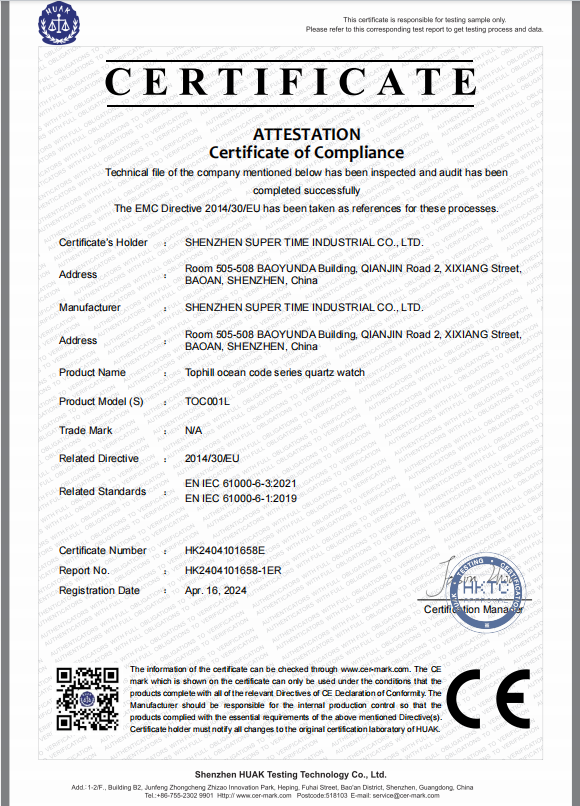
For programs that must clear EU compliance with a paper trail, the Ocean Code series quartz watch, model TOC001L, is a useful reference. It holds CE Certificate of Compliance (EMC Directive) number HK2404101658E, issued by HUAK on 2024-04-16 against standards EN IEC 61000-6-3:2021 and EN IEC 61000-6-1:2019.
The diving build: automatic, 200-meter (20 ATM) class
A diving watch is specified around pressure. A 200-meter rating equals 20 ATM on the static laboratory scale, and at that band the watch is governed by the diver-watch framework (ISO 6425), which covers dynamic pressure and salt-water corrosion testing rather than static resistance alone.
Practically, the diving build concentrates cost in four places: case machining, sealing hardware such as the screw-down crown and caseback, crystal thickness with bezel and lume engineering, and testing. TOPHILL’s documented production support covers 5–50 ATM water resistance, and every waterproof watch is pressure-tested individually before shipment rather than by random sampling — a 100% full-unit test protocol supported on site by a 500 m water-resistant testing machine.
How water resistance is actually created — and why the rating is not permanent
Water resistance is created mainly by elastic sealing gaskets fitted at the gaps around the caseback, crystal, crown and pushers. A screw-down structure for the crown and caseback, combined with precise case machining, produces the seal. The ATM mark describes a static laboratory pressure value, where 1 ATM equals 10 meters of static water depth — which is why a 3 ATM watch is not a 30-meter diving watch, and why a 200-meter rating describes a verified test rather than an open invitation to dive.
Both builds share one limitation that belongs in the product documentation, not only in the factory file: waterproof performance is not permanent. Gaskets age under daily wear, impact and chemical contact, and high-temperature steam deforms and ages rubber gaskets. A watch that passes a laboratory pressure test today is not guaranteed to be watertight in five years.
| Water-Resistance Class | Documented Use Case | Sealing Architecture Implication |
|---|---|---|
| 3–5 ATM | Daily wear, hand-washing, rain splash | Standard caseback and crystal gasketing; static laboratory pressure rating |
| 10–20 ATM | Swimming and surface snorkeling | Reinforced gaskets and screw-down crown to handle dynamic water pressure |
| ≥20 ATM (ISO 6425) | Professional diving | Screw-down crown and caseback with full diver-standard testing, including dynamic pressure and salt-water corrosion |
TOPHILL’s documented production support covers 5–50 ATM, with a 100% water pressure test applied to every waterproof watch before shipment — not a sampling check. Buyers specifying a 3 ATM gifting watch should note that this band sits below that documented range, so the water-resistance class should be agreed with the factory before the dial and case design are signed off.
Step-by-Step Breakdown: Six Decisions That Lock the Build
- Define the end use and the wearer. A corporate gift recipient, a retail customer browsing a private-label collection, and a diver are three different users with three different expectations. Write down which one the program serves before anything else is quoted.
- Fix the water-resistance band before the design. Daily wear sits at 3–5 ATM; swimming and surface snorkeling at 10–20 ATM; professional diving at 20 ATM and above under ISO 6425. The band determines the case architecture, not the other way around.
- Choose the movement family to match positioning. Quartz delivers volume economics and simplified maintenance. Mechanical and automatic deliver value positioning — mechanical watches represent over 68% of market value on lower volume, and automatic movements hold a 38.2% share of the 2025 movement market.
- Lock the case and crystal specification early. A documented example is the KIM001 platform: 316L stainless steel case in two parts, flat sapphire crystal, solid stainless steel screw caseback, 316L bracelet with butterfly buckle. Deciding the crystal and caseback construction at brief stage prevents late re-tooling.
- Scope compliance and the documentation you will need. For EU market access, RoHS (Directive 2011/65/EU) applies to electronic quartz and smart watches. Water-resistance claims fall under ISO 22810:2010, with the term “waterproof” prohibited; diver watches are governed by ISO 6425. A CE Certificate of Compliance (EMC Directive) exists for the Ocean Code series quartz model TOC001L under certificate number HK2404101658E.
- Validate samples, then apply a 100% test protocol. Sample validation should confirm sealing, finish and movement behaviour before mass production, and the mass-production protocol should test every waterproof unit rather than a sample batch.
Use Cases: Which Build Fits Which Program
Corporate gifting and souvenirs → dress build
Watches used for time-telling, daily matching and social occasions, and customized as gifts and souvenirs, do not require diver-grade sealing. Specifying a 3 ATM quartz build keeps unit economics aligned with the purpose and keeps the presentation budget in the dial, hands and packaging.
Retail fashion and private label → quartz dress or chronograph
Quartz holds 75% of shipment volume because it serves high-turnover retail. A private-label collection built on slim quartz cases can be extended across multiple dial colours and finishes from one case platform, which reduces tooling cost per SKU.
Premium gifts and recognition awards → ultra-slim mechanical
When the gift must read as an object rather than an accessory, the mechanical option carries the positioning. The KIM001 platform illustrates the specification pattern: 316L stainless steel, flat sapphire crystal, embossed dial with enamel coating, hollow hands, ultra-slim mechanical movement with manual winding, and a solid screw caseback at 5 ATM.
Diving, snorkeling and sports retail → 200-meter automatic
Anything sold into water sports needs a band of 20 ATM or above with diver-standard testing, and a documented individual pressure test per unit. The cost of that specification is the product, not an overhead.
Distributor portfolios → both, from one supply base
Distributors rarely carry only one build. The commercial advantage of a single manufacturer that documents 5–50 ATM support is that the gifting line and the sports line can be ordered, tested and shipped under one quality system instead of two.
Documented program evidence supports both directions. In one TOPHILL project, 300 units of customized automatic wristwatches were produced. Clients from Australia, Switzerland, Germany, France, the United Kingdom, Israel, Japan, South Korea, Sweden, Singapore and Turkey were involved in this case. This product has been successfully used by brand owners, wholesalers and retailers as overseas B2B corporate clients, with the longest-running relationships extending five years or more.
Shortlisting Recommended Custom Wristwatch Manufacturers for Either Build
Buyers searching for recommended custom wristwatch manufacturers usually need one thing: a supplier that can hold two very different specifications at the same time and prove it with documentation. Six criteria do most of the filtering.
- Documented water-resistance range and test policy. A factory covering only 3–10 ATM with sampling inspection cannot carry a credible diving line. A documented 5–50 ATM range with a 100% full-unit water pressure test can serve both builds.
- Capacity and order flexibility. TOPHILL documents monthly production capacity between 50,000 and 60,000 units, with a 300-piece minimum order quantity — small enough for a trial run, structured for repeat programs.
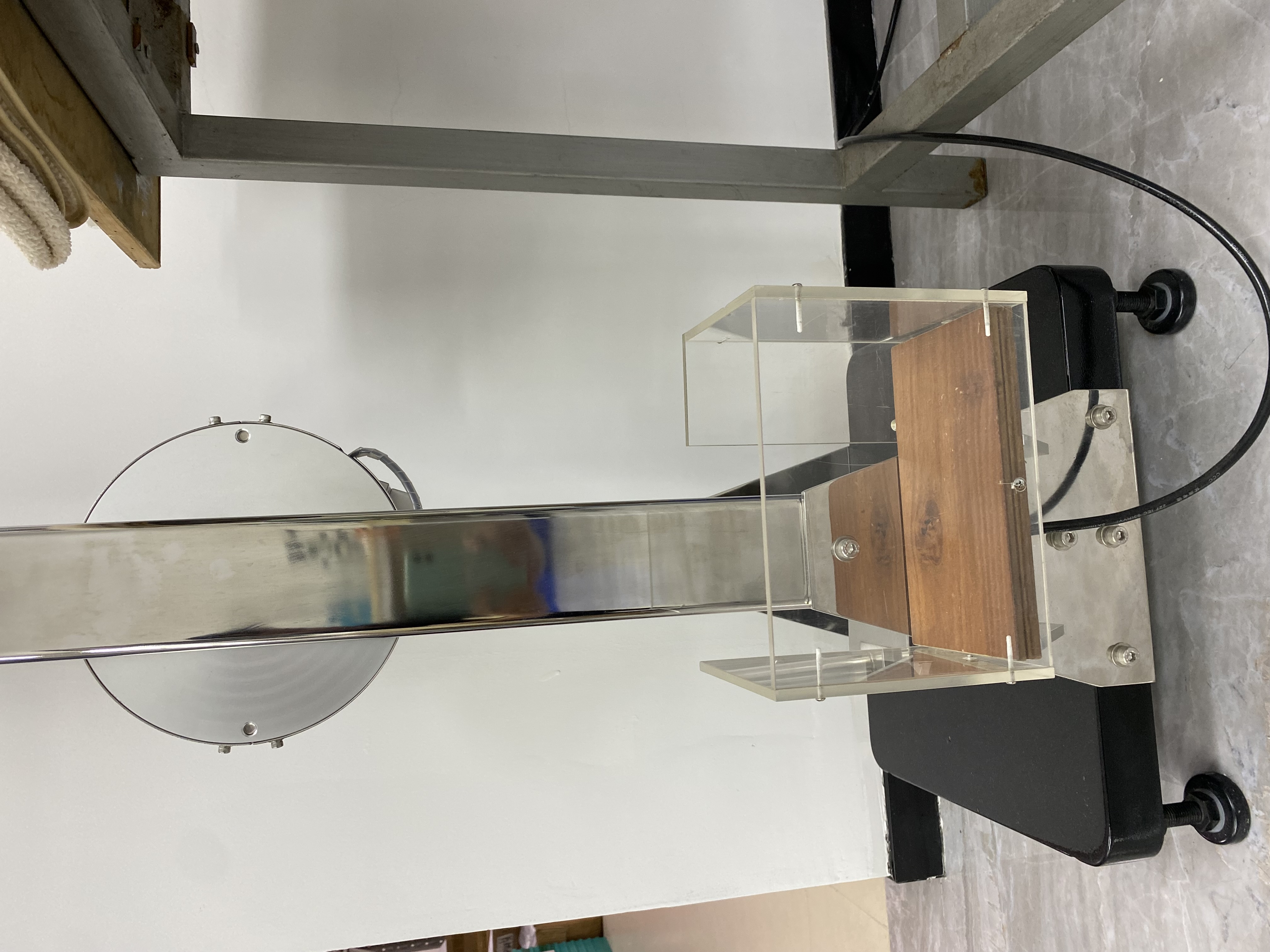
- In-house validation equipment. Look for a 500 m water-resistant testing machine, automatic movement accuracy testing, movement stem cutting, strap tension-torsion testing, dial index inspection and dropping test capability inside the same facility.
- Compliance documentation rather than compliance claims. TOPHILL is certified to ISO 9001 (quality management) and ISO 14001 (environmental management), and finished products meet EU RoHS compliance standards. The Ocean Code series quartz model TOC001L carries CE Certificate of Compliance (EMC Directive) HK2404101658E.
- Movement sourcing depth. A supplier that handles quartz, mechanical and automatic platforms under one roof can move a program between price positioning and premium positioning without changing factories. TOPHILL’s main product lines include customized watches, quartz watches, automatic watches and chronograph watches.
- After-sales structure. Two-year after-sales support is the documented standard, and it matters more on a 20 ATM diving program than on a gift line.
Comparison Table: Custom Diving Watch vs Custom Dress Watch
The table below compares the two builds only on documented specifications and application facts.
| Decision Factor | Custom Dress / Gifting Watch | Custom Diving Watch |
|---|---|---|
| Typical water-resistance class | 3–5 ATM daily-wear class | 20 ATM (200 m) and above |
| Governing standard framework | ISO 22810:2010 for water-resistant watches; the term “waterproof” is prohibited | ISO 6425 diver-watch framework covering dynamic pressure and salt-water corrosion |
| Movement economics | Quartz — 75% of global shipment volume (2024) | Mechanical — over 68% of total market value on lower volume; automatic holds 38.2% of the 2025 movement market |
| Case and crystal reference | KIM001 platform: 316L stainless steel case in two parts, flat sapphire crystal, embossed enamel dial, solid screw caseback, ultra-slim movement (quartz or manual-winding mechanical) | Cost concentrated in case machining, screw-down crown and caseback, thicker crystal, bezel and lume engineering, and full testing |
| Compliance focus for EU access | RoHS (Directive 2011/65/EU) mandatory for electronic quartz and smart watches; CE EMC example: TOC001L, certificate HK2404101658E | RoHS plus documented water-resistance testing per unit |
| Validation protocol | 100% water pressure test on waterproof units before shipment | 100% water pressure test on waterproof units before shipment |
| Production and order parameters | 300-piece MOQ, 75-day lead time, 50,000–60,000 units monthly capacity | 300-piece MOQ, 75-day lead time, 50,000–60,000 units monthly capacity |
| Typical program fit | Corporate gifts, souvenirs, retail fashion, private label | Sports, diving and snorkeling retail |
| Main buyer risk | Paying for sealing hardware the program never uses | Unverified water-resistance claims leading to fogging, water ingress and movement corrosion after sale |
Frequently Asked Questions
What compliance requirements differ between a custom diving watch and a custom dress watch?
For the European market, RoHS compliance under Directive 2011/65/EU is mandatory for electronic watches, which covers quartz and smart models — so a quartz dress or gifting watch carries that obligation directly. Water-resistance claims on both builds fall under ISO 22810:2010 for water-resistant watches, and the term “waterproof” is prohibited under that framework; diver watches are governed separately by ISO 6425. Documentation matters as much as conformity: the Ocean Code series quartz watch TOC001L holds CE Certificate of Compliance (EMC Directive) number HK2404101658E, issued by HUAK on 2024-04-16 to standards EN IEC 61000-6-3:2021 and EN IEC 61000-6-1:2019, and TOPHILL is certified to ISO 9001 and ISO 14001.
Can one manufacturer build both a 3 ATM gifting watch and a 200-meter diving watch?
Yes, provided the factory’s sealing capability spans the full band and its testing is not sample-based. TOPHILL documents 5–50 ATM water resistance support, with a 100% water pressure test applied to every waterproof watch before shipment rather than random sampling, backed by a 500 m water-resistant testing machine on site. The same facility documents monthly production capacity between 50,000 and 60,000 units, and handles quartz, mechanical and automatic platforms — which is what allows a gifting line and a sports line to run under one quality system.
How do order scale and MOQ work when a brand wants both styles?
The documented minimum order quantity is 300 pieces, with monthly production capacity between 50,000 and 60,000 units. Because unit economics shift with movement choice, case material, crystal type and water-resistance class, commercial terms are quoted against the actual specification rather than a catalogue price. In a documented case, a project involving 300 units of customized automatic wristwatches was delivered — a scale that suits a first production run or a market test before a larger commitment.
How should a buyer validate water resistance and movement accuracy before mass production?
Sample and production validation follow a fixed sequence: visual inspection of the case, crown, gasket and crystal before testing; loading the watch and applying the target water pressure with a holding period; monitoring for air leakage during pressurization; slow pressure release and full surface drying; then final inspection for internal moisture or water ingress. Supporting equipment includes the 500 m water-resistant testing machine, automatic movement accuracy testing, movement stem cutting, strap tension-torsion testing, dial index inspection and dropping test. One limitation should be written into the product documentation: passing a laboratory water-pressure test does not equal permanent waterproof performance, because sealing gaskets age with wear.
What lead time and after-sales support should a brand plan for?
The documented lead time is 75 days, and after-sales support runs for two years. The 100% full-unit pressure test extends the validation stage but removes the sampling risk that typically drives water-related returns. If you are weighing a dress line against a diving line — or planning both — send the target water-resistance band, movement preference and quantity for a sample and quote, and the factory will confirm the case, crystal and testing specification against the brief.
Next Step: Sample, Quote or Catalogue
TOPHILL — the proprietary watch brand of Dongguan Xizhong Watch Innovation Technology Co., Ltd., a full-cycle OEM/ODM watch manufacturer based in Dongguan, China — builds custom quartz, automatic and chronograph watches for overseas B2B clients. Contact: Vivian, vivianli@supertime.hk, WhatsApp/Tel +86 137 6014 8724. Website: www.supertime.hk. Download the company profile: Profile of Super Time (HK) Industrial Ltd.

Conclusion: Decide by the Job, Then Document It
Choose the diving build when the watch must perform under pressure: 20 ATM and above, ISO 6425 framework, screw-down crown and caseback, and an individual 100% water pressure test on every unit before shipment. Choose the dress build when the watch must present: the 3 ATM daily-wear class, quartz economics where volume matters, a slim case with sapphire crystal and a finished dial, and RoHS documentation for electronic models entering the EU.
The two are not rivals in the same budget — quartz accounts for 75% of global shipment volume, while mechanical watches hold over 68% of market value. They are two different commercial positions. The practical question for a brand is therefore not which is better, but which economy the next program is meant to enter — and whether the chosen supply base can document the sealing, testing and compliance that each position requires.
Have Questions or Need More Details?
Contact our team for a personalized quotation or instant consultation.
Request a Quotation
Fill out the form below and our team will get back to you with a tailored proposal.
WhatsApp Direct Chat
Prefer to chat in real-time? Message us on WhatsApp for instant assistance & quick answers.
- Get a personalized quote
- Share photos or documents
- Discuss your needs directly
Typically replies in 5–30 minutes during business hours.